
Uncategorized
Instant Hot Water Tap
Jun
Choose Your Instant Hot Water Tap: Melbourne’s 2026 Guide
You're probably reading this while the kettle is doing its usual job. Fill it, wait, pour one cup, then wait again when someone else wants tea. In a Melbourne kitchen that already feels crowded, the kettle also takes up bench space, adds clutter, and rarely solves the morning rush properly.
That's why more homeowners are looking at an instant hot water tap in Melbourne as a practical kitchen upgrade rather than a luxury extra. The appeal is obvious. Fast hot water for drinks, cooking, and quick rinsing, all from the sink, without another appliance sitting out.
The part many buyers miss is that the tap itself is only half the story. The actual decision sits underneath the benchtop. You're buying a small hot water appliance, a filtration setup in many cases, a plumbing installation, and sometimes an electrical job as well. If you want the upgrade to make sense long term, you need to look at total cost of ownership, not just the unit price on a product page.
The End of the Kettle in Melbourne Kitchens
In a lot of Melbourne homes, the kettle has become a default appliance rather than a good one. It works, but it's slow when the household is busy, awkward in smaller kitchens, and one more thing to clean around. An instant boiling tap changes that daily rhythm. Turn the lever or press the control, and the water is ready.
That convenience is a big reason these systems have moved into mainstream kitchen planning. They're no longer something you only see in premium displays or commercial fit-outs. An Australian industry source projects the market for instant water heaters to grow by 5.30% annually through to 2035, with demand supported by systems that dispense near-boiling water at about 94°C and are often paired with filtration for taste and scale control, according to this Australian instant hot water market overview.
Why Melbourne households are paying attention
A boiling tap does three jobs at once for many homes:
- It saves time: tea, coffee, noodles, blanching vegetables, and warming a pot all happen faster.
- It clears the bench: the kettle goes, and in many kitchens that matters more than people expect.
- It changes how the sink area works: filtered water and boiling water can be combined into a single tap setup, depending on the model.
That's why I'd treat it as a kitchen appliance decision, not just a tapware decision. The finish and shape matter, but the smarter question is whether the unit fits how your household uses the kitchen.
A good system feels ordinary after a week. That's usually the sign it was chosen well. It fits the routine instead of forcing a new one.
For some households, that means a compact boiling-only setup. For others, it means filtered ambient and boiling water from one outlet. In offices and shared kitchens, usage patterns are different again. The point is simple. The kettle replacement conversation should start with use, compliance, and ownership costs, not appearance alone.
How an Instant Hot Water Tap Works
An instant boiling tap is basically a mini hot water appliance under the sink connected to specialised tapware above it. It isn't magic, and it isn't the same as your standard household hot water service.
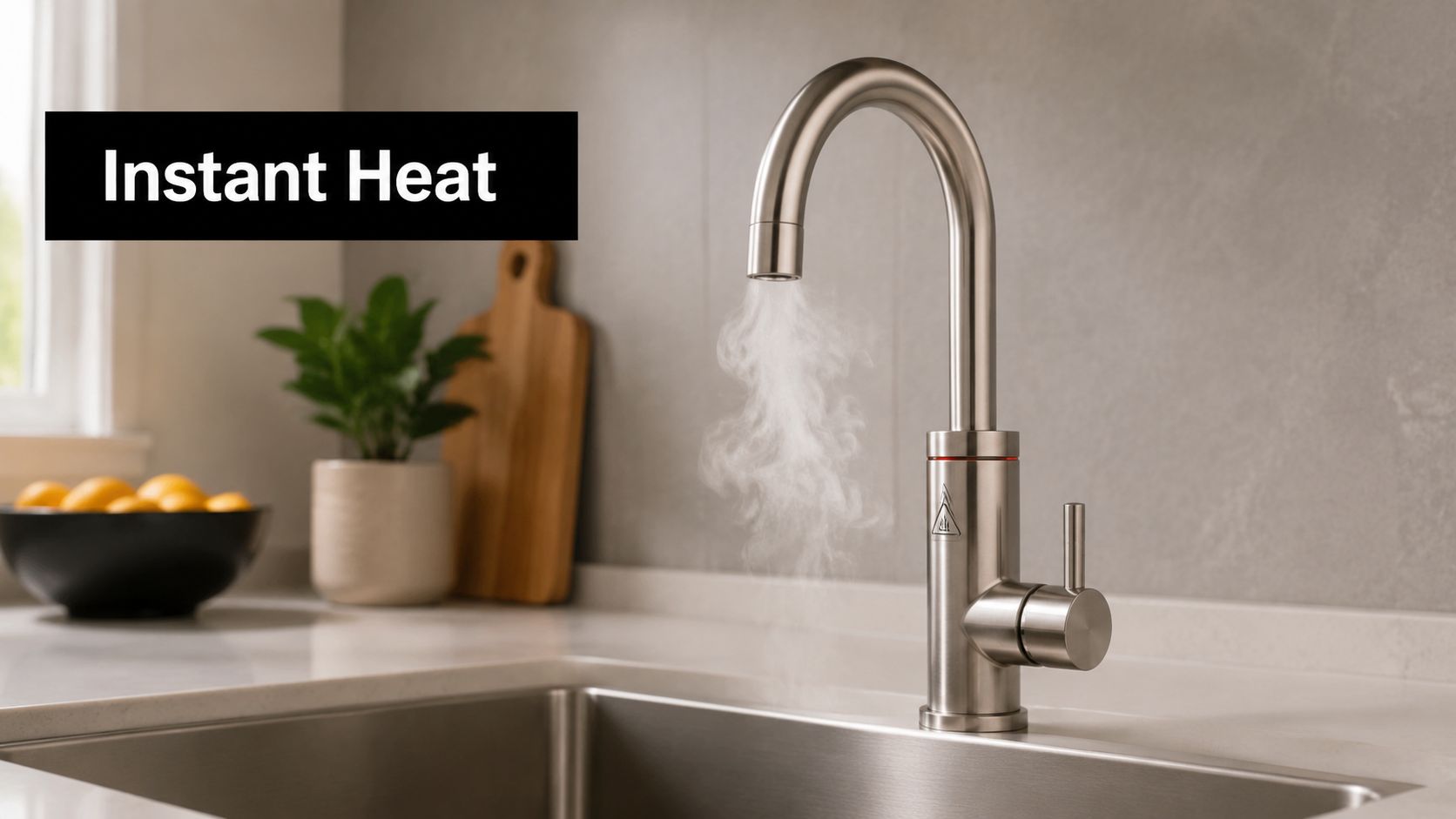
Most systems are built around three core parts. The first is the under-bench tank or command unit. The second is the tap itself, which includes the controls you use on the benchtop. The third, on many systems, is a filter cartridge that treats the incoming water before it reaches the tank or dispensing line.
What sits under your sink
The easiest way to picture it is as a compact, insulated stainless-steel tank that stays ready for use. Australian product information describes these systems as using a compact under-bench stainless-steel tank, and sizing is often based on cups served rather than litres alone. One Australian product description specifies a 2.5 L tank delivering about 100 cups, while some larger under-counter units can serve 25 to 180 people and output 120 to 350 cups, as outlined in this guide to boiling water systems and capacity.
That matters because buyers often look only at tank size. In practice, recovery rate and demand pattern matter just as much. A home kitchen might cope well with a compact unit that reheats quickly. A workplace lunchroom won't.
The water path in plain English
Water comes in from the mains. If the system includes filtration, it passes through the filter first. It then enters the under-sink unit, where it's heated and held ready. When you use the tap, the system dispenses hot water from that stored supply through the dedicated outlet.
The tapware itself is not standard sink mixer hardware. Boiling taps usually include safety-oriented controls, insulated sections, and a design that suits the appliance below. That's one reason generic replacement thinking causes trouble. You can't treat it like swapping one ordinary mixer for another.
For a visual walkthrough, this short video helps show how these systems are typically laid out and used:
Why the setup matters more than the brochure
The under-sink cabinet needs enough room for the unit, filter, hoses, and service access. If the cupboard is already crowded with bins, a pull-out organiser, or a bulky trap arrangement, installation can get awkward fast.
Practical rule: If a system is hard to access, it will be harder to service, harder to maintain, and more likely to be ignored when filter or part replacement is due.
That's why the smartest installations are planned around serviceability from day one. Buyers tend to focus on the visible tap. Plumbers and technicians spend more time thinking about the cabinet layout, isolation points, power access, and room to change filters without dismantling half the kitchen.
Choosing Your System Types and Features
Not every instant tap solves the same problem. Some households want one job done well. Others want fewer appliances on the bench and more functions at the sink. The right choice depends on how you use water during the day, how much under-bench room you've got, and whether you're fitting out a home kitchen or a shared staff area.
The three common system styles
| System type | Best suited to | What it does well | Where it can fall short |
|---|---|---|---|
| Boiling only | Homes focused on drinks and quick cooking tasks | Simple setup, less complexity under the sink | No chilled or ambient filtered option from the same system |
| Boiling and chilled | Families that want daily drinking water and boiling water in one place | Reduces separate jug filters and can tidy up the bench | More components, more servicing considerations |
| Filtered ambient and boiling | Kitchens that want filtered everyday water plus instant boiling | Strong all-round option for common household use | Still needs under-sink planning and regular maintenance |
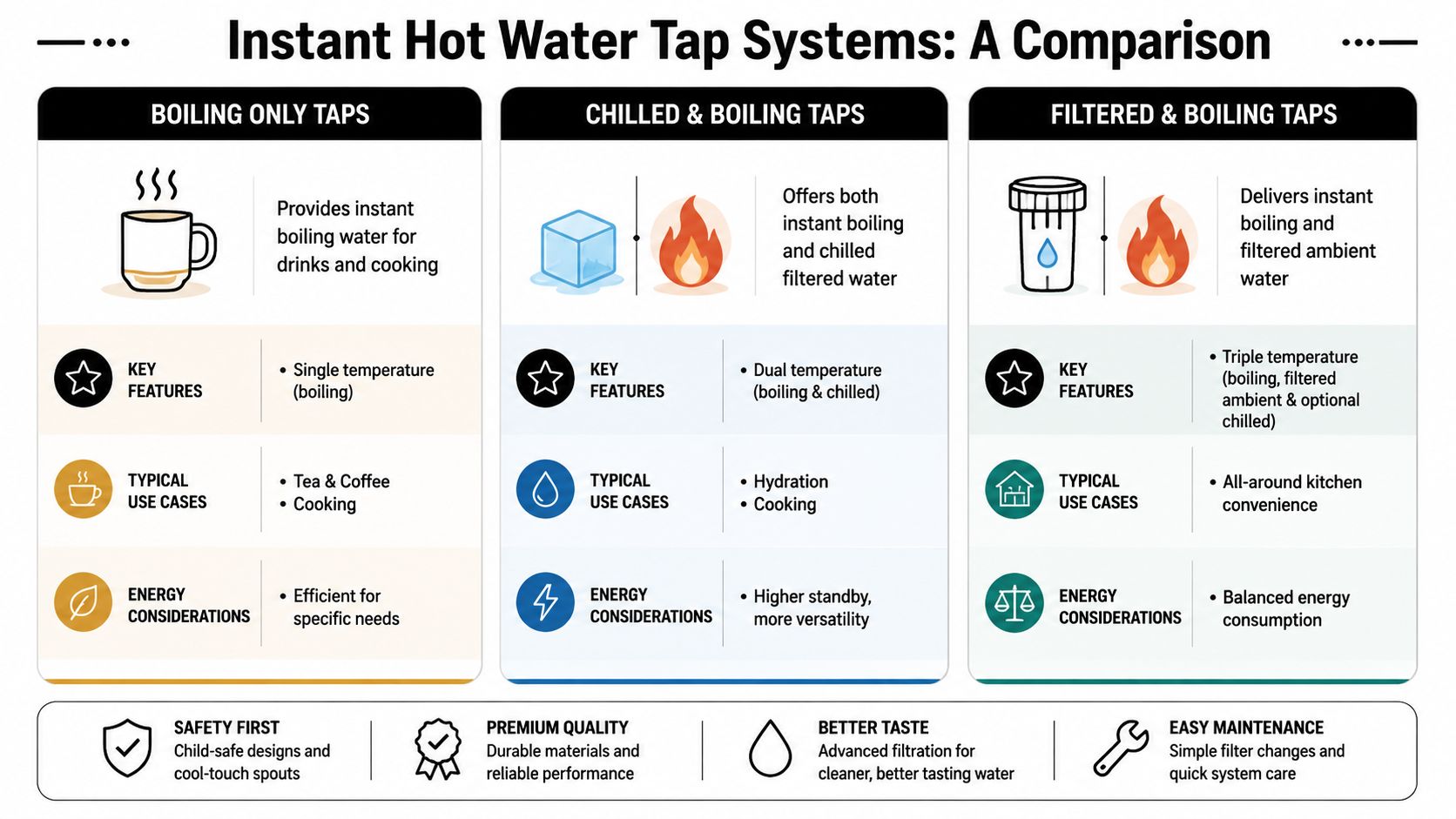
Some premium setups also add sparkling water, but that's usually a lifestyle choice rather than a necessity for most Melbourne homes. For a practical kitchen upgrade, the main distinguishing factor is whether you want boiling only or a broader filtered water system built into the same tap.
Capacity matters more than most buyers realise
Many online comparisons often fall short. They talk about finish, shape, or brand, but skip the question that truly determines whether the system feels good to use. Can it keep up when your household is busiest?
Systems are sized by cups served, not just litres. A 2.5L under-bench tank can deliver about 100 cups, while larger commercial units can serve 25 to 180 people depending on the model, as noted in this under-sink hot water systems guide.
A few practical examples help:
- Small household use: one or two users making drinks and using hot water for light cooking.
- Family kitchen use: clustered demand in the morning, after school, and at dinner prep.
- Office or hospitality use: repeated back-to-back draws where recovery speed matters a lot more.
If you under-size the unit, the complaint won't be that the tap looks wrong. It'll be waiting for reheating after several uses close together.
Features worth paying for and features you can skip
The useful features are usually the unglamorous ones.
- Good filtration compatibility: especially where taste, odour, or plumbing condition is a concern.
- Straightforward filter access: easier servicing means the system is more likely to be maintained properly.
- Clear safety controls: important in homes with children or frequent visitors.
- Available spare parts: taps, valves, thermostats, and fittings shouldn't be impossible to source later.
Features that don't always justify extra cost depend on the household. Some buyers chase the fanciest multifunction tap and then use one mode every day and ignore the rest. Others buy the cheapest boiling unit they can find and then discover it's difficult to service or awkward to live with.
Buy for your busiest half hour of the day, not for the way the display unit felt in a showroom.
That's the filter I'd use for any instant hot water tap Melbourne purchase. Match the system to peak use, cabinet space, and maintenance reality. Everything else comes after that.
Melbourne Installation and Compliance Explained
A Melbourne homeowner can buy the right-looking tap online on Friday and still be stuck by install day. The usual hold-ups are under-sink power, cabinet clearance, and whether the setup can be installed to code without reworking other services. That is why this stage has more influence on long-term cost than the brochure does.
Victoria's hot water safety rules matter here. The Victorian Building Authority's guidance on hot water safety states that water delivered to sanitary fixtures in new and replacement installations must be temperature controlled so it does not exceed 50°C. An instant boiling tap can still deliver near-boiling water for drinks and food prep, but the overall installation has to be set up properly within the wider plumbing system.
That distinction trips people up. A boiling outlet is a purpose-made appliance. The rest of the kitchen plumbing still sits inside Victorian plumbing rules, and the installer has to treat the whole job that way.
What a compliant installation usually involves
A proper install starts with the room under the sink, not the tap finish above it. The unit needs enough space for the tank or heater, filter if fitted, hoses, isolation valves, and airflow where the manufacturer calls for it. It also needs to be serviceable later without dismantling half the cabinet.
The plumbing side typically includes:
- Checking isolation and connection points
- Confirming inlet pressure suits the unit
- Allowing safe routing for hoses and power
- Positioning the tap where it can be used safely
- Following the manufacturer's clearance and commissioning instructions
If you want a clearer picture of how these products differ from standard tapware, this guide to a hot water dispenser for under-sink kitchens gives useful context before you compare installation quotes.
The electrical side is where budgets often blow out
This is the part many buying guides barely mention. Some instant hot water taps are simple to accommodate electrically. Others expose problems that were already sitting in the kitchen, such as no usable outlet in the cabinet, poor outlet location, limited circuit capacity, or an older switchboard that needs attention before a new fixed appliance is added.
In practice, the question is not whether the tap can physically fit. The real question is whether the home can support the unit safely, legally, and without creating a servicing headache later.
For Victorian homes, any fixed electrical work must be handled by a licensed electrician. On older Melbourne properties, especially inner-suburban homes with renovated kitchens and original electrical infrastructure, that can change the installed price fast. A tap that looks inexpensive at checkout can end up costing more overall once electrical rectification is included.
I never treat an instant boiling tap as a tap-only job. It is a plumbing job and, quite often, an electrical job in the same cabinet.
Where installations usually go wrong
The recurring problems are predictable:
- Buying for appearance before checking services
- Assuming any powerpoint under the sink is suitable
- Forcing the unit into a cabinet with no access for filter changes or repairs
- Ignoring ventilation or clearance requirements
- Leaving compliance questions until after the product arrives
The best installs are quiet, tidy, and boring. The system works, the cabinet still functions, and future servicing is straightforward. The poor ones cost more twice. First during installation, then again when faults, awkward access, or replacement parts turn a simple appliance into an expensive nuisance.
Understanding the True Cost in 2026
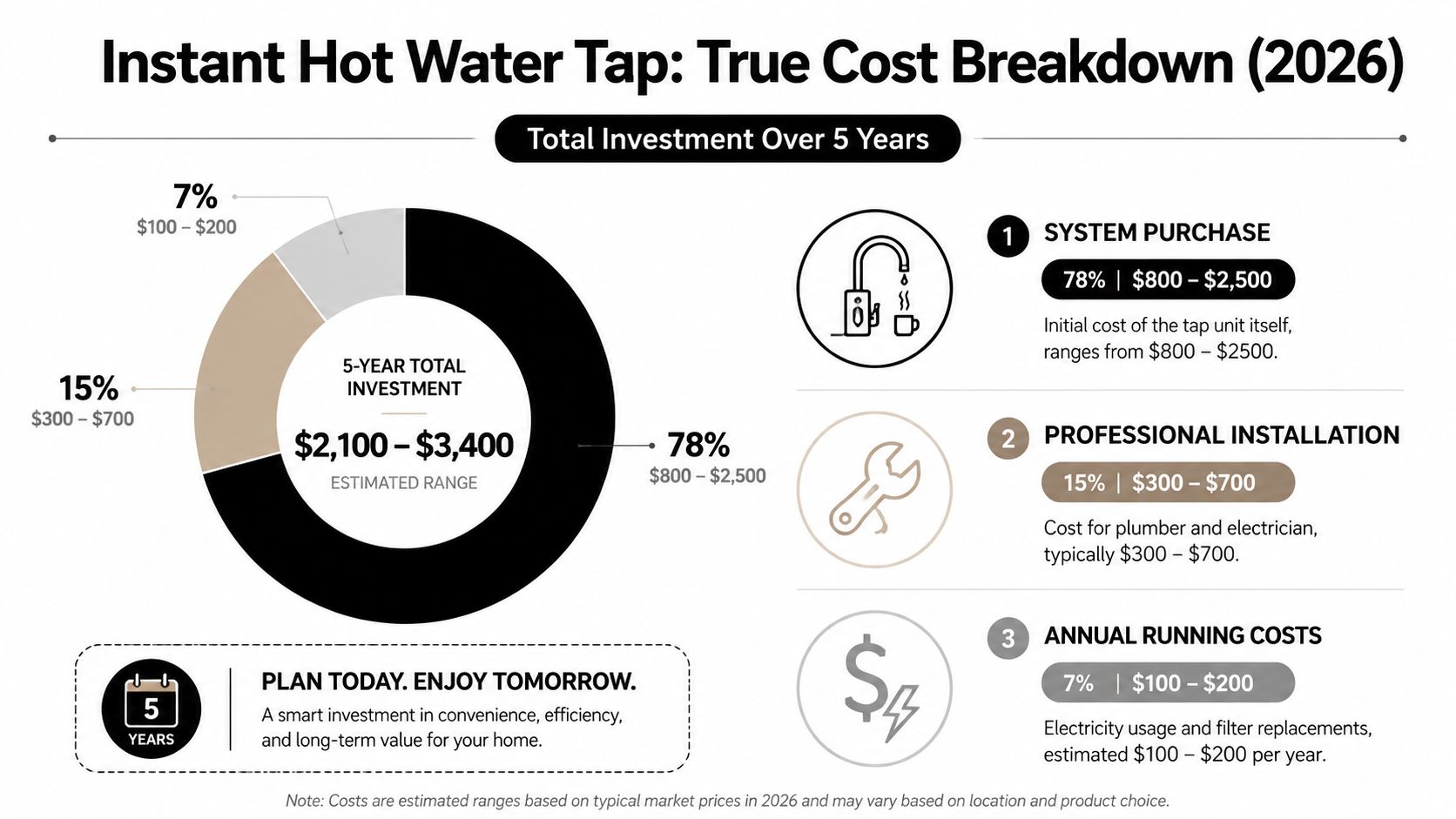
A Melbourne homeowner buys an instant hot water tap online for what looks like a sharp price. By the time the unit is fitted, the cupboard is altered, the power is sorted, and the first filter change comes due, the actual spend looks very different.
That gap between purchase price and ownership cost is where good buying decisions are made.
The costs that actually shape the decision
For Melbourne households, the true cost usually falls into three parts.
Appliance cost
The tap, the under-sink boiler or tank, and any filtration package.Installation cost
Plumbing labour, commissioning, minor cabinet work, and any electrical work needed to make the setup compliant and serviceable.Ownership cost
Filter replacements, servicing, wear parts, and repairs over the life of the unit.
The first figure is the one people see in the ad. The second and third figures are the ones that decide whether the system still feels like good value after two or five years.
Where budgets often blow out
Electrical work is the hidden item that changes the numbers fastest. A boiling or near-boiling unit may need more than a spare outlet under the sink. In older Melbourne homes, the issue can be circuit capacity, outlet location, switchboard condition, or the need to bring the setup into line before a fixed appliance is connected.
That does not make the tap a poor investment. It means the house has to be part of the calculation.
The other costs are less dramatic, but they add up:
- Cabinet alterations: enough room for the unit, filter, hoses, and future access
- Plumbing changes: isolation valves, connection changes, or tidying poor existing pipework
- Consumables: replacement filters where the system uses them
- Repairs over time: far cheaper when the brand has local support and parts supply
I tell clients to price the second service call before they buy the first tap. If a technician cannot reach the unit properly, or if basic parts are hard to get, a cheap system becomes expensive in a hurry.
What a sensible budget question looks like
A better question is not “What does the tap cost?” It is “What will this unit cost me to install properly, maintain on schedule, and keep running for years in this kitchen?”
That changes the shortlist fast.
Ask:
- Does this model suit the way the household uses hot water?
- Will the cupboard still allow easy filter changes and servicing?
- What electrical work might be required in this property?
- Are genuine replacement parts available locally, including common service items?
- Can the unit be repaired economically, or does a small fault push you toward full replacement?
For owners comparing brands, long-term parts support matters just as much as the finish on the tap. A unit backed by genuine Zip spare parts in Australia is usually easier to keep in service than a model with patchy supply or unclear support.
Good value comes from a compliant install, realistic running costs, and a system you can still service years later.
That is the essential cost conversation in 2026. Convenience matters, but total cost of ownership matters more.
Maintenance and Sourcing Genuine Spare Parts
An instant boiling tap should be thought of as a serviceable appliance, not a decorative tap that happens to heat water. That distinction matters. The households and workplaces that get the best life out of these systems are the ones that maintain them on schedule and buy with future servicing in mind.
What regular maintenance actually means
For most owners, maintenance starts with filtration. If the system includes a filter, that filter isn't an optional extra after installation. It's part of how the unit protects water quality and helps the appliance cope with what's coming through the line.
Melbourne water is generally softer than in some other capitals, but that doesn't mean every property has the same plumbing condition or the same maintenance needs. Building age, local pipework, and usage volume all affect how the unit behaves over time.
Basic ownership usually includes:
- Filter replacement: done at the right interval for the system and usage pattern
- Visual inspection: hoses, fittings, and signs of leaks under the sink
- Performance checks: changes in temperature, flow, or unusual operation
- Prompt servicing when faults appear: before a small issue becomes a larger one
Why serviceability matters more than marketing
Quality begins to separate itself. In busy workplaces, the key question becomes, “What does maintenance look like over 5 years?” A primary differentiator is often serviceability and rapid access to genuine spare parts to minimise downtime, which matters far more to business continuity than it does in a typical home, as discussed in this video on serviceability and spare-part planning.
That same logic still applies in homes. A unit that looks sharp but has poor parts support can become a headache after warranty. A system with accessible filters, available valves, and genuine replacement components is usually the better long-term buy.
If you need a reference point for what genuine component support looks like, this spare parts range for Zip systems in Australia shows the kind of ongoing parts ecosystem that makes repairs more realistic than full replacement.
What to look for before you buy
Ask these questions before choosing a system:
- Can filters be changed without dismantling the cabinet?
- Are valves, elements, thermostats, and hoses available later?
- Will a technician be able to work on it without fighting the cupboard layout?
- Does the supplier support the system after installation, or only sell the box?
Those answers tell you more about long-term value than a polished brochure ever will.
A tap that's easy to maintain usually stays in service longer. A tap that's hard to service often gets neglected until the owner gives up on it.
Your Local Solution with Ring Hot Water
If you want an instant hot water tap in Melbourne installed properly, local knowledge matters. The product choice is only one part of the job. You also need someone who understands Melbourne homes, cabinet constraints, local compliance expectations, and the practical reality of keeping the unit serviceable after installation.
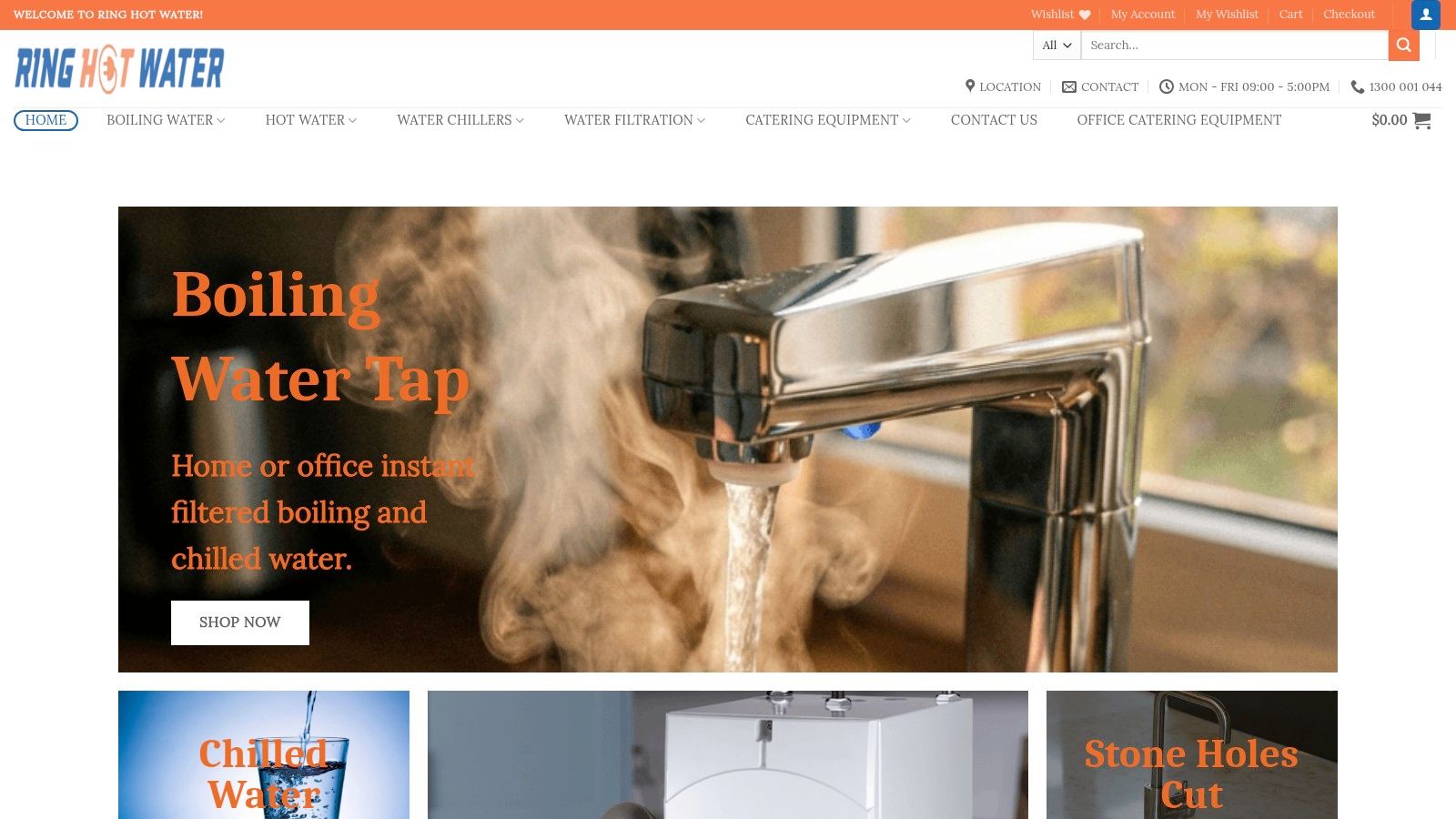
For homeowners comparing options, Ring Hot Water is one Melbourne-based supplier that handles boiling and chilled water systems, installation, servicing, repair, and genuine spare parts support through its local service offering and online store. That matters if you don't want to piece the project together across separate suppliers, installers, and parts sources.
A straightforward way to approach the job
The cleanest process usually looks like this:
- Start with the kitchen layout: check under-sink room, power access, and how you use the space.
- Choose the right system type: boiling only, filtered and boiling, or a broader multi-function unit.
- Confirm installation requirements early: especially electrical suitability and service access.
- Plan for maintenance from day one: filters, spare parts, and future servicing shouldn't be an afterthought.
That's the difference between buying a tap and making a good long-term kitchen decision. If the system is selected well and installed properly, it becomes one of those upgrades that feels normal very quickly. You stop waiting on the kettle. You get cleaner bench space. And you avoid the expensive mistakes that usually come from chasing the lowest upfront price.
If you want practical advice on an instant hot water tap in Melbourne from Ring Hot Water, the next step is simple. Ask for guidance based on your kitchen layout, your likely usage, and any electrical or compliance issues under the sink before you buy. That gives you a clearer installed picture, not just a product price.

