
Uncategorized
Instant Boiling Water Tap Australia: Your 2026 Buying Guide
Jun
You're probably here because the kettle has become one of those small daily annoyances you're no longer willing to tolerate. In a home kitchen, it clutters the bench and adds another appliance to clean around. In an office, it creates a queue. In a café prep area, it's the wrong tool for the job.
An instant boiling water tap solves that problem, but in Australia the buying decision shouldn't stop at convenience. The primary concern is total cost of ownership. That means the install, the space under the sink, filter changes, service access, and whether the unit you choose matches how you use hot water day to day. A compact home setup, a staff kitchen, and a caravan fit-out all have very different economics.
The Australian market is moving in that direction. The instant boiling water tap market in Australia was valued at USD 8.54 million in 2025 and is projected to reach USD 16.7 million by 2034, according to this Australia market projection from Ring Hot Water. That's a projection, not a current installed-base figure, but it does show that more buyers are treating these systems as a practical fixture rather than a novelty.
The End of the Kettle Wait
The kettle wait sounds trivial until you add it up across a week. You fill it, boil it, pour it, then repeat the whole routine for the next mug, saucepan, noodle cup, or cleaning task. In a busy household that's friction. In a workplace, it interrupts people all day.
That's why instant boiling taps have shifted from “nice kitchen extra” to a serious planning item in renovations and office fit-outs. They free up bench space, remove a visible appliance, and make the kitchen move faster. For many buyers, that workflow improvement matters more than any design trend.
If you're still deciding between keeping a conventional kettle or upgrading, it's worth comparing both approaches side by side with a practical resource like this 2026 electric kettle buyer's guide. A kettle still makes sense for some households. A fixed boiling tap makes more sense when hot water is part of the daily rhythm rather than an occasional need.
Why the shift feels bigger in Australia
Australian kitchens and break rooms often have one thing in common. Space is tight, and people want fewer standalone appliances on show. An under-bench boiling unit answers both problems at once. The bench looks cleaner, and the hot water is available without another jug, cord, or power point in the splash zone.
There's also a practical local angle. Australian buyers tend to ask direct questions. How much room does it take? What does it cost to install? Who services it if it fails? Those are the right questions, because the tap head is only the visible part of the system.
Practical rule: If you use boiling water several times a day, judge the system by workflow and whole-of-life cost, not by showroom appearance.
How Instant Boiling Water Taps Work
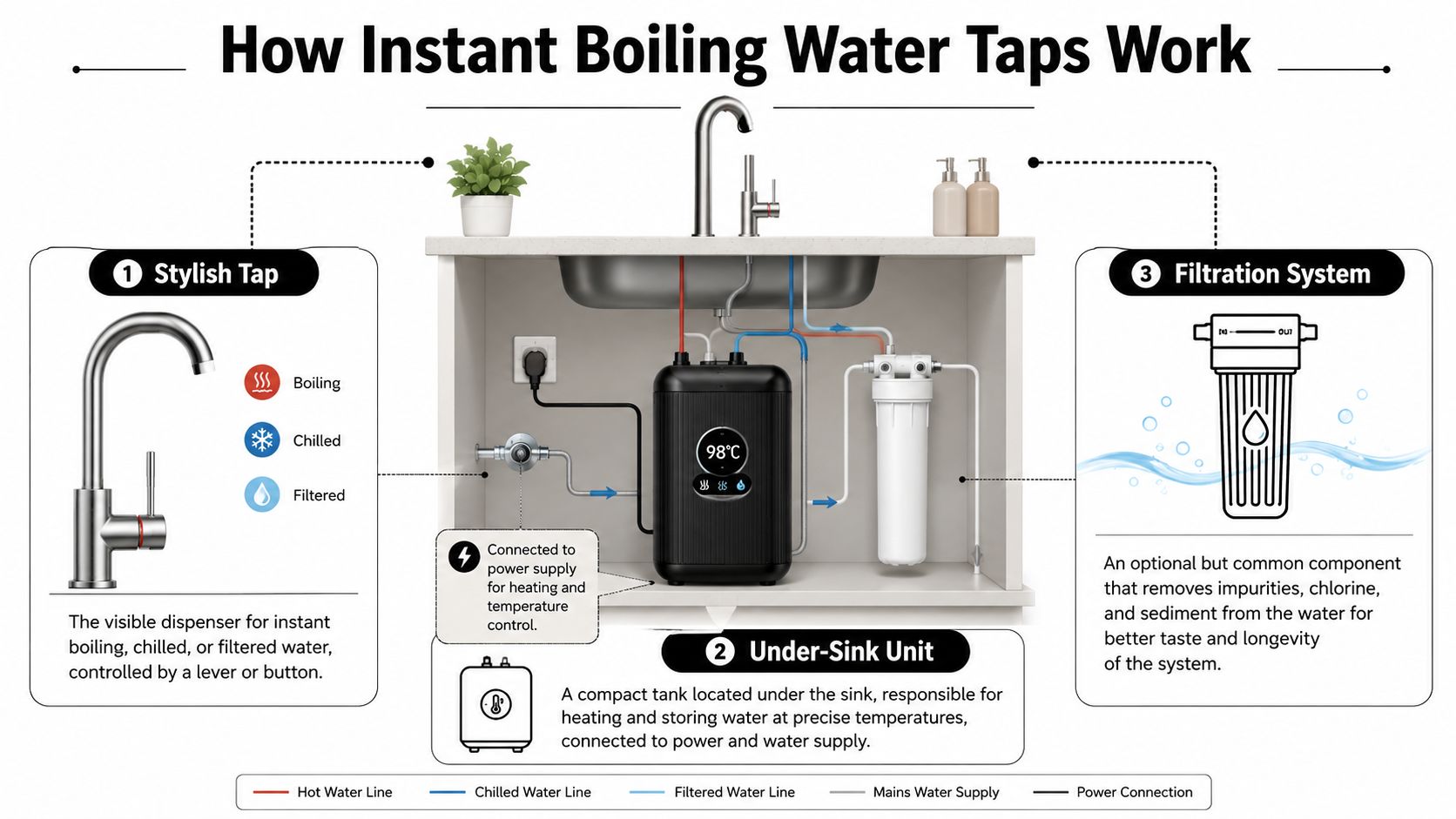
An instant boiling water tap is best thought of as a small dedicated hot water appliance under the sink, not just a fancy spout. The tap on the bench is only the delivery point. The actual work happens in the cabinet below.
Most Australian systems follow the same basic layout. Cold mains water enters the unit, passes through a filter in many setups, and moves into an insulated tank. The system then holds that water at a controlled near-boiling temperature so it's ready when you use the lever or button.
The three parts that matter
The tap on the bench
This is the part you see and use. Depending on the model, it may dispense boiling water only, or combine boiling with filtered ambient, chilled, or sparkling water. The control method matters more than many buyers expect.
A good tap should feel deliberate to operate. If the boiling function is too easy to trigger, that's a safety concern. If it's awkward, people stop using it and go back to the kettle.
The under-sink unit
This is the engine room. One Australian product description notes a 2.5 litre stainless-steel tank that heats water to about 98°C to 100°C under thermostat control, with output of around 100 cups. That compact-tank design is described on Waterpeople's boiling water tap page. The important point isn't just the number. It's the architecture. You're not heating a large household cylinder for one mug of tea. You're storing a small volume close to point of use.
That's why these systems suit kitchens where people want immediate access without a bulky standalone unit on the bench. The tank is hidden, the response is fast, and the heat is concentrated where it's needed.
The filtration stage
Many Australian installs include filtration before the water reaches the heating tank. That improves taste and helps reduce the sediment and debris that can make systems work harder over time. It's one of the reasons the water from a quality boiling tap often tastes cleaner than what comes from a standard mixer.
What controls performance
People often assume the spout controls output. In practice, the bigger limitation is usually the tank capacity and recovery rate. If one person makes tea a few times a day, almost any correctly chosen residential unit will feel instant. If ten staff hit the tap during a morning break, the system can run out of stored boiling water and then wait on reheating.
That's why product brochures can be misleading when read too quickly. The tap style, finish, and controls matter, but sizing is what decides whether you'll be happy with it six months later.
A boiling tap performs well when the hidden unit matches the usage pattern. It performs poorly when the buyer chooses on appearance alone.
The common system types
A simple way to sort the market is by function:
- Boiling-only systems suit buyers who want fast drinks and cooking water without adding other features.
- Boiling and filtered systems make sense where taste improvement is part of the goal.
- All-in-one taps combine regular hot and cold with premium filtered functions from one fixture, which can simplify the bench layout.
- Boiling, chilled, and sparkling setups are more common in premium homes, boardrooms, and hospitality spaces where one tap replaces several separate solutions.
Not every feature pays for itself. In many Melbourne homes, a straightforward boiling and filtered setup is the most sensible balance. In a high-use office, the premium is often justified because one system can handle several daily needs from the same point.
Key Benefits and Potential Drawbacks
Instant boiling taps are easy to like when you test one in a showroom. Living with one is a more useful test. The strengths are real, but so are the compromises.
Where they work well
The biggest benefit is convenience. Tea, coffee, blanching vegetables, filling a pot, warming a bowl, loosening a jar label, cleaning a chopping board. You turn a control and the water is ready. There's no waiting for a kettle cycle, no appliance to refill, and no hot jug left on the bench.
The second benefit is layout. A well-planned under-bench system clears visual clutter and gives the kitchen a simpler working zone. That matters in compact homes, apartment kitchens, office lunchrooms, and butler's pantries where every bit of bench space gets used.
There's also a safety argument, but it depends heavily on the product. A boiling tap with a proper safety lever or lockout can be safer than a kettle that's overfilled, carried across the room, or left near the edge of a bench. The opposite is also true. A poorly chosen tap without clear safety control is not an upgrade.
Where buyers get caught out
The first surprise is upfront spend. The tap itself is only part of the cost. You also need room under the sink, a suitable power supply, plumbing access, and in many cases filtration changes over time.
The second surprise is that “instant” does not mean endless. Residential units can feel limitless in light use, then struggle when several people draw boiling water in quick succession. Offices and hospitality venues notice this quickly if the unit was selected like a home appliance instead of a demand-based system.
A third issue is standby energy use. These systems keep water hot so you don't have to wait. That convenience comes with an ongoing power cost. Whether that cost is reasonable depends on how often you use the tap.
Side-by-side view
| Consideration | Instant boiling tap | Kettle |
|---|---|---|
| Speed at point of use | Immediate when correctly sized | Wait for each cycle |
| Bench space | Bench stays clear | Appliance remains visible |
| Upfront complexity | Higher, with install planning | Low, plug and play |
| Suitability for repeated use | Strong in busy kitchens | Less efficient in repeated cycles |
| Service and maintenance | Filter and system upkeep required | Usually replace when it fails |
The honest trade-off
For frequent use, these systems make daily kitchen work easier. For low use, they can be harder to justify. If someone in the home makes one or two hot drinks a day and rarely cooks with boiling water, the convenience uplift may not offset the added cost and maintenance.
If, on the other hand, the kitchen is active from morning to night, the value shows up in small repeated wins. Less waiting. Less clutter. Less back-and-forth.
Choosing The Right System for Your Needs
Start with the busiest ten minutes of your day. A family breakfast rush, a staff kitchen at 10:30, or a caravan running on limited power all put very different demands on an instant boiling water tap. The right unit is the one that handles that peak use without leaving you paying for capacity you never use.
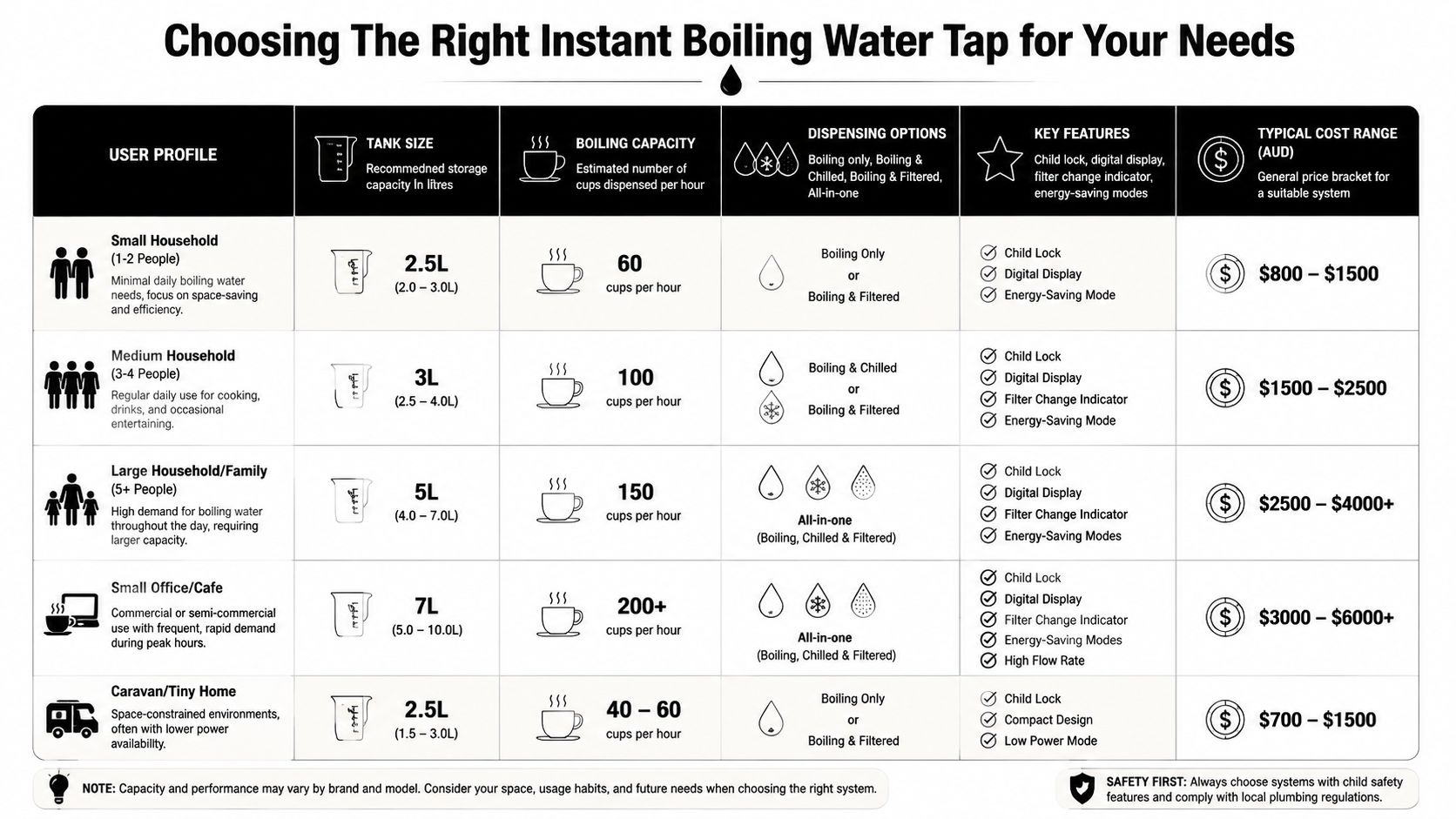
Purchase price matters, but in Australia the long-term cost usually comes from three areas. Installation complexity, ongoing electricity use, and filter or service intervals. That is why I separate buyers into home, office, hospitality, and mobile living. Each group uses hot water differently, and each one carries a different ownership cost over time.
Home kitchens
For most homes, an under-bench unit is the practical choice if the household uses boiling water often enough to justify it. The mistake I see is buying on finish and tap style, then discovering the cupboard has become cramped, the filter is hard to reach, or the tank blocks bins and storage.
A better approach is to match the unit to actual household habits. Two people making a few drinks a day do not need the same setup as a five-person household cooking, filling bottles, and making tea from morning to night. In lower-use homes, a premium boiling tap can take a long time to repay its higher install and maintenance costs. In busy homes, the daily time saving is easier to justify.
Homes usually benefit most from:
- Compact under-bench layout that still leaves usable storage
- Clear child-safety operation on the boiling side
- Filtered water integration where taste, sediment, or scale are concerns
- Simple service access so filter changes and repairs do not turn into a cabinet rebuild
If you are comparing layouts, this guide to under-sink hot water systems gives a useful picture of the space, plumbing, and servicing implications before you buy.
Offices and staff kitchens
Office demand is rarely steady. It spikes. That changes the buying decision.
The key question is not whether the tap can produce boiling water once. It is whether the tank and element recover quickly after repeated draws during tea breaks and lunch. A unit that seems fine in a showroom can become frustrating in a real office if several staff use it back-to-back.
The running cost calculation also shifts in workplaces. A larger system usually costs more to buy and install, but undersizing can waste staff time every day and lead to earlier replacement if the unit is worked too hard. For many offices, paying more upfront for stronger recovery is cheaper over the life of the system than dealing with complaints, downtime, and premature service calls.
A representative Australian example is the Puretec Sparq-H2, which focuses attention on hourly output and recovery performance on the Puretec Sparq-H2 specification page. That is the right way to assess an office unit. Look at throughput, recovery, filter cost, and service access, not just the tap body.
After a first look at the options, this video helps visualise the kind of system differences buyers should be watching for:
Selection rule for workplaces: Size for the busiest break period, because that is when performance problems show up.
Hospitality and food service
Hospitality buyers need serviceability and reserve capacity. A stylish tap means very little if the unit slows down during prep or cannot be repaired quickly.
This is one area where overbuying is often the cheaper decision over several years. A larger or semi-commercial setup costs more at the start, but repeated shortages during service affect workflow immediately. Staff end up waiting, changing routines, or using backup kettles. That hidden cost adds up faster than many owners expect.
Look closely at replacement part availability, filter pricing, access under the bench, and whether a local technician can service the unit without delays. In Melbourne, that practical support often matters more than the badge on the tap.
Caravans, RVs, and tiny homes
Mobile and compact living setups need a stricter filter on what counts as suitable. Space is tighter, power supply can be limited, and movement places more stress on fittings and connections than a fixed house installation.
In plenty of caravans and RVs, a full instant boiling water tap is hard to justify on total ownership cost alone. The cabinet space is valuable, the electrical demand may be awkward, and servicing is more inconvenient if something fails on the road. For some owners, a filtered drinking water system paired with another heating method is the smarter choice.
For fixed tiny homes, the numbers can work better if the whole plumbing and electrical layout is planned around the appliance from the start. In that case, check:
- Cabinet volume so the tank and filter do not consume all storage
- Power availability because continuous-heating appliances need the right supply
- Mounting security to reduce movement stress on pipework and fittings
- Service access because cramped installs are expensive to maintain
The best system is not the one with the longest feature list. It is the one that fits the way the site is used, carries a reasonable running cost, and can be serviced without trouble in Australian conditions.
Installation and Compliance in Australia
This is not a plug-in benchtop appliance. A boiling tap becomes part of the plumbing and electrical setup of the property, so installation matters as much as model choice.
In Australia, professional installation for a boiling water tap typically ranges from AUD $250 to $500, according to this Australia-focused boiling water tap cost comparison. That cost isn't just labour on a quote. It buys proper connection, safer operation, and a much better chance that your warranty remains valid.
What a proper install usually involves
A normal installation checks more than the sink hole and the power point. The installer needs to confirm there's enough room for the tank and filter, suitable ventilation around the unit, sensible hose runs, and water pressure that matches the product requirements.
Pressure control is one area homeowners often overlook. If supply pressure is too high or unstable, the system may not behave as intended. If you're unsure how that side of the plumbing affects appliance life, this guide to a pressure limiting valve explains why pressure management can matter before a premium tap is installed.
Compliance questions worth asking
Before work starts, ask the installer:
- Is the product appropriate for Australian plumbing conditions
- Does the installation method protect the manufacturer's warranty
- Can the filter and service parts be accessed later without removing cabinetry
- Is the power arrangement suitable for the unit location
- What isolation valves or pressure controls are needed nearby
These aren't fussy questions. They decide whether the system remains easy to own after the install day is forgotten.
Don't treat installation as a bolt-on extra. A good unit with a poor install becomes a recurring service call.
Melbourne-specific practicalities
In Melbourne homes, under-sink space is often tighter than people expect once waste pipes, bins, pull-out drawers, and cleaning products are taken into account. I've seen buyers choose a tap based on the display stand, then discover the boiler and filter make the cupboard awkward to use.
That doesn't mean the product is wrong. It means the planning was incomplete. A measured cabinet check, power check, and pressure check before purchase usually prevents the headaches.
Energy and Cost Considerations in Australia
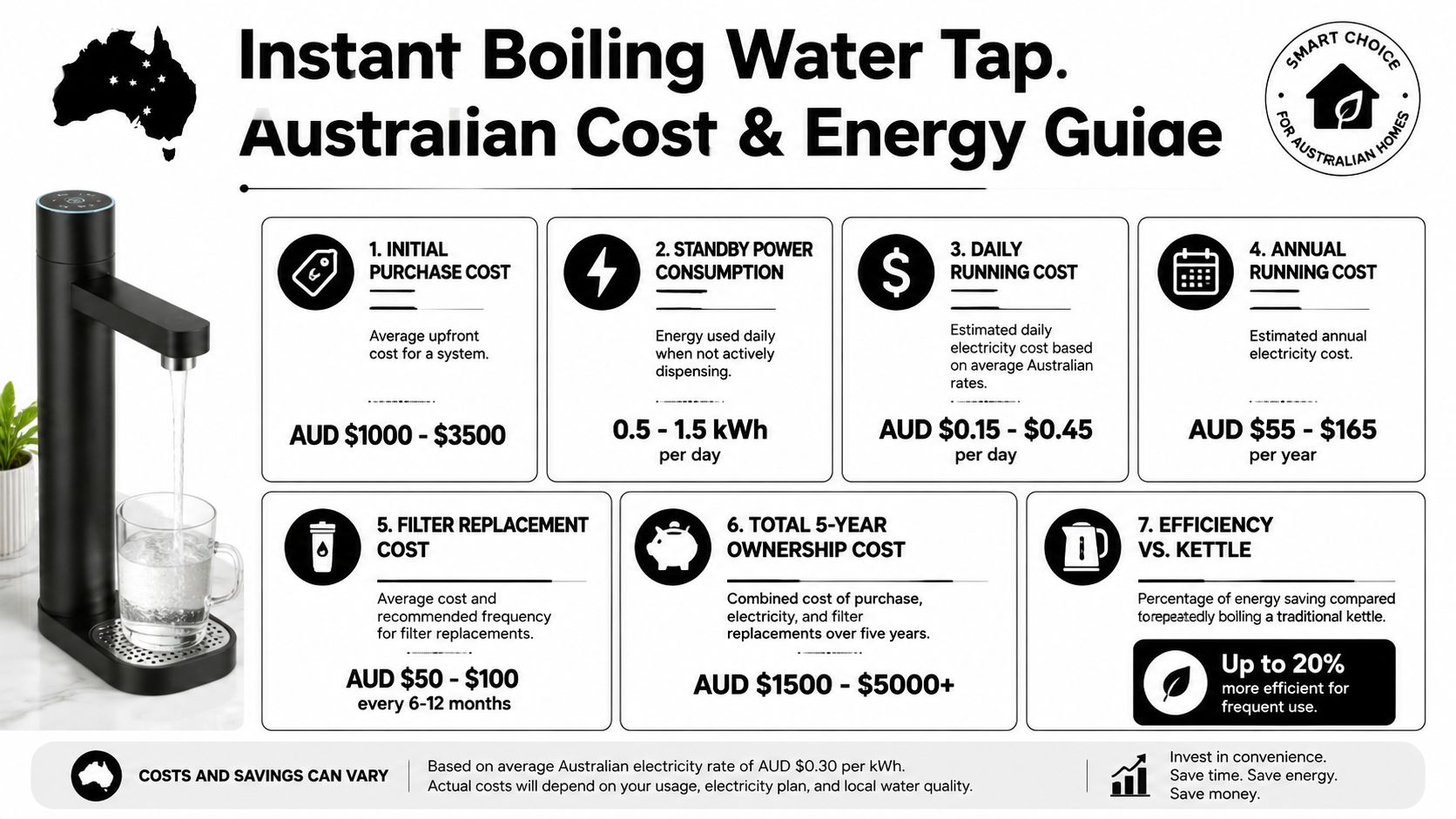
This is the part most marketing skips. Buyers ask, “Will it save money?” The honest answer is, it depends on how often you use it.
One Australia-focused guide points out that real operating cost is still a major consumer knowledge gap, and that the business case changes substantially by usage pattern, especially between a home user and a Melbourne office with heavier demand, as noted in this operating-cost discussion from SodaTap. That aligns with what I see in practice. The same appliance category can be sensible in one setting and hard to justify in another.
The four cost buckets that matter
Installation
This is the first essential ownership cost. If you budget only for the product and ignore fitting, isolation, possible pressure control, and access adjustments, your project cost won't be realistic.
Electricity
A boiling tap keeps water ready. That means there is always some standby consumption in exchange for immediate access. Whether that feels expensive depends on usage.
For a high-use workplace, standby energy can be easier to justify because the unit is replacing repeated kettle cycles and interruptions. For a low-use household, the system may spend much of its life staying ready for hot water that isn't being drawn.
Filters and routine service
If the system includes filtration, that filter becomes part of the ownership cycle. In this context, buyers sometimes make a false comparison against a kettle. A kettle has no filter replacement schedule. A boiling tap often does. The trade-off is improved water quality, cleaner internal operation, and better taste.
Repair risk over time
No appliance runs forever without wear. Solenoids, valves, taps, cartridges, seals, and heating components can all require attention eventually. What keeps total cost of ownership manageable is choosing a system with sensible service access and available parts.
A practical way to judge the economics
Ask three questions.
- How many times a day is boiling water used
- Is the demand spread out or concentrated into short bursts
- Will filtered water replace another existing cost or appliance
If the answer is “used often, by several people, every day”, the ownership case improves. If the answer is “used occasionally, mostly for one or two drinks”, the convenience may still be worth it, but the financial case becomes softer.
What works for different users
| User type | Cost logic that usually works | Common mistake |
|---|---|---|
| Home kitchen | Buy for daily convenience and layout improvement | Paying for extra functions that never get used |
| Office | Buy for throughput and staff efficiency | Under-sizing the recovery rate |
| Hospitality | Buy for reliability and serviceability | Treating a light-duty unit as commercial equipment |
| RV or tiny home | Buy only if the whole system supports it | Ignoring power and space limits |
What doesn't work
The worst buying approach is comparing only the ticket price of the tap against the ticket price of a kettle. That's not the true choice. The true choice is between two different ways of running the kitchen.
One is cheap to start and slower every day. The other costs more upfront and can make daily use smoother, while adding maintenance and standby power as ongoing costs. Neither is automatically right. The correct answer depends on your pattern of use.
Cost takeaway: For Australian buyers, total cost of ownership is driven less by the product label and more by install quality, usage frequency, and filter servicing.
Maintenance Troubleshooting and Professional Service
A Melbourne office kitchen at 8:30 am is a good test of any boiling water tap. If the unit is slow, leaking, or overdue for a filter, staff notice straight away. At home, the warning signs are quieter. A slight drop in flow, a change in taste, or moisture on the cabinet base often shows up before a real failure. Catching those early matters because maintenance cost in Australia is usually driven by callout time, parts availability, and whether the original install left enough room to service the unit properly.
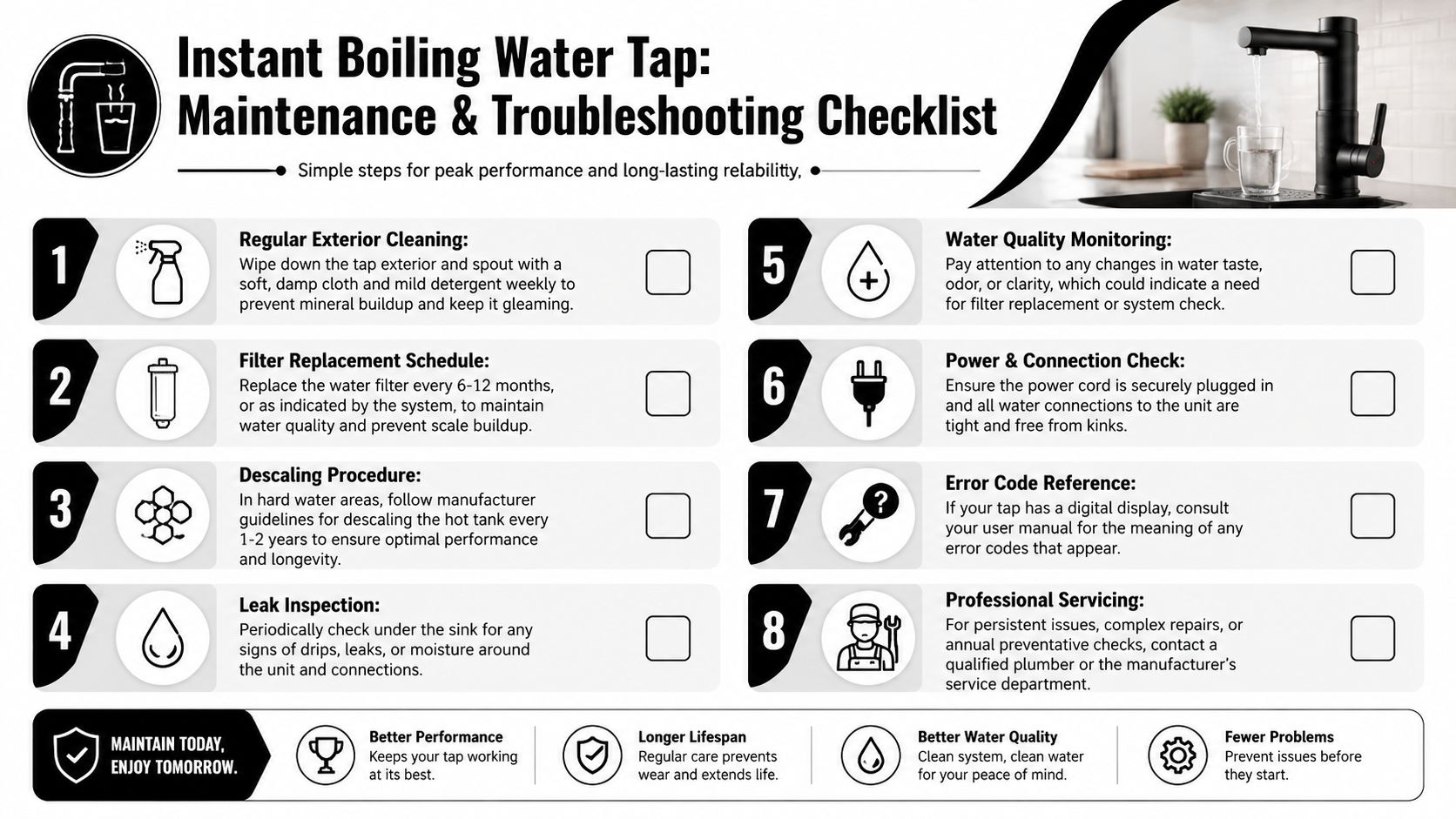
The routine tasks worth doing
Most owners can handle the basic upkeep without tools.
- Clean the outlet and spout area so residue does not build up around the dispense point.
- Pay attention to taste, smell, and flow rate because those changes often point to a filter nearing replacement.
- Check the cabinet floor and fittings for drips, swelling, or staining.
- Keep stored items clear of hoses, vents, and power leads under the sink.
Filter servicing is the big one. If the unit uses a branded cartridge, fit the correct replacement rather than a generic part that may not match the head, flow rate, or water conditions. For Zip owners, this guide to replacing a Zip water filter is a practical starting point.
That simple habit can save money. A neglected filter often shows up as poor flow first, but it can also put extra strain on the system and lead to a service visit that would have been avoidable.
Basic troubleshooting you can do yourself
Start with the easy checks before booking a technician.
If the water is not hot enough, confirm the power is on at the isolation point and the unit has not been switched off inside the cupboard. If the flow is weak, suspect the filter before assuming the tank or electronics have failed. In homes with tighter under-sink storage, I often find a hose kinked by cleaning products or a plug disturbed by something pushed to the back of the cabinet.
Uneven dispensing or spluttering can happen after installation, servicing, or a filter change. Follow the manufacturer's flushing steps and give the unit time to settle if the instructions say so. That is common, and it does not automatically mean the system is faulty.
Signs you should stop and call a professional
Some faults are not worth experimenting with, especially under Australian electrical and plumbing requirements.
- A burning smell or repeated tripping at the power circuit
- Leaks from inside the tank or unit casing
- No-heating or overheating faults that return after a reset
- Cracked hoses, damaged fittings, or visible casing damage
- Poor performance that continues after filter replacement and basic checks
These appliances combine mains power, stored heat, pressure, and drinking water. Licensed trade work matters here. If the fault sits inside the unit, involves wiring, or keeps returning, proper diagnosis is cheaper than repeated guesswork.
How to reduce long-term repair costs
The lowest ownership cost usually comes from prevention, not from chasing the cheapest repair.
Leave enough clearance around the unit for ventilation and access. Do not pack the cupboard so tightly that nobody can inspect valves, connections, or the filter head. A service technician who can reach the isolations quickly will usually spend less time diagnosing the problem, and in Australia that directly affects the labour charge on the invoice.
Usage pattern matters too. A lightly used home unit may only need routine filter and visual checks, while an office or staff kitchen will usually justify scheduled servicing because downtime has a real productivity cost. RV and tiny-home owners need to be stricter again. Vibration, space limits, and variable water quality can shorten the life of hoses, fittings, and filters if the system is not checked regularly.
What professional servicing should achieve
A proper service visit should identify the cause, not just restore hot water for the day. The fault may relate to scale, inlet pressure, ventilation, a worn valve, a failed component, or poor access from the original install. If that cause is missed, the same problem often returns and the total spend climbs.
For Melbourne clients, I also look at whether the unit was installed in a way that supports future maintenance. Good access, compliant isolation, and sensible placement make a real difference over five or ten years of ownership. Ring Hot Water can assist with servicing advice and replacement part selection where a unit needs repair rather than another temporary fix.

