
Uncategorized
Urn for Hot Water: The Ultimate AU Buyer’s Guide (2026)

May
If you're reading this, there's a fair chance you're tired of the same small frustration. The office kettle keeps emptying. The tea break at the club rooms turns into a queue. A family gathering starts smoothly, then someone gets stuck on permanent refill duty while everyone else asks, “Is the water boiled yet?”
That's usually the point where people start looking for an urn for hot water. Not because it sounds fancy, but because a kettle stops making sense once more than a few people need drinks in the same window of time. The right urn changes the whole rhythm of a kitchen, meeting room, canteen, or event table. People serve themselves, service flows better, and you stop babysitting boiling water.
Buying one, though, is where many people get tripped up. Capacity, insulation, temperature control, power draw, cleaning, spare parts, standby costs, bench space, plumbed-in options. It's easy to choose based on price alone and only realise later that the unit is awkward to clean, too small for peak periods, or expensive to keep hot all day.
The End of the Kettle Queue An Introduction to Hot Water Urns
A hot water urn solves a simple but common problem. One kettle works fine for two people. It struggles when ten staff walk into the lunchroom at once, or when a community fundraiser needs a steady run of tea and instant coffee, or when a host is trying to keep up with guests instead of standing at the bench.

The appeal isn't new. Hot water urns for tea service were first produced in England in the 1760s, and they later arrived in Australia with early colonial settlers. By the 19th century, they were already established in Victorian-era homes and hotels across the colony, including Melbourne districts such as Sunshine and Footscray, giving the urn a 250-year legacy in large-scale hospitality, as documented by the historical hot water urn collection notes.
Why the urn lasted
The basic idea has always been practical. Keep a larger volume of hot water ready to dispense, safely and steadily, without repeatedly lifting and pouring from a kettle.
That still matters now. In a church hall, it means fewer delays between serves. In an office, it means less clustering around the kitchenette. In catering, it can be the difference between smooth service and constant interruption.
Hot water equipment should remove friction from hospitality, not add to it.
There is also an important distinction here. Not everyone who needs hot water all day needs an urn. Some people only need a smaller pour-over kettle for controlled brewing. If that is your setup, a gooseneck option can make more sense, and this guide to buy Hario Buono V60 silver kettle is useful for coffee-focused kitchens where precision pouring matters more than bulk capacity.
When an urn starts to make sense
An urn usually becomes the smarter option when you recognise one of these patterns:
- Repeated demand: People want hot water across a short period, not one cup at a time.
- Host fatigue: One person keeps refilling the kettle instead of doing everything else they need to do.
- Service pressure: Drinks need to move quickly during a break, event, or rush.
- Safety concerns: Repeated lifting of full kettles isn't ideal in busy spaces.
An urn for hot water isn't old-fashioned. It's one of the oldest examples of equipment that still solves a modern bottleneck cleanly.
Commercial vs Domestic Urns Decoding the Right Type for You
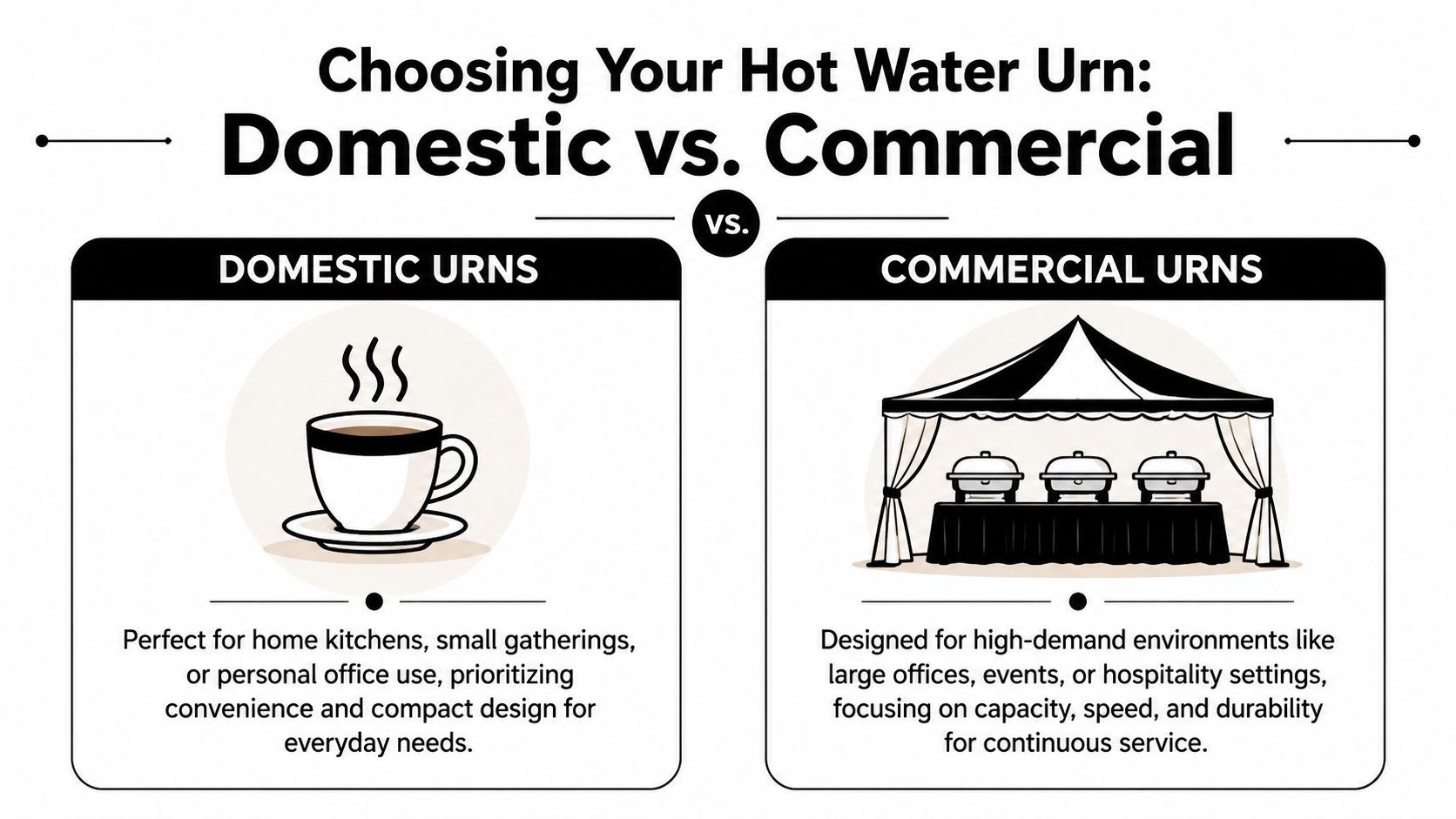
The first buying mistake I see is simple. People assume “bigger” means “commercial”, and “smaller” means “domestic”. That's only part of the story.
A domestic urn is usually built for occasional or moderate use. A commercial urn is designed for repeated service, tougher handling, and longer operating periods. Two units can look similar on the bench and still suit completely different jobs.
What an urn does differently
A kettle boils a small batch. An under-sink boiling tap gives you a fixed installation with instant access at the sink. An urn sits in the middle. It stores a larger volume, dispenses from a tap, and can often be moved where needed.
That portability is why urns are so common in temporary or flexible setups. Think school functions, club kitchens, workshop lunch areas, meeting rooms, mobile catering, and seasonal overflow spaces.
Domestic and commercial side by side
| Type | Best fit | Typical strengths | Usual trade-offs |
|---|---|---|---|
| Domestic urn | Home entertaining, occasional gatherings, light office use | Easier to store, simpler controls, lower upfront spend | Not ideal for constant daily demand |
| Commercial urn | Offices, cafés, canteens, events, regular service | Heavier-duty build, better suited to repeated use, stronger safety focus | Larger footprint, usually more expensive |
Questions that separate the two
Ask yourself how the urn will live day to day.
- Will it run every day or only on occasion? A Christmas lunch and a daily lunchroom aren't the same job.
- Will lots of people use it without supervision? Shared staff kitchens and public-facing service areas benefit from sturdier taps, clearer water-level visibility, and stronger lids.
- Will it be moved often? Caterers and community groups need something durable enough for transport and setup.
- Will downtime cause disruption? In a business, reliability matters more than shaving a little off the purchase price.
Practical rule: If the urn will be used hard, shared by many people, or expected to keep service moving, buy for duty rather than appearance.
Where many buyers go wrong
Homeowners sometimes overbuy. They choose a commercial unit for a once-a-month need, then end up with a bulky appliance that takes up too much room and feels awkward for normal use.
Office managers often do the opposite. They buy a lighter domestic model because the litre size looks right, then discover the unit wasn't built for the constant opening, dispensing, reheating, and cleaning that a shared workplace creates.
If you want a broader look at business-grade options, this overview of commercial hot water urns is helpful for comparing setups used in workplaces and hospitality settings.
A simple way to decide
Choose domestic if your need is occasional, predictable, and fairly gentle.
Choose commercial if your need is shared, frequent, time-sensitive, or part of service delivery.
That sounds obvious, but it's the decision that shapes everything else. Lifespan, maintenance needs, cleaning effort, safety, and operating cost all follow from that first call.
How to Choose the Right Urn Size and Capacity
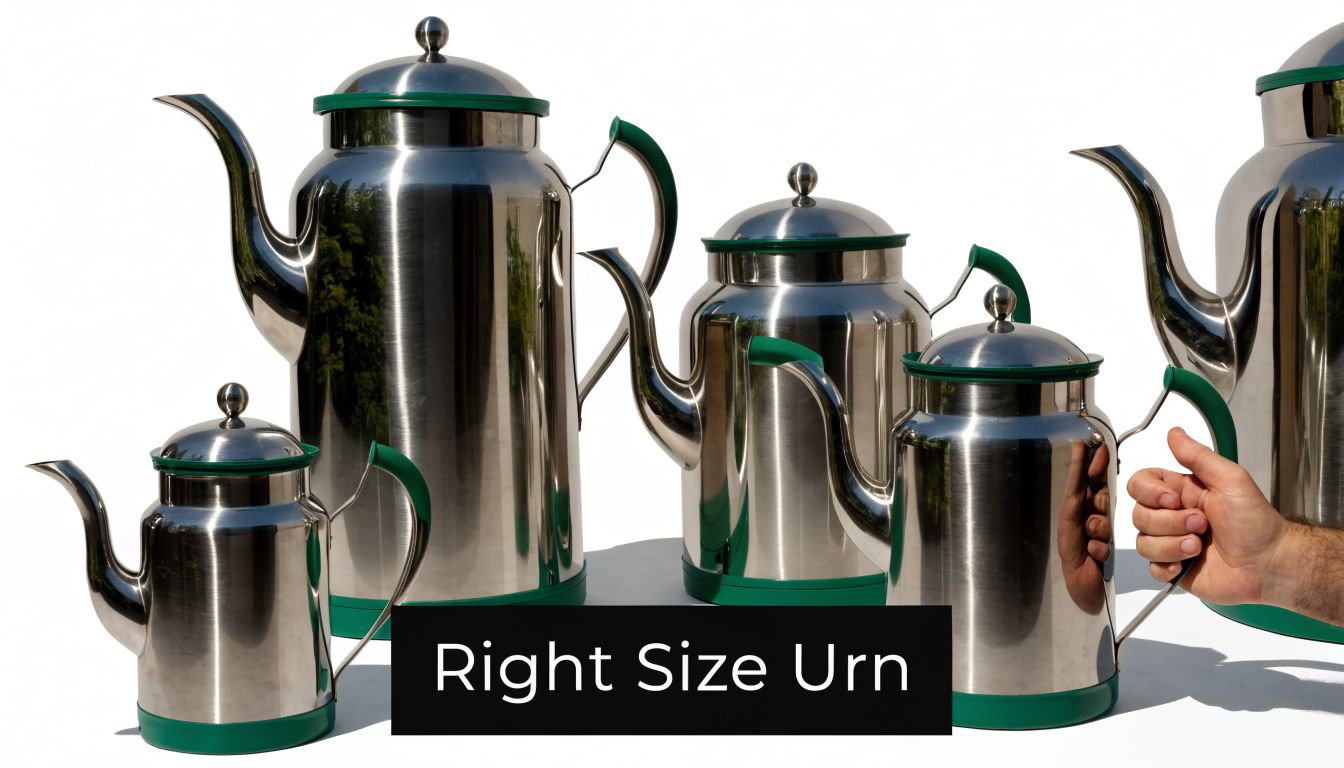
You see the sizing mistake fastest when the tea break starts. Ten people line up at once, the first few fill their mugs, and by the time the last person reaches the tap, the urn is already struggling. That problem usually has less to do with the total number of people on site and more to do with how many need hot water at the same time.
That is the key idea for sizing an urn properly. Buy for the busiest short burst, not the full day.
A hot water urn works a bit like a car park at a stadium. You do not size it for everyone who attended across 24 hours. You size it for the rush when many arrive together. Urns are the same. Morning tea in an office, intermission at a hall, or a catering break at a training session will tell you more than the headcount on the booking form.
One common planning approach is to allow about 0.25L per person during the busiest serving window, as outlined in this urn capacity planning guide. As a practical reference point, a 20L urn is often described as serving 80 to 100 cups at typical cup sizes. That gives buyers a useful starting point, but real use still matters more than brochure maths.
Start with the busiest 15 minutes
Homeowners, office managers, and event organisers often overestimate capacity because they count every possible user across the day.
A better question is simpler. How many people will want hot water within one short window?
In a small office, that may be the group that arrives between 8:30 and 9:00. At a community event, it may be the break after a speech. At a catered function, it may be the moment dessert lands and everyone wants tea and coffee together. Those are the moments that create queues, complaints, and constant refilling.
A practical way to size an urn
Work through these four checks.
Count likely peak users
Estimate the number of people drawing hot water in the busiest period, not everyone who has access to the urn.Allow for what they are filling
A single mug is one thing. Teapots, soup cups, and multiple coffee orders drain an urn much faster.Consider refill reality
If staff can refill the unit between waves, you can size more tightly. If the urn sits on a service table during an event and refilling is awkward, more buffer makes sense.Factor in ownership cost, not just purchase price A bigger urn costs more to buy, takes more bench space, and often keeps more water hot than you need. In Australian conditions, especially in offices where the unit stays on for long periods, that extra stored water can turn into unnecessary power use year after year.
That last point gets missed often. Capacity is not only a service decision. It is also a running-cost decision.
Real-world sizing examples
| Setting | Peak-use pattern | What usually makes sense |
|---|---|---|
| Small office kitchen | Short morning and lunch bursts | A mid-size urn that recovers well is usually more practical than a large unit left simmering all day |
| Community hall or clubroom | Sharp demand during scheduled breaks | Extra capacity helps avoid a visible queue and frantic refills |
| Home entertaining | Concentrated but occasional use | A compact or mid-size urn is often enough and easier to store |
| Catering or self-serve events | Repeated dispensing over a service period | A larger commercial unit is often the safer choice |
If you are also comparing equipment for tea service, this guide to choosing the right tea maker is useful for thinking about volume, serving style, and how guests use hot beverage equipment in practice.
Where buyers usually get it wrong
The first mistake is buying for attendance instead of peak demand. Fifty guests does not mean fifty people need boiling water together.
The second is ignoring draw size. A workplace that fills standard mugs behaves very differently from a sports canteen serving noodles and large takeaway cups.
The third is forgetting the physical job of living with the urn. Large units are harder to lift, drain, clean, and store. That matters in homes, church kitchens, school staff rooms, and mobile catering setups.
The fourth is treating bigger as safer. Bigger can be safer during a rush, but it can also mean paying to heat water you never use. Over several years, that affects total cost of ownership just as much as the purchase price.
The right urn size keeps service moving without leaving you with an oversized tank heating spare water and taking up bench space every day.
A good choice feels uneventful. No queue. No last-minute refill panic. No bulky unit dominating the kitchen for a demand level you rarely reach.
Understanding Heating Methods and Essential Features
After you have decided on the size, the next consideration is quality. Two urns with identical capacity may perform quite differently as time passes.
Buyers often focus on the obvious things first. Lid, handle, shape, price. The more important details are usually less visible: the insulation, the thermostat, the tap quality, and how easy the unit is to clean after months of use.
Why insulation matters
A quality commercial urn uses a double-layer stainless steel body. That construction creates an insulating air gap, which can reduce energy consumption by 15 to 20% compared with single-wall models while also keeping the outer surface cooler to touch, according to the double-layer urn specification details.
That gives you two practical benefits.
First, less heat escapes. The urn doesn't have to work as hard to maintain temperature. Second, the outside is safer in a shared kitchen, office, or service area where people may brush past it.
Features worth paying attention to
Not every useful feature is flashy. In daily use, these are the ones that usually matter most:
- Thermostat control: Better temperature control gives more flexibility for tea, coffee, and general kitchen use.
- Tap design: A smooth, non-drip action matters more than many buyers expect. Cheap taps often become the most annoying part of ownership.
- Lid security: A twist-lock or firm-fitting lid helps with safe operation and heat retention.
- Water level visibility: Sight windows or clear indicators make it easier to manage service without opening the unit repeatedly.
- Cleaning access: Wide openings and sensible internal design save time when descaling and wiping out the vessel.
Concealed versus exposed elements
This is another point that causes confusion. Some buyers assume any heating element setup is fine because “it just boils water”. In practice, cleaning effort and scale build-up can differ a lot.
A concealed element is generally easier to wipe around. An exposed element can make mineral build-up more obvious and sometimes more fiddly to clean. Neither design is automatically wrong, but you should think about your water quality, your cleaning routine, and who'll maintain it.
The easiest urn to own isn't always the cheapest to buy. It's the one people can clean properly without putting it off for another week.
Match the feature set to the drinks
Some kitchens need straight boiling water for instant coffee and general use. Others care more about holding a stable temperature for tea service. If tea is central to what you serve, it also helps to understand how the brewing side affects the result. This guide on choosing the right tea maker is a useful companion if you're balancing hot water supply with better tea quality.
A good urn for hot water should be easy to live with. That means stable performance, safer external surfaces, parts that don't feel flimsy, and controls that suit the way you use hot water.
Installation Plumbing and Australian Compliance
Some urns are straightforward. Fill them, plug them in, and place them where they can be used safely. Others are closer to a fixed hot water solution and need proper installation planning before you switch anything on.
That difference matters. Buyers sometimes compare a portable countertop urn with a plumbed-in boiling unit as if they're interchangeable. They're not. One is an appliance you can move for events or cleaning. The other becomes part of the kitchen or staff room setup.
Portable and plug-in setups
A portable urn is the simpler option. It suits temporary service points, occasional functions, and rooms where flexibility matters. You'll still want stable bench space, safe clearance around the unit, and a power point that suits the appliance load.
If the urn sits in a shared area, place it where people can dispense without twisting around corners or reaching across other appliances. Good positioning prevents spills as much as good hardware does.
Plumbed-in systems
A plumbed-in hot water unit is a different category. These are better when your need is permanent and frequent, especially in offices or kitchens where refilling becomes tedious or inconsistent.
Any connection into your water service should be handled properly. If your setup includes pressure control components, it's worth understanding how a pressure limiting valve fits into safe and reliable operation for fixed hot water systems.
Compliance and practical checks
Australian buyers should look for equipment suited to local electrical and workplace expectations. In real terms, that means checking:
- Electrical suitability: The unit should match the available supply and intended use environment.
- Placement safety: Keep the appliance on a stable surface away from edges, walkways, and splash zones.
- Access for cleaning: Leave enough room to drain, refill, and descale safely.
- Professional installation where needed: Fixed water connections and related plumbing work should be handled by the right licensed trade.
Electrical load is one area people often underestimate. If you're setting up a more permanent boiling water solution, broad guidance from tradespeople can help frame the questions to ask before work starts. This article with expert electrical water heater advice is useful for thinking through installation responsibilities and household safety considerations.
If the appliance will stay in one spot for years, install it like permanent equipment, not like a temporary shortcut.
The safest install is usually the one that feels uneventful after day one. No overloaded power points, no awkward hose routing, no balancing the urn on a crowded bench, and no guessing whether the location is suitable.
Urn Maintenance Troubleshooting and Spare Parts
A hot water urn rarely stops without warning. In a staff kitchen, you often see the signs first. The boil takes longer, the tap starts to drip, or the water tastes flat because the unit has been sitting with residue inside. At a catered function, those small faults become very obvious the moment a queue forms.
That is why maintenance matters for cost, not just convenience. A neglected urn often uses more power to do the same job, takes longer to recover between pours, and is more likely to need parts in a hurry. If you are comparing options for long-term value, ownership costs start to show up here. The purchase price is only day one. Cleaning time, descaling frequency, spare part availability, and lost use during a fault all matter over the next few years.
What regular maintenance actually involves
An urn is simple equipment, but simple does not mean maintenance-free. It works a bit like a kettle that stays on duty for much longer periods. The same enemies apply. Scale, worn seals, residue, and heat stress.
A practical maintenance routine usually includes:
- Descaling at sensible intervals: Mineral build-up coats the element and tank surfaces, which can slow heating and make the unit work harder.
- Checking the tap for early leaks: A slow drip often points to a worn seal or tap assembly before it becomes a bigger problem.
- Watching temperature behaviour: Water that never quite reaches serving temperature, or water that seems to boil too aggressively, can indicate thermostat or scale issues.
- Cleaning the interior thoroughly: Tea stains, sediment, and stale water affect taste, hygiene, and heating performance.
- Inspecting the cord, lid, handles, and seals: Shared kitchens and event setups put plenty of wear on the parts people touch every day.
Melbourne water quality can vary from site to site, especially between older buildings, different suburbs, and properties with their own filtration setups. Even moderate mineral content can leave enough scale over time to affect performance.
Why the right spare parts matter
Urn repairs are usually straightforward when the replacement part matches the unit. Trouble starts when an owner fits a generic tap, seal, or thermostat that is close enough in size but not correct in function. The urn may go back into service, but with a slow leak, unreliable temperature control, or a shorter lifespan for the next component.
That is a real total-cost issue. One incorrect part can create repeat callouts, extra downtime, and more wasted energy if the urn is no longer heating efficiently.
For brand-specific replacements, a specialist source for Zip spare parts in Australia can help when you need to match components to the original unit rather than guessing from appearance alone.
Cheap replacement parts often cost more in the long run because they add doubt to every repair.
Common Hot Water Urn Troubleshooting Guide
| Symptom | Likely cause | Practical response |
|---|---|---|
| Urn will not heat | Power supply problem, failed element, thermostat fault | Check the outlet, plug, and reset points first. If power is present, have the element and thermostat checked |
| Water is not hot enough | Scale build-up, thermostat drift, partial element failure | Descale the urn, then test whether temperature control is still consistent |
| Heating is slow | Heavy mineral build-up or an ageing element | Clean and descale thoroughly. If recovery time is still poor, the element may be nearing the end of its service life |
| Tap is leaking | Worn washer, damaged seal, loose fitting, tired tap assembly | Tighten where appropriate and replace worn parts with the correct matching components |
| Outside of urn feels unusually hot | Insulation wear, body damage, or a basic single-wall design | Inspect the body condition and consider whether the urn is still suitable for heavy daily use |
| Water has an odd taste or smell | Old standing water, residue, overdue cleaning | Drain, clean, descale, rinse well, and refill with fresh water |
When to repair and when to replace
Repair usually makes sense if the tank body is sound, the fault is limited to one or two serviceable parts, and replacements are easy to get. A leaking tap or tired thermostat is very different from an urn with scale damage, unreliable heating, worn insulation, and poor parts support.
A good rule is to look at the whole ownership picture. If you are spending time chasing parts, cleaning around recurring leaks, or waiting through slow heat-up every day in a busy office or service setting, replacement can be the cheaper decision over a year or two. If the urn still suits the workload and only needs a straightforward fix, a proper repair is often money well spent.
Well-maintained urns can serve for years. The units that become expensive are usually the ones with no cleaning routine, no record of past faults, and no clear path to the right spare parts when something small goes wrong.
Urns vs Under-Sink Taps A Melbourne Energy Cost Analysis
A common Melbourne scenario goes like this. An office buys a countertop urn because it is quick to set up and the price looks reasonable. Six months later, the urn is still sitting in the same corner every day, someone is topping it up by hand, bench space is tight, and the power bill has become part of the conversation.
That is the point where the actual comparison starts.
An urn and an under-sink boiling water unit can both deliver fast hot water, but they solve different problems. An urn is built for flexibility. An under-sink tap is built for a fixed location. If you choose the wrong one, the extra cost often shows up slowly through electricity use, cleaning time, lost bench space, and daily inconvenience rather than in the purchase price alone.
What actually affects running costs
The fairest way to compare these systems is to look at how they behave over a normal week in Melbourne.
An urn usually stores a larger body of hot water in a visible tank on the bench. If it is left on for long periods, it keeps reheating that stored water and the metal body around it. A built-in under-sink unit is usually insulated and designed to stay in one place with less exposure and less temptation to overfill for "just in case" demand.
Usage habits matter just as much as the appliance itself. A 20-litre urn kept full all day for ten staff members can cost more to run than necessary if only a fraction of that water is used. It is like heating every room in a building when everyone is working in one office. The system is ready, but some of that energy is serving empty space.
Where an urn still makes better sense
Urns remain the practical choice in jobs where the hot water point needs to move or appear only when needed.
A caterer setting up at a hall, a school running an occasional fundraiser, or a workshop creating a temporary tea station all benefit from portability. In those cases, plumbing a permanent boiling water unit into one wall would miss the point. The value of an urn is not only in the hot water. It is in being able to carry the solution to where the demand is.
That flexibility can outweigh higher day-to-day running costs if the unit is used only for short periods and stored between events.
Where an under-sink unit often wins
A fixed kitchen, staff room, or reception area usually points in the other direction.
If the same sink is used every workday, an under-sink system often gives a better ownership experience over time. There is no bench-top tank taking up room. Staff do not need to refill it manually. The unit is more likely to stay matched to the actual demand of that location rather than being oversized for occasional peak use.
For a home renovation, office kitchenette, or small professional suite, that difference adds up in practical ways. Less clutter. Less handling. Less chance that someone leaves a large vessel heating away for hours longer than needed.
The cheaper option on day one is not always the lower-cost option across the next three to five years.
A practical decision filter
Use this table the same way you would use a site plan. Start with where the hot water is needed, then look at how often that need changes.
| Question | Urn often suits better | Under-sink tap often suits better |
|---|---|---|
| Do you need to move the hot water point between rooms or venues? | Yes | No |
| Is the setup occasional, temporary, or event-based? | Yes | No |
| Is bench space already under pressure? | Less suitable | Usually more suitable |
| Is the unit likely to stay in one spot every day? | Sometimes | Usually yes |
| Do you want the least day-to-day handling in a permanent kitchen? | Less suitable | Often more suitable |
Total cost of ownership is the real test
Buyers often make the clearest decision at this point. Purchase price is only one part of the cost.
With an urn, include electricity from keeping stored water hot, regular descaling, tap wear, manual filling, cleaning around the base, and the risk of running a larger unit than the site needs. With an under-sink unit, include installation, access for servicing, any filtration requirements, and the fact that it only makes sense if the location is staying put.
So which one is better?
For mobile service, pop-up use, and occasional demand, the urn often earns its place. For a permanent Melbourne kitchen or office where people want boiling water from the same point every day, an under-sink unit often makes better financial sense over the life of the product, even if the upfront cost is higher. The right choice is the one that still feels sensible after the novelty of the first week has worn off.
Your Complete Hot Water Solution with Ring Hot Water
Buying an urn goes much more smoothly when you strip the decision back to three things. How many people need hot water at once. How often the unit will be used. What ownership will feel like after the first week.
That last part is where many buyers change their mind. They start by comparing litres and prices. Then they realise the better question is whether the appliance will be easy to clean, economical to keep ready, simple to repair, and suited to the space they already have.
The shortlist that usually matters
If you're making the final call, keep your focus on these points:
- Use case first: Occasional hosting, daily office demand, catering, and fixed kitchen use all point to different solutions.
- Capacity second: Size for the rush, not for the total number of people who exist in the building.
- Construction third: Insulation, tap quality, and serviceability matter more than cosmetic extras.
- Running cost always: A portable urn and a fixed under-sink unit solve different problems, even if both deliver hot water.
One practical option in this space is Ring Hot Water, which supplies hot water products, genuine spare parts, and installation or repair support for Melbourne customers while also shipping online orders Australia-wide.
Make the decision that still works a year from now
A good purchase should still feel right after repeated use, cleaning, and the occasional part replacement. That's true whether you're fitting out a staff kitchen in Footscray, serving tea at a club in Sunshine, or sorting a better setup for a renovated home kitchen.
The right solution might be an urn. It might be an under-sink boiling tap. It might even be a different mix of equipment entirely. The important thing is choosing for the actual workload, not the showroom impression.
If you get that part right, the rest becomes simple. Hot water is there when people need it. Service moves. The bench stays organised. And no one gets trapped in the kettle queue again.
If you want help choosing the right setup for your home, office, or venue, talk to Ring Hot Water. They can help you compare urns, under-sink boiling units, spare parts, and installation options so you end up with a hot water solution that fits your space, workload, and long-term running costs.

