
Boiling Hot Water Tap
Commercial Hot Water Urns
Apr
Commercial Hot Water Urns: Zip Hydroboil Spares Guide
The queue is building, the milk is steaming, staff are reaching for cups, and the boiling water unit suddenly stops behaving. In a café, that means tea orders stall, long blacks get delayed, and service staff start improvising with kettles that were never meant to carry peak demand. In an office kitchen, it’s the same story in slower motion. People line up, the unit drips, trips, or won’t heat, and the complaints start before anyone has found the isolator.
That’s why commercial hot water urns still matter so much in Australia. They’ve been part of hospitality operations since the mid-20th century, and 78% of Australian cafés and restaurants use commercial hot water urns or boiling units daily, with service times reduced by up to 40% compared with traditional kettles according to the RCIA figures cited here. When a unit goes down, the problem isn’t just inconvenience. It’s workflow, staff pressure, and lost confidence in the equipment.
For smaller batch brewing or front-of-house precision pouring, a dedicated kettle can still have a place beside larger boiling systems. If you’re comparing service styles, the Fellow Stagg EKG Electric Kettle is a useful reference point for controlled pour applications, but it’s not a substitute for a commercial Zip Hydroboil serving a busy site.
The Moment Every Cafe and Office Dreads
A Hydroboil fault rarely arrives at a convenient time. Most failures show up under load. Early morning. Lunch break. Catering prep. That’s when a worn tap starts leaking, an element gives up, or a thermostat starts cycling badly enough that the water never gets where it should.
In Melbourne sites, the pattern is familiar. A staff member notices the unit is taking too long. Someone else says it was making noise yesterday. Then somebody tries a quick fix that makes diagnosis harder, usually by swapping in the wrong part or tightening something that shouldn’t be forced.
You can get through a rush with a backup kettle once. You can’t run a reliable venue on workarounds.
The practical response is simple. Identify the exact unit, identify the failed component, and replace it with a genuine compatible part. That sounds obvious, but most mistakes happen in the gap between “I know what’s wrong” and “I’ve ordered the right thing”.
For Zip Hydroboil units, that gap matters. A mismatched thermostat, a poor-quality seal, or an unverified tap assembly can create safety issues, nuisance leaks, heating faults, and warranty headaches. If the unit is part of a commercial fitout, those shortcuts can also create compliance problems that don’t show up until later.
Why Genuine Zip Parts Are a Non-Negotiable Investment
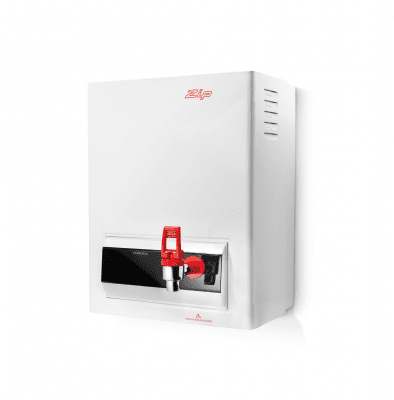
A lot of commercial hot water urns can be kept going for years with sensible maintenance. The trouble starts when someone treats spare parts like they’re all interchangeable. They aren’t. Genuine Zip components are built around the unit’s electrical load, temperature control logic, fittings, and safety cut-outs. Once you step away from that, you’re guessing.
Safety comes first
Typical commercial urns operate at 220 to 240V and 2800W with a 10 Amp plug, and the thermostat plays a critical role in preventing dry-boiling. That’s why RCM-marked parts matter for safety and warranty, as outlined in this commercial urn specification reference. If the replacement part doesn’t match the unit’s design, the problem isn’t just poor performance. It can be overheating, nuisance tripping, or a dangerous fault condition.
Cheap aftermarket parts commonly fail in practice. On the bench, they can look close enough. In service, they can drift in temperature, seat badly against the tank, or use lower-grade terminals and seals.
Compatibility saves time twice
The first saving is obvious. You avoid ordering the wrong part.
The second saving is what tradespeople notice immediately. Genuine parts reduce call-backs. The screw holes line up. The sensing bulb sits where it should. The tap body clears the casing properly. The wiring terminals fit without modification. You don’t spend half an hour trying to make a “universal” part behave in a unit it wasn’t designed for.
Common Hydroboil failure points usually fall into a few categories:
- Heating element faults that leave the unit slow, cold, or tripping.
- Thermostat drift where the unit heats inconsistently or cuts out at the wrong point.
- Tap wear that shows up as dripping, loose handles, or poor shut-off.
- Internal valves and seals that harden, leak, or restrict flow.
- Filtration-related strain where scale and debris shorten component life.
Practical rule: If a part affects heating, electrical switching, or water containment, don’t gamble on pattern parts.
Compliance is now part of the parts decision
This is the point many sites still miss. Effective October 2024, new MEPS under AS/NZS 5125.1:2024 apply to commercial electric storage water heaters. Audits in 2025 showed only 40% of imported commercial urns were compliant, with non-compliance fines reaching up to $500,000 for businesses, according to the MEPS compliance reference here.
That changes the conversation. Parts choice isn’t only about “will it fit”. It’s also about whether the repaired unit remains aligned with the compliance expectations around that equipment class. Genuine, compliant parts from brands such as Zip reduce the risk of drifting into a grey area after a repair.
What works and what doesn’t
What works:
- Matching by model and serial data, not by appearance
- Replacing related seals and consumables at the same time
- Using genuine electrical components for thermostats, elements, and cut-outs
- Checking filtration and water quality factors before blaming a new part
What doesn’t:
- Buying the cheapest listing online
- Assuming all Hydroboil taps are the same
- Reusing old washers on a new assembly
- Forcing non-matching connectors to fit
A Zip Hydroboil is straightforward to service when the parts are right. It becomes expensive when they’re almost right.
Your Guide to Identifying the Correct Spare Part
Before you order anything, confirm exactly what you’re working on. That means the model series, the serial number, and the failed component. Most wrong-part orders happen because one of those three was guessed.
Start with the compliance plate
On many Zip Hydroboil units, the identifying details are on a compliance label fixed to the casing. Depending on the model, it may be on the side panel, rear panel, or inside an access area. Clean the plate and photograph it clearly before you do anything else.
Look for:
- Model series such as the Hydroboil family designation
- Serial number for age and revision matching
- Electrical rating so you can confirm you’re dealing with the correct load class
- Compliance markings that support proper replacement choices
That electrical rating matters because these units aren’t low-risk appliances. As noted earlier, typical commercial urns run at 220 to 240V and 2800W with a 10 Amp plug, and the thermostat is a core safety device.
Identify the failed part by symptom
You don’t need to strip the whole unit immediately. Start with the fault pattern.
If the unit leaks from the dispensing point, focus on the tap assembly, spindle, seals, or seat. If it powers on but doesn’t heat correctly, inspect the thermostat, cut-out, or element circuit. If it fills incorrectly or behaves erratically on plumbed systems, the issue may sit with a solenoid valve, inlet control, or filter restriction.
A quick field guide:
| Symptom | Most likely area |
|---|---|
| Dripping from outlet | Tap seals, spindle, full tap assembly |
| No heating | Element, thermostat, high-limit cut-out |
| Intermittent overheating | Thermostat drift, sensor seating, wiring |
| Slow dispense or poor flow | Filter blockage, valve issue, scale |
| Unit dead after service | Wiring error, tripped safety, power supply issue |
Don’t order off a symptom alone if the unit has more than one issue. A leaking tap and a failing thermostat often show up together on older service calls.
The common parts to recognise
A Hydroboil usually contains a small group of parts that get replaced far more often than the rest.
Heating element
This converts electrical energy into heat. When it fails, the unit may stay cold, heat slowly, or trip protection.Operating thermostat
This controls temperature cycling. If it drifts, the unit may underheat or over-cycle.Safety cut-out or thermal protection
This is there to stop unsafe overheating conditions. If it has activated, find out why before resetting or replacing.Tap assembly
This is the most visible wear item. It handles repeated opening and closing and often shows the first obvious leak.Solenoid valve
Common in systems with controlled fill. A faulty one can mimic several other issues.Filter cartridge or filter head components
Poor filtration contributes to scale, valve wear, and reduced flow.
For trade customers and repeat buyers, the simplest path is to compare your unit details against a dedicated parts listing such as this Zip spare parts Australia guide, then confirm by photo if the unit has had prior modifications.
Zip Hydroboil spare part compatibility chart
The exact genuine part number depends on the Hydroboil model and revision. Because manufacturers update assemblies over time, the safest method is to verify against the compliance plate and, where possible, the existing part itself.
| Zip Hydroboil Model Series | Common Part | Genuine Part Number | Notes |
|---|---|---|---|
| Hydroboil wall-mounted series | Tap assembly | Verify by model and serial | Tap styles vary by generation and mounting arrangement |
| Hydroboil wall-mounted series | Thermostat | Verify by model and serial | Match temperature control type and terminal layout exactly |
| Hydroboil wall-mounted series | Heating element | Verify by model and serial | Confirm voltage and wattage compatibility before ordering |
| Hydroboil plumbed series | Solenoid valve | Verify by model and serial | Inlet valve design may differ between revisions |
| Hydroboil filtered series | Filter cartridge | Verify by filter head and unit type | Don’t assume cartridge interchangeability across systems |
| Older Hydroboil units | Seal and service kits | Verify by part image and serial | Earlier units may have superseded parts |
Insider checks that prevent the wrong order
Use these before you click buy:
- Compare the mounting points. A thermostat that looks right but mounts differently isn’t right.
- Check terminal orientation. This matters more than many DIY buyers realise.
- Inspect old repairs. If someone has already fitted a non-genuine part, don’t use that as your reference.
- Photograph the failed part beside the unit label. It makes supplier verification much easier.
- Confirm whether the unit is vented, plumbed, or filtered. That affects more than one component family.
If there’s any doubt, stop at identification. That’s the point where a quick verification saves a second order, extra downtime, and a unit still sitting dead on the bench.
How to Source Genuine Zip Parts Anywhere in Australia
Once you know the exact part, the next question is where to get it without wasting days or ending up with a knock-off. Most buyers choose between an online parts supplier and a local service agent. Each option has strengths. Each also has traps.
Online supplier versus local agent
A national online supplier is useful when you already know the correct part and want it shipped quickly. That suits plumbers working interstate, maintenance teams managing several sites, and business owners who’ve already confirmed the model and component.
A local service agent makes more sense when the diagnosis is still uncertain, the unit has multiple faults, or the replacement involves live electrical components, internal disassembly, or water connections that need testing under load.
Here’s the trade-off:
| Option | Works well for | Watch out for |
|---|---|---|
| Online parts supplier | Known part numbers, repeat orders, remote sites | Generic listings, poor photos, unclear compatibility |
| Local service agent | Fault-finding, installation, urgent in-person repair | Limited stock on hand for less common parts |
| Hybrid supplier and service business | Buyers who want parts plus technical support | You still need accurate model details |
A hybrid model is often the most practical. A business such as Ring Hot Water can supply genuine parts online across Australia while also handling in-person service work around Melbourne.
How to spot a suspect listing
Counterfeit or low-grade substitute parts usually reveal themselves in the listing before they reveal themselves in the unit.
Check for:
- No model-specific fitment information
- Stock images only, with no close-up detail
- Vague language such as “fits many models”
- No mention of genuine branding or compliance
- No ability to verify by serial number or photo
If the seller can’t tell you what the part fits, they’re asking you to take the risk.
A proper supplier wants the model details. A poor supplier wants the sale.
A practical buying method that reduces mistakes
Use a short checklist before ordering:
- Start with the unit label and photo record.
- Match the failed part physically where possible.
- Ask whether the part is genuine rather than “equivalent”.
- Confirm return conditions before purchase, especially for electrical items.
- Buy related consumables together, such as seals, washers, or a filter if the unit is already open.
For Melbourne sites in Footscray, Yarraville, Sunshine and surrounding suburbs, local collection or service booking can save a lot of downtime. For buyers elsewhere, shipping a genuine part is still straightforward if the identification work has been done properly first.
Replacing Your Zip Hydroboil Part Safely
Some Hydroboil repairs are manageable if you’re replacing an external or clearly isolated part. Others should stop the moment you reach live wiring, internal tank seals, or anything you’re not fully sure about. The line matters.
Safety before tools
AU-compliant urns have mandatory safety features such as thermal fuses and auto-shutoffs to meet AS 60335 standards, and double-wall insulation can retain heat above 90°C for hours, as explained in this commercial urn safety guide. That’s why the first step is always to fully de-energise and fully cool the unit before touching it.
Use this checklist:
- Isolate power at the plug or dedicated supply point
- Shut off water supply if the unit is plumbed
- Drain or dispense off hot water carefully if needed
- Wait until the casing and outlet are cool
- Use insulated hand tools where appropriate
- Wear gloves because residual heat and sharp edges are common
If the job involves opening the electrical compartment and you’re not licensed or experienced, that’s usually the stop point.
Replacing a tap assembly
A worn tap is one of the more common service jobs because it’s visible, messy, and annoying for staff. It’s also one of the repairs that can be manageable when the tap is external and the replacement is a true like-for-like genuine assembly.
Confirm the fault
Make sure the leak is from the tap itself, not from a higher fitting tracking down the body.Isolate and cool the unit
Don’t rush this. A tap on a recently heated urn can still carry dangerous stored heat.Remove any external trim or retaining hardware
Keep the parts laid out in order on a clean towel or tray.Support the fitting while loosening
Don’t twist against a thin panel without support. That’s how casings get bent.Check the sealing faces
Old scale, hardened washers, or damaged threads will ruin a new install.Fit the new genuine tap assembly
Seat it squarely. Tighten firmly, not aggressively.Restore water, then check for seepage before heating
Power the unit and test the tap under normal use
If you need a reference on the filtration side before reopening the unit, this Zip filter replacement guide helps clarify when poor flow is actually a filter issue rather than a failed tap.
Replacing an external filter cartridge
This is usually simpler than a tap replacement, but it still goes wrong when people skip depressurising or fit the wrong cartridge to the wrong head.
A sound method is:
- Turn off the inlet water
- Dispense water to relieve pressure
- Release the old cartridge as directed by the head design
- Check the O-ring area for debris or damage
- Install the correct genuine cartridge
- Reopen supply slowly
- Flush according to the cartridge instructions
- Check flow and taste before returning to service
After that, it’s worth watching a practical visual walkthrough before touching anything internal:
When the job has gone beyond DIY
Stop and call a technician if you find any of the following:
- Burnt wiring or overheated terminals
- Water near live electrical sections
- Internal tank leakage
- Repeated safety cut-out trips
- A replacement part that doesn’t fit exactly
- Evidence of previous non-standard repairs
Hydroboil units are serviceable. They are not forgiving when repaired casually.
Troubleshooting Common Post-Replacement Problems
A fresh part doesn’t guarantee a finished repair. Sometimes the original fault was only part of the story. Other times the new part is right, but something nearby wasn’t seated, connected, or reset correctly.
Start with the simplest checks
If the unit won’t behave after replacement, work in order. Don’t strip it again immediately.
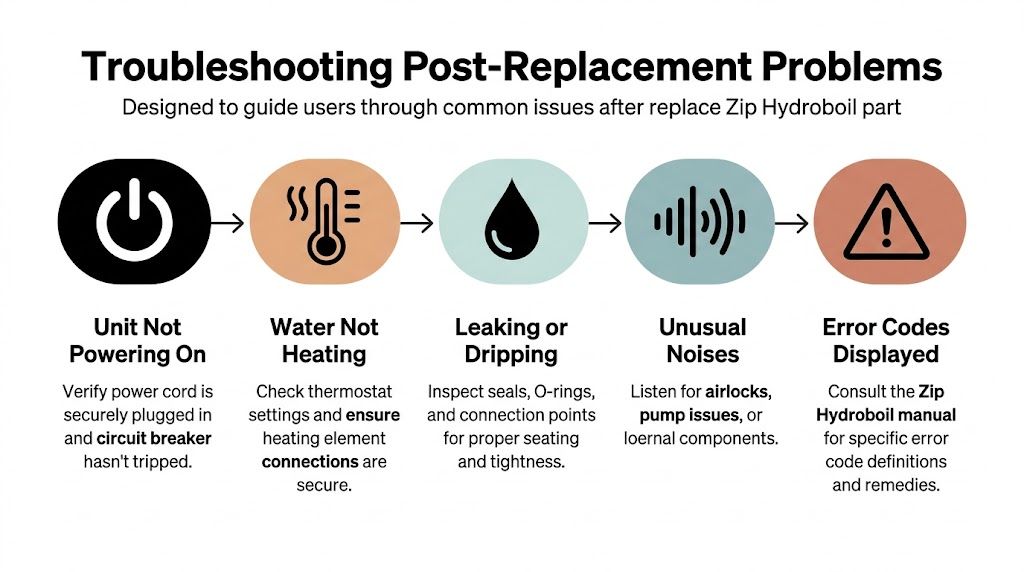
A sensible sequence is:
Unit not powering on
Verify the power cord is connected properly and check whether the breaker or protection device has tripped.Water not heating
Recheck the thermostat setting and confirm the element connections are secure and correctly seated.Leaking or dripping
Inspect seals, O-rings, threads, and seating surfaces. A new part can still leak if the old sealing face is damaged.Unusual noises
Listen for trapped air, loose components, or fill-related problems.Error indication or abnormal operation
Consult the unit manual for the model-specific meaning before replacing another part.
Match the symptom to the likely cause
| Post-replacement issue | Likely cause | First action |
|---|---|---|
| No power | Loose connection, tripped protection, unset safety | Recheck supply and safety reset points |
| Heats poorly | Incorrect thermostat fit, weak element connection | Inspect wiring and part match |
| Tap still drips | Old washer reused, poor seating, overtightened body | Remove and reseat correctly |
| Flow is weak | Filter restriction or trapped air | Check filtration and flush |
| Repeated cut-out | Underlying overheating issue | Stop and investigate before further use |
Most “new part failed” complaints turn out to be one of three things. Wrong part, missed secondary fault, or incorrect installation.
Don’t keep replacing parts blindly
That’s the expensive mistake. If the unit still has the same fault after a correct replacement, the next move is diagnosis, not another order. A thermostat fault can be caused by a bad element. A leaking tap can be caused by pressure issues or casing distortion. A dead unit can be a safety device that has tripped for a reason.
The goal is to fix the cause, not build a collection of unused spares.
Know When to Call a Professional Service Technician
Some jobs should stay in the hands of a qualified technician from the beginning. Others start as a simple parts swap and then reveal a second fault once the casing comes off. Knowing the difference saves time, protects staff, and usually costs less than pushing through a repair that isn’t under control.
Red flags that mean stop
Call a professional if you see any of these:
- Internal water leaks near electrical components
- Scorched wiring, melted connectors, or burnt smells
- Repeated tripping after a correct part replacement
- Control issues that don’t point clearly to one component
- Tank corrosion or signs of casing heat damage
- Any repair history involving mixed or non-genuine parts
If the unit is in a commercial kitchen, downtime pressure often pushes people to take shortcuts. That’s exactly when bigger failures happen.
Why repeat failures happen
Equipment that fails again after a recent repair usually has an unresolved root cause. Water quality, heat stress, poor ventilation, incorrect parts, and installation shortcuts all stack up over time. While it focuses on HVAC rather than boiling water units, this piece on common reasons for repeated equipment failures captures the same maintenance logic. If the underlying cause stays in place, the replacement part just becomes the next casualty.
What a technician adds
A proper service visit isn’t only about fitting a part. It’s about confirming the diagnosis, checking adjacent components, pressure testing where needed, and making sure the unit returns to service safely.
For units in Melbourne that need in-person diagnosis or repair, a dedicated Zip Hydroboil service booking is the practical option when the job has moved past a straightforward external replacement.
A technician is also the right call when the site can’t tolerate another failed attempt. In hospitality, offices, aged care, and staff kitchens, certainty matters more than a cheap guess.
Frequently Asked Questions About Zip Hydroboil Repairs
Can I use a non-genuine part if it looks the same
That’s the shortcut that causes a lot of second repairs. Visual similarity isn’t enough. The mounting pattern, temperature behaviour, material quality, connector fit, and compliance status all matter. If the part controls heat, water flow, or electrical protection, use a genuine compatible component.
How do I decide whether to repair or replace
Use a practical test, not an emotional one.
If the unit is otherwise sound, the fault is isolated, and the right genuine part is readily available, repair usually makes sense. If the unit has multiple faults, visible wear across several components, or a history of recurring breakdowns, replacement may be the cleaner option.
Energy use should be part of that decision. A 2023 Sustainability Victoria study found that modern commercial hot water urns can reduce energy consumption by 25 to 35% compared with older models or batch boiling, and for a mid-sized café that can mean about $450 in annual savings, according to this Sustainability Victoria summary. If you’re deciding between a major repair and a newer unit, that ongoing operating cost matters.
What maintenance prevents most Hydroboil issues
The biggest wins are boring, which is why they work.
- Replace filters on schedule so flow and scale control stay where they should
- Inspect taps early when drips begin instead of waiting for complete failure
- Look for scale and mineral build-up around outlets and fittings
- Check for slower heat-up times because that often shows up before a full element failure
- Keep records of part replacements so repeat faults are easier to trace
Is a leaking tap always just a tap problem
No. Sometimes it is. Sometimes it isn’t.
A leak at the outlet can come from worn seals in the tap assembly, but it can also be caused by pressure fluctuations, poor seating, old mineral deposits, or a crack or distortion around the fitting point. That’s why experienced technicians inspect the surrounding area before blaming the visible part.
Can I replace a thermostat myself
Only if you know exactly what you’re doing and the work is permitted in your situation. Thermostats are part of the unit’s heat control and safety function. Miswiring one or fitting the wrong type can create serious problems. If there’s any doubt, leave thermostat work to a qualified person.
What’s the most common ordering mistake
Ordering by appearance instead of by model and serial. Hydroboil parts can look very similar across generations while still being wrong in ways that matter. Always start with the compliance plate, then match the part.
If your commercial hot water urn is leaking, underheating, tripping, or you’re not fully confident you’ve identified the right Zip Hydroboil spare, Ring Hot Water can help with genuine parts supply, practical guidance, and Melbourne-based service support where the job needs a technician.

