
Uncategorized
Instant Boiling Water Tap Australia: 2026 Buyer’s Guide
Jun
You're probably here because the kettle routine has started to annoy you. It sits on the bench, takes up space, adds another appliance cord to the kitchen, and still makes you wait when all you want is a fast coffee, tea, or saucepan of boiling water. In offices and staff kitchens, it's worse. People queue, refill it badly, and wear it out.
That's why interest in the instant boiling water tap Australia market keeps growing. The appeal is obvious. You get near-boiling water from the tap, the bench looks cleaner, and the kitchen works better. But the buying decision shouldn't stop at convenience. In Australian conditions, the key difference between a good purchase and a frustrating one comes down to installation quality, filter management, hard water, and whether you can get parts when something eventually fails.
The End of the Kettle Why Australia is Switching
The kettle used to be the default. Now it feels like a workaround.
Modern kitchens are expected to do more with less clutter, and people want fixtures that solve daily friction without adding another appliance to the bench. A boiling water tap does exactly that. You turn a lever or press a control, and the water is already there for tea, coffee, noodles, blanching vegetables, or warming a pot before cooking.
This isn't just a design trend. Australia's instant boiling water tap market was valued at US$8.54 million in 2025 and is forecast to reach US$16.7 million by 2034, a projected CAGR of about 7.7% according to this Australian market overview. That tells you two things. First, more homes and workplaces are adopting these systems. Second, buyers now have a broader field of products, fittings, service providers, and replacement parts than they did when these taps were treated as a niche luxury.
Why the switch makes sense
For most households, the move starts with small frustrations:
- Bench crowding: The kettle, toaster, coffee gear, and charging devices all compete for the same space.
- Morning bottlenecks: One kettle cycle rarely lines up with how families move through breakfast.
- Office wear and tear: Shared kitchens punish consumer-grade appliances quickly.
- Kitchen upgrades: Renovators often want one tap area to handle more tasks neatly.
Some buyers also compare these systems against other quick-dispense options before committing. If you want a broader product context before choosing a fixed installation, it's worth taking a look at how others compare hot water dispensers across different use cases.
Convenience sells the first conversation. Long-term reliability decides whether the tap was actually worth buying.
That's the part many glossy product pages skip. A boiling water tap can be a smart upgrade. It can also become an expensive nuisance if the tank size is wrong, the filter is neglected, or the installer treats it like a standard mixer tap.
How an Instant Boiling Water System Actually Works
A lot of people call it a tap. Technically, it's a small hot water system dedicated to drinking water.
The visible part on the benchtop is only one piece. Under the sink, you've got the hardware that performs the core function. That matters because when buyers underestimate what sits below the bench, they also underestimate space, ventilation, servicing, and replacement costs.
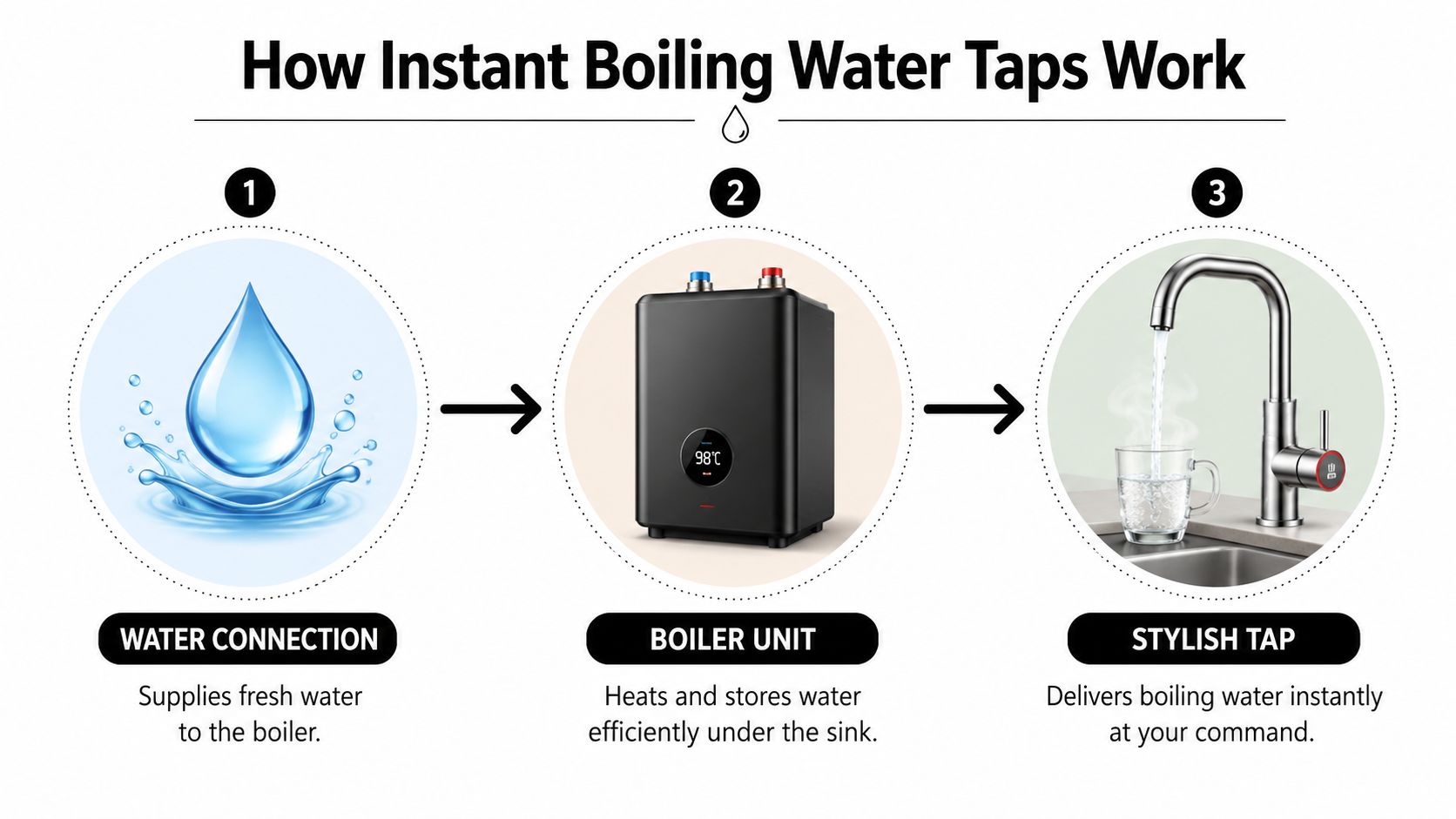
The three core parts
The tap itself
This is the user-facing control on the sink or benchtop. Depending on the model, it may dispense only boiling water, or combine boiling with ambient, chilled, or standard mixer functions.The under-bench boiler
This is the heart of the system. Australian instant boiling water systems are engineered to hold water in an insulated reservoir at a near-boiling temperature, typically 98°C to 100°C, using thermostat control, as noted in this Australian guide to boiling water taps. That's what removes the wait time you get with a kettle.The filter assembly
In Australian conditions, filtration isn't just about taste. It helps reduce chlorine and sediment reaching the boiler. That can improve water quality at the outlet and reduce fouling inside the unit over time.
What happens when you use it
A simple way to think about it is this:
- mains water enters the system
- it passes through a filter
- the under-bench unit heats and stores it
- the tap dispenses it on demand
That stored-water design is why product selection matters. Some compact systems use a sealed stainless steel reservoir of about 2.5 litres, while other under-sink units are specified around 4 litres, depending on the model and outlet configuration, as described by Water People's boiling water tap overview. Smaller tanks save cupboard space and can suit light domestic use. Larger ones cope better with repeated draws, but they need more room and can carry more standby heat loss if the site doesn't justify the capacity.
Why this matters in practice
If the household uses a few cups spread through the day, a compact system often makes more sense. If you've got back-to-back use in a workplace, showroom, staff lunchroom, or hospitality prep area, capacity and recovery become far more important.
Practical rule: Buy for your usage pattern, not the brochure. Oversizing wastes cupboard space and can increase idle energy use. Undersizing creates recovery delays and frustrated users.
The most common misunderstanding is thinking the tap alone determines performance. It doesn't. Performance comes from the match between tank size, thermostat control, insulation, filtration, and actual demand.
The Real Pros and Cons for Australian Households
Boiling water taps are easy to like when you've only seen the showroom pitch. Living with one is where the trade-offs become clear.
The good systems are convenient and tidy. The wrong systems, or badly installed ones, create hassle that buyers didn't budget for. Australian households should look at both sides before they decide.
What works well
There's a reason these products keep turning up in renovated kitchens.
- Immediate access: Tea, coffee, cooking prep, and quick cleanup all get easier.
- Cleaner bench layout: The kettle disappears, and the kitchen looks less crowded.
- Better workflow: You stop waiting around for small jobs that happen every day.
- Integrated design: The tap becomes part of the kitchen, not another appliance sitting beside it.
For households that make hot drinks frequently, the convenience is real. It's also useful for older homeowners who want to avoid lifting a full kettle, and for workplaces where repeat boiling quickly becomes annoying.
What buyers often underestimate
The first issue is cost. The purchase isn't just the tap body. It usually includes under-bench hardware, filtration, installation labour, and future maintenance.
The second issue is standby heating. These systems keep water hot so it's available immediately. That convenience comes from stored heat, which means insulation quality and sizing matter.
The third issue is maintenance discipline. If you ignore filters and scale, performance drops and internal parts wear faster.
Safety needs a hard look
This is the area I'd never gloss over for families.
A 2025 ACCC report found a 22% increase in scalding incidents from boiling taps in Victoria over three years, with 70% occurring in homes with children under 10, according to the Product Safety Australia 2025 report. That doesn't mean boiling taps are unsafe by default. It means you have to treat safety features and installation layout as essential.
If children use the kitchen, pay attention to:
- Child-safety controls: Don't buy a model with vague or awkward activation.
- Tap position: Avoid placing the outlet where a child can easily reach or lean under it.
- User behaviour: Some systems are safe in theory but poor in busy family kitchens because adults bypass the safety sequence carelessly.
- Model choice: In some homes, a different boiling water setup can be a better fit than a compact under-sink tap.
If you've got young kids, don't choose based on finish colour first. Choose based on the safety mechanism and where the outlet will sit in the kitchen.
For many Australian households, the answer is still yes. A boiling water tap can be a worthwhile upgrade. But it only works as a sensible purchase when the family profile, kitchen layout, and maintenance reality all line up.
Matching the Tap to Your Needs Home Office and RV
The right system for a family kitchen isn't automatically right for a lunchroom, café prep area, site office, or caravan, leading buyers to overspend, underspecify, or choose a product category that was never built for their usage pattern.
Start with the setting, not the finish.
Home kitchens
For most homes, the decision comes down to how often the tap will be used and whether you also want chilled or filtered ambient water from the same point. A compact under-bench unit suits light to moderate use when cupboard space is limited and the household mainly wants convenience.
A larger all-in-one setup can make sense in a renovated kitchen where the tap is replacing several separate habits at once. That said, more features also mean more components under the bench. More components usually mean more future servicing.
Offices and staff kitchens
Office use is different because demand comes in bursts. Morning tea, lunch, and afternoon breaks all produce concentrated draw-offs. The wrong domestic-grade unit may cope on paper but feel slow in real use.
In offices, I usually look for durability, sensible recovery, easy filter access, and a system that won't become awkward when several people use it daily. In some settings, a wall-mounted boiler is the better answer than a designer under-sink tap because it's easier to service and less exposed to cupboard congestion.
Hospitality and higher-demand sites
Hospitality needs equipment that keeps up. If staff are using hot water repeatedly through service, don't try to force a light domestic product into a commercial role. Heavy use magnifies every weakness, from poor recovery to marginal fittings.
For cafés, canteens, meeting venues, and back-of-house areas, dedicated commercial boiling units or urn-style solutions are often the practical choice. They may not be as sleek, but they're easier to match to repeated demand and easier to service quickly.
RV and caravan setups
RV owners have a different problem. Space is tight, power constraints matter, and vibration changes what fittings and connections hold up over time. A fixed residential tap system isn't automatically suitable.
If you're fitting out a van or motorhome, look at dedicated compact products and read use-case guidance rather than copying a house installation. For broader caravan maintenance support, some owners also rely on your source for RV repair needs when they're sorting out space, fitment, and service issues around mobile systems. If you want a more specific look at mobile hot water options, this guide to an RV hot water heater setup is the better starting point.
Instant Boiling Water System Comparison
| System Type | Best For | Key Feature | Typical Brands |
|---|---|---|---|
| Compact under-sink boiling tap | Homes, apartments | Space-saving filtered boiling water | Zip, Insinkerator |
| Boiling and ambient or chilled combo tap | Renovated family kitchens, premium fit-outs | Multiple water types from one point | Zip, Stiebel Eltron |
| Wall-mounted boiling unit | Offices, staff kitchens, utility areas | Service-friendly installation and higher practical output | Boiling Billy, Birko, Kwikboil |
| Commercial boiler or urn | Hospitality, catering, event spaces | Built for repeated hot water demand | Crown, Birko |
| Compact RV or caravan hot water setup | Caravans, motorhomes, mobile use | Small footprint and mobile fitment suitability | Various RV-specific systems |
The right choice is usually the one that looks slightly boring on paper and performs properly every day.
Australian Installation Rules and Costs
An instant boiling water tap is not a DIY weekend job. It joins plumbing, electrical requirements, filtration, heat, and safety in one installation. If any part of that is handled casually, the problems show up later as leaks, nuisance faults, poor performance, or unsafe use.
In Australia, buyers should expect a proper installation process rather than a simple swap-over like a standard sink mixer.
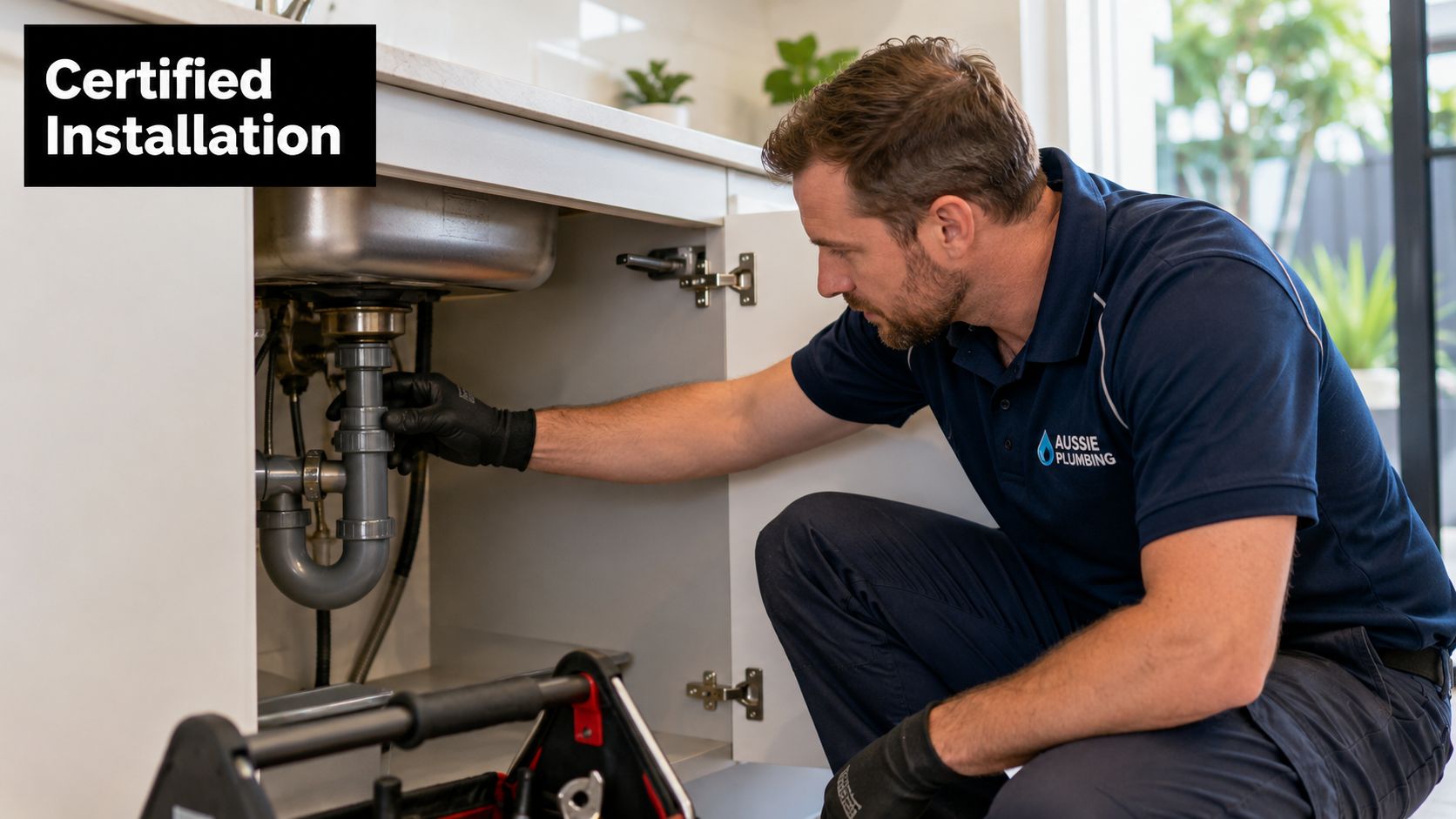
What the installer needs to check
A competent installer will usually start with the cupboard, not the tap.
- Available under-bench space: The boiler, filter, hoses, and ventilation all need room.
- Water supply layout: The unit must connect cleanly to the cold-water feed.
- Power access: Many systems need a suitable nearby power point.
- Serviceability: Filters and parts should be reachable without dismantling half the cabinet.
- Pressure management: Some installations also need pressure control addressed. If you're not sure where that fits in, this overview of a pressure limiting valve is useful background.
What installation usually costs
Independent Australian plumbing guidance puts the typical installation cost at AU$250 to AU$500, covering the labour needed to connect the system to water and power, as outlined in this Australian installation cost comparison. That figure matters because many buyers budget only for the tap and forget the fitting cost entirely.
That range is a baseline, not a promise for every site. If the cupboard is crowded, power access is poor, old plumbing needs correction, or extra valves are needed, the total job can become more involved. The point is simple. Installation is a real cost line, not a minor add-on.
What good installation looks like
Good installation is quiet, neat, and boring. That's what you want.
A properly fitted boiling water system shouldn't leave you guessing which hose does what, whether the filter can be changed easily, or why the cupboard suddenly feels unusable.
The best installations also account for the life of the system, not just the day it goes in. That means leaving access for future filter changes, checking hose routing, avoiding strain on fittings, and placing components so a technician can service them later without fighting the cabinet.
If an installer treats the job like they're fitting a standard kitchen mixer, that's a warning sign.
Maintenance and Spare Parts A Look Under the Sink
This is the part many buyers don't hear enough about. Boiling water taps are sold like lifestyle upgrades, but they behave more like compact appliances with plumbing attached. If you want them to last, you need to think beyond the day of purchase.
The two biggest ownership issues are water quality and parts access.
Hard water changes the ownership equation
In Melbourne, this matters more than many product pages admit. Hard water and mineral content can be rough on heating systems. The tap may still look perfect on the bench while scale builds where you can't see it, inside the tank, around heating elements, and through connected parts.
Suburbs with tougher water conditions often expose weak maintenance habits quickly. If the filter is neglected, or if scale is allowed to build, the system can lose efficiency and components can wear out earlier than expected. Thermostats, elements, seals, and flexible connections are not abstract future problems. They're the parts that decide whether the unit keeps working or sits idle waiting for repair.
The maintenance jobs that actually matter
Forget cosmetic cleaning for a moment. The serious maintenance work is straightforward:
- Filter replacement: The filter protects water taste and helps reduce what enters the system.
- Descaling attention: In harder water areas, scale management is part of ownership.
- Visual checks under the sink: Hoses, fittings, and signs of moisture should be looked at periodically.
- Servicing before failure: It's cheaper and less disruptive to replace wear parts before they fail at the worst time.
For households and workplaces using Zip systems, product-specific maintenance planning matters too. If you're trying to stay on top of regular consumables, this guide to Zip filter replacement is a practical place to start.
Spare parts availability is not a minor detail
A smart-looking tap becomes useless fast if the replacement thermostat or element can't be sourced quickly. That's not a theoretical issue. A 2026 Victorian Plumbing Industry Association study found that 55% of tradespeople report 2–3-week delays for common replacement parts such as thermostats and elements for major brands, according to the VPIPA spares availability report.
That delay matters differently depending on the site:
- At home: it's an inconvenience
- In an office: staff revert to kettles and bench clutter returns
- In hospitality: service flow can be disrupted
- For facility managers: a small component failure becomes a procurement issue
If you're choosing between similar systems, ask where the parts come from and how quickly your plumber can get them. That answer often matters more than a cosmetic feature list.
This is one reason buyers and tradespeople look for suppliers that carry genuine components locally. Access to thermostats, elements, flexible hoses, valves, and filter parts can make a routine repair stay routine. In Melbourne, some customers use Ring Hot Water for that reason, particularly when they need brand-specific boiling water components without chasing multiple suppliers.
The total cost of ownership isn't just purchase price plus installation. It's purchase price, installation, filters, servicing, wear parts, downtime risk, and how painful the repair chain becomes when something finally gives up.
Where to Get Expert Advice and Service in Melbourne
Buying the unit is only the start. The actual test comes later, when you need the tap installed neatly, the filter changed on time, or a failed part identified without guesswork.
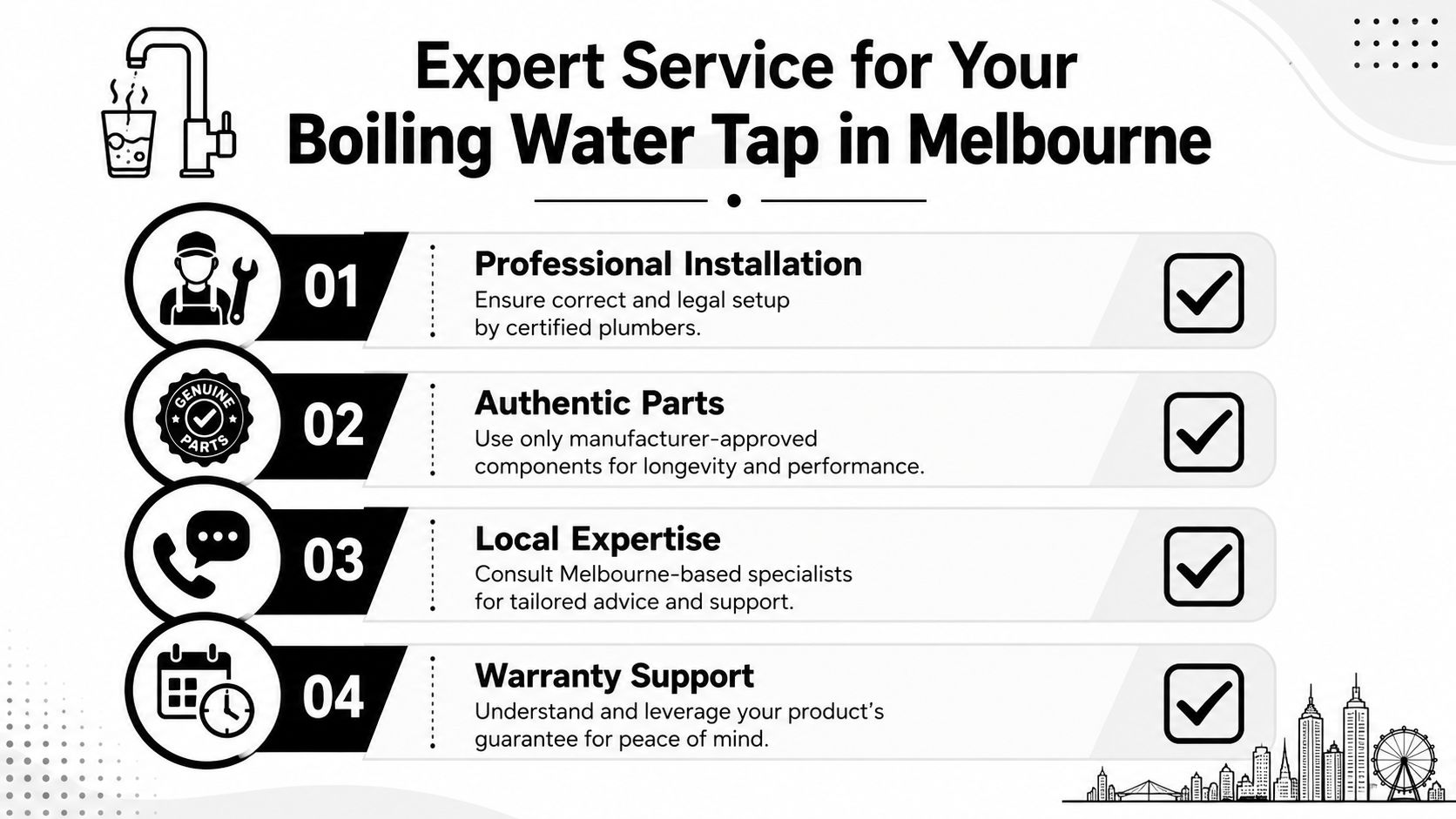
In Melbourne, specialist support matters because boiling water systems sit at the intersection of plumbing, appliance servicing, filtration, and local water conditions. General advice can help you shortlist products. It won't always help when a unit in Sunshine, Footscray, Yarraville, or a city office kitchen starts showing signs of scale, inconsistent heating, or part fatigue.
What to look for in a service provider
The right provider should be able to handle more than sales.
- Installation knowledge: They should understand under-bench layout, pressure, filtration, and safe commissioning.
- Brand familiarity: Different systems fail in different ways, and generic troubleshooting wastes time.
- Parts access: A service booking is far more useful when the technician can source the needed component.
- Melbourne water awareness: Local conditions affect scale, filter choice, and service intervals.
When specialist help pays off
A lot of buyers only think about support after the first fault. That's backwards.
If you're comparing options for an instant boiling water tap Australia purchase, ask practical questions before you buy. Who installs it. Who services it. Who supplies genuine filters. Who can source thermostats, elements, hoses, and valves without weeks of delay. Those answers shape the ownership experience more than showroom styling ever will.
The best time to choose your service path is before the tap goes in, not after hot water stops.
For Melbourne households, offices, hospitality venues, and trades, the strongest setup is usually a local specialist for installation and repairs, paired with reliable access to genuine parts and consumables for ongoing maintenance.
If you want practical advice before you buy, or need help with installation, servicing, filters, or genuine replacement parts, Ring Hot Water supports Melbourne customers locally and ships authentic components Australia-wide.

