
Boiling Hot Water Tap
Boiling Water Tap Australia
Jun
Boiling Water Tap Australia: Your Ultimate 2026 Buying Guide
You're probably here because the kettle has started to annoy you.
It's slow when everyone wants a drink at once. It eats up bench space in a kitchen you've just renovated. In an office, it turns into a queue machine at morning tea. And if you're filling pots, sterilising a baby bottle, or trying to keep a staff kitchen tidy, a kettle suddenly feels like an old workaround instead of a proper solution.
That's where a boiling water tap starts to make sense. In Australian homes and workplaces, it's less about luxury than it is about convenience, control, and getting one more cluttered appliance off the benchtop. The right system gives you boiling water on demand from a dedicated tap, usually from a compact tank under the sink, with filtration and safety features built into the setup.
The catch is that not every system suits every kitchen, and not every installation is worth doing. Some buyers focus only on the tap finish and miss the parts that matter more. Tank access, filter servicing, power supply, cabinet space, local water quality, and who's going to maintain it in two years all make a real difference.
If you're comparing options for a home renovation, office fitout, or replacement job in Melbourne, this is what you need to know.
The End of the Kettle as We Know It
A lot of people start looking at a boiling water tap after the same moment. The kitchen's been updated, the stone's in, the new sink's in place, and then the kettle goes back on the bench and ruins the whole line of it. Or the office gets a tidy new kitchenette, but staff still wait around for a jug kettle that's forever being overfilled, reboiled, or left in the wrong spot.
That's usually the point where the kettle stops looking harmless and starts looking inefficient.
In a family kitchen, the pain points show up first thing in the morning. Someone wants tea, someone else needs hot water for porridge, another person is filling a saucepan. In a workplace, it's the same pattern with more mugs and less patience. A boiling water tap changes that routine because the hot water is already there, ready when you turn on the dedicated control.
Why the shift feels bigger than a small appliance swap
This isn't just replacing one way of heating water with another. It changes how the kitchen works day to day.
- Benchtops stay clearer because the kettle disappears.
- Small jobs get done faster like topping up a pot, loosening baked-on residue in cookware, or making back-to-back drinks.
- The kitchen feels more organised because one fixed point handles what used to need a loose appliance, a power lead, and bench room.
In Melbourne renovations, I often see boiling taps considered late in the process, almost as an add-on. That's backwards. They're easier to plan well when you treat them like part of the plumbing and appliance layout from the start.
A boiling water tap makes the most sense when it solves a daily irritation, not when it's chosen only because it looks good in the brochure.
That practical angle matters in the Australian market. Local buyers aren't just choosing a tap finish. They're weighing safety, servicing, running costs, and whether the unit will suit a real household or staff kitchen. Done properly, a boiling water tap doesn't feel like a gadget. It feels like the kitchen finally works the way it should have all along.
How a Boiling Water Tap Actually Works
The simplest way to think about a boiling water tap is this. It's a small under-sink hot water system built for one job only. Instead of heating a full kettle on the bench every time you need it, the unit keeps a small volume of water at near-boiling temperature in an insulated tank, ready to dispense through a specialised tap.
That under-sink setup is what makes the whole thing work cleanly. The tap above the bench looks compact, but the actual hardware sits inside the cabinet.
The main parts under the sink
Most Australian systems follow the same basic layout.
- Cold mains feed brings water into the unit from your household supply.
- Filter cartridge treats the water before it reaches the tank.
- Insulated heating tank stores and reheats the water.
- Safety tap assembly controls how boiling water is dispensed.
According to SodaTap's guide to taps with boiling water, boiling water taps in the Australian market use under-sink heating tanks that maintain water temperatures between 98°C and 100°C, controlled by precision thermostats. The system draws water from the supply line, heats it in a compact tank such as 2.5L, and delivers it through a pressurised safety tap at a flow rate of 2.5 to 3L/hr.
What happens when you use it
Once installed, the process is straightforward.
- Water enters from the mains and passes through the filter.
- The tank holds heated water at near-boiling temperature.
- The thermostat monitors the heat so the unit stays within its operating range.
- You activate the tap's safety control and the system dispenses boiling water on demand.
The thermos comparison is useful here. A good unit isn't endlessly reheating a big cylinder like an old storage service. It's keeping a small amount of water hot inside an insulated chamber, then topping itself back up as you use it.
Why the filter and thermostat matter
These two parts do most of the unseen heavy lifting.
A proper filter does more than improve taste. The same SodaTap guide notes that a 5-micron multi-stage filtration system is used to remove chlorine and sediment, which helps prevent scale build-up in the heater tank and supports component life. In practical terms, cleaner water is kinder to the tank, heating element, and internal valves.
The thermostat matters just as much. If it holds temperature accurately, the tap performs consistently. If it doesn't, you'll notice unstable output, poor recovery, or unnecessary strain on the heating components.
Practical rule: Buyers tend to focus on the tap they can see. Installers focus on the tank, filter access, and controls underneath, because that's what determines whether the system is easy to live with.
If you understand those basics, the rest of the buying decision gets much easier. You're not buying a fancy spout. You're buying a compact hot water appliance with plumbing, filtration, heating, and safety all working together.
Real Benefits Beyond a Quicker Cup of Tea
The obvious selling point is speed. Turn the control, fill the mug, move on. But in real kitchens, the benefit of a boiling water tap goes well beyond tea and coffee.
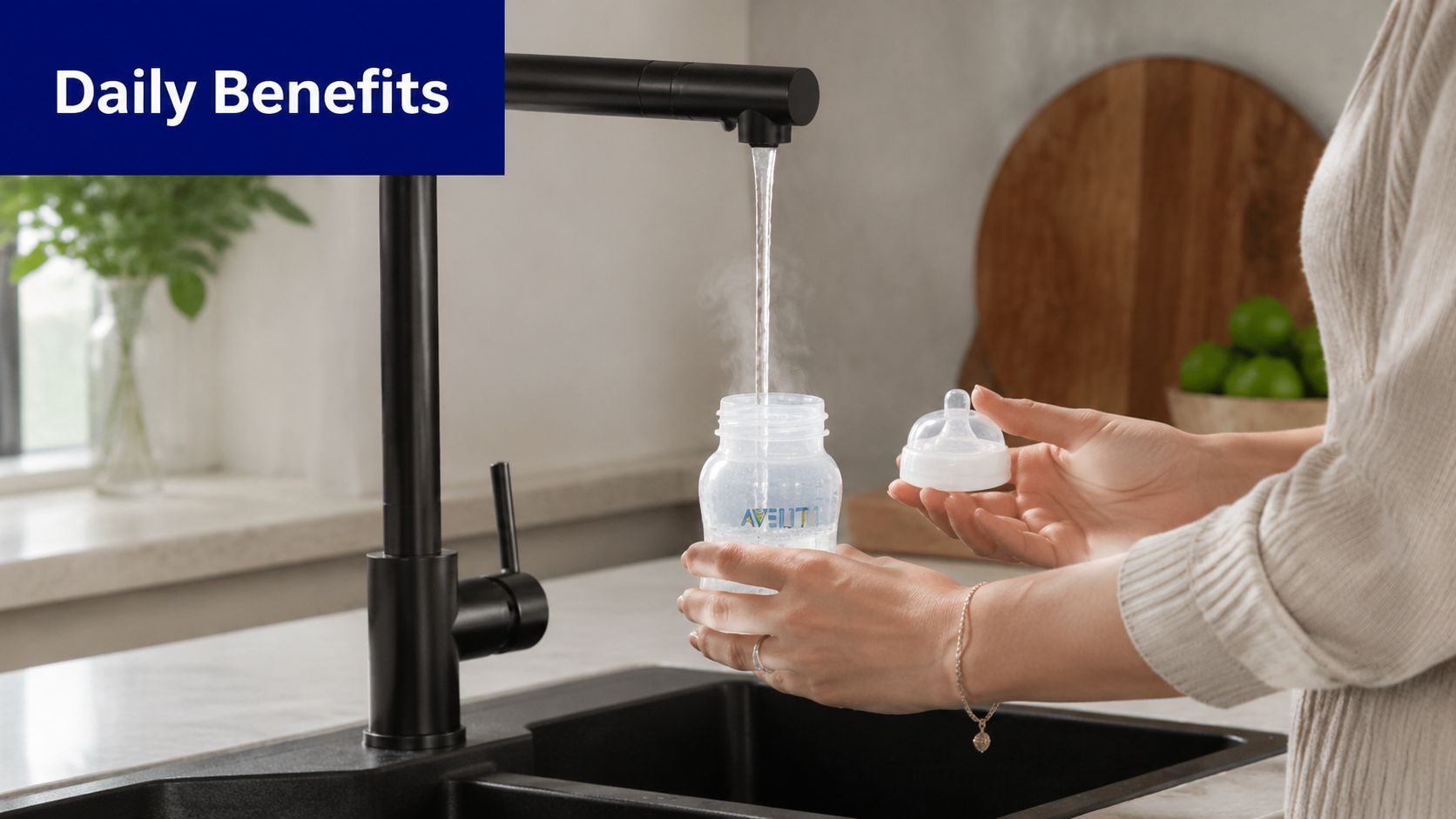
It changes small tasks that happen all day. Filling a saucepan becomes instant. Blanching vegetables is easier. You can loosen grease on cookware quickly, rinse chopping boards with very hot water, or speed up prep when dinner is already running late. In homes with babies, the convenience is even more noticeable because hot water is there when you need it, without juggling a kettle and cord on the bench.
Where it earns its keep
A boiling water tap proves its value in the jobs people don't think about until they have one.
- Cooking prep gets faster when you're starting rice, pasta, noodles, or stock with near-boiling water.
- Cleaning tasks become simpler for soaking utensils, shifting stubborn residue, or doing a quick hot rinse.
- Daily drink runs stop interrupting the room, especially in offices where several people use the kitchen in bursts.
- Bench space improves immediately because the kettle, base, and cable are gone.
That last point matters more than people expect. In a compact Melbourne kitchen, bench space is valuable. Getting rid of one freestanding appliance can make the whole work area feel calmer and less cluttered.
Better kitchen flow, not just more speed
There's also a design reason these systems have become popular. A dedicated boiling tap keeps the bench line cleaner and the sink zone more organised. In new builds and renovations, that fits the way people want kitchens to look now. Fewer loose appliances. Fewer cords. More built-in functions.
What works well is matching the unit to the way you use the room. A home that wants quick drinks and cooking water will use it differently from a staff kitchen where people need repeated, short bursts throughout the day. The best setups are the ones chosen around routine, not novelty.
A kettle is portable, but that portability isn't much use if it spends its whole life in the same corner of the bench.
The safety side is often overlooked
A traditional kettle has its own risks. It can be overfilled, knocked, grabbed by the handle, or left near the edge of the bench. Boiling water taps aren't risk-free, but many are built with controls that require a deliberate action to dispense, such as push-and-turn or two-step activation. That's a better arrangement than carrying a full kettle across the kitchen.
What doesn't work is assuming every model is equally safe or equally suitable for a household with children or older users. Safety comes down to the tap design, the installation quality, and how the unit is used day to day. Those details matter far more than the showroom finish.
Exploring the Types of Instant Hot Water Systems
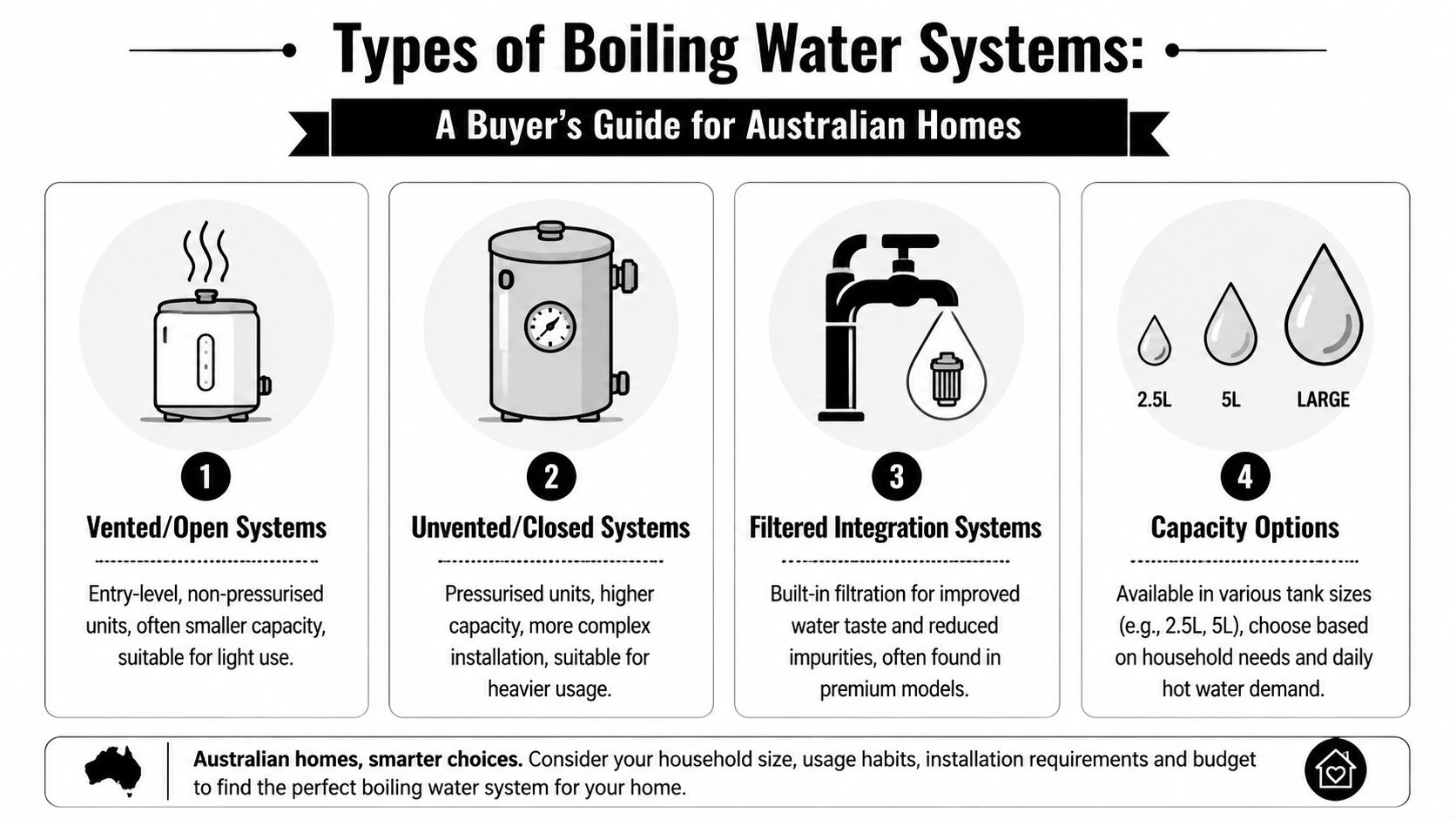
The term 'boiling water tap in Australia' often brings to mind one specific product. In practice, there are several different system categories, and they suit very different spaces. A family kitchen, a staff lunchroom, and a community hall usually shouldn't be running the same kind of unit.
The key is to choose by use pattern first, then by features.
Under-sink boiling tap systems for homes
This is the format most renovators look at first. The tank sits in the cabinet and the tap mounts through the benchtop or sink.
Some units provide boiling water only through a dedicated spout. Others combine boiling and ambient filtered water. Premium versions can also add chilled or sparkling water from the same tap assembly, turning the fixture into more of a water appliance than a standard mixer.
These are usually the best fit when you want:
- a clean benchtop,
- a modern kitchen finish,
- filtration built into the same setup,
- and regular use spread across the day.
If you're comparing home options, this instant hot water dispenser guide is useful for seeing the common product formats buyers come across in Australian kitchens.
Wall-mounted boiling water units for workplaces
Wall-mounted units are a different animal. They're built for utility, not kitchen styling. You'll see them in offices, staff rooms, schools, churches, medical settings, and community facilities where reliable hot water matters more than appearance.
They make sense when:
- several people need hot water in short succession,
- the room needs a hard-wearing commercial-style solution,
- and under-sink cabinet space is limited or poorly configured.
The main advantage is practicality. They're visible, serviceable, and straightforward for repeated use. The downside is that they won't give you the same integrated kitchen look as an under-bench tap.
Urns and larger-capacity commercial options
For hospitality, event spaces, and high-traffic kitchens, a tap system may not be the right answer. A commercial hot water urn or heavier-duty boiling water unit often handles volume better when demand comes in waves.
Think catering prep, clubrooms, functions, and break areas where people are filling many cups back-to-back. In those settings, the question isn't how elegant the tap looks. The core issue is recovery time, serviceability, and whether the unit can keep up when everyone wants hot water at once.
Compact setups for caravans and smaller spaces
There's also a smaller category for caravans, RVs, and compact utility areas. These jobs need tighter planning because space, power access, and storage are far less forgiving than in a standard kitchen.
A short comparison helps:
| System type | Best fit | Main strength | Main limitation |
|---|---|---|---|
| Under-sink boiling tap | Homes and premium office kitchens | Clean look and convenient daily use | Needs cabinet space and careful planning |
| Wall-mounted unit | Staff rooms and shared facilities | Practical for repeated use | Less integrated visually |
| Commercial urn or boiler | Hospitality and events | Handles heavier demand | Takes up more room |
| Compact specialty unit | Caravans and small utility areas | Suits tight spaces | Limited by layout and services |
What doesn't work is choosing by tap style alone. A sleek all-in-one kitchen unit can be the wrong choice for a busy workplace, and a heavy commercial setup can be complete overkill in a small home. The right category saves headaches later.
Australian Standards and Installation Essentials
Installation is where a good boiling water tap setup is either secured properly or compromised from day one. People tend to think about the visible tap, but the essential work is behind the cupboard door. That includes the water feed, isolating valve, filter placement, tank clearance, ventilation, drainage considerations where required, and a suitable power point in the right place.
If any of those are awkward, the whole system becomes awkward to own.
What a proper installation usually involves
In most kitchens, a standard install means checking four basics before the unit is even unpacked.
- Cabinet space has to suit the tank and allow room for servicing.
- Plumbing access needs a clean cold-water feed and shutoff arrangement.
- Electrical access has to be appropriate for the appliance location.
- Ventilation and layout need to support safe operation and future maintenance.
The details vary by brand and model, but one rule stays the same. This is not a casual DIY tap swap. It's a hot water appliance with plumbing and electrical requirements, and it should be treated that way.
Why safety matters more in Australia
Scalding from hot tap water is a real safety issue, not a theoretical one. The Victorian Building Authority hot water safety guidance states that each year hot tap water causes serious scalds to many small children and elderly or disabled people, and that more than 90% of these scalds are preventable through safer water-temperature control and safer tapware design.
That matters directly when choosing a boiling water tap in Australia. The water being delivered is near boiling, so safety can't be treated as an optional extra. For homes with young children, older residents, or support workers coming and going, tap design matters a lot. Push-and-turn controls, two-step activation, and insulated under-bench components are worth paying attention to.
If a buyer asks me whether the finish should be chrome, black, or brushed nickel before asking how the boiling control works, they're asking the wrong first question.
Here's a useful rule of thumb:
| Installation priority | Why it matters |
|---|---|
| Safety control on the tap | Prevents accidental operation |
| Enough room around the tank | Makes servicing possible |
| Accessible filter position | Encourages proper maintenance |
| Licensed installation | Supports safe, compliant operation |
A short visual walkthrough can help if you haven't seen the internal setup before.
What often goes wrong
The problems I see most often are planning mistakes, not product defects. Units get squeezed into cabinets with no service room. Filters are mounted where no one can change them easily. Power access gets treated as an afterthought. In some renovations, the bin system, pull-out drawers, or sink bowl depth ends up competing with the tank for the same space.
That's why a licensed plumber matters. Proper installation protects performance, safety, and, in many cases, the manufacturer's warranty position. It also gives you a much better chance of having a system that's still easy to service years down the track, which is what home renovators and office managers should be thinking about from the start.
Understanding Costs Maintenance and Spare Parts
This is the section buyers usually want straight away. What will it cost to run, what needs replacing, and what turns a smart purchase into an expensive nuisance?
The first thing to understand is that the true cost of a boiling water tap isn't just the tap body. You're paying for the appliance under the sink, the installation work, the filter system, the power it uses while on standby, and the maintenance needed to keep it performing properly.
Running costs in Melbourne conditions
Operating cost has become a more visible issue as power prices have moved. A Melbourne-based guide published in 2026 notes that electricity prices in Melbourne rose 18% in 2025, and that the annual standby cost for some models, including certain Zip HydroTap units, can range from about AUD 60 to 120 per year according to Ring Hot Water's instant boiling water on tap article.
That doesn't mean every unit costs the same to run. It means buyers should ask the right question. Not just “what does the tap cost?” but “what does this unit cost to sit there ready all year?”
For renovators already budgeting cabinetry, stone, and appliance choices, that whole-life thinking matters. If you're reviewing overall project spending, broader references like Flascon insight on Brisbane building costs can be useful because they show how quickly small fixture decisions add up across a renovation.
The maintenance most owners forget
Maintenance is usually simple, but only if it's done on time.
- Filters need replacement because they protect taste, tank internals, and flow performance.
- Scale management matters in areas where mineral build-up is harder on heating components.
- General inspections help catch tired hoses, fittings, or valves before they become leaks.
If you own a filtered system, it's worth understanding the filter side properly rather than treating it as an afterthought. This Zip filter replacement guide gives a practical reference point for what that servicing looks like.
The cheapest boiling water tap to buy can become the most expensive one to own if filters are awkward to change and spare parts are hard to source.
Spare parts and what actually wears out
Over time, the components that usually need attention are the ordinary working parts. Filters, valves, flexible hoses, thermostats, elements, and fittings wear, block, or age. That's normal. The key difference is whether the system you choose has accessible parts and a clear servicing path in Australia.
What works well is buying a system with genuine parts support and choosing an installer or supplier who can still help when something small fails. What doesn't work is ending up with an obscure unit that no one wants to repair and no one can match parts for without trial and error.
Basic troubleshooting is often straightforward. Slow flow can point to a tired filter or supply issue. Inconsistent temperature can suggest a service need. Unusual noises, leaks in the cabinet, or repeated reset behaviour are signs to stop guessing and get the unit checked properly.
How to Choose the Right System and Supplier
Choosing the right boiling water tap in Australia gets easier when you ignore the marketing language and ask plain operational questions. Start with use, then layout, then support. If you reverse that order and buy on appearance first, you can still end up with a tap you like looking at and a system you don't like owning.
For most buyers, the right choice becomes obvious once the daily pattern is clear. A couple renovating a compact inner-suburban kitchen has different needs from an office manager fitting out a staff lunchroom. One wants bench space and a clean look. The other wants reliability, safe use, and easy servicing when the unit gets hammered every day.
The questions worth answering first
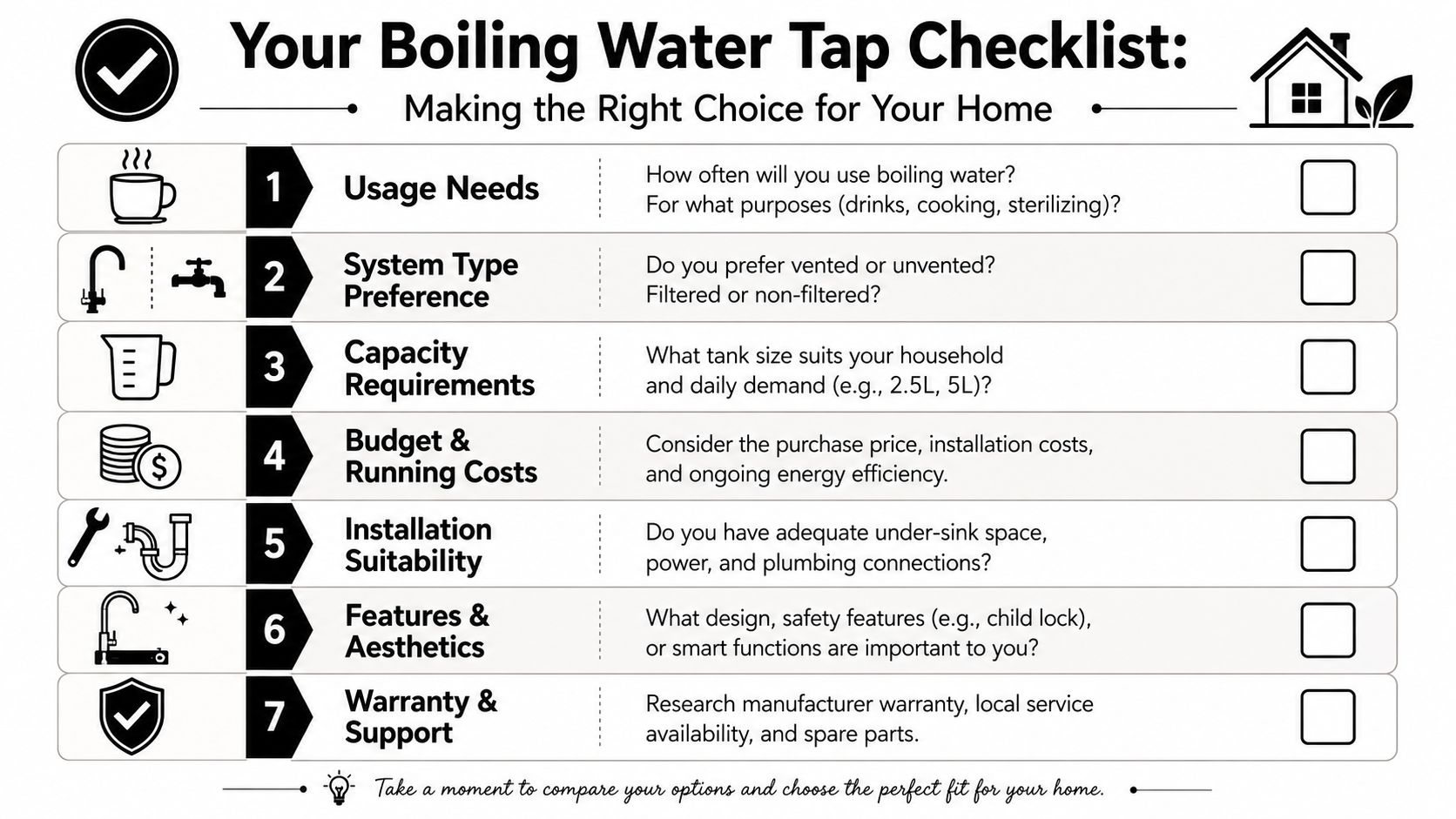
Run through these before you compare brands.
How often will the system be used?
Occasional cups and cooking top-ups suit a different setup from constant office use.Who's using it?
A family with children, an aged-care setting, and a staff room all have different safety priorities.What do you want from the tap itself?
Some people only need boiling water. Others want filtered ambient water, chilled water, or a combined multifunction tap.What space do you really have under the sink?
Not the brochure version. The actual cabinet, with bins, traps, shelves, and power access included.Can you get it serviced locally?
A good unit with poor after-sales support becomes a long-term irritation.
A lot of the same thinking applies across renovation decisions in general. If you're planning a broader kitchen update, resources about choosing appliances for your remodel in Kalamazoo are useful because the selection logic is similar. Match the appliance to how the room is used, not just how it looks in a display.
What separates a decent supplier from a frustrating one
There's a big difference between a retailer who can sell a box and a specialist who understands the whole setup. For boiling water systems, the better supplier usually helps with four practical points:
- Product fit for the household or workplace.
- Installation advice based on real cabinet and plumbing conditions.
- Access to genuine parts later on.
- Repair and maintenance support when the unit needs attention.
That's where a specialist can make more sense than a big-box purchase. In Melbourne, for example, some buyers need installation and service support as much as they need the product itself. Others around Australia mainly need the correct replacement filter, valve, hose, or thermostat shipped without guesswork. A specialist option such as Ring Hot Water's instant hot water tap range is relevant in that context because it covers both complete systems and the parts side of ownership.
A simple way to narrow it down
If you want the shortest path to the right decision, use this checklist:
| Your situation | Usually the better fit |
|---|---|
| Renovated home kitchen with limited bench space | Under-sink boiling tap |
| Workplace tea point or lunchroom | Wall-mounted unit or robust office system |
| Hospitality or event use | Commercial boiler or urn |
| Tight service space or specialty vehicle setup | Compact unit planned around available services |
Buy for the actual workload. Buy for service access. Buy from someone who can still help once the unit is no longer new.
If you need advice on a new boiling water tap, replacement parts, or Melbourne installation support, Ring Hot Water is a practical place to start. The team handles instant boiling and chilled water systems, repairs, maintenance, and genuine spare parts for homes, offices, hospitality sites, and trade buyers across Australia.

