
Boiling Hot Water
Instant Boiling Water Tap Australia: Your Complete Guide
Apr
The usual starting point is a kettle that never seems to leave the bench. It takes up space, gets boiled more often than needed, and becomes one more thing to clean around when the kitchen is already busy. In offices and staff rooms, it’s the same story with a larger footprint. A kettle or urn in the corner, a queue around it, and the same stop-start routine all day.
An instant boiling water tap australia setup solves that problem neatly, but only if you buy the right type of system for your water, your cupboard space, and your usage. The glossy brochures tend to focus on finish, tap shape, and how quickly the water comes out. What matters just as much is what happens after installation. Filter changes, scale management, spare parts, service access, and how the unit copes with Melbourne water all affect whether the purchase feels smart in year one and still feels smart later.
Your Guide to Instant Boiling Water Taps in Australia
An instant boiling tap isn’t a niche upgrade anymore. The Australia boiling water tap market was valued at USD 8.54 million in 2025 and is projected to reach USD 16.7 million by 2034, with a CAGR of 7.65%. That tells you something simple. More Australian homes and workplaces are moving away from separate kettles and toward built-in hot water systems.
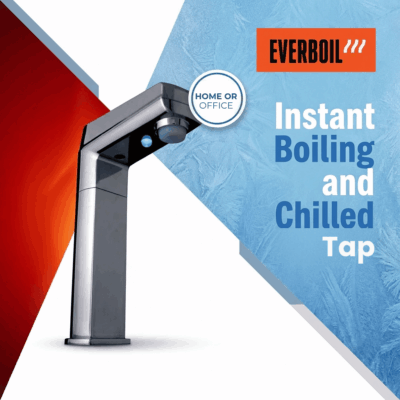
In Melbourne, the appeal is easy to understand. Bench space is valuable. Renovated kitchens often aim for a cleaner look. Offices want fewer appliances cluttering the tea point. Hospitality venues want faster service without a kettle sitting beside the prep area. A boiling tap handles all of that, but the right answer for a family kitchen isn’t always the right answer for a café back counter or a staff room.
What buyers usually miss
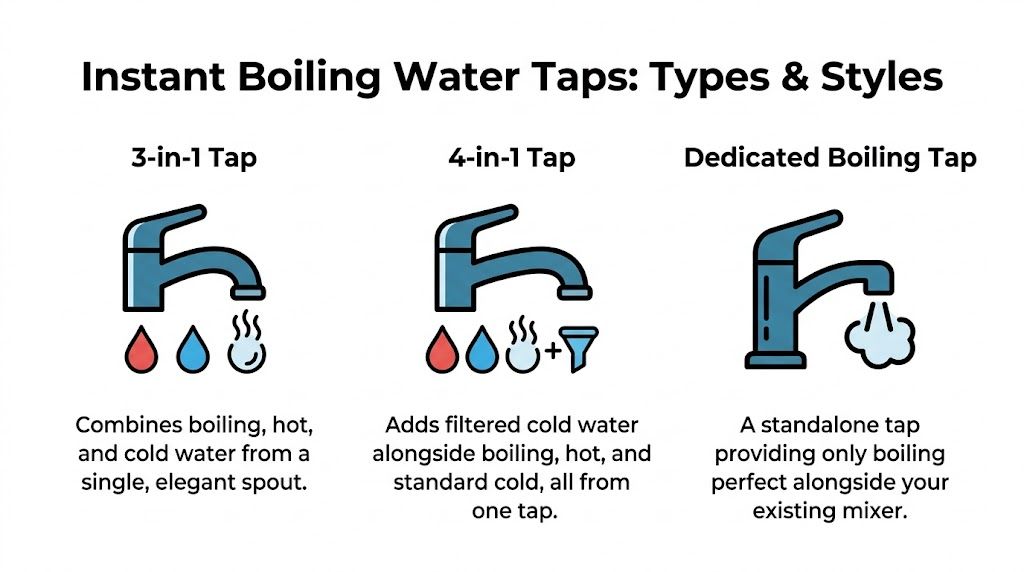
Shoppers often prioritize tap style first. They look at whether they want a dedicated boiling tap, a 3-in-1, or a 4-in-1. That matters, but it’s not the whole decision.
The more important questions are these:
- Water quality: Melbourne and broader Australian water conditions can create scale issues that shorten element life.
- Serviceability: Some systems are much easier to maintain and repair than others.
- Real operating costs: Filters, descaling, and replacement parts affect total ownership cost.
- Installation fit: Not every cupboard has the right space, power access, or plumbing setup.
- Usage pattern: A home making tea and pasta water has different demands from an office making drinks all day.
Practical rule: Buy the tap for the water conditions and the service plan first. Buy the finish second.
That’s how hot water specialists look at these systems. A polished tap on the bench means very little if the unit underneath is wrong for the site. The strongest results usually come from a simple match between environment, filtration, and a system that can be maintained with genuine parts when needed.
Key Benefits of an Instant Boiling Water Tap
Search behaviour gives a good sense of where the market is heading. Google searches for boiling water taps in Australia increased 25% year-on-year in 2021, which lines up with what many installers and service technicians have seen on the ground. More people now treat these systems as a practical kitchen appliance rather than a luxury extra.
The convenience is immediate
The simplest way to think about an under-sink boiling unit is as a compact insulated tank that keeps water ready for use. You don’t fill it like a kettle. You don’t wait for it every time. You turn the tap and the water is there for tea, coffee, noodles, blanching vegetables, or getting a pot started quickly.
That changes daily habits more than people expect. In a family home, it cuts the small delays that happen over and over. In a workplace, it reduces congestion around a kettle. In hospitality, it can speed up prep and make the hot water point far tidier.
It frees up the bench
One of the most obvious improvements is visual. The kettle disappears. So do the cords, the steam stains near the powerpoint, and the routine of shifting the appliance every time you want a cleaner benchtop.
A built-in tap also keeps the water point exactly where people expect it to be. That sounds minor, but it helps in busy kitchens where movement and workflow matter.
Safety is usually better than a kettle
A kettle is familiar, but it isn’t always the safest option. It can be overfilled, knocked, pulled by the cord, or left near the edge of the bench. Most boiling taps designed for homes and workplaces include safety steps such as child locks or two-step dispensing for boiling water.
That doesn’t make them risk-free. Boiling water is still boiling water. But a well-designed tap generally gives you more controlled dispensing than lifting and pouring from a heavy kettle.
A boiling tap is safest when the tap design, user habits, and installation position all work together. One good safety feature won’t fix a poor location.
The energy argument depends on use
The energy-saving claim is often oversimplified. These systems can be more efficient than repeatedly boiling a kettle, especially when they heat on demand or hold heat efficiently. But actual savings depend on how often the tap is used, whether eco settings are enabled, and whether the unit is free of scale.
What works well is this. Homes and workplaces with frequent hot water use usually get the most practical value. Places with very occasional use can still benefit from convenience and space savings, but the economics should be considered more carefully.
Comparing Boiling Water Tap Types and Styles
The format of the system matters as much as the brand. Buyers often start with the tap they can see, but the better decision is to begin with the unit style that matches the room, the plumbing access, and how many cups or tasks it needs to cover in a normal day.
Under-sink systems
This is the format most homeowners picture first. The tank and filter sit in the cupboard, and the only visible part above the bench is the tap itself. That gives the cleanest finish and suits renovated kitchens well.
Under-sink systems are usually the best fit when appearance matters and there’s enough cupboard room for the tank, filter, and plumbing. They’re also a strong choice if you want a combined boiling and filtered setup rather than a separate benchtop appliance.
Pros include:
- Clean appearance: The bench stays clear.
- Flexible tap options: You can choose a dedicated boiling tap or a combined mixer style.
- Good for daily use: They suit homes, offices, and many light commercial settings.
The drawbacks are practical rather than cosmetic. Under-sink access can be tight. Filter replacement space matters. Service takes longer if the cupboard is crowded with bins, cleaning products, or other appliances. If you want a broader look at common kitchen formats, this boiling water taps for kitchens review is useful.
Countertop units
Countertop or benchtop units appeal to buyers who want less involved installation or don’t have suitable cupboard space underneath. They can also be useful in rentals, temporary fit-outs, and workplaces where cabinetry isn’t being altered.
They’re simpler in one sense because the appliance is accessible. Servicing and cleaning can be easier because the unit isn’t hidden away. But the trade-off is obvious. They use visible bench space, and that can be exactly what people are trying to recover by moving away from a kettle.
Countertop systems tend to suit:
- Renters or temporary setups
- Small offices without cabinetry changes
- Sites where under-sink power or plumbing is awkward
They don’t suit buyers chasing a minimal integrated look.
Wall-mounted boilers
Wall-mounted units are built for throughput rather than kitchen styling. They’re common in staff rooms, schools, commercial kitchens, and hospitality areas where multiple users need hot water across the day.
These systems keep the bench free and can handle heavier use than many domestic under-sink units. They also make sense where durability and refill speed matter more than appearance.
In a commercial setting, choosing a domestic-looking tap for a high-demand tea point often creates service problems later.
The compromise is that wall-mounted boilers are functional. They don’t disappear into the room. They’re chosen because they work hard, not because they look invisible.
A quick comparison
| System type | Best for | Main strengths | Main compromises |
|---|---|---|---|
| Under-sink | Homes, premium office kitchens, light commercial use | Clean look, integrated design, good daily convenience | Needs cupboard space and good access for service |
| Countertop | Rentals, temporary setups, smaller workplaces | Easier access, simpler placement in some sites | Uses bench space, less streamlined look |
| Wall-mounted | Offices, staff rooms, hospitality, higher-demand areas | Strong output, bench stays clear, practical for multiple users | More utilitarian appearance |
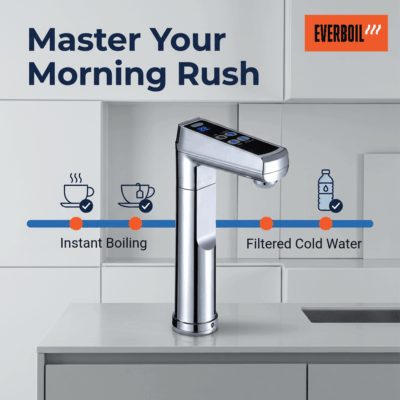
The right choice usually becomes obvious once you stop asking which tap looks best and start asking how the site works.
The Critical Role of Water Filtration for Your Tap
Filtration isn’t an optional extra on a boiling tap. In Australian conditions, especially in areas where mineral content varies, the filter helps protect the unit underneath as much as it improves what comes out of the spout.
Why Melbourne buyers should pay attention
Scale forms when dissolved minerals are heated and left behind on internal parts. In a boiling tap, the main concern is the heating chamber and element. Once scale starts building, the element has to work harder to transfer heat. That raises running costs and usually shortens component life.
The hard truth is that many buyers only realise this after the tap starts slowing down, getting noisy, or tripping faults. By then, what could have been managed with routine filtration often turns into a service job.
Without proper filtration in hard water areas, scale buildup can cause a 20 to 30% loss in heating efficiency annually. Systems with 0.1 to 0.2 micron filters have shown 40% less internal buildup after 12 months. Those figures explain why filtration affects total ownership cost, not just water taste.
What a filter is actually doing
A good filter can help with several problems at once:
- Sediment control: Fine particles can enter valves and internal pathways.
- Taste and odour improvement: Chlorine and related taste issues are reduced in many filter types.
- Scale management: Some filtration setups reduce the mineral impact that damages heating components.
- System protection: Cleaner incoming water generally means less stress on seals, valves, and tanks.
Not every cartridge does every job equally well. That’s where buyers get caught. A basic taste-and-odour filter may improve drinking quality but do very little for long-term scale control. A better setup considers both.
Choosing the right filtration approach
The right filter depends on your local water and the system you’re installing. A family kitchen in Melbourne may need a different cartridge choice from a regional office or a hospitality site with heavier use.
Look at these decision points:
Micron rating
Finer filtration can remove smaller particles. For boiling tap protection, that matters because sediment and internal contamination affect performance over time.Scale focus
If your area tends to leave mineral deposits on kettles, taps, or shower screens, don’t ignore that warning. Your under-sink boiling unit will notice it too.Replacement access
A cartridge may be technically suitable but still frustrating if the cupboard makes change-outs difficult.Certification and quality control
Buyers often pay attention to the appliance and overlook the treatment side. If you want a broader explanation of why standards matter in water products, this guide to quality certification for purified water is a useful reference.
Workshop note: The cheapest filter is often the most expensive one if it allows scale to build inside a premium tap.
What works in practice
What works is a matched system. Tap, tank, and filter need to be chosen together. Swapping in a generic cartridge because it fits physically isn’t always a good decision if it changes flow, water quality, or protection level.
If you’re specifically weighing options for local conditions, this guide to an under-sink water filter in Melbourne gives useful local context. The big takeaway is simple. If you’re budgeting for an instant boiling water tap australia purchase, budget for the right filtration from day one. That’s what keeps the running costs predictable.
Planning Your Installation Requirements and Costs
The easiest boiling tap installations are the ones planned properly before the unit is ordered. The difficult ones usually involve a cupboard that’s too tight, no nearby power, awkward pipework, or a benchtop that doesn’t suit the chosen tap layout.
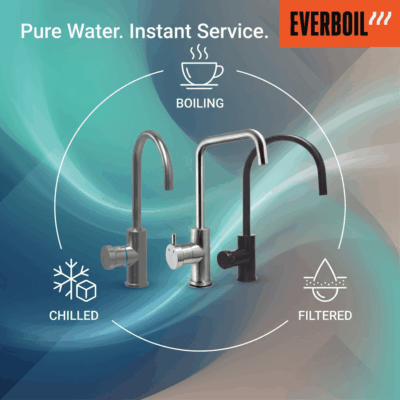
A practical benchmark helps. A typical under-sink system such as the ES7 uses a compact 4L tank and filter unit with approximate dimensions of W24 x D18 x H39cm, runs on a standard 1250W / 240V heating element, and suits mains pressure up to 550kPa. That tells you two useful things. First, many modern kitchens can physically accommodate one. Second, you still need to measure properly, because “compact” doesn’t mean “fits anywhere”.
Check the cupboard before you shop
Under-sink installations work best when the cupboard has enough room not just for the tank, but also for airflow, hoses, electrical access, and future servicing.
Use this checklist:
- Measure usable space: Account for bins, shelves, hinges, and pipework already in the cupboard.
- Confirm a power point: Most units need an accessible standard outlet under or near the sink.
- Check the water feed: A cold-water isolating stop tap is usually required.
- Think about filter access: If a filter can’t be changed easily, servicing costs and inconvenience go up.
- Review bench drilling needs: Some installations need an additional tap hole if you’re keeping the existing mixer.
Installation isn’t just about fitting it in
A boiling tap combines plumbing, electrical supply, and safety. That means the installation should be handled in line with Australian requirements, including AS/NZS 3500 where relevant to plumbing work. It also matters for warranty and insurance. If there’s a leak, a power issue, or a failure linked to poor installation, the savings from cutting corners disappear quickly.
Here’s a visual walkthrough that helps show the sort of planning involved before a unit goes live:
Upfront cost versus ownership cost
The purchase price is only one part of the equation. Buyers should think in two buckets.
The first is the unit and installation cost. That includes the appliance, the tap, any required fittings, and labour from a licensed plumber or appropriate installer.
The second is the ownership cost. That includes filter changes, occasional servicing, and any maintenance linked to local water conditions. In Melbourne, that second bucket deserves more attention than it usually gets.
A low purchase price can hide a high-maintenance system. That’s why installers look at access, water quality, and spare parts before they look at finish options.
A well-planned installation is usually quieter, cleaner, easier to service, and less likely to become expensive later.
Which Boiling Water Tap Suits Your Environment
The right boiling tap becomes clearer when you stop thinking in product categories and start thinking in day-to-day use. A family kitchen, a staff room, a café, and a caravan all ask for different things. The same tap won’t suit all four.
The family home
In a home kitchen, convenience and safety sit at the top of the list. People want fast drinks, easier cooking prep, less bench clutter, and a setup that doesn’t feel awkward with children or guests around.
A family home usually suits an under-sink system with a tap designed for deliberate boiling-water activation. Many households also prefer combined functions so the fixture does more than one job. That reduces clutter and keeps the sink area cleaner.
Key things to focus on:
- Safety controls: Child locks or two-step boiling activation matter.
- Service access: Filters should be easy to change without unpacking the whole cupboard.
- Water treatment: Homes in Melbourne should think seriously about scale protection, not just taste.
The modern office
Offices need reliability more than novelty. If a tea point serves multiple people across the day, the system has to recover well, stay tidy, and avoid becoming another appliance that someone has to manage manually.
Under-sink units work well in boardrooms and client-facing kitchens where appearance matters. Wall-mounted boilers often make more sense in general staff kitchens because they handle repeat use better and keep the bench clear.
What tends to work best is a system chosen around volume and maintenance discipline. An office that ignores filter changes usually ends up with service calls at the worst possible time.
Hospitality and catering
Hospitality sites need output, durability, and practical cleaning. This environment exposes weak systems quickly. If the unit is under-specced, staff will work around it, and that usually means slowing service or dragging another appliance into the workflow.
Wall-mounted boilers and heavier-duty under-sink systems are the usual fit here. The best choice depends on how the kitchen or service counter operates. A front-of-house drink station has different needs from a back-of-house prep area.
In hospitality, the wrong hot water setup doesn’t just inconvenience staff. It changes service speed and workflow.
Caravans and RVs
Compact hot water gear for caravans and RVs is its own category. Space is tighter, movement matters, and the installation has to deal with a mobile environment rather than a fixed kitchen.
That means buyers should focus on compact design, compatibility with the vehicle setup, and durable fittings rather than trying to mimic a full household arrangement. The nice-looking domestic tap isn’t always the right answer once vibration, storage, and service access become part of the equation.
Boiling tap recommendations by use case
| Environment | Primary Need | Recommended Tap Type | Key Feature Focus |
|---|---|---|---|
| Family home | Safe daily convenience | Under-sink integrated tap | Safety lock, filtration, easy filter access |
| Modern office | Reliable multi-user performance | Under-sink or wall-mounted | Recovery, low clutter, serviceability |
| Hospitality and catering | Higher-volume hot water | Wall-mounted or commercial under-sink | Throughput, durable components, easy cleaning |
| Caravan or RV | Compact installation | Compact dedicated system | Space efficiency, robust fittings, practical access |
One practical option in the market is Ring Hot Water, which supplies under-sink boiling taps, wall-mounted boilers, spare parts, and caravan-related fittings alongside installation and service in Melbourne. That matters if you want a purchase path that also covers maintenance, not just the initial unit.
Maintaining Your Tap for Long-Term Reliability
Total cost of ownership becomes a tangible consideration. A boiling tap can be a very good long-term appliance, but only if it’s maintained like one. The units that fail early are often the units that were installed and then largely forgotten.
A useful warning sign comes from hard-water testing. A 2024 CHOICE review highlighted a 30% failure rate for some models in hard water tests within 18 months, and estimated annual maintenance costs can range from $200 to $500 if filtration and servicing aren’t managed properly. Those numbers shouldn’t scare buyers off. They should push buyers toward a proper maintenance plan.
The maintenance jobs that matter
Some tasks are simple and routine. Others are easy to postpone until they become expensive.
Keep an eye on these:
- Filter replacement: This is not optional. A spent filter can reduce water quality and leave the internal system exposed.
- External cleaning: Wipe the spout and tap body regularly so residue doesn’t build up around controls and outlets.
- Descaling where needed: If your water leaves deposits elsewhere in the kitchen, your boiling unit may need scale attention as part of service.
- Visual checks: Look for slow flow, unusual sounds, drips, or changes in heating behaviour.
What users tend to notice first
The first sign of trouble is often subtle. The water may seem slower. The unit may sound different. The tap may drip after use, or the temperature may feel less consistent. Those are the moments to act, not to wait.
Common causes include blocked filters, scale on the element, worn valves, ageing hoses, and failed thermostatic components. In many cases, a repair is straightforward if it happens early and the correct parts are available.
Genuine parts make a difference
A lot of maintenance problems get worse because someone reaches for an improvised part. That might get the system running briefly, but it can create a mismatch in pressure, fit, or performance. Genuine filters, valves, elements, thermostats, and hoses usually save time and reduce repeat faults.
If you run a Zip system, this guide on Zip filter replacement is a practical reference point. The same principle applies across other brands too. Match the part to the unit, and don’t treat filtration as an accessory.
Good maintenance isn’t complicated. It’s consistent. Most expensive boiling tap repairs start as small ignored issues.
Where to Buy and Service Your Boiling Water Tap
A good buying decision comes down to four things. Your usage. Your space. Your water conditions. Your willingness to maintain the system properly after installation.
If you’re fitting out a Melbourne home, office, or hospitality venue, local support matters because boiling taps aren’t just bought, they’re installed, serviced, and occasionally repaired. That matters even more in suburbs where hard water conditions and heavy daily use can expose poor setup choices quickly. Sunshine, Yarraville, Footscray, and surrounding areas all benefit from having someone who understands both the appliance and the local installation realities.
If you’re elsewhere in Australia, access to genuine parts matters just as much as access to the original unit. Filters, fittings, thermostats, elements, hoses, and tap components all affect uptime. That’s especially important for plumbers, builders, facility managers, and caravan owners who may need a specific part rather than a whole new system.
The strongest buying approach is usually the least glamorous one. Choose a system that fits the cupboard, suits the demand level, has a realistic maintenance path, and can be serviced with proper parts later. If a tap looks great but creates ongoing scale, access, or repair headaches, it won’t stay good value for long.
If you’re comparing systems, planning an installation, or trying to keep an existing unit running properly, Ring Hot Water is a practical place to start. Melbourne customers can organise installation, repairs, and maintenance support, while customers across Australia can source boiling water units, filters, fittings, and genuine spare parts through the online store.

