
Uncategorized
Hot Water Heater for RV: Guide & Options 2026

Jun
You're probably in one of two spots right now. Either your current RV hot water unit has started acting up, or you're trying to choose a better setup before the next trip. Both situations can get confusing fast because most advice online jumps straight to “endless hot water” and skips the questions owners ask once they're standing beside the van with a tape measure and a spanner.
A good hot water heater for RV use has to suit the way you travel, the power you have, and the space your caravan or motorhome gives you. In Australia, there's another layer. Retrofit jobs often run into cutout mismatches, different plumbing assumptions, and local gas or electrical requirements that generic overseas guides don't explain well.
The simplest way to get this right is to break it down the way a technician would. First, understand the two heater types. Then match the heater to your travel habits. Then look at installation, parts, and maintenance so you don't buy something that only works on paper.
Understanding RV Hot Water Heater Types
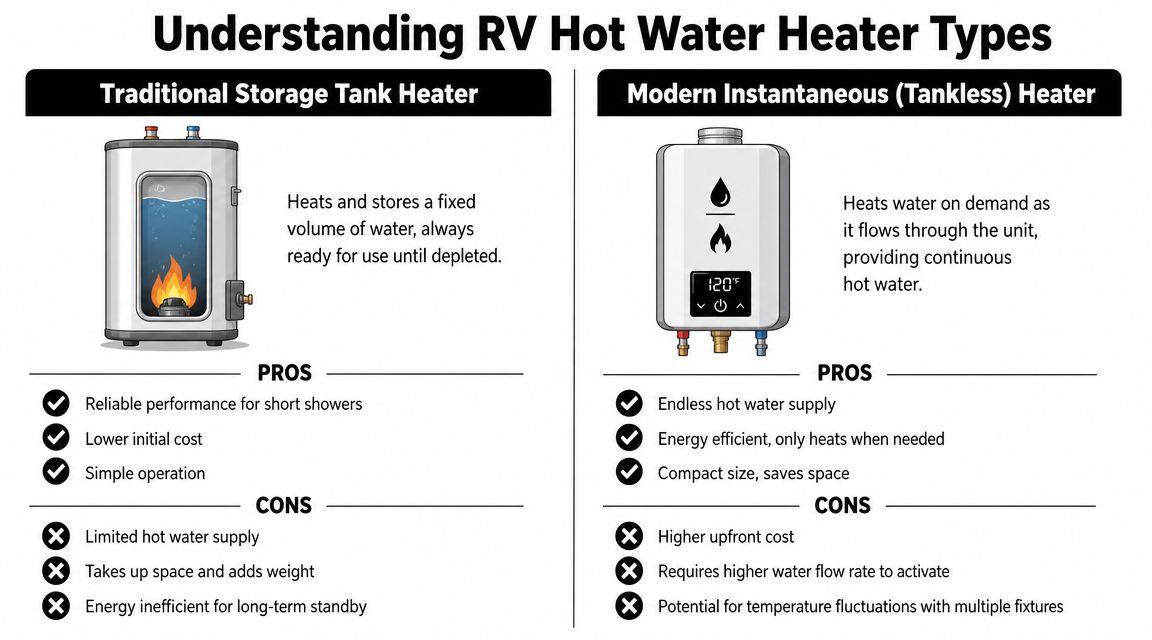
Most RV hot water systems fall into two basic designs. A storage tank heater keeps a small volume of water heated and ready. A tankless heater only starts heating when you open a tap.
A simple way to think about it is this. A storage unit is like a small kettle that stays hot in the background. A tankless unit is like a heater that works only when water passes through it.
How storage tank heaters work
Traditional RV systems have long used compact tanks. Common capacities are 6 gallons and 10 gallons, with some models as small as 4 gallons or as large as 12 gallons, according to RVshare's overview of RV water heater sizes. That small-tank history explains why many owners are used to quick showers, then waiting for reheating.
The upside is predictability. You heat the tank, the hot water is sitting there ready, and the system usually copes well with ordinary tap use. If you wash hands, rinse dishes, or take a short shower, the experience tends to feel straightforward.
The downside is just as clear. Once the hot water in that tank is used, you wait for recovery. You're also carrying the tank itself and giving up storage space in a vehicle where every compartment matters.
How tankless heaters work
Tankless RV heaters use a flow sensor. When you open a hot tap, the flow triggers the burner or electric heating process, and a heat exchanger raises the outlet temperature. Lippert's RV water heater basics guide explains that distinction clearly and notes that storage models typically use 6- to 10-gallon tanks while tankless models heat only when a tap opens.
That sounds ideal, and in the right setup it can be. The strongest case for tankless is energy efficiency in intermittent-use situations. The U.S. Department of Energy says demand-type water heaters can be 24% to 34% more energy efficient than conventional storage-tank heaters for households using 41 gallons or less per day, because they avoid standby heat losses. You can read that directly in the Department of Energy's guide to tankless or demand-type water heaters. In RV use, that logic fits well because hot water demand is usually stop-start rather than constant.
Practical rule: Tankless suits owners who want on-demand heating and are prepared to match the unit carefully to water flow, fuel supply, and actual camping conditions.
Some replacement guides also cite a typical on-demand RV output of 2.4 gallons per minute, which gives a useful sense of how these systems are sized in practice. If you want another plain-English comparison from the broader RV market, this overview of Utah RV hot water solutions is worth a look alongside local advice.
Side-by-side comparison
| Feature | Storage Tank Heater | Instantaneous (Tankless) Heater |
|---|---|---|
| Basic operation | Heats and stores a fixed volume of water | Heats water only when flow starts |
| Hot water supply | Limited by tank size | Continuous while flow, fuel, and power are adequate |
| Everyday feel | Simple and familiar | More responsive once activated, but setup matters |
| Wait time | Usually ready if the tank is already hot | Can have a short startup delay before hot water arrives |
| Space use | Tank takes up room | Usually more compact |
| Energy use | Loses heat while standing by | Avoids standby heat loss |
| Best fit | Owners who want predictable short-use performance | Owners who value compact design and on-demand operation |
If you're comparing specific product styles, it also helps to see how caravan-focused compact heaters differ from domestic under-bench units. This breakdown of the Duoetto water heater range is useful for understanding that product-category difference.
How to Choose the Right Heater for Your Travels
The right answer depends less on marketing and more on how you camp. A couple who stay mostly in powered sites can live happily with a very different setup from a family trying to stretch water and gas during remote touring.

Start with your travel pattern
Ask yourself three plain questions.
Where do you camp most often?
Caravan park, farm stay, free camp, or mixed use all place different demands on the heater.How many people use the hot water?
One person washing up and showering alone is very different from multiple campers trying to use water around the same time.What annoys you more?
Running out of hot water, or having to fiddle with flow and temperature to keep a tankless unit happy?
Those answers usually point you in the right direction faster than product brochures do.
Match the heater to your power and water reality
In Australian RVs, the heater has to suit the services already in the van. That means checking whether you're working with LPG, 240V supply when plugged in, a 12V/240V arrangement, or a mixed setup. It also means carefully assessing your water pressure and pump behaviour.
Tankless systems often sound perfect until real-world conditions expose the weak point. Keystone's discussion of tankless RV units notes that while manufacturers focus on “unlimited hot water”, owners also run into ignition delay and the need for sufficient water flow to activate the burner. That matters if you're trying to conserve water, using low-flow taps, or dealing with patchy campground pressure. You can read that in Keystone's tankless water heater benefits and usage tips.
If your pump cycles a lot or your van has low-flow fixtures, don't assume every tankless heater will behave nicely at the sink or in the shower.
A practical decision guide
Here's the version I'd give a first-time owner in the workshop.
- Choose storage tank if you want simple operation, don't want to think about flow-trigger behaviour, and mostly use hot water in short bursts.
- Choose tankless if you value compact design, dislike waiting for tank recovery, and your van can provide stable flow and appropriate fuel or electrical support.
- Pause the purchase if you haven't confirmed cutout size, gas type, venting path, and how the unit integrates with your current plumbing.
A lot of confusion comes from owners shopping by feature list instead of by use case. “Endless hot water” sounds great until someone tries to rinse dishes with a trickle, or another person turns on a second tap and the shower temperature shifts.
This video gives a useful visual overview before you compare units in person.
Common buyer mistakes
- Buying for the best-case trip: A heater should suit your normal travel, not the occasional holiday where everything is powered and easy.
- Ignoring startup feel: Tankless can work well, but the user experience at a handbasin or kitchen sink may differ from what you expect.
- Assuming shower comfort equals brochure comfort: Real performance depends on pump pressure, tap mixers, plumbing layout, and how the system was installed.
- Treating all RVs as the same: A hot water heater for RV use in Australia has to fit the van you own, not a generic North American layout.
RV Hot Water Installation and Venting Essentials
Installation is where many tidy upgrade plans fall apart. The old heater comes out, the new one arrives, and suddenly the wall opening is wrong, the gas connection is in the wrong spot, or the venting arrangement doesn't suit the replacement unit.
That's especially important in Australia. Forum discussions show that different brands of tank-style heaters often require different wall cutouts, and generic online advice often doesn't reflect local 12V/240V systems or the gas fitting standards needed for a compliant install. The issue is outlined in this RV forum discussion on tankless and on-demand replacement fitment.
Measure first, order second
Before you buy anything, check the existing opening and the surrounding service space. Don't just measure the visible door or external trim. Measure the actual cutout, the cavity depth, nearby framing, and where the plumbing and wiring enter.
If you're replacing a tank heater with another tank heater, don't assume brand-to-brand interchangeability. If you're moving to tankless, check whether the new unit needs different clearances or a different vent arrangement.
Gas, electrical, and water connections
An RV heater doesn't operate in isolation. It connects to gas or electricity, cold-water supply, hot-water outlet, and often a control circuit. In compact caravans, those connections are packed into a small service zone, so poor alignment can turn a “simple swap” into a larger fabrication job.
Use this mindset when planning:
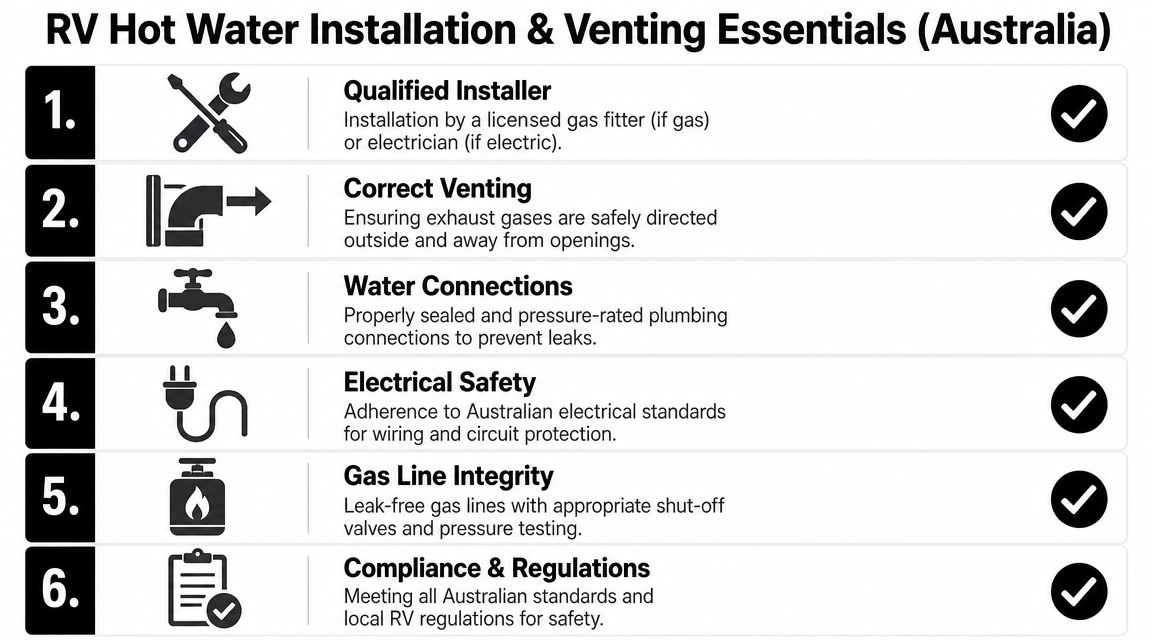
- Gas supply: Have a licensed gas fitter handle installation, testing, and commissioning where gas is involved.
- Electrical integration: Confirm the heater matches the van's electrical arrangement and protection requirements.
- Water pressure control: Make sure the rest of the system supports the heater safely, especially where pressure varies between mains connection and pump-fed operation.
A pressure control issue upstream can affect the whole heater installation. If you need a practical primer on that part of the system, this guide to a pressure limiting valve helps explain why the valve matters and where owners often get caught out.
Safety note: Venting is not cosmetic. Exhaust gases must leave the RV safely, and the vent path must suit the heater model and the vehicle layout.
Venting is a safety requirement
With gas heaters, proper venting protects the people inside the van. The appliance has to expel combustion gases outside, away from windows, doors, and openings where those gases could re-enter the living space.
That's why DIY enthusiasm needs limits here. Owners can measure, inspect, and plan. But if gas or compliance is involved, the final installation needs qualified hands. A neat-looking job isn't enough if the venting, testing, and certification aren't right.
Essential Fittings Pumps and Spare Parts
A hot water heater only performs as well as the parts around it. The heater may get all the attention, but pumps, valves, hoses, relief devices, and fittings decide whether the system feels smooth and reliable or fussy and leak-prone.
The support parts that matter most
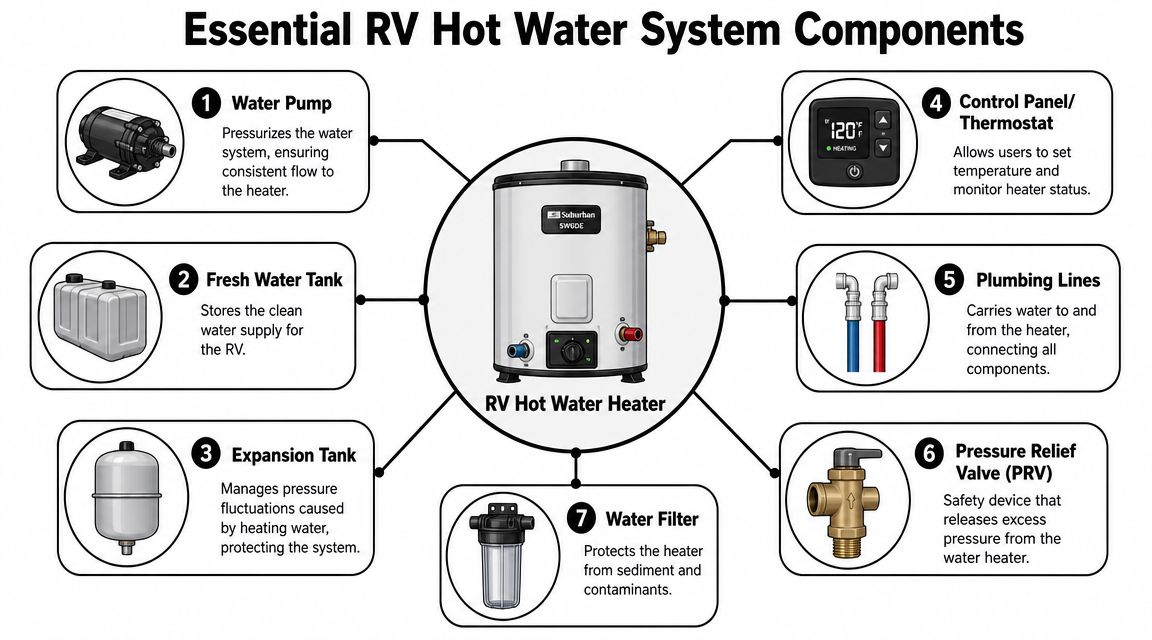
Start with the water pump. In many caravans, the pump determines whether a tankless unit activates consistently and whether a tank heater fills and flows properly. If your pump is weak, inconsistent, or badly matched to the van's plumbing, the heater often gets blamed for symptoms that start elsewhere. If you're weighing pump styles before replacing one, this article comparing and helping you compare Harbor Freight pump options is useful as a general pump-selection reference.
Next comes the safety hardware and flow control.
- Pressure relief valve: Protects the heater from excess pressure.
- Expansion management: Helps the system handle pressure changes as water heats.
- Filters: Reduce sediment getting into the heater.
- Thermostat or control panel: Lets you monitor operation and set usable temperature.
Then there are the pieces owners often underestimate. Hoses, elbows, joiners, threaded adaptors, and seals need to suit the system material and the way the van moves on the road. A connection that might survive in a static installation can loosen or chafe in a caravan.
Why spare-part compatibility matters
Compact RV systems leave very little room for “close enough”. A good example is the electric element. A common RV electric water-heater element standard is 6-1/4 inches, and using the wrong size can stop the part from installing or sealing correctly, as noted in this etrailer technical answer on RV water heater elements.
That same principle applies to thermostats, anodes, valves, and fittings. Correct thread type, sealing face, length, and orientation all matter.
The part that “almost fits” is usually the part that causes the second repair.
Build the system, not just the heater
When owners choose parts well, the heater becomes easier to live with. The pump delivers stable flow. The valves keep pressure under control. The plumbing lines don't weep or rattle. Servicing gets simpler because replacement parts match what's already there.
If your caravan still uses older pump or plumbing hardware, this guide to a 12 V water pump for caravan systems gives a good grounding in one of the most important supporting components.
Routine Maintenance and Simple Troubleshooting
You pull into a park after a long drive, connect water and gas, turn on the hot tap, and get a burst of lukewarm water that quickly goes cold. In many vans, that sort of problem starts with something small. A little scale in the heater. A weak pump that no longer keeps flow steady. A fitting that has started weeping after thousands of kilometres of vibration.
Routine care is what stops those small faults turning into a cold shower or a damaged unit. Storage heaters usually need attention inside the tank and around the relief valve area. Tankless heaters ask for a different kind of attention. They are more sensitive to water flow, clean burners, and mineral build-up, which matters in Australia where water quality can vary a lot from one stop to the next.
A simple maintenance routine
For storage-tank systems, the goal is simple. Keep the inside clean, make sure protective parts have not worn out, and catch leaks early.
- Drain and flush the tank from time to time: Sediment settles at the bottom, much like grit collecting in the bottom of a kettle. Left there, it can reduce heating efficiency and shorten component life.
- Inspect the anode rod if your heater uses one: The anode corrodes so the tank does not. Once it is heavily eaten away, it can no longer do that job.
- Check the pressure relief valve and nearby fittings: A stain, crusty residue, or damp patch often appears before a clear leak does.
- Empty the system before long storage if the van will sit unused: Old water, trapped debris, and corrosion are all harder on the heater than regular use.
Tankless units need a different checklist. Look at inlet filters, water connections, and burner operation. If the unit starts and stops during use, scale or unstable flow may be part of the problem. That is one reason tankless heaters can frustrate owners in real conditions even when the brochure promises continuous hot water. If the pump pulse is uneven or the tap is only opened slightly, the heater may not see enough flow to stay on.
What owners can check first
A hot water heater needs three basics to work properly. Water must be reaching it at the right flow. Power or gas must be available. The controls must be calling for heat. If one of those is missing, the heater itself may be fine.
| Problem | First things to check |
|---|---|
| No hot water | Gas bottle turned on, 240 V or 12 V supply available, heater switched on, water actually reaching the unit |
| Water not hot enough | Incoming water very cold, thermostat setting too low, flow rate too high, someone mixing too much cold water at the tap |
| Heater won't start | Fuse, isolation switch, gas supply, air in the gas line, flow too low to trigger operation on a tankless unit |
| Leaking water | Loose fittings, relief valve discharge, split hose, worn seal, cracks around the casing or tank area |
| Temperature keeps changing | Pump pressure fluctuating, partial blockage, tap opened too little for a tankless heater, startup lag as the burner catches up |
Startup lag catches many first-time owners. A tankless heater does not make hot water the instant you crack the tap. There is usually a short delay while flow is detected and the burner or element responds. In a van with short pipe runs this can still feel noticeable, and owners sometimes mistake that delay for a fault.
When to stop DIY troubleshooting
There is plenty an owner can inspect safely. You can look for leaks, check valves and switches, confirm the pump is running properly, and make sure access areas stay clean and dry.
Stop once the fault points to gas combustion, internal electrical parts, or a sealed component. At that stage, the job is less like tightening a loose fitting and more like diagnosing a stove or switchboard. That needs proper test equipment, correct parts, and someone who understands caravan-specific clearances, fittings, and safety requirements.
Your Melbourne Partner for RV Hot Water Needs
You are parked in a Melbourne workshop yard after a cold weekend away. The old heater has failed, the cutout in the caravan wall does not quite match the replacement unit you found online, and the fittings on the back are the wrong thread for your van's plumbing. That is the point where a supplier matters, not just a product listing.
Melbourne RV owners often run into practical fitment problems that generic advice skips over. A new heater may suit the brochure dimensions but still create trouble with the exterior cutout, vent position, gas connection, water line orientation, or access space behind the unit. In Australian vans, those details decide whether the job is a straightforward swap or a half-finished install that stalls while you chase adaptors, trim plates, or the correct valve.
Good support also matters after the heater is in. Tankless units, for example, can confuse first-time owners if the van has low pump pressure or a tap is only cracked open slightly. The heater may not trigger cleanly, or the water may arrive hot a few seconds later than expected. That does not always mean the unit is faulty. It often means the system around it needs the right setup and diagnosis from someone who works with caravan hot water systems regularly.
That is the value of a local partner. Melbourne customers can get help with replacement selection, fitment issues, servicing, and repairs. Owners elsewhere in Australia can still get the caravan-specific parts that save time, such as pumps, valves, fittings, and genuine spare components that match the heater properly.
If you need help with RV hot water systems, Ring Hot Water can support both sides of the job. Melbourne customers can arrange professional installation, repairs, and maintenance, while the online store supplies genuine heaters, pumps, fittings, valves, and spare parts Australia-wide for caravans and RVs.

