
Hot Water Services
Your Electric Heat Pump

Jul
Your Electric Heat Pump Guide for Melbourne Homes 2026
You know the feeling. It's a cold Melbourne morning, the shower's gone lukewarm halfway through, and the next energy bill is already in the back of your mind. A lot of households are in exactly that spot right now, weighing up whether to keep patching an old gas or electric system or finally move to something that's cheaper to run and easier to live with.
That's where the electric heat pump starts to make sense. It isn't just another appliance upgrade. For many Victorian homes, it's a practical way to cut running costs, move away from gas, and get more heat from the electricity you're already paying for. The important part is knowing how it works, how the rebates stack up, and when the savings are real in Melbourne rather than just on paper.
The End of High Winter Energy Bills
A common Melbourne pattern goes like this. The heater runs longer through winter, hot water demand climbs, and the old system suddenly looks a lot more expensive than it did in autumn. People often blame winter itself, but the bigger issue is usually the equipment doing the work.
Older electric resistance systems are simple, but they're expensive to run. Gas can still feel familiar, yet plenty of homeowners are noticing that “familiar” doesn't always mean economical anymore. When your system creates heat the hard way, every cold snap costs more.
That's one reason the shift toward all-electric homes has picked up speed. In the first half of 2023, Australia installed an estimated 60,000 air source heat pumps, a 70% jump in installations as households moved toward all-electric living, according to reporting on the Clean Energy Regulator findings. For Melbourne homes, that matters because it shows this isn't a fringe upgrade anymore. It's becoming a mainstream replacement for older heating and hot water setups.
Why households are changing now
Some people upgrade because their old unit failed. Others do it before failure, which is often the calmer and cheaper way to decide. Instead of replacing a dead system in a rush, they can compare efficiency, check rebates, and choose a unit suited to Victorian conditions.
A good plain-English starting point is Understanding heat pump systems, which walks through the basics for readers who want a broader overview before focusing on Melbourne-specific costs.
Many homeowners don't start by asking for a heat pump. They start by asking why their winter bills keep getting worse.
What changes in day-to-day life
The practical benefit isn't abstract. You're trying to get reliable hot water, steady indoor comfort, and a bill that doesn't feel like a punishment for using your own home in winter.
An electric heat pump helps by moving heat rather than generating it in the most energy-hungry way. That sounds technical at first, but the result is simple. You can use less electricity for the same job.
For a Melbourne homeowner, that means the conversation shifts from “How much will this cost me every month?” to “How quickly will this better system pay for itself?”
How an Electric Heat Pump Magically Moves Heat
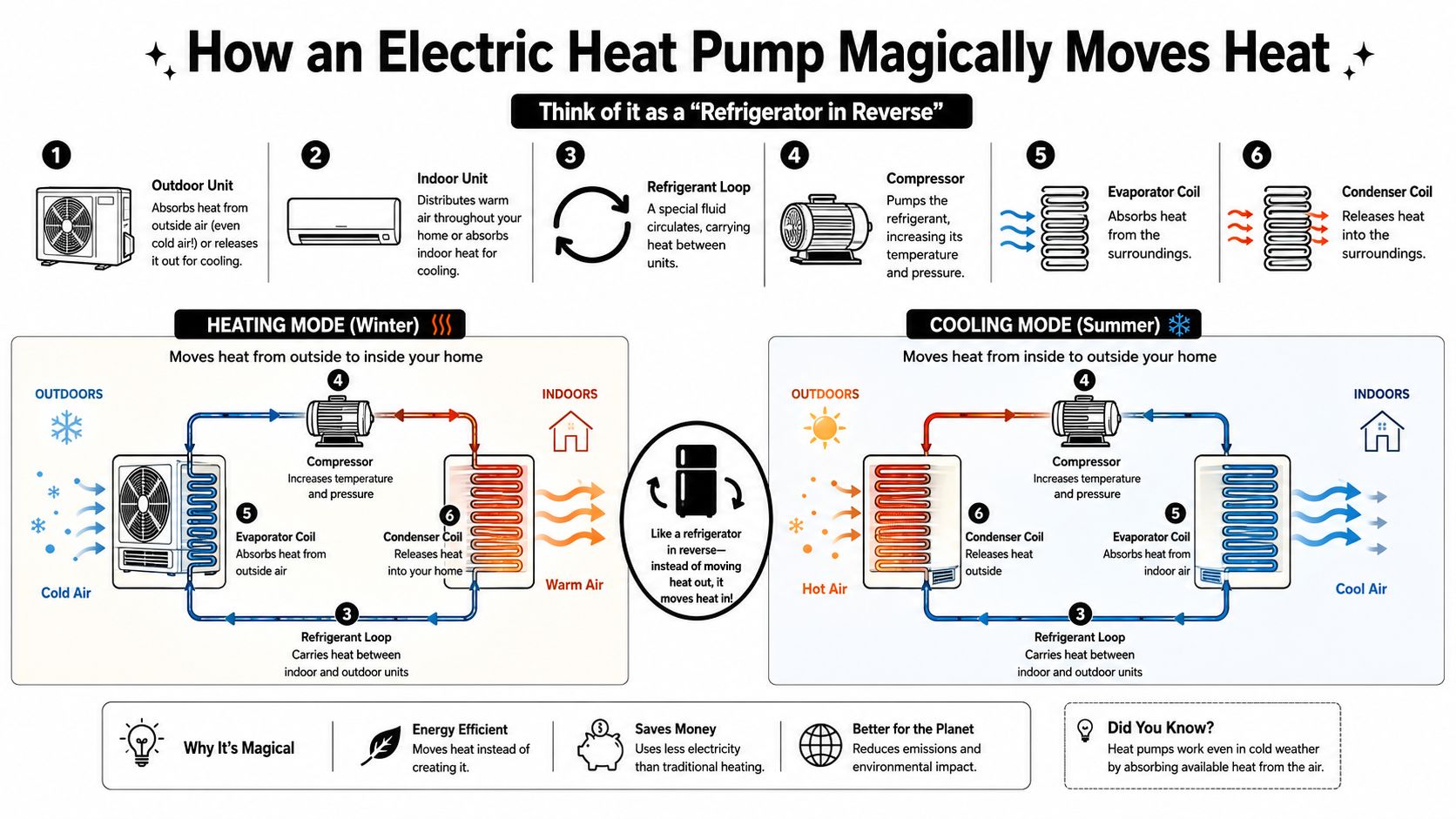
The easiest way to understand an electric heat pump is to think of a fridge in reverse.
Your fridge doesn't create cold out of nowhere. It pulls heat from inside the fridge and dumps that heat somewhere else. A heat pump does the same sort of trick, just in the opposite direction when you want warmth. It grabs heat from the surrounding air and moves it where you need it, either into your home or into your hot water tank.
It moves heat instead of making it from scratch
This is the part that often causes confusion. Many hear “electric” and assume it works like an old bar heater or storage tank element. It doesn't.
A resistance heater creates heat directly from electricity. A heat pump uses electricity to run a system that collects heat from the air and transfers it. That difference is why the running costs can be so different.
For Melbourne conditions, a high-quality electric hot water heat pump can operate with a Coefficient of Performance of 4.0 or higher, meaning 1 unit of electricity can generate 4 units of heat, and it can use 65 to 70% less electricity than a traditional electric resistance heater, according to the Australian heat pump water heater product profile.
A simple way to picture the cycle
Here's the non-engineer version:
The outdoor section collects warmth
Even cold air contains heat energy. The unit absorbs some of that heat.A refrigerant carries that heat
A special fluid moves through the system and picks up the heat.The compressor concentrates it
The system squeezes the refrigerant, raising its temperature.The heat gets delivered where you need it
For hot water, that heat goes into the storage tank. For home heating, it goes indoors.
Practical rule: If you remember only one thing, remember this. A heat pump wins on efficiency because it transfers heat rather than brute-forcing it.
Why Melbourne homeowners care about COP
COP sounds like installer jargon, but it's really just a shorthand for value. The higher the COP, the more heat you get for the electricity used.
That doesn't mean every heat pump on the market performs equally well. Quality, climate rating, installation, and controls all matter. But once you grasp the basic principle, the appeal becomes obvious. You're not paying for a machine to fight physics. You're paying for one that uses physics intelligently.
Exploring the Main Types of Heat Pumps
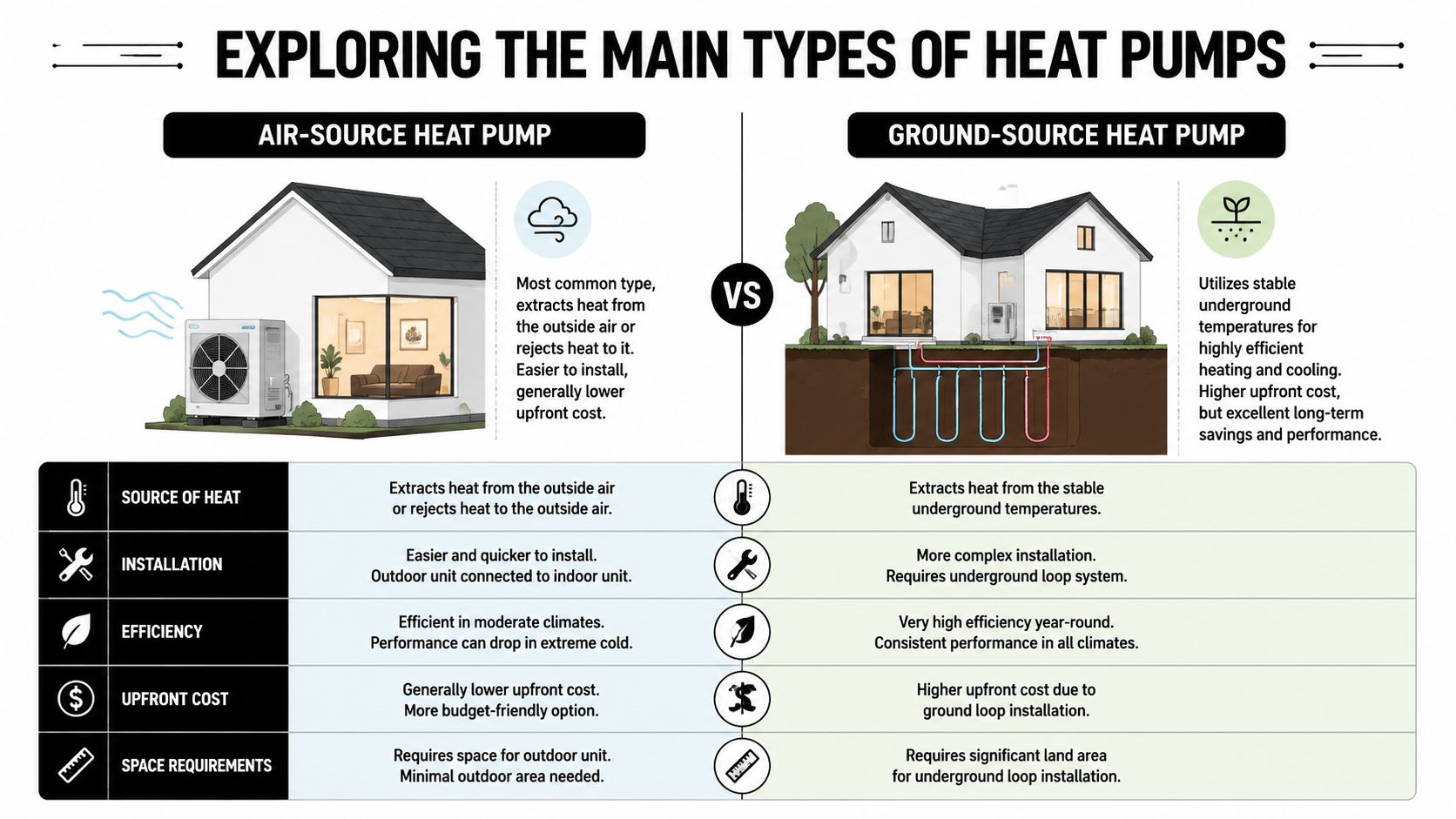
Not every electric heat pump looks the same, and that often confuses people. They hear one installer talk about air-source systems, another mention geothermal, and someone else starts talking about water-source units. For most Melbourne homes, the answer is simpler than the terminology makes it sound.
The main categories
| Type | How it works | Best fit for Melbourne homes |
|---|---|---|
| Air-source | Pulls heat from outdoor air | Best match for most suburban and urban homes |
| Ground-source | Pulls heat from the ground | Better for properties with land and bigger budgets |
| Water-source | Exchanges heat with a water source | Usually limited to specific property conditions |
Air-source heat pumps
This is the type most homeowners will be offered. It uses the outside air as the heat source and is usually the most practical retrofit option in Melbourne.
Why it suits local homes:
- Easier installation: It doesn't need major excavation.
- Good fit for existing properties: Most suburban blocks can accommodate the outdoor unit.
- Relevant for hot water upgrades: Many heat pump hot water systems in Victoria fall into this category.
For a typical house in places like Sunshine, Yarraville, Preston or Bentleigh, air-source is usually the realistic path.
Ground-source heat pumps
Ground-source systems can perform very well because underground temperatures are more stable than outdoor air. The trade-off is installation complexity.
You need enough site access and enough budget to justify trenching or drilling. That makes ground-source less common for established Melbourne suburbs, especially where block size is tight or landscaping is already finished.
Water-source heat pumps
These rely on a nearby body of water or a specific site setup that lets the system exchange heat effectively. In practical terms, most homeowners won't be choosing this option.
It's not that water-source is bad. It's just not the everyday answer for the average Melbourne residential block.
For most retrofits, the best heat pump isn't the most exotic one. It's the one that suits your property, your layout, and the way your household actually uses hot water or heating.
Why air-source dominates local retrofits
Air-source systems hit the sweet spot. They're more accessible to install, they work for a wide range of homes, and they don't demand the sort of site conditions that ground-source and water-source systems do.
That's why when a Melbourne homeowner says, “I'm thinking about an electric heat pump,” they're usually talking about an air-source unit even if they don't realise it yet.
Heat Pumps vs Gas and Electric Resistance Heaters
Most homeowners aren't comparing technologies in theory. They're asking a blunt question. “Is this better than what I've got now?”
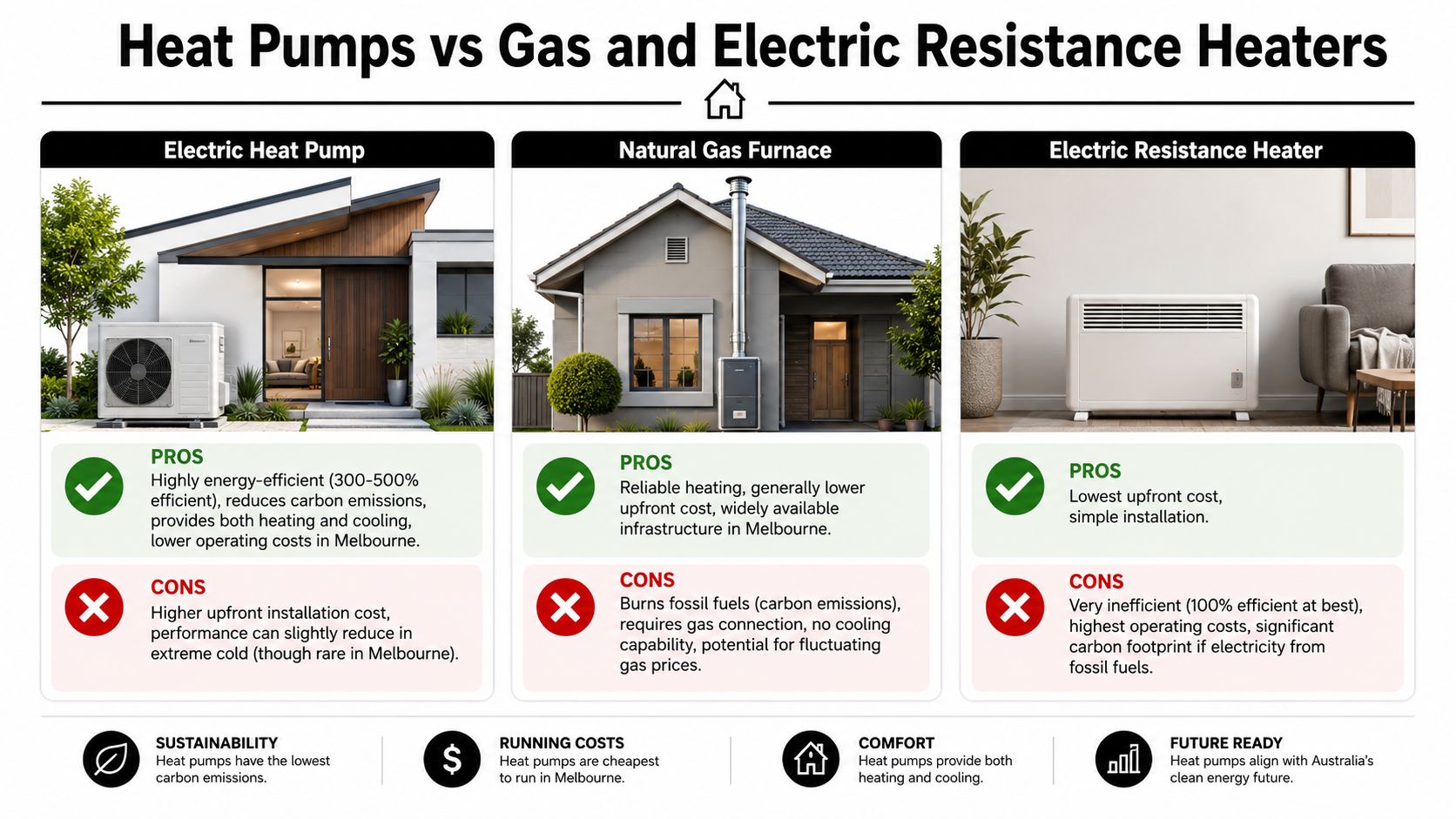
For Melbourne homes, the comparison usually comes down to three options: a heat pump, a gas system, or an old-style electric resistance unit.
The quick comparison
| System | Upfront feel | Running cost pattern | Main trade-off |
|---|---|---|---|
| Electric heat pump | Higher initial spend | Usually far more efficient | Needs correct sizing and good controls |
| Gas system | Familiar for many homes | Can be competitive in some setups | Burns fossil fuel and doesn't offer the same efficiency logic |
| Electric resistance | Often cheapest to buy | Usually the most expensive to run | Simple, but costly over time |
Why heat pumps usually win on efficiency
The core reason is mechanical, not marketing. Gas burns fuel to make heat. Electric resistance turns electricity directly into heat. A heat pump moves existing heat from one place to another.
That's why high-quality systems can deliver much more useful heat from the electricity they consume than resistance heating can. In practical terms, you're getting more warmth per unit of power.
If you're comparing hot water options specifically, that difference matters a lot. Households use hot water every day, not just in winter. So inefficiency doesn't wait for a cold snap. It shows up all year.
A related option some households consider during a broader upgrade is an on-demand unit. If you want to compare that pathway, this guide to tankless instant water heater options helps clarify where instant systems fit and where a heat pump may offer better long-term value.
A short explainer can also help if you want to see the wider heating debate in action:
The cost argument isn't as simple as “gas is cheaper”
Generic advice often misleads on this point. People hear that heat pumps are efficient and assume that automatically means they're always the cheapest option to operate. Not necessarily.
Actual running cost depends on:
- Your tariff structure: Peak and off-peak pricing can change the maths.
- Your usage pattern: Morning and evening demand matters.
- Your controls: Smart scheduling can protect the savings.
- Your solar setup: Daytime self-consumption can improve economics.
That doesn't weaken the case for heat pumps. It strengthens the case for choosing and setting them up properly.
Comfort and practicality
Gas still appeals to some people because it feels strong and familiar. Resistance systems appeal because they're simple. But when homeowners look at the full picture, heat pumps usually offer the stronger long-term proposition.
They align with the broader move away from gas, they can slash electricity use compared with resistance heating, and they make more sense for households trying to control bills without giving up comfort.
Sizing Costs and Savings for Melbourne Homes
This is the section that captures the most attention. Not the science. Not the trend. The money.
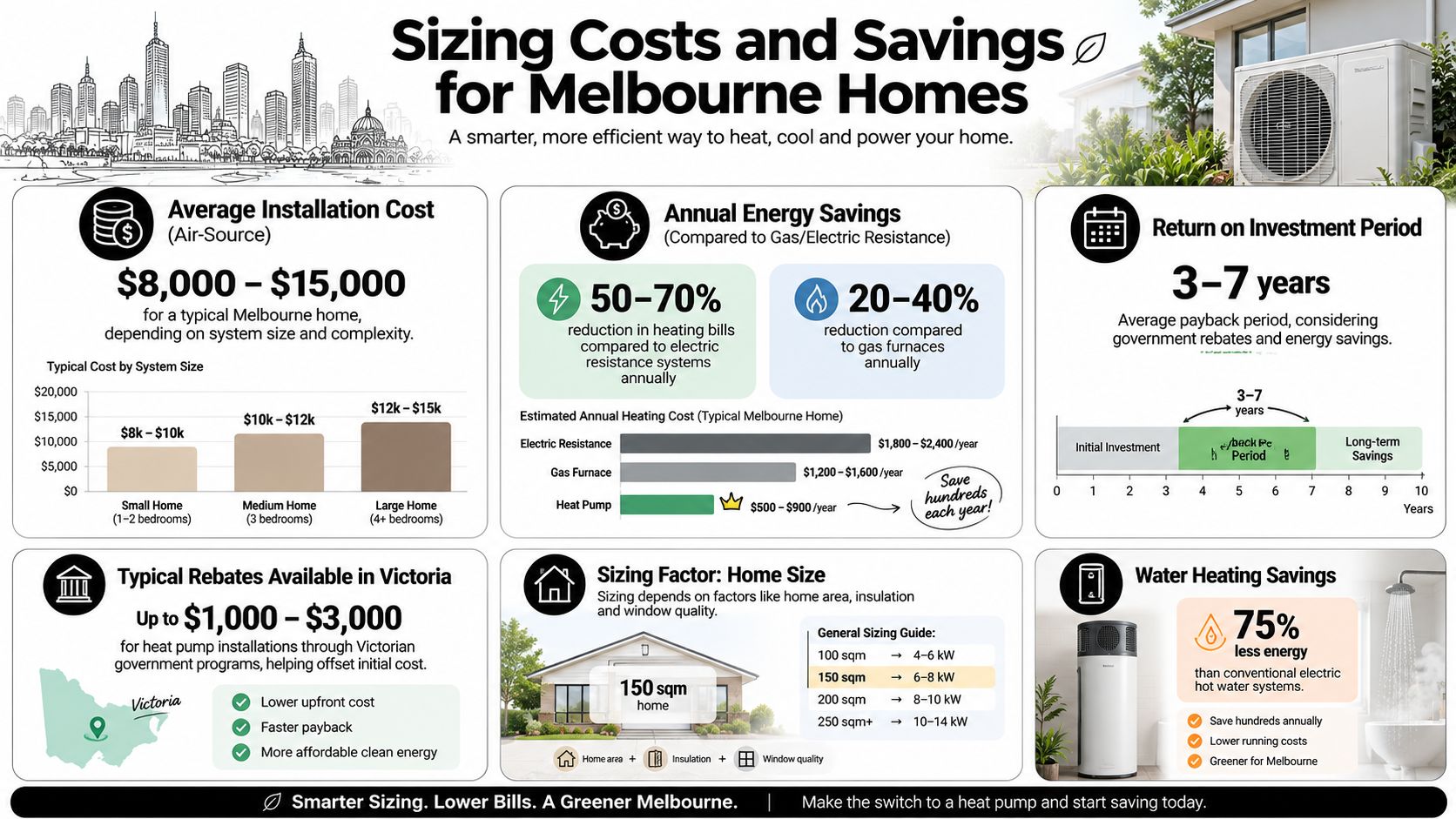
The first thing to know is that bigger isn't automatically better. Oversizing can leave you paying more upfront for capacity your household doesn't really need. Undersizing creates the opposite problem, where the system struggles or runs at the wrong times.
What affects the right size
For hot water systems, installers should look at your actual household pattern rather than guessing from bedroom count alone.
Key factors include:
- How many people use hot water daily
- Whether usage is spread out or clustered
- The type of system being replaced
- Available outdoor space and airflow
- Your electrical setup and roof solar, if any
A family that showers back-to-back in the morning has different needs from a couple who use most hot water across the day. Good sizing reflects behaviour, not just the floorplan.
The Melbourne rebate picture
Victoria becomes especially relevant. For Melbourne households, rebates can materially change the decision.
According to Australian heat pump market analysis, Victorian rebates can reduce upgrade costs by over 50%, and households may be able to stack a $1,400 Solar Victoria rebate, about $800 through the Victorian Energy Savings program, and a federal STC rebate of around $700. The same source notes that this can bring the average installed cost down significantly, with annual savings ranging from $400 to $2,000.
That's the point where many homeowners stop seeing a heat pump as a premium upgrade and start seeing it as a financially sensible replacement.
If you're comparing multiple low-energy water heating pathways, it also helps to understand how solar hot water systems fit into the same decision.
Time-of-use tariffs can change the real savings
This is the part too many articles skip.
A heat pump can be highly efficient and still cost more than expected if it's doing most of its work during expensive tariff periods. The technology is efficient. Your billing structure may not be.
The policy direction reflects that concern. The Australian government discussion of heat pump market trends identifies enabling time-of-use control as a key investment area. The same material notes that fewer than 10% of current residential installations appear to have smart controls for peak-shaving, which helps explain why some households don't capture the full economic benefit.
Local insight: In Melbourne, an electric heat pump isn't automatically the cheapest option to run if it's heating water during peak-rate windows. Smart scheduling or pairing with solar makes a big difference.
How to think about savings realistically
A sensible homeowner asks three separate questions:
What's the installed cost after rebates?
This tells you whether the upgrade is affordable now.When does the system usually run?
This tells you whether your tariff helps or hurts.Can the unit be scheduled intelligently?
This tells you whether the quoted savings are likely to show up on your bill.
A practical rule for Melbourne homes
If your household has solar, daytime heating can be very attractive. If you're on time-of-use pricing without solar, then scheduling matters more than people realise. A good installer shouldn't just sell the unit. They should explain when it runs, how it's controlled, and how to avoid expensive peak periods where possible.
That's the difference between buying a theoretically efficient appliance and getting a practically cost-effective system.
What to Expect During Installation and Maintenance
People often imagine heat pump installation as a major renovation. In most homes, it's much more straightforward than that.
For a heat pump hot water system, the installer usually removes the old unit, positions the new system in a spot with suitable airflow, completes the plumbing and electrical connections, and checks that condensate drainage and controls are set up properly. The exact details vary by property, but the process is generally more about careful placement than chaos.
What the installer will look for
Before installation, a good technician should assess:
- Location: The outdoor component or integrated unit needs appropriate airflow.
- Noise and access: Placement should work for the household and neighbouring boundaries.
- Electrical capacity: The system must suit the site's electrical setup.
- Usage pattern: Settings should reflect when your household needs hot water.
That early assessment matters because a poorly sited or poorly configured heat pump can underperform even if the product itself is decent.
The cost question during install
There's usually some sticker shock when people compare old electric systems with premium heat pump hardware. The benchmark figures often quoted in Australia show that a premium electric heat pump hot water system can cost around $5,500 installed, compared with around $1,800 for a standard electric system, but Victorian incentives of up to $2,600 can narrow the gap substantially. The same guide notes that this can make the effective cost comparable to gas systems while delivering three times the efficiency and reaching cost neutrality in 4 to 6 years, according to the Sustainable Household Scheme guide to hot water heat pumps.
If you're weighing smaller point-of-use options in the same project, an under sink hot water system in Melbourne can solve a different problem entirely, especially in kitchens, offices, or compact layouts.
Maintenance is usually simple
Most homeowners don't need to do much.
Basic care usually means:
- Keep airflow clear: Don't crowd the unit with stored items or dense plants.
- Watch for unusual noise: A change in sound is worth checking early.
- Book servicing when recommended: A qualified technician can inspect controls, components, and overall operation.
A well-installed heat pump should feel boring in the best way. Reliable hot water, steady operation, and no constant fiddling.
Key Questions to Ask Your Heat Pump Installer
The installer matters almost as much as the equipment. That's especially true in Australia because buyers still face a quality-visibility problem in this category.
A major concern flagged in the 2026 HPHWS Roadmap is the lack of mandatory Minimum Energy Performance Standards and energy rating labels for heat pump hot water systems. In plain terms, unlike some other appliance categories, homeowners can't always rely on a simple label to sort strong performers from weak ones. That means the installer's judgment, product selection, and honesty matter a lot.
Ask these before you sign
How did you size this system for my household?
If the answer is vague, that's a warning sign. They should ask about occupancy and hot water habits, not just point at a standard model.Is this model suitable for Melbourne conditions?
You want a clear answer about local climate suitability, not a generic “she'll be right”.What controls are included, and can I schedule operation around my tariff?
This is one of the smartest questions you can ask. Savings depend on operation, not only efficiency.Which rebates apply to my installation, and who handles the paperwork?
Don't assume every quote includes every available incentive.
Ask about product quality, not just brand names
Some homeowners focus only on a familiar brand badge. That helps a bit, but it's not enough.
Also ask:
- What performance information can you provide for this exact unit?
- What warranty applies to the system and to workmanship?
- What support is available if the controls need adjusting after installation?
Ask how they'll set it up to save money
The quality of installers becomes evident through their approach. They won't just talk about the unit. They'll talk about the household.
A strong conversation sounds like this:
- When do you use the most hot water?
- Are you on a time-of-use tariff?
- Do you have rooftop solar?
- Do you want the system to prioritise lower running costs or faster recovery?
Those are practical questions. They show the installer is thinking beyond the brochure.
If an installer can't explain how the system will perform in your home, on your tariff, with your usage pattern, they haven't finished the job of advising you.
A good electric heat pump should be efficient on paper and sensible in real life. The right questions help you separate those two things.
If you're in Melbourne and want practical advice on hot water upgrades, system compatibility, spare parts, or specialist water solutions, Ring Hot Water is a solid local place to start. Their team works across hot water products, installation support, and genuine replacement components, so you can get advice that fits the way your home or workplace uses water.

