
Sparkling Water
CO2 Refills Near Me

Jul
CO2 Refills Near Me: Your Melbourne Guide 2026
The cylinder always seems to empty at the wrong time. You line up a weekend keg, go to pour sparkling water, or check an aquarium setup, and the pressure has fallen away. The next move is usually the same. Search CO2 refills near me and hope the closest result can help.
In Melbourne, that quick search can waste a fair bit of time. One supplier mainly services welders. Another only exchanges its own branded bottles. Another can fill industrial gas but will not touch beverage-use cylinders. By the time you factor in valve type, bottle ownership, hydrostatic test date, and whether you need food-grade CO2, the nearest shop is not always the right shop.
Local knowledge matters here. Melbourne has a strong homebrewing base, and organisations such as the Australian Amateur Brewing Championship reflect how established the brewing community is across the country. That demand helps keep refill and swap options active across the metro area, especially around the western and south-eastern industrial belts where gas agents, brew shops, and hospitality suppliers overlap.
The catch is that supplier fit matters more than distance. A home bar, soda setup, planted aquarium, and workshop welder can all use CO2, but they should not all be handled the same way. If you are troubleshooting a draft setup before blaming the bottle, it also helps to compare beer tap systems. In Melbourne, the best refill run usually starts with one question. What exactly is your cylinder approved and set up for?
That Familiar Hiss The End of Your CO2 Cylinder
A flat pour tells you more than most gauges do. If your beer line starts sputtering, your soda setup loses bite, or your regulator pressure falls away faster than expected, the bottle is likely done. For most Melbourne households, that's the moment the phone comes out and the hunt for a nearby refill starts.
The problem is that search results don't tell you whether the supplier fits your actual use. Beverage carbonation needs the right gas and the right handling. A place that deals mainly with industrial cylinders may still be useful, but only if it can confirm the bottle and gas are appropriate for drinks. If you're running a home bar and still refining the setup, it also helps to compare beer tap systems before assuming the gas side is the only issue.
Why local beats convenient-looking
Physical access matters more with CO2 than many people expect. In Melbourne, refill and swap services are commonly tied to specialist shops, not broad online ordering. A cylinder has to be inspected before service, so the practical question isn't just “who sells CO2?” but “who will inspect, accept, and service my exact bottle today?”
That changes how you should search. The better approach is to start with your suburb radius, then narrow by use case:
- Homebrew and kegerators: Specialist brewing suppliers are usually the cleanest fit.
- Sparkling water systems: Check whether the shop handles small consumer cylinders or only larger bottles.
- Aquarium CO2: Some suppliers can help, but not all will stock the bottle sizes or fittings you use.
Practical rule: Don't choose a supplier based only on distance. Choose one that can legally and safely handle your cylinder type.
What catches people out
The wasted-trip problems are usually the same. The cylinder is out of test, the bottle isn't accepted for that supplier's refill stream, or the customer assumes any CO2 is fine for beverage use. It isn't a hard process once you know the checks, but it does reward a methodical approach.
First Know Your Cylinder
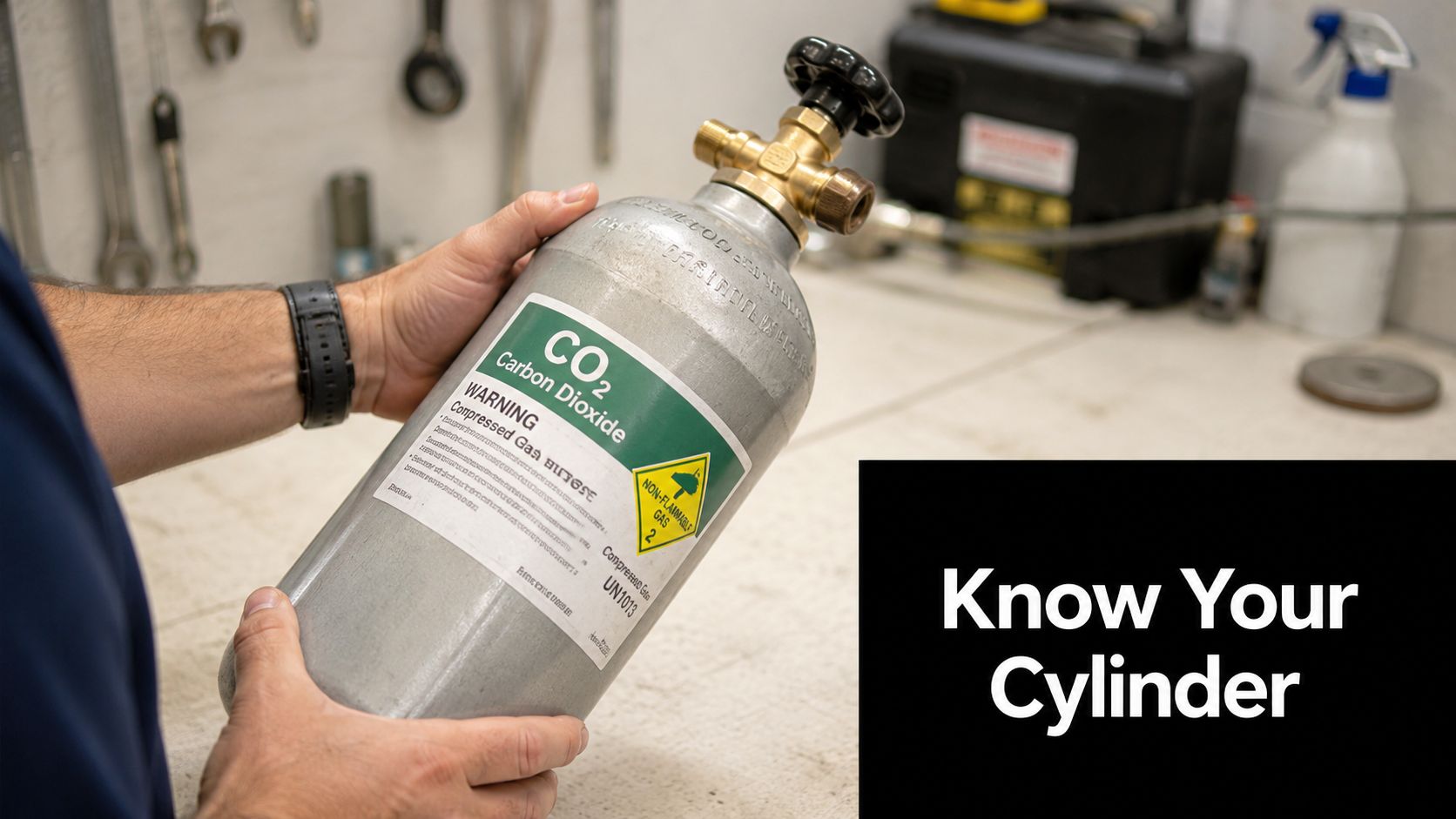
Before you leave the house, pick up the bottle and inspect it properly. This step is often rushed, and it's the reason many refill runs fail. A quick look at the body, valve, and date stamp will tell you whether you're ready to go or whether you need a different plan.
Check the bottle type first
Not every cylinder sits in the same category. In Melbourne homes, you'll commonly see small appliance-style bottles, SodaStream-compatible cylinders, and the larger bottles used with kegerators, soda systems, and homebrew setups. The common residential refill market also leans heavily toward the 2.6kg size, which accounts for 45% of refill transactions in the Melbourne market according to Hoppers Bubbles.
What matters in practice is simple. A supplier may happily service a standard homebrew bottle but decline a proprietary cylinder from a branded appliance system. If the bottle looks unusual, branded, or has a non-standard valve arrangement, call before driving.
Find the test date stamp
The stamp is the detail that matters most. It's usually pressed into the cylinder shoulder or neck area. You're looking for the test marking that tells the filler whether the bottle is still within its certification period.
In Australia, older cylinders must be retested on a mandatory 10-year cycle under AS/NZS 2983 standards, and a 2025 report from the Australian Gas Association indicates 28% of CO2 cylinders in private use are overdue for that retesting, which makes them legally ineligible for refill (Sabrewing Supplies).
A clean-looking cylinder can still be refused. Test status matters more than appearance.
Look at the valve and general condition
You don't need to be a gas fitter to do a basic pre-check. Look for obvious thread damage, bent valve hardware, deep corrosion, fresh impact damage, or signs the bottle has had a hard life in the shed. If the handwheel feels rough or the outlet thread looks chewed up, expect questions at the counter.
A useful pre-visit routine is:
- Read the stamp: Confirm the cylinder is still in test.
- Check the valve closes properly: Turn it fully off before transport.
- Inspect the body: Surface wear is one thing. Major dents and rust are another.
- Note the size and brand: That helps when you call a supplier.
If you do that at home, you avoid most of the common knock-backs.
Finding the Right Local Supplier in Melbourne
A supplier can have CO2 in stock and still be the wrong place to go.
Around Melbourne, the deciding factor is use case. A kegging setup, a soda system, a planted aquarium, and a workshop bottle do not always belong in the same service stream. If you need gas for anything you drink, start by asking for food-grade CO2 and ask the staff to confirm they handle beverage-service cylinders. If they hesitate, move on.
A rough price check helps too. Melbourne refill pricing is commonly quoted by the kilo, and homebrew shops often sit in the same general band seen at suppliers such as Supagas CO2 cylinder services. The exact figure matters less than whether the quote includes a refill, a swap, a bottle inspection, or a test-related refusal at the counter.
Melbourne CO2 Supplier Comparison
| Supplier Type | Best For | Grade | Things to Check |
|---|---|---|---|
| Homebrew shop | Kegerators, soda systems, home bar setups | Usually food-grade | Ask whether they refill, swap, or both, and which bottle sizes they accept |
| Aquarium supplier | Aquarium CO2 and some smaller home setups | Varies by supplier | Confirm bottle compatibility and whether they handle your regulator style |
| Industrial gas supplier | Workshop, trade, mixed-use users | Can vary between industrial and food-grade streams | Confirm the gas is suitable for beverage use before committing |
| Specialist local gas outlet | Regular refill users who want a straightforward counter process | Often application-specific | Check opening hours, inspection requirements, and exchange stock |
Food-grade versus industrial matters
This catches people out all the time.
Industrial CO2 may be fine for welding or other non-beverage jobs, but that does not make it the right choice for beer, sparkling water, or post-mix use. Good Melbourne suppliers will answer this plainly. They will tell you whether the gas is food-grade, whether your bottle can stay in beverage service, and whether they refill your exact cylinder type or only exchange approved bottles from their own pool.
Homebrew-focused shops are usually easier to deal with for this reason. The staff see kegerator bottles every day. They know common sizes, regulator fittings, and the usual questions about carbonation, leak checks, and swap stock.
Where local habits help
Melbourne buyers often get better results in brewing corridors and outer-metro trade strips where staff are set up for walk-in gas work, not general retail. KegLand lists its retail store at 410 Princes Highway, Noble Park North, which is the sort of location that suits same-day errands and counter checks.
That requirement is one reason local searching works better than broad e-commerce searching. A proper gas supplier still needs to sight the bottle, check its condition, and confirm it is in test before filling or swapping. That is also why it makes sense to ring ahead and ask direct questions instead of assuming every shop that sells fittings also fills cylinders.
If you are combining the trip with other maintenance jobs, a local guide for spare parts near me can save an extra drive across town.
Questions worth asking before you drive
A two-minute phone call can save a wasted trip. Ask these in plain language:
- Is your CO2 food-grade for beverage use?
- Do you refill customer-owned bottles, or swap only?
- What bottle sizes do you accept in-store?
- Will you handle my cylinder brand and valve type?
- Do you refuse out-of-test bottles on the spot?
- What are your cut-off times for same-day service?
Clear answers usually mean the counter process will be straightforward.
Vague answers usually mean delays, arguments, or a drive home with the same empty bottle.
The Refill vs Exchange Decision
You arrive with an empty bottle, hoping for a quick turnaround, and the counter staff ask a simple question. Refill your cylinder, or swap it for a full one from the cage. That choice affects turnaround time, test-date certainty, and sometimes gas suitability for the job.
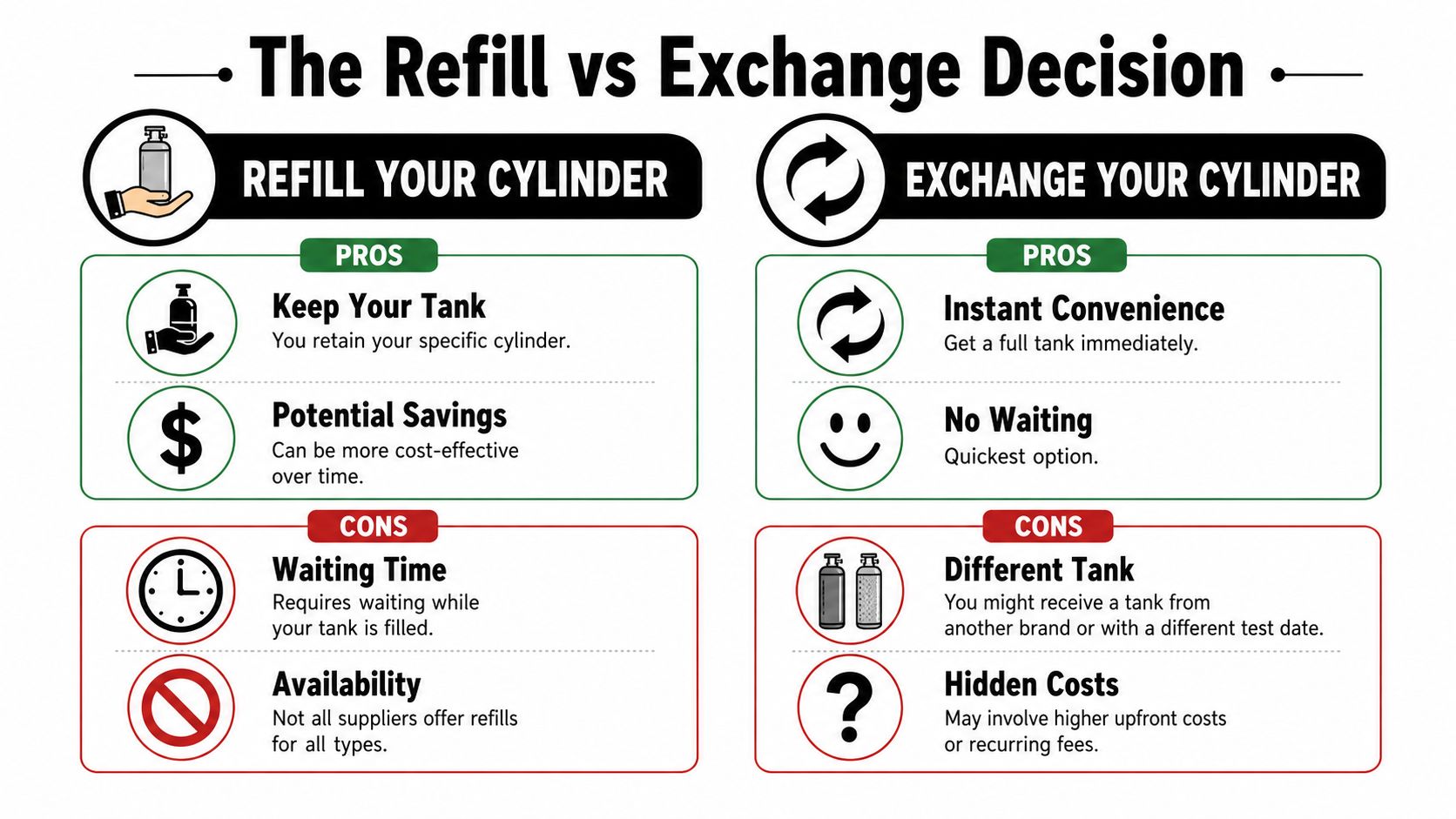
For Melbourne buyers, the right answer depends on what the bottle is doing. Beverage setups usually call for closer checking of gas grade and cylinder condition. Workshop or industrial use can be more flexible, provided the cylinder is approved, in test, and accepted by the supplier. BOC's gas cylinder size guide is a useful reference for common bottle sizes and typical applications if you are still working out where your setup fits.
Refill suits owners who want to keep control of the bottle
A straight refill is usually the better option if your cylinder is clean, recently tested, and already matched to your regulator and storage space. I generally recommend it for customers who know their bottle history and want to keep it that way.
There are practical reasons for that. You keep the same valve feel, the same stamping, and the same physical bottle that already fits your bracket or kegerator layout. That matters more than it sounds, especially in tighter installs or mobile setups like a caravan gas hot water heater system where clearance and bottle dimensions can affect access.
Exchange suits urgent jobs
Swap-and-go is often faster. If the keg is down, the soda setup is empty before guests arrive, or the workshop needs gas back on the same day, exchange usually gets you moving sooner.
The trade-off is straightforward. The replacement cylinder may be older-looking than yours, from a different brand pool, or closer to its next test date. That is not automatically a problem, but it is worth checking the stampings and general condition before you accept it.
What I suggest in practice
For a standard home or small business setup, exchange is often the quickest fix. For a newer customer-owned bottle, or any cylinder you specifically want to retain, ask for a refill and expect a bit more waiting.
Use this quick rule set:
- Choose refill if you want to keep your own cylinder, know its history, and it is in test.
- Choose exchange if speed matters most and you are comfortable accepting a serviceable equivalent bottle.
- Stop and ask questions if the replacement cylinder's test markings are hard to read, the valve looks damaged, or the supplier cannot clearly confirm the gas grade for your use.
Safety First Preparing and Transporting Your Cylinder
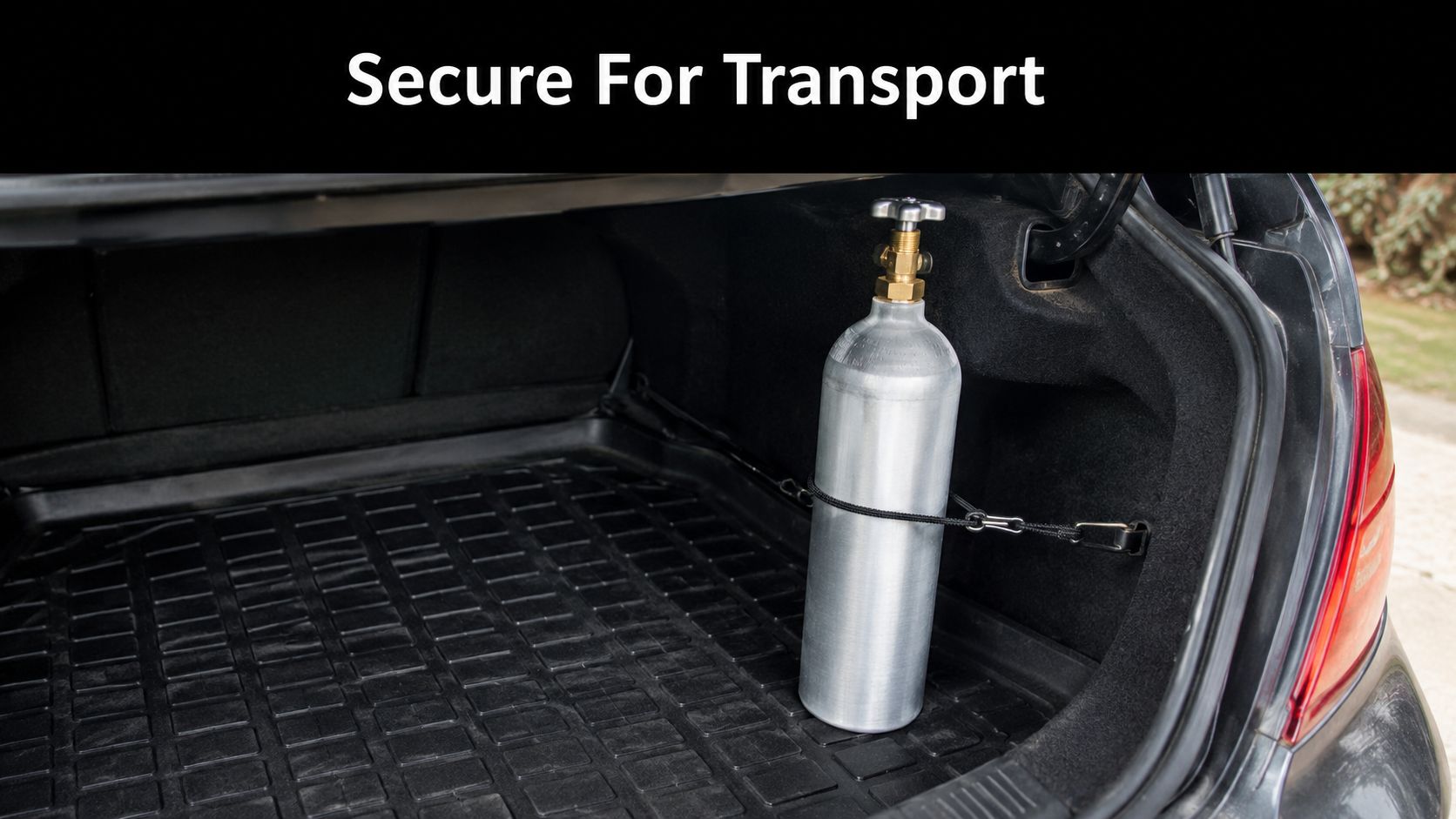
The safest refill trip starts before the bottle reaches the car. Turn the valve fully closed, check that nothing is still attached, and treat the cylinder like pressurised equipment, not shed clutter. A loose bottle in a vehicle is a bad habit and a preventable one.
Australian refill practice is strict for a reason. A mandatory visual inspection is required before refill or swap, and that inspection requirement is one reason refill services aren't sold as simple online transactions. The process keeps consumers tied to physical locations such as The Brew Barn in Melbourne, where the cylinder can be checked in person before service (The Brew Barn gas supply and refill information).
What to do before the drive
The bottle should travel upright if possible and be secured so it can't roll or tip. In a car, that usually means wedged firmly in the boot or footwell with restraint, not loose on a seat. If the valve gets struck, the consequences can be serious.
A sensible routine looks like this:
- Valve off: Turn it fully closed before lifting the bottle.
- Regulator removed if practical: Fewer protruding parts means less chance of damage.
- Bottle upright: Keep it stable during transport.
- No rolling around: Use straps, towels, or cargo restraints.
Workshop habit: If you'd be annoyed hearing the cylinder knock once in a corner, it isn't secured well enough.
Why online refill ordering doesn't exist the way people expect
People often ask why they can't just book a refill online like any other consumable. The answer is safety and compliance. The filler must inspect the actual bottle for damage, corrosion, and eligibility before service. That can't be done properly through a checkout page.
For practical gas handling around mobile and compact systems, the same mindset applies in other equipment categories too. If you work with portable hot water or gas appliances, the transport and connection discipline is similar, which is why guides on a caravan gas hot water heater are worth reading alongside cylinder safety habits.
A quick visual refresher
This short clip is useful if you want a visual sense of handling and setup basics before your next refill run.
What the counter staff will look for
Don't expect the inspection to be a formality. Staff will usually look at the overall condition, the markings, and whether the bottle is acceptable for their system. If they reject it, ask why. A good operator will usually tell you whether the issue is test status, condition, bottle type, or service limitations.
That answer matters because it tells you whether the fix is retesting, replacing the bottle, or going to a more suitable supplier.
Your Melbourne CO2 Refill Checklist and Final Tips
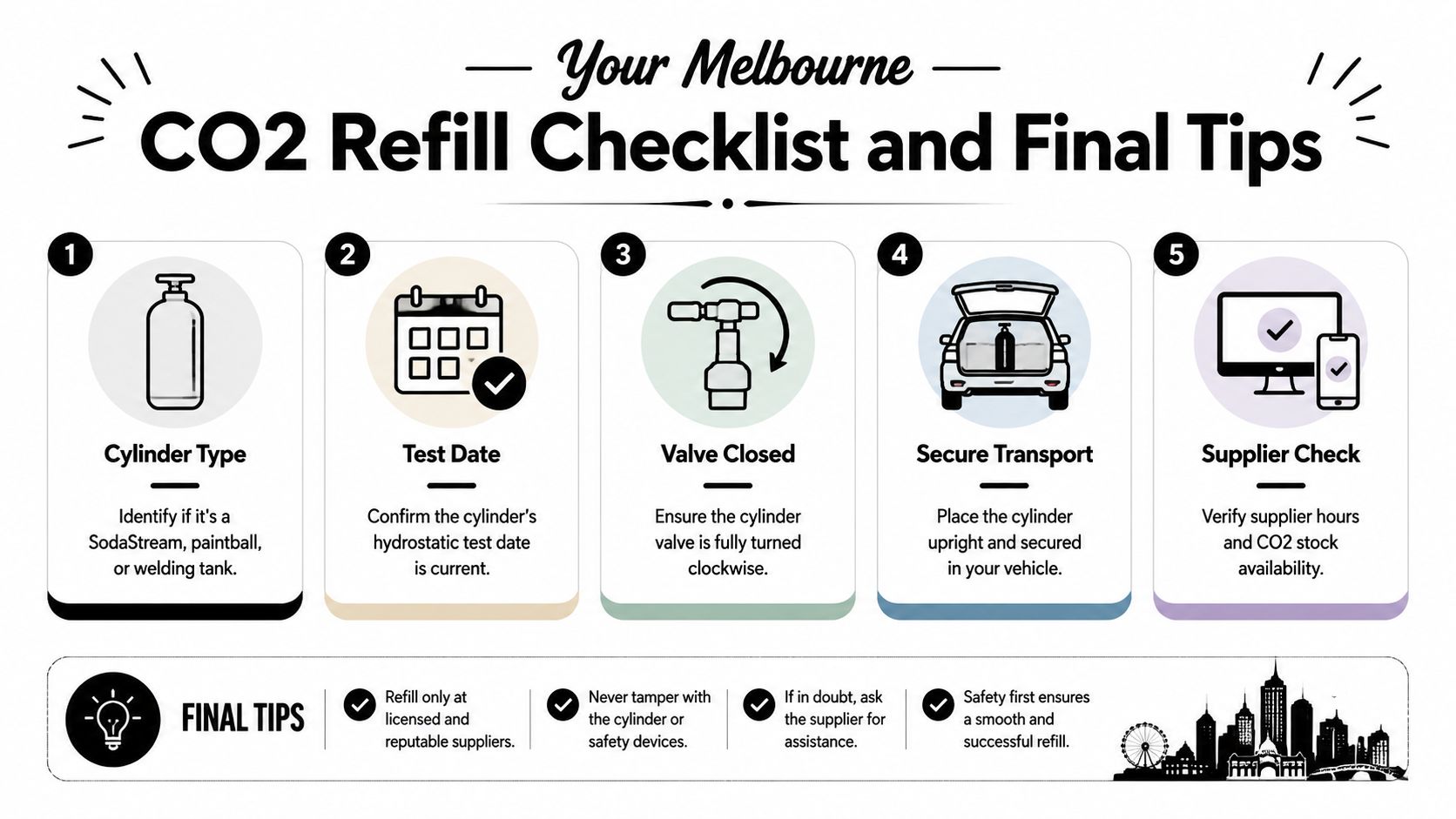
By the time one searches for CO2 refills near me, they're often already in a hurry. That's when mistakes happen. A better approach is to treat the refill like a short pre-flight check. Two minutes at home can save an hour on the road.
The checklist that prevents wasted trips
- Cylinder identification: Know whether you've got a standard homebrew bottle, a smaller appliance cylinder, or something more specialised.
- Test status: Check the stamped date before you load the car.
- Correct gas stream: For drinks, confirm the supplier handles food-grade CO2.
- Transport prep: Valve closed, bottle stable, no loose gear in the car.
- Phone confirmation: Call first and ask whether they've got stock or can service your exact bottle.
Final local advice
The most reliable Melbourne refill runs usually happen mid-day, not right before closing. Staff have more time to inspect the bottle properly, explain your options, and deal with oddball cylinders if needed. If your bottle is old, unusual, or branded for a specific machine, calling ahead isn't optional.
One last practical tip. Keep a photo of the cylinder stamp and valve on your phone. If you're unsure where to go, you can send or describe it when you ring the supplier. That single habit prevents a lot of guesswork.
If you need broader help with water, appliance, or replacement component questions around Melbourne, the team at Ring Hot Water contact page is a practical place to start.
If you need help with boiling, chilled, or filtered water systems in Melbourne, Ring Hot Water can help with supply, servicing, repairs, and genuine spare parts. They support homes, offices, hospitality sites, and trade buyers with practical advice and fast local support.

