
Uncategorized
Caravan Gas Hot Water Heater: Your Essential AU Guide 2026
May
Free camping sounds romantic until the first cold rinse at the end of a dusty day. You've found a quiet spot, the battery is healthy, the fridge is humming, and then the shower turns the mood. Either the water never gets warm, it runs out too fast, or the whole hot water unit starts behaving like it has a mind of its own.
That's usually the point where a caravan owner stops thinking about hot water as a luxury and starts seeing it as core equipment. A caravan gas hot water heater changes how usable the van feels, especially in Australia where many trips alternate between off-grid camping, regional parks, and long driving days with no interest in boiling kettles just to wash up.
The catch is that these aren't simple comfort appliances. In Australian conditions, they sit right at the intersection of convenience, gas compliance, ventilation, and carbon monoxide risk. That matters more than glossy product brochures and more than generic buying guides written for other markets.
The End of the Cold Caravan Shower
A lot of new owners start the same way. They rely on short bursts of park facilities, a kettle, or a very optimistic idea of what “quick shower” means after a beach day, muddy track, or cold inland morning. It works for a trip or two. Then the compromises get old.
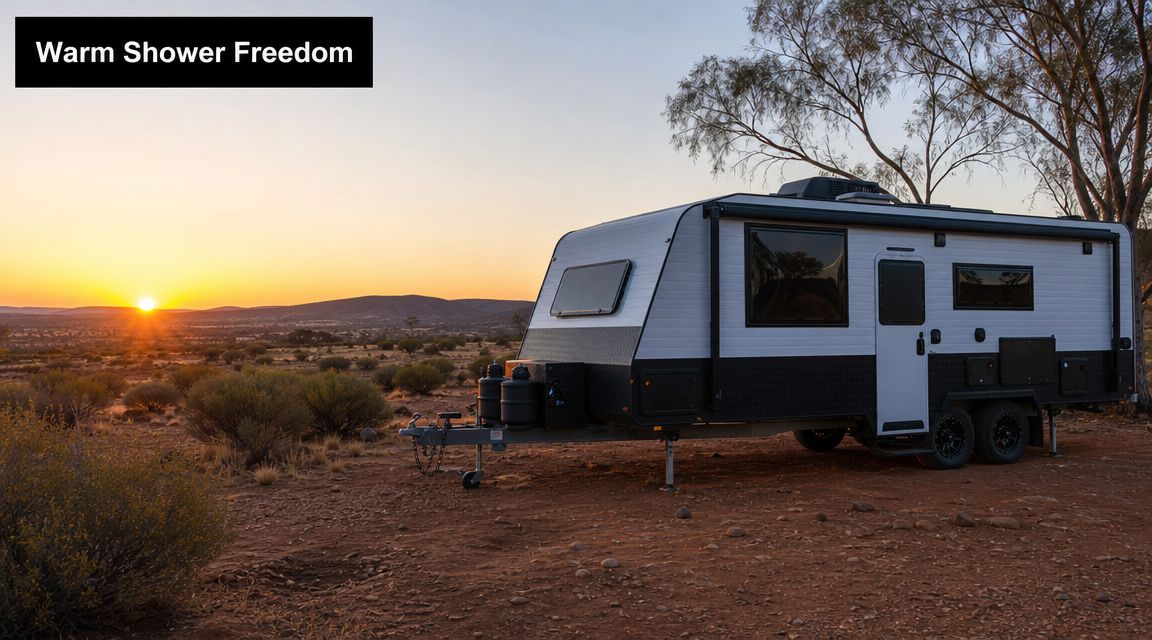
Gas hot water changed caravanning because it made the van more self-sufficient. You can stop thinking in terms of “Can we manage tonight?” and start thinking in terms of “Is the water tank full and the gas on?”. For washing up after dinner, rinsing kids off, or getting two adults through back-to-back showers, that's a major difference in day-to-day comfort.
Why gas still matters in Australia
Australia's travel pattern makes gas particularly practical. Many van owners don't stay in one style of campsite. One week might be a powered site. The next might be a roadside stop, bush camp, or beachside free camp where 240V isn't part of the equation.
That's where a gas heater earns its keep. It gives you hot water without tying the whole setup to mains power.
Workshop reality: The owners who value their hot water system most aren't always the full-time travellers. They're often weekend users who want the van ready to work properly the moment they pull up.
It's comfort, but it's also a system
A caravan gas hot water heater isn't just about showers. It affects how you pack, how long you can stay off-grid, how much LPG you carry, and how you manage your morning routine. It also affects safety, because the same unit that makes life easier uses combustion, venting, and regulated gas supply.
That's the part too many guides skip. In a caravan, hot water isn't separate from compliance. The two come together every time the burner lights.
How Your Gas Hot Water System Works
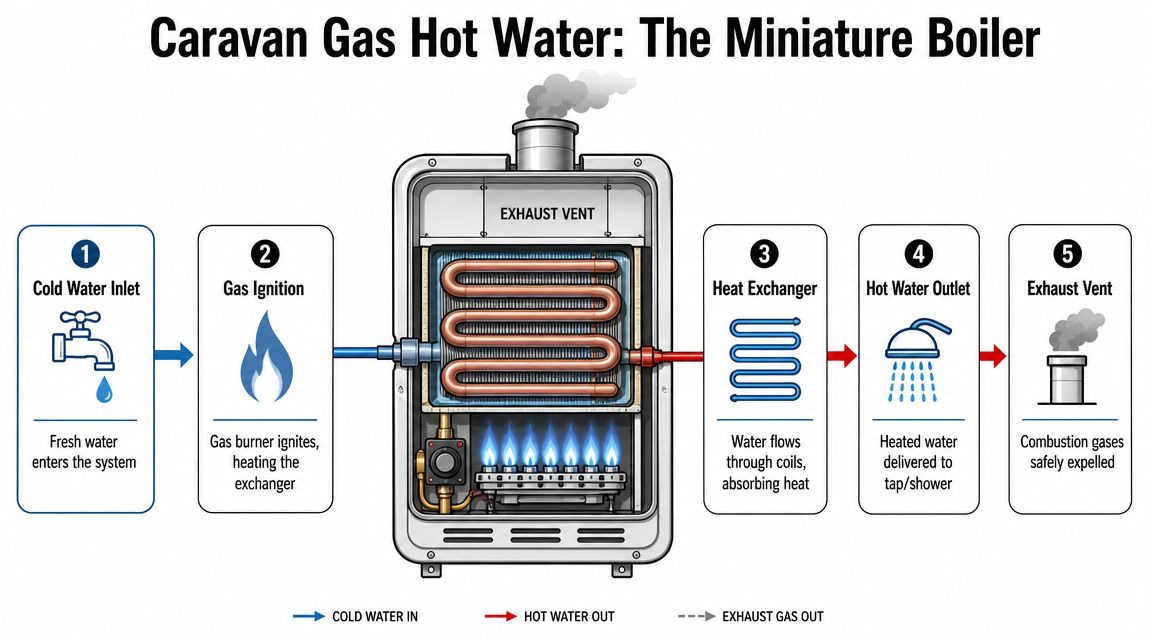
Think of the unit as a miniature storage boiler mounted into the van. It stores water, heats it with LPG, and controls the cycle with ignition and temperature components so you don't have to stand outside managing a flame by hand.
The basic heating cycle
In plain terms, the sequence looks like this:
- Cold water enters the unit. Your pump or mains supply feeds water into the heater tank.
- The ignition system lights the burner. Most caravan units use a 12V ignition/control setup to start the gas burner.
- The burner heats the water through the exchanger and tank body. That's where the LPG does the work.
- A thermostat controls temperature. Once the target temperature is reached, the burner cycles off.
- Hot water is delivered to the tap or shower. When you draw off hot water, the tank refills and the process repeats as needed.
A short visual makes that easier to grasp:
LPG, propane, and regulator pressure
In everyday caravan talk, people often say “gas” for everything. What matters in practice is that the appliance receives the correct LPG supply and pressure. If pressure is off, the heater can fail to ignite, burn poorly, or produce weak performance that looks like a heater fault when the underlying problem is upstream.
A practical benchmark from Australian caravan guidance is about 1.3 kg/hour gas consumption, which means a standard 9 kg LPG cylinder gives roughly 7 hours of continuous heater runtime, and reliable operation depends on regulator pressure near 2.8 kPa. Low pressure, blocked burners, or line obstructions can stop ignition or reduce output even when the appliance itself is mechanically sound, according to Australian caravan hot water system guidance from My Generator.
What new owners often miss
The heater doesn't work alone. It depends on several other caravan systems all doing their job:
- Gas supply: The bottle must be on, contain fuel, and feed through a healthy regulator.
- Water flow: No water, airlocked lines, or poor pump performance can all create symptoms that feel like heater failure.
- 12V power: Even gas units commonly need low-voltage power for ignition and controls.
- Venting: Combustion gases must leave the van correctly. That isn't optional.
If a gas hot water unit won't light, don't jump straight to replacing parts. Check fuel, pressure, 12V power, and water flow first. Faults often start outside the heater.
Choosing the Right Size and Capacity
Size questions usually sound simple, but they're really usage questions. A solo traveller washing up once a day has very different expectations from a couple doing morning showers, and different again from a family trying to run through everyone before heading out.
What most caravan units look like
In Australia, most caravan hot water systems are compact storage units in the 10 to 14 litre range, and that's generally enough for two people to shower one after the other. Some models also use residual heat to lift stored water from 60°C to about 70°C after switch-off, so usable performance depends on more than just tank size, as noted in Truma's caravan and motorhome water heater guide.
That last point matters. Two heaters with similar tank volume can feel different in real use if one manages heat retention and recovery better.
Match the heater to your travel pattern
A simple way to think about capacity is by routine, not by brochure language.
| Travel style | What usually matters most | What tends to work |
|---|---|---|
| Solo or couple, short trips | Fast wash-up, one or two showers, compact install | Standard compact storage unit |
| Couple touring regularly | Reliable back-to-back use, manageable gas use | Storage unit with solid recovery and easy controls |
| Family use | Recovery speed, disciplined shower habits, smart water use | Larger-capacity option or system choice based on how often hot water is drawn |
Tank size isn't the whole story
New buyers often fixate on litres. In practice, recovery rate is what determines whether the system feels generous or frustrating. A modest tank with good heating behaviour and sensible shower habits can outperform a larger tank used wastefully.
Look at these practical questions before buying:
- How many consecutive users? Two adults showering back-to-back is different from several family members expecting home-style hot water.
- How do you camp? If you mainly wash up and take short showers, a compact unit usually makes sense.
- How patient are you? Some owners don't mind timing showers around reheating. Others want the system ready again quickly.
- How much space do you have? Caravan layout often limits the decision more than wishlist features.
Bigger isn't automatically better in a van. A heater that fits the cupboard, gas setup, and water habits properly will usually outperform an oversized choice that complicates the installation.
Comparing Gas, Electric, and Dual-Fuel Heaters
If capacity is one half of the buying decision, energy source is the other. This is where travel style really decides the answer. The right heater for a powered-site traveller can be the wrong heater for someone who spends most nights off-grid.
Where each system makes sense
Gas-only systems suit owners who value independence. If your caravan regularly stops where 240V isn't available, gas remains the straightforward answer. It's practical, proven, and doesn't depend on a powered bollard to get hot water happening.
Electric-only systems make sense in more fixed conditions. If the van lives mostly in caravan parks or permanent setups with mains power available, electric heating can be perfectly workable. For mixed touring in Australia, though, it's limiting.
Dual-fuel systems sit in the middle. They let you run on gas off-grid and use 240V when you're plugged in. That flexibility is the reason many owners end up there, especially if they alternate between free camping and park stays.
Heating time and convenience
Modern dual-energy models add a real convenience advantage. Current Australian comparison content notes that a unit may take around 28 minutes to heat on one source, but about 20 minutes when both gas and 240V are used together, which is useful at powered sites where you want quicker recovery and less waiting, as discussed in this Australian caravan water heater comparison video.
That doesn't mean dual-fuel is always the better buy. Extra capability can also mean extra complexity, more components, and a higher expectation that the van's electrical side is in good order.
Gas vs. Dual-Fuel Heaters Which is Right for You
| Feature | Gas-Only System | Dual-Fuel Gas + 240V System |
|---|---|---|
| Best fit | Frequent free camping | Mixed travel between free camping and powered sites |
| Off-grid use | Strong | Strong |
| Powered-site convenience | Limited to gas operation | Can use 240V, gas, or both depending on model |
| Heating flexibility | Simple | More versatile |
| System complexity | Lower | Higher |
| Decision trigger | You want independence and simplicity | You want one heater that adapts to different campsites |
What works and what doesn't
Gas-only works well when you want fewer variables. Turn on the gas, confirm supply, heat water. That simplicity matters in remote travel.
Dual-fuel works well when you use both modes. If you spend time in parks, being able to lean on site power is practical.
What doesn't work is buying dual-fuel just because it sounds more advanced, then never using the electric side. In that situation, you've paid for flexibility you don't need.
Installation and Footprint Essentials
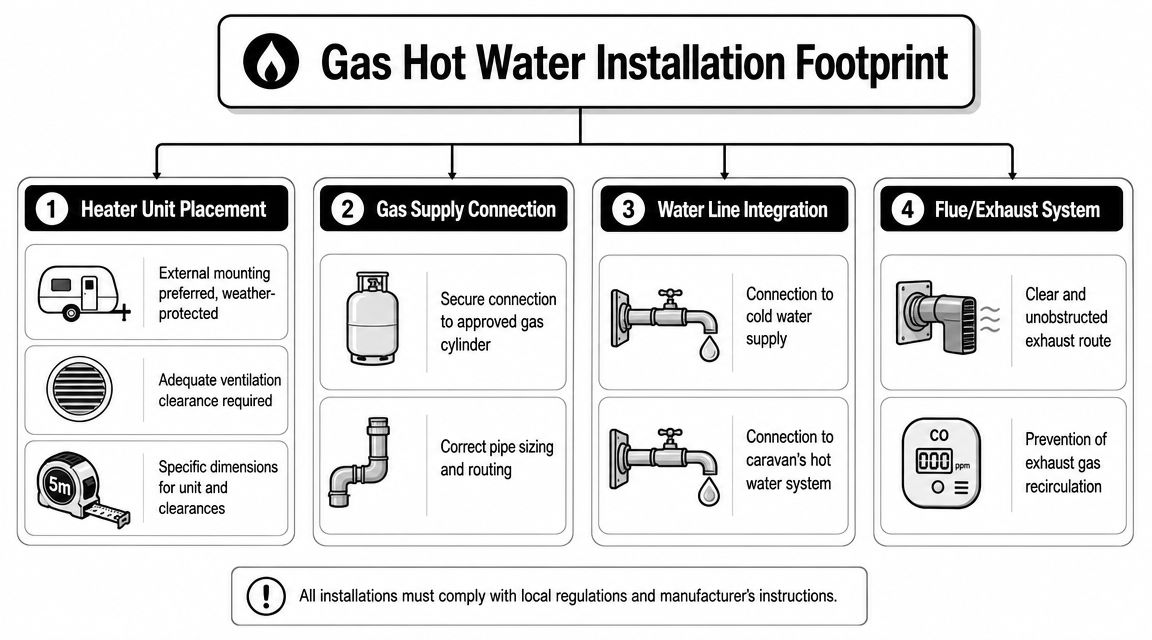
A caravan heater install always looks easier in photos than it does in the workshop. The challenge isn't just fitting the box. It's fitting the box, the water lines, the gas connection, the service access, the venting path, and the surrounding clearances without creating future servicing headaches.
Where the unit usually goes
Most caravan gas hot water heaters are mounted against an external wall with an external access door or service opening. That layout gives the technician access to the burner side, flue area, and serviceable parts without dismantling half the van interior.
Before choosing a replacement or retrofit, check these points:
- Wall position: The van needs a practical external mounting location.
- Internal depth: Cupboards, framing, or adjacent equipment can limit what fits.
- Service access: A heater that technically fits but can't be serviced cleanly is a poor install.
- Flue path and drainage: The venting arrangement has to suit the appliance and caravan wall construction.
Plumbing and electrical needs
Even a gas unit is never just gas. It needs water in, hot water out, and a low-voltage electrical supply for ignition and control components. Owners planning an upgrade often also need to consider whether the current pump and line layout are suitable.
For caravans where flow stability is part of the wider water setup, it helps to understand how the pump side supports the heater. This guide to a 12 V water pump for caravan systems is useful background before discussing a full heater replacement with your installer.
Questions worth asking before you book the job
A good installer will already be thinking about these, but owners should ask them too.
| Check | Why it matters |
|---|---|
| External access available | The unit needs safe service and vent access |
| Water lines in the right area | Reduces awkward rerouting and pressure issues |
| 12V feed nearby | Supports ignition and controls |
| Enough surrounding clearance | Protects nearby materials and helps compliance |
| Space to remove parts later | Makes future maintenance realistic |
A tidy install isn't just about appearance. It's about leaving enough room for safe combustion, correct pipe routing, and the next repair job that will inevitably happen years later.
Critical Safety Rules and Australian Regulations
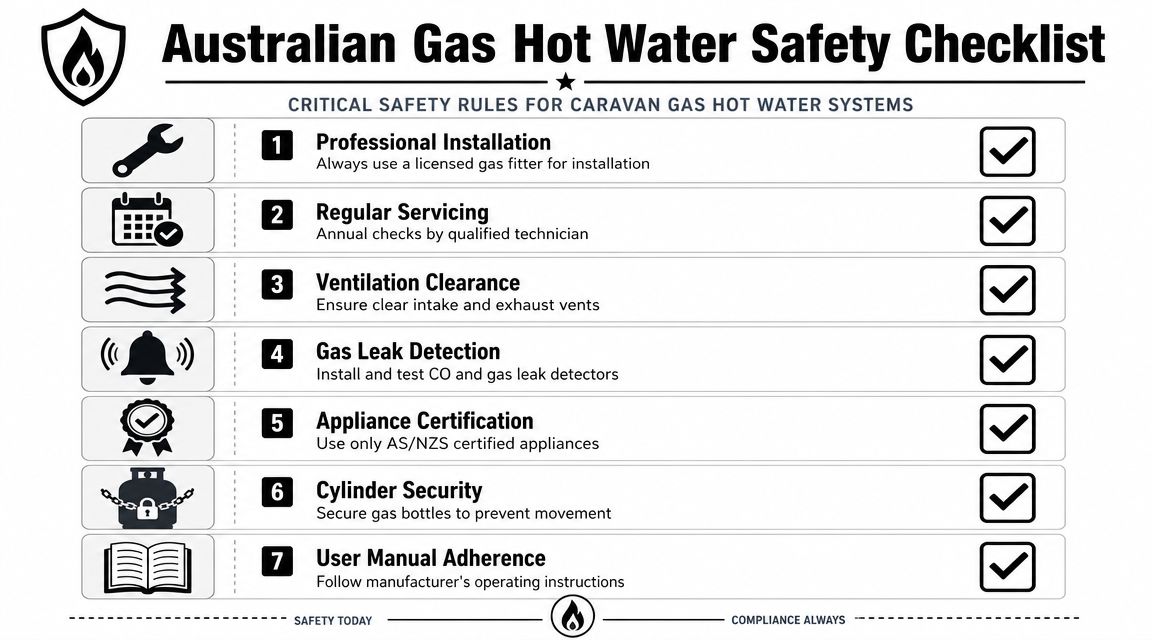
This is the part that matters most. A caravan gas hot water heater is a safety-critical appliance. If it's installed badly, vented badly, or kept in service when it shouldn't be, the risk isn't inconvenience. It's exposure to combustion gases, including carbon monoxide.
Carbon monoxide risk is real, not theoretical
In Australia, a major recall covered 18,139 Suburban Recreational Vehicle Water Heaters sold across all states and territories. The affected units were manufactured between 4 April 2018 and 1 August 2019, and the ACCC warned owners not to use the heaters in gas mode because they may produce unsafe levels of carbon monoxide. The recall covered several model lines including SW6DEA, SW6DA, SW4DEA, SW4DA, SW4DECA, SW6DECA and SW6PA, according to the ACCC recall notice for faulty caravan and motorhome water heaters.
That single recall should end any idea that caravan hot water safety is a minor issue. These units are common, widely installed, and capable of becoming dangerous when faults develop.
Clearance, venting, and LP gas operation
Queensland's safety regulator has also issued an alert for Suburban recreational vehicle water heaters, warning owners of caravans, motorhomes and camper trailers about a potential safety risk while operating these appliances on LP gas. Product guidance for this category stresses correct clearances, venting, and drainage, including keeping combustibles at least 25 mm away and maintaining the flueway in a frost-free, downward-draining configuration, as set out in the Queensland safety alert on LP gas caravan water heaters.
Those are not optional preferences. They are the difference between safe combustion and unsafe operation.
The practical rules owners should treat as non-negotiable
- Use licensed gas work only: Don't treat a caravan heater like a DIY camping accessory. Gas appliance installation and rectification need qualified hands.
- Stop using recalled units immediately: If your model and serial details match a recall notice, don't test it again “just to see”.
- Keep venting unobstructed: Covers, debris, insect nests, and poor mounting can all interfere with combustion and exhaust.
- Respect clearance requirements: If nearby wall linings, insulation, or stored items are too close, the install needs correction.
- Separate fault-finding from guesswork: A heater that won't ignite may be a simple supply issue, but a heater producing unsafe combustion is a different problem entirely.
Unsafe combustion often gives owners very little warning. Don't rely on smell, noise, or “it seems okay” as a safety check.
If you want a broader overview of Australian gas safety regulations compliance before speaking with a technician, that resource helps frame the legal and practical side of gas appliance work.
Pressure control also matters elsewhere in the hot water circuit. If you're sorting out the plumbing side around relief and control components, this explanation of a pressure limiting valve helps clarify where that fitting sits in the wider system.
Maintenance, Troubleshooting, and Spare Parts
Once the heater is installed properly, ownership gets easier. Most long-term problems start with neglected basics: dirty burners, blocked flues, tired valves, scale, corrosion, or a unit that sat unused for months and then got asked to work flawlessly on a holiday weekend.
A sensible owner checklist
These are the checks worth building into your routine:
- Flush the tank periodically: Sediment and debris reduce efficiency and can shorten component life.
- Inspect the flue opening: Mud daubers, spiders, and road grime can interfere with burner performance and exhaust flow.
- Check the sacrificial anode if your model uses one: It protects the tank from corrosion and should never be forgotten.
- Exercise valves and look for drips: Relief valves and related fittings can begin to seep or stick.
- Look over hoses and connections: Water leaks around fittings often get noticed late because they start small.
Common faults and what they usually point to
No hot water doesn't always mean the heater itself has failed. Start with the system around it.
| Symptom | Often worth checking first |
|---|---|
| No ignition | Gas supply, regulator behaviour, 12V power |
| Burner lights but poor heating | Burner cleanliness, gas supply quality, water demand |
| Hot water runs out too quickly | User expectations, tank recovery, mixing habits |
| Drips or discharge | Relief valve behaviour, pressure control, plumbing condition |
For broader fault patterns on RV units, this expert guide for RV water heater troubleshooting is a useful reference point before ordering parts or booking repairs.
Spare parts that commonly matter
The parts owners ask for most often are usually the ones that wear, protect, or control:
- Sacrificial anodes for corrosion protection
- Thermostats for temperature control
- Pressure relief valves and related water-side safety parts
- Heating elements on models that include electric operation
- Flexible hoses and fittings when plumbing needs repair or rework
Water quality also affects maintenance intervals and general system cleanliness. If you're refining the whole caravan water setup, this guide to the best water filter for caravan use is worth reading alongside heater maintenance planning.
If you need parts, fittings, or practical advice for a caravan hot water setup, Ring Hot Water supplies caravan and RV hot water products, replacement components, and related water system hardware Australia-wide, with Melbourne-based installation and repair support for local customers.

