
Boiling Hot Water Tap
Hot Water Urn

Apr
Hot Water Urn Guide for Melbourne Homes & Offices
You’re probably reading this because the kettle routine has started to annoy everyone.
In a small office, it’s the queue at morning tea. In a canteen, it’s the staff member who keeps topping up boiling water instead of serving customers. At home, it’s the same cycle of boil, pour, wait, repeat when family or guests all want a hot drink at once. A hot water urn solves that bottleneck by keeping a larger volume of water ready to dispense, without turning every tea round into a job.
In Melbourne, the right urn can save bench time, reduce fuss during busy periods, and make hot drinks feel organised instead of improvised. The wrong one does the opposite. It sits in the way, struggles to recover after a rush, scales up too quickly, or costs more to run than it should. That’s why choosing one isn’t just about litres on a product label. It’s about how you use hot water, where you use it, and how much maintenance you’re willing to do.
What Is a Hot Water Urn and Why You Need One
A hot water urn is a storage-and-dispense appliance built to hold heated water ready for use. It’s not just a larger kettle. A kettle boils one batch, then stops. An urn is designed for repeated pouring over time, which is why it suits offices, church halls, sports clubs, waiting rooms, staff kitchens, catering setups, and homes that regularly serve several people at once.
That difference matters in practice. If you’ve got ten people waiting on one domestic kettle, the bottleneck isn’t the water itself. It’s the repeated boil cycle. An urn removes most of that friction by keeping hot water available from a tap.
Australian venues worked this out a long time ago. Hot water urns became common in commercial kitchens and hospitality venues from the mid-1960s, and by 1970 over 65% of Melbourne’s 1,200 licensed cafes used urns with capacities of 10 to 40 litres, cutting refilling time by 40% compared with kettles according to Australian Hotels Association archive material referenced here.
That history still lines up with modern use. If you need to serve many cups from one point, an urn is often the simplest tool.
A kettle suits bursts. A hot water urn suits flow.
There’s also a practical middle ground where urns beat more expensive built-in systems. A plumbed boiling tap is neat and permanent. A portable urn is flexible. You can move it for events, store it when you don’t need it, and set it up without changing joinery.
For people organising functions, temporary kitchens, school events, or community gatherings, it also makes sense to look at broader catering equipment for hire options so the hot water setup matches the rest of the service plan.
Choosing Your Urn Type and Capacity
A good urn choice starts with one practical question. Will this unit live in one spot every day, or will someone need to move it, store it, refill it, and set it up again next week?
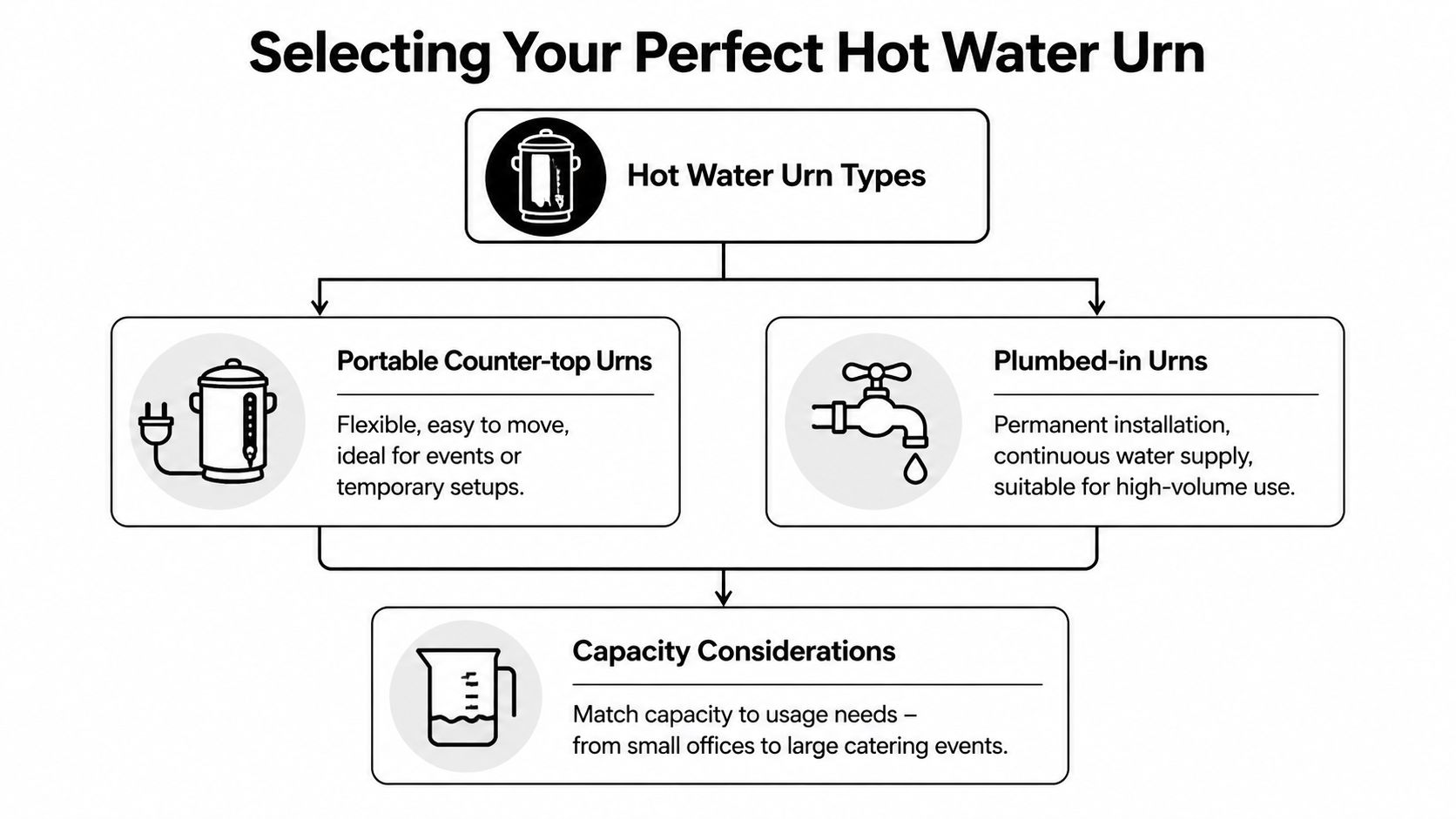
I see Melbourne buyers get this wrong in both directions. Some buy a large portable urn for a fixed staff kitchen and get tired of lifting, filling, and cleaning it. Others install a permanent unit for occasional use, then realise a simple benchtop model would have done the job for less money and less installation work.
Portable counter-top or plumbed-in
A portable counter-top urn suits sites where demand moves around or only appears at certain times. School functions, church halls, meeting rooms, market stalls, home entertaining, and temporary service areas all fit that pattern. You fill it manually, plug it into a suitable outlet, and put it where the crowd is.
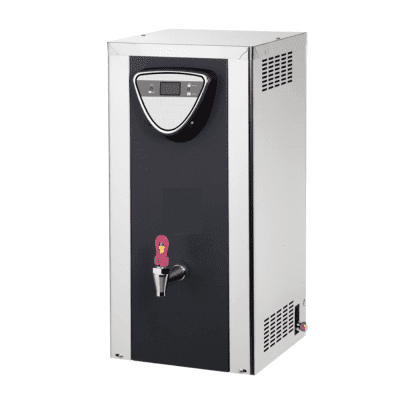
A plumbed-in urn or fixed boiling unit suits repeat demand in a permanent location. Staff kitchens, hospitality prep areas, medical waiting rooms, and busy office breakout spaces benefit because nobody has to top it up by hand. It behaves more like part of the building services than a portable appliance.
Bench space matters too. A large urn can take up more working room than buyers expect, especially in small commercial kitchens where every clear patch of bench already has a job.
Use this shortlist.
- Choose portable for occasional service, changing layouts, hired venues, or events.
- Choose plumbed-in for daily use in the same position.
- Choose a wall-mounted or under-bench boiling system if space is tight and the site justifies a permanent setup.
Match litres to actual service
Capacity is easier to judge if you stop thinking in litres and start thinking in rounds of drinks.
A small urn works well when people make drinks in short bursts, then leave it alone for a while. A larger urn suits sites where cups keep coming one after another and nobody wants to stop to refill. As noted earlier, small domestic-style units are usually suited to light home or office demand, while 30L class commercial units are built for heavier service.
That difference shows up quickly in real settings. A family brunch for eight is one pattern. A community hall serving tea after a meeting is another. A staff room after a training session is different again.
| Use case | Better starting point | Why |
|---|---|---|
| Home kitchen with regular guests | 5L to 10L | Enough for several rounds without swallowing the bench |
| Small office tea station | 5L to 10L | Handles short peaks without the size of a full commercial unit |
| Club canteen or community hall | Larger portable urn | Better for group service where refill runs become disruptive |
| Hospitality pass or event service | 30L class unit | Suits repeated pours during busy periods |
Size for the rush, not the lull
Peak demand is the part that catches buyers out.
An urn can seem perfectly adequate at 10 am, then struggle badly at 11:15 when a meeting finishes and twelve people line up at once. Recovery time matters later, but capacity is the first filter. If the vessel empties halfway through the busy spell, staff end up waiting, refilling, and resetting the flow of service.
A practical sizing rule is simple. Choose the smallest urn that can get through your busiest realistic serving window without becoming a refill chore.
That usually means asking a few direct questions:
- How many cups are likely to be poured in a 10 to 20 minute burst?
- Will the urn be topped up by staff, volunteers, or nobody in particular?
- Is there a safe, easy path to a sink for refilling?
- Does the site have the bench space to carry a larger unit properly?
At Ring Hot Water, that is usually where the right answer becomes clear. Homes and light offices often need a modest portable unit. Venues with regular traffic usually save time and frustration with a larger or fixed system.
Bigger is not automatically better. An oversized urn uses valuable space, stores more hot water than you need, and can feel clumsy in daily use. The right unit is the one that matches your busiest normal pattern without turning hot drinks service into a small logistics problem.
Understanding Key Technical Specifications
Capacity gets the first look. Performance decides whether the urn works for your site.
A Melbourne office kitchen can cope with a slower unit if staff make drinks in small waves across the morning. A church hall, clubroom, or staff lunch area cannot. Once people start pouring cup after cup, the important specs are power input, recovery speed, element design, temperature control, and whether the unit suits the power supply and water conditions on site.
Power rating and recovery time
Power rating affects how quickly an urn heats from cold and how well it keeps up after repeated draws. Recovery time is the practical measure. It is the gap between a busy run of pours and the point where the urn is back at proper serving temperature.
A simple way to picture it is a kettle versus a larger storage tank. Both can give you hot water, but the stronger system catches up faster after you take a lot out at once. That matters in workplaces and venues where people tend to arrive together, not one by one.
Earlier in the article, we covered the typical split between smaller domestic plug-in urns and larger commercial units. The short version is straightforward. Light-duty models are easier to place and usually suit homes, meeting rooms, and occasional service. Higher-powered commercial urns recover faster and handle back-to-back pouring with less waiting.
That trade-off matters more than the glossy finish or the advertised cup count.
Domestic vs commercial hot water urn comparison
| Specification | Domestic urn | Commercial urn |
|---|---|---|
| Typical capacity | Small batch service | Higher-volume service |
| Cups per fill | Suitable for homes and light offices | Better for sustained demand |
| Power supply | Standard plug-in setup in many cases | May draw more current and need closer checking |
| Power rating | Lower | Higher |
| Current draw | Lower circuit demand | Higher circuit demand |
| Best fit | Homes, small offices, light events | Hospitality, canteens, heavy office use |
| Safety features commonly offered | Overheat or dry-boil protection | Boil-dry protection, often with heavier-duty construction |
Concealed element or exposed element
Element style changes the cleaning workload.
A concealed element usually makes more sense for Melbourne homes and shared commercial kitchens because there are fewer exposed surfaces for scale to cling to. That reduces scrubbing time and makes routine descaling less awkward. In areas with harder water or inconsistent maintenance, that can mean fewer nuisance faults over the life of the urn.
An exposed element can still do the job well, but it asks for more discipline. If the unit will be used by different staff, volunteers, or tenants, simpler internals often hold up better in day-to-day use.
Temperature control and build quality
Basic urns boil water and hold it hot. Better units give you more control over the holding temperature, which helps if the urn is being used steadily across the day rather than emptied in one hit. That can reduce excessive cycling and make the water more suitable for tea, instant drinks, and general beverage service.
Build quality shows up in small parts first. The tap starts dripping. The lid loses its firm fit. The thermostat becomes erratic. The body gets too hot to touch. Those are the details that separate a unit that feels dependable after two years from one that becomes a maintenance nuisance after a few months.
Double-skinned stainless bodies are often worth paying for in busy settings. They are usually safer to brush against, lose less heat, and feel less flimsy when the urn is being filled, moved, and cleaned regularly.
If the site has variable mains pressure, or you are comparing an urn with a more permanent boiling water setup, it also helps to understand how a pressure limiting valve affects appliance protection and plumbing performance. It is not the first thing buyers ask about, but it often matters once installation and long-term reliability enter the conversation.
When we assess urns at Ring Hot Water, four checks usually sort the good options from the frustrating ones:
- How quickly does it recover after a heavy round of pours
- Does the site power supply suit the unit comfortably
- How easy is it to descale, inspect, and service
- Do the tap, lid, thermostat, and handles feel built for regular use
Those answers usually tell you how the urn will behave six months from now, not just on the day it comes out of the box.
Installation Plumbing and Safety Compliance
Monday morning in a Melbourne staff kitchen is where bad installation choices show up fast. Someone balances an urn near the bench edge, plugs it into the nearest outlet, and runs the cord across a prep area. By the second refill, the bench is wet, the tap area is crowded, and nobody is quite sure whether the circuit is coping. The urn itself may be simple. The setup still has to be right.
Portable and plumbed-in units need different thinking. A counter-top urn usually suits homes, meeting rooms, club-rooms, and small office kitchens because setup is straightforward and there is no water connection to organise. Many smaller models run from a standard Australian power point and include overheat or dry-boil protection, as noted earlier. That does not remove the need for a sensible location, safe clearance, and a circuit that is not already carrying too much load.
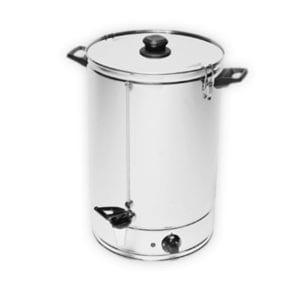
Portable setup done properly
Set the urn on a firm, level bench where the tap can overhang slightly without sitting on the very edge. Leave enough room to fill it, remove the lid, and empty it safely for cleaning. If users have to twist sideways, reach over other appliances, or drag the unit forward each time, the position is wrong.
Three checks prevent a lot of trouble:
- Match the outlet to the urn load so the plug, socket, and circuit are suited to the appliance.
- Keep water away from cords and power points by choosing a dry section of bench and controlling where the tap drips.
- Leave space to service the urn because regular emptying, wiping, and descaling should not be a wrestling match.
This matters more in shared spaces. In offices and community venues, the person using the urn is often not the person maintaining it. A forgiving layout reduces spills, burnt fingers, and the slow build-up of mess around the base.
Fixed units and plumbing considerations
Plumbed-in boiling water units are closer to a small built-in hot water system than a portable appliance. They need proper isolation, suitable filtration where water quality calls for it, access for servicing, and enough room around the unit so future repairs are practical. I have seen good units become expensive annoyances because they were wedged into joinery with no thought for filter changes, valve access, or element replacement.
Melbourne water conditions can be hard on heaters, taps, and internal chambers. In some suburbs, scale forms quickly enough to affect performance and shorten service life. Filtration and pressure control are not fancy extras in those sites. They are part of protecting the appliance and keeping maintenance predictable.
Supply pressure also needs attention. If the property has fluctuating mains pressure, or you are comparing an urn with a more permanent boiling water setup, it helps to understand how a pressure limiting valve protects hot water appliances and improves plumbing performance. The part is small. The effect can be the difference between a stable system and recurring drips, noise, or stress on fittings.
Safety features you should insist on
Start with the basics. Dry-boil protection, over-temperature cut-out, a lid that stays secure in use, and handles that do not encourage awkward lifting all reduce the chance of injury. A double-skinned body also helps in busy kitchens because the outer surface is generally safer if someone brushes past it.
Self-serve sites need extra care. Reception areas, church halls, waiting rooms, and lunchrooms all have one thing in common. Users are distracted. Good installation should account for that by keeping the unit stable, visible, and easy to approach without reaching across steam or power leads.
For any fixed commercial-style setup involving plumbing connection, filtration, cabinetry, or electrical assessment, get the job done professionally. At Ring Hot Water, that is usually the point where we can spot whether a site will be easy to live with for years or whether it is heading for repeat callouts over issues that should have been solved on day one.
Cleaning Maintenance and Common Repairs
Most hot water urn failures don’t begin as dramatic failures. They begin as neglect. A bit of scale on the element. A tap that starts to drip. A lid seal that never gets cleaned properly. Water quality and hygiene are what separate an urn that reliably works for years from one that becomes unreliable and unpleasant.
There’s also a health angle people tend to miss. A 2023 NSW Health report documented Legionella cases linked to commercial hot water systems, and a 2025 Victorian Hospitality Association survey found only 29% of Melbourne hospitality businesses test urn water quarterly, as noted in this referenced report page. An urn isn’t just a heating appliance. It’s part of your drinking water chain. If the interior, tap, and surrounding setup aren’t maintained, you’re managing risk badly.
What routine maintenance actually looks like
Good urn maintenance isn’t complicated. It just has to be regular.
Start with the parts that contact water and hands most often. The tap outlet, lid underside, and internal chamber collect residue faster than people realise. If the urn is used in a shared environment, those areas need more attention than the shiny outer body.
A practical routine usually includes:
- Wiping the exterior often so spills, tea splashes, and sticky residue don’t bake on.
- Descaling the chamber on a regular cycle suited to local water conditions.
- Cleaning the tap and spout area because that’s where hygiene lapses often hide.
- Checking seals and fittings for early signs of drips or mineral crust.
Clean the tap assembly as if it were a food-contact surface, because that’s exactly what it is.
Descaling matters more in Melbourne than many owners expect
Scale works like plaque in a pipe. It narrows, insulates, and interferes. On a heating surface, that means the element has to work harder to deliver the same result. On taps and valves, it can affect sealing and flow.
If your urn starts taking longer to heat, sounds harsher when cycling, or leaves visible mineral deposits near seams and outlets, don’t ignore it. Descale it before the problem turns into a component failure.
For owners who want to understand one of the most common electrical faults, this guide on how to test a hot water element is a useful reference point before ordering parts or booking service.
A simple rule helps here:
- Empty the urn safely.
- Clean the interior with a descaling method suitable for the model.
- Rinse thoroughly before returning it to service.
- Check the tap after cleaning, because debris can lodge there.
Common repairs and when to stop DIY
Some faults are minor. Some aren’t worth guessing at.
Usually manageable with the right spare part
- Dripping tap: often points to a worn washer, seal, or tap assembly issue.
- Loose lid or worn handle fitting: straightforward if replacement parts are available.
- Minor thermostat or indicator issues: sometimes simple, but only if the diagnosis is clear.
Better handled professionally
- Repeated tripping or no heat at all: could be element, thermostat, wiring, or protection device related.
- Burn marks, melted connectors, or unusual smells: stop using the urn immediately.
- Leaks from the body seam or base area: these can involve internal corrosion or structural failure.
Here’s a useful visual before you start a deeper clean or fault check:
If you run an office or hospitality venue, log the cleaning and service history. Not because paperwork is exciting, but because memory is unreliable. The sites that think they “just cleaned it recently” are often the sites dealing with avoidable faults.
Energy Costs and Efficiency Comparisons
A 10L urn left on from first tea break to late afternoon can add cost if the site only draws a few cups every hour. On the other hand, the same urn can be the cheaper and more practical choice in a staff room, church hall, mobile setup, or temporary lunch service where people need batches of hot water without plumbing work.
The useful comparison is between three real-world patterns of use: repeated kettle boils, a portable urn holding temperature through the day, and a plumbed boiling water unit. Each has a place. The cheapest option to buy is not always the lowest-cost option to run, and the most efficient appliance on paper can still waste power if it does not match the way the site uses hot water.
Urn versus instant tap
The earlier draft quoted specific daily energy figures without a source link, so those figures should not be relied on. The practical point still stands. Under-sink instant boiling systems are often more efficient in sites with steady, predictable demand and a suitable permanent installation, because they are designed to store or heat only what the system needs with tighter temperature control.
A portable urn still has strengths that matter in Melbourne homes and businesses. It avoids cabinet work and plumbing changes. It can be moved where the service point is needed. It also gives clear value where demand comes in bursts rather than as an even stream through the day.
If you are comparing fixed and portable options, Ring Hot Water’s range of hot water dispensers and boiling water solutions is a useful reference point for seeing where an urn fits against under-sink systems.
Where urns still make sense
Urns usually suit these jobs well:
- Temporary setups such as events, meetings, pop-up service areas, and community spaces
- Shared spaces where several people draw water over a short window
- Lower-cost upgrades where adding a fixed boiling tap would mean cabinetry, power, and plumbing changes
- Occasional-use sites such as workshops, site sheds, and caravan setups where portability matters
An under-sink boiling tap usually suits a different pattern. Daily office use with consistent demand, limited bench space, and a preference for a cleaner-looking kitchen area are common examples.
What changes the power bill in real use
Real efficiency comes down to fit and condition.
Insulation matters because a well-insulated urn loses less heat while standing by. Sizing matters because heating 20 litres for a site that only uses 6 litres a day is like running a half-empty commercial fridge. You are paying to maintain volume you do not need. Scale matters as well, especially in parts of Melbourne where water quality can leave noticeable mineral build-up. A furred-up element has to work harder and longer, which raises running cost and slows recovery.
Recovery time is worth understanding here. It is how fast the unit gets back to serving temperature after several cups have been drawn off. A small urn with slow recovery can look efficient at purchase, then frustrate staff because it lags during the morning rush. A larger or better-insulated unit may use more standby energy but perform better and avoid repeated kettle top-ups that wipe out any saving.
For lower running costs, keep the approach simple:
- Size the urn to actual daily use and peak draw-off
- Choose insulated models where possible
- Turn the unit off during long idle periods
- Descale on schedule so heat transfer stays efficient
- Review whether a fixed plumbed unit makes more sense for steady all-day demand
The best value comes from matching the appliance to the site. For a mobile or occasional-use setup, an urn often wins. For a busy kitchen with the same hot water demand every day, a fixed boiling water system often makes better long-term sense.
Sourcing and Servicing Your Urn in Melbourne
Once you know the capacity, format, and running style you need, the last piece is support. That matters more than buyers expect. Urns are simple compared with many appliances, but they still need the occasional thermostat, tap, seal, element, or fitting. If parts are hard to source, even a minor fault can put the whole unit out of action longer than necessary.
Melbourne buyers usually fall into a few groups. Homeowners want a compact unit that’s easy to live with. Office managers want dependable daily service with minimal fuss. Hospitality sites want recovery, durability, and access to parts when something wears. Trades want genuine fittings and straightforward compatibility. Each group needs advice that relates to the actual model and use case, not generic catalogue descriptions.
That’s where specialist supply is more useful than broad retail. A focused supplier can help you match the appliance to the site, identify whether a fault is likely tap-related, thermostat-related, or element-related, and point you to the right accessory or replacement instead of guessing. For buyers comparing options beyond portable urns, Ring Hot Water’s hot water dispenser range shows the broader category of boiling water solutions available for homes, offices, and commercial sites.
What to look for in a local service option
Choose a supplier or service provider that can support the whole lifecycle:
- Pre-purchase advice so you don’t oversize or undersize the unit
- Parts availability for common wear items like taps, valves, elements, and thermostats
- Installation support if you move toward a fixed or filtered setup
- Repair capability so a serviceable urn isn’t replaced unnecessarily
Brands and compatibility matter
In Melbourne, many sites are running familiar names such as Birko, Boiling Billy, Robatherm, Crown, Everboil, and Kwikboil. The practical issue isn’t the logo. It’s whether someone can still identify the correct part and service path when the unit starts dripping, cycling poorly, or failing to heat.
A hot water urn is only convenient when it remains serviceable. Local support shortens the gap between “something’s wrong” and “it’s back in use”.
The Right Hot Water Solution for Your Needs
Choose the urn for the busiest 15 minutes, not the quietest hour.
That one test avoids a lot of regret. A unit can look fine on paper, then struggle the moment a staff break starts, a meeting finishes, or a family has guests over. Capacity matters, but the better question is how quickly the urn can get back to temperature after several cups are drawn in a row. Recovery works like traffic clearing after a red light. If the queue builds faster than it clears, people wait.
A practical short-list helps:
- Occasional use with no fixed location: a portable urn suits homes, community halls, and temporary setups
- Regular daily use by the same group: a fixed boiling water unit often makes more sense than repeatedly filling and descaling a portable urn
- Short, heavy demand periods: prioritise recovery rate and tap durability over total litres
- Sites with harder water: choose a unit with serviceable parts and a realistic cleaning routine, not just a low purchase price
The last point gets missed in Melbourne. In some suburbs, water quality will shorten the gap between cleans and put more stress on elements and taps. A cheaper urn can cost more once scale buildup slows heating, causes poor thermostat behaviour, or turns a simple service job into a replacement.
The best buying decision is usually the one that matches the site for the next few years, not just next week. If usage is growing, or if staff are already treating the urn as a permanent fixture, it is often worth upgrading earlier instead of replacing another undersized portable unit later.
If you need help choosing, replacing, repairing, or upgrading a boiling water setup, Ring Hot Water can help Melbourne homes, offices, hospitality venues, and trades source the right unit or spare part for the job.

