
Commercial Water Chillers
Water Chillers: Guide for Melbourne Homes & Businesses

Apr
A lot of people start looking at water chillers after the same moment. It’s a hot Melbourne afternoon, the tap water is nowhere near refreshing, and the fridge is already crammed with milk, lunch containers, and half-frozen water bottles. In offices, it’s the same story in a different setting. Staff keep opening the fridge for drinks, clients ask for cold water, and someone’s always restocking bottles.
That’s where water chillers make sense. They give you cold drinking water on demand, without relying on the office fridge, bags of ice, or a cluttered benchtop setup. For homes, that can mean a neater kitchen and better daily convenience. For businesses, it often means faster service, tidier workflows, and a more reliable way to keep people hydrated.
Why Your Home or Office Needs a Water Chiller
On a warm day in Yarraville or Footscray, lukewarm water feels like a let-down. You turn the tap, fill a glass, take a sip, and it’s only just cooler than room temperature. In a family kitchen, that usually leads to someone stuffing bottles into the fridge and waiting. In an office, people end up queuing at the kitchenette or buying extra bottled water.
A water chiller fixes that problem in a simple way. It cools drinking water continuously so it’s ready when you need it. No rotating bottles in the fridge. No wasted bench space from jugs. No guessing whether there’ll be enough cold water for guests, staff, or the lunch rush.
Why Melbourne buyers look at chillers differently
Australia isn’t a mild-water country for much of the year. The Asia Pacific region, including Australia, accounted for 46.74% of the global water chiller market in 2018, and demand is tied to our climate, where cities like Melbourne can face summer temperatures exceeding 40°C according to water chiller market data from Fortune Business Insights. That matters because chilled water stops being a luxury once heat becomes part of daily life.
For homeowners, the appeal is usually a mix of convenience and kitchen design. People want instant chilled water without another appliance sitting out. For office managers, it’s more practical. A purpose-built dispenser or under-sink setup often works better than asking a staff fridge to do a job it wasn’t meant for.
The everyday benefits people notice first
A good chiller changes habits quickly because it removes friction.
- Cold water is always ready: You don’t need to plan ahead or refill bottles.
- The kitchen feels less cluttered: Under-sink and wall-mounted setups free up visible space.
- People drink more water: When chilled water is easy to get, people reach for it more often.
- You can cut down on bottled water use: That means less plastic to store, chill, and throw away.
Cold water isn’t the feature people value most. It’s the fact that they stop thinking about it altogether.
If you’re weighing up options for a workplace, it also helps to look at examples of office water dispensers for Melbourne workplaces so you can compare a proper plumbed-in solution against the stopgap fixes most offices start with.
From Warm Tap to Cool Refreshment How Chillers Work
The easiest way to understand a water chiller is this. It’s a refrigerator for your water line. Instead of cooling milk and leftovers inside a cabinet, it removes heat from the water moving through the unit so the water coming out is crisp and cold.
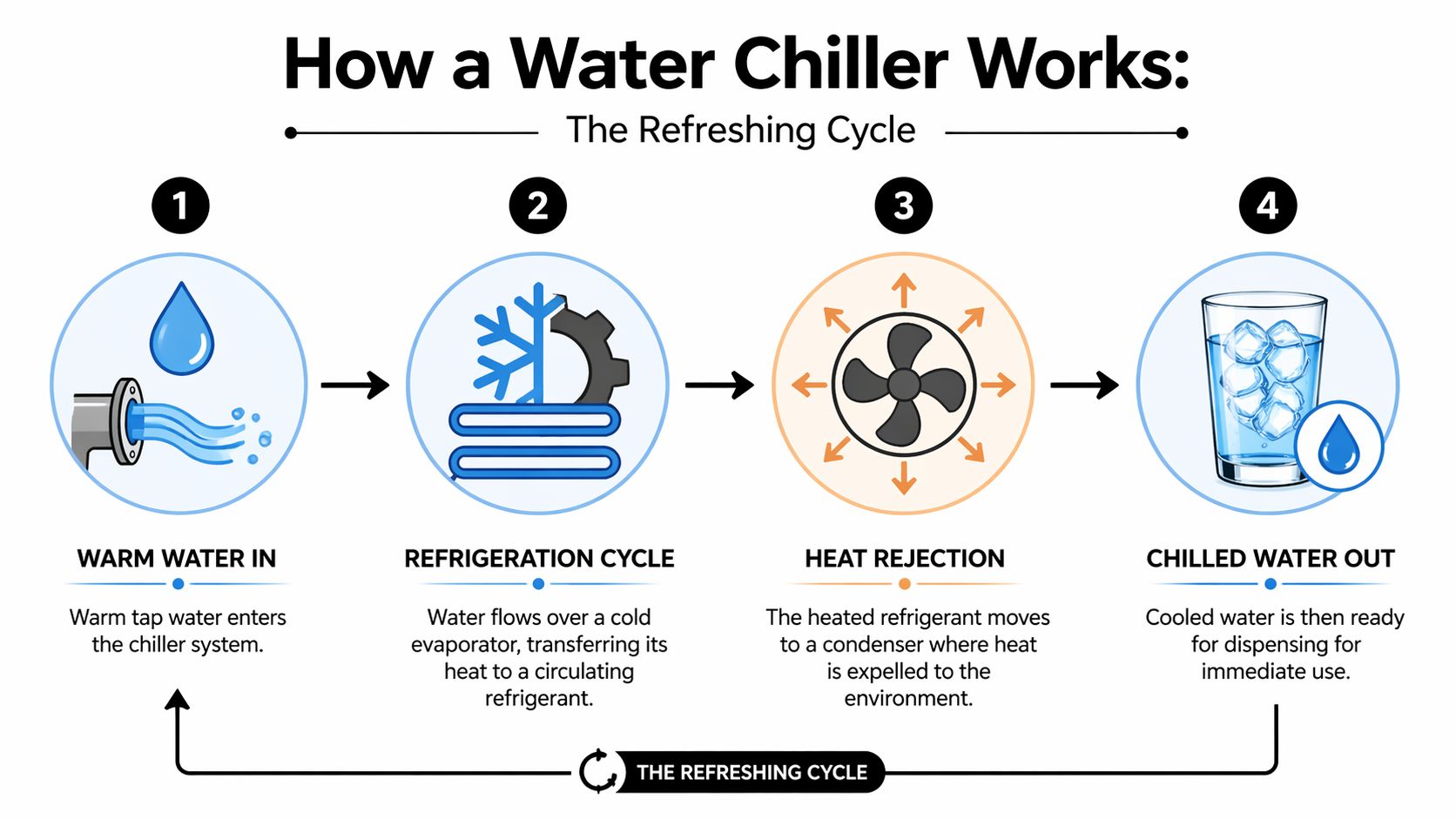
A water chiller doesn’t “make cold”. It pulls heat out of water and pushes that heat somewhere else.
That idea trips people up because cooling feels passive. It isn’t. A chiller is actively moving heat.
The simple version
Warm tap water enters the unit. Inside, a refrigeration system absorbs heat from that water. The heat is then rejected out through the condenser. What’s left is cooler water stored or delivered for drinking.
If you’ve ever felt warm air blowing from the back or side of a fridge, you’ve already seen the same principle at work.
The four-step cooling cycle
Here’s the process in plain language.
Compression
The compressor pressurises the refrigerant. When pressure rises, the refrigerant gets hot. Think of this as the system getting ready to move heat.Condensation
That hot refrigerant travels to the condenser, where the unit sheds heat to the surrounding environment. The refrigerant cools down enough to change state.Expansion
The refrigerant passes through an expansion device that drops its pressure. Once pressure falls, the refrigerant becomes very cold.Evaporation
The cold refrigerant moves through the evaporator. Water passes over or around this cold section, and heat transfers from the water into the refrigerant. The water cools down. The refrigerant warms up and heads back to the compressor to repeat the cycle.
Where readers often get confused
People often ask whether the refrigerant mixes with the drinking water. It doesn’t. The two are separate. The refrigerant sits inside a sealed circuit. The water stays in its own path, just like your drinking water and the gas inside a fridge don’t mix.
Another common question is whether a chiller cools instantly from nothing. In reality, most systems either chill a small stored volume of water or cool water continuously as it passes through. That’s why storage size, recovery rate, and compressor design matter so much when you’re choosing a unit.
Why the unit still gives off heat
Some buyers are surprised when a chiller makes the cupboard or room around it warmer. That’s normal. The heat removed from the water has to go somewhere. The unit rejects it into the air or, in larger systems, into a water-cooling setup.
That’s also why ventilation matters. If you tuck a chiller into a sealed cupboard with no airflow, the system has a harder time getting rid of heat. It can still run, but it won’t run as well.
A practical example
Say your office tap water feels tepid after the pipes have sat through a warm afternoon. The chiller doesn’t “store coolness”. It takes that incoming warmer water, strips out the heat through the evaporator, and sends chilled water to the tap or dispenser. If the demand is light, the system catches up easily. If a dozen people fill bottles at once, the recovery rate tells you how quickly it can get back to full cold performance.
That’s the basic logic behind every water chiller, from a compact under-sink unit to a larger commercial plant.
Finding Your Fit Under-Sink Commercial and Remote Units
Once people understand the cooling process, the next question is usually practical. What type of chiller suits my building? The answer depends less on brand names and more on where the water will be used, how many people need it, and where the equipment can physically go.
There are three broad setups most Melbourne buyers compare. Under-sink units, freestanding or wall-mounted commercial units, and remote systems.
Under-sink chillers
Under-sink chillers suit kitchens where appearance matters. They’re common in homes, boardrooms, staff kitchens, and small consulting suites because the cooling hardware stays hidden in the cabinet while the tap above does the visible work.
These systems make sense when you want chilled water without another appliance in view. They’re also useful in renovations where bench space is tight and the goal is a cleaner look. The catch is that the cabinet needs enough airflow, enough room for plumbing, and enough thought if you’re pairing chilled water with an instant boiling tap.
A lot of buyers start their search in this category by comparing under-sink and office water chiller units because that’s where the overlap between residential and light commercial use often sits.
Freestanding and wall-mounted commercial units
Commercial units are built for busier areas. Think staff lunchrooms, gyms, schools, clinics, waiting areas, workshops, and hospitality venues where demand comes in waves. They’re easier to access, easier to locate in shared spaces, and generally simpler to service than a hidden under-sink unit.
In a Melbourne office, this type of chiller often solves the “fridge door all day” problem. In a café or hospitality venue, it can keep cold water available without relying on ad hoc bottle storage. The main trade-off is footprint. You gain easier access and often higher delivery capability, but you give up some floor or wall space.
Remote chiller systems
Remote systems separate the cooling plant from the dispensing point. The chiller may sit in a plant room, service area, or another back-of-house location while water is delivered to taps or outlets elsewhere in the building.
This layout suits larger offices, multi-level commercial sites, hospitals, breweries, and hospitality operations where heat, noise, or service access make a hidden remote plant more sensible. It also suits sites where public-facing areas need to stay tidy and quiet.
Practical rule: If the building has heavy daily demand, limited public-space ventilation, or strict presentation standards, a remote setup is often easier to live with than trying to force a larger chiller into a small visible area.
Water Chiller Types Compared
| Chiller Type | Ideal Use Case | Typical Capacity (Litres/Hour) | Footprint & Location |
|---|---|---|---|
| Under-sink | Homes, small offices, boardrooms, kitchen renovations | Varies by model | Hidden in cabinetry below the sink or bench |
| Freestanding or wall-mounted commercial | Offices, gyms, clinics, lunchrooms, hospitality front-of-house | Varies by model | Installed in shared accessible spaces |
| Remote system | Large buildings, hospitality back-of-house, multi-point supply | Varies by design | Chiller located away from the outlet, often in plant or service areas |
Air-cooled or water-cooled for business use
For many businesses, the bigger technical choice isn’t just unit style. It’s how the condenser rejects heat. In Australia’s climate, water-cooled commercial chillers are often more efficient than air-cooled models. During a Melbourne heatwave, an air-cooled unit’s power consumption can increase by 20-30%, while a water-cooled system maintains more stable performance, according to commercial chiller engineering specifications.
That doesn’t mean every business should install a water-cooled system. It means a busy venue should think carefully before defaulting to air-cooled equipment just because it looks simpler on paper. In hot conditions, “simpler” can become “more expensive to run” or “harder to keep performing consistently”.
A simple way to decide
If you want chilled water at one sink and care about presentation, go under-sink.
If lots of people need easy access through the day, look at freestanding or wall-mounted commercial units.
If the building is larger, noisier, or more demanding, remote systems deserve serious attention.
The right fit usually becomes obvious once you map three things. Where the water is needed, how often it’s needed, and where the heat from the machine can safely go.
Decoding the Specs Sizing and Performance Metrics
Specification sheets can make a straightforward purchase feel more technical than it really is. Most buyers don’t care about jargon for its own sake. They care about whether the unit will keep up on a hot day, fit the space, and avoid turning into an expensive annoyance.
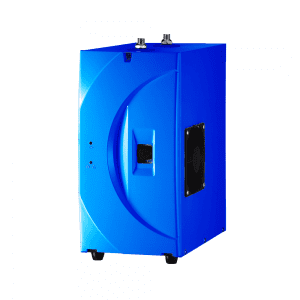
Cooling capacity means output, not hype
Cooling capacity is the unit’s ability to chill water over time. In plain terms, it tells you how much cold water the system can produce or support within a working period. If a model is undersized, it may seem fine in the morning and struggle badly after repeated use.
A small family kitchen doesn’t draw water like a staff room in a busy office. A home setup tends to see shorter bursts. An office in Footscray with people filling bottles before meetings sees clustered demand. The unit has to handle the pattern, not just the total number of users.
Recovery rate is what you notice after a rush
Recovery rate tells you how quickly the chiller gets back to full performance after water has been drawn off. This is one of the most overlooked specs because people focus on storage and ignore what happens after that first round of glasses or bottles.
In practical terms:
- Low-demand home use: Recovery matters, but not as aggressively.
- Small office use: Repeated bottle fills can expose a weak recovery rate quickly.
- Hospitality and waiting areas: Fast recovery becomes essential because demand arrives in bursts.
If your unit starts strong but serves warmer water after a few fills, the recovery rate was probably the weak point.
Thermostat range and control quality
The thermostat range tells you how cold the delivered water can be set, but control quality matters just as much as the headline setting. A unit that swings between too cold and not cold enough is frustrating even if the spec sheet looks impressive.
That’s one reason modern control systems matter. Commercial chillers increasingly use digital scroll compressors that can modulate from 100% down to 25% load, which helps prevent overload on hot days and can reduce energy use by up to 30% during part-load conditions, according to Trane’s water-cooled chiller technical information. For Melbourne conditions, that flexibility matters because demand and ambient temperature can vary sharply across the day.
Sizing for your actual use
Buyers often make one of two mistakes. They buy too small because they’re trying to save space, or they buy too large because they assume bigger always means better. Neither is ideal.
Use these questions instead:
- How many people use it daily: A family of four behaves differently from a shared office kitchen.
- When do they use it: Even moderate demand can stress a unit if everyone uses it at once.
- Do people fill glasses or bottles: Bottle filling creates heavier draw-off.
- Will it pair with other systems: A boiling tap, filter, or remote outlet changes the installation picture.
- Where is it installed: A warm cupboard or service area affects real-world performance.
Don’t size for the quietest hour of the day. Size for the busiest pattern you expect repeatedly.
Why Melbourne conditions change the decision
Ambient heat affects performance. So does cabinet ventilation. Water quality matters too. In some locations, mineral content and scaling risk influence maintenance needs and long-term reliability. A compact under-sink chiller installed in a tight cabinet during summer won’t behave the same way as the same unit in a cooler, better-ventilated fit-out.
This walkthrough gives a useful visual reference for how performance settings and operating behaviour are interpreted in real equipment.
The specs that matter most to buyers
You don’t need to become a refrigeration tech. You just need to read the sheet with the right questions in mind.
| Spec | What it means in real life |
|---|---|
| Cooling capacity | How much chilled water the unit can support over time |
| Recovery rate | How fast the unit catches up after use |
| Thermostat range | How cold the water can be set and maintained |
| Compressor type | How efficiently and smoothly the unit handles varying demand |
| Physical dimensions | Whether it will actually fit the cupboard, wall, or plant area |
| Ventilation requirements | Whether the installation space allows proper heat rejection |
The best unit on paper is the one that matches your use pattern, your space, and your local conditions. Not the one with the longest list of technical terms.
Beyond the Price Tag Energy Use and Running Costs
The purchase price gets attention because it’s visible. Running costs are quieter, but they decide whether a chiller feels like a smart investment or an ongoing burden.
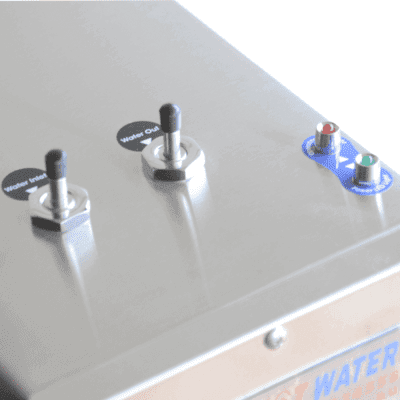
A modern chiller usually uses energy more purposefully than the makeshift alternatives people lean on. Fridges packed with drink bottles, repeated cooling of fresh bottles, and old coolers with poor insulation tend to waste effort. A dedicated water chiller is designed for one job, which is why insulation, controls, and compressor behaviour matter more than a bargain sticker.
What affects ongoing cost
Running cost comes down to a handful of practical factors.
- Insulation quality: Better insulation helps the unit hold temperature with less cycling.
- Control system: Smarter controls avoid unnecessary compressor operation.
- Usage pattern: Constant draw-off behaves differently from occasional demand spikes.
- Ambient conditions: A hot plant area or poorly ventilated cupboard raises the workload.
- Maintenance standard: Dirty coils, blocked airflow, and neglected filters force the unit to work harder.
Commercial buyers should also think beyond the chiller alone. Pumps, fans, and flow control choices affect the total energy picture. If you’re reviewing broader plant efficiency, this overview of VFD energy savings is useful background because variable speed control often plays a role in how supporting equipment manages load.
Free cooling for Melbourne businesses
One of the most underused ideas in commercial chilled water design is the water-side economizer. In simple terms, it takes advantage of cooler outdoor conditions so the system can chill water without relying as heavily on the compressor.
For commercial venues in Melbourne, integrating a water-side economizer can achieve energy savings of 30-50% by using cool winter air to chill water instead of running the compressor continuously, according to Cooling Best Practices on integrated water-side economizer systems. That’s especially relevant for hospitality and office sites that operate year-round and carry high utility costs.
Worth checking on commercial projects: Ask whether the building can use seasonal free cooling rather than assuming the compressor must do all the work in every month of the year.
How to judge value properly
A cheaper unit can still cost more over time if it runs hotter, cycles harder, or struggles in summer. A better-built unit may cost more upfront but hold temperature more steadily, need fewer interventions, and fit the site properly.
For homeowners, the value usually shows up in convenience and less fridge dependence. For businesses, it shows up in predictable service and lower waste. The useful mindset is simple. Don’t ask only what the chiller costs to buy. Ask what it costs to operate, maintain, and live with.
Keeping Your Chiller Running Smoothly Installation and Care
A water chiller can be excellent equipment and still perform poorly if the installation is rushed. Most problems I see aren’t because the machine was intrinsically flawed. They happen because the unit was boxed into a hot cupboard, connected with awkward plumbing, or left with no practical access for servicing.
The installation points that matter first
Start with airflow. Every chiller needs a way to reject heat. If it’s installed under a sink, the cabinet can’t be treated like a sealed box. There needs to be sensible ventilation and enough surrounding space for the unit to breathe.
Power and water access need equal attention. The connection points should be safe, reachable, and planned before cabinetry is finalised. If the installer has to force hoses into tight bends or squeeze the unit around waste pipes and power leads, maintenance becomes harder from day one.
The Melbourne under-sink trap
The most common renovation issue is trying to fit too much under one sink. A chiller, an instant boiling system, filters, traps, cleaning products, and pull-out bins all end up competing for the same cabinet volume.
A common mistake in Melbourne kitchen renovations is improper plumbing when pairing a chiller with a boiling tap. That can lead to efficiency losses of up to 30% and uneven chilling, according to engineering guidance on chilled water distribution schemes. In a home, that often shows up as disappointing temperature consistency or a system that seems to run more often than expected.
If you’re considering that kind of setup, it helps to review a dedicated under-sink water chiller guide before the joinery is locked in, because the cabinet layout matters almost as much as the appliance choice.
A practical pre-install checklist
Use this before the unit arrives.
- Check cabinet space: Measure width, depth, and height with plumbing already in place.
- Allow ventilation: Don’t assume a closed cupboard is fine just because the unit fits physically.
- Plan service access: Filters, valves, and electrical points should be reachable without dismantling half the kitchen.
- Map the plumbing path: Short, sensible pipe runs usually make for neater and more reliable installs.
- Think about combined systems: Boiling and chilled setups need coordinated layout, not last-minute improvisation.
A neat installation isn’t just about appearance. It affects airflow, serviceability, and how hard the chiller has to work every day.
Ongoing care without overcomplicating it
Maintenance doesn’t need to be intimidating. Most owners just need a steady routine.
Monthly checks
- Look for leaks: Check fittings, valves, and visible pipe joins.
- Listen for changes: New rattles, buzzing, or longer run times often mean something has shifted.
- Check dispensing performance: Slower flow or warmer water can be an early warning sign.
Periodic servicing tasks
- Replace filters when required: This protects water quality and helps system performance.
- Clean condenser areas: Dust and lint restrict heat rejection.
- Inspect insulation and pipework: Damaged insulation can reduce efficiency.
- Test controls and thermostat behaviour: Stable temperature matters more than just “cold enough”.
When to call a professional
Call for service if the unit trips power, leaks persist, cooling performance drops noticeably, or the cabinet becomes unusually hot. Those symptoms usually point to a real issue, not something worth ignoring.
The best-performing chillers tend to be the ones that were installed with space, airflow, and future servicing in mind. Good care then keeps that early advantage going.
Common Chiller Problems and Finding the Right Spare Parts
Most chiller faults start with a simple symptom. The water isn’t as cold as it used to be. The unit makes a noise it never made before. There’s moisture or a small leak under the cupboard. The trick is to connect the symptom to the likely cause before replacing random parts.
When the water isn’t cold enough
Start with the obvious. Check airflow around the unit, especially for under-sink installations. A chiller that can’t get rid of heat won’t cool efficiently. Then look at filter condition and water flow. Restricted flow can make the unit behave unpredictably.
If the issue persists, the likely parts conversation usually turns toward the thermostat, control components, or a refrigeration service matter rather than a plumbing-only fault.
When the unit makes a strange noise
Noises give clues. A loose panel or vibration issue sounds different from compressor strain. Rattling often points to mounting, casing, or nearby pipe contact. A harsher hum can point to workload or a component that needs inspection.
The first DIY step is a visual check. Make sure the unit is sitting level, pipework isn’t rubbing, and nothing stored in the cupboard is pressing against the casing. If the sound remains, stop guessing and have it assessed.
When you notice a leak
Small leaks often come from fittings, hoses, or connection points rather than the core chiller assembly. Check visible joints first. Condensation can also be mistaken for a plumbing leak, particularly if insulation is missing or damaged.
That’s why the right spare part matters. Replacing a generic fitting with “something close enough” can create a second problem even if the drip stops temporarily.
The spare parts that commonly matter
For water chillers and related hot and chilled systems, the parts people most often need include:
- Thermostats: For temperature control problems
- Valves: For flow control and isolation
- Flexible hoses and fittings: For leaks or worn connections
- Filters and filter components: For water quality and flow issues
- Elements and electrical parts in combined systems: Especially where chilled and boiling equipment share space
Why genuine parts matter
Manufacturer-approved parts protect fit, safety, and performance. That matters most with water systems because a poor seal, an ill-fitting valve, or the wrong thermostat can affect both reliability and hygiene. It’s also important when servicing brands commonly found in Australian homes and businesses, including Birko, Insinkerator, and Kwikboil.
The best troubleshooting approach is simple. Match the symptom to the likely subsystem first, then source the correct part for that model. That saves time, avoids repeat faults, and usually costs less than trial-and-error repairs.
Your Water Chiller Questions Answered
Some chiller questions don’t come up until the buyer is halfway through a renovation or trying to solve a very specific site problem. These are the ones I hear most often from Melbourne homeowners, office managers, builders, and caravan owners.
FAQ Section
| Question | Answer |
|---|---|
| Do I need a water chiller at home if I already have a fridge? | If your fridge already struggles for space, a chiller is often much more convenient. It gives you chilled water on demand without storing bottles or waiting for them to cool. |
| Is an under-sink chiller better than a benchtop dispenser? | Usually, if appearance and bench space matter. Under-sink systems keep the hardware out of sight, but they need careful planning for ventilation, plumbing, and servicing. |
| Are water chillers suitable for offices? | Yes. They’re often a better fit than using a kitchen fridge for drink bottles because they’re designed for repeated daily access and more predictable chilled water delivery. |
| What if I want chilled and boiling water from the same kitchen area? | That can work well, but the cabinet layout and plumbing path need to be planned properly. Combined systems are where poor installation choices often create performance problems. |
| Should a business choose air-cooled or water-cooled equipment? | It depends on the site, usage, and how heat is managed. In hotter conditions and larger commercial settings, water-cooled designs can make more sense, especially where stable performance is important. |
| Can water chillers work in hospitality venues? | Yes. Cafés, lunchrooms, waiting areas, and back-of-house spaces often benefit from a proper chilled water setup because demand tends to come in bursts and consistency matters. |
| Do caravan or RV owners use water chillers too? | Some do, especially where compact water equipment and compatible fittings are already part of the setup. Space, power availability, and mounting stability matter more in mobile applications. |
| How often do chillers need maintenance? | That depends on use, environment, and water quality. A lightly used home unit needs less attention than a busy commercial system, but all of them benefit from regular checks, filter changes, and cleaning. |
| Can I install one myself? | A simple unit may look straightforward, but water, electricity, ventilation, and cabinetry constraints can make DIY risky. Professional installation usually prevents the problems that cost the most later. |
| What matters most when choosing a unit? | Match the chiller to the actual demand, the available space, and the installation conditions. A well-sized, well-installed unit is usually far more satisfying than a bigger unit forced into the wrong location. |
A water chiller is one of those upgrades that looks simple from the outside but rewards careful planning. Choose the right type, size it to your real usage, and install it properly, and it becomes part of the building in the best possible way. Quiet, dependable, and easy to use.
If you’re comparing options for your kitchen, office, hospitality venue, or service fit-out, Ring Hot Water offers water chillers, filtration, spare parts, and Melbourne-based installation support for hot and chilled water systems. If you’re not sure what fits your space, start with the practical details first: location, ventilation, demand, and whether you’re pairing chilled water with other equipment.

