
Uncategorized
Replace Kettle with Tap: 2026 Melbourne Guide
Jun
The kettle starts the day well enough, until it doesn't. It sits on the bench taking up space, somebody fills it past what they need, somebody else waits for it to boil, and in a busy kitchen it seems to be forever in the way. That's the point where a lot of Melbourne homeowners start asking the same question. Should I replace the kettle with a tap?
For some homes and workplaces, the answer is yes. For others, it's only worth doing if the kitchen can support the system and the usage is high enough to justify the spend. That practical gap matters, because most advice stops at “it's convenient” and doesn't spend enough time on cupboard space, power, filtration, compliance, or realistic payback.
A proper boiling water system offers more than a lifestyle upgrade. It changes how the kitchen works every day, but only when it's selected well, installed properly, and looked after. In Melbourne homes, offices, and hospitality spaces, the details under the sink matter just as much as the tap you see above the bench.
Goodbye Kettle Hello Instant Boiling Water
A rushed weekday morning is usually what pushes this decision along. Coffee cups are out, breakfast is happening, someone needs hot water now, and the kettle is either half full, empty, or still heating. The problem isn't just the wait. It's the clutter, the repeated boiling, and the habit of heating more water than anyone needs.
An instant boiling water tap changes that routine. You free up bench space, draw hot water as needed, and stop treating boiling water like a separate kitchen task. In a practical sense, that's why the idea has stuck. It solves a real workflow problem in homes, staff kitchens, and compact apartment layouts.
Australia has been moving in this direction for a while. Instant boiling water taps started gaining momentum here in the early 2000s, and their integration in new kitchen designs rose from less than 5% in 2005 to over 25% in 2023, according to the National Construction Code 2022 material from the ABCB. That isn't a short-term design fad. It's a clear shift in how modern kitchens are being planned.
For readers weighing up options, a closer look at instant boiling water tap systems helps show why this category now sits alongside dishwashers, pull-out mixers, and filtered water as a standard upgrade rather than a novelty.
Why the kettle starts to feel outdated
The kettle still works. That isn't the issue.
The issue is that it's a standalone appliance doing a job that integrated systems now handle more neatly. In a tight kitchen, reclaiming a patch of bench matters. In an office, removing a queue around the kettle matters. In a home where people cook often, quick access to hot water for tea, coffee, blanching, or cleaning up matters.
Practical rule: If the kettle annoys you every day, that annoyance is worth paying attention to. Small friction adds up in a kitchen.
Who usually benefits most
This kind of change tends to make the most sense for:
- Busy households: Multiple people using hot water across the day usually notice the convenience straight away.
- Workplaces and staff kitchens: Shared use highlights the value of instant access more than almost any marketing line does.
- Compact kitchens: Losing a benchtop appliance can make the room feel more organised immediately.
- Renovators: If cabinetry, benchtops, or plumbing are already being touched, it's the easiest time to make the swap.
That said, wanting one and being suited to one are not always the same thing. Cost, cabinet space, electrical capacity, and maintenance all need a proper look first.
The Real Cost and Convenience of an Instant Tap
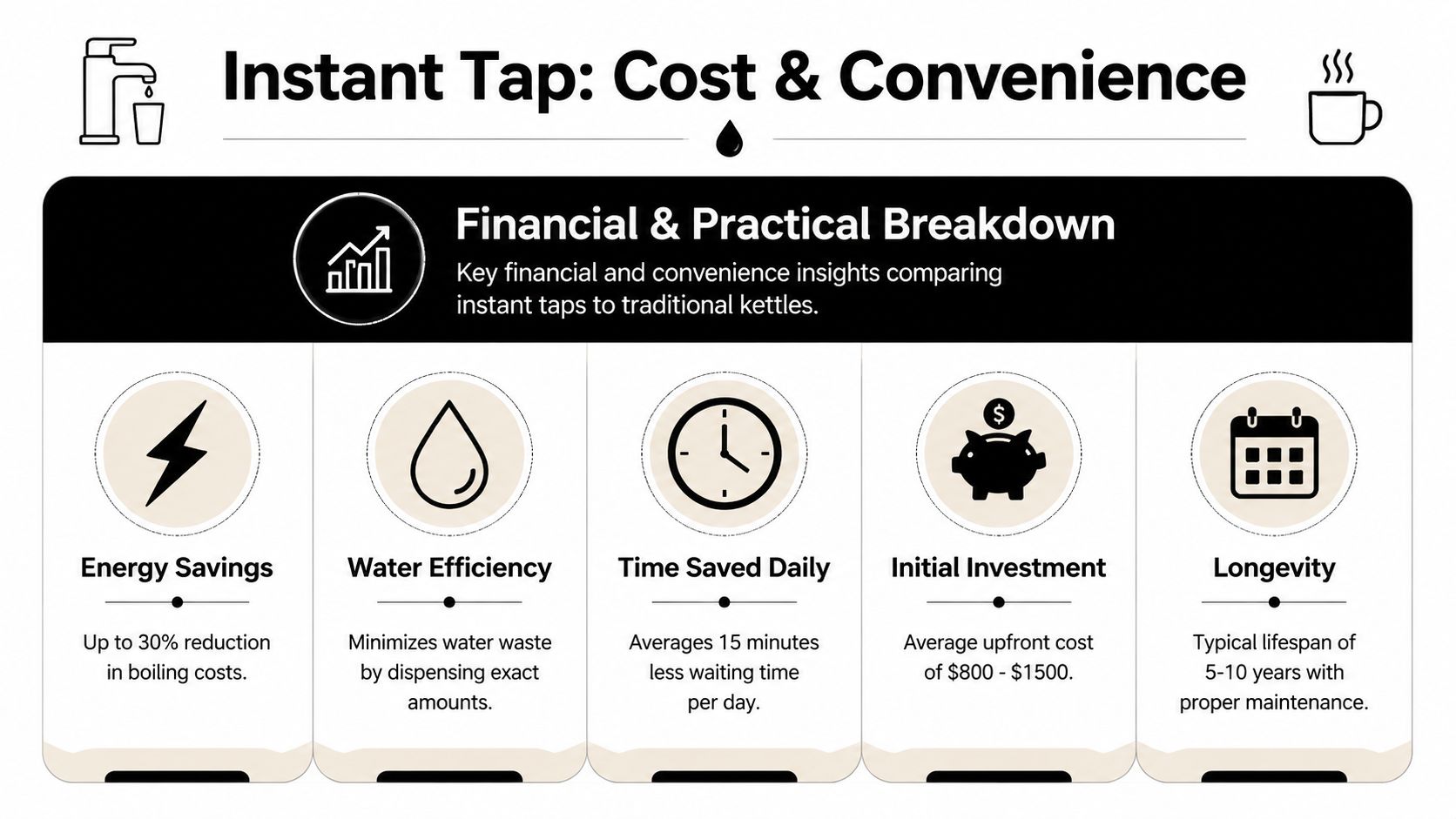
The biggest mistake people make is assuming this upgrade pays for itself quickly in every home. In Melbourne kitchens, I usually frame it differently. Buy an instant boiling tap because you want faster access to hot water, less bench clutter, and a cleaner setup. If the running-cost savings also stack up well in your household, that is a bonus.
For a busy family kitchen or staff room, the convenience is easy to feel on day one. For a low-use home, the maths can be slower because these systems keep water hot under the sink and draw standby power between uses. That is the trade-off buyers need to see clearly before they spend money.
What you are actually paying for
There are two parts to the spend. The tap and under-sink unit are the obvious cost. Installation is the part people often underestimate.
A straightforward swap in a modern kitchen is one thing. An older Melbourne home with a crowded cabinet, no nearby power point, tired isolation valves, or awkward stone cut-outs can cost more to set up properly. If cabinetry, benchtops, or layout changes are already on the table, the wider renovation budget matters just as much as the tap model. That is why broader planning resources such as this 2026 kitchen renovation guide are worth reading before fixtures get locked in.
Where the value usually shows up
The strongest return is often time and ease of use, not just the power bill.
Energy Consumers Australia notes that household energy use is shaped heavily by appliance type and how often it is used, which is why boiling-water habits matter when you compare a kettle with a stored boiling system (Energy Consumers Australia). In practice, households that boil water many times a day tend to get more value from an instant tap than households that make the occasional cup of tea.
That also lines up with what we see on jobs. In offices, the benefit is less waiting around for repeat boils. In family kitchens, it is faster drinks, quicker food prep, and less clutter on the bench. In renovation projects, clients also like getting rid of one more appliance and power lead.
Where buyers get caught out
A boiling tap is not automatically the cheaper option over a short period. Filter replacements, servicing, and standby energy all need to be part of the decision. Some premium models also push the upfront cost well beyond what a simple kettle replacement ever needs to be.
The good news is that the convenience is very predictable. If hot water gets used all day, people usually stay happy with the upgrade. If usage is light, the decision is more about finish, bench space, and kitchen function than strict payback.
For readers comparing local options, these Australian-focused notes on instant boiling water tap systems are useful because they focus on how the systems perform in real kitchens, not just how they look in a showroom.
Choosing Your Ideal Boiling Water System
Once you've decided the kettle replacement is worth considering, the next question is simpler. What type of system suits the way you use the kitchen?
People often overbuy. They see a premium all-in-one tap with every feature available, then install it in a home that really only needed reliable boiling water and solid filtration. The best system is the one that matches demand, available space, and how much complexity you're willing to maintain.
Start with function
Some people want boiling only. That's common in homes replacing a kettle and nothing else.
Others want boiling and chilled from one tap because they also want to reduce bottled water or simplify the bench. In workplaces and entertaining-heavy homes, a system with broader functionality can tidy up the whole drinking water setup.
A good starting point is to think in terms of use:
- Tea, coffee, and quick cooking: boiling only is often enough
- Daily drinking water needs as well: boiling plus chilled makes more sense
- Higher-end entertaining kitchens: more feature-rich systems can be worth it if they'll be used
Capacity matters more than most buyers expect
A two-person household and a staff lunchroom don't need the same tank or recovery behaviour. Even among under-sink units, some systems are designed for lighter household use and some cope better with repeated draw-offs through the day.
That's why it helps to look at under-sink hot water systems as a category rather than fixating on the tap design first. The visible spout is only half the system. The hidden boiling unit performs the core function.
Buy for peak use, not just average use. The system has to perform when everyone wants hot water at once.
Filtration is not an optional extra
In Melbourne, filtration does two jobs. It improves water quality at the point of use, and it protects the appliance.
Sediment and water quality issues are one of the fastest ways to turn a good system into a fussy one. If the unit has a filter requirement, treat that as part of ownership from day one. It's the same logic as servicing any other water-dependent appliance. Skip the maintenance, and performance usually drops before the owner notices why.
Brand fit is usually about application
Different brands suit different jobs. In this market, homeowners and facilities teams often compare options from Zip, Stiebel Eltron, Boiling Billy, Insinkerator, Kwikboil, and other established names. Some are better known for residential under-sink systems. Others are stronger in commercial wall-mounted boilers or higher-demand applications.
If you're also coordinating finishes and materials, visual compatibility matters too. A practical fixture still needs to sit comfortably in the room. For anyone refining the wider look of the kitchen, these latest kitchen tile styles can help line up finishes around the tap area without turning the whole decision into a design exercise.
Instant Tap System Comparison
| System Type | Best For | Features | Example Brands |
|---|---|---|---|
| Boiling only under-sink tap | Homes replacing a kettle | Instant boiling water, cleaner bench, compact setup | Zip, Stiebel Eltron, Boiling Billy |
| Boiling and chilled tap | Families and premium home kitchens | Boiling plus chilled water from one fixture | Zip, Insinkerator |
| Wall-mounted boiler | Offices, staff kitchens, commercial use | Higher-volume delivery, practical for shared spaces | Kwikboil, Boiling Billy |
| Commercial boiling and chilling setup | Hospitality and facility use | Built for heavier demand and repeat use | Everboil, Everchill, Crown |
The right choice is usually the one that disappears into your routine. If you have to change habits to justify the product, it's probably the wrong system.
Your Melbourne Pre-Installation Checklist
This is the part most brochures skip. The tap might look simple above the bench, but the success of the whole job sits below it.
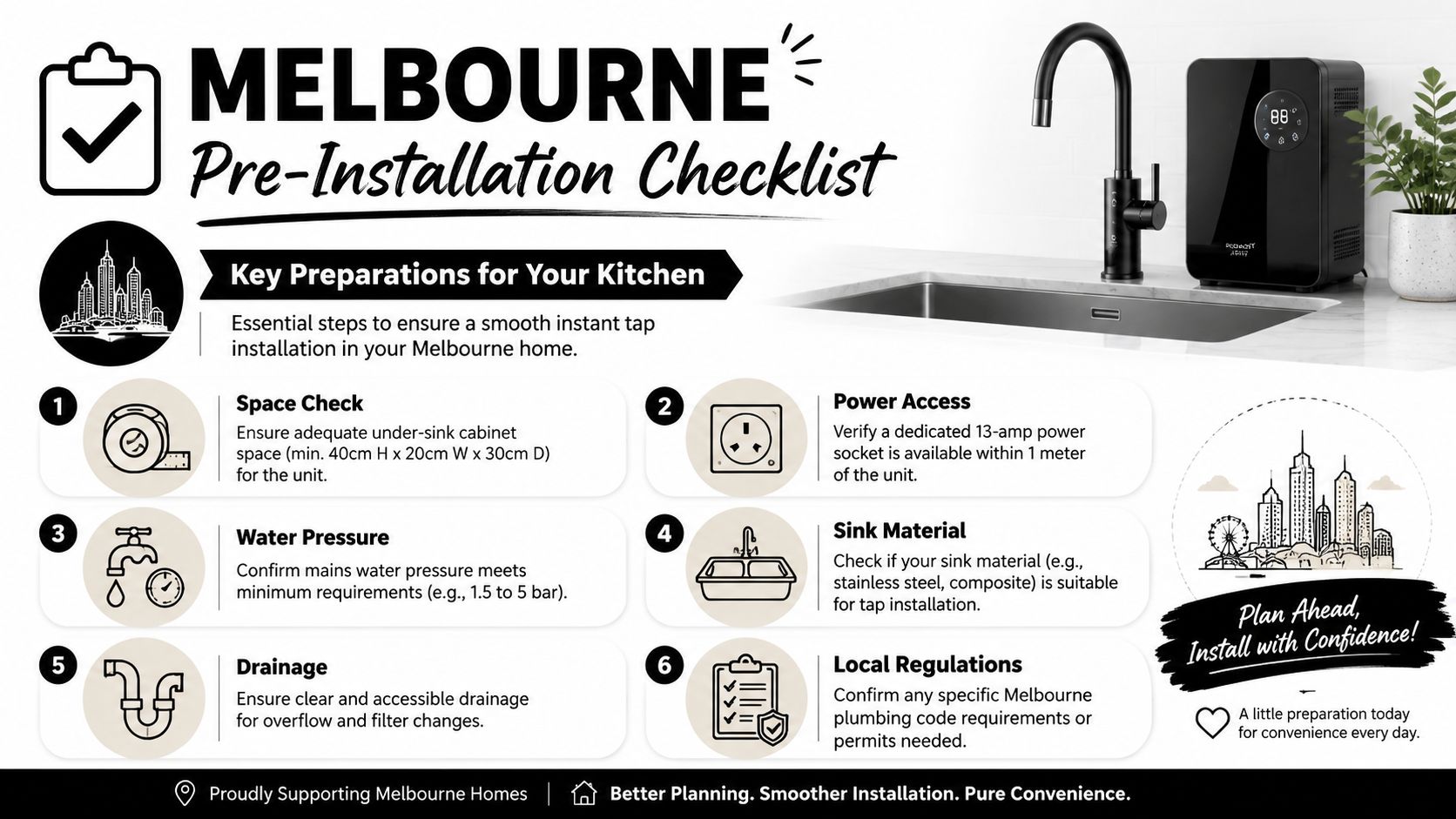
A lot of Australian homeowners run into the same issue. They choose a unit first and only later realise the cupboard is too crowded, ventilation is poor, or there isn't suitable power where it's needed. Practical guidance on under-sink space, ventilation, and whether a licensed electrician or plumber is required is often missing from lifestyle-focused advice, as highlighted in ACCC business guidance.
Check the cupboard before you shop
The first job is physical space. Open the cabinet under the sink and look at what's already there.
You're checking for three things:
- Available room: the unit and filter need a stable home without crushing hoses or blocking access
- Obstructions: bins, pull-out systems, waste pipes, and cleaning products often compete for the same space
- Ventilation path: the unit can't be boxed in so tightly that it struggles to shed heat
A showroom photo won't tell you any of that. A tape measure will.
Confirm the services
The next step is working out whether the kitchen can support the system without awkward retrofits.
Look for:
- Cold water access: the installer needs a suitable supply point to feed the unit
- Power location: some systems need a dedicated supply arrangement, and the point needs to be placed sensibly for safe connection
- Bench or sink mounting position: there must be enough room to mount the tap without clashing with cabinets, splashbacks, or sink bowls
If the intended tap position is too tight to the wall or too close to another fixture, the finished result can feel compromised even if the install is technically possible.
Think about how the door closes and how the filter changes
The best installs are tidy and serviceable. That means the cupboard should still function once the unit is in.
Ask yourself:
- Can the cabinet door close cleanly?
- Can the filter be changed without dismantling half the cupboard?
- Is there a sensible route for hoses that won't kink or rub?
A system that fits only on installation day, but becomes awkward every time it needs service, wasn't planned properly.
Know when professional advice is necessary
If the kitchen is straightforward, a pre-install assessment is usually quick. If it's an older Melbourne home, an apartment, or a retrofit with crowded cabinetry, the inspection matters much more.
The key requirements are simple. Water connections and compliant electrical work need the right trades. If there's any doubt about power, pressure, or available space, get those checked before you order the unit, not after it arrives.
The Professional Installation Process Unpacked
A well-planned install usually feels uneventful. That is the outcome you want.
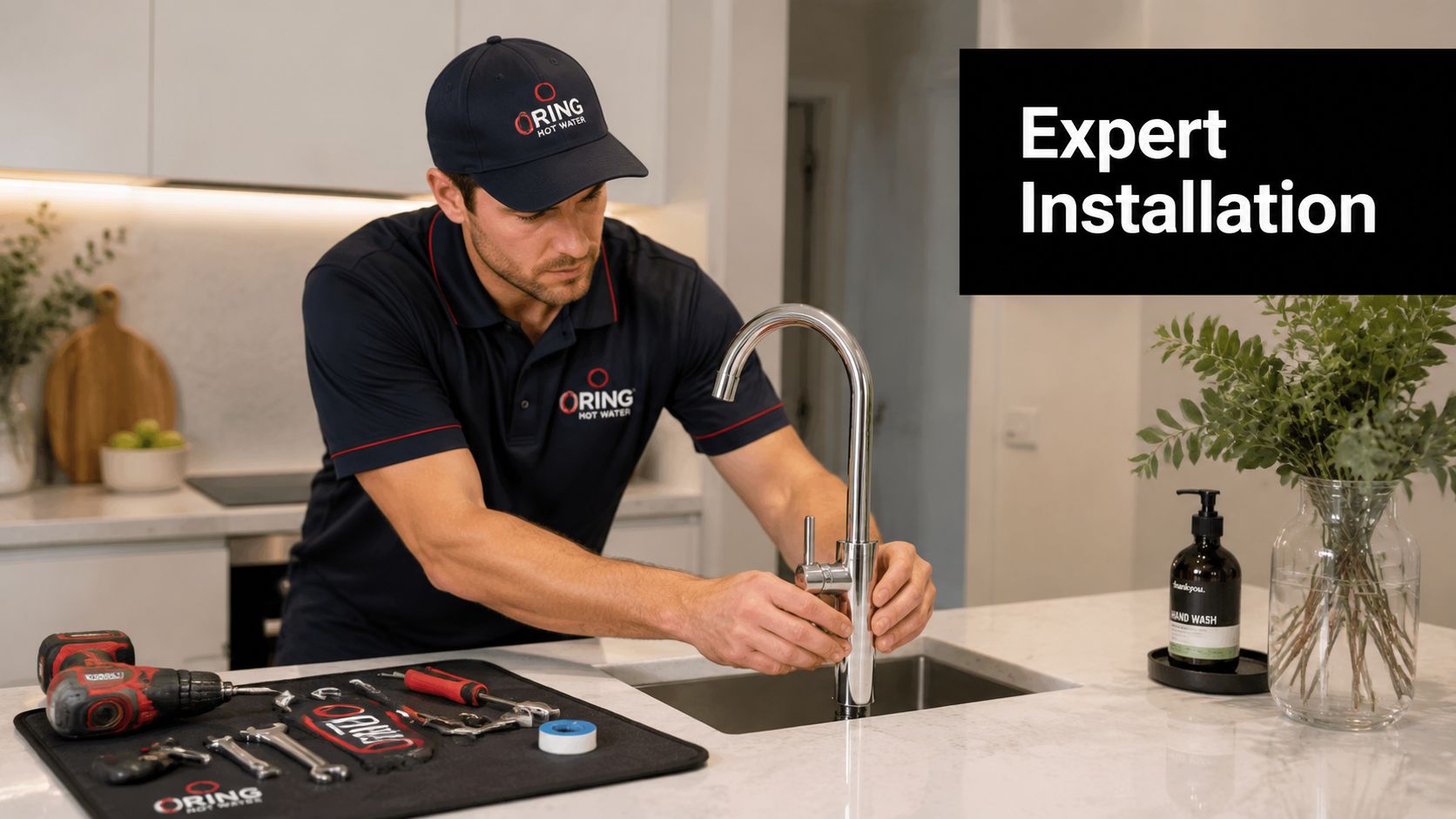
Once the unit is on site, the job starts with confirming the final set-out, not rushing straight to fittings. The installer checks the tap location against the actual sink, benchtop, splashback, and cupboard internals, then isolates water and confirms the power arrangement is ready for connection by the appropriate trade. If a new hole is needed in the sink or bench, that part has to be done carefully. A few millimetres can affect how the tap operates, how it looks, and whether it stays comfortable to use every day.
Above the bench, the visible work is fairly simple. The tap is mounted, aligned, and fixed so it feels solid and the controls move properly.
Below the bench, the standard of the installation is easier to judge. The tank or command unit needs to sit securely with enough clearance around it. The filter should be mounted where it can be changed later. Hoses need clean runs without kinks, tight twists, or abrasion points against cabinet edges. In practice, that is where tidy jobs stay reliable and rushed jobs start building in future problems.
That matches the installation guidance manufacturers publish for under-sink boiling water systems, including service clearance, filter access, and correct commissioning steps, such as those outlined by Zip Water in its product installation resources. On service calls around Melbourne, the faults that show up after a new install are usually predictable. Poor hose routing, awkward filter placement, loose isolation arrangements, or skipped commissioning steps are common causes.
A good install is not just about getting hot water out of the tap. It is about making the unit safe, serviceable, and trouble-free six months later.
What the trades actually do on the day
For a straightforward retrofit, the work usually follows a clear sequence.
The plumber handles the water connections, mounting, valve work, leak testing, and final commissioning of the hydraulic side. If the system needs electrical connection beyond a simple existing plug arrangement, a licensed electrician handles that part. In some Melbourne homes, especially older kitchens and apartments, the electrical side is what changes the timing and cost of the job more than the plumbing.
The final stage matters just as much as the rough-in:
- Connection testing: every join is checked under pressure, not just hand-tightened and assumed to be fine
- System flushing: new filters and lines are flushed to clear carbon fines, air, and installation residue
- Temperature and safety check: the unit is tested to confirm correct operation and user safety features
- Owner handover: you should be shown shut-off points, normal startup behaviour, and the filter replacement process
A short visual walkthrough can help make sense of what's involved on site:
Why DIY usually costs more in the end
Boiling water taps sit in an awkward category for DIY. They look like a tap upgrade, but they behave more like a small appliance installation combined with plumbing work. That means water connections, heat, pressure, safety controls, filtration, and sometimes electrical compliance all have to line up.
I have seen plenty of attempted self-installs where the tap worked on day one but the cabinet was left hard to service, the filter could not be removed cleanly, or a minor seep turned into swollen cabinetry. Those are not dramatic failures. They are expensive annoyances that a proper installation avoids.
When the work is done properly, the system feels simple because the details were handled properly from the start.
Aftercare Maintenance and Troubleshooting
A boiling water tap isn't high-maintenance, but it does need regular attention. Owners who treat it like a fit-and-forget appliance usually run into the same avoidable issues. Reduced flow, odd taste, slower performance, or scale-related wear all tend to start with neglected filtration or missed servicing.
The most important routine task is the filter change. The exact timing depends on the unit, the filter type, and local water conditions, so always follow the manufacturer's guidance for your model. What matters is consistency. If the filter is overdue, the system has to work harder and the water quality can suffer before the problem becomes obvious.
What good routine care looks like
A sensible maintenance approach usually includes:
- Filter replacement: use the correct genuine filter for the unit and change it on schedule
- Exterior cleaning: wipe the tap body with non-abrasive products so finishes don't get marked
- Cupboard inspection: look occasionally for dampness, hose rubbing, or anything stored too close to the unit
- Performance check: pay attention to flow, temperature stability, and any changes in normal behaviour
None of this takes long. The value is in doing it before performance drops.
First checks when something seems off
If the tap isn't behaving normally, start with the basics.
Reduced flow often points to a filter issue or a supply-side restriction. Changes in taste can also indicate the filter needs attention. If the unit seems noisy, inconsistent, or slower than usual, don't keep pushing it and hope it sorts itself out. Shut it down if needed and have it checked before a small issue turns into a repair.
A boiling tap usually gives warning signs before it fails. Owners save money when they respond early instead of waiting for a complete stop.
This is also why long-term support matters. Spare parts, compatible filters, valves, hoses, and brand-specific service knowledge make ownership much easier over the years than relying on generic replacements that may or may not suit the system.
If you're ready to replace your kettle with a tap and want advice grounded in Melbourne installation reality, Ring Hot Water can help with product selection, genuine parts, filtration, and professional service for homes, offices, hospitality venues, and caravans.

