
Uncategorized
Duoetto Water Heater: Specs, Installation & Melbourne

May
You've parked up for the night. The awning's out, dinner's nearly sorted, and then someone asks the question that decides whether the evening feels civilised or roughing-it: “Do we have hot water?”
That's where a lot of caravan and RV owners start looking at the Duoetto water heater. On paper, it sounds ideal. It's compact, electric, and designed to work in the sort of spaces where every millimetre matters. In practice, it can be a very smart bit of kit, but only if you understand what it is, what it isn't, and how your power system will cope.
I'll explain it the same way I would if you were standing in the workshop asking whether a Duoetto suits your van. No fluff. No pretending every setup is the same. Just the practical stuff that matters when you're choosing, wiring, and living with one in Australia.
Your Guide to Hot Water Anywhere in Australia
A lot of people land on the Duoetto after getting tired of compromise. They've used camp amenities that were a long walk away, dealt with kettle-and-bucket washing up, or tried to make a tiny van feel comfortable without adding a bulky gas system. They want something cleaner and simpler, but they still want real hot water.
That's why the Duoetto has stayed relevant in the local market for so long. The original 12V/240V model launched roughly 15 years before a 2019 industry report, and combined sales across the original Duoetto and Aqueous designs had exceeded 30,000 units by that point, according to RVBusiness coverage of the Duoetto's market history. That kind of lifespan tells you it isn't a novelty product.
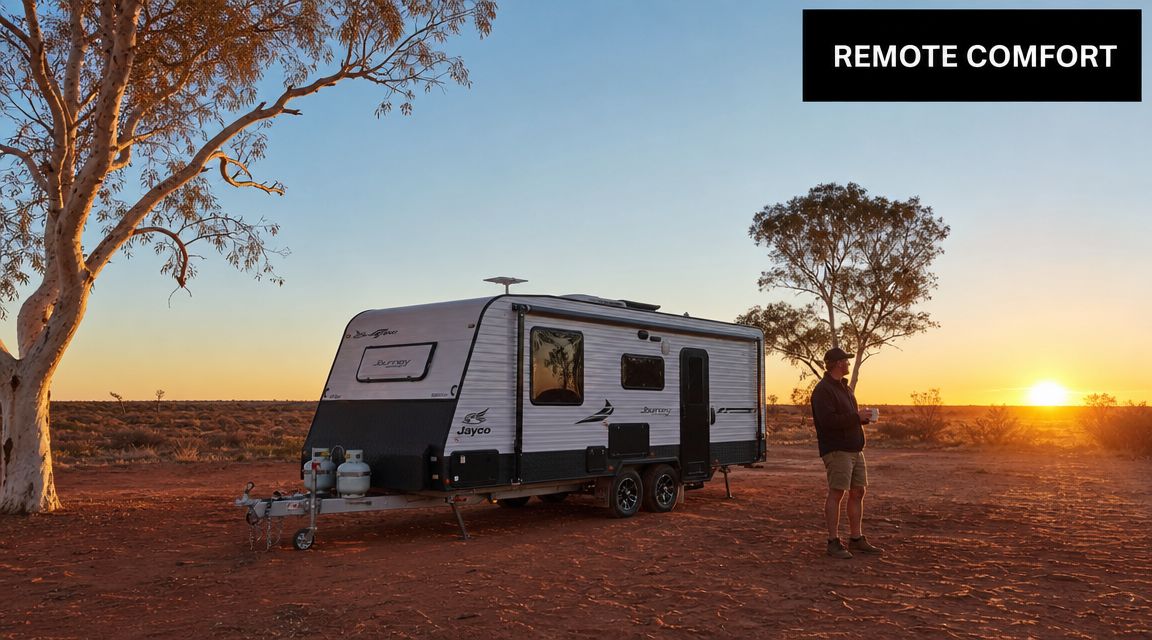
Why people look at the Duoetto
The appeal is easy to understand:
- Compact footprint means it can suit caravans, camper trailers, boats, and tight cabinetry.
- Dual-voltage operation means you can use mains power when it's available and still have a battery-powered option.
- Electric-only design appeals to owners who don't want to add another fuel source to the vehicle.
That last point matters more than many buyers realise. If you can avoid building around both gas and electric, the whole fit-out can stay simpler.
The Duoetto makes sense when space is tight and you want one hot-water appliance that can work across different camping styles.
What usually gets missed
The brochure-level specs only tell part of the story. What matters in ownership is how quickly it reheats, how it behaves on 12V, what sort of wiring it needs, and whether your battery system is up to the task.
That's where people get caught. They assume “12V capable” means “easy off-grid hot water” in every setup. Sometimes it does. Sometimes it doesn't.
What Is a Duoetto Water Heater
You pull into a powered caravan park after a long drive, wash the dishes, and still want enough hot water left for a quick rinse. A Duoetto is built for that kind of use. It is a compact storage water heater for caravans, camper trailers, and boats that can heat water from either 12V DC or 240V AC, then hold that hot water in a small insulated tank until you need it.
That sounds simple, but the distinction matters. The Duoetto is designed to store a modest amount of hot water ahead of time. It is not trying to behave like a household continuous-flow unit.
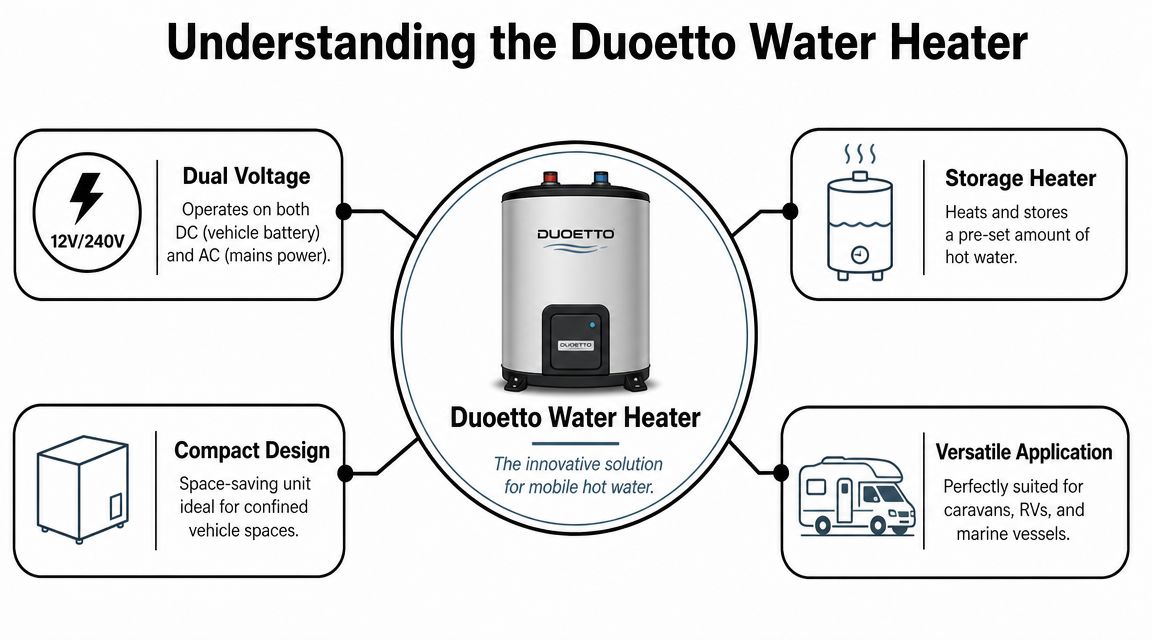
It's a storage heater, not an instant unit
A storage heater works like a thermos with an electric element inside. You heat the water first, then draw from that stored supply. A tankless system heats water as it passes through, which changes the plumbing layout, power demand, and the whole ownership experience.
If you are comparing options, this guide to a tankless instant water heater for caravans and RVs helps show the difference.
For this reason, the Duoetto suits compact mobile setups where simple plumbing and a ready reserve of hot water are often more useful than chasing household-style performance. That is the practical reality owners care about. You get predictability and a simpler install, but you also accept the limits of a small stored volume.
The parts that matter in real use
You do not need to memorise every internal component. You do need to understand the three things that shape daily use.
The tank
The Duoetto is a small tank water heater. In caravan terms, that means it is best suited to handwashing, dishwashing, and short, disciplined shower use rather than long back-to-back showers for a family.
This is one of the biggest points buyers miss. A small tank can work very well in an Australian van if your expectations match the job. It feels much less generous if you expect home-style hot water habits while free camping.
The dual-power heating setup
The Duoetto has separate heating arrangements for 240V mains power and 12V battery or vehicle-side power. That dual-voltage design is the reason people keep looking at it. On a powered site, it fits neatly into normal caravan use. Off-grid, it gives you an electric hot water option without adding gas appliances and gas bottle planning to the van.
There is a catch, and it matters. “Runs on 12V” does not mean “cheap to run from batteries.” It means the unit can heat from a 12V supply if your wiring and battery system are built for that load. In real ownership, that power side often matters more than the brochure description.
A quick product overview helps if you want to see the form factor before getting into wiring details:
The thermostat
The thermostat sets the target water temperature, and that affects more than comfort. Higher settings can give you more flexibility at the tap because you can mix hot and cold water, but they also increase heating time and energy use.
That trade-off is a big part of living with a Duoetto. It rewards owners who use it deliberately.
Practical rule: Judge the Duoetto as a small stored hot water system with two power options, and it makes sense. Judge it like an unlimited off-grid shower system, and it will disappoint.
Understanding Key Features and Specifications
A spec sheet is only useful if you can picture what those numbers mean at the sink or shower. With the Duoetto, the headline figures are simple. The practical part is working out how a small storage heater behaves in a caravan once you add limited space, battery limits, and the stop-start way people use hot water on the road.
According to CamperTrailers technical reference information, the commonly cited figures are 10 litres of storage, 1,000 watts on 240 volts with a draw of 4.6 amps, 300 watts on 12 volts with a draw of 25 amps, and a thermostat adjustable between 30°C and 75°C.
Duoetto MK2 technical specifications
| Specification | Value |
|---|---|
| Tank capacity | 10 litres |
| 240V power | 1,000 watts |
| 240V current draw | 4.6 amps |
| 12V power | 300 watts |
| 12V current draw | 25 amps |
| Thermostat range | 30°C to 75°C |
What those numbers mean in practice
The tank size
The 10-litre tank sets the whole personality of the unit. You are storing a modest amount of hot water, then mixing it with cold to make it go further. Used carefully, it addresses the jobs many caravan owners care about most: washing up, hand basins, a quick rinse, or a short shower with a low-flow head.
It helps to picture it like an esky, not a running tap. Once the stored heat is used, you wait for the tank to recover.
That is the part brochures often rush past. In daily use, tank capacity affects comfort more than almost any other spec.
The 240V side
On 240V, the Duoetto behaves like a sensible small mains storage heater. The 1,000-watt element is far better suited to normal campsite use because it reheats the tank at a pace that feels reasonable for a compact van.
If you spend a lot of time on powered sites, this is the mode that makes the Duoetto easiest to live with. Turn it on, let it heat, and use hot water in short sessions without wondering what it is doing to your battery bank.
The 12V side
The 12V rating is where owners need to slow down and do the maths. A 25-amp draw is not extreme in automotive terms, but it is a serious continuous load in a caravan electrical setup, especially if lights, a compressor fridge, fans, pumps, or an inverter are also running.
That means the question is not just, “Can it run on 12V?” The better question is, “Can my wiring, fuse protection, charging setup, and battery capacity support it without turning hot water into a power penalty?”
For off-grid setups, that distinction matters a lot. A Duoetto can work well with strong charging support, regular driving, or a system sized for heavier DC loads. In a lightly equipped van with a small battery bank, the same feature can become frustrating. That is why some buyers also compare small storage heaters with tankless instant water heater options, because the trade-off is really about energy use, plumbing layout, and how you travel, not just whether one unit has more features.
Temperature control
The thermostat range also deserves a practical reading. Higher stored temperatures can stretch a small tank because you mix more cold water at the tap. The trade-off is longer heat-up time and more energy used getting there.
In plain terms, hotter water can make a 10-litre tank feel more useful, but only if your plumbing, tempering, and day-to-day habits suit that setup. In a caravan, comfort and efficiency usually come from balance, not solely winding the thermostat up.
Differences you may see across versions
This part catches buyers out. Duoetto units have changed over time, and the exact controls and protections can vary by version.
Earlier material commonly describes the MK2 with the broader temperature range listed above. Later version descriptions often refer to added protection features and revised control ranges, including dry-run protection, over-temperature protection, a pressure and temperature relief valve, and mounting options for different caravan or boat setups.
The practical lesson is simple. Check the exact model on the compliance plate and installation paperwork before you assume two Duoetto heaters behave the same way. That matters for replacement parts, wiring expectations, and deciding whether the unit suits your style of camping.
The Pros and Cons A Real-World Verdict
The Duoetto is one of those products that can be either a clever choice or a frustrating one, depending on the setup around it. The unit itself isn't the problem. Mismatched expectations usually are.
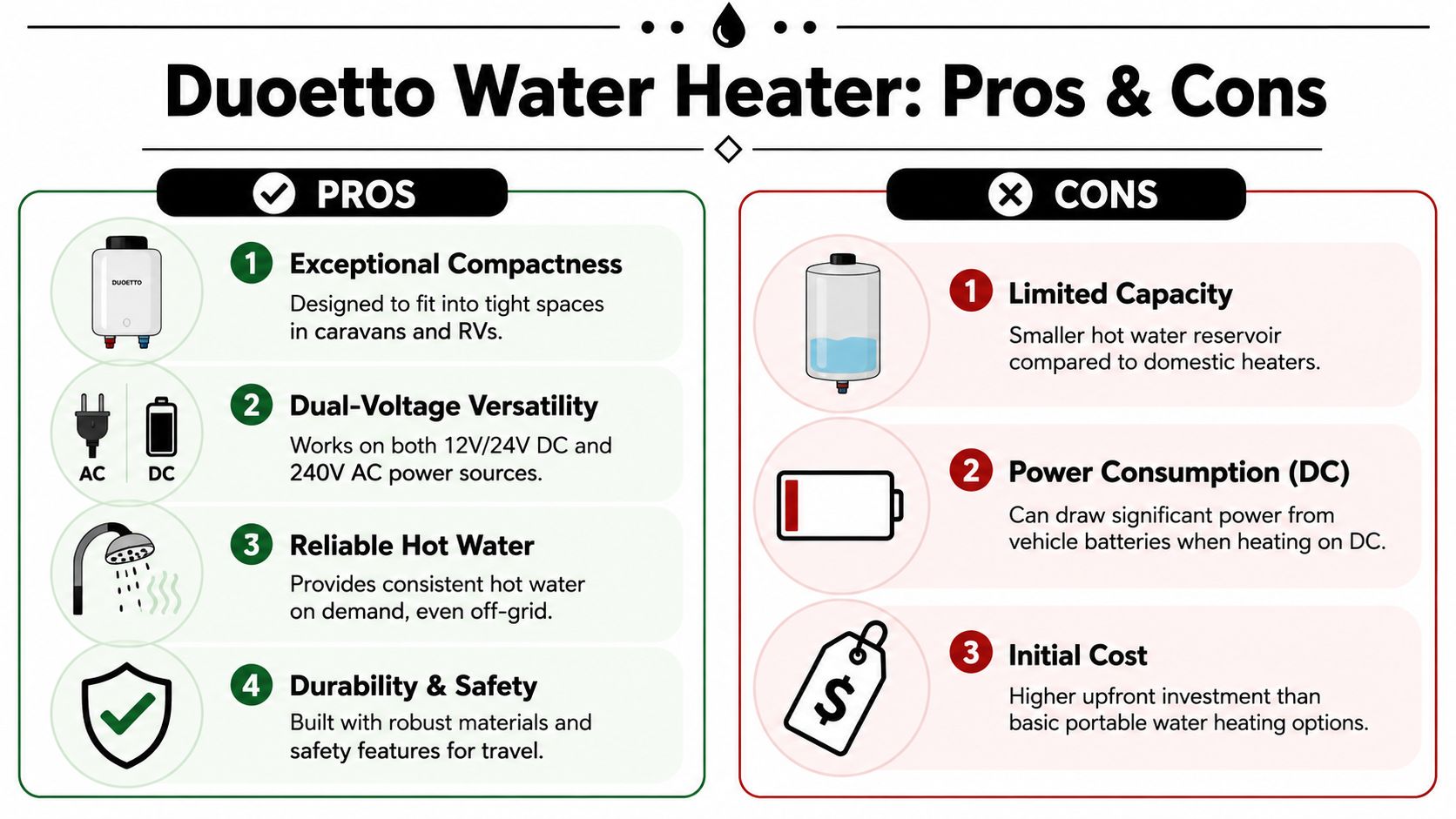
The good
The biggest win is flexibility. If your travel pattern includes both powered sites and time away from mains, having one heater that can work in both conditions is handy.
The physical size is another strong point. In mobile fit-outs, compactness isn't just convenience. It affects cabinet design, pump placement, service access, and how much room you've got left for everything else.
There's also something to be said for staying electric-only. Some owners prefer not to add gas components to a compact van build.
Where it feels easy to own
The Duoetto generally suits owners who use hot water in short bursts and don't expect residential performance. In that role, it can feel tidy and sensible.
Examples include:
- Weekend caravanners who mainly use powered sites and want straightforward electric hot water
- Compact van owners who need something that fits under a bench or into a tight service compartment
- Boats and marine users who value small-footprint equipment with flexible supply options
The bad
The limitation is capacity. A 10-litre storage heater asks you to think a bit differently about hot water use. You use what's available, mix it wisely, and give the unit time to recover.
That's not a defect. It's the design brief. Still, buyers coming from domestic systems can be disappointed if no one explains that upfront.
The ugly for off-grid use
This is the bit many listings don't make plain enough. The 12V mode is not free hot water from nowhere. It's a serious electrical load, and the battery cost adds up.
User discussion in an Australian forum estimates around 22 to 25 amps draw and roughly 2 hours 15 minutes to raise 10 litres from 15°C to 70°C, which points to a substantial amp-hour hit for off-grid use in real conditions, as discussed in AULRO forum comments on Duoetto 12V heating demands.
Treat the 12V function as a capability that needs planning, not as a magic switch for effortless bush hot water.
What that means in plain English
If you've got a powerful charging setup, healthy battery reserves, and you understand when to heat water, the 12V side can be useful. If your van has a basic battery system and you're already watching every amp, the Duoetto may feel expensive to run off-grid even though it's electric.
This is the honest verdict:
- Excellent when your setup is compact, well-wired, and often connected to mains
- Reasonable when your off-grid system is strong and you use hot water carefully
- Poor fit when you expect long showers from a light-duty battery setup
Duoetto Installation and Setup Guide
Installation is where a good Duoetto experience is made or ruined. Most trouble comes from one of three areas: bad placement, rushed plumbing, or underdone electrical work.
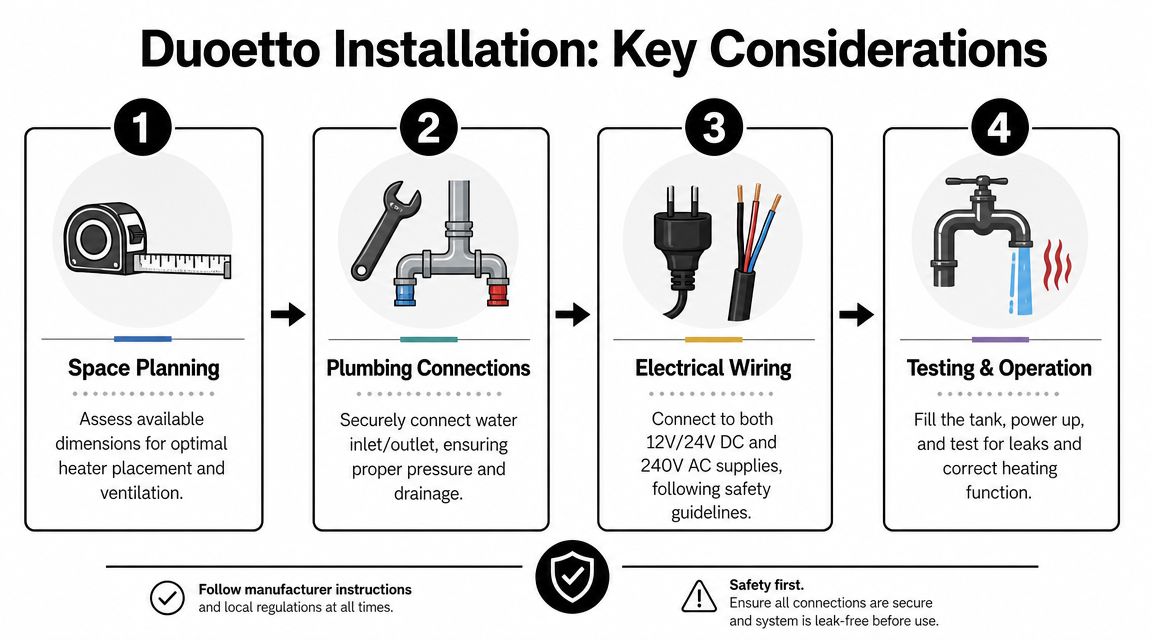
Start with space, not cables
A lot of DIY installs go wrong because the owner starts by asking where the wires can reach. Start with serviceability instead.
The unit needs a location that works for access, plumbing runs, mounting strength, and relief-valve discharge planning. Gen 3 materials describe options for wall or floor mounting, which gives you more flexibility in cabinetry and under-bench layouts, but “it fits” isn't enough. You also need to reach it later for checks and parts replacement.
Good placement usually means
- Shorter plumbing runs so you waste less water waiting for heat
- Access to valves and fittings so maintenance doesn't mean dismantling half the van
- A solid mounting surface because mobile installations deal with vibration and movement
Plumbing needs to stay simple and safe
The Duoetto is usually happiest in a tidy, direct plumbing layout. That means clean inlet and outlet routing, proper support for fittings, and correct relief-valve handling.
If you're building or upgrading the surrounding system, details like a proper hot water shut off valve arrangement can make later servicing much less painful. Isolation matters when you need to inspect, repair, or swap parts without draining or disrupting more of the system than necessary.
A common owner mistake is treating the heater as if it were just another inline accessory. It isn't. It's a pressurised hot water appliance and should be installed like one.
The electrical side is where people get caught
This is the part I'd be most cautious about in any van or caravan install.
Real-world discussion around wiring shows that the 12V element is activated by relay and switch logic, and users have highlighted the need for correct positive and ground signal handling in actual installations. The same walkthrough also points back to the manual warning not to power the unit without water, because that can cause permanent damage, as shown in a Duoetto wiring and setup walkthrough on YouTube.
Fill the tank first. Test for leaks second. Apply power after that. Not before.
Why professional wiring matters
The 12V circuit is not a token accessory circuit. It's a high-current load. That means:
- Cable sizing matters because voltage drop and heat become real issues
- Protection matters because fusing and switching need to suit the load
- Relay logic matters because the unit's control side must trigger correctly
- Commissioning matters because a dry-fired element can be permanently damaged
The 240V side also needs proper compliance and safe installation practices. In mobile builds, that's even more important because vibration, moisture, and confined spaces are all part of the environment.
A sensible setup approach
If you're planning a Duoetto install, work through it in this order:
- Choose the mounting location based on access, plumbing path, and safe support.
- Design the plumbing layout around serviceability, not just convenience on install day.
- Assess the battery and charging system realistically before deciding how useful the 12V mode will be.
- Have the electrical work done properly if there's any doubt about current draw, relay control, or mains compliance.
A neat install often looks simple from the outside. It rarely is.
Is a Duoetto Water Heater Right For You
The Duoetto suits certain owners very well. It's much less convincing for others. The easiest way to decide is to match it to your travel style rather than your wish list.
People who usually suit it
The weekend caravanner
You mostly stay in parks, want clean electric hot water, and don't need long back-to-back showers. The Duoetto makes sense here because the 240V side does the heavy lifting and the compact tank is less of a nuisance.
The compact camper owner
Your build is tight, every appliance has to justify its footprint, and you want one unit that can serve a sink, an outdoor rinse, or a modest shower arrangement. The storage design can be a strong match because it keeps the system physically small.
The careful off-grid traveller
You already know your electrical system well. You're realistic about battery use, and you don't assume every appliance should run the same way in the bush as it does on mains. This owner can make a Duoetto work because expectations are aligned with the hardware.
People who should think twice
Some setups are better served by other solutions.
- Families wanting lots of consecutive hot water may find the tank capacity restrictive.
- Owners with basic battery systems may not enjoy the 12V side at all.
- Travellers expecting instant, endless showers are shopping in the wrong category.
How it compares with alternatives
A gas instant system usually suits people chasing longer hot-water use, but it adds fuel-related complexity. Diesel-based solutions can make sense in some integrated touring setups, especially where diesel is already central to the vehicle's other systems, but they're a different type of install and ownership experience.
The Duoetto sits in a specific niche. It's for people who want a compact, all-electric storage heater and understand the trade-off. If that description sounds like your van, it's worth serious consideration. If not, another hot-water style may fit your life better.
Maintenance Parts and Melbourne Support
A Duoetto usually does not fail in dramatic fashion. More often, it gives you small warnings first. A drip at a fitting. Slower heat-up than usual. A relief valve that has not been exercised in ages. In a caravan, those little signs matter because vibration, storage time, and inconsistent water quality all wear on components faster than they do in a house.
The practical way to look at maintenance is simple. Treat the heater like any other working van component, similar to a pump or battery connection. It needs periodic checks, not constant tinkering.
What owners should watch
A sensible routine includes a few basic inspections:
- Check the relief valve occasionally to make sure it is not stuck
- Look for slow leaks around fittings and connections, especially after corrugated roads or long trips
- Pay attention to heating performance if recovery time changes or the water does not seem as hot as before
- Use the correct manual for your model before adjusting settings or ordering replacement parts
As noted earlier, the Duoetto's tank and heating components are designed as serviceable parts rather than throwaway pieces. That matters in real ownership. If a van appliance can be repaired with the right part, you have a better chance of keeping the system going without replacing the whole unit.
Hard water can shorten the life of valves and internal components too. If you travel through different parts of Australia, that is worth keeping in mind.
When to stop troubleshooting and call for help
Some faults are owner-check territory. Others are not.
If the unit trips electrical protection, leaks from a key connection, refuses to heat, or shows odd behaviour on the 12V or 240V side, get it checked properly. A Duoetto is straightforward in concept, but the mix of water, heat, and power means guesswork can turn a small repair into a bigger one.
If you are comparing parts support for compact hot water gear, it also helps to look at related product categories such as instant hot water tap systems and spare parts. The point is not that they are the same product. It is that suppliers who deal with compact hot water equipment often understand the parts, fittings, and space limits common in caravans and RVs.
In Melbourne, local support can save time because access is half the battle. A technician who understands caravan cabinetry, tight service clearances, and mixed 12V and 240V setups will usually diagnose problems faster than a generic repair shop.
If you're in Sunshine, Footscray, Yarraville, or the outer suburbs, having a local specialist who can supply parts, check installation quality, and help with repairs is often more useful than a generic online listing.
If you need advice on a Duoetto water heater, replacement parts, or a practical installation approach for a caravan or RV, Ring Hot Water can help with product supply Australia-wide and Melbourne-based support for installation, repairs, and maintenance.

