
Uncategorized
Duoetto 12V Water Heater the Complete Aussie Guide 2026

May
You've pulled up after a long drive, the van is dusty, the kids are hungry, and all you want is hot water without firing up a complicated system or relying on a park amenity block. That's where the Duoetto starts to make sense. For many Australian caravan owners, it sits in the sweet spot between a simple electric storage heater and a full gas setup.
The attraction isn't just that it can heat water. It's that it can fit the way real vans get used. Some days you're plugged into mains power. Other days you're leaning on your battery bank, pump, and solar. If you're also sorting out your broader water setup, this guide to a 12 V water pump for caravan systems helps tie the whole picture together.
A lot of product pages stop at “12V and 240V compatible” and leave the hard questions unanswered. Can your wiring carry the load? Will your battery handle it sensibly? Why do people keep talking about check valves? Those are the questions that matter once the heater is in your hands and you're staring into a cupboard with a torch.
Your Guide to Off-Grid Hot Water
A new caravan owner usually starts with the same assumption. If a heater says 12V, it must be easy to run off the van battery. Sometimes that's true. Sometimes it's the start of nuisance fuse blows, slow heating, voltage drop, and a lot of muttering under the sink.
The Duoetto has become popular because it was built around mobile use rather than copied from a household appliance. It's meant for the kind of setup many Australian travellers already have. Battery, pump, compact plumbing, and occasional shore power. That makes it a practical fit for off-grid touring, beach trips, and overnight roadside stops where gasless hot water is appealing.
A good caravan hot water setup doesn't just heat water. It has to match the way your van stores power, moves water, and switches between park power and off-grid use.
Selecting tyres for a touring rig offers an apt comparison. The tyre itself matters, but it only works properly if it suits the weight, rim, pressure, and road conditions. A Duoetto is similar. The unit can be right, but the install still has to suit the van.
That's why experienced installers focus on two things first. Electrical load planning and plumbing control. Get those right and the heater usually behaves well. Get them wrong and the heater often gets blamed for problems caused elsewhere in the system.
What Is a Duoetto 12V Water Heater
You pull up at a bush camp, fill the tank, and want enough hot water for dishes and a quick rinse without firing up gas. That is the job a Duoetto is built for. It is a compact electric storage water heater made for caravans, RVs, and other mobile setups where cupboard space is tight, water pressure is modest, and the power source may change from one stop to the next.
The Duoetto MK2 is an Australian-designed unit from Aus J Hot Water Solutions. In practical terms, it is a small insulated tank with electric heating built in. Water is heated and stored, then delivered to your tap or shower as needed. That matters because a storage heater behaves differently from an instant heater. You are working with a set volume of hot water, much like a thermos under the bench, rather than asking the heater to warm every litre on demand.
The core specs that matter
The Australian retail specifications set out the details that affect real caravan use. The Duoetto MK2 has selectable temperatures from 30 to 75°C on 240V and up to 70°C on 12V, with electrical ratings of 12V at 25A / 300W and 240V at 4.2A / 1000W. The unit measures 409 mm × 262 mm × 267 mm, has a 10L tank, and comes with a 12-month warranty (Aus J Duoetto MK2 specifications).
Those numbers answer the first questions an installer asks.
- Will it fit? The cabinet-sized body suits under-bench and service-compartment installations where every millimetre counts.
- How much hot water do you get? The tank holds 10 litres, so planning matters. For one person washing up or taking a careful caravan shower, that can be workable. For a family expecting household-style long showers, it will feel small.
- Can your 12V system carry the load? A 25A draw is closer to a serious appliance than a light accessory. That affects cable size, fuse selection, battery capacity, and how long you can sensibly run it off-grid.
That last point is where many new owners get caught out.
A water pump might draw a few amps and cycle on and off. A 12V water heater asks for a heavy, sustained current. The comparison is a garden hose versus a fire hose. Both move water, but the supply requirements are very different. With the Duoetto, the heater itself may be compact, yet the electrical planning behind it cannot be an afterthought.
How it differs from other hot water options
The Duoetto sits in a specific middle ground for Australian vans. It is an electric-only storage heater for mobile use. It does not bring gas bottle management, burner servicing, or flue placement into the job. It also does not behave like a household mains-only heater that assumes unlimited park power and plenty of installation room.
That makes it a sensible option for owners who want a small local hot water source near a sink or shower point, and who need to be realistic about both battery load and plumbing safety. In a caravan, those two systems are linked. If the wiring is undersized, heating performance suffers. If the plumbing protection is wrong, pressure and expansion problems can show up quickly in a small closed system.
A simple way to view it is this. The Duoetto is a compact hot water tank designed to live inside a van's electrical and plumbing limits. If your setup can support those limits, it can be a tidy solution. If it cannot, the heater is often blamed for issues that started with cable sizing, battery expectations, valve selection, or poor water line routing.
How the Dual-Voltage System Works
You pull into a powered site on Friday, plug the van in, and expect hot water to work like it does at home. A week later you are free camping, running only from the battery, and the same heater now has to play by very different rules. That change in power source is the whole point of the Duoetto's dual-voltage design.
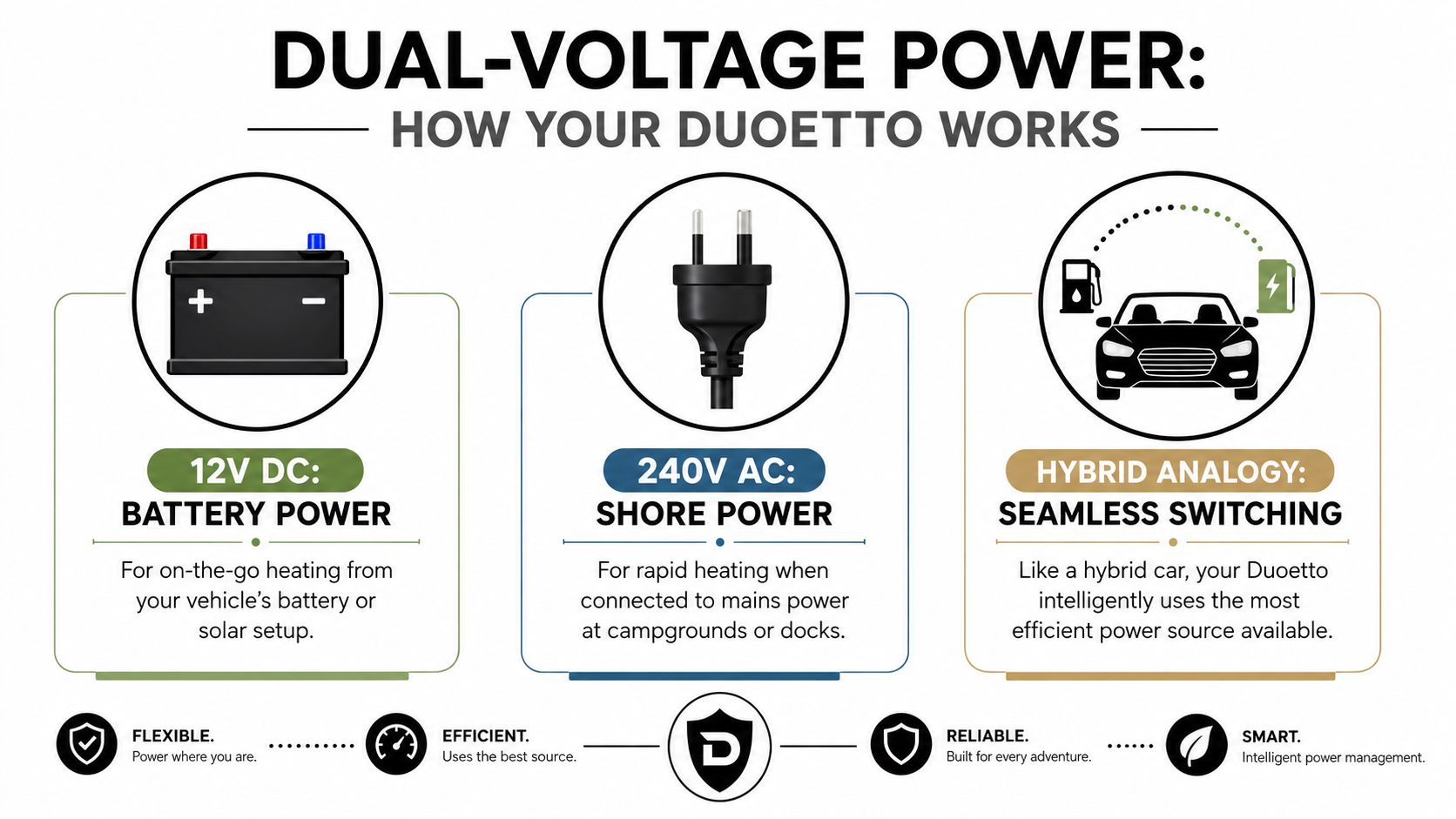
It has two separate heating paths. One uses 240V AC from shore power. The other uses 12V DC from your caravan battery system. The heater can operate from either source, but you should treat them as two different jobs with two different demands on the van.
Why this matters in an Australian caravan
Australian caravan use swings between powered parks and off-grid camps. A heater that only runs on one supply forces the rest of your trip to fit around it. A dual-voltage unit gives you options, but only if you understand what each mode asks from your wiring, battery, and plumbing.
The simple version is this. 240V mode is the easy mode for the battery system. 12V mode is the demanding mode.
On mains power, the heater behaves much like a small storage heater connected to a proper external supply. Off-grid, the same tank is now relying on the van's DC system, where cable size, voltage drop, battery condition, charging input, and fuse protection all affect performance. That is why owners asking about a hot water heater for caravan power and plumbing planning need more than the heater's dimensions and litre capacity.
What dual-voltage does, and does not, mean
A lot of confusion starts here. Dual-voltage does not mean both heating circuits combine to give extra heating at the same time.
Treat it as a changeover arrangement. If the unit is heating on 240V AC, the 12V heating side is not doing the heating job. That matters because some caravan owners expect shore power and battery heating to stack together like two burners under the same pot. They do not. The system is designed so one supply is doing the work at a time.
That is also why an inverter needs careful thought. An inverter may create 240V output, but that does not magically turn battery power into “free mains power.” You are still drawing energy from the same battery bank, just through another piece of equipment with its own losses. In practical terms, that can be a harder path for the battery, not an easier one.
Use the right mental model
The tank stays the same. The supply behind it changes.
With 240V, your van is borrowing energy from the site. With 12V, your van is paying for every bit of heat from its own stored power. That is the reason load planning matters so much more in off-grid use than many first-time owners expect.
Here is the practical way to read each setup:
| Situation | What it means in practice |
|---|---|
| Plugged into caravan park power | Let 240V handle water heating and save battery capacity for other DC loads |
| Parked off-grid with battery support | Use 12V with realistic expectations about heating time and battery draw |
| Running an inverter | Treat it as battery-powered heating by another route, not the same as direct shore power |
| Both systems available | Check which supply is active and do not assume both are heating together |
If the Duoetto is on 240V, treat it like a mains-powered heater. If it is on 12V, treat it like a high-draw DC appliance that needs proper cable sizing and battery support.
That one habit prevents a lot of bad fault-finding. Owners often chase the heater when the underlying issue is low voltage at the unit, an undersized cable run, weak battery support, or a plumbing setup that was never designed for heated water expansion in a compact van system.
The dual-voltage feature is useful because it gives you choice. The safe result comes from knowing which mode you are in, what that mode demands, and whether your caravan setup can support it.
Planning Your Duoetto Installation
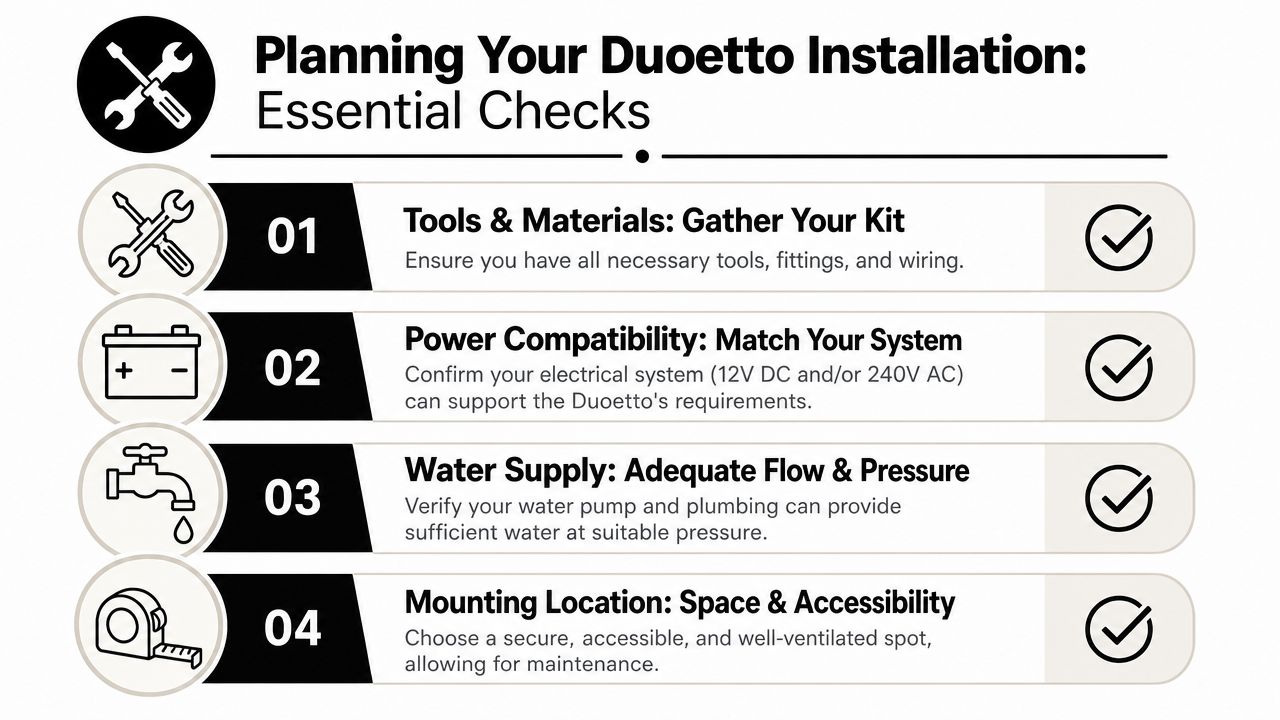
Most Duoetto installation problems start before the first hole is drilled. The heater gets chosen because the dimensions look right, but nobody has checked whether the battery, fuse protection, cable run, pump plumbing, and valve layout are ready for it.
Start with electrical reality
The big planning fact is simple. The Duoetto's 12V element draws around 25 amps, so battery capacity, cable size, and fuse protection need proper thought before installation (video discussion of Duoetto electrical load planning).
That number matters because many caravan owners mentally lump a water heater in with lights, fans, and a water pump. It isn't in that class. A hot water element is more like a dedicated working load. If the cable is undersized or the battery voltage sags, the heater won't behave as expected.
A simple way to think about it is water through a hose. Voltage is the pressure. Current is the flow. If you try to push strong flow through a hose that's too skinny or too long, performance suffers. Electrical cable behaves much the same way.
Questions to ask before you buy cable
Use these as a planning checklist:
Battery support
Can your battery bank comfortably support a sustained 25A draw while heating? A setup that already struggles with a fridge, charger, and lights may not enjoy adding another major DC load.Cable path
Is the heater close to the battery or distribution point, or is the cable run long and awkward? Longer runs make voltage drop more important.Fuse and switching
Have you planned proper fuse protection and a suitable switching method? Heavy loads need heavy-duty control gear.Use pattern
Will you mainly heat on powered sites, or are you expecting regular off-grid use? That answer changes how much money and effort should go into the DC side.
If you need a broader look at caravan hot water options before committing, this guide to a hot water heater for caravan setups helps compare the bigger picture.
A simple planning table
The table below sticks to verified electrical ratings. Heating time varies with incoming water temperature, thermostat setting, and installation conditions, so any estimate should be treated as approximate rather than exact.
| Power Source | Amperage Draw | Power (Watts) | Estimated Time to 60°C |
|---|---|---|---|
| 12V DC | 25A | 300W | Slower than 240V. Depends on starting water temperature and system conditions |
| 240V AC | 4.2A | 1000W | Faster than 12V. Depends on starting water temperature and thermostat setting |
Plumbing planning is just as important
Electrical issues get more attention because they sound technical. Plumbing mistakes are just as common, and often more confusing to diagnose.
The key issue is backflow control. In mixed caravan systems, water may come from a pump-fed tank supply, a mains pressure inlet, or both at different times. Without the right one-way valves, pressure can push water where it shouldn't go. That can show up as hot water creeping into the cold line, pressure bleeding away, odd cycling, or the pump behaving strangely.
A heater can only perform properly if the water is moving in the correct direction. That sounds obvious, but many caravan plumbing systems have enough tees, taps, and changeover paths to make “obvious” disappear quickly.
Wiring and Plumbing Your Heater Step-by-Step
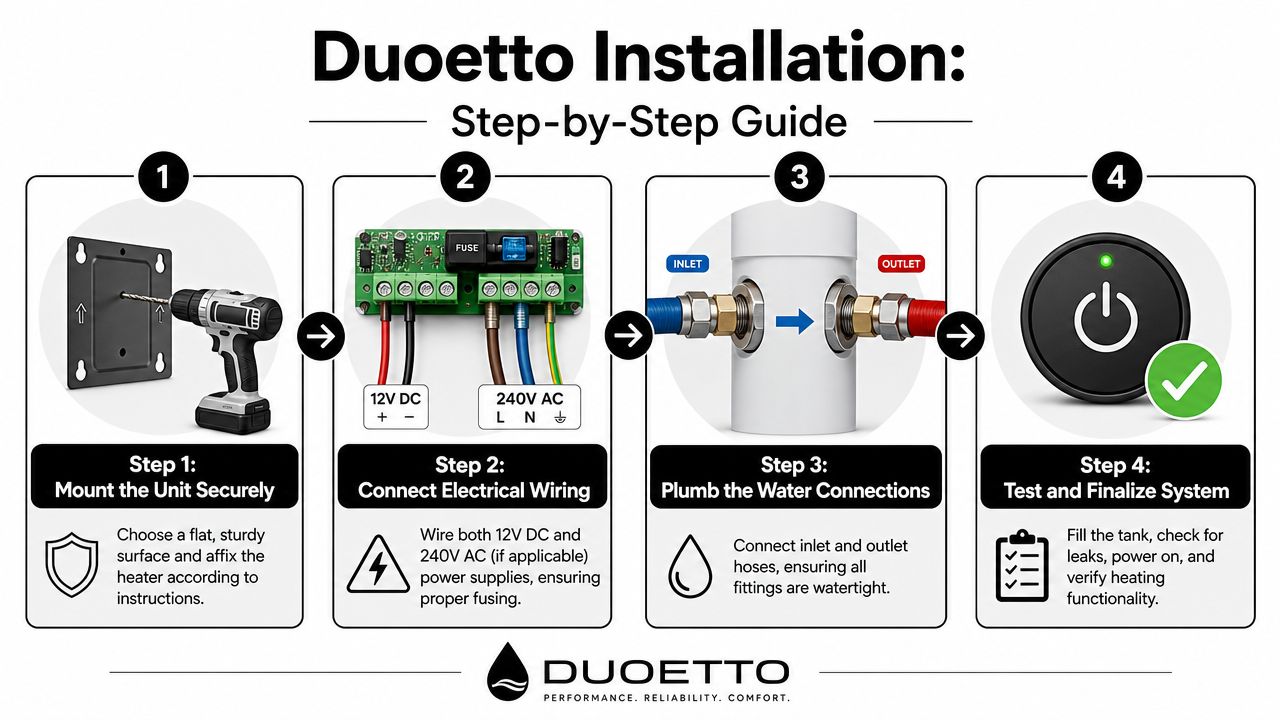
The cleanest installs follow a strict order. Mount first. Plumb second. Fill and prime. Then wire. The reason is simple. A storage heater must never be powered before it contains water.
Mounting the unit
Pick a position that is solid, accessible, and sensible for service work later. Under a bench can work well if you can still reach fittings, wiring, and safety components without dismantling half the van.
Mount it upright and secure it properly. Caravans bounce, twist, and vibrate. A heater that feels “firm enough” in the driveway may not feel that way after corrugations and potholes.
Plumbing the water side
Many DIY installs often go wrong. The common error is leaving out the non-return valves.
A common installation mistake is neglecting check valves on both the pump-fed cold line and any mains pressure inlet, which can lead to pressure bleed, hot water migrating into the cold line, or pump backflow (installation discussion covering check valve placement).
Use the plumbing layout as a controlled one-way path:
- Cold inlet from pump side with the correct one-way valve.
- Mains inlet protection with its own one-way valve if the system can accept park water.
- Hot outlet routed cleanly to the fixtures.
- Leak check before any electrical connection is energised.
Missing one non-return valve can make the whole plumbing system feel haunted. Water turns up in the wrong place, pressure behaves oddly, and the heater gets blamed.
If you're more comfortable reading a general dual-battery wiring layout before tackling the DC side, this boat wiring diagram for dual batteries is useful background because the logic of battery isolation and heavy-load planning is similar to many caravan systems.
To see a general install walkthrough in action, this video gives a useful visual reference:
Wiring the 12V and 240V sides
Treat the DC side and AC side as separate jobs. Don't blur them together.
For 12V DC:
- Run suitable cable for the load and cable length.
- Protect the circuit with an appropriate fuse near the supply side.
- Use a relay or heavy-duty switching arrangement if the control method requires it.
- Make secure negative and positive connections with clean terminations.
For 240V AC:
- Follow applicable electrical rules and manufacturer instructions.
- Use a licensed electrician for any mains work if you're not legally qualified to do it.
- Keep AC and DC wiring organised and clearly separated.
The step people skip
Before applying power, fill the tank completely and confirm water flow. Open a hot tap and let air purge until water runs steadily. Only then should the heater be energised.
This is not optional. An empty tank and a powered element are a fast way to damage equipment.
Essential Maintenance and Troubleshooting
A Duoetto doesn't need constant fussing, but it does reward routine checks. Caravan systems live a harder life than house systems. Vibration, changing water quality, long storage periods, and mixed power sources all add wear in different ways.
Modern Duoetto models include features such as polyurethane insulation, automatic voltage detection, run-dry protection, and a PTR valve for overpressure safety (published feature summary for newer Duoetto models). Those features help, but they don't replace basic owner checks.
A sensible maintenance routine
A simple annual routine is usually enough for most owners.
Inspect wiring connections
Look for looseness, heat marks, or corrosion at terminals and switching points.Check the plumbing fittings
Look for weeping joints, hose stress, and signs that a valve isn't sealing properly.Test the PTR valve carefully
Make sure it isn't seized and that discharge arrangements remain safe. If you need background on how these protective valves fit into a broader water system, this guide to a pressure limiting valve is useful context.Run the heater before a trip
Don't wait until the first campsite stop to discover a flat battery, stuck relay, or plumbing leak.
Common symptoms and likely causes
| Symptom | Likely cause | First check |
|---|---|---|
| No heating on 12V | Fuse issue, switching fault, low battery voltage, poor cable connection | Check fuse, terminals, battery state, and control circuit |
| Water heats on mains but not off-grid | DC side problem or system not set up for proper 12V operation | Inspect 12V feed and switching path |
| Pump behaves oddly after install | Missing or faulty non-return valve | Re-check valve placement and flow direction |
| Hot water appears in cold line | Backflow through plumbing | Confirm one-way valves are installed correctly |
| Heater seems to lose heat too quickly | Normal standby loss, usage pattern, or insulation expectations | Review draw-off habits and system condition |
Workshop habit: If a Duoetto problem appears “mysterious”, split it into two systems. Water path first. Power path second. Most faults show themselves once you stop treating the heater as a single black box.
When to stop DIY troubleshooting
Call a professional if:
- 240V work is involved
- A relief valve appears faulty
- There are repeated electrical trips
- The tank has been powered while empty
- You can't confirm safe plumbing direction and pressure control
That saves time and often saves parts.
Buying Advice and Melbourne Installation Services
When buying a Duoetto, focus on more than the heater body itself. You also need the correct fittings, valves, electrical protection, and replacement parts support. In caravan work, the missing accessory is often what delays the whole job.
It's worth buying through a supplier that understands mobile hot water systems rather than treating the product like a generic appliance. That matters if you later need a thermostat, element, flexible hose, or compatible push-fit and threaded fittings. For example, Ring Hot Water lists the Duoetto 12V/240V water heater and also supplies caravan and RV-related valves, elements, hoses, and fittings, including John Guest and brass threaded options.
If you're in Melbourne and don't want to gamble on mains wiring, valve layout, or load planning, professional installation makes a lot of sense. Caravan hot water jobs often look simple until you hit a cramped cabinet, mixed-pressure plumbing, or an older battery setup that wasn't designed for a heater load. A technician who works on these systems can usually spot those issues before they become repeat faults.
For owners in Sunshine, Footscray, Yarraville, and the wider Melbourne metro area, local service is especially helpful when you want installation, fault-finding, or repairs rather than just a box delivered to the door.
If you want help choosing, supplying, or installing a Duoetto system for your caravan or RV, Ring Hot Water can assist with product advice, genuine parts, and Melbourne-based installation and repair support.

