
Uncategorized
Expert Guide: Gas Hot Water Heater for Caravan

May
You pull into camp late, level the van, get dinner sorted, then go to wash up and remember the part nobody romanticises about caravan life. Cold water. The first splash is a shock. The second makes you start mentally pricing every comfort upgrade you put off before the trip.
That's usually the moment people start looking for a gas hot water heater for caravan use. Not because they want luxury. Because hot water changes daily life on the road. Dishes get easier, showers stop being a negotiation, and off-grid travel feels much more sustainable when the basics work properly.
The problem is that caravan hot water in Australia sits right at the intersection of comfort, gas safety, legal compliance, and practical plumbing. A lot of advice online blurs together two very different things: a portable outdoor camping heater and a fixed hot water system installed in a caravan. They are not the same product, they are not used the same way, and they are not governed by the same safety expectations.
The End of Cold Showers on the Road
A lot of owners start in the same place. They've done a few trips with a kettle, a basin, and a very optimistic attitude. That works for a weekend. It gets old fast on a longer run, especially when mornings are cold, water is limited, and everyone in the van wants first turn at the tap.
The difference hot water makes isn't complicated. It removes friction from the trip. You stop planning basic hygiene around the weather and start using the van the way it was meant to be used.
What changes once hot water is reliable
With a proper caravan system, you can wash dishes immediately instead of waiting for boiled water. You can shower after a dusty drive without turning it into a military operation. You can use your onboard tanks more sensibly because the whole system is designed around controlled flow rather than improvised buckets and mixing bowls.
That's why gas remains the default choice for many caravanners. It suits off-grid travel because the heat comes from LPG, not from trying to drag heavy electrical loads through a small mobile setup. In practice, that makes it one of the most workable options for people who want independence from powered sites.
Hot water in a caravan isn't about convenience alone. It's about making the van usable day after day without workarounds.
The mistake new owners make
New owners often search for “caravan hot water heater” and end up comparing fixed appliances with outdoor camp shower units. On paper they can sound similar. In real use, they solve different problems.
A portable camping heater can be suitable for outdoor showering in open air, used exactly as intended by the manufacturer. A legally installed caravan system has a different job. It has to work with the van's gas supply, water pump, ventilation, flue arrangement, and overall compliance requirements. If you miss that distinction, you can buy the wrong product before you've even started.
A good setup isn't the one with the most impressive headline spec. It's the one that matches how you travel, fits the van properly, and can be installed and serviced safely in Australia.
How Caravan Gas Heaters Make Hot Water
A caravan gas water heater works on the same basic principle as a home unit, but the tolerances are tighter and the installation rules matter more. Cold water enters the heater, LPG supplies the heat, and the appliance transfers that heat into the water before it reaches the tap or shower.
Three parts do the work. The burner creates heat. The heat exchanger transfers that heat into the water. The water circuit moves water through the unit and out to your fixtures. If one of those parts is undersized, dirty, or poorly installed, hot water performance drops fast.
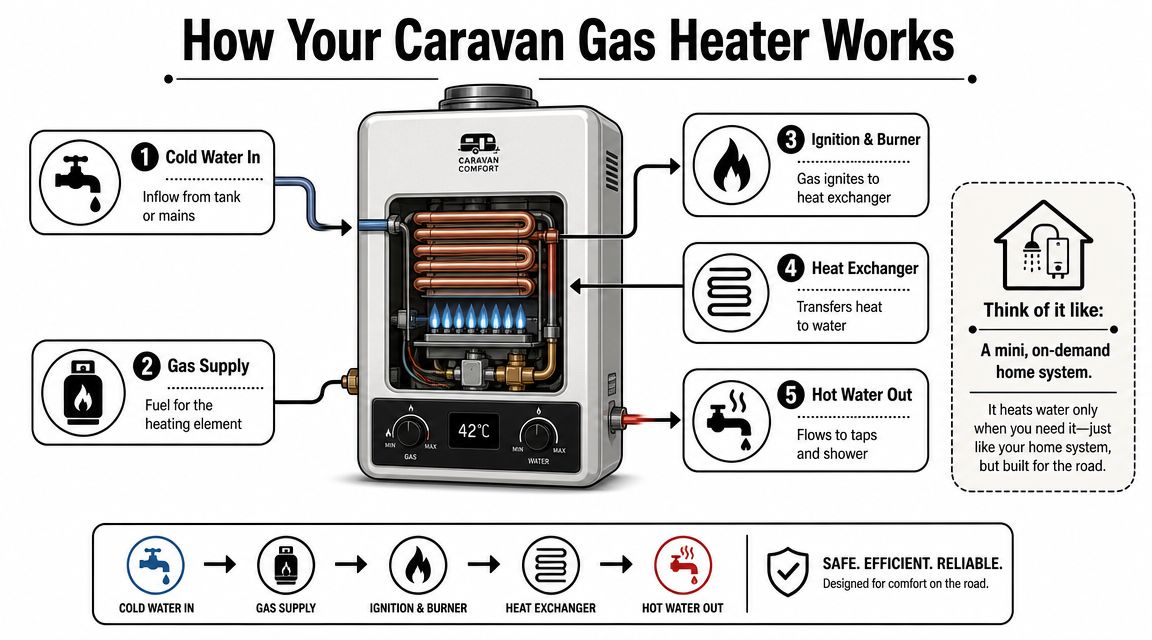
The basic heating sequence
Water comes in from the van's fresh tank through the pump, or from a mains connection if you are on a site. Once the heater is called on, gas flows to the burner and ignition starts the flame. That flame heats the exchanger. As water passes through or around it, depending on the heater design, the temperature rises before the water heads to the outlet.
That sounds simple because the core process is simple.
What makes caravan systems different is the environment around the heater. Water pressure can vary. Gas supply depends on correct regulator performance and pipe sizing. Airflow and flueing have to meet the appliance design, especially in Australia where a legally installed caravan heater is a fixed gas appliance, not a portable outdoor shower unit adapted for indoor use.
Two families of heater
You will usually be dealing with one of two designs.
Storage tank heaters heat and hold a small volume of water, ready for use. They suit owners who want predictable tap performance and a system that is generally more tolerant of small changes in pump flow or user habits.
Instantaneous or tankless heaters heat water only while it is moving through the appliance. They can save space and avoid storing hot water, but they are more sensitive to real-world setup issues such as minimum flow rate, steady gas supply, and stable flame operation.
In practice, the trade-off is straightforward:
- Storage units are usually easier to live with in a caravan that has modest pump output or simple plumbing.
- Tankless units can work well, but only if the van's gas, water, ventilation, and flue arrangement are matched properly.
- Storage heaters tend to give a steadier experience for short showers and washing up.
- Instantaneous heaters are less forgiving when flow pulses, pressure drops, or someone tries to mix water too aggressively at the tap.
That is why experienced installers look at the whole van, not just the heater brochure. The same principle applies in domestic work handled by hot water systems Melbourne, but caravans give you less room for error because every service is compact and closely linked.
Why the distinction matters in daily use
Small caravan heaters are built around limited water volume, limited space, and controlled use. If you have a storage unit, the available hot water depends on tank size, thermostat setting, and how quickly cold water mixes in during use. If you have a tankless unit, comfort depends on whether the heater can stay lit and modulate properly while the van's pump and gas system hold steady.
This is also where Australian compliance matters. A heater sold for camping use in open air is not the same thing as a caravan water heater designed to be permanently installed, flued, and connected to the van's gas and water systems. New owners miss that difference all the time, then wonder why a cheap portable unit cannot legally or safely do the same job.
Practical rule: Hot water performance in a caravan comes from the appliance, the gas setup, the water supply, and the installation all working together.
Treat the heater as one part of a complete system, and your buying and fault-finding decisions get much easier.
Choosing Your Ideal Caravan Water Heater
Buying the right heater starts with one question. Do you want a small stored reserve of hot water, or do you want heat generated as water flows?
That choice affects shower feel, recovery time, plumbing complexity, and how forgiving the system is when your gas or water supply isn't perfect.
Storage or tankless
Storage units suit caravanners who want a simple routine. Heat the water, use it, let the unit recover. That pattern works well for many couples and solo travellers.
Tankless units appeal to buyers who want continuous hot water behaviour, at least in principle. But “continuous” only applies when the van's LPG regulator, gas line sizing, water pressure, and ventilation arrangement all support the heater properly.
Here's the side-by-side view.
| Feature | Storage Tank Heater | Instantaneous (Tankless) Heater |
|---|---|---|
| Hot water delivery | Stored hot water ready for use | Heats water only when flow starts |
| Best fit | Predictable daily use, simple shower routines | On-demand use where system supply is strong and stable |
| System sensitivity | Generally more forgiving of small caravan plumbing variations | More sensitive to gas flow, water flow, and installation quality |
| Recovery behaviour | Uses stored volume, then reheats | No stored reserve in the same way, depends on live heating |
| Maintenance focus | Tank condition, flushing, scale, anode where fitted | Burner condition, heat exchanger cleanliness, water flow stability |
| Owner expectation | Short, planned use works well | Better for buyers who understand whole-system compatibility |
What performance figures actually mean
A lot of people shop by burner size alone. That's how they end up disappointed.
The useful benchmark is this: tankless units can deliver up to 60,000 BTU/h in RV applications, while a common static-caravan gas model cited at 24 kW delivers about 15.82 L/min at a 20°C temperature rise, as outlined in Flexiheat's caravan gas water heater overview. The headline sounds impressive, but the primary lesson isn't “bigger is always better”.
The lesson is cause and effect. Higher burner input can support stronger output. A smaller temperature rise allows higher flow. But in a caravan, actual performance still depends on the rest of the system. If your regulator, pipe sizing, or water delivery can't support the appliance, the numbers on the brochure won't save it.
Match the heater to the trip style
Different travel styles need different priorities:
- Weekend touring couples often do well with a compact storage system because the pattern of use is predictable and easy to manage.
- Families with back-to-back shower demand may prefer the idea of tankless performance, but only if the van is designed to support it properly.
- Mostly powered-site users can look at alternatives such as electric-assisted options, though gas still gives flexibility when mains power isn't available.
- Remote and mixed-condition travellers usually value a setup that's simple, durable, and easy to service over one with the flashiest spec sheet.
If you're comparing broader household options to understand design trade-offs, resources on hot water systems Melbourne can be useful for learning how storage and instantaneous approaches differ in practice, even though caravan installation requirements are their own category.
What works and what doesn't
What works is buying for your real use pattern. Two quick showers, dishwashing, and compact tank storage is a very different brief from trying to mimic a suburban bathroom in a small van.
What doesn't work is chasing maximum output without checking whether the van can legally and safely support it. In caravan hot water, the best buying decision is usually the one with the fewest surprises after installation.
Installation Rules and Gas Safety in Australia
This is the part many owners need to hear clearly. A portable outdoor camping heater is not the same thing as a fixed caravan gas appliance. Once a unit is being installed into the van as part of its gas and water system, the conversation changes from convenience to compliance.
Australian caravan owners need to think beyond “Will it fit?” Key questions are: can it be legally installed in this caravan, does the ventilation and flue arrangement suit the appliance, and is the work being done by the right licensed person?
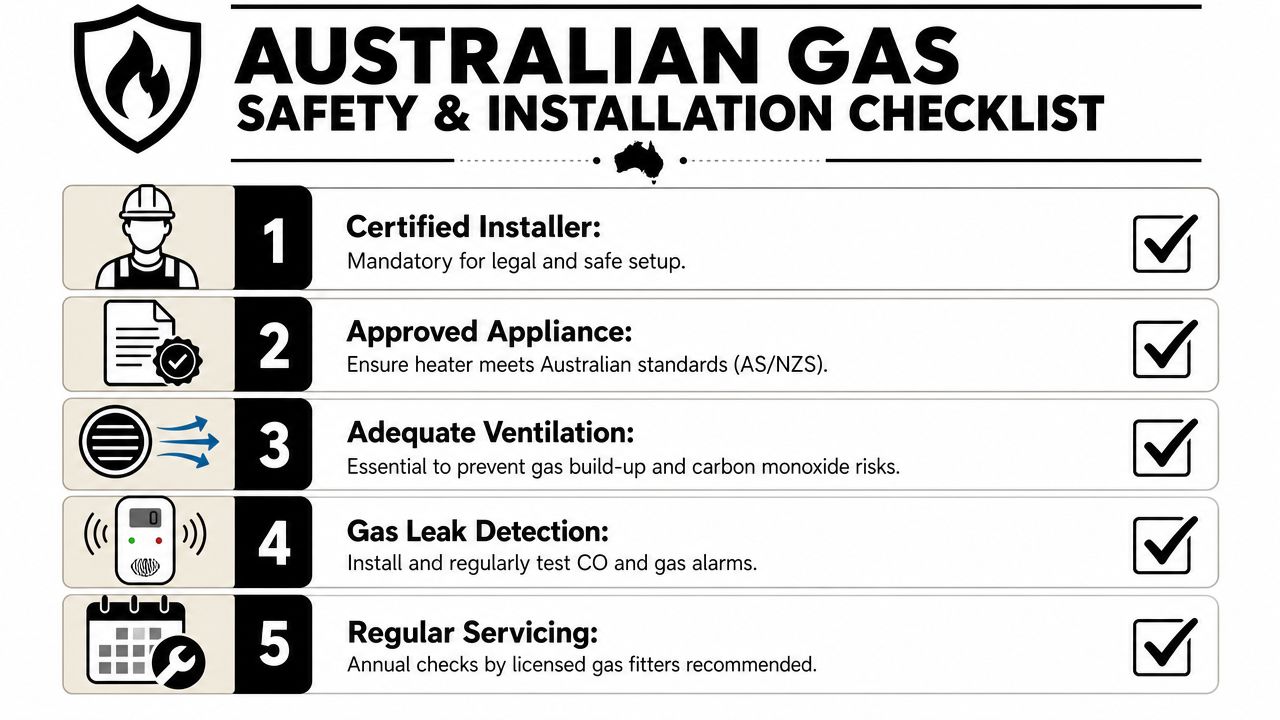
Portable outdoor use versus fixed in-van installation
Owners can be caught out by this. Some products are marketed for camping, outdoor showers, and general off-grid use. That doesn't automatically make them suitable for permanent caravan installation.
A fixed caravan system has to be assessed as part of an enclosed, road-going vehicle. Combustion air, exhausting, clearances, mounting, gas connections, and appliance approval all matter. The legal requirements sit under state and territory gas-fitting rules and the relevant standards framework. In practical terms, that means this is not a casual DIY job.
Why the risk is real
The strongest warning came from a major recall. The ACCC said 18,139 Suburban dual-fuel water heaters were sold nationally between 1 May 2018 and 25 September 2019, with 9,600 recalled units still to be inspected, including 8,359 not yet registered for inspection. The ACCC also said more than 50% of those units might emit deadly odourless carbon monoxide when used in gas mode, according to the ACCC water heater recall notice.
That's why owners should never treat gas hot water in a caravan as just another accessory. Combustion problems in an enclosed RV environment can become serious quickly.
If a heater's model approval, flue path, or installation method is unclear, stop there and get a licensed gas fitter involved before anything is connected.
The non-negotiables
A safe Australian caravan installation generally comes down to a short list of hard rules:
- Use the right appliance. A heater designed for outdoor portable use isn't automatically suitable for fixed caravan installation.
- Use a licensed gas fitter. Permanent gas work in a caravan needs to be done by someone authorised to do it.
- Check certification and paperwork. If you're unsure what that process looks like, Voyager Plumbing's gas compliance details give a useful plain-English overview of why certification matters after gas work.
- Address pressure control. Water-side protection matters too, and owners often overlook components such as a pressure limiting valve for hot water systems.
- Plan ventilation and exhaust correctly. In a caravan, combustion products must be managed, not assumed away.
What a good owner does before approving install work
Ask the installer whether the heater is approved for the intended caravan application. Ask how combustion air and exhaust are being handled. Ask what servicing access will remain after the unit is fitted. If the answer to those questions is vague, keep asking.
The owners who avoid trouble aren't necessarily the most technical. They're the ones who insist on clear, compliant answers before any holes are cut and any gas line is touched.
Connecting Your Heater to Power and Water
Once the appliance choice and compliance path are sorted, the practical side starts. A caravan hot water system doesn't work in isolation. It has to integrate cleanly with the van's 12V electrics, water pump, pipework, and control valves.
That's where good installations stand apart from frustrating ones. The reliable setups are simple, accessible, and built so each component can do its job without fighting the rest of the system.
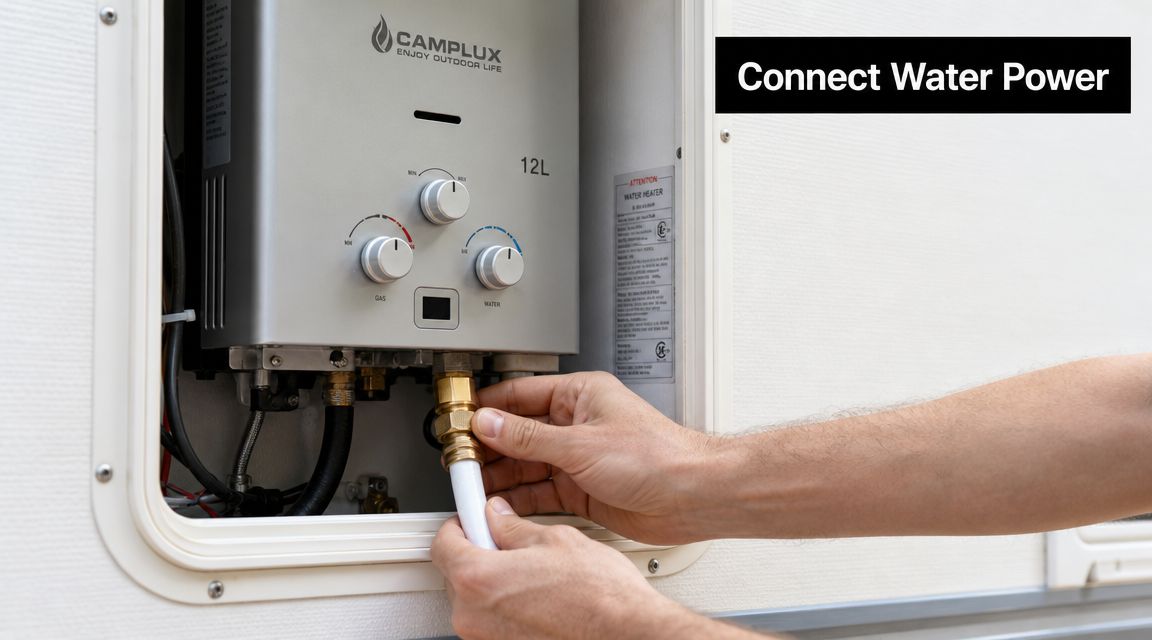
The electrical side
Most caravan gas heaters still need electrical support, even though gas is doing the actual heating. That power usually handles ignition, control boards, safety circuits, and in some systems fan operation or monitoring.
In caravan setups, that commonly means a 12V connection. Owners should understand this because a heater can look like a gas-only appliance while still depending on healthy low-voltage supply to operate properly. If voltage is unstable, ignition and control behaviour can become erratic.
The water side
Your heater is only as good as the water delivery feeding it. In most caravans, the system relies on a pump, pressure switch, and compact pipework. That means flow has to be consistent enough for the heater to behave as intended.
The most common trouble points are familiar:
- Undersized or tired pumps can struggle to maintain steady flow.
- Poorly routed pipework can create restrictions or make airlocks harder to clear.
- Loose or badly chosen fittings often become the source of leaks and pressure loss.
- Hidden valves make servicing and winterising harder than it needs to be.
For owners trying to understand how the pump side of the system interacts with hot water delivery, a guide to a 12 V water pump for caravan setups helps frame what the heater expects from the rest of the plumbing.
Fittings and valves that matter
A neat caravan install often uses 12mm push-fit fittings, including common systems such as John Guest style connections. These make sense in compact vans because they're fast to service, widely understood, and easy to route in tight spaces when used correctly.
A well-thought-out system will often include:
- Bypass valves so the heater can be isolated for servicing or winterising.
- Tempering or mixing protection where required to reduce scald risk at the outlet.
- Accessible isolation points so a small repair doesn't turn into a full drain-down.
- Secure hose and pipe support so vibration on the road doesn't work fittings loose.
This walkthrough gives a useful visual reference for the connection side of caravan hot water systems:
What works on the road
The best caravan systems are boring in the best way. The pump starts cleanly. The heater ignites consistently. The fittings stay dry. Service points are reachable. You don't have to dismantle half a cupboard to inspect a valve.
What doesn't work is crowding too many adaptors, making permanent joints where service access is needed, or mounting everything so tightly that a simple repair becomes a labour-heavy job. Caravan plumbing always rewards clean layout over clever improvisation.
Maintenance and Troubleshooting for Your System
You usually find out what maintenance was missed at the worst time. The shower goes lukewarm at a roadside stop. The burner clicks three times and locks out. A fitting that only wept at home starts dripping after a few hundred kilometres of vibration.
That is how caravan hot water faults show up in real use.
Most of them start small. Scale builds inside a compact tank or heat exchanger. A filter loads up with debris. Flow drops just enough to upset ignition. A valve starts seeping. In Australian touring conditions, where water quality changes from park to park, small systems foul up faster than many new owners expect.
The maintenance jobs that matter
Manufacturers of caravan water heaters commonly recommend regular descaling and routine inspection, and that advice matches what turns up in the workshop. Mobile water supplies are inconsistent, storage tanks sit unused between trips, and compact heaters have less margin for neglect than a house system.
A sensible owner routine includes:
- Descaling at intervals that suit your water supply. Hard water leaves mineral deposits that reduce heat transfer and make the unit work harder.
- Flushing any stored-water section after periods of non-use. Sediment, stale water, and fine debris should not sit in the system for months.
- Checking fittings, valves, and drain points for weeping or staining. A small leak in a van quickly affects cabinetry and flooring.
- Watching burner and ignition behaviour. Slow lighting, repeated clicking, or a burner that drops out under load should be checked early.
- Inspecting sacrificial anodes where fitted. On storage-style units, a spent anode can shorten tank life.
- Cleaning inlet strainers and pump filters. Poor flow often starts upstream of the heater.
One workshop pattern comes up again and again. Owners blame the heater, but the underlying fault is low flow, scale, a dirty strainer, or a partly closed valve.
Simple fault-finding
Start with the symptom, then work in order.
If the heater will not ignite, check that the gas bottle is open, the regulator is supplying properly, the 12V power is healthy, and the water flow is strong enough to trigger operation. Many caravan gas heaters rely on good flow and stable low-voltage power, even though gas is doing the heating.
If ignition starts and then drops out, stop guessing. That can point to flame sensing, combustion issues, gas delivery faults, or a service condition inside the unit. On an Australian caravan, that is the point where legal and safety boundaries matter. Portable camping water heaters are not a substitute for a fixed caravan appliance, and fault-finding on a compliant installed gas system must stay within what an owner is allowed to do.
If water is hot but pressure is poor, look beyond the heater first. Check the pump, strainers, filters, non-return valves, kinked hose, and any restriction at the inlet side. In a caravan, one weak link affects the whole system.
If water temperature has fallen away over time, the usual suspects are scale, poor burner performance, low gas supply, or unstable flow. Dual-fuel owners can also rule out an electric-side problem with a guide on how to test a hot water element, but that only helps on systems that include electric heating.
Know when to stop
Owners can usually handle draining down, flushing, cleaning filters, checking visible leaks, and following the maintenance steps in the appliance manual.
Do not open gas train components, alter flue parts, or start probing internal electrical controls unless you are licensed and authorised to do that work. In Australia, caravan gas compliance is not paperwork for the drawer. It is a safety requirement tied to how the system was approved and installed.
A good rule on the road is simple. If the fault is no longer clearly a flow, filter, drain, or basic inspection issue, book it in with a qualified technician. That decision is cheaper than replacing damaged parts, and a lot safer than trying to repair a caravan gas appliance by trial and error.
Your Partner for Caravan Hot Water
A good caravan hot water setup comes down to three decisions. Choose the heater type that suits how you travel. Treat Australian gas compliance as mandatory, not optional. Maintain the system before small issues become trip-ending faults.
That approach saves money, but above all, it saves frustration. Most owners don't need the most complex system available. They need one that fits the van, works with the existing pump and plumbing, and can be serviced without drama.
For caravan owners sourcing parts, fittings, pumps, and heater accessories, Ring Hot Water is one of the suppliers in this space with product support relevant to caravan and RV systems, including the kind of 12mm fittings, valves, pumps, and replacement components that often make the difference between a clean install and a compromised one. For Melbourne customers, local installation and servicing support can matter when licensed trade work is part of the job. For owners elsewhere in Australia, access to compatible parts and practical advice matters just as much.
The best result is never just “hot water”. It's a caravan system that's safe, legal, serviceable, and dependable when you're a long way from home.
If you're planning a caravan hot water upgrade, replacing worn parts, or sorting out the fittings and valves around your current setup, Ring Hot Water offers caravan and RV components through its online store, with installation, repair, and maintenance support available across Melbourne.

