
Uncategorized
Hot Water Heater Caravan: The Ultimate 2026 AU Guide

May
You pull into camp late, level the van, connect water, and finally think about a shower. Then the hot water runs lukewarm halfway through, the gas won't relight, or the heater works perfectly on powered sites but refuses to cooperate after a couple of days free-camping. That's the moment most owners realise a caravan hot water system isn't just an appliance. It's part of a bigger setup that includes power, plumbing, ventilation, maintenance, and compliance.
A good hot water heater caravan setup changes the whole trip. Washing up is easier. Showers stop feeling rushed. Cold mornings become manageable. But the wrong setup creates constant workarounds. You start timing showers, avoiding dishwashing until later, or chasing faults that turn out to be somewhere else in the van.
The practical part is this. The right heater isn't always the biggest unit or the fanciest one. It's the one that suits how you travel, how often you use powered sites, how much space you've got, and how well the rest of your caravan supports it. Owners often focus on the heater box itself and ignore the surrounding systems. That's where a lot of disappointment starts.
Practical rule: Choose the heater as part of the van, not as a standalone product.
Enjoying Hot Water Anywhere in Your Caravan
The simplest benchmark for a good caravan setup is whether you can get hot water without thinking too hard about it. If you need a mental checklist every time someone wants a shower, the system isn't matched properly to the van or the way you travel.
At a remote stop, hot water usually matters most when conditions are least forgiving. You've driven all day, there's dust on everything, the kids need washing, and the battery has already been running lights, pumps, and charging devices. On a powered holiday park site, the same heater might feel completely different. Recovery is quicker, you're less careful with water, and the whole van feels easier to live in.
That's why choosing a caravan hot water unit always comes back to use case, not just brochure features. One owner needs a compact system for handwashing, dishes, and quick showers. Another needs enough stored hot water to get multiple people through a morning routine without arguments.
What usually goes wrong for new owners
Most early mistakes come from one of these assumptions:
- Bigger must be better: A larger tank gives you more buffer, but it also uses more room and adds more weight.
- Gas solves everything: Gas is excellent for off-grid travel, but poor ventilation, bad regulation, or weak 12V control power can still stop the system working properly.
- If it fits, it works: A heater can physically fit in a locker and still be wrong for service access, flue routing, or plumbing layout.
- A heater fault is always the heater: In real caravan use, water flow, battery condition, power source, and plumbing restrictions often create the symptom.
What makes the trip easier
The best result is boring reliability. You turn on the tap and get the hot water you expected. You know roughly how long recovery takes. You know whether the van is happier on gas, electric, or both. And when something goes wrong, you've got a clear path to diagnose it instead of replacing parts at random.
That's the difference between owning a heater and owning a system that works.
Comparing Caravan Hot Water Heater Types
Caravan hot water heaters fall into a few broad groups. Labels matter less than their practical behaviour. Some give you stored hot water ready to go. Some heat water as demand arrives. Some are built around gas. Others depend on mains power or combine energy sources for flexibility.
The main types in practical use
Gas storage heaters store a set amount of hot water in a tank and reheat it after use. They're familiar, predictable, and usually straightforward to live with. You get a reserve of hot water, but once you've used it, you're waiting for recovery.
240V electric storage heaters do a similar job but rely on mains electricity. They're suitable for owners who spend most of their time at powered sites and want a simpler energy setup. They're not the natural fit for extended off-grid touring unless the van is specifically designed around that load.
Hybrid gas/electric systems are often the most versatile choice for mixed travel. In caravan applications, power-source flexibility is a key design variable. Combination 240V/gas systems can produce hot water from cold in about 28 minutes on a single source, or as quickly as 20 minutes when both heat sources operate together, according to Truma's guide to water heaters for caravans and motor homes. That matters at powered sites, where fast warm-up is more useful than absolute off-grid efficiency.
Diesel-fired systems appeal to some touring setups, particularly where owners already carry diesel and want fuel consistency across appliances. They can make sense in specific builds, but they need proper installation and airflow planning.
Instantaneous units heat water as it passes through, rather than storing it. In theory, that saves space and avoids keeping a tank hot. In practice, caravan use adds extra variables such as water flow, pressure consistency, and installation constraints. If you're weighing that style up, this overview of a tankless instant water heater gives a useful starting point for how the concept differs from storage-based systems.
Caravan Hot Water Heater Comparison
| Heater Type | Primary Power Source | Best For | Key Consideration |
|---|---|---|---|
| Gas storage | Gas with 12V controls in many setups | Off-grid travel with predictable daily use | Limited stored volume means recovery planning matters |
| 240V electric storage | 240V AC | Powered sites and park stays | Depends on mains supply |
| Hybrid gas/electric | Gas and 240V AC | Mixed touring, flexible site use | Works best when the van's power design supports both modes |
| Diesel | Diesel and electrical controls | Specific touring builds using diesel appliances | Needs careful ventilation and installation planning |
| Instantaneous | Usually gas or electric depending on unit | Space-conscious installs with suitable flow conditions | Sensitive to flow, pressure, and installation quality |
What works well and what doesn't
Storage heaters work well for caravans because they match the stop-start way people use water. You wash up, have a shower, leave the van, then come back later. A small tank can be completely manageable if the owner understands the routine.
Instant systems can be attractive on paper, but they don't automatically create a better caravan experience. If flow is inconsistent or the installation is compromised, you can end up with unstable temperature control. In a caravan, the supporting systems matter just as much as the heater type.
A heater that suits a house doesn't always suit a van. Caravans move, vibrate, share limited services, and demand far more compromise.
The right choice by travel style
A weekend owner who stays mostly in caravan parks usually values fast recovery and simple operation. A remote-area traveller usually values gas capability, serviceability, and low dependence on heavy electrical loads. A family often values stored capacity and predictable shower order more than outright efficiency.
That's why there isn't one universal answer. There is only the system that best fits how the van is used.
Choosing the Right Heater Size and Capacity
Capacity is where comfort becomes real. You can have the right fuel type and still hate the system if the stored volume doesn't match your routine. In caravan use, storage size is often more important than owners expect.
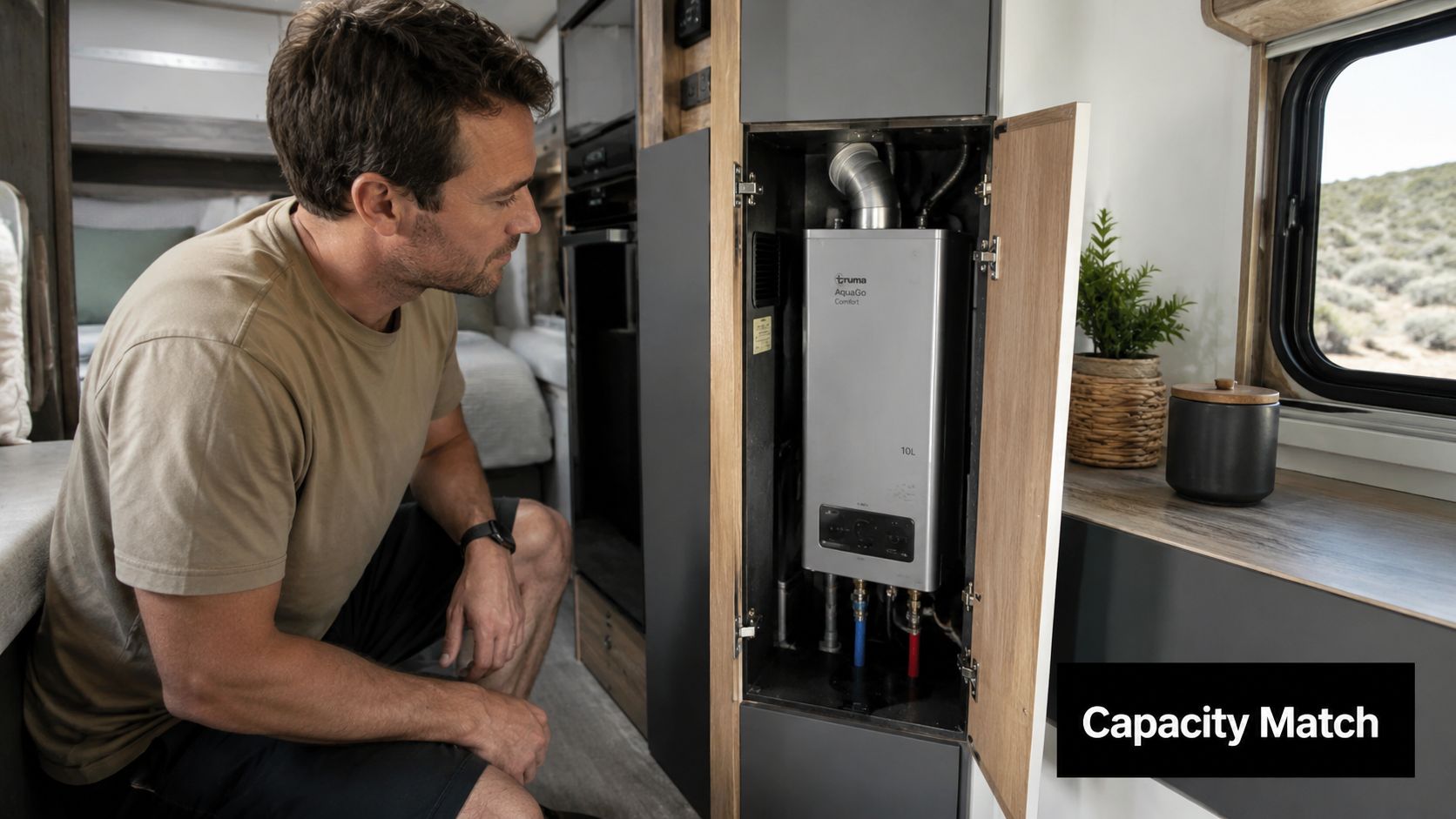
Australian caravan hot water systems are commonly discussed by tank volume. Compact marine-grade units are available from 20 to 80 litres, while dedicated caravan boilers are often in the 10 to 14 litre range. Manufacturers note that 10 to 14 litres is typically enough for two people to shower consecutively, as outlined in BCAA's guide to caravan hot water systems.
Start with how you actually use water
If you're a couple doing short showers, dishwashing, and normal handwashing, a smaller caravan boiler often works well. The key is routine. One shower after the other is usually fine. One long shower, dishes, and another shower immediately after can expose the limits.
For family use, or for owners who don't want to schedule every draw-off, extra storage gives breathing room. That doesn't mean everyone needs a larger tank. It means the larger tank is buying convenience, not just litres.
A simple way to choose
Use these questions:
How many people need hot water in a tight window
Morning demand is what matters most. If several people want water close together, small storage becomes more noticeable.What jobs matter most
Some owners barely shower inside the van and just want reliable dishwashing and hand basins. Others expect home-like shower use.How much room and payload do you really have
A larger tank adds buffer, but it also takes up installation space and contributes more mass.Are you patient about recovery time
Small tanks can work brilliantly when users understand the pause between uses. They frustrate owners who expect continuous draw.
What the trade-off feels like in practice
A 10 to 14 litre setup is often a smart caravan choice because it keeps the installation compact and manageable. The compromise is that recovery and sequence matter more. If you use hot water in bursts and let the system catch up, it feels efficient. If you treat it like a large domestic cylinder, it feels undersized.
A 20 litre or larger setup gives more cushion. It smooths out mistakes. You don't notice one extra bit of washing up or a longer rinse as quickly. But you pay for that cushion with space and weight, and those costs matter in a caravan more than they do at home.
Sizing shortcut: Buy for your busiest half hour of the day, not your average day.
Understanding Power Plumbing and Ventilation Needs
A caravan water heater only performs as well as the systems feeding it. Owners often compare heater brands while ignoring the power supply, the plumbing size, and the airflow path. That's where a lot of poor installations start.
Power has to match the heater logic
Many caravan water heaters use 12V DC for controls, ignition, or burner operation, while electric heating functions may rely on 240V AC. That split catches people out. The heater can look like a gas unit and still depend on healthy low-voltage supply to run correctly.
This is why mixed-energy systems feel so different depending on site conditions. On shore power, a combination unit can be quick and easy. Off-grid, the same unit may need more careful battery management, especially if several loads are active at the same time.
Plumbing matters more than people think
Australian caravans commonly use 12mm plumbing fittings, and that detail matters. The heater needs the right hoses, reducers, clamps, valves, and pump performance to deliver stable operation. A poor join, a partially restricted fitting, or an awkward change in line size can create weak flow, pressure drop, or nuisance behaviour that looks like a heater fault.
For owners sorting out the supply side, a practical reference point is this guide to a 12 V water pump for caravan. Pump choice, line condition, and fitting compatibility all affect how consistently the heater receives water.
Ventilation is not optional
Gas and diesel heaters need proper external venting. That's a safety issue first, but it also affects performance and service life. Poor airflow can lead to combustion problems, heat stress around the appliance, and difficulty keeping the installation compliant.
The broader principles are similar to other enclosed equipment spaces. If you want a plain-language reference on airflow thinking, this guide to container ventilation is useful because it explains how stale air, trapped heat, and poor vent placement create avoidable problems in enclosed structures.
Think of it as one working chain
The most reliable caravan hot water systems are balanced. The heater suits the power source. The plumbing supports the expected flow. The ventilation path is correct. Service access is still possible after installation.
When one part is wrong, the symptom often appears somewhere else.
- Weak battery supply: ignition becomes unreliable
- Restricted plumbing: temperature delivery becomes inconsistent
- Poor venting: the appliance may run hot, soot up, or become unsafe
- Bad layout choice: routine maintenance becomes far harder than it should be
A better installation mindset
Don't ask only, “Will this heater fit?” Ask:
- Can it be serviced later
- Can the flue or vent be routed correctly
- Can the pump and fittings support stable operation
- Does the battery and charging setup suit the controls
- Can the unit be isolated, drained, and inspected without dismantling half the van
That's what separates a neat-looking install from one that keeps working.
Key Installation Considerations and DIY Steps
You arrive at camp after a long tow, fill the system, hit the switch, and get a leak behind a cupboard or a heater that refuses to light. That usually starts long before the first test. It starts with a rushed install that treated the heater as a standalone appliance instead of part of the van's gas, 12V, 240V, plumbing, and ventilation system.
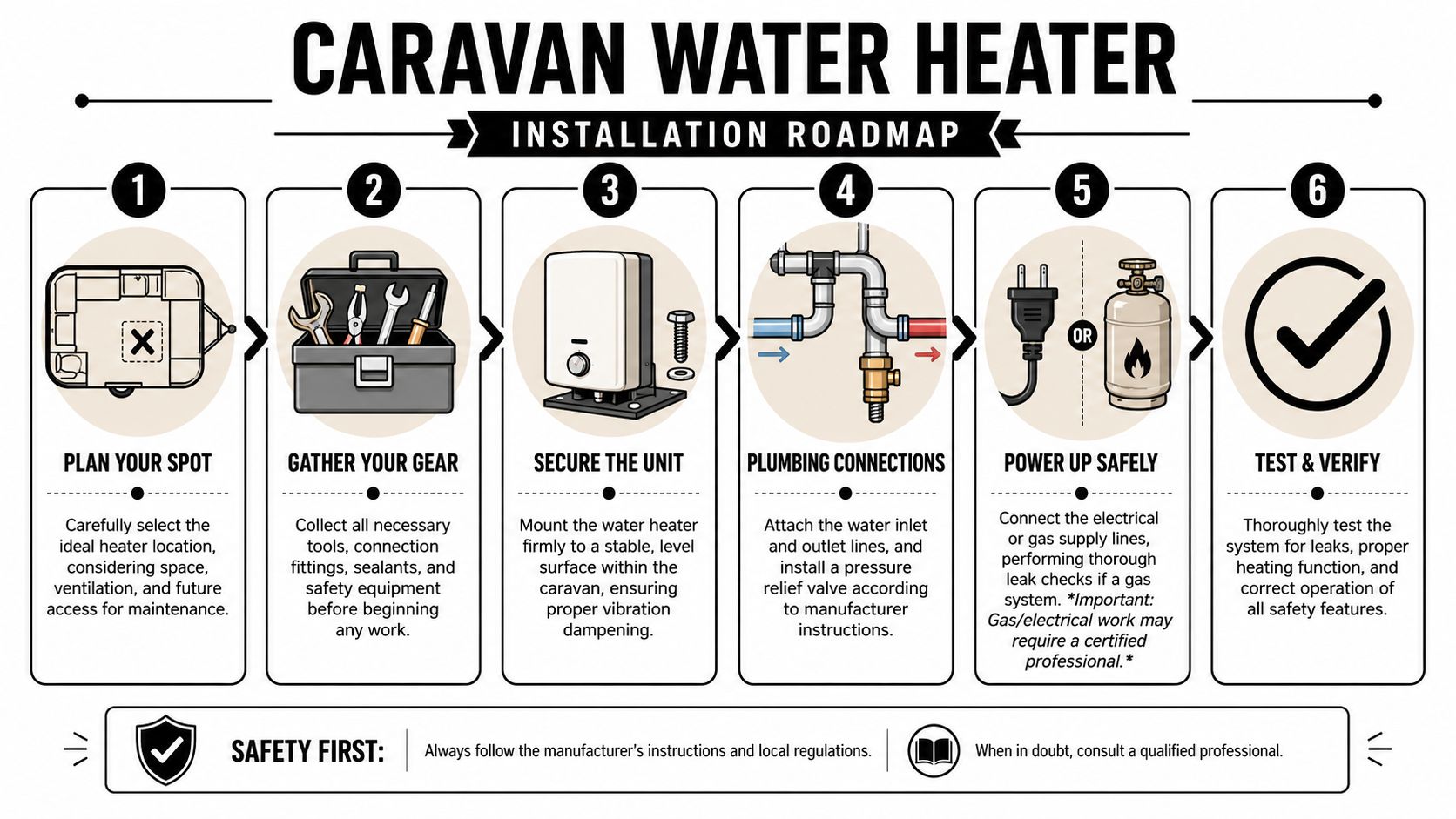
That is why a good caravan hot water install is half planning and half restraint. Owners can do useful preparation work and save labour time. Licensed trades must handle gas connections and any 240V wiring in an Australian caravan.
Owner jobs that genuinely help
The best DIY contribution is preparation that makes the final install safer, cleaner, and easier to service later.
- Mock up the heater position first: Check door clearance, pipe entry points, surrounding heat-sensitive materials, and whether you can still reach valves, fittings, and service panels after the unit is fixed in place.
- Measure the plumbing route properly: Many vans use 12mm water lines, so confirm the heater connections, reducers if needed, and how you will support pipework against vibration.
- Set up isolation and drain access: A heater that cannot be isolated, drained, or removed without pulling apart cabinetry becomes a maintenance problem from day one.
- Prepare the opening and work area: Remove panels, empty lockers, label lines, and give the gas fitter or electrician clear access.
This prep work pays off later. Tank units need room for draining and anode rod service. Electric models need enough access for element testing and replacement. If your system includes an electric element, this guide on how to test a hot water element helps owners understand the service side before the heater is boxed into a tight compartment.
Jobs that belong to licensed trades
Some boundaries are simple.
- Gas fitting and gas testing: Required to be done by a licensed gas fitter.
- 240V AC wiring: Required to be done by a licensed electrician.
- Final compliance checks and documentation: Keep the certificate and any installer notes with the van's paperwork.
That paperwork is not just for resale. It matters if there is a fire, a gas fault, or an insurance claim.
Before any hands-on work starts, it helps to see the overall process in motion:
A practical installation order
This sequence avoids the problems I see most often in retrofits and first-time DIY prep.
Confirm the system match
Check the heater against available gas supply, battery support for controls or ignition, 240V availability if fitted, water pressure, and the space needed for venting or a flue.Dry-fit before cutting or drilling
Hold the unit in place and mark plumbing, wiring, and vent paths. Small alignment mistakes become large sealing and clearance problems once holes are cut.Route plumbing with movement in mind
Caravans flex on the road. Support 12mm lines properly, protect them from abrasion, and avoid tight bends that reduce flow or stress the fittings.Leave ventilation and flue work to the installation plan, not guesswork
Clear airflow and correct terminal placement affect safety, burner performance, and heat around nearby materials. Poor vent placement can create the same sort of trapped-heat problems discussed in broader guides to efficient home heating solutions, but caravan installations have tighter clearances and stricter placement limits.Have licensed trades complete gas and electrical connections
Compliance and safety are secured or compromised at this stage.Fill, purge, and test every mode
Run the heater on each available energy source. Check for leaks, airlocks, ignition faults, pressure relief valve operation, and stable hot water delivery at the tap.
One final tip. Do not judge the install by how neat it looks on day one. Judge it by whether you can still service the anode, inspect fittings, test the element, drain the tank, and reach shut-off points without dismantling half the van. That is the difference between a heater that works in the driveway and one that keeps delivering hot water on the road.
Maintenance Troubleshooting and Winterising Your System
Most caravan water heaters don't fail all at once. They get noisy, slower, intermittent, or annoying before they stop. Owners who catch those early signs usually avoid the bigger repair bill.
Routine maintenance that prevents trouble
A practical maintenance routine is simple:
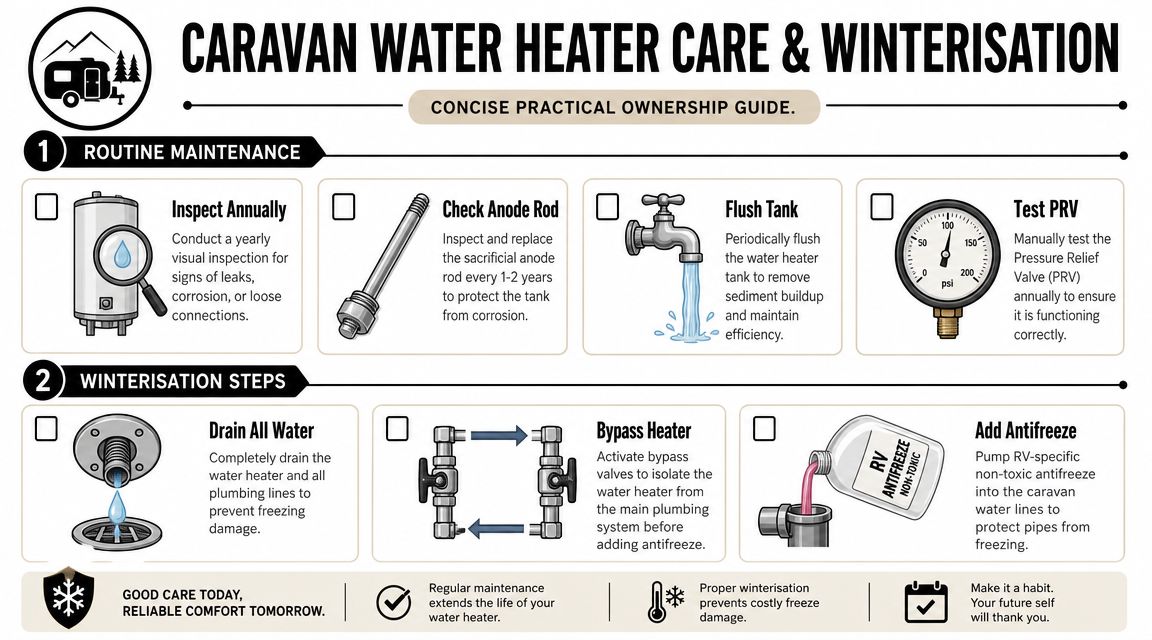
- Inspect visually: Look for leaks, staining, corrosion, loose mounts, and heat damage around the unit.
- Check the pressure relief valve: Make sure it isn't seized, weeping continuously, or showing obvious deterioration.
- Flush sediment when required: If the tank design allows for it, removing debris helps the heater recover and operate more cleanly.
- Watch burner and ignition behaviour: Delayed lighting, repeated clicking, or inconsistent flame behaviour usually means something needs checking.
One maintenance item deserves extra attention in storage-type units. The anode rod protects the tank by sacrificing itself first. Australian guidance around caravan ownership often shows the replacement procedure, including the need to depressurise the tank, turn off gas and 240V power, and bleed air before restart. What owners often don't get is a simple local schedule, because water quality and travel patterns vary a lot. A sensible habit is to inspect regularly and replace when it's heavily corroded rather than waiting for tank damage.
Faults that are often misdiagnosed
A heater that won't run isn't always broken. One commonly overlooked check is battery voltage. Some RV troubleshooting guidance notes that voltage should be above 10.5 volts or the unit can develop operating issues, which is especially relevant after free-camping or overnight battery drain, as discussed in this RV troubleshooting video on low-voltage heater faults.
If the unit has electric heating, element faults are also worth checking before replacing major components. This guide on how to test a hot water element is a practical reference for narrowing that down.
Low voltage can imitate a heater fault so convincingly that owners replace parts they never needed.
A straightforward troubleshooting sequence
Use this order before assuming the heater itself has failed:
Confirm water supply
Tank filled, pump working, valves open, no obvious restriction.Check available power
Battery condition, charger status, fuse condition, and any signs of wiring drop.Verify the energy source selected
If it's a combination unit, confirm whether you're trying to run gas, electric, or both.Inspect for reset or safety lockout conditions
Some units stop to protect themselves after failed ignition or abnormal operation.Look at service items
Element, anode, relief valve, and signs of sediment or corrosion.
Winterising and storage care
If the van is going into storage in cold conditions, don't leave water sitting in the heater and pipework. Drain the system properly. Open the relevant valves. Clear the tank. Protect the plumbing if freezing is a real possibility in your area.
The broader lesson is the same one seen in residential systems. Water, air, heat, and neglect don't mix well over time. If you want a useful comparison of how maintenance thinking carries across heating systems more generally, this overview of efficient home heating solutions is worth a read for the way it frames upkeep around performance and reliability.
What long-term owners do differently
Experienced caravan owners don't just react when the shower goes cold. They learn their system's normal behaviour. They know how long it takes to recover. They know what the flame or heating cycle usually sounds like. They inspect parts before a trip, not after a failure.
That habit matters more than any single spare part.
Australian Regulations Safety and Final Recommendations
A caravan hot water heater has to be safe before it can be convenient. In Australia, gas appliance installation in caravans must comply with relevant requirements such as AS/NZS 5601.2, and the practical message for owners is simple. If gas or 240V work is involved, treat compliance as part of the product, not as an optional extra.
The clearest reminder came from the Suburban dual-fuel RV water-heater recall. The ACCC reported that 18,139 heaters were sold nationally between 1 May 2018 and 25 September 2019, and at the time of its update, 9,600 recalled units still had not been inspected, including 8,359 units not registered for inspection, according to the ACCC recall reminder for caravan and motorhome owners. That isn't just a product story. It shows how widely caravan heaters are distributed and how slowly safety remediation can move when owners, installers, and records don't line up.
The final checklist that matters
Before buying or replacing a unit, check these points:
- Travel style: Mostly powered sites, mostly free-camping, or a genuine mix
- Capacity needs: Couple use, family use, short showers, or heavier morning demand
- Power design: 12V controls, 240V availability, and whether the van can support the chosen mode
- Plumbing compatibility: Correct fittings, sensible line routing, and service access
- Ventilation and flue requirements: Properly planned from the start, not improvised later
- Maintenance access: Can you reach the drain, anode, relief valve, and service points
- Compliance: Licensed gas and electrical work, plus documentation where required
What usually leads to the right decision
The best caravan setup is rarely the one with the longest feature list. It's the one that fits the van, the way you travel, and the level of maintenance you're willing to stay on top of. Smaller storage systems often work beautifully for disciplined use. Hybrid units suit mixed travel well when the van's power setup is ready for them. Larger-capacity options make life easier for heavier demand, but only if you've accounted for space and payload.
Buy carefully. Install properly. Maintain it before it complains. That's the formula that gives you reliable hot water on the road instead of one more thing to troubleshoot at camp.
If you need parts, caravan-compatible heaters, fittings, or Melbourne-based installation and repair support, Ring Hot Water is a practical place to start. The online store supplies products Australia-wide, and the local service team can help owners who want a compliant, maintainable setup rather than a rushed swap-over.

