
Uncategorized
Best Hot Water Heater for Caravan: 2026 Buying Guide

May
You're probably choosing between comfort, space, and hassle right now.
Most first-time buyers start with a simple question: what's the best hot water heater for a caravan? In practice, the better question is which system will still work properly when you're on a cold site, using limited power, and trying to get through showers, dishes, and handwashing without waiting around or tripping over compliance problems later.
A caravan hot water system has to do more than make water hot. It has to suit the way you travel, fit the van, work with your pump and plumbing, and be installed safely under Australian conditions. That matters even more if you split your time between powered parks and free camping, or travel across very different climates.
The biggest mistakes are predictable. Buyers choose by tank size alone. They assume any LPG heater will suit a caravan. They underestimate winter inlet water temperature. Or they buy a unit first and think about installation, parts, and legal compliance afterwards.
Choosing Your Perfect Caravan Hot Water Heater
A cold morning in a caravan makes hot water feel less like a luxury and more like basic liveability. The difference between a van that feels easy to use and one that feels awkward often comes down to the hot water setup.
Most buyers narrow the choice too early. They look at litres, or whether a unit is gas or electric, and stop there. That overlooks key considerations. The right hot water heater for caravan use depends on how you camp, how many people use it, what power you have available, and whether the installation is compliant for Australian use.
Start with how you travel
A van used mostly in caravan parks needs a different setup from one that spends long stretches off-grid. If you rely on gas bottles in remote areas, your heater choice needs to respect fuel use and ignition reliability. If you stay on powered sites, 240V compatibility becomes much more important. If you move through southern winters, cold inlet water changes what “adequate” performance looks like.
Three questions usually sort the options quickly:
- Where do you camp most often: powered sites, free camps, or a mix.
- How do you use hot water: quick showers and dishes, or frequent back-to-back use.
- What matters more: instant recovery, compact size, or simpler plumbing.
Practical rule: Choose the system around your hardest-use scenario, not your easiest one. A heater that feels fine on a warm weekend near home can feel underpowered on a cold trip interstate.
What actually matters
For most caravans, the decision comes down to five practical factors:
- System type. Storage tank or instantaneous.
- Power source. Gas, 240V, 12V, or a combination.
- Sizing. Not just stored water, but recovery or temperature rise.
- Installation requirements. Mounting, venting, pump compatibility, and plumbing layout.
- Safety and support. Compliance, servicing, and access to parts in Australia.
The right system is the one that fits your travel pattern without creating work every time you turn on a tap.
Storage Tank vs Instantaneous Heaters
Pull into a free camp on a cold Victorian night, and hot water stops being a nice extra. It becomes one of the first systems people judge their van by. The right heater type decides whether you get a quick, predictable wash-up or a longer shower without watching the tank run out.
A storage tank heater keeps a set volume of water hot and ready. An instantaneous heater heats water only while it is flowing through the unit. For a first-time buyer, the difference is day-to-day behaviour, not just the label on the brochure.
How each type works in real caravan use
Storage systems are usually easier to live with if you want simple operation. Open the tap and hot water is already there. They are generally less sensitive to small changes in pump pressure or tap position, which matters in caravans with basic plumbing or older pumps.
The compromise is limited supply. Once the stored hot water is used, you wait for reheating. On a mild Queensland trip that may be a minor annoyance. In a Melbourne winter, colder inlet water can make that recovery period feel much longer, and the available hot mix may not stretch as far as people expect.
Instantaneous systems solve a different problem. They suit travellers who want longer showers, back-to-back use, and a more compact layout without carrying a tank of heated water. If gas supply, water flow, and heater capacity are all matched properly, they can provide continuous hot water rather than a single stored batch.
That last point matters in Australia because performance changes with conditions. A tankless unit that feels excellent in warm northern weather can feel average in colder southern conditions if the temperature rise is marginal. Buyers comparing layouts and use cases can get a clearer picture from this guide to a tankless instant water heater for caravan use.
Storage tank heaters. Best for simple, predictable use
Storage units suit owners who value consistency over maximum runtime. They are often the safer choice where the van has average pump performance, a straightforward plumbing setup, or users who do not want to fine-tune flow to keep a burner active.
Common strengths:
- More forgiving operation. They usually cope better with lower or slightly inconsistent flow.
- Straightforward user experience. Hot water delivery is predictable for handwashing, dishes, and short showers.
- Good fit for light daily use. They work well when usage comes in short bursts.
Common drawbacks:
- Limited hot water reserve. Once the tank is drawn down, reheating time becomes part of your routine.
- More bulk. The tank takes up room and adds weight.
- Heat loss while standing. Stored water cools over time, especially if the system sits unused between stops.
Instantaneous heaters. Best for longer demand, if the system supports them
Instantaneous units suit travellers who dislike rationing hot water. They can be an excellent match for couples who shower one after the other, families washing up after meals, or buyers trying to save space inside a tight van layout.
They are also less tolerant of poor setup. Many tankless complaints come back to weak pump performance, unstable pressure, restricted plumbing, or a heater that was not sized for colder Australian conditions. The heater gets blamed, but the fault is often with the system around it.
Common strengths:
- Continuous hot water while water and gas supply hold up.
- Compact packaging in many caravan layouts.
- No tank recovery wait after normal use.
Common drawbacks:
- More sensitive to flow and pressure. Low activation flow can cause frustrating stop-start heating.
- Performance depends heavily on installation quality.
- Cold-weather expectations need checking. Southern winter inlet temperatures expose undersized units quickly.
| Feature | Storage Tank Heater | Instantaneous (Tankless) Heater |
|---|---|---|
| Hot water delivery | Stored hot water ready to use | Heated only when flow starts |
| Typical caravan behaviour | Better for short, predictable use | Better for longer or repeated demand |
| Recovery | Needs reheating after draw-off | No tank recovery wait |
| Sensitivity to flow | Usually less sensitive | Usually more sensitive |
| Space use | Bulkier because of tank volume | More compact in many installs |
| Best fit | Simpler systems and first-time owners | Well-matched systems with stable flow |
One more Australian point is easy to miss. Gas appliances in caravans need to be checked against current compliance requirements and recall notices, including ACCC recalls where relevant. That matters with both heater types, but especially with gas installations and replacement parts. Parts support also matters more than people think. If you are travelling regionally, being able to source fittings, valves, and service items locally through an Australian supplier can save a trip.
For most first-time buyers, the practical rule is simple. Choose storage if you want fewer setup surprises and can live with limited capacity. Choose instantaneous if long hot water runs matter more, and you are prepared to match the heater to the pump, plumbing, climate, and compliant gas installation.
Selecting the Right Power Source
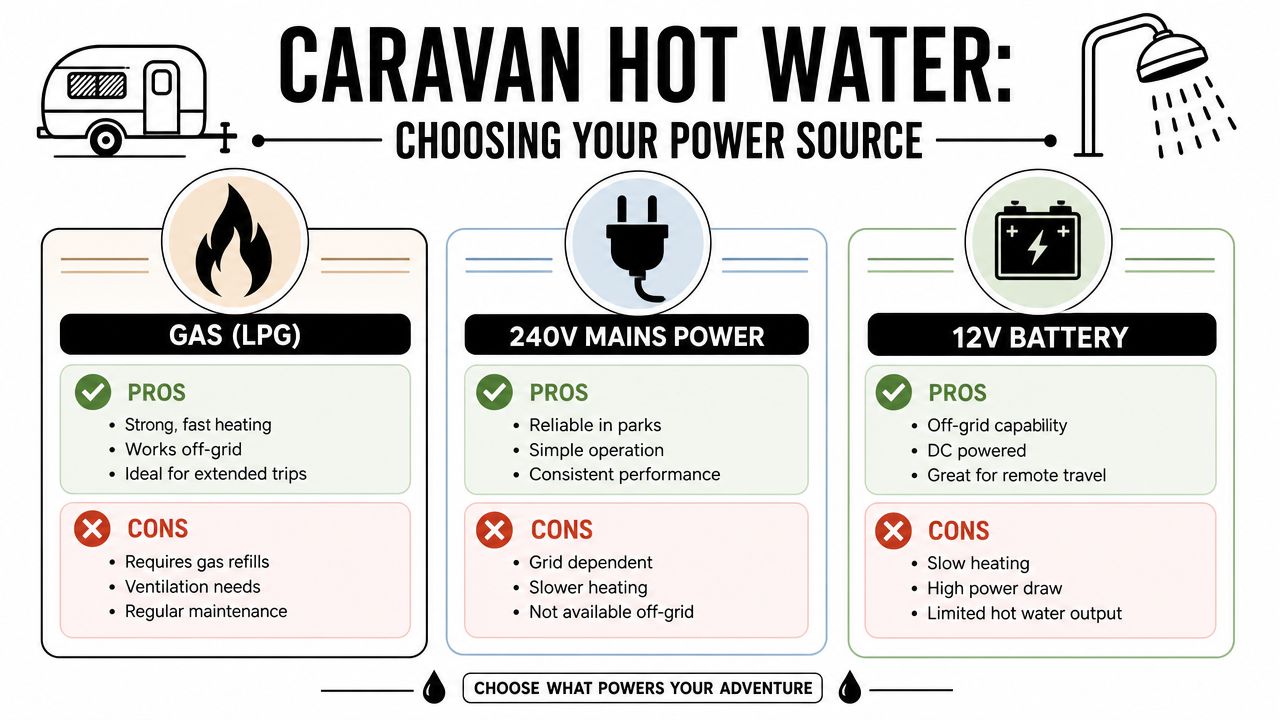
Once you've chosen the heater type, the next decision is what will power it. In Australia, this usually comes down to LPG, 240V mains power, 12V battery support, or a dual-fuel arrangement.
The power source shapes how practical the system will be day to day. A heater that performs well at a caravan park may be frustrating off-grid. A heater that's ideal for bush camping may feel wasteful if you mostly stay on powered sites.
Gas is the off-grid workhorse
LPG remains the practical choice for many caravan owners because it delivers strong heating without depending on campsite mains power. If your travel includes free camping or long stays away from hookups, gas usually does the heavy lifting.
That said, heater selection should reflect the energy source and usage pattern, not just tank capacity. The best fit changes depending on whether the caravan relies on a 9 kg LPG bottle for off-grid use, has solar and battery support, or mainly uses 240V shore power, as discussed in this campground tankless water heating guide.
240V is convenient when you're plugged in
On powered sites, 240V operation is easy to live with. You're not drawing down gas for normal hot water use, and operation is often straightforward. For travellers who spend most nights in caravan parks, electric compatibility is more than a backup feature. It may become the preferred mode.
12V has limits for water heating
People often ask whether 12V can run the whole job. In a caravan, 12V is vital for pumps and controls, but using it as the main heat source for water is far less common in mainstream setups. The issue isn't whether it's possible. It's whether the rest of your battery system is built for it.
A heater also has to work with the pump supplying it. If you're reviewing flow and pressure through the van, it helps to understand how a 12V water pump for caravan systems affects tap performance and heater activation.
What works for most buyers
In real Australian touring use, gas plus 240V is often the most flexible arrangement. Gas covers free camping. Mains power covers caravan parks. You're not forcing one energy source to do every job.
A simple way to decide is this:
- Mostly off-grid. Prioritise LPG performance and gas efficiency.
- Mostly powered sites. Prioritise straightforward 240V use.
- Mixed travel. A dual-fuel unit usually makes the most sense.
- Battery-heavy setup. Check whether your electrical system is intended to support water heating, not just lights and pumps.
Sizing Your Heater for Australian Conditions
A heater can be technically good and still feel disappointing if it's sized for the wrong conditions.
Australian travel exposes that quickly. A setup that seems fine in warm weather can feel weak when inlet water gets much colder. That's why sizing should be based on use pattern and climate, not the marketing label on the box.
For storage heaters, think in routines
With a storage system, the practical question is not just how much hot water the tank holds. It's how you use that hot water through the morning or evening.
If two people shower back-to-back and then someone starts washing dishes, a small tank may feel exhausted very quickly. On the other hand, if your routine is quick rinses, a small storage unit may be perfectly serviceable and simpler than a tankless setup.
Use this quick reality check:
- One or two users with short showers. Compact storage often works.
- Frequent back-to-back use. Recovery time starts to matter more.
- Longer showers. Stored volume disappears fast.
For tankless heaters, temperature rise matters most
A tankless caravan heater should be sized by peak flow and temperature rise, not just litres per minute on a product page. Camplux explains that required flow should reflect all fixtures used at the same time, and temperature rise is calculated by subtracting incoming cold-water temperature from desired hot-water temperature. Their example uses 50°F inlet and 120°F outlet, requiring a 70°F rise, in this RV tankless heater sizing guide.
That matters in Australia because inlet temperatures vary sharply by region and season. A unit that feels generous in a Queensland summer may underperform in a Melbourne winter because the heater has to do more work before the water reaches shower temperature.
Sizing shortcut: Don't ask only “How many litres per minute does it do?” Ask “At what inlet temperature, and with what temperature rise?”
A practical way to choose
When I'm helping people think this through, I usually suggest they size for the coldest trip they realistically expect to take, not the warmest one.
Check these points before buying:
- Your likely peak use. One shower at a time, or shower plus sink use.
- Expected inlet water temperature. Warm coastal trip or cold southern inland stop.
- Minimum activation flow. Especially important on tankless units.
- Pump capability. The heater can't perform if the water supply is marginal.
In short, summer testing can flatter a system. Winter reveals whether it was sized properly.
Plumbing Fittings and Installation Essentials
You usually find out whether a caravan hot water setup was installed properly on the first cold morning of a trip. The pump surges, the heater cuts in and out, a fitting starts weeping under the bed, or the relief valve dribbles because the pressure was never controlled properly. The heater gets blamed, but the plumbing around it is often the actual problem.
In caravans, space is tight and access is worse. That changes how you should approach installation. A good layout leaves room to service valves, replace hoses, drain the unit, and inspect joints without pulling half the van apart.
The fittings that matter most
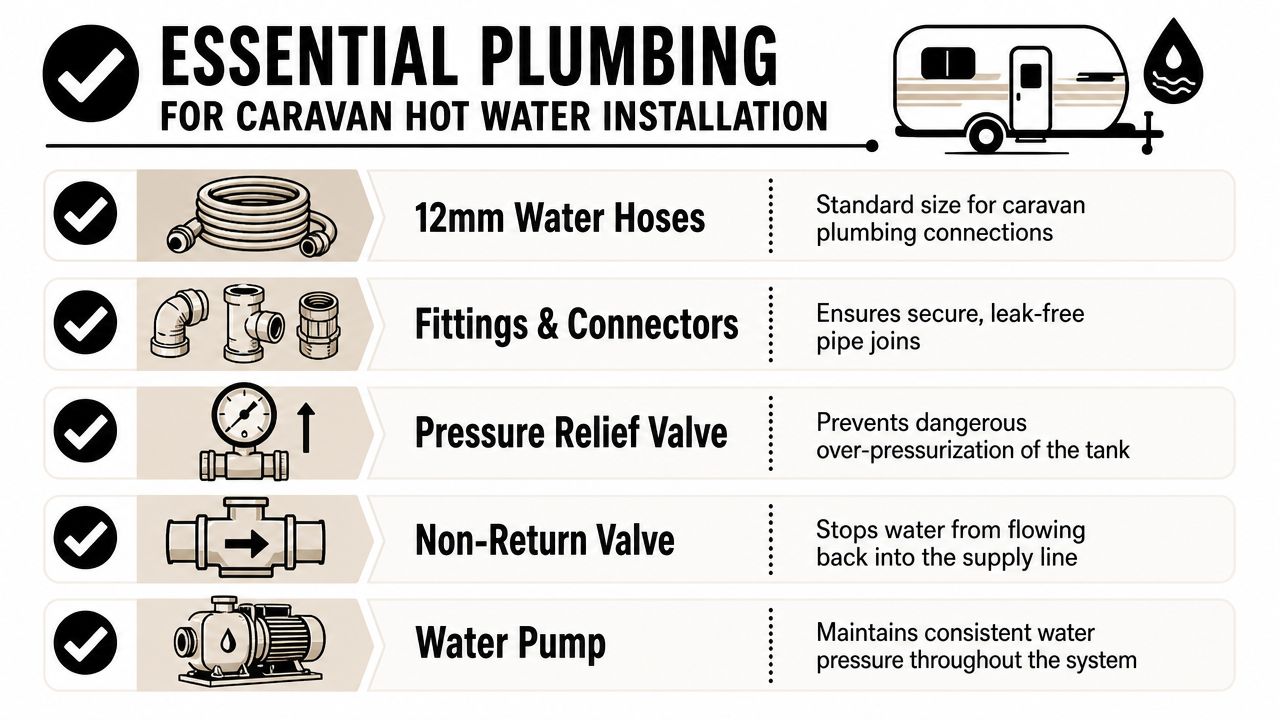
A basic caravan hot water system usually relies on a small group of parts doing their job properly:
- 12mm water hose. Common in Australian caravan plumbing, but only if the inside diameter, pressure rating, and temperature rating suit the job.
- Push-fit or threaded connectors. Both can work well if they match the pipe material and are installed square, clean, and fully seated.
- Pressure relief valve. Required on storage systems and needs correct discharge routing.
- Non-return valve. Stops reverse flow and helps protect the heater and pump arrangement.
- Water pump. Needs to provide steady flow, not just enough pressure on paper.
- Pressure control hardware. In many vans, a pressure limiting valve for caravan hot water systems is what stops nuisance dripping, protects fittings, and keeps the system within the heater maker's limits.
Where installations go wrong
The faults I see most often are simple, but they cause expensive frustration later.
| Problem | What it causes |
|---|---|
| Undersized or mismatched fittings | Flow restriction, leaks, cracked joins |
| Weak or pulsing pump flow | Tankless heater fails to activate or cycles on and off |
| Missing or badly placed valves | Relief discharge, backflow issues, unstable pressure |
| Poor mounting or no service access | Harder maintenance and faster wear from vibration |
| Incorrect venting or gas work | Serious safety and compliance problems |
One detail first-time buyers often miss is vibration. Caravans flex, shake, and bounce over thousands of kilometres. A joint that might survive in a house can loosen early in a van if the pipe run is unsupported or the heater is mounted hard against a panel without allowing for movement.
What owners can plan, and what should be left to licensed trades
Owners can do the useful prep work. Measure available space. Check hose sizes. Confirm where the drain, relief discharge, and service access will go. Source matching fittings, elbows, reducers, clamps, and replacement valves before booking the install. That is often the difference between a tidy one-day job and a van stuck in the workshop waiting on parts.
For local parts support, suppliers such as Ring Hot Water carry caravan and RV plumbing items that suit common Australian setups. That matters more than many buyers expect. If you are travelling through regional Australia and need a compatible valve, hose, or fitting quickly, local availability is worth more than saving a few dollars on an odd imported part that no one stocks.
Leave gas fitting and 240V electrical connection to licensed professionals. In Australia, that is not optional on a permanently installed caravan hot water system. It also matters for warranty, insurance, and recall work if a unit is later affected by an ACCC safety notice.
A neat installation does more than look good. It cuts leak points, keeps flow stable, and makes future fault-finding far easier.
Safety Compliance and Maintenance in Australia
This is the part many buyers leave until after purchase. It should be near the top of the list.
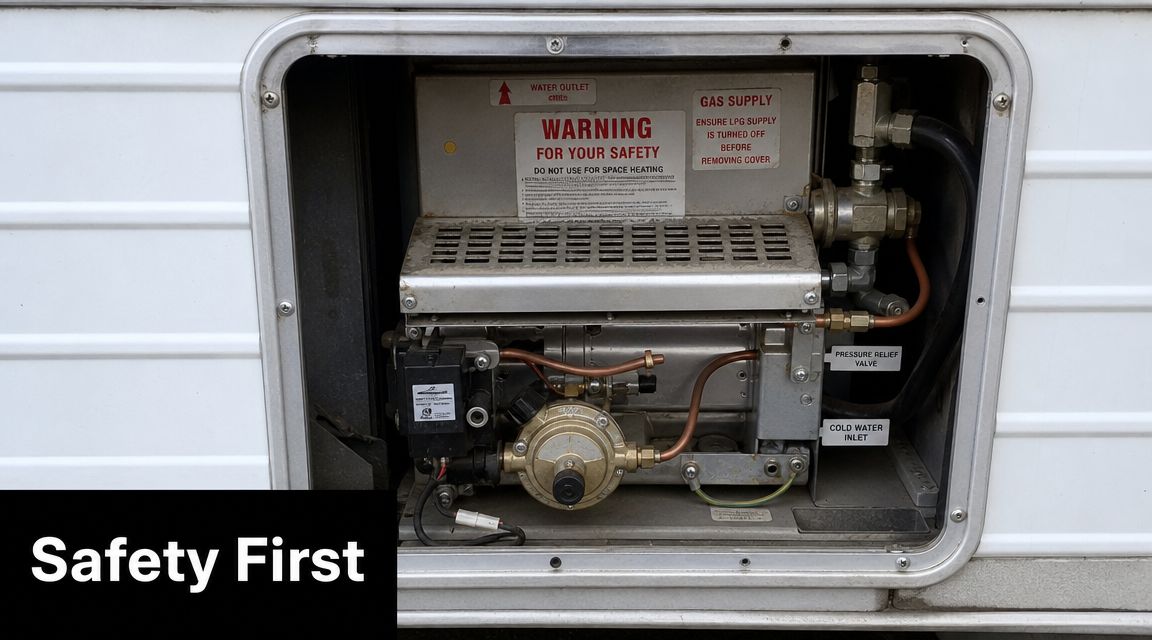
A caravan hot water unit, especially a gas-fired one, is a safety-critical appliance. Australian caravan owners have already seen why. The ACCC warned that a recalled dual-fuel Suburban recreational vehicle water heater could produce deadly carbon monoxide under some gas-mode conditions. The affected products were supplied between 1 May 2018 and 25 September 2019, with 18,139 heaters sold nationally. At the time of the ACCC update, 9,600 recalled units still needed inspection, including 8,359 not yet registered for inspection, according to the ACCC recall notice on Suburban caravan and motorhome water heaters.
Why compliance isn't optional
That recall changed the conversation for many owners. A caravan water heater isn't just a comfort upgrade. It sits in the same category as other gas appliances that can become dangerous when installed incorrectly, poorly maintained, or used outside their intended environment.
That's why permanently installed gas appliances in caravans should be installed and maintained by licensed gasfitters, with proper attention to venting, flueing, pressure, and appliance suitability. It's also why portable outdoor camp shower units are not the same thing as certified built-in caravan heaters.
A lot of DIY trouble starts when someone buys a portable LPG unit online and assumes it can be mounted into a van compartment. That's exactly the kind of shortcut that can create combustion and ventilation hazards.
The maintenance that prevents expensive problems
Owners don't need to do licensed gas work to stay ahead of faults. Regular checks still matter.
A sensible maintenance routine includes:
- Leak inspection. Check water connections and look for staining or drips.
- Valve checks. Make sure relief and isolation components aren't seized or bypassed.
- Tank care. On storage systems, inspect service items such as the anode where applicable.
- Descaling. Important where mineral build-up affects performance.
- Operational checks. Watch for ignition issues, erratic temperature, or inconsistent flow.
Pressure control hardware also needs to match the installation. If you're reviewing or replacing that part of the system, this guide to a pressure limiting valve for hot water systems helps explain the component's role.
For a visual walk-through on caravan hot water safety and servicing context, this video is worth watching.
If a gas caravan heater has an unclear service history, treat that as a problem to solve before your next trip, not after you arrive.
Frequently Asked Caravan Hot Water Questions
Can I use a normal household water heater in a caravan
In almost every case, no. A house unit is built for a fixed installation, not for road vibration, tight service clearances, caravan ventilation limits, or the compliance rules that apply to mobile gas and water systems in Australia. A unit that fits through the hatch can still be the wrong choice.
Is solar hot water a good option for caravans
Solar can reduce power or gas use in the right setup, but it is rarely the heater first-time buyers should rely on as their main system. A van parked in shade on the coast, a week of poor weather, or a cold run through Victoria will quickly show the limits. In Queensland summer, solar assistance can make sense. In a Melbourne winter trip, buyers usually want a heater that delivers consistent hot water without depending on sun exposure.
Where do spare parts usually become a problem
Parts become difficult when the heater is an older model, a grey import, or built around uncommon valves and fittings that local suppliers do not stock. That matters more than many buyers expect. A failed igniter, relief valve, or control part can turn into days off the road if nothing matches locally.
This is one reason I tell owners to check parts support before they buy, not after the first fault.
What should I buy first if I'm unsure
Start with how the van will be used. A couple doing short park stays with mains power has different needs from a family free camping across mixed climates and relying on LPG and battery capacity. Once that is clear, choose the heater type, confirm the power source, check pump and pressure compatibility, and make sure the installation can meet Australian compliance requirements, including gas safety obligations and any relevant recall history.
If you're comparing caravan hot water options or trying to match fittings, valves, pumps, or replacement parts, Ring Hot Water supplies caravan and RV water system components through its online store, with Melbourne-based servicing available for local customers.

