
Water Filters
Water Filter for Caravan
Jul
Water Filter for Caravan: Guide to Safe Drinking Water
You pull into camp late, hook up the hose, and glance at the tap. It might be mains water from a caravan park. It might be bore water. It might be tank water that's been sitting in the sun. Most travellers think first about taste. The real question is whether that water is suitable to drink once it reaches your van.
A good water filter for caravan use isn't just a convenience item. In Australian conditions, it's part of basic trip preparation, the same way you'd check your tyres, battery, and pump before heading off.
Why Clean Water is Non-Negotiable on the Road
The risk changes with the source. Town supply usually raises fewer red flags for safety, but many travellers still want to reduce chlorine taste and smell. Bore water can carry sediment, mineral load, and off flavours. Tank and river water bring a different concern again, because now you're not just dealing with murky water or bad taste. You're dealing with possible biological contamination.
That's where a lot of caravan advice falls short. A standard inline carbon filter can make water taste better, but better taste doesn't mean safer water.
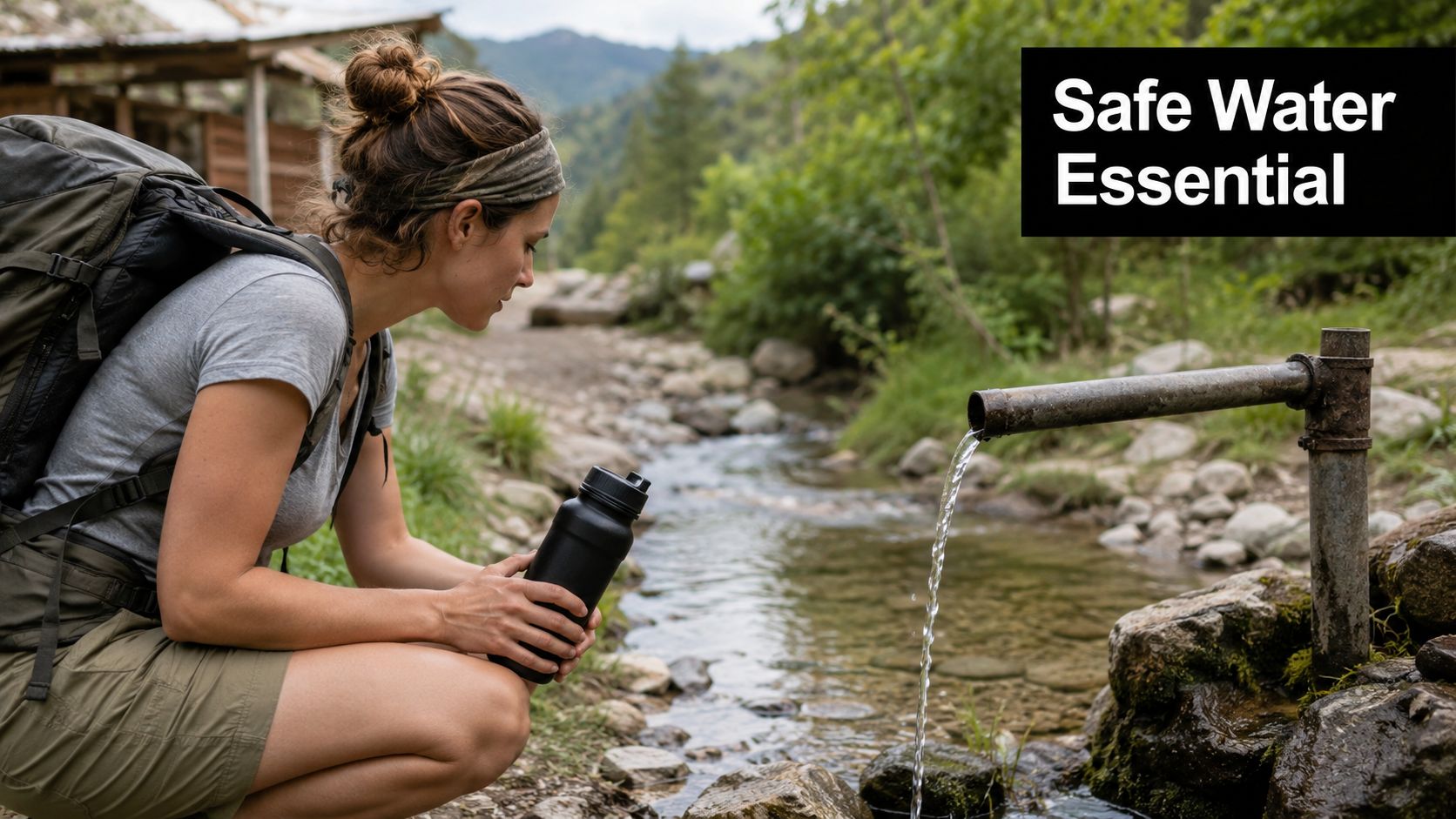
The mistake many travellers make
A common setup is simple. Fill at the park, run the hose through a basic filter, and assume the job's done. That approach can be fine for improving taste on treated supply. It's not the same as verified protection when you're filling from uncertain sources.
According to this guide to caravan and RV water filtration, only 12% of Australian caravan filters marketed in 2025 include a certified 0.1-micron absolute rating needed to remove CYST parasites like Cryptosporidium from non-treatable sources. That matters because many buying decisions are still being made around taste, convenience, and price, not microbiological safety.
Clean-looking water can still be the wrong water to drink.
If you spend most of your time in sealed caravan parks, your filter choice can be simpler. If you regularly free camp, fill from tanks, or travel remote routes, the calculation changes. A filter then becomes part of your health protection, not just a comfort upgrade.
Why this matters more in remote travel
Remote travel already asks more of your van and your routine. Water is one of the systems that catches people out because the problem often isn't obvious until later. That's one reason many travellers researching the benefits and challenges of RV living end up rethinking how they handle drinking water once they move beyond powered sites and predictable supplies.
A practical rule works well here:
- If the water source is known and treated, a filter aimed at chlorine, taste, and sediment may be enough.
- If the source is uncertain, you need to think about verified microbiological filtration, not just clarity.
- If you can't confirm what the filter is rated to remove, assume it's a taste filter until proven otherwise.
That distinction is the difference between water that seems fine and water you can trust.
Understanding Caravan Water Filter Types
Not all caravan filters do the same job. Some are there to protect plumbing and improve taste. Others are built to deal with biological contaminants. If you compare filters by price alone, you'll miss the point of the system.
A simple way to understand micron ratings is to think of each filter as a different fishing net. A coarse net catches leaves and sticks. A finer net catches sand. A much finer one is needed for the things you can't see but still don't want in your drinking water.
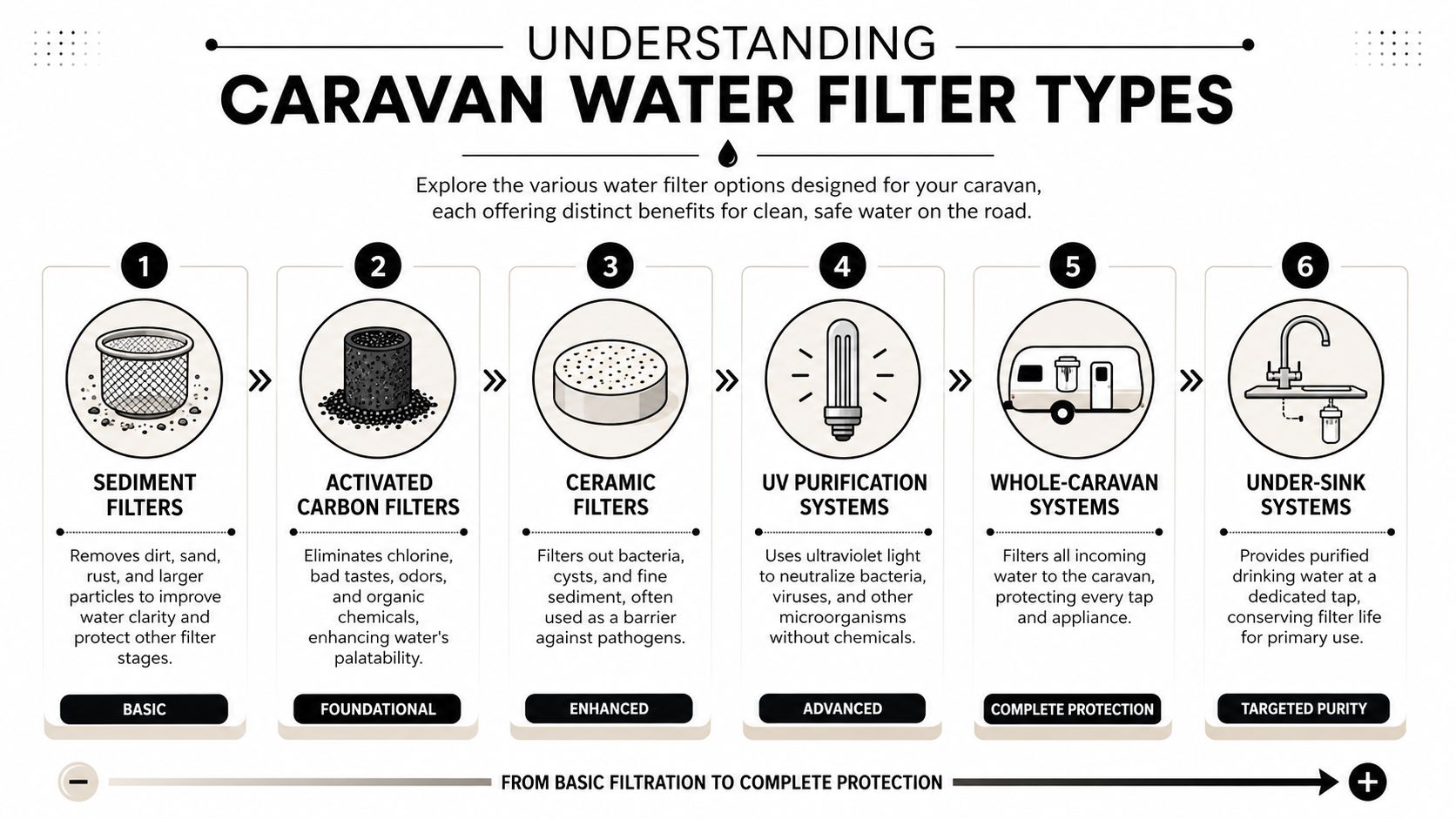
Sediment filters
Sediment filters are your first line of defence against visible contamination. They're designed to catch dirt, sand, rust, and other particulates before those particles reach taps, pumps, and finer filter media.
These filters are especially useful when:
- Filling from older park taps, where rust or grit may come through
- Using tank water, where sediment can build up over time
- Protecting a second-stage cartridge, so the more specialised media doesn't load up too quickly
Sediment filtration improves clarity and helps the rest of the system last longer. On its own, though, it's not a complete drinking water solution.
Activated carbon filters
Carbon filters are what most travellers notice first because they affect flavour. They reduce chlorine taste, odour, and some chemical taints that make treated water unpleasant to drink.
That makes them popular for vans that mainly connect to town supply. If you've ever filled at a caravan park and thought the water smelled like a swimming pool, a carbon stage is the part doing the heavy lifting.
Carbon is useful, but it has limits. It doesn't automatically mean the filter is suitable for suspect water sources.
Cyst-rated and microbiological filters
This is the category that matters when you move beyond treated reticulated supply. In the Australian caravan market, premium caravan filter systems often use a dual-stage setup with a 9" x 2.5" 1-micron AquaCo polyspun sediment pre-filter followed by a post-filter stage that reduces 99.9% of Giardia and Cryptosporidium cysts.
That combination makes practical sense. The first stage catches the physical load such as silt and rust. The second stage targets the biological issue that a basic taste filter won't address.
Workshop view: For remote travel, a multi-stage setup is usually the safer way to think. One stage protects the cartridge. The other handles what actually worries you.
Other system styles
Some travellers choose water treatment by layout rather than media alone. That's where the format of the system matters.
| System style | Best use | Main trade-off |
|---|---|---|
| Inline hose filter | Fast setup at the tap or inlet | Often limited if you need verified microbiological protection |
| Whole-caravan filter | Filters all incoming water to taps and appliances | Uses cartridge life on showering and washing, not just drinking |
| Under-sink drinking filter | Dedicated filtered water for consumption | Doesn't protect the rest of the van's plumbing |
| Portable countertop or gravity unit | Flexible backup option | Takes space and may be slower or less convenient |
Ceramic and UV systems also come up in caravan discussions. They can suit certain setups, but they still need to be matched to your actual water source, available space, and maintenance tolerance. The right answer isn't the most complicated system. It's the system that matches the risk.
How to Choose the Right Water Filter For Your Caravan
Start with your travel pattern, not the catalogue. The right water filter for caravan use depends on where you fill, how often you move, and whether you need every tap filtered or only a safe drinking point.
A van that lives on powered sites and mains water has different needs from one that regularly tops up from tanks and bores. Treat those as two separate jobs, because they are.
Match the filter to the water source
If most of your trips involve caravan parks and treated supply, you're mainly trying to improve water quality at the point of use. Sediment protection plus activated carbon often makes sense there. You'll notice cleaner taste, less odour, and less grit reaching the van.
If you spend time off-grid, your buying criteria tighten up quickly. You should be looking for AS/NZS-focused caravan water filter guidance that points to micron filtration fine enough to capture bacteria and parasites alongside activated carbon media to reduce chlorine levels and improve taste. In plain terms, that means a caravan filter should be judged by what it's rated to remove, not by whether the housing looks sturdy.
A useful way to assess your needs is this:
- Mainly park water. Prioritise sediment and carbon for taste and plumbing protection.
- Mixed travel. Choose a staged system that can handle changing source quality.
- Bore, tank, or uncertain supply. Focus on verified microbiological capability first, then taste and convenience second.
Read the product listing like a technician
The most important words in a listing are usually buried in the specifications. That's where you'll see what media is inside, what line size it suits, and whether the system is intended for drinking water or whole-van use.
Check for:
- Micron rating. This tells you how fine the filtration is.
- Media type. Sediment and carbon do different jobs.
- Australian compatibility. Fittings, line size, and standards matter in real installs.
- Serviceability. You want cartridges and fittings that are easy to replace on the road.
If you're comparing options, an inline caravan water filter setup is the sort of product format many owners start with because it's compact and straightforward to integrate. Whether it's enough depends on the source water you expect to use.
Don't choose on flow alone
Fast flow feels good at the sink, but flow by itself can be misleading. A filter that moves water quickly isn't automatically the better filter if it isn't rated for the contaminants you care about.
I'd rather see a traveller choose a properly matched drinking setup and accept a little more planning than fit a cheap cartridge that only masks poor water. You can work around slower flow. You can't work around the wrong filter once you're already relying on it.
Buy for the worst water you're realistically going to use, not the best water you hope to find.
Installing Your Caravan Water Filter System Correctly
A good filter can still perform badly if it's installed in the wrong place, with the wrong fittings, or in the wrong sequence. Most caravan installs are straightforward, but the details matter. Leaks, cracked housings, poor flow, and premature cartridge failure usually trace back to setup errors, not the filter itself.
For most vans, the cleanest approach is an inline installation on the cold-water side where the cartridge stays accessible for service.
Start with the right line size
In Australia, most caravans use standard 12mm water lines. That's why 12mm fittings and John Guest connectors are the normal choice for a proper install. They suit the plumbing already in the van and give you a secure push-fit connection that holds up better to vibration and road movement.
If you mismatch fittings, you create trouble for yourself straight away. The line may seem tight at first, then seep under pressure or pull loose once the van has been over corrugations.
A sound install usually includes:
- A clear mounting position with enough room to remove the cartridge
- Correct 12mm pipe and fittings matched to the filter head
- Support for the housing and lines so the plumbing isn't hanging under strain
- A controlled first flush before anyone drinks from it
Get the sequence right
Placement matters as much as the fitting size. In most practical caravan setups, the pressure regulator should protect the filter rather than the other way around. That means your drinking-water filter is generally installed after the regulator, not before it.
This is one of the most common mistakes I see in improvised installs. Owners often focus on finding any spare space under the sink and forget to think through the order of components.
A caravan water system works best when each part does one job in the right order. The regulator controls pressure. The filter treats water. Swap those roles around and both can suffer.
Here's the usual flow logic for a basic mains-connected arrangement:
- Supply tap
- Hose
- Pressure regulator
- Filter
- Caravan cold-water line and tap
If your van also relies on a pump and tank, the layout can vary. In those cases, match the install to how you drink and fill, not just to where the space is.
A related system many owners review at the same time is the 12 V water pump for caravan applications, because pump condition and pressure stability affect how the filter behaves once you're off mains.
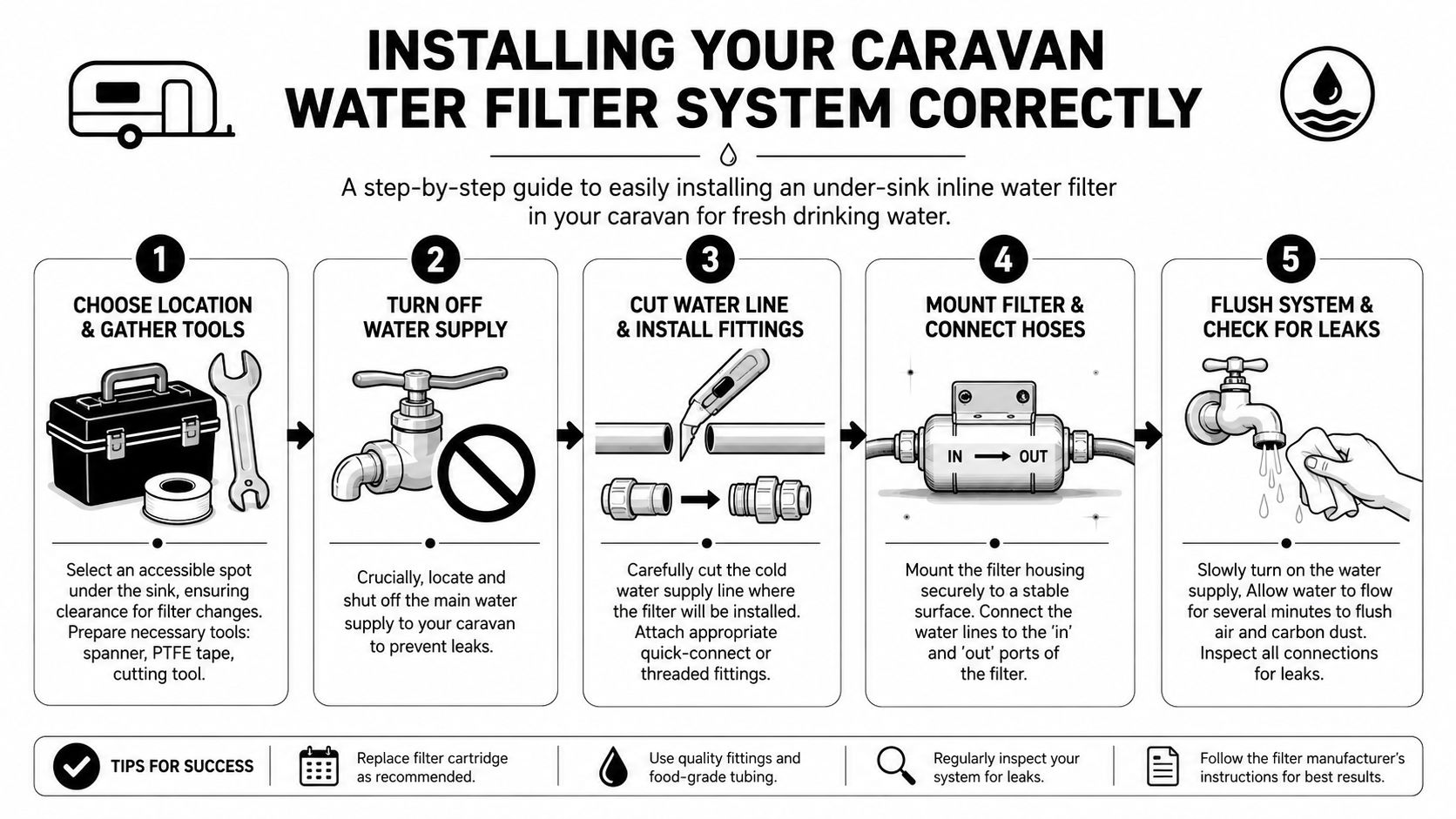
Basic installation routine
This isn't difficult work, but it rewards patience.
| Step | What to do | Why it matters |
|---|---|---|
| Choose the location | Pick a spot with access for cartridge changes | A hidden filter becomes a neglected filter |
| Isolate the water | Turn off supply and release pressure | Stops a simple install turning into a wet mess |
| Cut and fit carefully | Make clean cuts and seat each line fully | Push-fit systems only seal properly when inserted correctly |
| Mount securely | Fix the filter head or bracket to a stable surface | Prevents movement and fitting stress during travel |
| Flush and inspect | Run water through and check every joint | Removes carbon fines and catches leaks early |
Later in the install process, it helps to see a general layout in action:
If you're not confident cutting into the van's plumbing, hand it to a technician. A neat install only needs doing once.
Filter Maintenance and Replacement Schedule
Cartridge maintenance is where good intentions usually fall apart. The filter gets installed before a trip, operates in the background, and then gets ignored until the water slows down or starts tasting wrong. By then, you're reacting instead of maintaining.
A caravan filter should be treated like any other service item. Check it regularly, replace cartridges when they're due, and clean the surrounding water system so the filter isn't being asked to compensate for a neglected tank or line.
What to watch for
The first clues are usually easy to spot:
- Reduced flow at the tap. The cartridge may be loading up with sediment.
- Taste or odour returning. Carbon media may be spent.
- Visible discolouration in a clear pre-filter housing. That's a sign the incoming water is carrying more load than usual.
- Leaks after storage. Seals can dry, shift, or harden if the system sits idle.
One pressure-related detail is often missed. According to Australian RV field test guidance on taps and filters, placing a 5-micron sediment filter before the pressure regulator reduced cartridge clogging by 34% compared to post-regulator placement in recent 2026 field tests, even though many buying guides don't discuss this sequencing. That's a reminder that cartridge life depends not just on water quality, but on system layout.
A practical maintenance routine
You don't need a complicated schedule. You need a repeatable one.
- Inspect before each trip. Look at the housing, fittings, and any visible line movement.
- Flush after periods of storage. Don't drink the first stagnant water through the system.
- Replace cartridges to the manufacturer's recommendation. If the source water has been poor, change them sooner.
- Sanitise tank and lines when needed. A clean filter won't fix a dirty water system.
For vans that have been sitting, I'd pay as much attention to the tank as the cartridge. A proper caravan water tank cleaner can be part of that reset, especially when stale smells or residue suggest the problem is broader than the filter alone.
Maintenance reality: Filters fail quietly. Most don't announce they're spent. They just stop doing the job you assumed they were still doing.
Before long storage
If the caravan is going away for a while, don't leave the filter system full and forgotten.
A sensible shutdown routine is:
- Drain where appropriate
- Remove or isolate cartridges if the manufacturer advises it
- Leave the system clean, not wet and stagnant
- Inspect seals before the next trip
That small bit of preparation helps avoid mouldy smells, stuck housings, and that first unpleasant taste when the season starts again.
Common Problems and Easy Troubleshooting
Most caravan filter faults are simple. The trick is identifying whether the issue is the cartridge, the plumbing, or the source water.
Quick fault guide
| Symptom | Likely cause | What to do |
|---|---|---|
| Water leaking at the fitting | Pipe not fully seated, wrong connector, damaged seal | Remove pressure, refit the line correctly, inspect the fitting and seal |
| Poor flow at the tap | Clogged sediment stage, blocked cartridge, kinked line | Check the line first, then replace the cartridge if needed |
| Bad taste has returned | Carbon stage exhausted, stagnant water after storage | Flush the system. If taste remains, replace the cartridge |
| Filter housing keeps moving | Poor mounting or unsupported pipework | Re-secure the bracket and support the line |
| Pump cycles strangely after install | Small leak, trapped air, or restriction | Check every joint, flush air out, and review line routing |
When the fix isn't the filter
A lot of people blame the cartridge for any water issue after installation. Sometimes the cartridge is fine. The actual problem is a dirty tank, a tired pump, a pressure mismatch, or fittings that were never properly matched to the van.
If you change the filter and nothing improves, step back and check the whole chain:
- Source water quality
- Tank cleanliness
- Pump behaviour
- Regulator condition
- Line size and fitting compatibility
If the van still has unreliable pressure, recurring leaks, or contamination concerns after those checks, get a technician to inspect it. That's faster than replacing parts at random.
Caravan Water Filter FAQ
Can I just use a filter jug instead of an installed caravan system
You can use a jug as a backup, but it's not the same thing. A jug won't protect your plumbing, won't help at the fill point, and usually isn't the best answer for regular travel. An installed setup is more practical when you're using the van often and want consistent drinking water on tap.
What's the difference between a drinking-water filter and a whole-caravan filter
A drinking-water filter treats the water you consume, usually at one dedicated outlet or cold tap. A whole-caravan filter handles all incoming water, including what goes to the shower and appliances. Whole-van filtration gives broader protection, but it also uses cartridge life on water you don't necessarily drink.
What should I choose for long off-grid travel
Choose for uncertainty, not convenience. If you expect to rely on bore, tank, or other non-standard sources, focus on verified microbiological protection and a staged system that can deal with sediment before the finer filter stage. Also think about how easily you can get replacement cartridges while travelling.
Do I need a professional to fit a caravan water filter
Not always. Many owners can install a basic inline system if they understand their plumbing, use the right fittings, and mount it properly. If you're unsure about pressure, line routing, or leak testing, professional installation is worth it.
If you're looking for reliable caravan filtration parts, compact systems, or the right 12mm fittings for an Australian van, Ring Hot Water is a strong place to start. They supply caravan and RV water filtration products, genuine fittings, pumps, spare parts, and practical support for owners who want a setup that works properly on the road.

