
Water Filters
Water Filtration for Hard Water

Jul
Best Water Filtration for Hard Water in Melbourne 2026
You install a premium boiling water tap, stand back, and admire the clean new kitchen. A few weeks later, the shine starts to dull. There's a chalky ring near the spout, white marks around the aerator, and a crust building where hot water flashes to steam.
That's the moment many Melbourne homeowners realise they don't just have a water taste issue. They have a hard water issue.
The frustrating part is that plenty of people try to solve it with a standard water filter and still end up with scale on tapware, kettles, coffee machines, and hot water systems. The water may taste better, but the mineral deposits keep coming. If you've bought a filter and you're still scrubbing white residue off expensive fixtures, you're not imagining things. You've likely treated the wrong problem.
The Unseen Problem in Your Melbourne Water
A lot of households only notice hard water after they've spent money on something new. It might be a Zip tap, a Boiling Billy, a coffee machine, a dishwasher, or a hot water service. The appliance works well at first, then the signs start creeping in. White spotting on chrome. A crust inside the kettle. Slower flow at the tap. A rough film on glassware after washing.
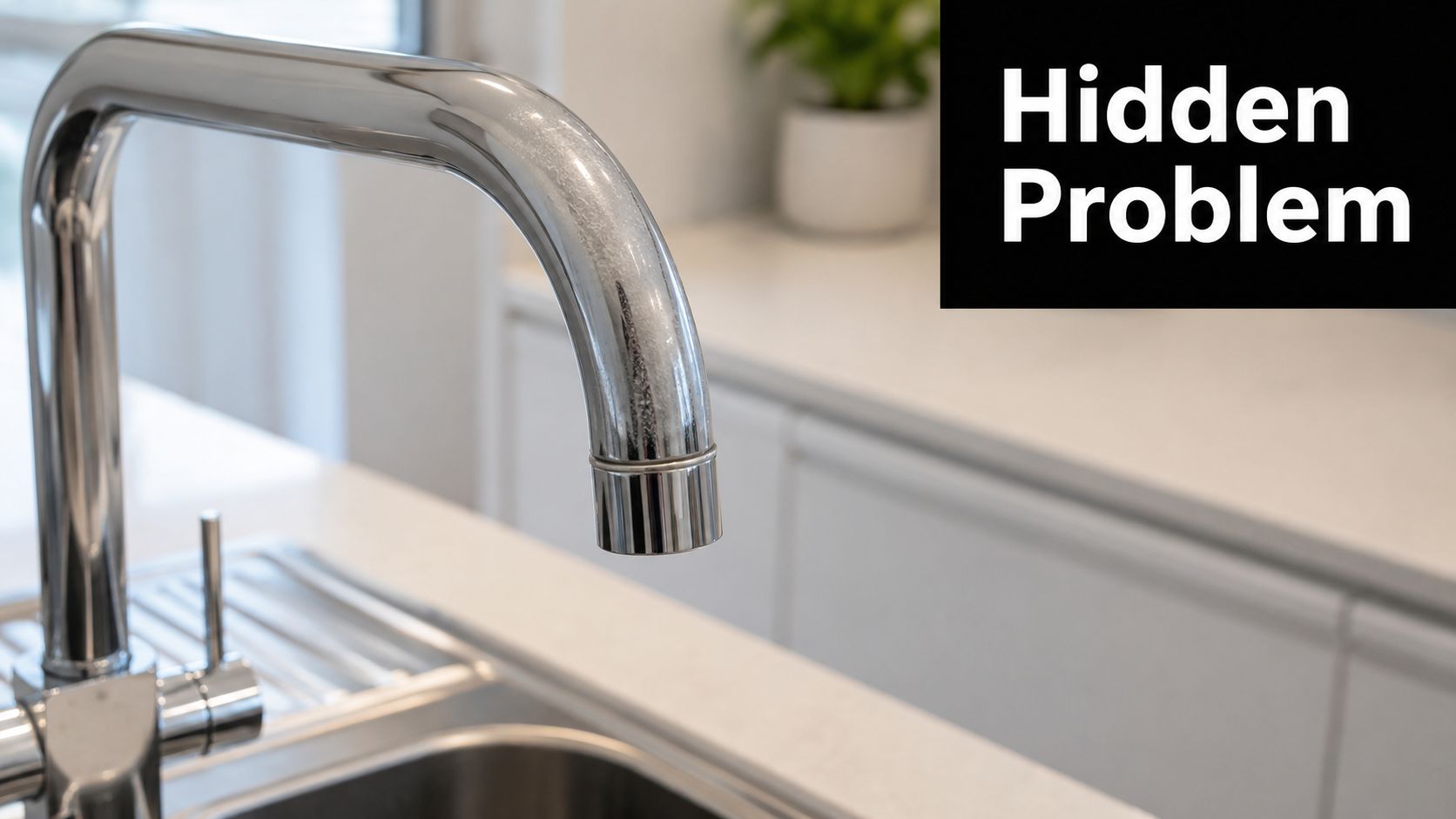
That residue is usually left behind by calcium and magnesium. They're naturally occurring minerals, but once water is heated or evaporates, they don't stay dissolved. They settle onto surfaces instead. In kitchens and plant rooms, that means trouble shows up fastest on anything that heats water.
Why the problem feels bigger than it first appears
At first, scale looks cosmetic. Then it starts affecting function.
A homeowner might wipe a tap every few days and think it's just part of living in Melbourne. A café owner might descale an urn more often and call it routine maintenance. But those mineral deposits don't stay on the surface. They also build inside valves, heating chambers, spray heads, and storage tanks.
If you want a plain-English look at what happens inside hot water equipment, this guide on calcium deposits in water heaters is useful because it shows why a bit of white residue outside often points to a bigger problem inside.
Hard water rarely announces itself with a dramatic failure. It usually starts with nuisance symptoms, then shortens the life of the equipment you rely on every day.
Safe water isn't always problem-free water
Australia has a strong drinking water system overall, but that doesn't mean every household gets water that behaves the same way. The broader market reflects that difference. The Australian water purifier market was valued at AUD 337.79 million in 2025 and is projected to reach USD 338.75 million by 2030, with a projected 5.52% CAGR, while about 93% of Australian households have access to clean, safe drinking water and bottled water averages $2.24 per litre compared with tap water at less than $0.001 per litre, according to Expert Market Research's Australia water purifier market report.
That matters because homeowners often face two separate goals at once:
- Protect fixtures and appliances from scale damage
- Improve drinking water quality so they don't keep buying bottled water
Those are related goals, but they're not the same job. Once you understand that split, the choices get much clearer.
Hard Water 101 What It Is and How to Spot It
Hard water is water carrying dissolved minerals, mainly calcium and magnesium. The easiest way to think about it is this: the water has travelled through mineral-rich ground and picked up a little bit of that rock on the way. Not chunks you can see. Tiny dissolved particles.
That's why hard water can look perfectly clear in a glass and still leave scale all over your kitchen.
What it feels like in daily life
Hard water is rarely diagnosed from a lab report. Its presence is typically noticed from the way water behaves around the house.
Common clues include:
- White marks on tapware and shower screens that return soon after cleaning
- Kettles and coffee machines developing chalky build-up
- Soap that won't lather properly, especially in the shower
- Laundry that feels stiff or looks a bit dull
- Hair and skin that seem harder to rinse clean
Window glass often tells the story too. If you've got stubborn mineral spotting on exterior panes, hard water is often part of the picture. This article on professional window stain cleaning is worth a look because it helps separate ordinary dirt from mineral staining.
A useful threshold for Melbourne homes
In Melbourne, hardness can vary by area and supply. For homeowners, local hardness levels often exceed the 120 mg/L threshold where intervention becomes necessary, while water hardness under 60 mg/L may not require filtration at all, according to Filter Out's guide to hard water filtration in Australia.
That doesn't mean every house above that threshold needs the same system. It means you're at the point where a water treatment decision becomes practical rather than optional.
Three simple ways to check
You don't need to start with expensive testing. A few basic checks can tell you a lot.
Look at heated appliances
Check the kettle, boiling tap nozzle, coffee machine, and showerhead. Hardness usually shows itself fastest where water is heated.Try a soap lather check
If soap seems reluctant to foam and leaves a film, hardness is a likely suspect.Use test strips or arrange proper testing
If you want a clearer answer before buying equipment, start with a home test kit or read this guide to water quality testing in Melbourne.
Practical rule: if you can see scale, don't assume a taste filter will fix it. Visible limescale is a hardness clue, not just a general water quality clue.
Filtration vs Softening The Critical Difference
Most purchasing mistakes occur here.
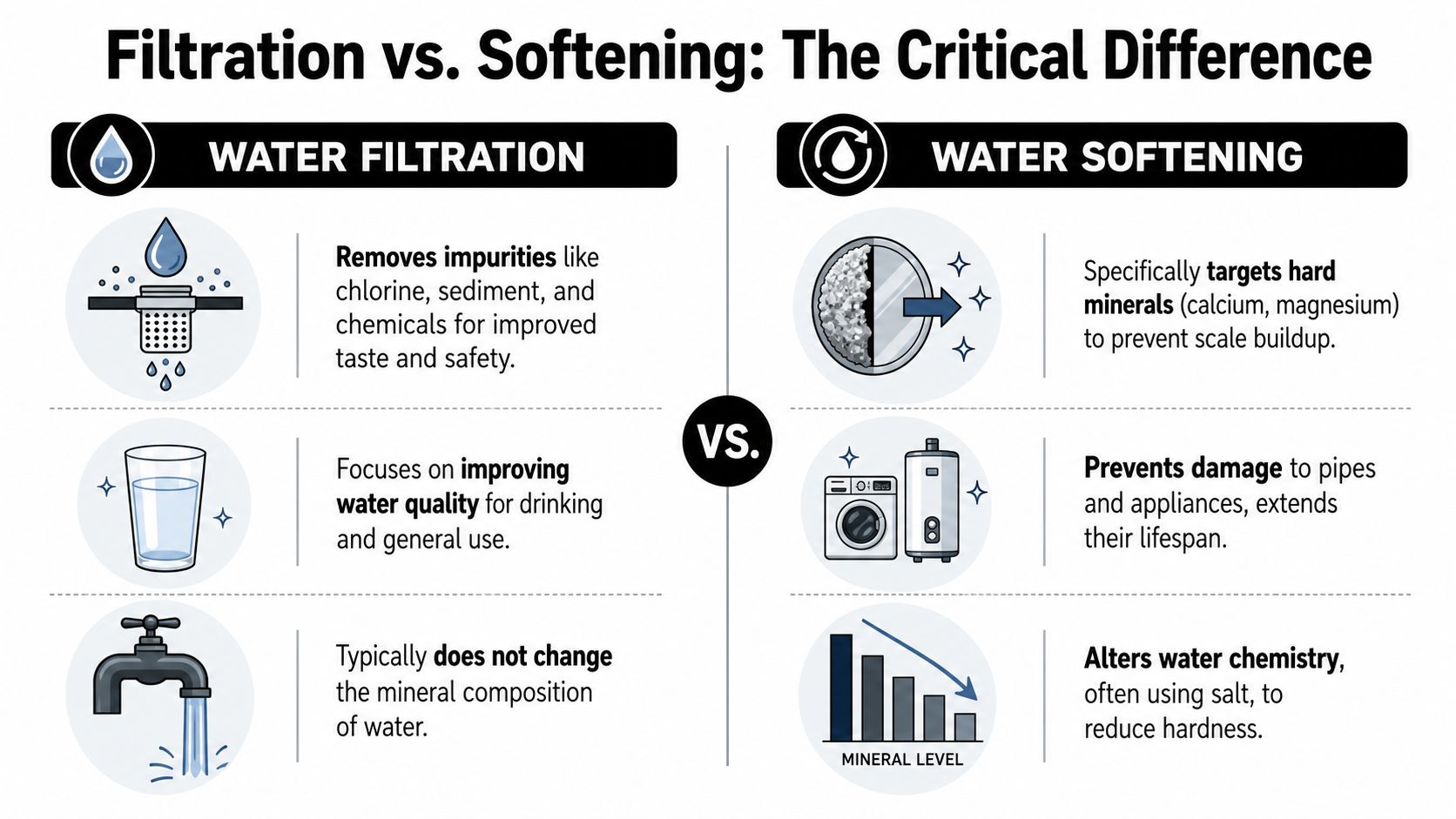
People say, “I need a water filter for hard water,” then buy a carbon filter, install it, enjoy better-tasting water, and wonder why the boiling tap still cakes up with white deposits. The filter worked. It just worked on the wrong problem.
A simple way to think about it
A filter is like a sieve. It's good at catching or reducing things that affect taste, odour, and clarity, such as chlorine or sediment.
A softener or conditioner deals with dissolved hardness minerals. Those minerals are the part causing limescale. They're not floating around like grit. They're mixed into the water itself, so a basic taste filter won't stop them.
That distinction is the core of good water filtration for hard water. You need to know whether you're trying to improve the water you drink, stop scale, or do both.
What carbon filters can and can't do
Standard carbon filters are popular for a reason. They can improve water for drinking and cooking by targeting taste and odour problems. But they do not remove the calcium and magnesium responsible for scale.
That confusion is common enough to call out directly. WaterScore's article on Australian tap water filters notes that the misconception is widespread and confirms that standard carbon filters are ineffective for hardness, even though they're commonly used for chlorine taste.
Here's the practical version:
- If your issue is chlorine taste, carbon filtration makes sense.
- If your issue is white scale, carbon filtration won't solve it.
- If you have both issues, you may need more than one treatment stage.
A quick visual helps if you want to see the distinction in action.
Why this matters for boiling taps and appliances
Boiling water units make hardness problems obvious because heat accelerates scale formation. That's why homeowners often think the appliance is faulty when the issue is untreated hardness.
Filtered water can still be hard water.
That single sentence clears up a lot of frustration. If your current system improves taste but doesn't stop chalky build-up, there's a good chance you've installed filtration without softening or conditioning.
Comparing Hard Water Treatment Technologies
Choosing a hard water treatment system gets much easier once you sort each option by job. Some systems remove hardness minerals. Some reduce the way scale sticks. Some are built for drinking water at one tap, while others are designed to protect the whole property.
That distinction matters in Melbourne homes with premium boiling taps, coffee machines, and hot water services. A homeowner can install a filter, enjoy better-tasting water, and still find white crust building up around the spout a few weeks later. The missing piece is usually the treatment method, not the brand.
Ion-exchange softeners
Ion exchange is the standard method if your goal is to remove hardness rather than just manage its effects. Pacific Water explains that these systems use cation resin to replace calcium (Ca²⁺) and magnesium (Mg²⁺) with sodium (Na⁺).
A simple way to picture it is a swap counter. The resin catches the minerals that cause scale and releases sodium in their place. Less calcium and magnesium in the water means less scale left behind on heating elements, tap outlets, and inside pipework.
This option suits homes or small businesses that want fully softened water across the property.
Salt-free conditioners
Salt-free conditioners take a different approach. They do not remove calcium and magnesium from the water in the same way a softener does. Instead, they are designed to change how those minerals behave so they are less likely to cling to metal surfaces and harden into stubborn scale.
That makes them appealing for people who want scale control without adding salt or producing traditionally softened water. They are often considered for whole-home use where the main priority is helping protect plumbing, hot water units, and appliances.
Reverse osmosis systems
Reverse osmosis, or RO, is usually chosen for high-quality drinking water at a single outlet. It pushes water through a very fine membrane that removes a wide range of dissolved contaminants, including hardness minerals.
In practical terms, RO works well under the kitchen sink, especially where a household wants cleaner-tasting water and lower mineral content at one tap. It can be a strong fit for protecting a boiling tap or coffee setup, and our guide to under-sink water filter options in Melbourne explains where that style of system makes sense.
RO is not usually the answer for showers, laundry, and whole-house scale protection. It is a targeted solution.
Electronic descalers
Electronic descalers are usually sold as compact devices attached to pipework. They aim to influence mineral behaviour electronically rather than removing hardness from the water.
Some property owners choose them because installation can be simpler than a traditional softener. The trade-off is clarity. Their results are often less predictable than ion exchange, especially where the goal is strong, measurable reduction in scale inside appliances and hot water equipment.
Hard Water Treatment Technology Comparison
| Technology | How It Works | Best For | Pros | Cons | Maintenance |
|---|---|---|---|---|---|
| Ion-exchange softener | Swaps calcium and magnesium for sodium using resin | Whole-home soft water and strong scale reduction | Effective on permanent hardness, protects plumbing and hot water equipment | Removes minerals, may not suit people who want untreated mineral content at every tap | Ongoing salt replenishment and periodic servicing |
| Salt-free conditioner | Changes mineral behaviour to reduce sticking and scale formation | Whole-home scale management where mineral removal isn't the goal | Helps protect appliances without fully softening all water | Doesn't produce fully soft water in the traditional sense | Media replacement or servicing based on system type |
| Reverse osmosis | Pushes water through a membrane for high-purity drinking water | Single tap drinking water, boiling taps, kitchen use | Strong reduction of dissolved minerals for drinking water | Not a whole-house solution, usually installed at one outlet | Filter and membrane changes |
| Electronic descaler | Uses an electrical or electronic treatment approach on pipework | Niche situations where a compact option is preferred | Minimal plumbing changes in some installations | Performance expectations can be less clear than ion exchange or RO | Device checks and occasional servicing |
A quick rule of thumb helps. If scale is showing up on showers, in the hot water service, and across multiple appliances, a whole-home solution usually makes more sense. If the problem is concentrated at the kitchen sink or a premium drinking water tap, a point-of-use system is often the better fit.
Choosing Your System Point-of-Use vs Whole-Home
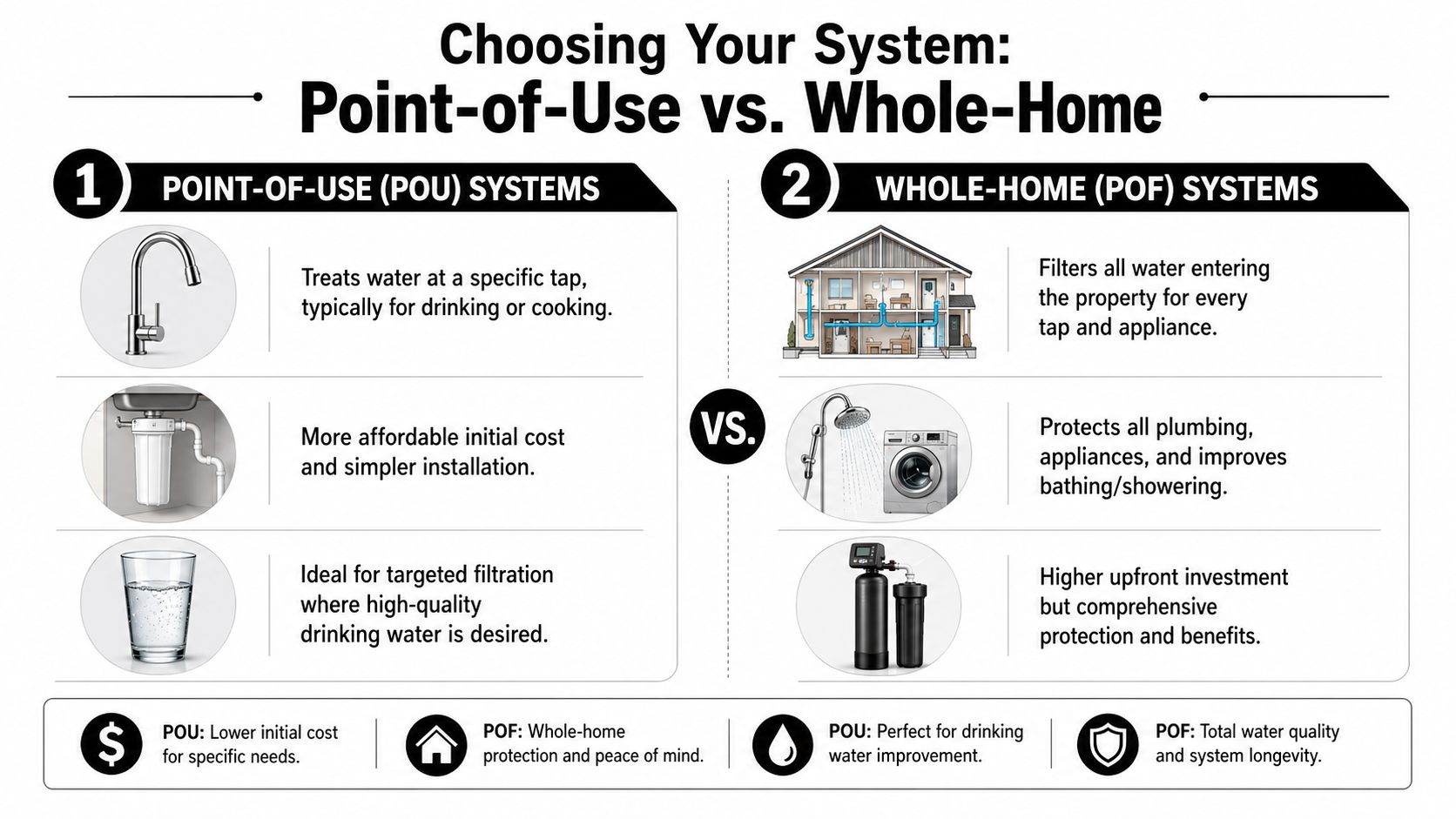
The smartest setup often comes down to one question: Where do you need protection?
If the answer is “just the drinking water tap,” that points one way. If the answer is “every pipe, shower, appliance, and hot water unit in the building,” that points another.
When point-of-use makes sense
A point-of-use system treats water at a specific outlet, usually under the kitchen sink or at a dedicated tap.
That suits people who want to protect a single premium fixture or improve the water they drink and cook with. A common example is an under-sink RO system serving a kitchen mixer or boiling tap. If that's the part of the house you're focused on, this guide to under-sink water filter options in Melbourne gives a practical starting point.
Point-of-use usually fits these situations:
- Apartment living where major plumbing changes aren't practical
- Targeted appliance protection for a boiling tap, coffee machine, or chiller
- Drinking water priority when taste and mineral reduction at one tap matter most
When whole-home treatment makes more sense
A whole-home system treats water as it enters the property. That means showers, laundry, kitchen cold, hot water services, and connected appliances all receive treated water.
This is the better strategy when scale is showing up everywhere rather than only at one outlet. It's also the stronger option for homeowners protecting a renovation or businesses protecting equipment across multiple points of use.
Typical whole-home cases include:
- Family homes with recurring scale on showers, kettles, and hot water systems
- Small offices using wall-mounted boiling units and kitchenettes
- Hospitality venues where hard water affects more than one appliance
The hybrid setup many properties need
A lot of Melbourne homes and small businesses don't need to choose one or the other. They need both.
One practical layout is:
- A whole-home conditioner or softener at the entry point to reduce scale across the property
- A drinking water filter or RO unit at the kitchen for taste and glass quality
That arrangement solves a common complaint. People want less scale in the shower and hot water service, but they also want pleasant drinking water at the sink. One device rarely handles both goals perfectly on its own.
The right system isn't the most advanced one. It's the one matched to where the problem shows up.
Installation Maintenance and Costs in Melbourne
Buying the right system is only half the job. The other half is installing it properly and keeping it maintained so it continues to do what you paid for.
Why professional installation usually wins
For anything connected to mains plumbing, professional installation is the safer path. That includes whole-home systems, under-sink systems with multiple stages, and any setup feeding a boiling or chilled unit.
A proper installer looks at more than just where the unit fits. They check isolation points, drainage needs, pressure conditions, service access, and how the treatment system interacts with the appliance it's protecting. If you're comparing options, this page on water filter installation in Melbourne is a useful reference for the practical side of the job.
For deeper infrastructure, commercial, or high-pressure applications, filtration equipment standards can become more technical. For example, Water Corporation's design standard for certain deep bed, down-flow multimedia filtration systems specifies an active media bed depth above 950 mm, a media composition of 58% anthracite, 28% medium/coarse sand, and 14% fine sand, and a vessel pressure rating of at least 800 kPa or 120% of pump dead head pressure, as set out in Water Corporation's filtration equipment design standard. Most homeowners won't need that level of specification, but it shows why plumbing design matters when pressures and equipment loads rise.
What maintenance actually looks like
Maintenance depends on the technology, and consequently, expectations need to be realistic.
- Ion-exchange softeners need salt replenishment and periodic checks
- RO systems need filter changes and eventual membrane replacement
- Conditioners usually need less day-to-day attention, but they still require servicing according to the manufacturer's schedule
- Carbon stages for taste and odour need cartridge replacement at intervals
None of that is difficult. The problem comes when owners install a system and then forget it exists. A neglected treatment system can stop working long before anyone notices.
Think in total ownership, not just purchase price
People often compare systems by shelf price alone. That's the wrong comparison.
A better way to budget is to look at:
| Cost area | What to consider |
|---|---|
| Initial equipment | The unit itself and any accessories required for connection |
| Installation | Labour, plumbing adjustments, valves, drainage, and commissioning |
| Consumables | Salt, cartridges, membranes, or replacement media |
| Servicing | Professional inspections or scheduled maintenance visits |
| Protected assets | The value of the appliances and fixtures the system is there to protect |
That last line matters. A hard water treatment system isn't only a water purchase. It's also a way of looking after expensive taps, hot water units, coffee equipment, and the finish on your kitchen and bathroom fixtures.
Hard Water FAQs for Melbourne Residents
Why isn't my existing water filter stopping limescale?
Because many filters are designed for taste and odour, not hardness. If your unit uses carbon, it may improve chlorine taste while leaving calcium and magnesium untouched. That's why filtered water can still leave scale on kettles and boiling taps.
Will a water softener make drinking water taste salty?
It can change the character of the water because ion exchange replaces hardness minerals with sodium. Some people don't notice much difference. Others prefer to pair a whole-home softener with a separate drinking water filter at the kitchen sink.
Is there a way to protect the whole house without fully softening the water?
Yes. This is one of the most overlooked questions. My Water Filter's overview of hard water treatment options notes that water conditioners can help prevent limescale by converting mineral ions into non-stick crystals without removing calcium or magnesium, which makes them a useful alternative where whole-home scale protection is wanted without fully stripping minerals from the water.
Is hard water unsafe to drink?
The practical issue discussed here is usually scale, appliance wear, and how the water behaves in daily use. If you're unsure about overall water quality, testing is the right first step.
What can renters do?
Renters usually need non-permanent options. The most realistic choices are point-of-use systems, such as bench-top or under-sink drinking water treatment where allowed, plus regular descaling of affected appliances. You may not be able to change the whole property, but you can still protect the water you drink and the appliances you own.
If you're weighing up the right treatment for a boiling tap, under-sink system, commercial urn, or whole-home setup, Ring Hot Water can help you sort out what's causing the problem and which solution fits your property. Their Melbourne team works with instant boiling and chilled water systems every day, so you can get practical advice, genuine parts, and installation support without guessing your way through hard water issues.

