
Uncategorized
Touchless Tap Bathroom Kitchen: 2026 Buyer’s Guide
Jul
You're probably here because of a very ordinary problem. You're cooking, your hands are covered in chicken marinade, dough, paint, potting mix, or bathroom cleanser, and the one thing you need to touch is the tap. So you either smear the handle, rinse one finger just to turn it on, or ask someone else for help.
That small annoyance is why touchless taps have moved from novelty to practical upgrade. In both kitchens and bathrooms, they solve a simple problem well. Water turns on when you need it and stops when you don't. That means less mess on the tap body, fewer touch points, and less wasted water from taps left running a bit too long.
For Melbourne homeowners, the appeal goes further than convenience. A good touchless tap bathroom kitchen setup can make a renovation feel more modern without being gimmicky. It can also fit neatly into the way many Australian homes already work, especially where water efficiency, easy cleaning, and compact under-sink planning matter.
The End of Fumbling with Taps
A kitchen is where touchless taps usually make immediate sense.
You're carrying a roasting tray with both hands. You need water for a pot. Your hands are sticky from jam, oily from olives, or dusty from flour. A standard mixer tap suddenly feels badly designed for real life. The same thing happens in a bathroom when someone wants a quick handwash but doesn't want to touch the handle first, then touch it again with wet hands to switch it off.
That's why I like to describe touchless taps as a practical plumbing upgrade, not a flashy gadget. They remove one repetitive friction point from daily life. In a renovation, those are often the upgrades people appreciate most six months later.
Where they make the biggest difference
In a kitchen, a touchless tap helps during messy prep, dishwashing, and pot filling. In a bathroom, it shines when multiple people use the basin through the day and you want a cleaner, simpler handwashing setup.
The benefit isn't only what the tap does. It's what it stops you from doing:
- No handle smears: Fewer greasy fingerprints, toothpaste marks, and soap buildup.
- No awkward elbow manoeuvres: You don't have to bump a lever with your wrist or forearm.
- No absent-minded running water: The tap stops when hands move away.
A good touchless tap should disappear into your routine. If you notice it all the time, it's usually because the wrong model was chosen for the job.
Homeowners often get confused by one point early on. They assume every sensor tap is basically the same. It isn't. A bathroom model that works nicely for quick handwashing may be frustrating in a kitchen if the spout is too low, the sensor is too twitchy, or the controls don't suit longer tasks. That's where most buying mistakes happen.
Another common worry is reliability. Fair question. A tap that works beautifully in an overseas showroom may not perform the same way in a Melbourne apartment, an older weatherboard home, or a humid kitchen. Local plumbing conditions and local servicing matter more than most generic buying guides admit.
How Touchless Taps Actually Work
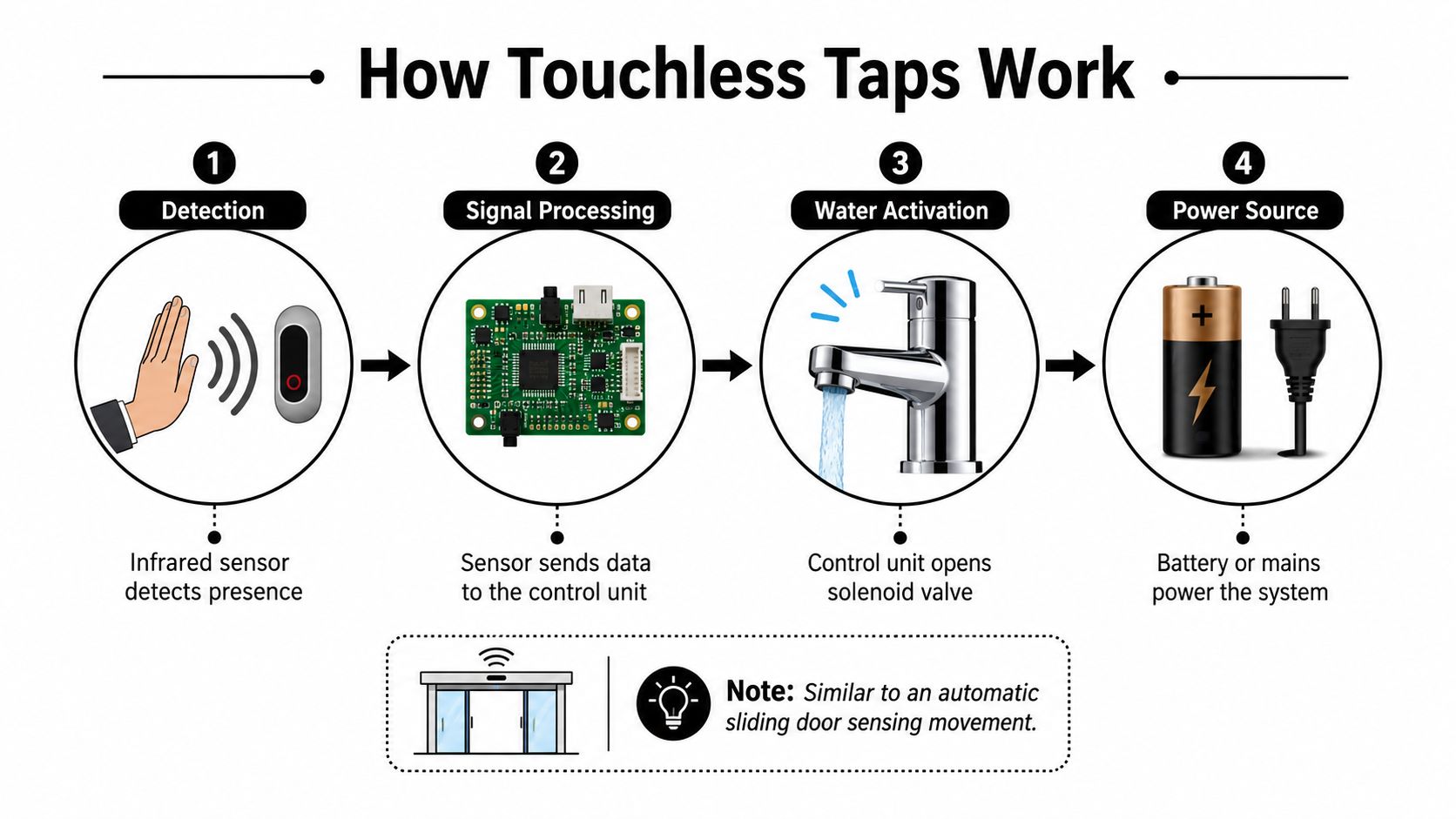
Think of a touchless tap like an automatic sliding door. The door stays shut until a sensor notices someone has arrived. Then a control system tells the mechanism to open. A touchless tap does the same job with water.
The three parts doing the work
Most units rely on three core components.
- The sensor detects your hand or movement near the spout.
- The control system interprets that signal.
- The solenoid valve opens and closes the water flow.
In Australian homes, many touchless kitchen and bathroom taps use infrared proximity sensors. These sensors detect the reflection of an invisible light beam from your hands, then trigger a solenoid valve so water flows without physical contact. According to Abey's explanation of touchless tap technology, this hands-free operation can reduce germ transmission by up to 85% in high-traffic commercial settings.
What the power source does
No power means no sensor operation. That power usually comes from one of two places:
- Battery-powered units are easier to retrofit because they don't usually need extra electrical work.
- Mains-powered units avoid battery changes but need proper planning during installation.
Neither option is automatically better. It depends on the sink cabinet, access, and whether you're renovating fully or swapping out an existing tap.
If you want a more detailed breakdown of the mechanism, this guide on how automatic taps work gives a useful technical overview.
Infrared vs other sensing methods
Infrared is the type most homeowners are likely to encounter. It's common because it's straightforward and responsive when properly positioned. Some systems use other sensing methods, but from a homeowner's point of view the main question is simpler: does the tap activate when you want it to, and ignore movement when you don't?
That's why placement matters. A well-designed tap should detect hands in the washing zone, not every sponge, cloth, or passing object near the sink edge.
Practical rule: The sensor should match the job. Quick and reliable activation matters more than extra smart features you'll never use.
A good touchless tap isn't magic. It's just a sensor, a valve, and a power source working together cleanly. Once you understand that, shopping gets easier because you stop judging taps by marketing language and start judging them by function.
Choosing Your Tap Kitchen vs Bathroom Needs
People often search for a touchless tap bathroom kitchen solution as if one model can do everything. Sometimes it can. Often it can't. The right choice depends on what happens at that sink all day.
What a kitchen tap has to handle
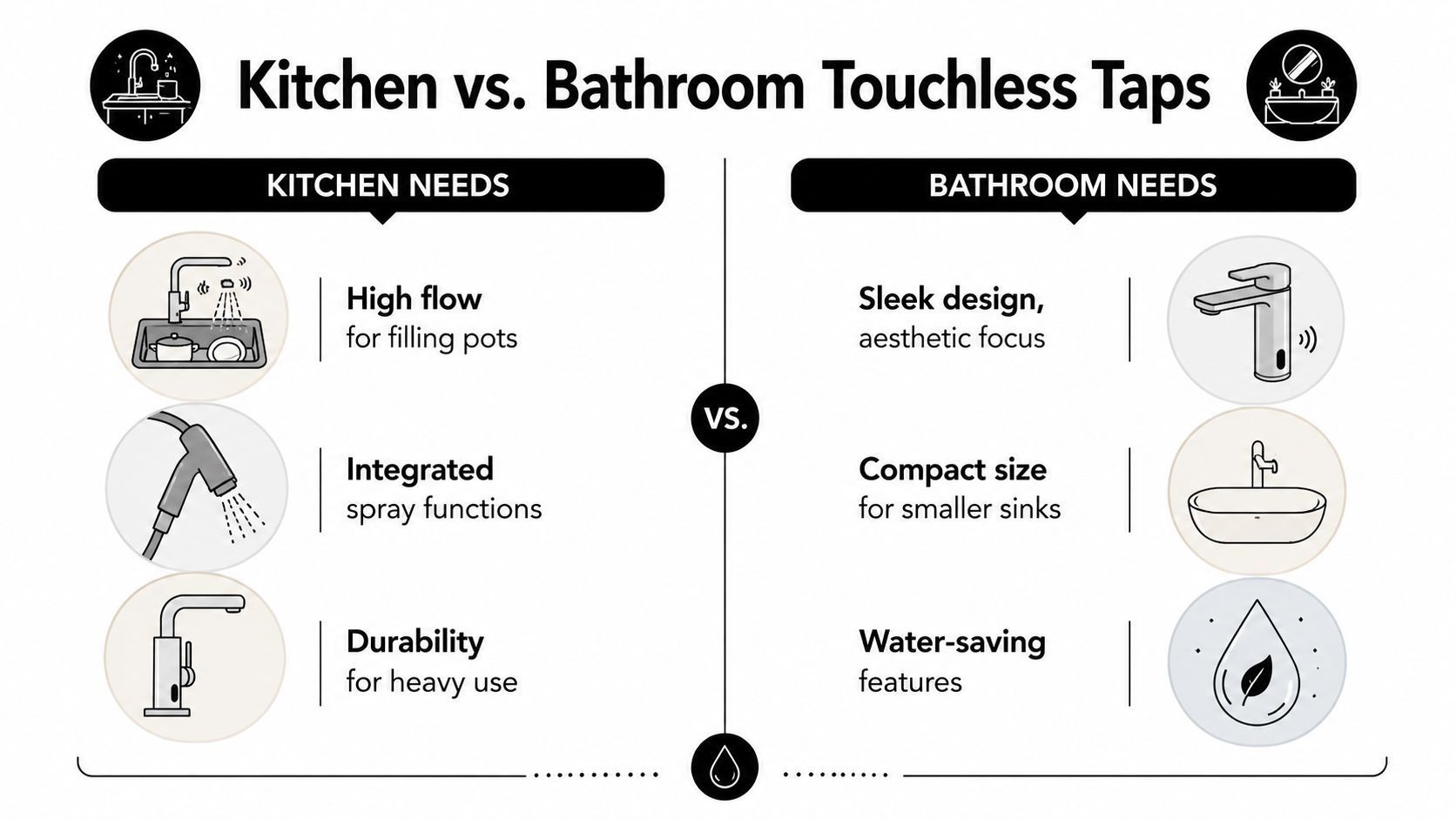
A kitchen tap does more than handwashing. It fills pasta pots, rinses fruit, washes roasting trays, and deals with greasy pans. That means the tap usually needs more reach, more clearance, and a more forgiving activation pattern.
Look for these traits in a kitchen model:
- Higher spout clearance: Better for large cookware, chopping boards, and awkward washing-up.
- Useful reach into the bowl: Water should land near the working centre of the sink, not too close to the back edge.
- Manual override or easy control: Handy for longer filling tasks where you don't want the flow interrupting.
- Spray functionality where relevant: Some households love a pull-down sprayer. Others prefer a simpler body with fewer moving parts.
Kitchen taps also live in a rougher environment. Steam, splashes, detergent residue, and constant use all test the finish and internal parts.
What a bathroom tap needs instead
A bathroom tap has a narrower job. It's mostly about handwashing, face washing, cleaning the basin, and occasional grooming tasks. That usually means the best bathroom touchless tap is simpler than the best kitchen one.
A bathroom model should prioritise:
| Need | Why it matters |
|---|---|
| Compact proportions | Small basins don't suit bulky tap bodies or overlong spouts |
| Predictable activation | Quick on and off matters more than advanced functions |
| Clean looks | The basin area is highly visible, so design matters more |
| Easy wipe-down surfaces | Soap splash and toothpaste residue build up fast |
For a bathroom, I'd usually pick calm, predictable performance over extra features.
One tap style doesn't fit every room
A common mistake is buying a bathroom-style sensor tap for a kitchen because it looks sleek. It may look great in the box and become annoying on day two. Low spout height, short reach, and touchy activation can make normal kitchen jobs harder.
The opposite happens too. A large, commercial-looking kitchen tap can overpower a small vanity and splash water around a shallow basin.
If you're comparing models for both spaces, this guide on the best automatic sensor tap for an Australian bathroom or kitchen is useful because it frames the decision around room type rather than trend language.
In kitchens, capacity matters. In bathrooms, control matters. Start there and the shortlist gets much shorter.
Finish is worth a thought too. In family homes, brushed finishes often hide water spotting and fingerprints better than highly reflective ones. In guest bathrooms, appearance may matter more than heavy-duty performance. In the main kitchen, I'd reverse that priority.
The Real Benefits Hygiene Water and Energy Savings
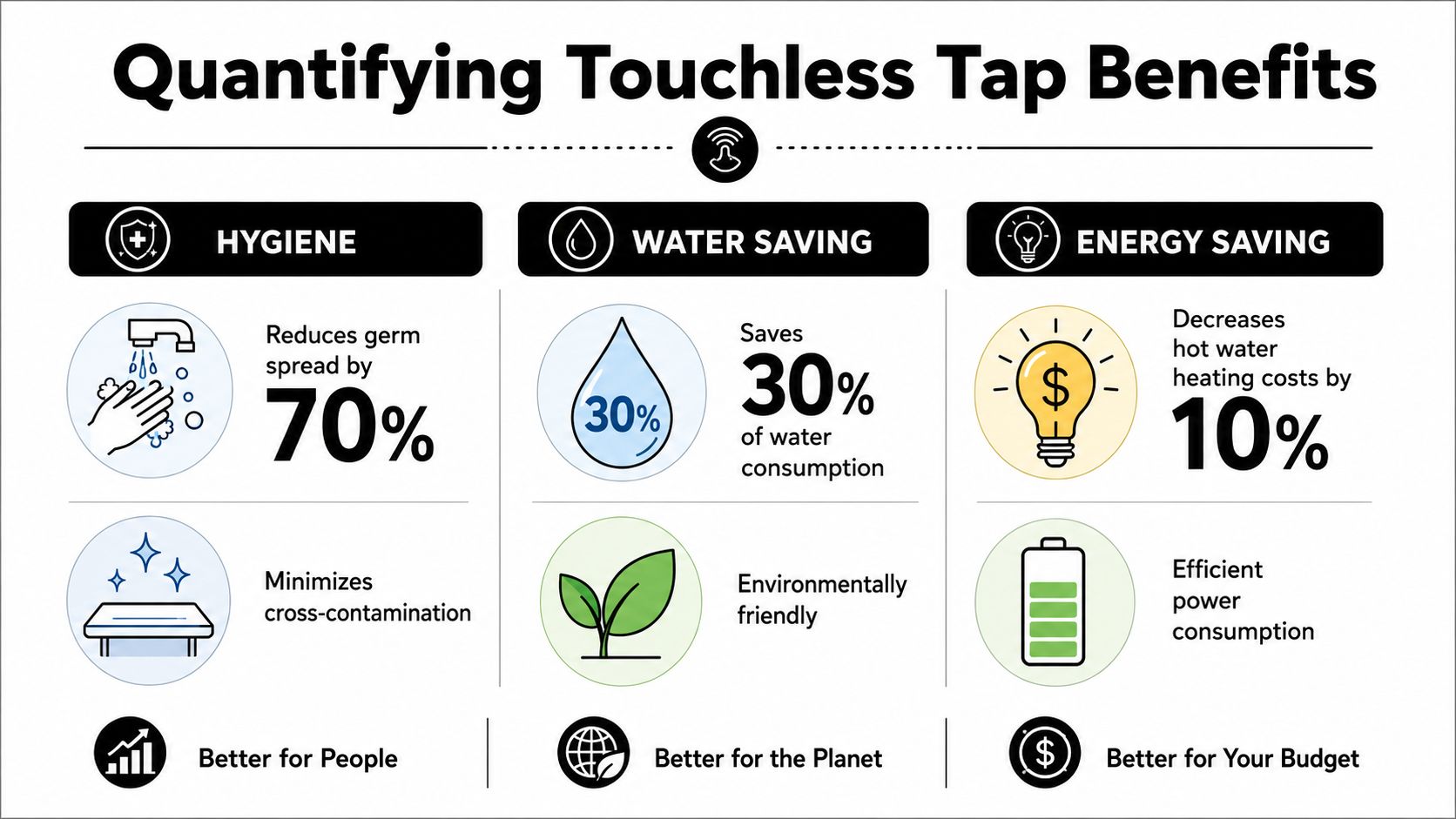
The strongest case for touchless taps isn't that they feel modern. It's that they solve three everyday problems at once: hygiene, water waste, and unnecessary hot water use.
Hygiene is the obvious win
The less you touch a tap, the fewer chances there are to transfer whatever is already on your hands back onto the fixture. In busy households, that matters more than people think. Bathroom taps get touched before washing. Kitchen taps get touched mid-cooking, mid-cleaning, and while handling raw ingredients.
The practical result is simpler than any marketing promise. The tap body stays cleaner, and the area around it is easier to manage.
This is especially useful in homes with children, older relatives, or anyone who values a more accessible setup. If you've ever tried to help someone wash their hands while juggling a towel, soap, and toothbrush clutter, you know how useful hands-free operation can be.
Water savings come from one simple behaviour
People leave manual taps running. They do it while soaping hands, turning to grab a sponge, or getting distracted at the sink. A touchless tap cuts that waste by switching off when it's no longer needed.
In public and commercial buildings, touchless faucets reduce water consumption by approximately 30% to 50% compared to manual faucets, and average use time drops from 10 seconds per use to 3 to 5 seconds, producing up to 50% water savings per use, according to Fontana's summary of touchless versus manual faucet performance.
That's commercial data, not a promise for every house. But the logic carries across neatly. Automatic shutoff removes the most common source of waste, which is human forgetfulness.
Less hot water wasted often means less energy wasted
If less water runs unnecessarily, less hot water gets heated and sent down the drain. That's one reason these taps can make sense in renovations focused on efficiency, especially when homeowners are already thinking about under-sink systems, filtration, or boiling water units.
For people planning a broader upgrade, it can help to compare fixture choices together rather than one by one. This article on whether a boiling water tap is more energy efficient than a kettle in Australia is a good example of how water and energy decisions often connect.
If you're still in planning mode, some homeowners also use AI tools for bathroom design to test layouts, finishes, and tap proportions before buying. That can be handy when you're trying to decide whether a sleeker sensor model suits a compact vanity or whether the basin needs a different shape first.
The biggest savings usually don't come from a clever feature. They come from stopping water flow the moment you stop needing it.
Installation and Retrofit Considerations for AU Homes
The best time to think about installation is before you fall in love with a tap. Not after.
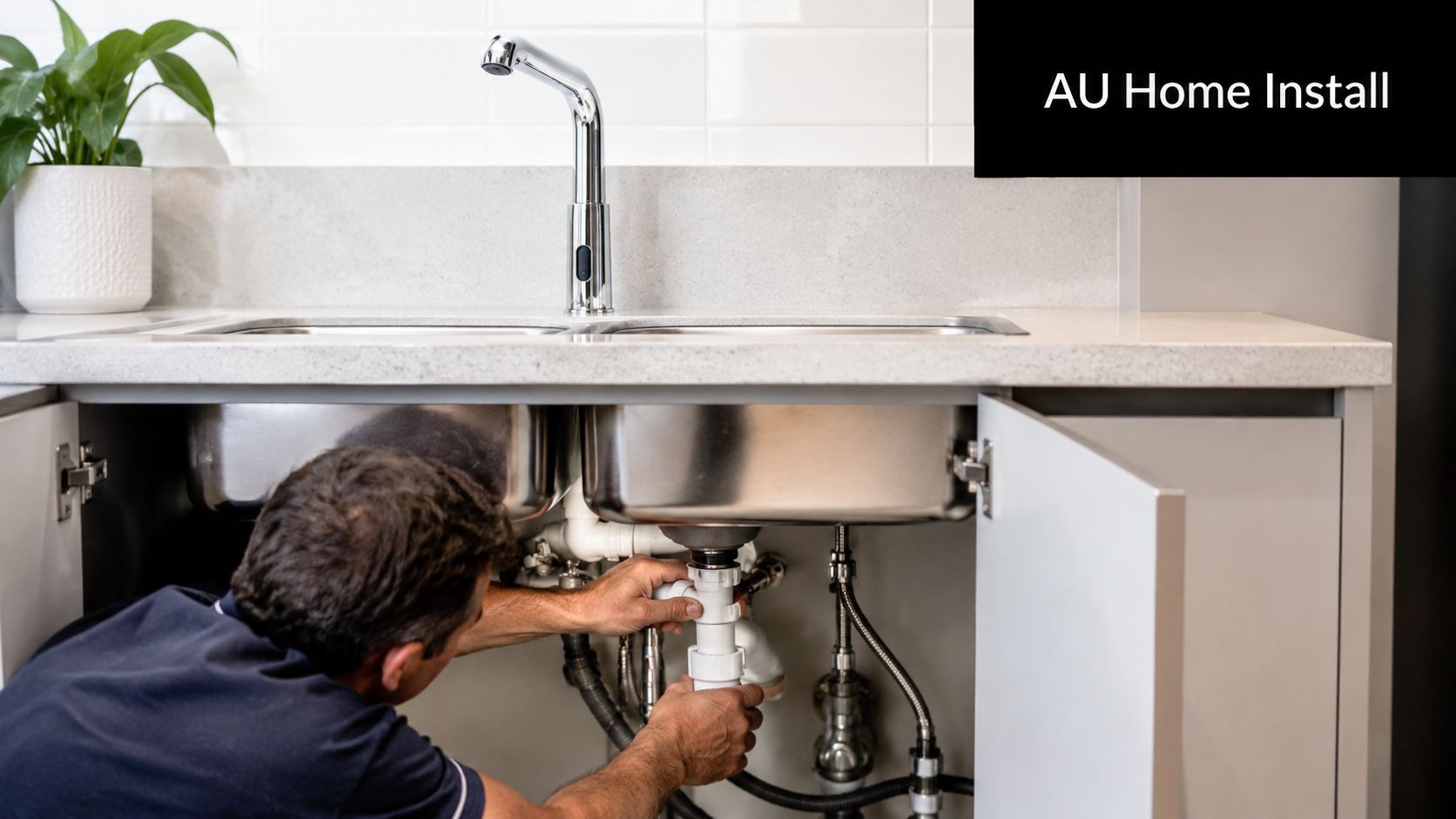
A touchless model asks more from the space under your sink than a basic mixer tap. You need room for the control box, room for the power setup, and sensible access for future servicing. In Australian homes, that becomes even more important because under-sink spaces are often already crowded with traps, shut-off valves, bins, filters, and sometimes compact water appliances.
Start with a pre-purchase checklist
Before buying, check these points.
- Cabinet space: Make sure there's physical room for the solenoid, controller, and any battery pack.
- Access for servicing: If a plumber can't comfortably reach the parts later, a small fault becomes an annoying job.
- Sink hole compatibility: Some replacements are straightforward. Others need a different mounting arrangement.
- Nearby equipment: Filters, chillers, boiling units, and waste systems can compete for space.
This matters in kitchens more than bathrooms, but both can get cramped fast.
Battery or mains power
This is one of the first practical decisions.
Battery power usually suits retrofits. If you're replacing an existing tap in an established home, batteries avoid the extra work involved in adding power to the cabinet. For many homeowners, that convenience is enough reason to choose it.
Mains power suits bigger renovations or new builds where the cabinetry and services are already being planned. It can be tidier long term because you won't need to think about battery replacement, but it needs proper coordination early.
Neither option fixes a poor tap design. It only changes how the system is powered.
Australian plumbing realities that guides often skip
Melbourne homes are not all the same. A detached brick veneer house with stable pressure behaves differently from an inner-city apartment tower. That matters because sensor taps depend on predictable flow.
A 2024 Sustainable Water AU study on Melbourne high-rise touchless taps found that 38% of touchless taps in Melbourne high-rises deliver inconsistent flow during peak hours due to low domestic pressure, triggering false shut-offs. If you live in a multi-unit building, don't ignore that.
Ask these questions before you buy:
- Does the tap tolerate pressure fluctuation well?
- Is it recommended for apartments or high-rise installations?
- Can the installer add a pressure-management solution if needed?
- Are replacement parts readily available in Australia?
In an apartment, a touchless tap can be perfectly good and still feel faulty if the building's pressure drops at the wrong times.
Compatibility with other under-sink systems
Many nice renovation ideas collide under the cabinet.
If you're also planning under-sink filtration, instant chilled water, or a boiling water setup, don't treat the touchless tap as a standalone item. Check hose routing, power access, and whether the chosen tap body and controls will interfere with nearby equipment. The more compact the cabinet, the more important that planning becomes.
A kitchen with multiple under-sink systems can work beautifully, but only if someone maps the space properly. Otherwise, future servicing becomes awkward, and that's when homeowners start regretting “smart” upgrades that should have been simple.
For older homes, I'd also check the condition of the isolation valves and flexible hoses while the tap is being changed. It's a small decision that can prevent a callback later.
Maintenance Troubleshooting and Costs
The fear most homeowners have is straightforward. What if the sensor stops working and I'm left with an expensive tap that acts like a moody robot?
That can happen, but most issues are more ordinary than that. A touchless tap is still plumbing hardware. It just has a few extra components that need sensible care.
The common issues are usually predictable
When a touchless tap misbehaves, the causes are often simple:
- Sensor not responding: Check whether the sensor window is dirty or blocked.
- Water turns on unexpectedly: Reflective surfaces, clutter near the sensor, or incorrect placement can trigger false activation.
- Weak or inconsistent flow: This may be a filter, valve, or pressure issue rather than a sensor problem.
- Intermittent operation: Power supply issues are often the first thing to check.
Most of those problems don't mean the tap is a bad product. They mean the system needs cleaning, adjustment, or a proper diagnosis.
Melbourne climate matters more than many buyers realise
Humidity is a real issue for electronics under sinks, especially in kitchens where steam, splashes, and poor cabinet ventilation are common. This is one of the least discussed parts of touchless tap ownership in Australia.
A 2025 Australian Plumbing Industry Council report discussed in this touchless faucet reliability article notes that 42% of touchless faucet failures in Australian homes occur within 18 months due to moisture ingress. That's why I'd always look for sealed electronics and locally available spare solenoids if the tap is going into a Melbourne home.
What to look for before buying
A practical shortlist should include:
- Sealed electronic housing: Better protection against moisture exposure.
- Accessible spare parts: Solenoids, sensors, and controllers shouldn't be impossible to source.
- Local servicing support: If something fails, you want a plumber who can source the part.
- Straightforward manual operation if available: Useful when diagnosing problems.
Choose the tap you can repair, not just the tap that looks good on launch day.
If you're already reviewing an older kitchen or bathroom before renovation, broad comprehensive plumbing inspection tips can help you spot surrounding issues that might affect tap performance, such as valve condition, corrosion, drainage layout, or poor access under the sink.
Costs are best viewed as ownership, not just purchase price
The upfront cost for a touchless tap is higher than for a standard mixer. That part is obvious. The more useful question is what the tap costs to own over time.
If the model is reliable, suits your plumbing conditions, and avoids unnecessary water waste, it can justify itself. If it's poorly matched to a humid cabinet, a high-rise pressure problem, or a cramped retrofit, it can become a nuisance. That's why I'd rather see a homeowner buy a slightly simpler, serviceable model than an overcomplicated one with hard-to-find parts.
Maintenance itself is usually modest. Keep the sensor area clean, replace batteries when required, and deal with small performance issues early instead of waiting for a complete failure.
Finding Your Perfect Tap with Ring Hot Water
The best touchless tap bathroom kitchen choice usually comes down to four decisions. Is it for a kitchen or a bathroom. Is the under-sink space generous or cramped. Is battery or mains power more realistic. And will the tap play nicely with the rest of your plumbing and any under-sink gear you already have.
That local detail matters. A tap that looks excellent online may be wrong for a Melbourne apartment, a humid family kitchen, or a renovation where filtration and specialty water systems already need cabinet space. Good advice saves more frustration than glossy features ever will.
Design still has a place in the decision. If you're renovating or building and want a broader sense of what people are choosing now, these latest design insights for home builders are a useful reference for seeing how fixture choices fit into the wider home, not just the sink zone.
From a value point of view, the long-term case is solid when the setup is chosen properly. In Australia, facility managers using touchless faucets report annual water cost savings averaging 12% and payback periods of 2 to 4 years, driven by automatic shutoff preventing user negligence, according to Market Intelo's touchless faucet market report. Residential outcomes vary, but the principle is the same. Match the tap to the space, install it properly, and it can be both convenient and economical.
A homeowner doesn't need the fanciest model. You need one that fits your sink, your habits, your plumbing, and your climate.
If you want help choosing a touchless tap that suits a Melbourne home, Ring Hot Water can help with practical advice, compatible products, genuine spare parts, and professional installation support. Whether you're upgrading a kitchen, refining a bathroom, or planning around filtration, chilled, or boiling water systems, their team understands the local plumbing realities that generic online guides often miss.

