
Automatic Taps
How Do Automatic Taps Work? A Complete Explainer

May
You’re probably here because you’ve used one. You place your hands under the spout, water starts instantly, and when you pull away it stops without a twist, press, or lever. In a home kitchen it feels tidy. In an office, café, or public washroom it feels normal. But a lot of people still wonder the same thing once the novelty wears off.
How do automatic taps work?
The short answer is that they’re not magic at all. They’re a small control system built into a tap body. A sensor looks for your hands, a valve opens the water, electronics decide when that should happen, and a power source keeps the whole thing alive. That’s the simple version. The useful version is understanding what each part does, why these taps sometimes misbehave, and what changes when that same touchless idea is built into a boiling or chilled water setup.
That practical side matters in Melbourne. Homeowners want something that feels effortless every day. Office managers want fewer wasted litres and fewer complaints from staff. Hospitality venues need reliability during busy service, not a clever fitting that stops working after steam, splashback, and scale have had their way with it. Tradespeople want to know which part usually fails first and whether it’s worth repairing.
This guide explains the mechanics in plain language, then moves into the practical issues most basic articles skip. That includes calibration, maintenance, sensor contamination, solenoid wear, and how touchless controls fit into under-sink hot and cold systems.
The Everyday Magic of a Touchless Tap
Early on a busy Melbourne morning, a staff member rinses their hands between tasks, steps away, and the water stops by itself. In a family kitchen, the same thing happens while someone handles raw food and does not want to touch a lever with messy fingers. That small moment feels almost automatic in the everyday sense of the word. The clever part is how much coordination is hidden inside the tap body and under the sink.
A touchless tap feels easy because each step happens in fractions of a second. The sensor checks a small target area under the spout. The electronics decide whether the signal matches a hand in range. The valve opens, water flows, and then shuts off once your hands leave. When all of that is calibrated properly, the tap feels polite and predictable rather than fussy.
The sensing area is narrow and close to the outlet, more like a marked hand-washing zone than a room-wide motion detector. That is why a well-set tap can ignore someone walking past but respond quickly when hands move into the right spot. If the zone is set too long, too short, or partly blocked by splashback and mineral film, the tap starts to seem temperamental even though the basic mechanism is straightforward.
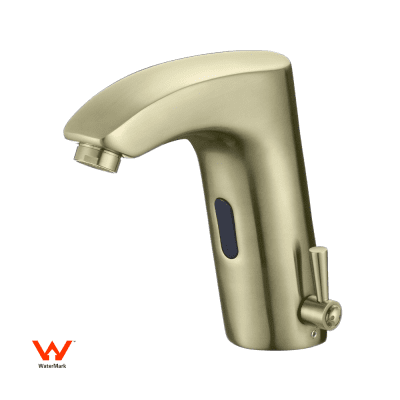
That precision is what makes these taps useful in places where water, hygiene, and reliability all matter. In our work at Ring Hot Water, the interesting part is not only how the tap starts and stops flow. It is how that touchless control behaves once you connect it to real plumbing conditions, under-sink filtration, boiling and chilled units, hard water, cleaning chemicals, and the daily wear you get in homes, offices, and hospitality venues across Melbourne.
A common assumption when a sensor tap misbehaves is that the sensor has failed. Sometimes that is true. Just as often, the problem sits elsewhere. Flat batteries, a dirty lens, a sticking solenoid, poor alignment, low power, or scale around the outlet can all produce the same symptom from the user’s point of view.
Treating the tap as a compact system makes faults much easier to diagnose and repairs much more sensible. That is where the everyday “magic” disappears in a good way. Once you know which part is detecting, which part is deciding, and which part is physically opening the water path, the behaviour of the tap starts to make practical sense.
The Four Core Components of Every Sensor Tap
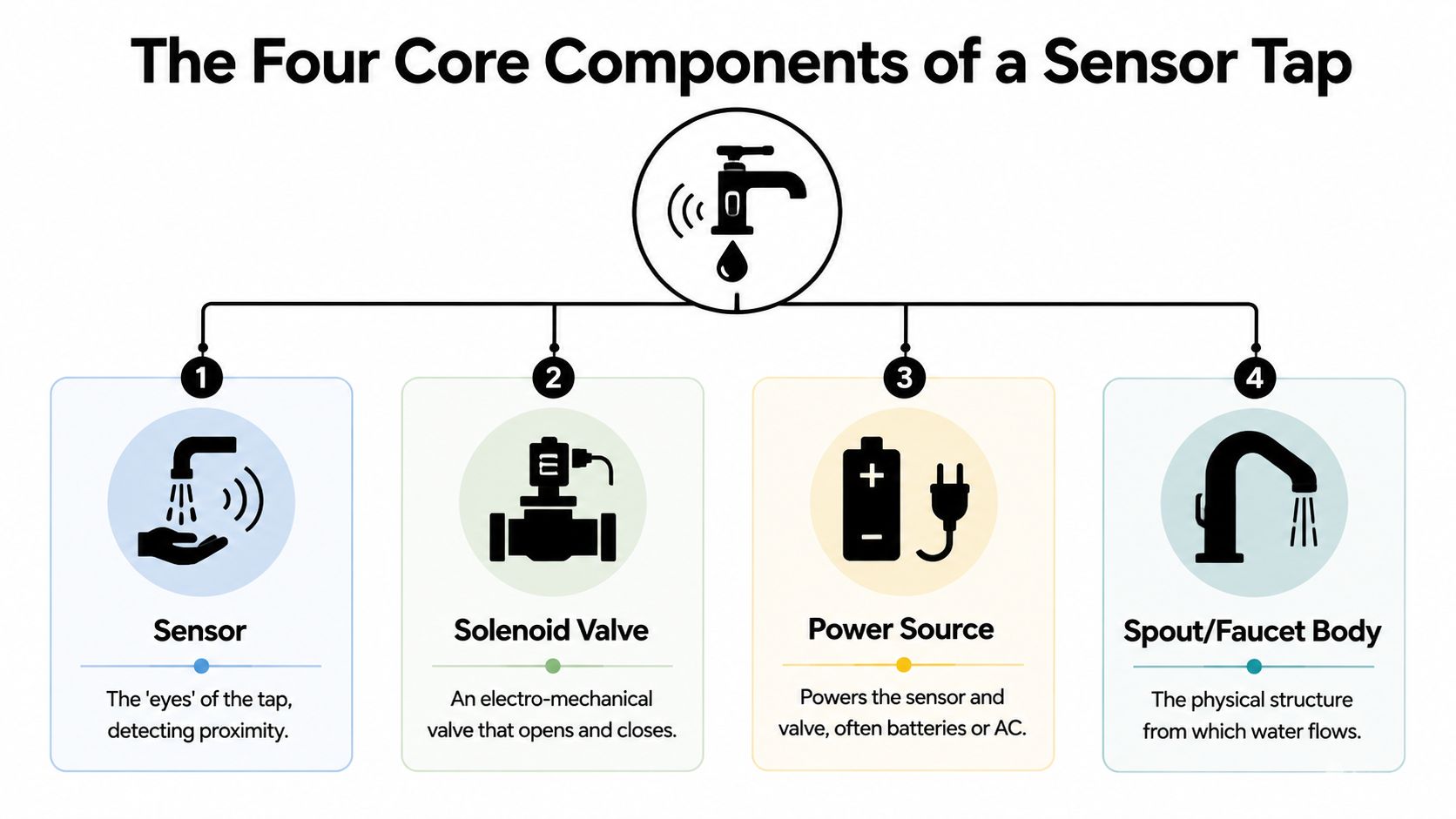
A sensor tap only feels mysterious until you split it into parts. Under the spout and below the basin, the same four pieces show up again and again. One detects your hands, one interprets the signal, one opens the water path, and one provides power.
The sensor
The sensor is the part that watches the hand-washing zone. In most models, it sends out invisible infrared light in a repeating pattern and checks whether that light returns after your hands move into range.
That is why response can feel quick without being random. The tap is not reacting to touch or room movement. It is reading a very local change in reflected light beneath the spout.
A useful way to picture it is a narrow beam checking a small patch of space over and over. Once your hands interrupt that pattern and reflect the signal back correctly, the tap has the first piece of information it needs.
The control electronics
The control electronics process that signal and decide whether the tap should run. In our service calls, this is one of the most overlooked parts because it sits out of sight, yet it has a big influence on how refined the tap feels day to day.
Good electronics filter out stray reflections and brief interruptions, so the tap responds to hands rather than to splashes, cloths, or awkward movement near the basin. They also manage timing, such as delay settings and automatic shut-off. That matters in Melbourne workplaces and hospitality settings where a tap may be used hundreds of times a day and may also be connected alongside filtration, boiling, or chilled water hardware under the sink.
The solenoid valve
The solenoid valve does the physical work of starting and stopping the water flow. It is the gatekeeper in the pipework.
This is a point that clears up a lot of confusion for customers. The sensor does not open the water path itself. It reports a signal. The controller approves it. Then the solenoid valve moves and allows water to pass.
Many better-quality installations use magnet-latching solenoid valves. These valves use a short burst of power to open and another short burst to close, instead of drawing power the whole time water is running. In practice, that can mean better battery life and fewer nuisance faults, especially in busy commercial bathrooms where reliability matters more than novelty.
The power source
The power source keeps the whole system alive. Depending on the tap, that may be a battery pack or mains power through a transformer.
Power faults often masquerade as sensor faults. A weak battery or unstable power supply can cause slow response, intermittent operation, or a valve that clicks but does not open properly. That is one reason Ring Hot Water technicians test methodically during fault-finding, especially on installations that share cupboard space with chilled or boiling water units, filters, and other electrical components.
How the four parts work together
The sequence is straightforward once you name each job:
- The sensor checks the space under the spout.
- Your hands reflect the infrared signal in the expected zone.
- The controller verifies that the reading is valid.
- The solenoid valve receives the command to open.
- Water runs until your hands leave or the timed shut-off steps in.
If you ever need to diagnose a misbehaving tap, work through those steps in order. Did it detect your hands? Did the electronics process that input correctly? Did the valve move? Did the unit have stable power?
That approach saves time because it treats the tap as a working system, not a single mystery part. It also matches real-world maintenance. On Australian installations, especially where water quality, scale, cleaning chemicals, and under-sink appliances all come into play, the fault is often less dramatic than it first appears.
How a Sensor Tap Detects Your Hands
You walk up to a tap in a Melbourne office kitchenette, hold your hands under the spout, and the water starts almost at once. No handle turns. No button clicks. The tap is watching a very small space and waiting for the right signal.
In most sensor taps, that signal comes from infrared light. The tap sends out a short-range beam beneath the spout. When your hands enter that zone, some of that light reflects back to the sensor. The electronics read that reflection and decide whether a real hand is present in the wash area.
The important part is location. A sensor tap is not scanning the whole room for movement. It is checking a tight pocket of space near the outlet, where hands should normally be placed for washing. That is why a person walking past usually does nothing, while hands held in the right spot trigger a response.
The invisible detection zone
The active zone is deliberately small. That helps the tap avoid false triggers from people passing by, cleaning cloths near the basin, or items left on the bench.
In practice, the exact detection area depends on the tap model, the spout shape, the basin depth, and how the unit was set up during commissioning. A shallow basin and a highly reflective bowl can change how the sensor reads the return signal. So can mirrored splashbacks, strong sunlight, steam, and residue on the sensor window.
That is one reason Ring Hot Water technicians do not treat sensor faults as pure electronics problems. A tap can have a working sensor and still behave poorly if the zone is aimed badly, the lens is dirty, or the surrounding surfaces are confusing the reading.
Why hand position matters
Users often describe a sensor tap as temperamental when hand placement is the issue. If your hands are too low, too far forward, or off to one side, the reflected signal may fall outside the range the tap expects.
A well-set tap should feel easy to use. You place your hands under the spout in a natural washing position, and it responds. If users need to wave around to find the trigger point, the unit usually needs cleaning, adjustment, or a closer inspection of parts such as the automatic tap solenoid and control assembly.
Sensor Technology Comparison
| Technology | How It Works | Pros | Cons |
|---|---|---|---|
| Infrared | Emits invisible light and reads the reflected signal from nearby hands | Common in Australian installations, precise at close range, adjustable in many models | Lens contamination or poor calibration can affect detection |
| Ultrasonic | Uses sound-based detection instead of light | Can suit some high-traffic or precision-focused environments | Less common in Australian installations and may not be the first choice for every retrofit |
| Capacitive | Detects changes associated with nearby objects rather than reflected light | Can be useful in some specialised designs | Not the standard setup discussed in most tap servicing work |
Why calibration matters
Calibration is the difference between a tap that feels natural and one that frustrates everyone using it.
Installers can often adjust sensitivity so the sensor suits the actual basin, not just the bench test at the factory. In homes and businesses with under-sink boiling or chilled units, space can be tight and services can be crowded. That makes proper setup more important, because wiring routes, mounting positions, and nearby equipment all affect access for later servicing.
Poor calibration usually shows up in familiar ways:
- Too sensitive and the tap starts when someone reaches near the sink.
- Not sensitive enough and people keep shifting their hands to find the live spot.
- Poorly aligned and the water only starts in an awkward position that does not match normal use.
What affects performance over time
Sensor taps work in tough conditions. They sit near soap, hard water deposits, splashback, steam, food prep mess, and strong cleaning products. In Melbourne homes, cafés, and office kitchens, those day-to-day conditions often explain more faults than component failure does.
A thin film on the sensor lens can weaken the reflected signal. Mineral build-up can alter how the light behaves around the spout. Even basin replacement can change performance if the new bowl reflects differently from the old one.
So the short answer to how automatic taps detect your hands is simple. The tap sends out a short infrared signal and waits for it to bounce back from your hands. The longer, more useful answer is practical. Detection depends on clean surfaces, correct calibration, suitable basin geometry, and careful installation alongside the rest of the water system.
From Signal to Flow The Solenoid Valve in Action
You hold your hands under a sensor tap, the sensor recognises them, and then one small part has to do the hard physical job of letting water through. That part is the solenoid valve.
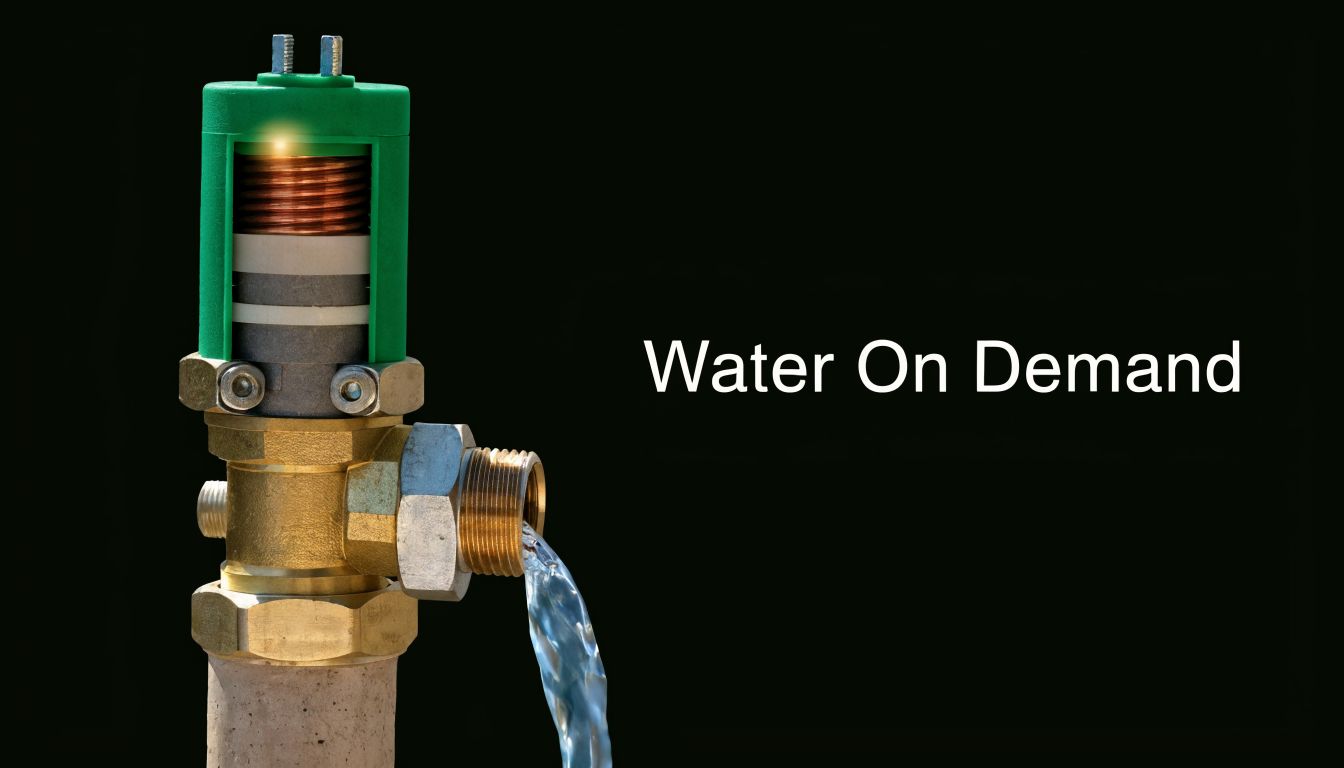
The part that actually opens the water path
Inside the valve is a coil and a moving plunger. When the tap’s controller sends power to the coil, it creates a magnetic field. That magnetic pull shifts the plunger, and the water path opens. When power is removed, or reversed in some designs, the valve returns to its closed position.
A good way to picture it is a door latch released by an electric signal. The sensor and control board decide when water should run. The solenoid valve is the part that turns that decision into flow at the spout.
In day-to-day service work around Melbourne, this distinction matters. A tap can detect hands perfectly and still deliver no water if the valve is stuck, blocked, or no longer actuating properly.
Why latching valves matter in real installations
Many modern sensor taps use latching solenoids rather than older continuously powered designs. A latching valve needs a short pulse to open and another pulse to close, instead of drawing power the whole time water is running.
That helps battery-powered taps last longer, but it also affects fault-finding. If a latching valve misses its closing pulse, or if the plunger is slowed by scale or debris, the symptom can look strange. The tap may run longer than expected, fail to start cleanly, or behave inconsistently from one use to the next.
This is one reason Ring Hot Water technicians often check the valve early, especially in kitchens and staff areas where the tap may be paired with busy under-sink equipment and limited service space. If you are matching a failed part to an existing unit, automatic tap solenoids are a specific spare category worth checking carefully against the original setup.
What usually goes wrong at valve level
The solenoid valve sits right in the path of real water conditions, not ideal laboratory ones. In Australian installations, that often means mineral deposits, fine debris from the line, ageing seals, or wear from frequent cycling.
Those problems often show up in practical, recognisable ways:
- Tap won’t open even though the sensor responds
- Tap won’t shut off cleanly because the valve cannot seal properly
- Flow pulses or weakens because internal movement is restricted
People often get tripped up on this point. A sensor tap feels electronic from the outside, so a fault is often blamed on the sensor first. In practice, many “smart tap” issues come back to a mechanical restriction in the valve body or a worn internal seal.
A quick visual explanation of solenoid action helps if you’ve never seen one operate:
The key point is simple. The sensor starts the process, but the solenoid valve is the component that physically allows water to move. That is why maintenance, water quality, and correct replacement parts matter just as much as the electronics.
Integrating Sensor Tech with Boiling and Chilled Water Systems
A standard bathroom sensor tap is only part of the story. In kitchens, offices, staff rooms, and hospitality setups, touchless control often sits alongside filtered drinking water, chilled water, or under-sink boiling units. That’s where the conversation gets more interesting, because the tap is no longer just opening cold or tempered supply to wash hands.
The tap is only one part of the system
In an integrated setup, the visible tap on the benchtop is really the user interface. The actual work happens across several connected parts:
- The spout assembly manages how water is dispensed at the point of use.
- The under-sink unit heats, chills, or filters water before delivery.
- The controller helps coordinate user input and dispensing logic.
- The plumbing connections keep separate water paths organised where needed.
That changes the design priorities. A handwashing tap mainly needs reliable detection and shut-off. A boiling or chilled water point also needs safe dispensing behaviour, clean routing, and compatibility with the appliance below the sink.
Safety changes the design
Boiling water introduces a different level of risk. A casual wave-under-the-spout design that works fine for ordinary handwashing isn’t enough on its own when the outlet may supply near-boiling water. For that reason, integrated systems need extra safety logic and hardware choices that suit the job.
In practice, that means installers and specifiers need to think beyond “Does the sensor work?” The better questions are:
- What water type is being controlled
- What prevents accidental dispensing
- How does the tap communicate with the under-sink unit
- What maintenance access is available later
These are the questions that usually decide whether the system feels tidy and dependable or awkward and fragile after a few months of use.
In integrated hot and cold systems, the smartest-looking tap can still be the wrong choice if servicing the under-sink components becomes difficult.
The information gap buyers run into
Many online guides offer incomplete information. There’s a clear gap in available content on how sensor taps integrate with boiling or chilled water units, and there’s little useful comparison of energy efficiency or return on investment for businesses choosing between manual and sensor-activated boiling water points. That gap makes purchasing harder for offices, cafés, and facilities teams trying to compare practical outcomes rather than just appearance.
For background on this broader topic, Ring Hot Water’s automatic sensor tap guide sits closer to an actual product ecosystem than a typical bathroom-only explainer.
What matters in homes and commercial sites
For a Melbourne homeowner, the appeal is usually convenience, bench space, and cleaner operation around the sink. For an office manager, it may be hygiene and easier staff use around a filtered chilled and boiling unit. In hospitality, the emphasis often shifts to repeatable performance and easier cleanup during service.
The touchless element can still be valuable in all three settings, but the right tap depends on the system around it. A well-chosen integrated setup should make the user’s job simpler without making the technician’s job harder when the time comes to replace a cartridge, check a connection, or access a control box.
That’s the part worth remembering. Sensor technology isn’t separate from the rest of the water system. In a kitchen, it has to live with the plumbing, the appliance, the filtration, and the safety requirements.
Troubleshooting Common Automatic Tap Problems
You walk up to the sink with wet hands, expecting the tap to react instantly, and nothing happens. Or the opposite happens. Water keeps running after your hands are gone. At Ring Hot Water, those are two of the most common service calls we see, especially on taps connected to busy kitchen and workplace systems where a small fault becomes obvious fast.

A sensor tap works a bit like a relay team. The sensor detects. The controller decides. The solenoid opens or closes. The plumbing delivers the water. Troubleshooting gets easier once you work out which runner dropped the baton.
Many faults are simpler than they look. The tap body may appear intelligent, but common problems usually come back to four practical causes our technicians check first: power, sensor visibility, valve movement, or restricted water flow.
The tap won’t turn on
Start with the basics under the sink before assuming an internal electronic failure.
If the tap is completely unresponsive, check whether it has power. Battery models often give warning signs first. The response may become slow, intermittent, or shorter than usual before the batteries go flat.
Next, inspect the sensor lens. A thin film of grease, detergent residue, or mineral spotting can block detection in the same way a smudged pair of glasses makes it harder to see clearly.
Work through this order:
- Check the power source. Replace batteries or confirm the mains transformer is switched on and connected.
- Clean the sensor lens gently. Use a soft cloth only.
- Confirm the isolation valve is open. A healthy sensor cannot produce flow from a closed supply.
- Inspect visible cables and plugs. Under-sink movement, stored items, or cleaning can loosen connections.
If the sensor light reacts but no water comes through, the problem often shifts away from detection and toward the valve or water supply.
The tap won’t shut off
A tap that keeps running can look like a sensor fault, but the valve is often the main culprit.
Here is the useful split our technicians make on site. If the tap still responds sensibly to hand movement but struggles to stop, the solenoid may be sticking or blocked by debris. If the tap activates at odd times or stays on with no clear trigger, the sensor window, reflections, or sensitivity settings deserve closer attention.
Reflections catch people out more often than expected. A glossy splashback, a polished sink rim, or even strong task lighting can bounce the infrared signal back toward the sensor and make the tap behave as if a hand is still present.
The flow is weak
Weak flow is usually a water path problem, not a sensor problem.
The easiest comparison is a torch with good batteries but a blocked lens. The power is there, but the output is restricted. On a tap, that restriction is often in the aerator, the valve inlet, or the supply line.
Check these points:
- Aerator blockage. Scale and grit at the outlet can reduce flow quickly.
- Partially closed isolation valves. This is common after recent plumbing work.
- Debris inside the solenoid or inlet filter. Small particles can limit flow without stopping it completely.
- A system-side restriction. On taps paired with filtered, chilled, or boiling units, the under-sink appliance or filter may be limiting delivery.
Our customers often spend time suspecting the sensor because the tap still feels “automatic.” In practice, weak flow usually needs a plumbing check first.
The tap turns on by itself
Self-activation usually has a plain explanation.
In Melbourne kitchens and staff rooms, the repeat offenders are sensor film, water spotting, splashback near the spout, and nearby reflective surfaces. In commercial settings, frequent wipe-downs can also nudge a sensor out of position or leave residue across the lens.
Common triggers include:
- A dirty or scaled sensor lens
- Sensitivity set too high
- Reflections from nearby surfaces
- Steam, splashing, or bench clutter entering the detection zone
If the tap is part of a branded filtered or boiling water setup, model-specific replacement parts also matter. Using the wrong valve or sensor component can create odd behaviour that looks like an electrical fault. For compatible replacements, Zip spare parts in Australia are worth checking before a technician ends up correcting an earlier mismatch.
When DIY is reasonable and when it isn’t
First-line checks are reasonable for a homeowner, office manager, or facilities staff member. Cleaning the lens, changing batteries, checking the aerator, and confirming the water supply is on are all low-risk tasks.
Bring in a licensed professional if:
- The tap needs electrical testing
- The solenoid may need removal or replacement
- The unit is connected to boiling or chilled water equipment
- There is a leak inside cabinetry or around the control box
- The sensor needs recalibration beyond the product instructions
A simple field routine
Use a consistent order and the fault usually becomes clearer.
- Clean the lens and outlet
- Check power
- Check water supply
- Watch whether the sensor detects your hands
- Test for valve or flow restriction only after the basics are ruled out
That sequence mirrors how Ring Hot Water technicians approach many service visits. It reduces guesswork, avoids random part replacement, and helps separate a detection problem from a delivery problem quickly.
Installation Maintenance and Sourcing Spare Parts
A sensor tap can be easy to use and still require careful installation. That’s especially true once you move beyond a simple basin tap and into systems connected to filtration, chilled supply, or under-sink boiling units.
When installation is straightforward and when it isn’t
Some tap replacements are mechanically simple. If the model suits the existing cut-out, the power arrangement is clear, and the plumbing connections are standard, the job may look uncomplicated on paper.
But there’s a big difference between fitting a basic unit and commissioning one properly. The sensor needs the right position. The control box needs sensible placement. Cables and hoses need protection from moisture and pinch points. If the tap is part of an integrated boiling or chilled setup, professional installation becomes much more important because the system includes more than one appliance and often tighter safety requirements.
The maintenance habits that prevent headaches
Most automatic tap issues don’t start with catastrophic failure. They start with neglect.
A simple routine helps:
- Clean the sensor lens so residue and mineral film don’t interfere with detection.
- Check the aerator if flow changes or spray becomes uneven.
- Watch for response delays that may suggest weakening power or early component wear.
- Inspect under-sink connections for moisture, movement, or obvious damage.
- Reassess calibration if the tap begins triggering awkwardly in a busy environment.
None of that is glamorous, but it’s cheaper and less disruptive than waiting for a full fault.
Choosing the right spare part
The good news is that many sensor tap components are replaceable. Solenoid valves, power packs, hoses, fittings, and some control components can often be sourced without replacing the entire tap. The hard part is matching the part correctly to the model and application.
That’s why product identification matters. Brand, series, installation type, and the exact symptom all help narrow down the right part. If you’re working across Zip, Stiebel Eltron, Boiling Billy, Insinkerator, Birko, or other commercial hot water equipment, it also helps to start with a supplier that already deals in model-specific components. For broader parts support, Zip spare parts in Australia is one example of the kind of category trades and facilities teams often need when they’re chasing replacements rather than full units.
The main point is simple. Treat a sensor tap like serviceable equipment, not a sealed mystery. Installed properly, cleaned regularly, and repaired with the correct parts, it can stay predictable for years.
If you need help choosing a touchless tap, identifying a failed valve, or matching parts for an integrated boiling or chilled water system, Ring Hot Water supplies spare parts, installation support, and servicing information fohttps://ringhotwater.com.ahttps://ringhotwater.com.au/product-category/automatic-taps/r homes, workplaces, and commercial sites across Melbourne and Australia-wide.

