
Uncategorized
What Is the Best Automatic Sensor Tap for an Australian Bathroom or Kitchen
Jul
You're probably looking at this upgrade for one of two reasons. In the kitchen, you're handling meat, dough, coffee grounds, or a sink full of dishes and you're sick of grabbing a lever with dirty hands. In the bathroom, you're tired of taps being left running, water marks building up around the base, or guests touching the same handle all day in a workplace or hospitality setting.
That's where automatic sensor taps stop being a novelty and start making practical sense. The right one can clean up day-to-day use, cut unnecessary flow, and make a bathroom or kitchen feel more modern without changing the whole room. The wrong one can be annoying, unreliable in steam, hard to service, and expensive to fix once the warranty period is over.
If you're asking what is the best automatic sensor tap for an Australian bathroom or kitchen, the short answer is this: it depends less on showroom looks and more on where it's going, how it's powered, how it handles humidity, and whether you can get parts in Australia when something eventually needs attention.
Tired of Taps The Old-Fashioned Way
A manual tap still does the job. That's true. But it also creates the same small frustrations every day.
In a kitchen, that usually means turning the handle with messy hands, then wiping the tap down afterwards because oil, chicken juice, sauce, or flour has ended up on the finish. In a family bathroom, it's usually a different problem. Someone turns the water on, gets distracted, and the tap keeps running longer than it should.
That's why sensor taps have become a practical upgrade in Australian homes, offices, and commercial wash areas. They remove the extra contact point. They also suit the way people move through a room now. Quick hand rinse, quick wash-up, quick refill, then off.
Why people switch
Most buyers start with hygiene and convenience. They stay interested once they realise the better models are built for repeat use and can fit neatly into ordinary Australian plumbing setups.
The appeal usually comes down to a few things:
- Cleaner operation: You don't need to touch the tap body every time you use it.
- Better control of casual waste: Water only runs when the sensor reads a hand or object in range.
- Easier use for shared spaces: Offices, clinics, hospitality venues, and busy homes all benefit from simpler operation.
- A more current fit-out: Even a straightforward basin or sink looks sharper with a well-chosen touchless tap.
The mistake I see most often is buying on style alone. A tap can look excellent online and still be a poor fit for a Melbourne kitchen with steam, splashing, limited under-sink room, or awkward power access.
The best sensor tap isn't the fanciest model. It's the one that activates when it should, stops when it should, and can be serviced locally without drama.
That long-term ownership side matters more in Australia than many buyers expect. Local stock, compliant installation, and replacement parts make a bigger difference than polished marketing copy.
How Sensor Taps Actually Work
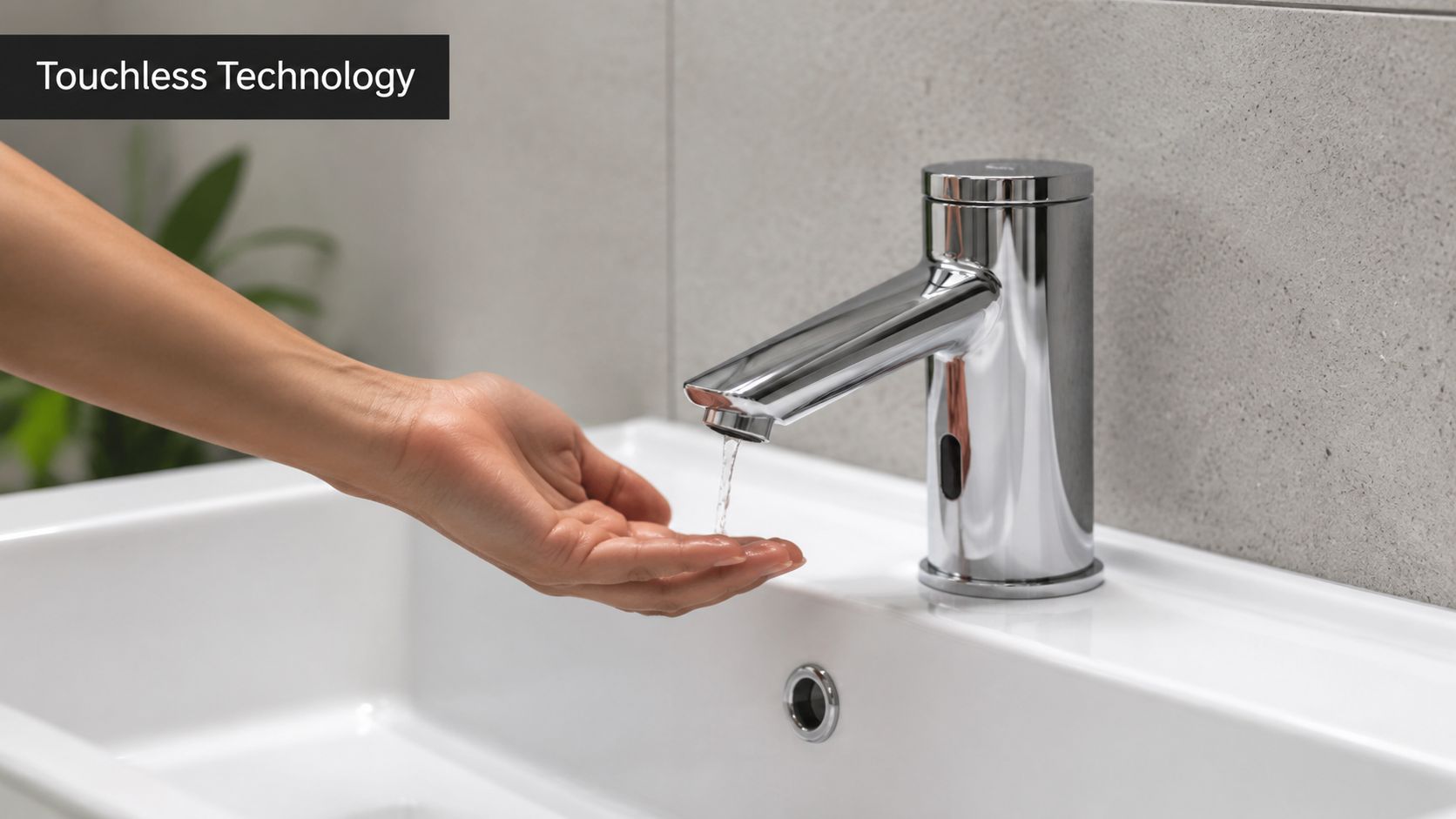
A sensor tap is a small control system built into a faucet body. When hands enter the sensor field, the electronics send a signal to a solenoid valve, and that valve opens the water path. When hands leave, the valve shuts.
That sounds simple because it is. The problems start when the parts are cheap, the sensor is badly positioned, or the unit is installed in a spot with constant splash, reflected light, steam, or tight under-sink access.
The three parts that matter
Every sensor tap has three working components.
- The sensor detects hands in front of the outlet, usually with infrared.
- The solenoid valve opens and closes the flow of water.
- The power source runs the sensor and valve, either from batteries or mains power through a transformer.
If one of those three is poor quality, the whole tap feels unreliable. In Melbourne bathrooms, I see this most often with budget models that trigger late, keep running after hands move away, or stop responding once moisture gets into the electronics housing.
If you want a clearer visual explanation of the mechanism, this guide on how automatic taps work separates the sensing side from the plumbing side well.
What users notice, and what installers notice
Users notice speed. They want water when they present their hands, and they want it to stop cleanly.
Installers notice different things. Sensor position has to suit the basin or sink. The control box needs protection from leaks and cleaning chemicals. The valve needs accessible isolation nearby, because every electronic fitting becomes a service job at some point.
This is where long-term ownership becomes more important than the showroom demo. A tap can behave perfectly on day one and still become a nuisance if the sensor lens fogs up, the battery compartment is awkward to reach, or the replacement solenoid has to come from overseas.
Battery or mains
There is no single right answer.
- Battery-powered taps suit retrofits and older homes where adding power under the sink would make a small job expensive.
- Mains-powered taps suit busy commercial bathrooms, offices, and hospitality sites where regular battery changes become a maintenance burden.
- Hybrid setups can make sense in larger fit-outs, but only if the servicing plan is clear from the start.
In Australian conditions, especially in humid bathrooms and hard-working kitchens, access matters as much as the power type. If a caretaker or plumber has to dismantle half the joinery to change batteries or replace a valve, the cheaper tap often becomes the dearer one to own.
For larger sites planning a touch-free wash area, soap dispensing and hand-care layout usually need to be considered alongside the tap. Teams managing that broader setup may find this guidance for facility managers useful.
Key Features to Compare in 2026
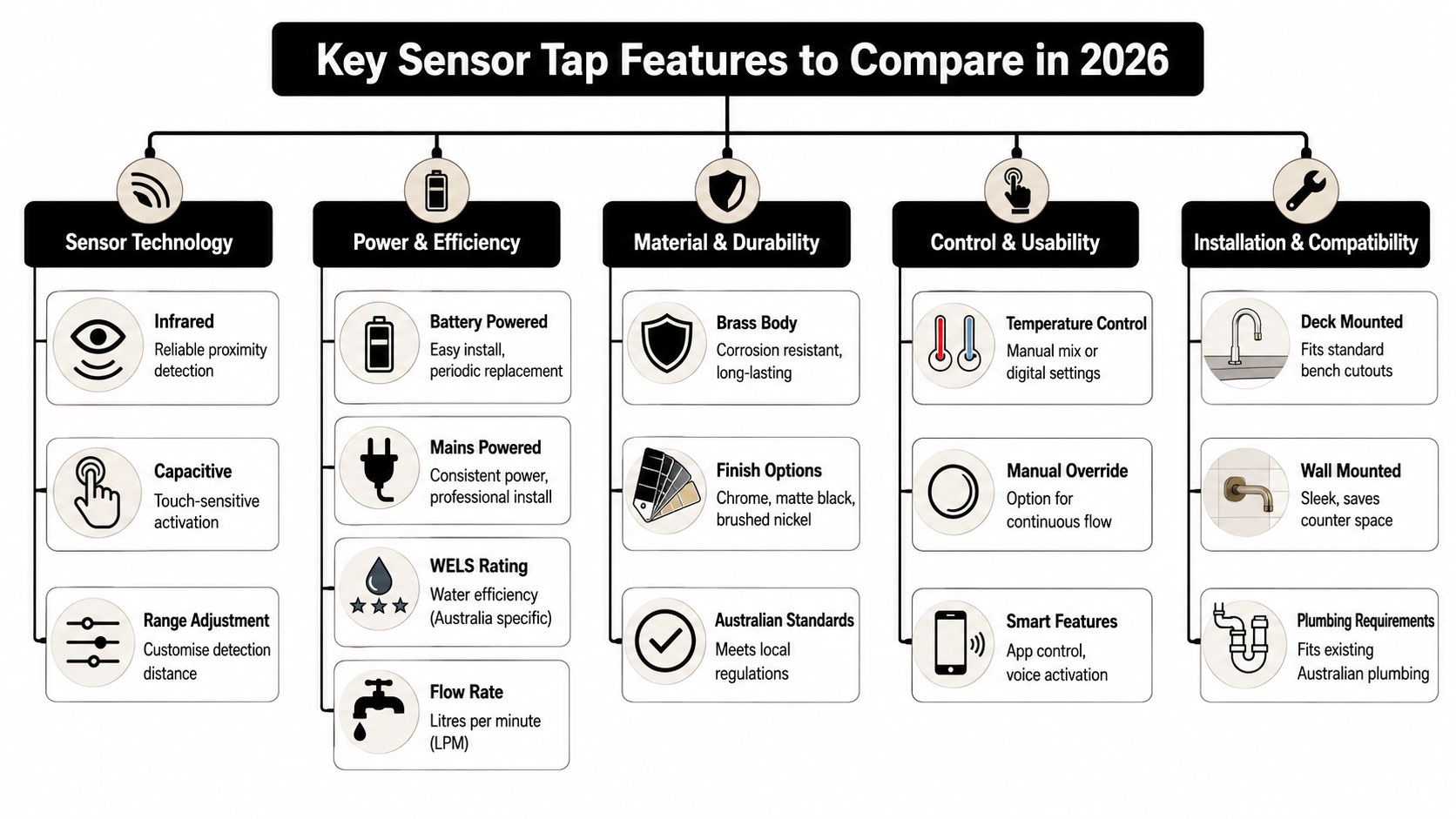
A sensor tap that behaves well in a showroom can become frustrating six months later in a busy Melbourne kitchen or a bathroom with poor ventilation. The better comparison is not colour or spout shape. It is how the unit handles steam, splash, cleaning chemicals, irregular water pressure, and future servicing once the novelty has worn off.
Sensor reliability in real Australian conditions
Humidity and steam matter more than many spec sheets suggest. In bathrooms, long showers can leave condensation on the sensor lens or inside the control area. In kitchens, splashback, reflected light off stainless steel, and constant wipe-downs can cause nuisance triggering or missed activation.
Autoflo points out that local discussions around sensor taps often focus on hygiene and water saving, while practical performance in hot, steam-heavy rooms gets less attention (Autoflo on sensor tap advantages).
The points I check first are straightforward:
- Sensor placement: Front-mounted sensors can be easier to trigger accurately, but some layouts make side reflections a problem.
- Range adjustment: Helpful for shallow basins, compact vanities, and tight kitchen sinks where the factory setting is too sensitive.
- Moisture protection: The electronics and connectors need proper sealing if the area gets frequent spray or heavy condensation.
- Stable shut-off timing: A tap should stop cleanly without hunting on and off during hand movement.
A poorly tuned sensor wastes just as much water as a careless user. It also creates complaints fast in offices, hospitality venues, and family homes.
| Feature | Why it matters in Australia |
|---|---|
| Humidity resistance | Reduces false triggers and missed activation in steamy rooms |
| Adjustable sensor range | Helps suit shallow basins and tight benchtop layouts |
| Waterproof electronics | Better suited to splash-prone kitchens and frequent cleaning |
| Accessible service parts | Shorter repair times and less hassle years after purchase |
Flow control and day-to-day usability
Flow rate matters, but so does how the tap delivers that flow. A bathroom handwashing tap can work well at a lower rate. A kitchen tap used for rinsing food or filling pots usually needs more usable flow and better reach, otherwise people end up avoiding the sensor function altogether.
Check whether the tap allows:
- Flow adjustment at commissioning
- Run-time settings that suit the basin or sink
- Temperature control that is clear and safe for regular users
- Manual or mixed-use operation for longer tasks
This last point gets overlooked. In kitchens, hands-free activation is useful, but there are jobs where the user wants continuous water without waving at a sensor every few seconds.
Build quality below the benchtop
The visible tap body tells only part of the story. The solenoid, filter screens, cable connections, and controller usually decide how well the unit ages.
Brass bodies still make sense for long-term durability, especially where water quality is inconsistent or the fitting gets hard daily use. Plastic control boxes are common and can be perfectly acceptable, but only if the seals are decent and the box is mounted away from leaking traps and aggressive cleaning products. I would also check whether the strainers, diaphragms, and solenoid cartridges are standard service items in Australia, not special-order parts with a long wait.
That is the ownership test many buyers miss. A sensor tap is only as good as the parts you can get in three or five years.
Local support often decides the better buy
Two taps can look similar on paper and perform very differently once a fault appears. If one brand has Australian stock, local technical support, and a clear spare-parts path, it is usually the safer choice than a cheaper imported unit with no service network.
Ask simple questions before buying:
- Who supplies replacement solenoids and sensors in Australia?
- Are spare parts held locally?
- Can any licensed plumber service it, or is brand-specific support required?
- What is the realistic turnaround if the tap fails in a commercial bathroom or staff kitchen?
Those answers matter more than a polished product video or a long list of marketing features.
Australian Compliance You Cannot Ignore
A sensor tap can look well made on the bench and still be the wrong product for an Australian install. I see that problem with online purchases more than homeowners expect. The tap body may fit the hole, but the approval paperwork, power arrangement, pressure limits, tempering setup, or servicing method can still cause trouble once a licensed plumber starts the job.
Start with WaterMark approval. If the tap is being connected to Australia's drinking water system, that approval is one of the first checks. Without it, you can run into issues with installation sign-off, warranty support, insurance questions, and future property works. In commercial sites, aged care, schools, and medical settings, that risk gets bigger because the fixtures are under more scrutiny and faults need to be resolved fast.
Electrical compliance matters too. Many sensor taps are battery operated, plug-in, or hardwired. Each setup changes what is involved under the basin or inside the joinery. In wet areas, the details matter. The controller location, transformer protection, cable routing, and access for servicing all need to suit the site and local requirements. A cheap imported unit with vague electrical specs is where jobs go sideways.
Temperature control is another point buyers miss. A sensor tap does not replace the need for safe water delivery. If the tap is fed by heated water, the installation still has to suit the application, whether that means tempered water, a thermostatic mixing valve, or a set maximum delivery temperature for the type of building. In Australia, that is not a styling choice. It is part of getting the installation right.
I also check ingress protection and service access, especially in humid bathrooms and busy staff kitchens. Steam, cleaning chemicals, and cramped cabinets shorten the life of poorly sealed control boxes. A model such as this gooseneck autoflow sensor tap for Australian installations only makes sense if the full assembly, not just the spout, is suitable for the room and can be maintained locally.
Use this buying check before the order goes through:
- Confirm the tap is approved for Australian plumbing connection
- Check how it is powered and whether that suits the room
- Verify the heated water setup is safe for the building type
- Ask who carries the spare parts in Australia
- Make sure the control box can be accessed without dismantling half the cabinet
If a seller cannot answer those questions clearly, leave it there. Long-term ownership in Australia depends on more than hands-free operation. It depends on compliant installation, reliable performance in heat and humidity, and parts you can readily get when the sensor, solenoid, or power unit eventually needs attention.
Best Sensor Taps for Kitchens Versus Bathrooms
A sensor tap that feels fine in a powder room can be a poor fit over a kitchen sink. I see this regularly in Melbourne homes and staff amenities. The owner buys on looks or price, then finds the sensor fires at the wrong time, the spout is too low for pots, or the control gear starts playing up after months of steam and splash.
What works in a kitchen
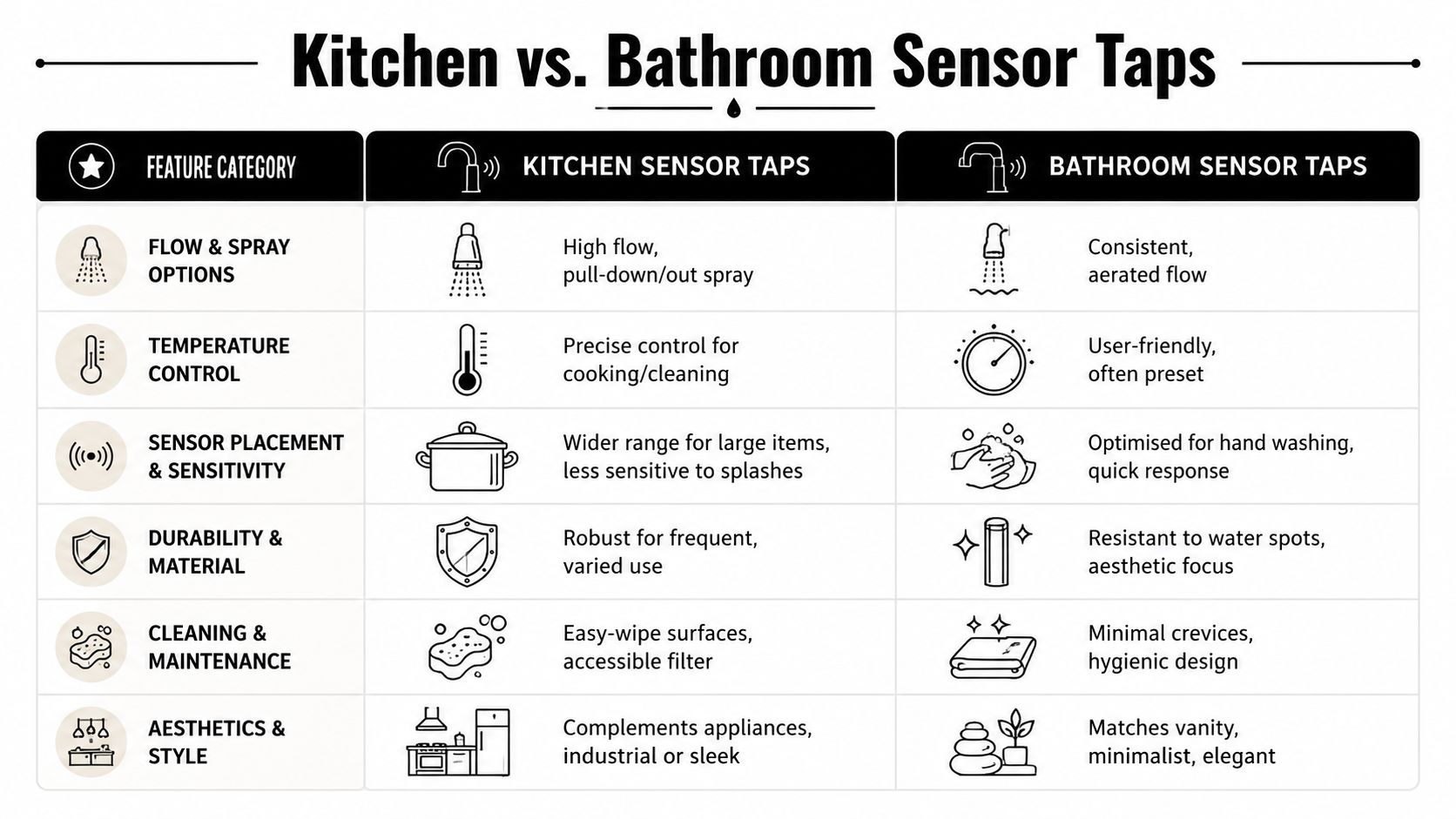
Kitchen taps do more jobs. They need clearance for filling kettles and pots, enough reach to hit the working part of the bowl, and a sensor that does not trigger every time someone wipes the bench or passes a hand nearby.
Spout shape matters more here than many buyers expect. A low vanity-style body can be fine for handwashing, but it becomes frustrating fast in a kitchen. A taller neck and sensible projection make day-to-day use easier, especially at a standard domestic sink. A gooseneck automatic sensor tap for deeper kitchen sink clearance shows the sort of profile that suits this job.
The electronics also cop more punishment in a kitchen. Splashing is heavier, cupboards often run warmer, and under-sink water filters or boiling and chilled units can crowd the cabinet. In that setting, I would prioritise:
- A taller spout with usable clearance
- A sensor range that can be adjusted during commissioning
- A shut-off time long enough for rinsing without constant re-triggering
- Sealed electronics and connections suited to repeated splash exposure
- Spare solenoids, sensors, and power components available locally
Local parts matter. Imported units can look attractive online, but if the sensor lens fogs, the solenoid sticks, or the power pack fails, the key test is whether an Australian supplier can get the part quickly.
What works in a bathroom
Bathroom use is simpler, but it is less forgiving of poor activation. People expect the tap to respond immediately for short handwashing cycles, then shut off cleanly without dribbling or false triggers.
Bathrooms also create a different problem. Steam, condensation, and cleaning chemicals shorten the life of poorly sealed components. In a family bathroom or commercial amenities block, humidity is often the reason a sensor tap becomes unreliable well before the body itself wears out.
A bathroom sensor tap usually performs better when it has:
| Bathroom need | Best design response |
|---|---|
| Quick handwashing | Fast activation with stable short-run flow |
| Easier cleaning | Compact body with fewer seams and ledges |
| Shared use | Clear sensor zone that works for adults and children |
| Humid conditions | Well-protected electronics and accessible service parts |
Compact design also helps keep the vanity cleaner. Less bodywork usually means fewer water marks, less soap residue, and fewer places for grime to build up.
The best choice depends on room behaviour
Room behaviour decides the better tap. A quiet ensuite, a family bathroom, a staff lunchroom, and a home kitchen all place different demands on the sensor, spout, and control box.
For kitchens, I would usually favour clearance, reach, and adjustability. For bathrooms, I would usually favour quick response, easier wipe-down, and electronics that hold up in a damp room.
The long-term ownership question is the one buyers often miss. In Australia, the better tap is not just the one that saves water or looks neat on day one. It is the one that keeps working in humidity, can be serviced without pulling half the cabinet apart, and has parts available locally when something eventually needs replacing.
Installation and Long-Term Maintenance in Australia
This is the part many buyers leave until too late. They compare activation range, finish, and shape, then treat maintenance as a minor issue. In Australia, maintenance can be the difference between a smart purchase and a tap that becomes expensive to own.
Installation should be handled properly from the start. A sensor tap isn't just a spout swap if power, under-bench access, mixer settings, or local compliance checks are involved. If the model is hardwired or part of a larger kitchen or bathroom refit, licensed trades are the safe path.
The hidden ownership costs
The bigger trap is spare parts and servicing. The Blue Space highlights a gap that matters for local buyers: only 12% of Australian homeowners are aware that some sensor taps need battery replacements every 6 to 12 months, and that limited local parts availability for some international brands can lead to 30 to 40% higher repair costs than manual taps (The Blue Space electronic sensor taps).
That aligns with what plumbers see on the ground. The fancy imported unit can look like a bargain until the battery compartment fails, the sensor module plays up, or a valve needs replacing and nobody stocks the part locally.
What to ask before you buy
These questions matter more than the finish chart:
- Where do replacement parts come from: Australia, or overseas on special order?
- Who services the brand locally: A real service network, or nobody in your area?
- How easy is battery access: Some are simple. Some are awkward under cramped vanities.
- Can the sensor module be replaced separately: Or do you end up replacing far more than you should?
For buyers comparing supply and service options, automatic sensor taps sold through a specialist water solutions supplier are generally easier to assess because the servicing conversation happens earlier, before the tap is installed.
What holds up better
Taps with local stockists, straightforward internals, and common fittings usually age better from an ownership point of view. That doesn't mean the cheapest model. It means the model you can keep running.
A sensor tap should be cleaned regularly, the sensor window kept clear, and the power source checked as part of routine maintenance. But that basic care is only half the story. The bigger issue is whether your chosen brand can still support the product a few years down the track.
Your Australian Sensor Tap Buying Checklist
By the time you're ready to buy, the decision should be narrower than “which one looks best”. If you want a sensor tap that works properly in Australia and stays economical to own, run through a short checklist before money changes hands.
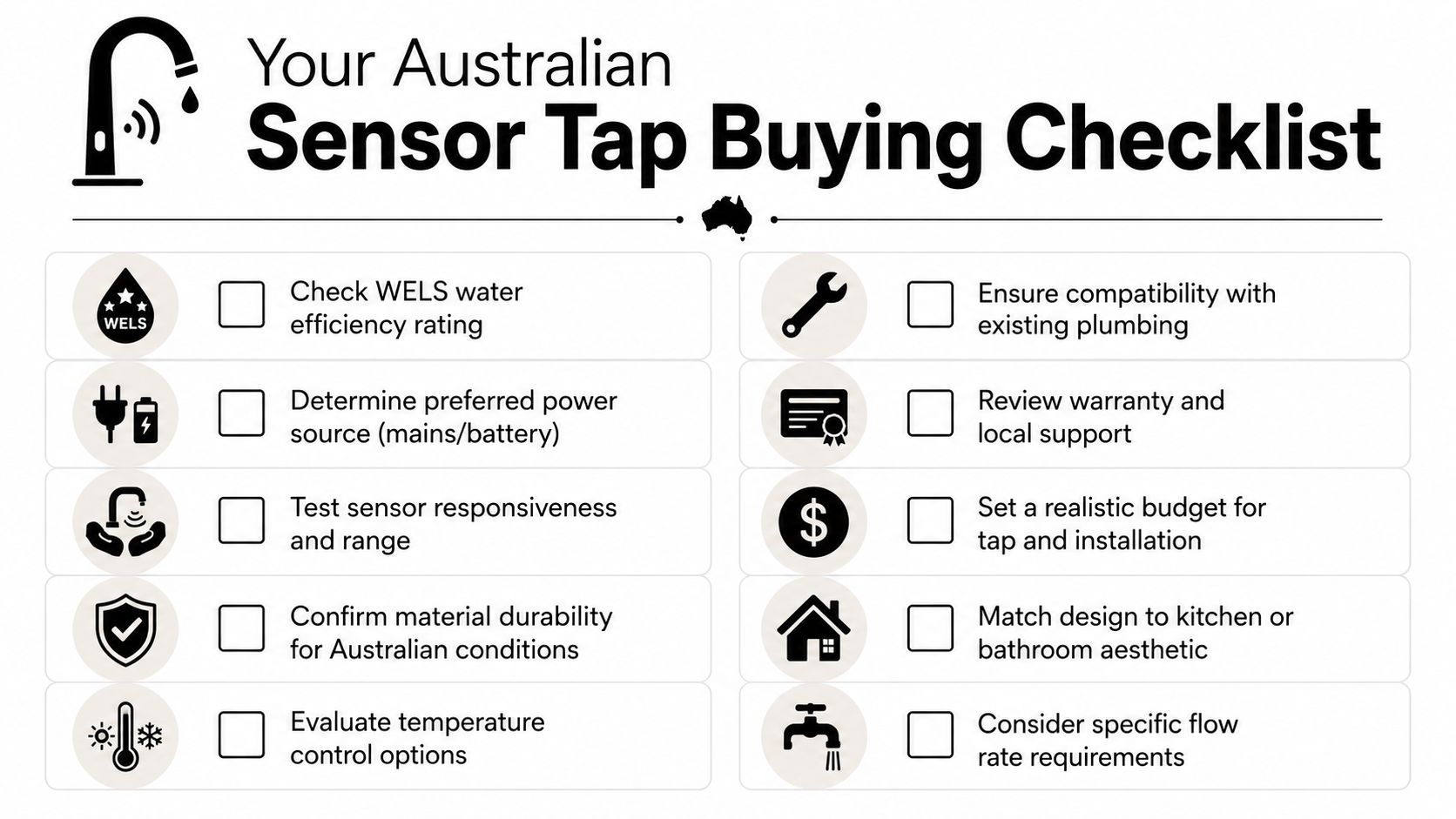
Use this list at the shortlist stage
- Check local compliance: Make sure the product is suitable for Australian installation conditions.
- Choose the right power setup: Battery can suit retrofits. Mains can suit high-use areas.
- Think about humidity: Bathrooms and steamy kitchens need better sensor reliability.
- Match the tap to the room: Kitchen and bathroom needs aren't the same.
- Ask about parts availability: Don't assume imported brands are easy to repair.
- Look at service access: Batteries, valves, and electronics should be reachable.
- Review cleaning reality: Some finishes show every mark, especially around basins and splash zones.
For appearance and upkeep, finish still matters. If you're trying to keep a new tap looking clean, this guide on how to tackle stubborn water spots is worth a read, especially for bathrooms and hard-water areas where spot build-up becomes part of weekly maintenance.
The final test
If I were narrowing the field for a client, I'd ask three plain questions.
Does it suit the room?
Can it be installed correctly here?
Can you still get help and parts in Australia if something goes wrong?
If the answer to any of those is shaky, it's not the right tap yet. That's the practical answer to what is the best automatic sensor tap for an Australian bathroom or kitchen. It's the one that fits the job, handles local conditions, and won't become a servicing headache later.
If you're comparing sensor taps and want advice grounded in Melbourne installation realities, Ring Hot Water can help you assess suitable options, compatible fittings, and service considerations before you buy. That's often the easiest way to avoid choosing a tap that looks right online but proves difficult to install or maintain in an Australian home or workplace.

