Commercial Boiling Water Urns
Office Boiling Water Tap Melbourne
Jul
Best Office Boiling Water Tap Melbourne: 2026 Buyer’s Guide
The kettle has probably become part of the office background. It clicks on, someone waits, someone else refills it, and the same little queue forms again before ten in the morning. In a small Melbourne office, that's annoying. In a busy one, it becomes part of the workflow problem.
That's why choosing an office boiling water tap in Melbourne shouldn't be treated like a simple appliance purchase. The sticker price matters, but it's rarely the deciding factor over the life of the unit. Capacity, electrical requirements, plumbing access, servicing, filtration, and compliance in Victoria will shape whether the system feels like a smart upgrade or a daily frustration.
Why Melbourne Offices Are Replacing the Kettle
A typical office kitchen tells the story quickly. One person wants tea, another is making instant noodles, someone else needs hot water for a plunger coffee, and the kettle is still halfway through its cycle. By mid-morning, the bench is wet, the cord is in the way, and the kettle has been boiled more times than anyone notices.
That routine looks harmless until you add it up as lost moments, clutter, and repeated reheating. Offices don't replace kettles because kettles stopped working. They replace them because the kettle stops matching the pace of the workplace.
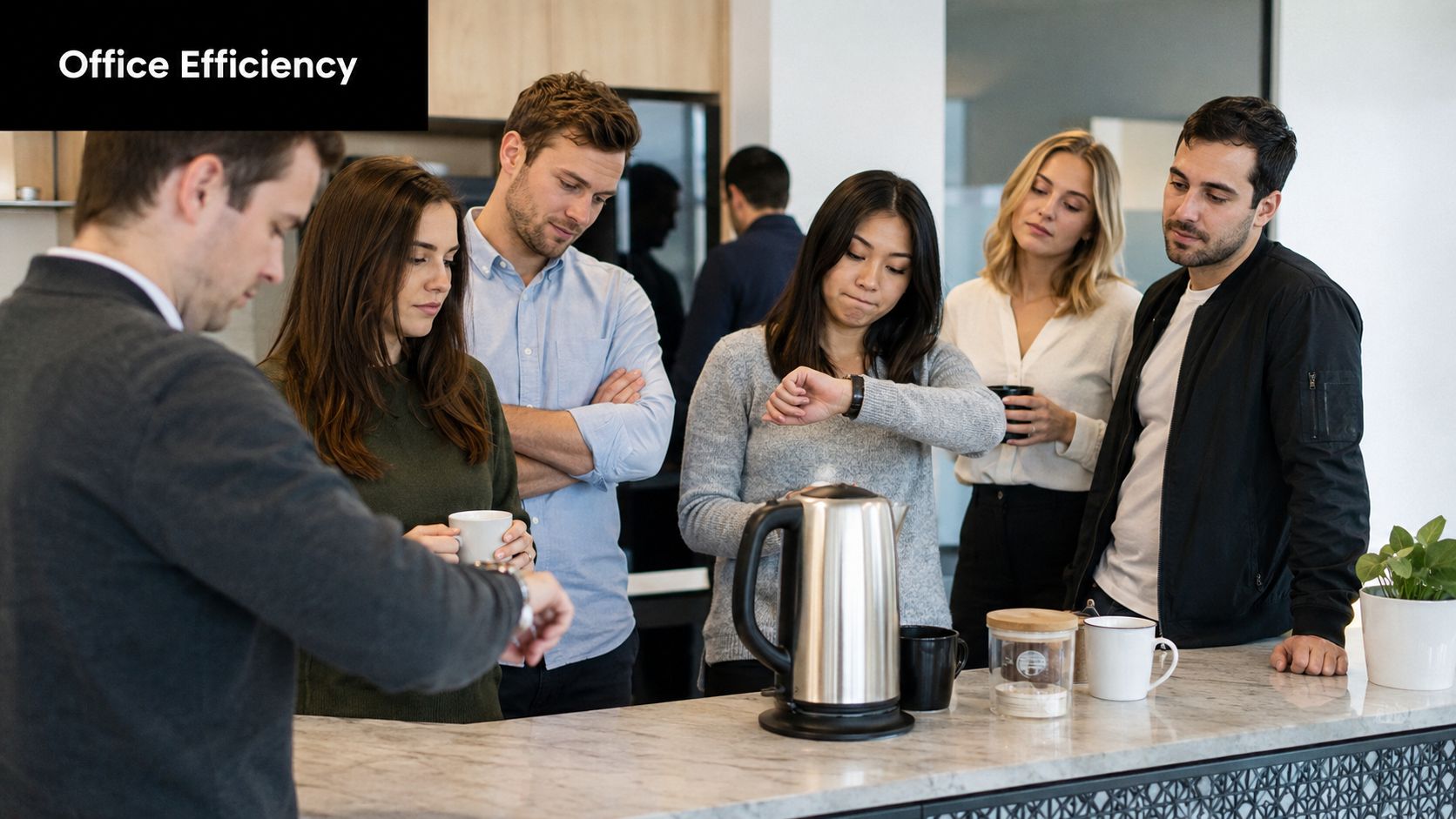
The daily friction a kettle creates
A boiling water tap changes the kitchen from a waiting zone into a service point. Staff get hot water where they already stand. The bench clears up. The stop-start pattern disappears.
That matters more in offices than in homes because usage comes in peaks. Morning tea, lunch, and mid-afternoon all create bursts of demand. A kettle serves one cycle at a time. A dedicated boiling tap or wall unit is designed for repeated use.
Practical rule: If staff regularly queue for the kettle, the problem isn't convenience. It's capacity.
There's also a broader context behind this shift. In the 2023 to 24 financial year, Australian household water consumption increased by 6.2%, and average household water use rose 3.6% to 174 kL per household, according to the ABS Water Account, Australia. That doesn't prove every office is installing a boiling tap, but it does reflect steady demand for convenient, high-efficiency water systems across Australia.
Why offices move fast once they decide
Most office managers don't start by wanting “premium tapware”. They start by wanting fewer bottlenecks in the kitchen and less bench clutter. Once they compare options such as office water dispensers and integrated drinking systems, the kettle starts to look like a short-term workaround.
What works well in practice is simple. Put the right system near the main prep area, size it for the busiest part of the day, and make sure the unit can be serviced without dismantling the cabinet. Offices that get those basics right rarely want to go back to a kettle on the bench.
Choosing the Right System for Your Office Layout
The wrong unit often fails for a boring reason. It doesn't fit the room, the usage pattern, or the expectations of the people using it. A sleek under-sink tap can look perfect in a brochure and still struggle in a staff kitchen that gets hammered at 8:30 am.
There are three common directions for an office boiling water tap Melbourne setup. Under-sink boiling taps suit cleaner-looking kitchens. Wall-mounted boilers suit higher traffic. Commercial urns still have a place, but mostly where portability or simple bulk dispensing matters more than appearance.
What each system is good at
Here's the quick comparison that usually helps office managers narrow the field.
| System Type | Best For | Capacity (Typical) | Space Requirement |
|---|---|---|---|
| Under-sink boiling tap | Small to medium offices, client-facing kitchens | Suits lighter to moderate peak demand | Bench tap above, tank and filter under sink |
| Wall-mounted boiling unit | Medium to larger offices, staff lunchrooms | 90 to 120 cups per hour in many Melbourne specifications | Wall space plus nearby services |
| Commercial urn | Training rooms, events, temporary setups | Bulk hot water dispensing | Bench or counter footprint |
The wall-mounted category is where many offices land once staff numbers rise. For many Melbourne office environments, wall-mounted boiling water units are specified to deliver 90 to 120 cups of boiling water per hour, and they require a dedicated 13-amp electrical supply to achieve that output, as noted in this Melbourne boiling water unit guide.
Under-sink taps versus wall units
An under-sink boiling tap works best when presentation matters. Think meeting-suite kitchens, reception-side tea points, and compact office fit-outs where a kettle would ruin the look of the space. Brands commonly discussed in this category include Zip, Billi, and Stiebel Eltron.
A wall-mounted unit is less discreet but usually more forgiving in busy staff areas. Birko, Robatherm, Boiling Billy, and similar styles are built around practical output rather than appearance. You don't hide them. You use them hard.
The trade-off is straightforward:
- Choose under-sink if the kitchen is visible to clients, bench space is limited, and demand is steady rather than intense.
- Choose wall-mounted if break times create short bursts of heavy use and reliability matters more than a minimalist finish.
- Choose an urn if the need is occasional, movable, or tied to event-style service rather than fixed daily office use.
What usually goes wrong
The most common mistake isn't buying cheap. It's buying for looks without thinking about demand. I've seen offices fit a stylish compact system into a breakout area, then discover the team still lines up because the unit can't recover fast enough during the morning rush.
Buy for the busiest 20 minutes of the day, not the average hour.
The second mistake is ignoring the room itself. Wall units need proper wall space and safe positioning. Under-sink units need actual cabinet volume, not wishful thinking around bins, traps, cleaning products, and existing pipework.
If the office has more than one kitchenette, splitting demand across two smaller points can work better than overloading one main station. That's especially true in longer floorplates where staff cluster by proximity rather than all using the central kitchen.
How to Correctly Size Your Boiling Water Unit
Sizing is where many first purchases go off course. A unit can be technically “good” and still be wrong for the office. Too small, and staff wait. Too large, and you've paid for capacity you won't use.
The practical way to size a unit is to focus on peak demand, not total headcount. A team of twelve can place more strain on a boiling unit than a team of thirty if they all break at once.
A simple way to estimate demand
Start with four questions:
- How many people will use it daily
- When is the busiest period
- Do people mainly make single drinks or fill containers
- Is headcount likely to grow during the next fit-out cycle
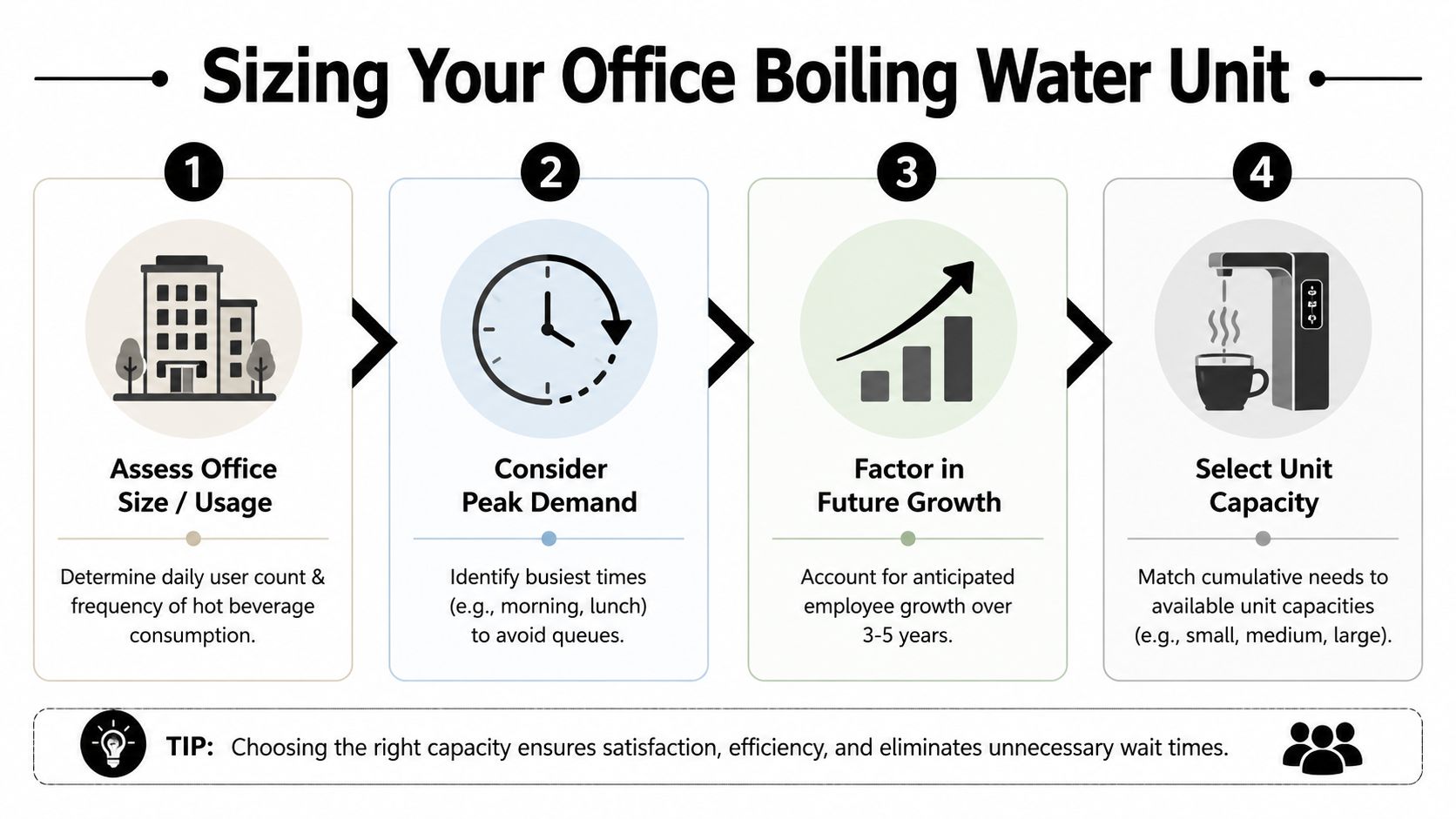
A simple working method is this:
- Count active users, not everyone on payroll.
- Identify the rush period. Morning is usually the stress test.
- Allow for clustering. Offices rarely use hot water evenly.
- Add growth margin if the team is expanding or the kitchen will serve visitors as well.
The two specs that matter most
When reading product sheets, office managers usually get hit with vague marketing language. Ignore most of it and look for two practical ideas.
Initial cup delivery means how much hot water the system can give you straight away before it needs to recover.
Hourly recovery rate means how much boiling water it can continue to produce over time.
A unit with a decent initial draw but weak recovery can still frustrate staff if ten people arrive one after another. That's why wall-mounted systems often suit office kitchens better than small domestic-style under-sink tanks.
For a broader explanation of how hot water systems are matched to real-world demand, this Brisbane homeowner's guide to hot water is useful because it shows the same sizing principle in a different setting. The building type changes. The logic doesn't.
A sizing mindset that saves money
Don't size for the rare all-hands meeting unless that demand is normal. Don't size for one person making tea at 3 pm either. Size for the repeatable rush.
A good supplier or installer should ask about break patterns, floor layout, and future staff numbers before recommending a model. If they only talk about the unit finish and the sale price, you're not getting proper sizing advice.
Installation Requirements and Melbourne Compliance
An office boiling water tap is not a plug-and-play kettle replacement. It's a fixed appliance tied into the building's plumbing and electrical systems. In Melbourne, the install has to make sense both technically and from a compliance point of view.
That starts with the basics. Is there room under the sink or on the wall. Is there a suitable cold water connection. Is there safe power access. Can the filter be changed without unloading half the cupboard. Those questions matter before anyone starts comparing tap finishes.
Electrical and plumbing realities
Wall-mounted boiling units in office settings often need a dedicated 13-amp supply to deliver their rated performance, as noted earlier. That's not a minor detail. If the circuit planning is wrong, the unit may never perform as intended.
Under-sink systems can look compact from above the bench, but the actual space they occupy is inside the cabinet. Office fit-outs often hide the problem until install day. Waste pipes, pull-out bins, cleaning stock, and tight cabinetry all compete for the same space.
Victorian safety considerations
Hot water safety in Victoria isn't optional. According to the Alia Global boiling tap and hot water comparison, hot water heating can account for up to 27% of household energy use in Australia, and Victorian guidelines also require tap temperatures at 50°C for safety while tanks must be at 60°C. Boiling water systems sit beside that wider safety framework, which is one reason proper selection and installation matter.
A boiling tap isn't the same thing as a standard tempered outlet. It's a specialist appliance designed to deliver very hot water under controlled conditions. The safety features on the tap itself matter, but so does the quality of the installation behind the joinery.
A neat-looking install that blocks filter access or service access usually becomes an expensive install later.
Why licensed work matters
In Victoria, plumbing work needs to be handled properly and in line with the relevant legal and safety requirements. Office managers should expect licensed trade involvement, not a handyman improvising around a sink cabinet. That protects safety, warranty, and the building owner's position if there's ever a leak or electrical issue.
For offices comparing concealed systems, this guide to under-sink boiling water unit installation gives a practical picture of how much planning sits below the benchtop.
What to confirm before approving the job
A sound pre-install check should cover:
- Cabinet access so the tank, filter, and valves remain reachable
- Power suitability for the actual unit being specified
- Water isolation points for future servicing
- Drainage and overflow planning where relevant to the model
- Safe tap location so staff aren't dispensing boiling water into a crowded pinch point
The cheapest quote can become the most expensive version of the job if it leaves poor access, non-compliant work, or avoidable downtime. That's why total cost of ownership starts at install, not after it.
Filtration Health and Overlooked Safety Risks
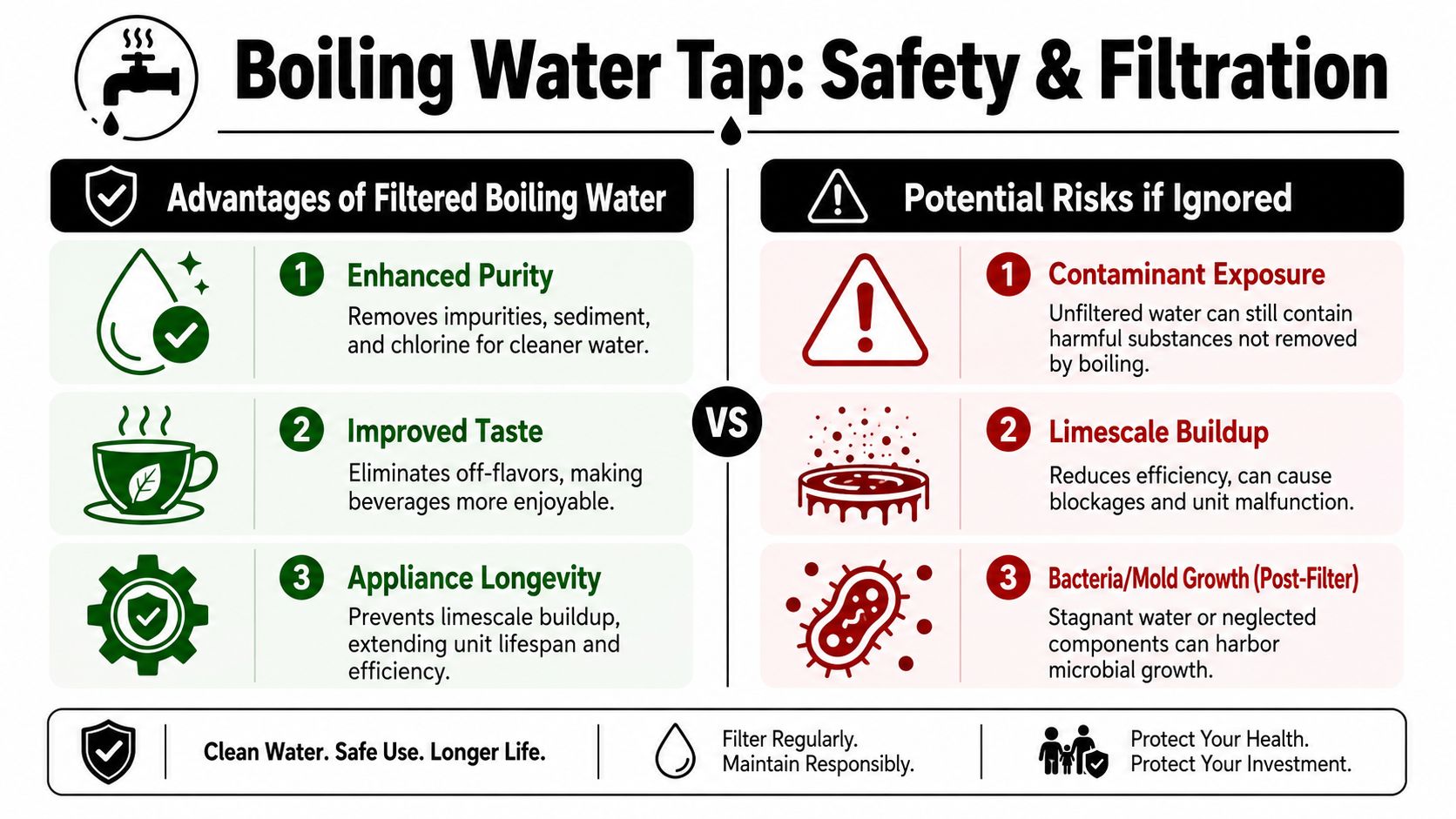
A lot of buyers assume “boiling” means “safe” in every sense. It doesn't. A boiling water unit is a very good convenience appliance, but it doesn't override every water-quality risk in an office building.
That matters most in two situations. The first is a contamination event or boil water advisory. The second is older plumbing where lead risk may be part of the conversation.
Boiling taps and boil water advisories are not the same issue
Office managers sometimes assume that having an instant boiling tap means they're already covered during a water supply warning. However, the situation is more specific. During an emergency advisory, the issue is whether the incoming water is microbiologically safe and whether the system is being used in a way that follows the advisory requirements.
The CDC overview linked in the brief makes an important practical distinction. Standard filtration does not remove bacteria by default, and emergency notices may require water to be brought to a rolling boil for a defined period. An office boiling tap may still play a useful role in response planning, but it shouldn't be treated as a magic exemption from the advisory itself.
What works in practice is having a written office procedure. If the building receives a contamination notice, staff need to know whether the installed unit is suitable for use, whether water should be drawn differently, and whether bottled water is the safer temporary option.
Hot water and lead risk in older buildings
The second issue gets even less attention. The EPA guidance in the brief states that hot water can dissolve lead more quickly than cold water. In older office buildings, that matters. If the plumbing contains legacy materials or older joints, heat can make the problem worse.
That doesn't mean every old Melbourne office is unsafe. It means office managers shouldn't assume that a boiling tap automatically delivers “pure” water just because it's hot and filtered. Filtration choice, pipework condition, and water pathway all matter.
If the building is older and nobody has checked the plumbing history, treat that as an information gap, not as proof everything is fine.
What filtration helps with, and what it doesn't
A good filtration setup can improve taste, reduce sediment, and help protect the appliance from build-up. It can also support longer-term reliability by reducing what reaches the heating chamber.
It does not mean every possible contaminant is handled by default. That's why offices should match the filter to the risk they're trying to manage.
For teams that need to understand filtration at a more technical level, especially where water quality is operationally important, these lab water purification systems are a useful contrast. Office boiling taps are convenience systems. Laboratory purification is a different category entirely, and seeing that difference helps buyers ask better questions.
A safer office setup
For most offices, the sensible approach is:
- Check the building age and plumbing history
- Choose filtration for actual water conditions, not just taste claims
- Keep service intervals current so filters and components don't get neglected
- Create an advisory response plan for any future contamination notice
The main lesson is simple. Convenience and water safety overlap, but they are not the same thing.
Budgeting Maintenance and Finding Spare Parts
Most buying mistakes happen when the budget ends at purchase price. That's how offices end up with a unit that was cheap to buy, awkward to service, and annoying to own. The better question is what the system will cost to run, maintain, and keep in service over time.
The total cost of ownership includes the unit, the installation, filter changes, service access, downtime risk, and the ease of getting genuine parts later. None of that is glamorous, but that's where good decisions show up.
What to include in the real budget
Start with the obvious line items. The unit itself. Professional installation. Any electrical work needed to support the appliance. Then add the costs buyers often forget.
- Filter replacements because these are part of normal ownership, not optional extras
- Service labour for faults, scale issues, or periodic maintenance
- Downtime if the kitchen relies heavily on the unit
- Spare part availability when a valve, thermostat, element, or fitting eventually needs replacement
For optimal maintenance, product choice is key. Widely supported brands such as Zip, Birko, Stiebel Eltron, Boiling Billy, Robatherm, and Insinkerator are generally easier to maintain because parts and trade familiarity are stronger. Niche imports can look attractive on day one and become a headache when one small component fails.
What works over the long term
The systems that hold value usually have three things in common. They were sized correctly. They were installed with proper access. They use parts that can be sourced in Australia without a long chase.
Office kitchens are hard on appliances because nobody “owns” the unit day to day. Staff use it constantly, nobody notices gradual performance drop-off, and filter schedules are easy to miss. A simple maintenance log fixes a lot of that.
Here's a useful reference point before you compare products in detail:
The spare-parts question most buyers leave too late
Ask this before purchase: if the unit fails in two or three years, who supplies the parts and who fits them?
That single question filters out a lot of bad buying decisions. Genuine spare parts matter with boiling systems because they're handling heat, pressure, and safety controls. Substituting whatever “looks close enough” is not a smart maintenance strategy.
Good ownership isn't about avoiding maintenance. It's about making maintenance predictable.
If you're budgeting properly, treat servicing and filter replacement as part of the appliance lifecycle, just like you would with office HVAC or a coffee machine. That's the difference between buying cheaply and buying well.
Where to Buy and Get Expert Service in Melbourne
By the time you're ready to buy, the right choice usually comes down to four decisions. Pick the system type that suits the kitchen. Size it for the busiest part of the day. Make filtration decisions based on the building and water risk, not marketing claims. Then make sure the install will be compliant and serviceable.
That last point matters most in Melbourne because support after the sale is what protects the investment. A local specialist can inspect cabinet space, confirm electrical and plumbing requirements, supply the right unit, and handle repairs later without sending you into a parts hunt.
For office managers, that's usually more valuable than buying from a generic online retailer with no practical involvement once the box arrives. Service continuity matters. So does access to genuine filters, valves, elements, thermostats, and fittings when the unit has been in daily office use for a while.
If ongoing support is part of your decision, it's worth reviewing what proper boiling water unit service in Melbourne should include. A good service partner doesn't just replace parts. They help keep the whole system reliable, compliant, and worth owning.
If you're comparing options for an office boiling water tap in Melbourne, Ring Hot Water can help with supply, installation, repairs, maintenance, and genuine spare parts. The team is Melbourne-based, services the metro area, and can provide advice specific to your office layout, staff usage, and compliance needs.

