
Boiling Hot Water Tap
Instant Hot Water Dispenser
Apr
Instant Hot Water Dispenser Your Complete 2026 Guide
If you’re reading this with a kettle on, you’re probably already feeling the problem.
Morning tea turns into a stop-start routine. Someone fills the kettle with too much water. Someone else reheats it twenty minutes later. The bench looks cluttered. In an office, the queue builds up. In a café prep area, every delay gets noticed. At home, it’s one more small task that keeps repeating all day.
An instant hot water dispenser solves that in a way a kettle never really can. You turn a handle or press a control, and near-boiling filtered water is there straight away. No waiting for a full boil cycle. No juggling bench space. No reheating the same water again and again.
For Melbourne households, there’s another layer to the decision. Water quality varies from suburb to suburb. Cupboard space in older kitchens can be tight. Many buyers want a unit that looks clean in a renovation, but they also want something serviceable when filters, valves or thermostats eventually need attention. That local detail matters more than glossy brochure language.
This guide is written from that practical angle. Not just what an instant hot water dispenser is, but what suits a Melbourne terrace, a new apartment, an office tea point, a hospitality fit-out, or a caravan heading out of town. Beyond that, it covers what keeps these systems working well long after installation.
The End of the Kettle Why Melbourne is Embracing Instant Hot Water
The usual scene is familiar. One person wants tea, another needs hot water for porridge, someone else is rinsing baby bottles, and the kettle is either empty, half full, or still taking its time. In a shared kitchen, that delay happens over and over.
Melbourne homes and workplaces have moved quickly toward under-sink boiling taps because they remove that friction. You don’t need to think about filling, waiting, lifting, or finding bench space. The hot water is there when you need it.
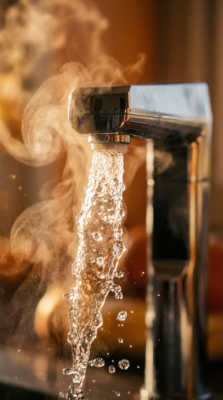
Melbourne isn’t a fringe market for this category. Melbourne accounted for an estimated 22% of national sales volume in 2024, with a 25% demand rise for under-sink boiling taps from brands like Zip, Birko and Everboil among local homeowners and offices, according to Cognitive Market Research’s instant hot water dispenser market report.
Why the shift feels permanent
A kettle is simple, but it’s also inefficient for frequent use. It monopolises the bench. It adds visual clutter. In offices, it slows everyone down. In compact kitchens, it competes with coffee machines, toasters, air fryers and prep space.
An instant hot water dispenser changes the rhythm of the room:
- At home: tea, coffee, noodles, blanching vegetables and quick cleaning jobs become faster.
- In offices: staff stop waiting around the kettle between meetings.
- In hospitality: prep gets smoother when hot water is available on demand.
- In renovations: the kitchen looks cleaner because the working hardware sits under the sink.
A good dispenser feels less like adding an appliance and more like removing a daily annoyance.
It’s not just about speed
The buyers who stay happiest with these systems usually aren’t chasing novelty. They want a practical kitchen. They want less bench clutter. They want one less thing to think about during the day.
That’s why the instant hot water dispenser has moved beyond “nice extra” territory in Melbourne. For many homes, it now sits in the same category as a pull-out mixer or a built-in dishwasher. Once it’s in place and working well, its absence is keenly felt.
From Cold Tap to Boiling Cup in Seconds
It’s often assumed an instant hot water dispenser must work like a miniature kettle that starts heating the moment you touch the tap. That’s not quite it.
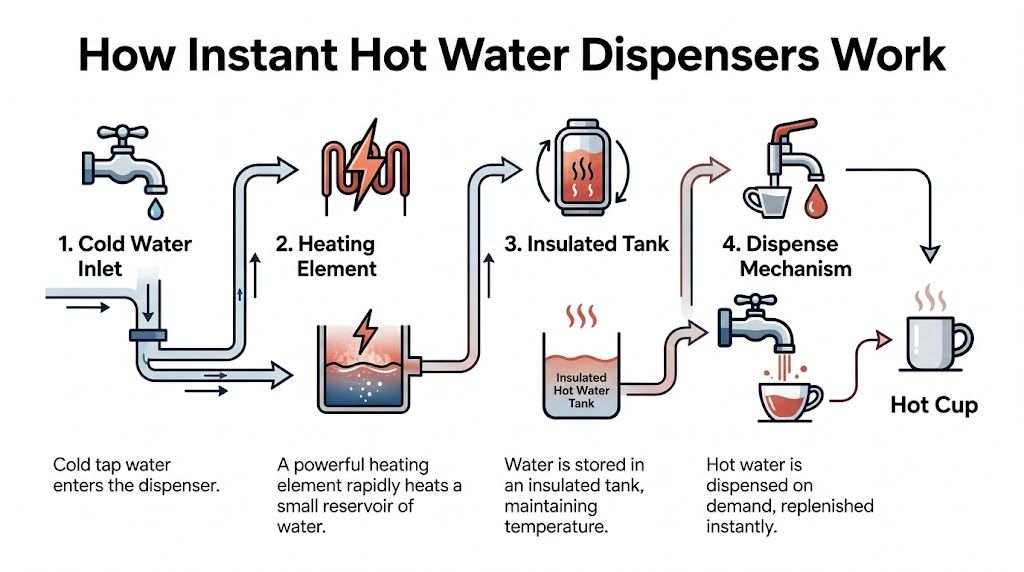
The easier way to think about it is this. Under your sink sits a small insulated tank, like a compact thermos with a heating system built in. It keeps a modest volume of water at dispensing temperature, ready for use. When you draw water off, the unit replenishes and reheats the tank so the next cup is ready too.
What’s happening under the sink
A typical under-sink unit has three core parts.
The inlet and tank
Cold water enters the system and fills a compact insulated reservoir.
The heating element
A 750W heating element brings that stored water up to near-boiling temperature and maintains it efficiently between draws.
The thermostat and controls
The thermostat keeps the water within a controlled range, so you get consistent output instead of a tank that swings from too cool to too hot.
According to the InSinkErator HWT-00 specifications, under-sink instant hot water dispensers typically deliver up to 60 cups per hour of near-boiling water at around 93°C, and that 750W setup is around 40% more efficient for frequent use than a standard 2000W+ kettle.
Why this uses less energy in real life
A kettle usually boils more water than you need. Then someone boils it again later from cold. That cycle keeps repeating.
An instant hot water dispenser avoids most of that waste because it stores a small hot reserve and reheats in a controlled way. For a household or office that uses hot water many times a day, that’s where the efficiency comes from.
Practical rule: If your kettle gets boiled several times a day for one or two cups at a time, you’re exactly the kind of user who benefits most from an under-sink unit.
What good performance looks like
Good systems don’t just hit temperature once. They recover properly between uses. That matters more than brochure language.
In a home kitchen, strong recovery means the second and third cup arrive without a long pause. In a small office, it means a short tea round doesn’t turn into a bottleneck. If you want a closer look at the tap-style format, this overview of instant hot water tap options is a useful starting point.
What doesn’t work is choosing by appearance alone. The tank, element, insulation and thermostat quality decide whether the system feels smooth or frustrating once the novelty wears off.
Finding the Right Hot Water Dispenser for Your Space
The right unit depends less on brand names and more on where it’s going, how often it will be used, and how much visible hardware you’re willing to have in the room.
A home kitchen renovation usually suits one style. An office tea point often needs another. Hospitality venues and mobile setups sit in their own category again. The mistake many buyers make is shopping by temperature alone. Capacity, recovery and install layout matter just as much.
Home kitchens and apartment fit-outs
For most homes, an under-sink tap system is the cleanest option. The tank lives in the cupboard, and a dedicated tap or mixed-function tap sits above. This works well when bench space matters and you want a tidy finish.
These systems suit:
- Renovators who want a minimalist look
- Busy households making drinks throughout the day
- Apartment owners where every bit of surface space counts
If you’re planning cabinetry and plumbing together, it helps to review the common layouts for under-sink hot water systems.
Offices and staff kitchens
An office doesn’t always need a decorative tap. It needs reliability and throughput.
Wall-mounted boilers often make more sense in shared staff areas because they’re easy to access, visible for maintenance, and designed for repeated daily use. They’re also a better fit when the sink cabinet is already crowded with cleaning products, bins or existing filtration gear.
Hospitality and back-of-house areas
Cafés, community spaces, lunchrooms and catering prep areas usually care about one thing above all else. Fast repeat service.
In those settings, you choose for durability, easy service access and sensible placement. A hidden residential-style unit can work in some hospitality applications, but many venues are better served by a more sturdy visible boiler or urn arrangement that staff can use without fuss.
Caravans and RV setups
Mobile use changes the priorities. Compact footprint, stable fittings and practical integration matter more than showroom appearance.
Some caravan owners want a tiny under-bench solution for tea and washing up. Others want a lightweight setup that works neatly with pumps and limited storage. A system that feels brilliant in a suburban kitchen may be completely wrong in a moving vehicle.
Under-Sink Tap vs. Wall-Mounted Boiler
| Feature | Under-Sink Tap (e.g., Zip, Stiebel Eltron) | Wall-Mounted Boiler (e.g., Birko, Kwikboil) |
|---|---|---|
| Best fit | Home kitchens, executive office kitchens, compact renovations | Staff rooms, offices, schools, back-of-house spaces |
| Visible footprint | Minimal above bench | Visible unit on wall |
| Cupboard use | Requires under-sink space for tank | Frees sink cupboard space |
| Aesthetic appeal | Cleaner, more integrated look | More functional than decorative |
| Service access | Accessed through sink cabinet | Often simpler to inspect and service |
| Typical user preference | People prioritising design and bench space | People prioritising capacity and practicality |
The small-kitchen factor
Many Melbourne buyers aren’t choosing between a kettle and a dispenser in isolation. They’re trying to make a compact kitchen work harder. If you’re comparing space-saving upgrades more broadly, this guide to best small kitchen appliances gives useful context around what earns its place on the bench.
What works and what doesn’t
What works:
- Matching the unit to usage pattern, not just room type
- Leaving enough cupboard room around an under-sink tank
- Choosing serviceable hardware with available parts
What doesn’t:
- Buying a home-style unit for heavy staff-room demand
- Picking a wall unit purely on size without thinking about user flow
- Hiding a system in a cabinet that nobody can access later for filter or valve work
If you use hot water constantly but only in small amounts, an under-sink dispenser is often the smartest choice. If many people draw water in bursts, a wall-mounted boiler usually makes life easier.
Why Water Filtration Matters for Your Dispenser
A premium dispenser connected to poor-quality water won’t stay premium for long.
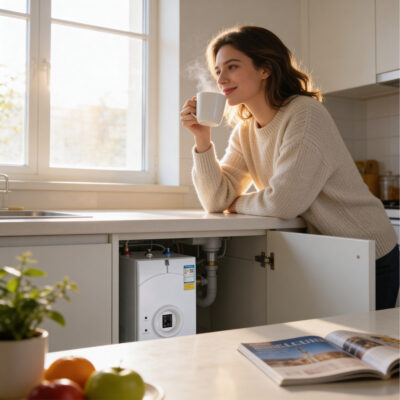
That’s especially true in Melbourne, where water conditions can vary enough to affect taste, scale build-up and long-term reliability. Filtration isn’t just about making tea taste cleaner. It protects the tank, valves, and heating surfaces that make the unit worth having in the first place.
Taste is only the first layer
Most buyers notice chlorine taste or odour first. That’s the visible part of the issue because it ends up in the cup.
The less visible part is what suspended minerals and sediment do inside the system. Over time, they settle on hot internal surfaces. Once scale starts building, the unit has to work harder to produce the same result.
Why Melbourne conditions matter
In harder-water areas, limescale isn’t an abstract maintenance topic. It’s a performance issue. A local setup should be selected with local water in mind, not copied from a generic overseas install guide.
That’s why many homeowners pair their dispenser with a purpose-built under-sink filter instead of treating filtration as an optional extra. If you want to compare local options, this guide to an under-sink water filter in Melbourne is a practical place to start.
Basic filters vs scale protection
Not all filters do the same job.
- Taste-focused filters improve flavour and reduce common odours.
- Sediment reduction helps stop fine particles from circulating through valves and fittings.
- Scale-oriented filtration helps reduce the mineral load that shortens service intervals.
A buyer who only thinks about drinking-water taste may choose too lightly. A buyer who only thinks about the appliance may overlook how much better the water can be for everyday use.
Filtration pays for itself in two ways. Better tasting water in the cup, and less internal stress on the appliance.
Where people go wrong
The common mistake is installing a high-end instant hot water dispenser on untreated supply water and assuming the unit will look after itself. It won’t.
The second mistake is fitting a filter once and forgetting it exists. Filters need to be changed on schedule. A neglected cartridge restricts flow and can create its own performance problems.
What works is simple. Choose filtration that suits your water, your usage and the specific dispenser model. That gives the unit the best chance of staying fast, clean-tasting and dependable.
Planning Your Instant Hot Water Installation
A smooth installation starts before the unit arrives.
The best buying decisions usually come from a quick check of the cabinet, power, plumbing and expected usage. Most install problems aren’t caused by the dispenser itself. They happen because the chosen model doesn’t suit the available space or the way the kitchen is used.
Start with the cupboard
Under-sink systems need more than just “some room”. They need practical room.
Check for the tank, filter head if fitted, hoses, power lead and enough access to service the unit later. A cabinet that looks spacious can become cramped fast once bins, pull-out trays and cleaning supplies are factored in.
Use this checklist before purchase:
- Measure height and depth: Look for obstructions such as waste pipes, shelving and drawer runners.
- Check access: A unit that fits tightly but can’t be reached for filter changes will become annoying quickly.
- Think about the tap position: The spout needs a sensible location above the sink, not just any spare hole in the bench.
Confirm power and plumbing
Most modern units are straightforward, but they still need the basics done properly.
- Power point nearby: The unit should have accessible power under the sink or in an adjacent compliant location.
- Cold water connection: The feed needs to suit the dispenser’s installation kit and fittings.
- Working isolation: Being able to shut the unit off cleanly makes later servicing much easier.
Size by actual use, not by guesswork
People often ask for a “small” or “large” unit. That’s not the useful question. A better question is how many cups you’ll need in a short period.
A couple in a home kitchen may only need steady convenience. A family with constant tea, coffee and cooking use needs stronger recovery. An office with a burst of demand at morning tea needs a unit that can handle several draws close together.
Don’t size for the average minute. Size for the busiest ten minutes of your day.
Renovation-friendly by design
These systems aren’t new to Australian kitchens. Instant hot water dispensers first gained popularity in Australia in the 1970s, and by the 1990s they were present in about 15% of Melbourne homes, according to the history summary on Wikipedia’s instant hot water dispenser page. That long history matters because today’s installation methods are well understood, especially in kitchen renovations.
DIY or plumber
Some owners are handy and can manage basic setup work around cabinetry or tap mounting. But plumbing connections, safe commissioning and warranty protection are where professional installation becomes the sensible choice.
A licensed plumber is the right move when:
- The sink cabinet is tight or awkward
- You’re combining filtration and hot water in one install
- The bench needs drilling or the tap layout is changing
- You want certainty around compliance and leak prevention
DIY usually works worst when someone underestimates how many parts need to coexist neatly under the sink. A clean installation isn’t just about making it work today. It’s about making future servicing possible without dismantling half the cabinet.
Understanding Energy Use Safety and Smart Features
People often assume a hot water unit sitting ready all day must be wasteful. In practice, that’s not how quality systems behave.
Modern dispensers rely on insulation, controlled reheating and precise thermostats. They aren’t heating a full kettle from cold each time someone wants one mug. That difference is what makes them practical for households and workplaces that use hot water repeatedly.
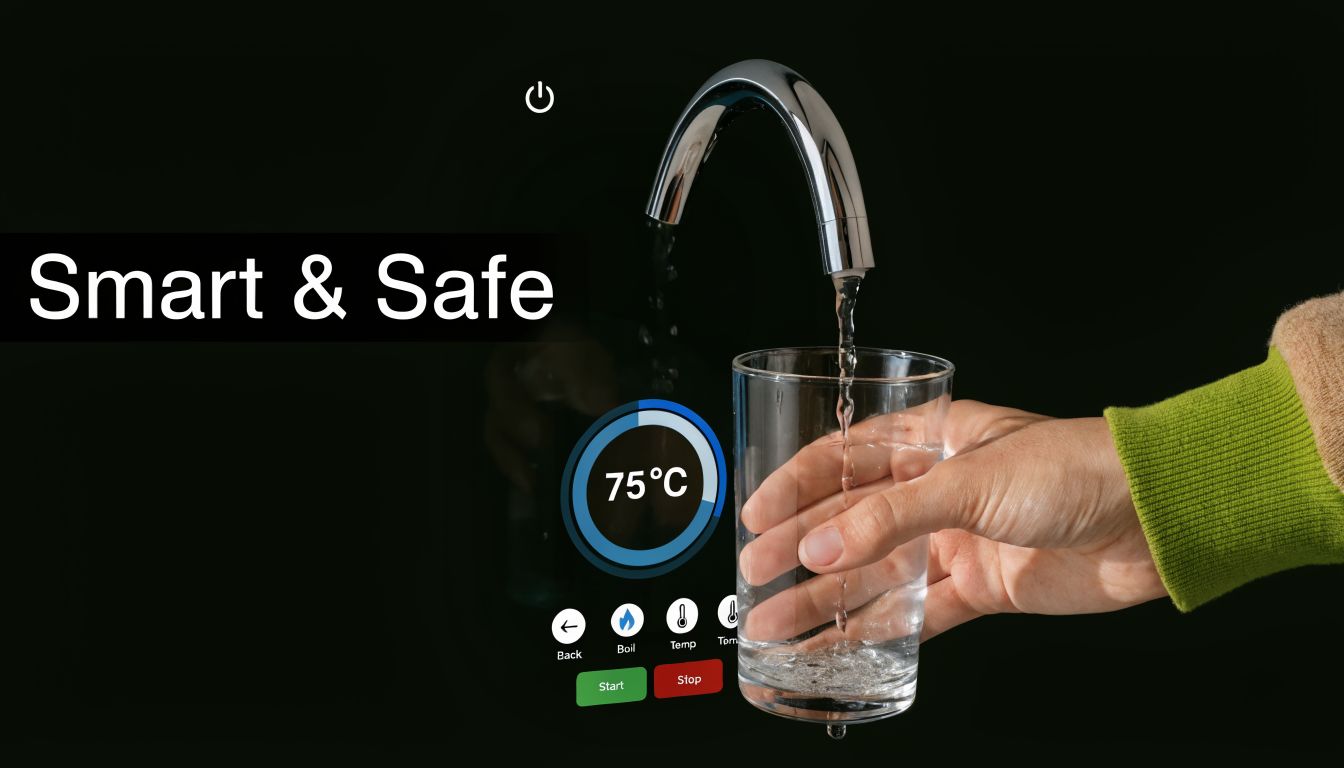
Energy use that matches real routines
This category has improved a lot. Premium models now offer additional features beyond holding temperature.
For example, Stiebel Eltron UltraHot Plus models deliver 34 cups per hour of 95°C water while using 750W, and their digital setback timers can cut standby energy losses by up to 30% in commercial settings, according to the Stiebel Eltron UltraHot Plus product page.
That matters more than it might sound. In a workplace or hospitality setting, overnight standby control can make the system far more sensible to run.
With many households already thinking harder about rising electricity prices, buyers are right to ask how an appliance behaves outside peak use hours, not just when it’s dispensing.
Safety features worth paying for
Boiling water demands good control. The better units don’t leave safety to chance.
Look for features such as:
- Child-lock controls: Helpful in family kitchens where curious hands are around the sink.
- Controlled flow delivery: Reduces splashing and sudden surges into the cup.
- Stable temperature management: Prevents unpredictable overheating behaviour.
- Dry-run or dry-start protection: Important where water supply interruptions can occur.
The cheapest-looking tap isn’t always the safest system once it’s installed and used daily.
Smart functions that are actually useful
Some “smart” features are fluff. Others solve real problems.
Altitude-sensing control is a good example in premium units because it adjusts boiling behaviour to local conditions rather than using a one-setting-fits-all approach. Setback timers are useful because they reduce unnecessary standby heating overnight. Memory settings can help in repeat-use commercial spaces.
A quick visual overview helps if you want to see how these systems are commonly positioned and used in real kitchens:
What works is buying smart features that reduce waste, improve safety or make the unit easier to live with. What doesn’t work is paying extra for controls you’ll never touch after the first week.
Troubleshooting and Proactive Maintenance
Most instant hot water dispenser faults don’t arrive out of nowhere. The unit usually gives warnings first.
Water flow slows down. The temperature starts drifting. The tap splutters. A harmless-looking drip becomes persistent. If you respond early, many issues stay small. If you leave them, a straightforward service call can turn into part replacement or a full strip-down.
The three symptoms owners notice first
Reduced flow often points to a filter issue, a valve restriction, or scale starting to narrow internal passages.
Inconsistent heat can come from thermostat problems, scale on heating surfaces, or a unit struggling under neglected maintenance.
Dripping at the spout may be as simple as expansion behaviour in some systems, but a persistent or worsening drip needs attention. Worn internals, pressure issues or scale interference can all be involved.
Melbourne’s hard water problem is real
Local ownership offers insights that generic advice online often overlooks. In Melbourne’s hard water areas, limescale buildup can cause a 20% to 30% efficiency loss within 12 months, and user forums show 40% of complaints relate to scale-induced failures, according to the InSinkErator Hot250 page referenced in the verified data.
That’s why a dispenser can seem fine at first and then slowly become sluggish. The unit hasn’t necessarily “failed”. It may be carrying mineral build-up that’s choking performance.
If your water tastes normal but the unit feels slower, don’t assume the element is dying. Scale often shows up as performance loss before it shows up as complete failure.
A maintenance routine that actually works
You don’t need to overcomplicate this. Most owners just need a repeatable schedule.
- Change filters on time: Old cartridges restrict flow and reduce water quality.
- Watch for flow changes: A slower stream is an early warning, not a minor annoyance.
- Flush when recommended: Regular flushing helps reduce build-up in suitable systems.
- Book descaling when needed: Hard water areas need a more deliberate approach than soft-water suburbs.
- Inspect fittings and hoses: Catching small leaks early protects the cabinet and the appliance.
What not to do
Don’t ignore a slow decline because the water is still technically hot. That’s how many units end up overworking for months.
Don’t attack every issue with a generic online fix. Different brands and models handle temperature control, valves and tank layouts differently. A cleaning step that suits one system may be wrong for another.
When to call for service
Call for help when the unit starts tripping power, loses heat completely, leaks internally, or keeps showing the same symptom after filter replacement and basic checks.
The best maintenance approach is boring by design. Keep water quality under control, replace consumables on time, and act on early symptoms. That’s what keeps an instant hot water dispenser running properly for years instead of becoming one more under-sink problem nobody wants to deal with.
Sourcing Genuine Parts and Expert Service in Melbourne
When a dispenser needs attention, the quality of the parts matters as much as the quality of the diagnosis.
That applies to filters, valves, thermostats, hoses, tap heads, elements and fittings. A substitute part might seem close enough on paper, but poor compatibility usually shows up later as leaks, erratic temperature behaviour, awkward installation or shortened service life. Genuine parts are the safer path when you want the system to perform the way the manufacturer intended.
Why local support makes a difference
Melbourne customers often need more than a box in the post. They need someone who understands local water conditions, common installation layouts, and the brands most often seen in homes, offices and hospitality settings across the metro area.
That’s where a specialist supplier is more useful than a generic appliance outlet. Ring Hot Water supplies and services instant boiling and chilled systems, repairs under-sink dispensers, and stocks genuine parts for brands including Zip, Stiebel Eltron, Boiling Billy, Birko, Insinkerator, Crown, Kwikboil, Everboil and others. That includes practical consumables and service items such as valves, elements, thermostats, flexible hoses, John Guest fittings and brass threaded fittings.
What to look for when ordering parts or booking service
- Brand match: Parts should suit the exact model, not just the brand family.
- Clear fault description: “No heat”, “dripping tap” and “low flow” lead to different likely causes.
- Access details: Under-sink photos and cabinet measurements save time.
- Serviceability: Some systems need parts only. Others need a technician to descale, test or recommission them safely.
For Melbourne homes and businesses, local installation and repair support can simplify the whole ownership experience. For customers elsewhere in Australia, access to the right part the first time is often what matters most.
If your kettle is becoming the most annoying part of the kitchen, or your existing unit needs a proper fix rather than guesswork, Ring Hot Water is a practical place to start. You can browse instant boiling taps, wall-mounted boilers, filters and genuine spare parts online, or organise installation, repair and maintenance support across Melbourne.

