
Uncategorized
Boiling Billy Instant Hot Water: The Ultimate 2026 Guide
Jun
You're probably reading this because you're tired of the same small delay, over and over. The kettle goes on. You wait. Someone else needs hot water too. The bench gets crowded, the cord snakes across the splashback, and the whole routine feels older than the kitchen around it.
That's where a Boiling Billy instant hot water system changes the rhythm of the day. You turn the tap, and the hot water is already there for tea, coffee, cooking, and quick prep work. In homes, that means less waiting in the morning. In offices, it means fewer people hovering around a slow kettle. In hospitality settings, it means smoother service and less clutter.
The End of the Kettle Your Ultimate Guide to Boiling Billy
The appeal of Boiling Billy is simple. It removes the pause between needing boiling water and getting it.
That sounds like a small improvement until you live with it. A parent filling a saucepan before school drop-off notices it. An office manager notices it when staff stop queuing for tea. A café prep area notices it when bench space opens up because the bulky kettle or urn is gone.
Boiling Billy also has a very Australian backstory. The concept traces its roots to the traditional Australian pot used to boil water over an open fire, and Boiling Billy systems have been operating in Australia for over 35 years since the early 1990s, becoming a familiar fixture in homes and commercial fit-outs across the country, according to Ring Hot Water's Boiling Billy history overview.
That history matters because it explains why the name still comes up so often in conversations about instant boiling water. What started as a basic way to make boiling water evolved into a concealed, purpose-built appliance designed for modern kitchens and workspaces.
Why people switch
Most customers don't buy one because they're fascinated by the technology. They buy one because they want fewer interruptions.
- Morning speed: Coffee, tea, oats, or a quick saucepan fill without standing around.
- Cleaner benches: No kettle parked permanently near the power point.
- Less fuss in shared spaces: Offices and staff rooms run better when people can get hot water and move on.
A good boiling water unit doesn't feel flashy after a week. It just feels normal, and that's usually the sign it suits the space.
How Boiling Billy Systems Provide Instant Hot Water
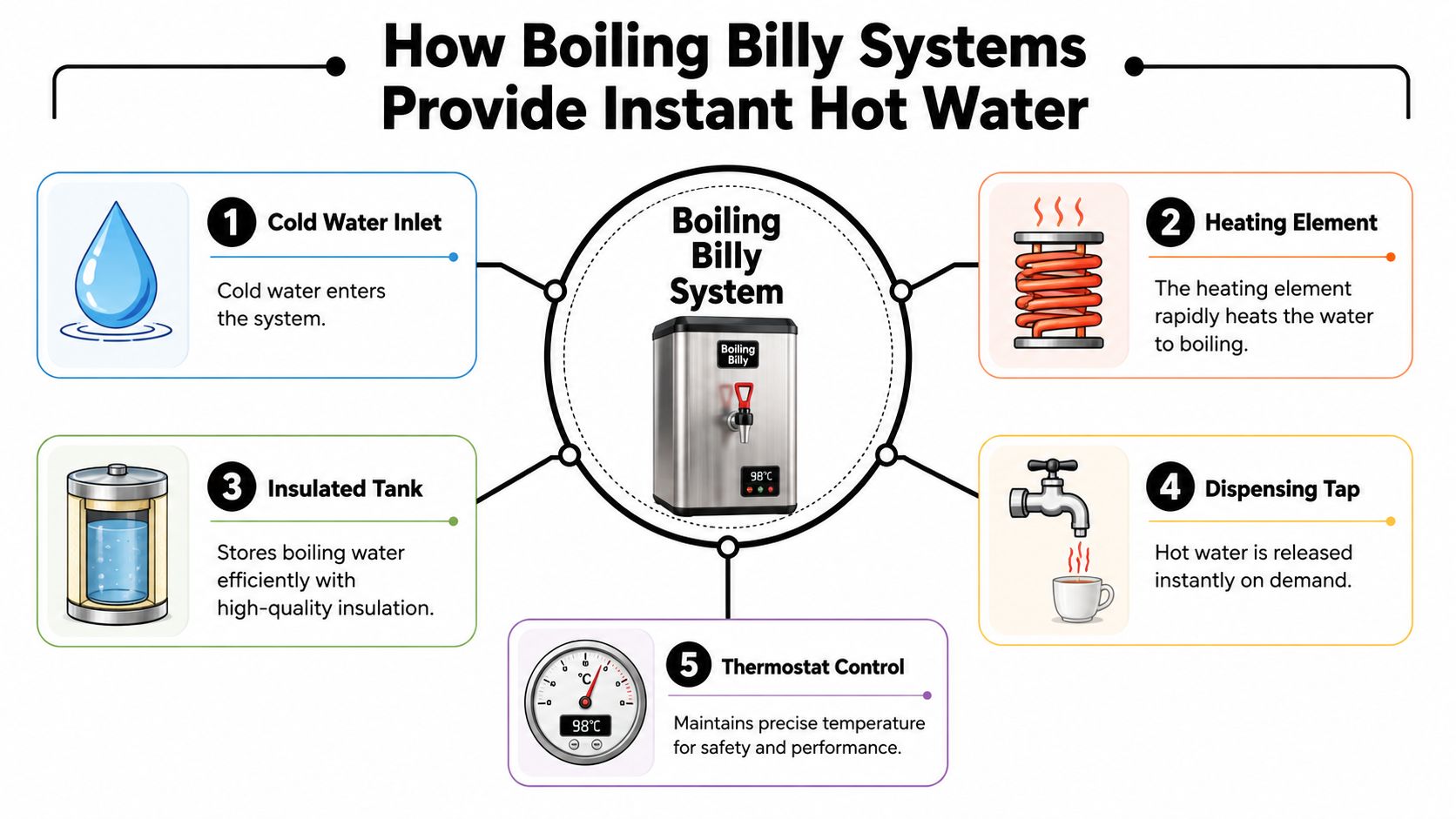
A Boiling Billy system is easiest to understand if you think of it as a compact under-sink hot water reserve. It isn't trying to heat the whole house. It has one job. Keep a small amount of water ready so the tap can deliver it immediately.
The basic sequence
Here's what happens in plain language.
- Cold water enters the unit from the mains supply.
- The tank stores that water in a compact chamber hidden under the sink or mounted nearby, depending on the model.
- An internal element heats the water and keeps it near boiling so it's available when needed.
- You activate the tap and the stored hot water comes out straight away.
- Fresh cold water refills the tank, ready for the next heating cycle.
That's why it feels instant at the tap. The unit has already done the waiting for you.
Why it feels different from a kettle
A kettle starts from cold every time. Even if you only need one mug, it often gets overfilled, boiled, and left on the bench until the next person repeats the process.
A Boiling Billy system behaves more like a well-insulated mini tank. It holds hot water in reserve and tops itself up after use. That makes it better suited to repeated small jobs through the day, especially in kitchens where people want hot water often, not all at once.
If you're comparing this with other instant water setups, it also helps to understand where dedicated boiling systems sit alongside broader tankless instant water heater options. They solve different problems. A tankless whole-of-home unit handles larger hot water duties, while a Boiling Billy focuses on one point of use with near-immediate delivery.
What usually confuses people
The most common misunderstanding is this. People assume “instant” means the water is being heated from cold at the exact second they open the tap.
That isn't how these systems usually work. The speed comes from stored readiness, not from magic. The unit keeps water hot in advance, then replenishes after dispensing.
Practical rule: If you want fast cups of tea, quick saucepan fills, and reliable performance at one sink, a dedicated boiling water unit is the right style of appliance.
Another point of confusion is the tap itself. The tap is only the visible part. The main work happens in the tank, element, thermostat, and control components tucked out of sight below.
Key Benefits for Homes Offices and Hospitality
People often start by asking whether a Boiling Billy is “worth it”. The better question is whether your space loses time, bench room, or convenience because hot water is still tied to a kettle or urn.
For many homes and workplaces, the answer is yes.
Time back in your day
The first benefit is the one everyone notices immediately. You stop waiting.
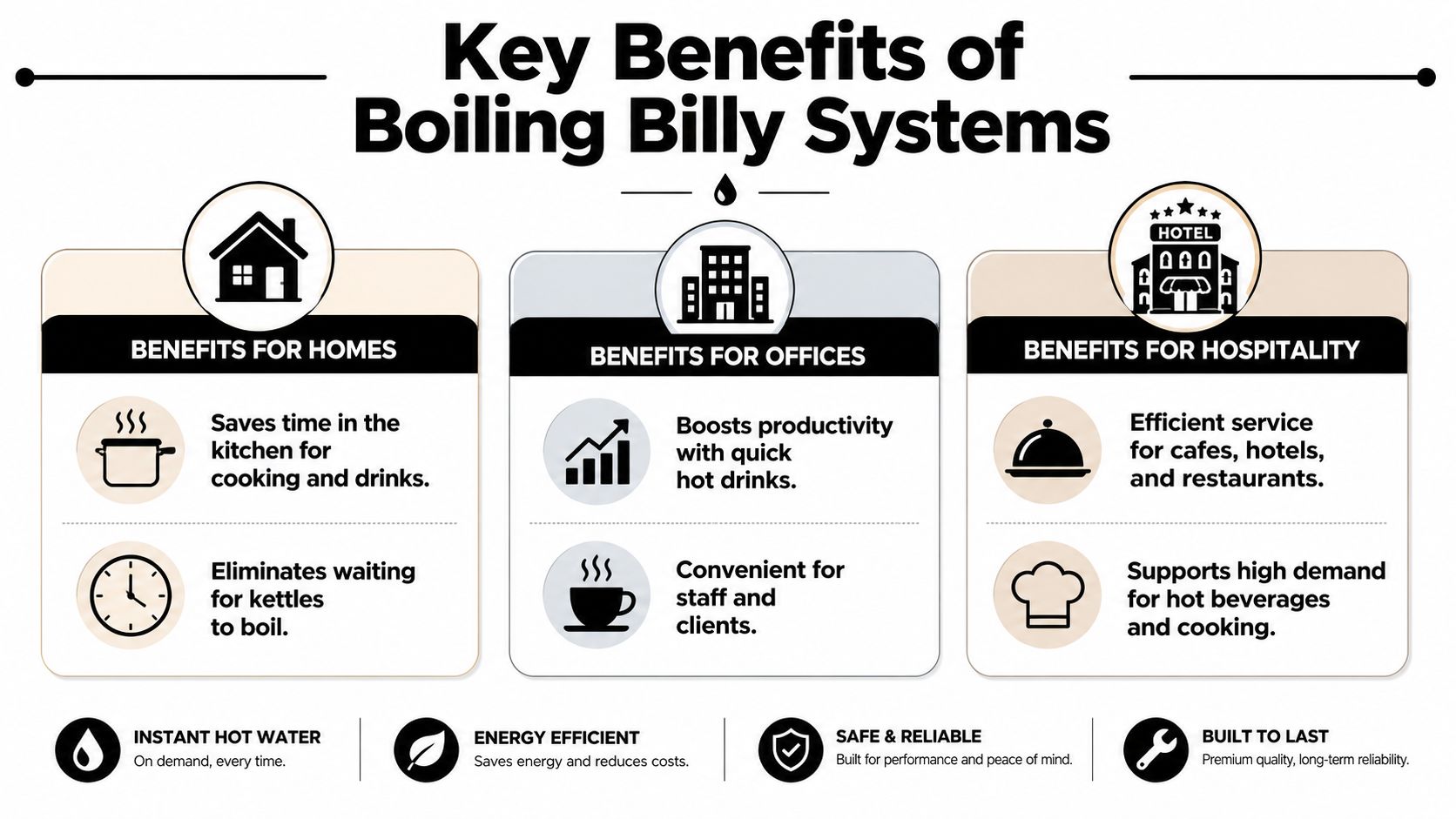
At home, that might mean filling a pot for pasta or making back-to-back hot drinks without a second thought. In an office, it means staff can get tea and coffee quickly and return to work instead of standing in line around a kettle. In hospitality, it helps during prep and service when repeated access to hot water matters.
Better day-to-day efficiency
The second gain is practical efficiency. A kettle encourages guesswork. People fill it too high, boil more than they need, and often re-boil leftover water later.
A boiling water unit is better matched to real use. You draw what you need, when you need it. That tends to create a tidier routine, especially in shared kitchens where small waste patterns build up across the day.
More bench space
Kettles and commercial urns claim permanent territory. They need a safe place, a nearby power point, and enough clearance so they don't become annoying.
An under-sink boiling system gives much of that space back. What remains above the bench is usually just the tap, which looks cleaner and makes the whole kitchen feel less crowded.
Safer in busy spaces
A kettle is portable, top-heavy, and easy to place badly. In homes with children, busy offices, or commercial settings, that's not ideal.
Many boiling water taps use deliberate activation methods, such as push-and-turn or other safety-focused controls. That reduces the risk of someone brushing against a kettle, lifting a heavy vessel full of boiling water, or knocking one off a crowded bench.
Where each setting benefits most
- Homes: Fast drinks, quicker meal prep, and a neater kitchen layout.
- Offices: Smoother staff-room flow and easier drink service for visitors.
- Hospitality: Consistent access to hot water without relying on separate countertop equipment.
The strongest benefit isn't just speed. It's removing a repetitive friction point that people had accepted as normal.
Choosing Your Boiling Billy Model and Specifications
Choosing the right model isn't about picking the fanciest unit. It's about matching the appliance to the way the space uses hot water.
A quiet household kitchen has different demands from a boardroom. A café back-of-house setup has different priorities again. The right choice comes from asking a few practical questions before anyone orders a unit.
Start with the installation style
Most buyers choose between under-sink and wall-mounted formats.
An under-sink model suits kitchens where appearance matters and cabinet space is available. The tank stays hidden, and the bench stays clean. A wall-mounted unit is often more sensible in staff rooms, utility spaces, and commercial areas where access, visibility, and serviceability matter more than visual integration.
Here's a simple comparison framework.
| Model Series | Type | Initial Cup Delivery | Cups Per Hour | Ideal For |
|---|---|---|---|---|
| Under-sink compact series | Under-sink | Varies by model | Lower to moderate output | Small households, apartment kitchens, light-use office kitchens |
| Under-sink high-demand series | Under-sink | Varies by model | Moderate to higher output | Family homes, shared kitchens, meeting spaces |
| Wall-mounted office series | Wall-mounted | Varies by model | Higher output | Staff rooms, boardrooms, lunchrooms |
| Wall-mounted commercial series | Wall-mounted | Varies by model | Higher sustained output | Hospitality prep zones, service areas, larger workplaces |
The exact figures depend on the specific model you're considering, so it's worth checking the product sheet rather than guessing from cabinet size or tap design.
Think about peak demand, not average use
Many buyers misunderstand a key point. They think about how many hot drinks they make across a day. What matters more is how many people need boiling water in the same short window.
A household may only need a modest-capacity unit because use is spread out. An office kitchen can need a stronger recovery rate because everyone wants a drink at roughly the same time. In hospitality, repeated short draws during prep can matter more than one large burst.
Ask these questions before you choose
- How many users share the unit: One sink for a couple is different from a lunchroom used by a whole team.
- When demand spikes: Morning rush, lunch break, and service prep are usually the pressure points.
- Where the unit will sit: Under-sink systems need suitable cabinet room. Wall-mounted units need sensible placement and service access.
- What else is under the sink: Filters, bins, cleaning products, and pipework can reduce usable space quickly.
Don't ignore support and parts access
The model itself is only part of the decision. The smarter question is what happens later if a tap needs servicing or a thermostat fails.
That matters even more in commercial kitchens and catering environments where downtime becomes disruptive fast. If you're planning a larger fit-out, this broader guide to selecting catering equipment is useful because it frames appliance choice around workflow, maintenance, and suitability, not just the initial purchase.
A practical way to narrow it down
If you're stuck between two sizes, don't start with litres on paper. Start with usage habits.
A good shortlist usually comes from this sequence:
- Map the setting: Home kitchen, office tea point, or hospitality workspace.
- Identify the busy period: That's when the unit proves itself.
- Measure the available space: Especially under-sink clearance and nearby services.
- Check servicing reality: Can a technician access it easily later?
That approach avoids the two classic mistakes. Buying too small for a busy shared space, or buying a heavy-duty unit for a kitchen that only needs straightforward household performance.
Installation Requirements and Essential Maintenance
Installation is where good systems either start well or start causing trouble. A Boiling Billy unit may look simple once it's running, but the work behind the scenes has to be right.
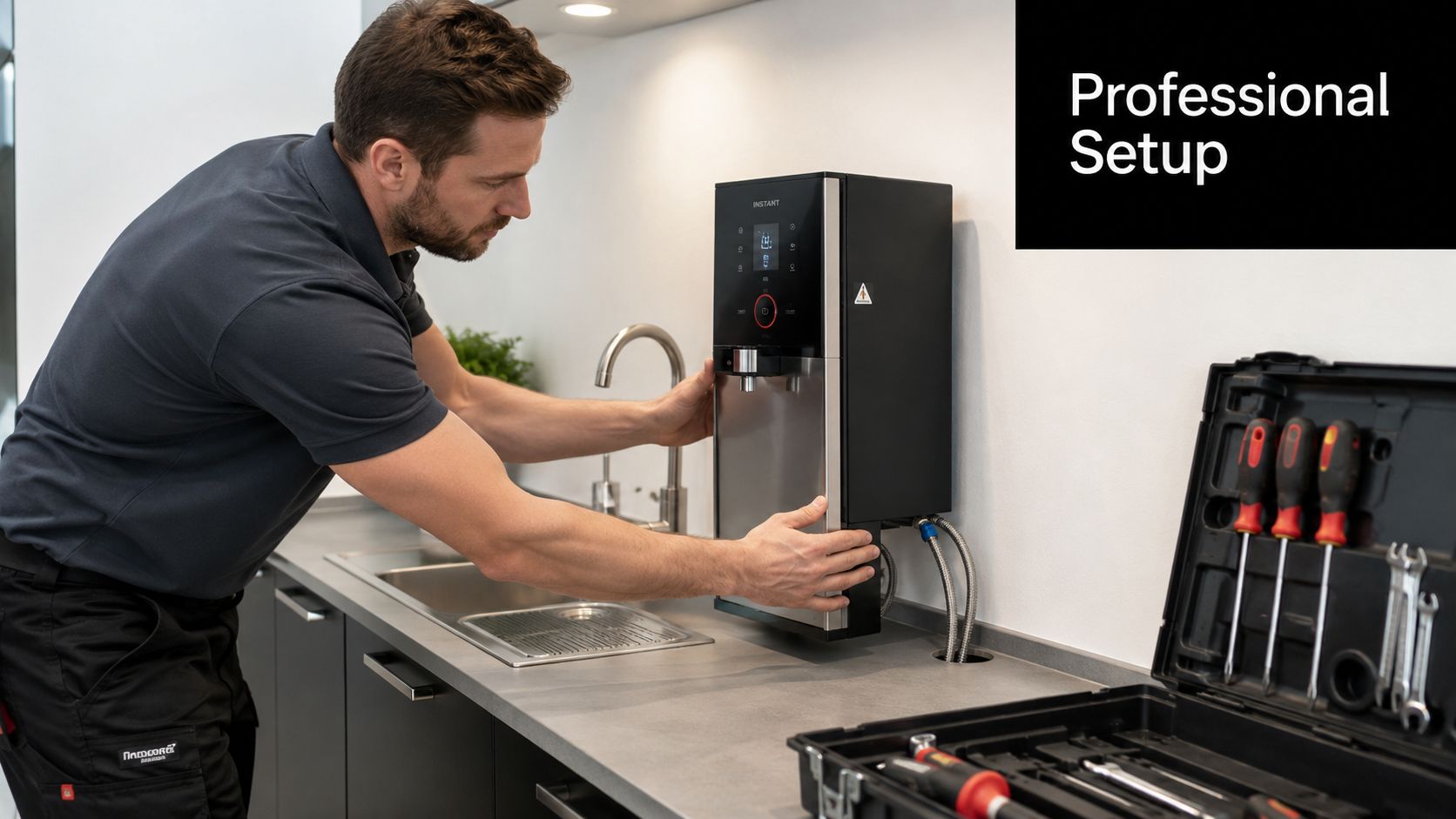
For Australian installations, the key points are pressure control and electrical compliance. A Boiling Billy brochure specifies that a 350 kPa pressure limiting valve must be fitted for maximum efficiency, and the installation manual requires a 220–240 V grounded 13 A switched outlet under the sink. It also states that systems with mains pressure above 5 bar should use a pressure reducing valve, as noted in the Boiling Billy product brochure and installation guidance.
Why pressure matters so much
A lot of people assume the heating element is the whole story. It isn't. Water pressure has a direct effect on how the unit behaves.
Too much pressure can put extra strain on valves and connections. That can lead to poor dispensing behaviour, unnecessary wear, and leak risk. The pressure limiting or reducing valve isn't a nice extra. It's part of making the system operate as intended.
If you're planning the water connection layout, it also helps to understand the role of a proper shut-off valve in a hot water setup. Good isolation makes servicing cleaner and less disruptive later on.
What a proper install usually includes
A compliant installation normally involves both plumbing and electrical checks. In practice, that means:
- Cold water connection: The unit must be fed correctly from the mains supply.
- Pressure control hardware: The specified valve setup needs to suit site conditions.
- Power access: The switched outlet must be correctly located and suitable for the appliance.
- Clear service access: Filters, hoses, and components shouldn't be boxed in so tightly that routine work becomes difficult.
If a unit is squeezed into a cabinet without room to service it, the problem won't show on day one. It shows up when a filter, hose, or internal part needs attention.
Here's a useful visual example of the sort of installation approach technicians follow in the field.
The maintenance most owners can do
Once installed properly, routine care is straightforward.
- Keep the tap clean: Wipe the spout and handles regularly so residue doesn't build up.
- Watch for behaviour changes: Drips, slower flow, or unusual sounds are worth noticing early.
- Keep the cupboard organised: Don't crush hoses or crowd the unit with cleaning supplies.
The maintenance a technician should handle
Professional servicing is different from everyday cleaning. It usually covers the parts that affect performance and lifespan.
Common service tasks include:
- Filter replacement: Water quality and usage affect how often this is needed.
- Descaling where required: Especially in areas with harder water.
- Inspection of valves and connections: Small issues are easier to fix before they become leaks.
- Operational checks: Thermostat, element behaviour, and dispensing performance should be verified.
A simple rule works well here. If the task involves opening the unit, disconnecting services, or replacing internal parts, it's service work, not casual DIY.
Troubleshooting Common Issues and Finding Genuine Parts
Even reliable units can develop faults. The trick is knowing the difference between a basic check and a repair that needs proper parts and technical work.
Start with the symptom, not the assumption. “It's broken” is usually too broad to be useful.
If the unit won't dispense
Work through the obvious items first.
- Check the power: Make sure the switched outlet is on.
- Check the water supply: Confirm the isolation point is open.
- Check recent changes: A cabinet clean-out, plumbing work, or moved items under the sink can disturb hoses or switches.
If the tap still won't deliver water, the issue may sit deeper in the valve, internal feed path, or control components.
If the water isn't hot enough
When temperature drops off, there are a few likely directions.
A thermostat may be out of adjustment. The heating element may not be performing properly. Scale inside the unit can also interfere with efficient heating over time, depending on local water quality.
That's where many owners waste time. They focus on the tap because it's visible, but the problem often sits in the hidden hardware.
If the tap drips or behaves oddly
A dripping tap often points to wear in a washer, valve assembly, or sealing surface. Strange flow can also come from pressure-related issues or component wear rather than the tap body alone.
Small drips rarely stay small. In boiling water systems, minor valve wear can turn into bigger service issues if it's ignored.
Why genuine parts matter
This is the point where a lot of trouble starts. Someone finds a part that “looks about right”, fits it, and then the unit behaves inconsistently or fails again.
Boiling water systems are less forgiving than ordinary kitchen tapware. Temperature, pressure, seals, and electrical components all work together. A generic replacement may fit physically but still create poor performance, nuisance leaks, or unsafe operation.
That's why genuine parts are the safer path for repairs. If you need components such as taps, elements, thermostats, or valves, it's better to source them from a dedicated Boiling Billy genuine parts range rather than match by appearance alone.
A simple decision rule
Use this as a rough guide.
- Basic owner checks: Power on, water on, cupboard clear, obvious drips noted.
- Service call territory: Internal faults, temperature problems, replacement of valves, elements, thermostats, or any persistent leak.
- Parts buying rule: If the exact part identification is uncertain, confirm it before ordering.
That approach saves time and usually avoids the common cycle of replacing the wrong component first.
Why Ring Hot Water Is Your Boiling Billy Specialist
Owning a boiling water system is easiest when one supplier can help with the full life of the unit. Selection, installation, maintenance, and spare parts all connect. If one part of that chain is weak, the owner feels it later.
That's why specialist support matters more here than it does with a basic kettle. A Boiling Billy system has plumbing, electrical, pressure, and service considerations that need to line up properly from the start.
For Melbourne customers, that usually means getting the unit matched to the space and installed with the practical details sorted properly. For trade customers and interstate buyers, it means being able to identify the correct replacement component without guesswork. Ring Hot Water operates in that specialist category, supplying instant boiling and chilled water products, servicing systems locally in Melbourne, and offering parts access online for customers around Australia.
What customers usually need help with
Some need help choosing between an under-sink and wall-mounted setup. Others need a replacement tap, thermostat, or valve for an existing unit. Offices often need support that keeps shared kitchens running with minimal disruption. Hospitality sites usually care most about reliability and service access.
Those are different jobs, but they all benefit from dealing with people who work with these systems regularly rather than treating them like generic appliances.
Why that specialist focus helps
A specialist doesn't just sell a box. They understand cabinet constraints, pressure control, servicing access, and the difference between a quick fix and a proper repair.
That matters because most long-term problems with boiling water units come from one of three places:
- The wrong model for the demand
- An installation detail that was skipped
- A repair done with the wrong part
Get those three things right and the ownership experience is usually straightforward.
If you need advice on a Boiling Billy instant hot water system, replacement parts, or support for installation and repairs, contact Ring Hot Water for practical help suited for Australian homes, offices, and commercial spaces.

