
Uncategorized
Boiling Billy Hot Water: A Melbourne Guide for 2026

Jun
A lot of people start looking into Boiling Billy hot water after the same kind of morning. The staff room kettle is already on, someone else is waiting with a mug, the urn is half empty, and the kitchen bench is cluttered with appliances that all solve the same problem badly. At home, it's similar. You want tea, coffee, or hot water for cooking, and you're still waiting for a kettle to finish doing what a plumbed-in system can do on demand.
In Melbourne, that daily delay adds up fast in offices, clinics, workshops, and busy family kitchens. People don't usually need more gadgets. They need one system that delivers hot water properly, fits the space, and doesn't become a maintenance headache six months later.
That's where a Boiling Billy style unit starts to make sense. It isn't just about convenience. It's about reclaiming bench space, cutting out the kettle queue, and installing something built for repeat use in a real kitchen or staff area.
The End of the Kettle Queue
In a small office, the problem shows up around the same time every day. Morning tea hits, three people head to the kitchenette, and the kettle becomes the bottleneck. Someone fills it too much. Someone else only needs one cup. Then the next person has to wait through the whole cycle again.
At home, it's less dramatic but just as annoying. You're making coffee, the kids want warm drinks, and you need hot water for a quick food prep job at the same time. A kettle handles one request at once. A proper instant hot water system changes that rhythm.
Where the old setup falls short
Kettles and urns still have a place, but they come with trade-offs.
- Kettles eat bench space: In tighter Melbourne kitchens, every appliance competes for room.
- Urns suit bulk use, not daily flexibility: They're useful in some workplaces, but they're bulky and often excessive for mixed day-to-day demand.
- Both create waiting time: That delay is exactly what people notice once they switch to a plumbed-in unit.
In practice, most buyers aren't chasing a luxury item. They're trying to remove friction from a kitchen that gets used constantly.
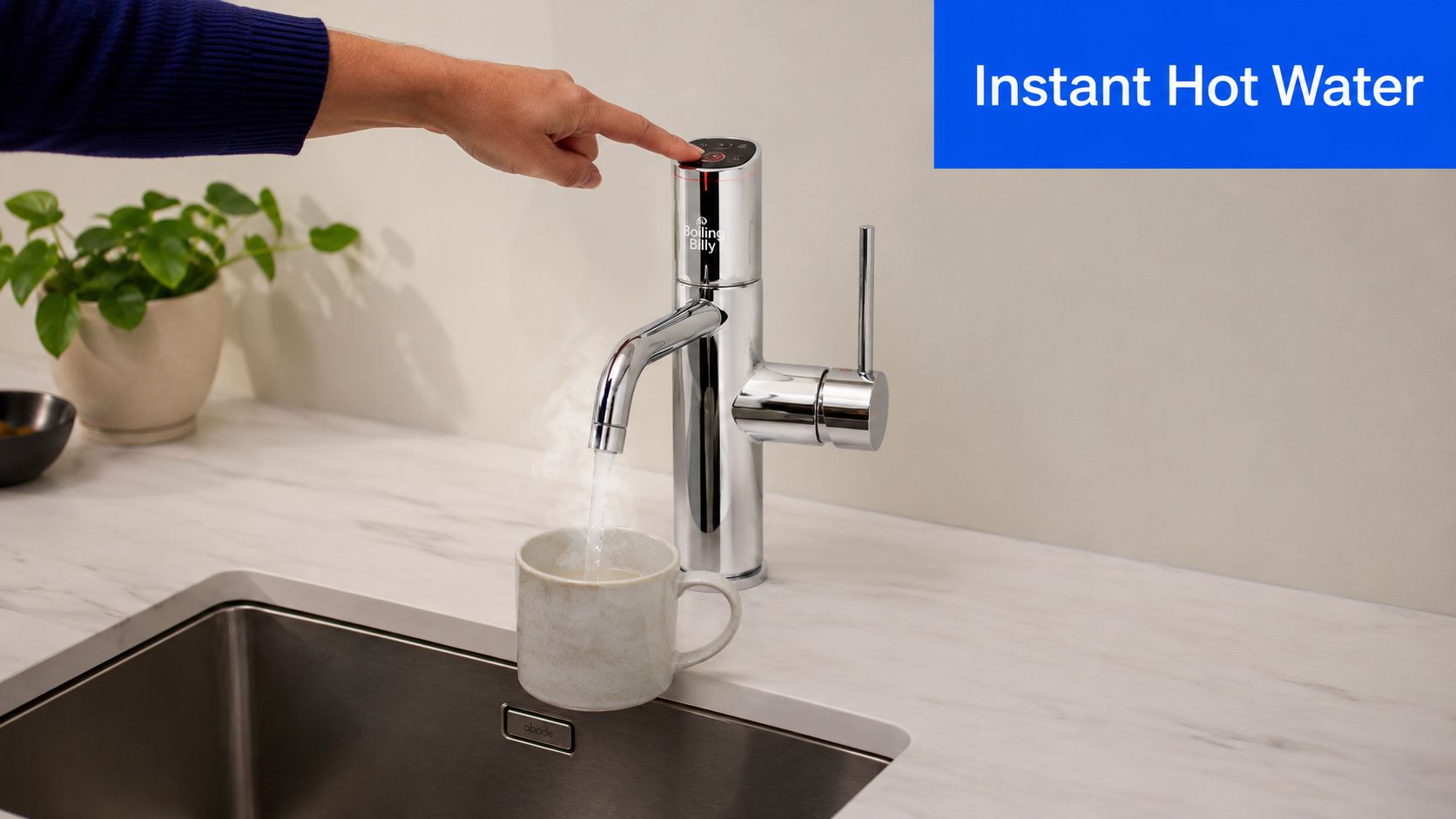
A Boiling Billy hot water system addresses the basic issue directly. You turn the tap and get filtered near-boiling water without filling, lifting, waiting, or reboiling. In offices, that means staff move through the break area faster. In homes, it means the kitchen works more like it should.
Why Melbourne buyers tend to move to a tap system
Melbourne properties often have one of two constraints. Either the kitchen is compact, or the kitchen gets heavy daily use. Sometimes both are true. That's why these units aren't just popular in corporate fit-outs. They also suit renovated homes, consulting rooms, lunchrooms, showroom kitchens, and shared workspaces.
The useful part isn't the novelty. It's the consistency. Once the unit is installed properly and matched to the actual level of use, it becomes one of those appliances people stop thinking about because it does its job.
What Exactly Is a Boiling Billy System
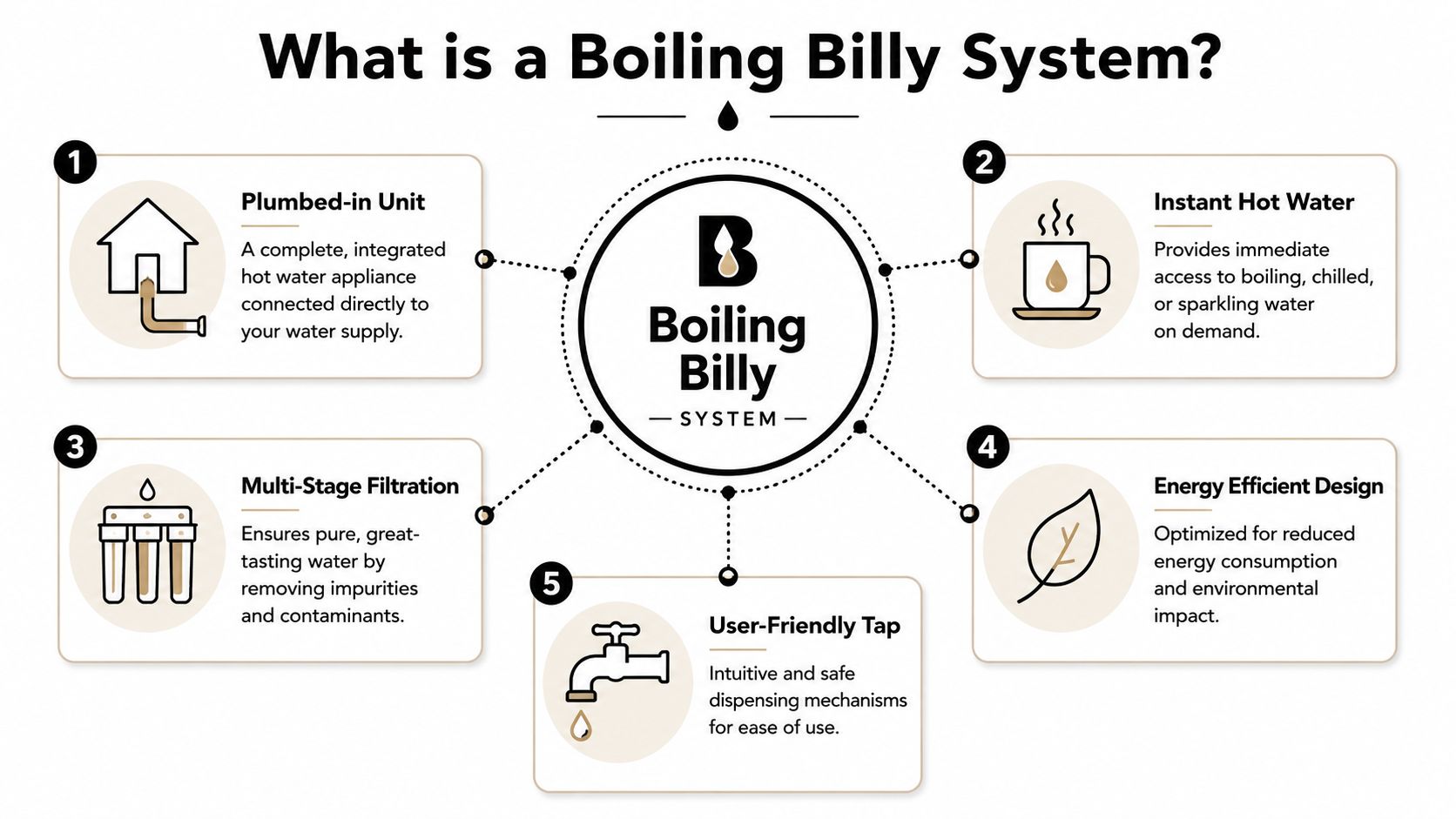
A Boiling Billy system is not just a fancy tap. It's a complete appliance. The visible tap is only the front end. The working parts usually sit under the sink or on the wall, depending on the model, and the system connects to your cold water supply, power, and filtration.
That matters because a lot of buyers assume they're comparing a boiling tap with a standard mixer. They're not. They're comparing a plumbed-in hot water appliance with a kettle, urn, or separate dispenser.
The category also has a clear Australian background. Billi says the concept traces back to the traditional “pot used to boil water over an open fire” and notes it has been operating in Australia for over 35 years in this space, which helps explain why these systems are now common in local homes and commercial fit-outs (Billi and the history of the billy).
What it includes
A typical setup usually combines several parts into one system:
- A dispensing tap: This is the part on the bench or sink.
- A heating unit: Usually concealed below the bench in residential installs, though larger commercial systems may be wall-mounted.
- A filter assembly: This improves water quality and helps protect the system.
- Safety controls: These are designed to make dispensing more controlled than a kettle being carried across a room.
How it differs from other options
A kettle is portable, cheap, and simple. It's also slow, easy to overfill, and constantly in the way.
An urn can serve a crowd, but it often suits occasional volume rather than a polished everyday kitchen. It also takes up visible space and doesn't integrate neatly into a fit-out.
A Boiling Billy style system is different because it's built into the space. That changes how the kitchen works.
| Appliance | Main strength | Main limitation |
|---|---|---|
| Kettle | Simple for occasional use | Waiting time and bench clutter |
| Urn | Useful for bulk hot water | Size and poor fit for modern kitchens |
| Boiling Billy system | Instant, integrated, filtered delivery | Needs proper installation and maintenance |
Practical rule: If the kitchen sees repeated hot-water use every day, a plumbed-in unit usually makes more sense than adding another benchtop appliance.
How Your Boiling Billy Delivers Instant Hot Water
Users don't need every technical detail. They do need to know why the system feels immediate, why it isn't just “normal hot water,” and why proper setup matters.
The basic process
The sequence is straightforward.
- Cold water enters the unit from the mains supply.
- The water passes through filtration before it's stored or dispensed.
- The system heats and holds water in a compact insulated reservoir so it's ready when you open the tap.
- The tap dispenses on demand without waiting for a full heating cycle every time.
That stored, controlled approach is what makes the system feel instant. A kettle has to start from scratch with each boil. A Boiling Billy style appliance is already prepared for the next draw-off.
Why the temperature sits just under a full boil
Modern units in this category are engineered for near-boiling delivery, not a rolling stovetop boil. One independent source reports a minimum setting of 80°C, a maximum of 98.9°C, and a default hot-tap setting of 98.5°C, which is just under water's 100°C boiling point at sea level (temperature range for a Billi tap).
That's important for two reasons. First, it's far hotter than ordinary household hot water. Second, it gives fast beverage-ready water without relying on a kettle cycle.
For most users, that's exactly the sweet spot. Tea, coffee, and quick kitchen tasks don't suffer because the water is fractionally below a rolling boil. What you gain is controlled, repeatable delivery at the tap.
What works better than a standard hot water line
A standard hot water service isn't designed to do this job. It feeds showers, basins, and general domestic use. A dedicated instant hot water appliance is built for immediate high-temperature dispensing through a specific tap and control system.
If you're comparing product types, this guide to an instant hot water tap is useful because it shows the difference between a dedicated appliance and a regular plumbing fixture.
The real advantage isn't that the water is merely hot. It's that the system holds a precise serving temperature ready for use.
Choosing the Right Boiling Billy Model for Your Needs
At 10:15 in a Melbourne office, the problem shows up fast. Three people want tea, two want coffee, and the kitchen tap that looked fine on the quote suddenly feels slow. That is usually not an installation fault. It is a sizing mistake.
The right Boiling Billy model starts with peak demand, the available cupboard or wall space, and the way the room is used. In Melbourne homes, I usually see short bursts in the morning and evening. In offices, demand often lands in one tight break window. That difference should drive the model choice more than finish, tap style, or brochure wording.
Size the unit for peak use
A home kitchen can often manage well with a compact under-sink unit because people draw water at different times. A staff room is different. If ten or fifteen people use it within a few minutes, a small unit can recover too slowly and the queue starts again.
Billi's own guide to under-counter instant hot water heaters sets out a useful planning range, with systems suited to different user counts and cup volumes across home and workplace settings (under-counter instant hot water heater capacity guide).
That is the better way to compare models. Start with how many cups are likely to be drawn during the busiest period, then check whether the unit can keep up without long recovery time.
Under-sink or wall-mounted
For houses, apartment kitchens, and smaller office kitchens, under-sink units are usually the better fit. They keep the bench tidy and suit spaces where appearance matters and demand is moderate. If you are comparing options in that category, these under-sink hot water systems are the place to start.
Wall-mounted units suit harder-working areas. I recommend them more often in warehouses, school staff rooms, church kitchens, canteens, and back-of-house hospitality spaces where output matters more than hiding the unit.
Boiling Billy Model Comparison
| Feature | Under-Sink Models (e.g., Billi Quadra) | Wall-Mounted Models (e.g., Boiling Billy BB40) |
|---|---|---|
| Installation style | Hidden under bench with tap above | Mounted on wall in service area |
| Best fit | Homes, boardrooms, small offices | Canteens, staff rooms, hospitality areas |
| Visual impact | Minimal | More commercial in appearance |
| Throughput approach | Good for moderate daily use | Better for repeated high-demand service |
| Space trade-off | Uses cupboard space | Uses wall space but frees cupboards |
When a commercial unit is the right call
The Boiling Billy BB40 sits firmly in the commercial category. Duratap lists it with a 40-litre tank, a rating of 200 cups per hour based on 200 mL serves, and dimensions of 775 mm x 600 mm x 250 mm (Boiling Billy BB40 specifications).
Those figures matter because they answer practical questions. Can it ride through a break-time rush? Will it physically fit where you want it? Is the wall strong and accessible enough for a proper install? In older Melbourne buildings, that last point matters more than many buyers expect.
A practical way to choose
Use these checks before you settle on a model:
- Home kitchen: Check cupboard room, filter access, and whether the family needs high output or just fast convenience.
- Small office or meeting room: Count likely users in the busiest 10 to 15 minutes, not across the full day.
- Larger workplace: Choose for simultaneous demand at smoko and lunch.
- Hospitality or service area: Prioritise output, refill speed, and easy access for cleaning and servicing.
If you want boiling and chilled water from one point, choose based on both habits. In Melbourne offices, that setup often makes sense because it covers tea and coffee on one side and drinking water on the other. Ring Hot Water commonly helps clients sort that choice out by looking at the site, the likely traffic, and how much room is available under the bench or on the wall.
A simple rule applies. If people regularly wait for the unit during the busiest part of the day, it was undersized from the start.
Melbourne Installation What to Expect
Installation is usually simpler than people fear, but it still needs planning. A boiling water unit has to fit physically, connect correctly, and operate safely in a kitchen that may already be crowded with waste bins, cleaning products, and existing plumbing.
What needs to be ready
Before installation day, check the basics.
- Under-sink clearance: The cupboard has to suit the size and shape of the unit, not just the tap.
- Cold water access: The system needs a practical connection point.
- Power availability: A dedicated outlet is often part of a tidy, compliant install.
- Service access: Filters and parts need to be reachable later.
In Melbourne homes, older cabinetry can be the main issue. In offices, it's often the opposite. The cabinetry is modern, but the services inside the cupboard are crowded by other equipment.
Local conditions that matter
Water quality, scale build-up, and general service conditions vary across Melbourne suburbs. That doesn't mean every installation becomes difficult. It does mean the right filter choice and a clean plumbing setup matter from the start.
A rushed install usually causes the same long-term problems. Awkward hose routing, hard-to-access filters, poor tap positioning, and not enough thought given to maintenance access.
Why professional installation matters
These systems combine plumbing, electrical supply, heating components, and filtration. That's why they shouldn't be treated like a DIY mixer-tap swap.
A proper install does a few things at once:
- It protects the appliance.
- It reduces the chance of nuisance faults.
- It helps keep warranty issues straightforward.
- It makes later servicing less painful.
The cleanest installations are the ones that look boring. No sharp bends, no stretched hoses, no crowded power leads, and no guesswork about shut-off access.
Maintenance and Common Troubleshooting Steps
Most Boiling Billy problems don't begin with a dramatic breakdown. They start with a small symptom. Slightly slower flow. Water not quite as hot. A drip that seems minor. A reset that fixes the unit once, then becomes a routine.
That's why troubleshooting matters. Existing guidance online is often too generic. Users see leaks, tripped breakers, or inconsistent flow and aren't sure whether the issue is simple, recurring, or unsafe to keep ignoring. That gap is a known problem in this category (Boiling Billy troubleshooting issues and fault patterns).
What you can check yourself
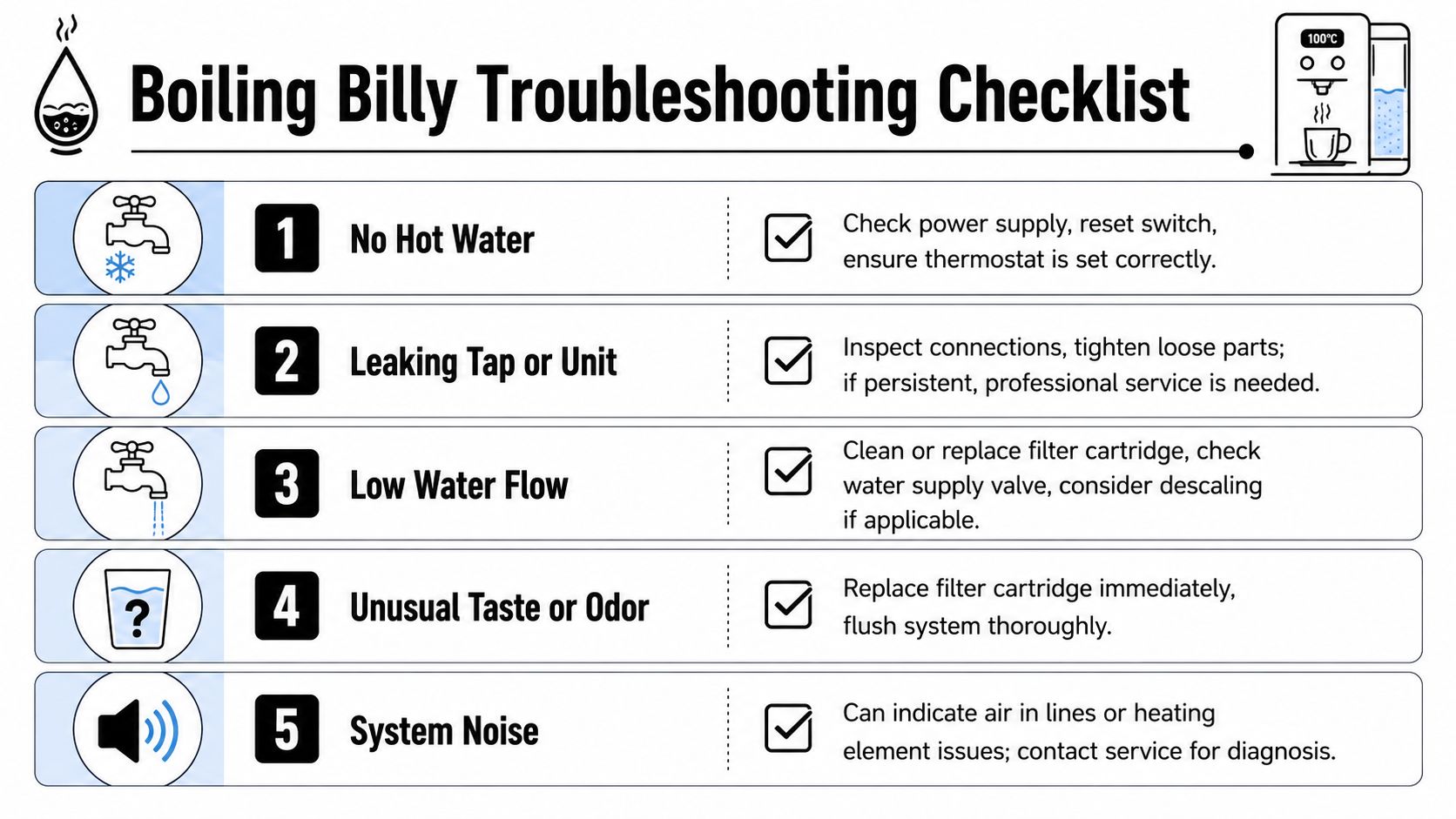
Start with symptoms that are low-risk and visible.
- No hot water at all: Check whether the unit has power and whether a reset has been triggered.
- Reduced flow: Look at the filter condition and make sure the water isolation point hasn't been partially closed.
- Change in taste or odour: A tired filter is often the first suspect.
- Minor external dripping: Check whether the leak is from an obvious connection point or from deeper inside the unit.
A good general maintenance mindset also helps. These hot water heater care tips from Bear Valley Plumbing & Heating are useful because the same habit applies here: don't wait for a full failure before paying attention to signs of wear.
When to stop and call a technician
Some faults shouldn't be treated as trial-and-error jobs.
Repeated resets are not a repair. If the same fault keeps coming back, the unit is telling you something.
Call for service if you notice any of these:
- Tripped breaker keeps returning: That points beyond ordinary user operation.
- Leak from inside the casing or cupboard base: That needs proper diagnosis, not guesswork.
- Erratic temperature: If the water is swinging between normal and underheated, the issue may involve controls, heating components, or scale.
- Unusual noise: Air, pressure problems, or internal wear can all show up this way.
A useful DIY versus service rule
Here's the practical version.
| Symptom | Reasonable first check | Likely next step |
|---|---|---|
| No hot water | Check power and reset status | Service if fault returns |
| Slow flow | Check filter and supply valve | Service if unchanged |
| Water tastes off | Replace filter and flush | Service if persistent |
| Visible leaking | Confirm source if external | Service promptly |
| Breaker trips | Stop repeated resets | Technician diagnosis |
If your unit needs professional attention, this Boiling Billy service page covers the type of work involved when a simple reset or filter change won't solve it.
Boiling Billy Parts and Repairs in Melbourne
In Melbourne, the repair question usually comes up on a busy morning. The unit is heating slowly, the tap is dribbling, or someone has spotted water in the cupboard and wants to know whether it is a small fix or the start of a replacement job. In many cases, the answer depends on two things. How early the fault was picked up, and whether the right parts are available.
Boiling Billy units are straightforward to service if the problem is diagnosed properly. The trouble starts when a worn filter is treated like a heating fault, or a leaking fitting is mistaken for a failed tank. That wastes time and often adds cost.
The parts that matter most
The parts that fail most often are usually the consumable or wear items, not the stainless casing you can see from the outside.
- Filters: Poor taste, reduced flow, and extra strain on the system often start here, especially in buildings with heavier sediment or older pipework.
- Heating elements: These are checked when the unit is powered but not reaching proper temperature.
- Thermostats and controls: If temperature is inconsistent, these parts are part of the diagnosis.
- Valves, fittings, and hoses: Small leaks often begin at connection points before they turn into a bigger cupboard leak.
Parts also need to match the unit properly. Capacity, recovery, tap style, filtration setup, and connection layout all affect what should be fitted. A part that physically fits is not always the right part for safe operation or normal performance.
Why local repair support matters
Melbourne conditions are not identical from one suburb to the next. Water quality, under-sink space, age of pipework, and how hard the unit is worked all affect repair decisions. An office kitchen in the CBD gets used very differently from a home kitchen in the eastern suburbs, and a unit in a clinic or staff room often has less tolerance for downtime.
That is why local support matters. You want someone who can work out whether the fault is in the electrics, water supply, filtration, or the unit itself, then source the correct part without turning a straightforward repair into multiple callouts.
For Melbourne customers who need supply, servicing, or replacement parts for Boiling Billy and similar systems, Ring Hot Water handles installation, repairs, maintenance, and spare parts across this category.
If you need help with a Boiling Billy hot water system in Melbourne, Ring Hot Water is a practical place to start. They cover supply, installation, repairs, maintenance, and replacement parts for instant boiling and chilled water systems, which is useful whether you're fitting out a home kitchen, replacing a workplace unit, or trying to diagnose a fault before it becomes a bigger repair.

