
Commercial Boiling Water Urns
Boiling Billy Hot Water Units
Jun
Boiling Billy Hot Water Units: A Complete Buyer’s Guide
You notice the problem most on busy mornings. The kettle is still heating, someone else is waiting behind you, the bench is crowded, and the first round of coffees turns into a small queue. In a workplace, that wastes time. At home, it just gets annoying.
That's where Boiling Billy hot water units make sense. They're built for people who need boiling water ready at the point of use, without juggling kettles, urns, or extra clutter. For Melbourne homes, offices, schools, workshops, and community spaces, they solve a very practical problem. You get fixed-position boiling water, cleaner bench space, and a setup that can be matched to how many people use it.
The catch is simple. The right unit works well for years. The wrong unit frustrates everyone. Capacity, recovery, installation position, and servicing matter more than most buyers realise at first glance.
Is It Time to Retire Your Kettle
A kettle is fine until it isn't. If one or two people use it a few times a day, it does the job. Once you've got repeated use, back-to-back drinks, food prep, or a shared kitchen, the kettle starts showing its limits.
The usual pain points are easy to spot:
- Waiting during peak times: Morning tea breaks and lunch rushes expose slow boil cycles.
- Bench clutter: Kettles, cords, and spare jugs take up room where people want workspace.
- Stop-start workflow: In offices and staff rooms, people keep returning to the kettle instead of getting on with the day.
- Inconsistent use: Someone fills it too much, someone else leaves very little in it, and everyone waits again.
A fixed boiling unit changes the routine. Hot water is there when needed, in the same place every time, and you're not relying on a portable appliance sitting on the bench. That's useful in home kitchens, but it becomes far more valuable in shared environments where several people need boiling water across the day.
When a kettle still makes sense
Not every property needs a dedicated boiling unit.
If you're in a small household, you don't drink many hot beverages, and the kitchen layout doesn't suit a fixed installation, a kettle may still be the simpler choice. The same goes for occasional-use spaces where demand is light and irregular.
Practical rule: Replace the kettle when the delay, clutter, and repeated refilling are affecting how the space works.
When a fixed unit is the smarter move
A Boiling Billy unit suits sites where demand is predictable and regular. Think office tearooms, reception kitchens, staff lunchrooms, medical practices, workshops, and homes where people cook and make drinks constantly through the day.
The big advantage isn't novelty. It's consistency. You remove the repeated wait, free up the bench, and make the kitchen easier to use.
Why Boiling Billy is a Trusted Australian Name
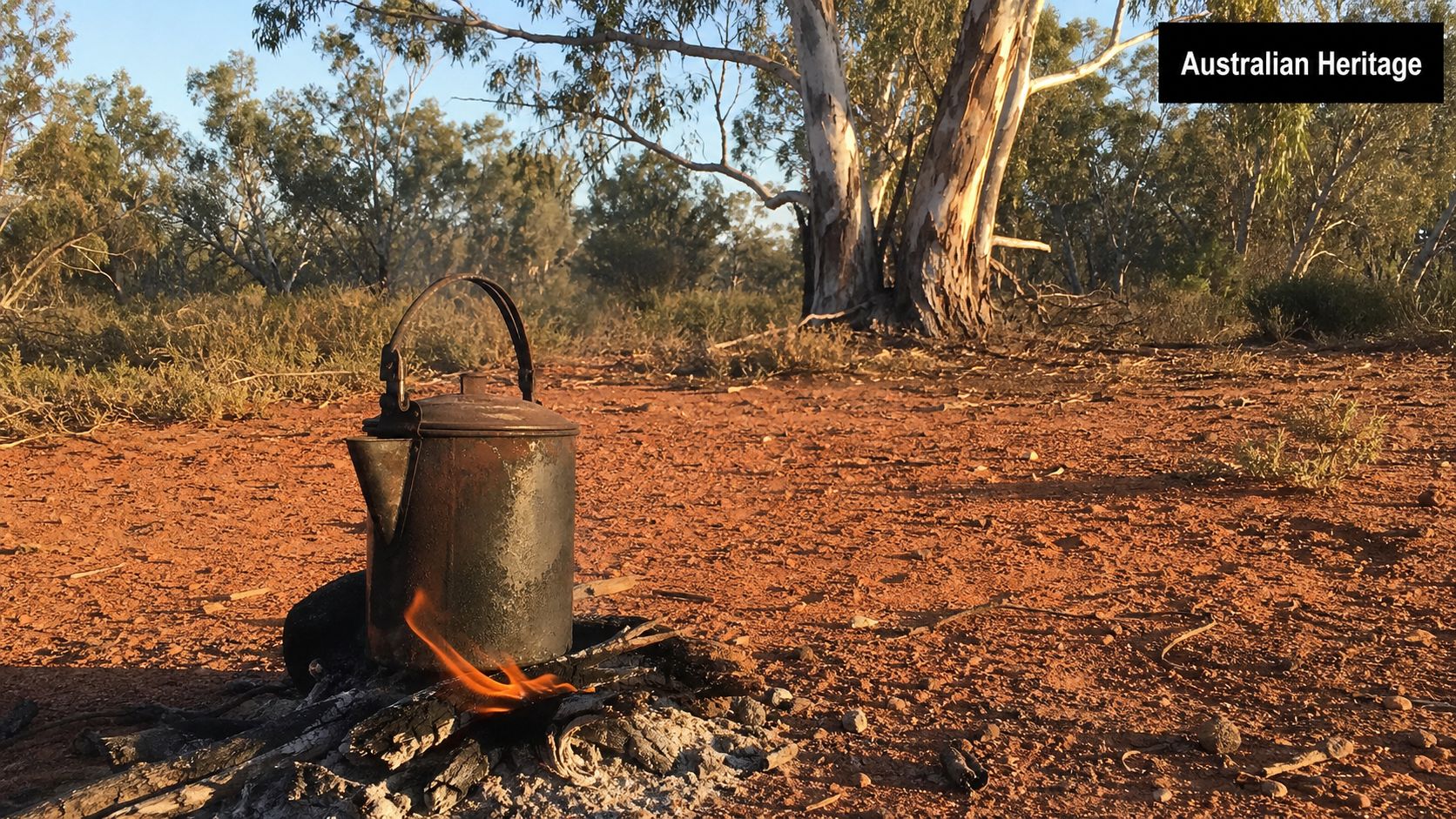
Walk into an older Melbourne staff kitchen at 8:30 on a winter morning and you can tell straight away what works and what does not. The systems that last are usually the simple ones, mounted where people can find them, built to handle repeated use, and easy to service when parts wear out. That practical reputation is a big reason Boiling Billy has stayed well known in Australia.
Boiling Billy earned its name in workplaces, not showroom displays. The brand has long been associated with wall-mounted boiling water units for commercial and shared-use settings, and that shows in the way the products are laid out and used. You see it in offices, workshops, schools, community facilities, and back-of-house kitchens where people need dependable boiling water without turning the bench into a storage zone for kettles and cords.
Built for practical Australian use
A wall-mounted boiling unit suits a different job from a designer tap. The point is not to hide the system. The point is to give people a fixed, obvious place to draw hot water, while keeping the appliance itself accessible for servicing.
That matters in real buildings around Melbourne. Plenty of sites we attend are older fit-outs with limited cupboard space, solid wall locations that suit surface-mounted equipment, or staff areas where durability matters more than appearance. In those settings, a Boiling Billy style unit often makes more sense than a premium tap setup or a portable urn.
Typical strengths include:
- Clear point of use: Staff, visitors, and contractors can see where boiling water is dispensed.
- Good fit for shared spaces: These units are suited to repeated daily draw-off across the day.
- Straightforward servicing: Covers, elements, valves, and other service parts are generally easier to access than under-bench systems.
- Bench space kept clearer: The boiling unit is mounted in a dedicated position instead of sitting loose on the worktop.
There are trade-offs. A wall-mounted unit is more visible, and it will not suit every high-end kitchen design. If appearance is the top priority, an under-sink hot water system for modern kitchens and office spaces may be the better fit. If reliability, access, and straightforward maintenance are higher on the list, Boiling Billy remains a sensible option.
Why local experience matters in Melbourne
Australian brand familiarity only goes so far. What matters more is whether the unit suits the building, the water conditions, and the way the site is used.
In Melbourne, that means looking at more than the brochure. We consider where the unit will be mounted, how many people use it at peak times, whether the electrical supply is suitable, and how easy it will be to service in two or five years. A good brand helps, but the right selection and a clean installation matter just as much.
That is why Boiling Billy still gets specified for practical-use sites. It has a long-standing place in the Australian market, and it continues to suit properties that need a simple, serviceable boiling water solution rather than a feature appliance.
Choosing the Right Boiling Billy Model for Your Needs
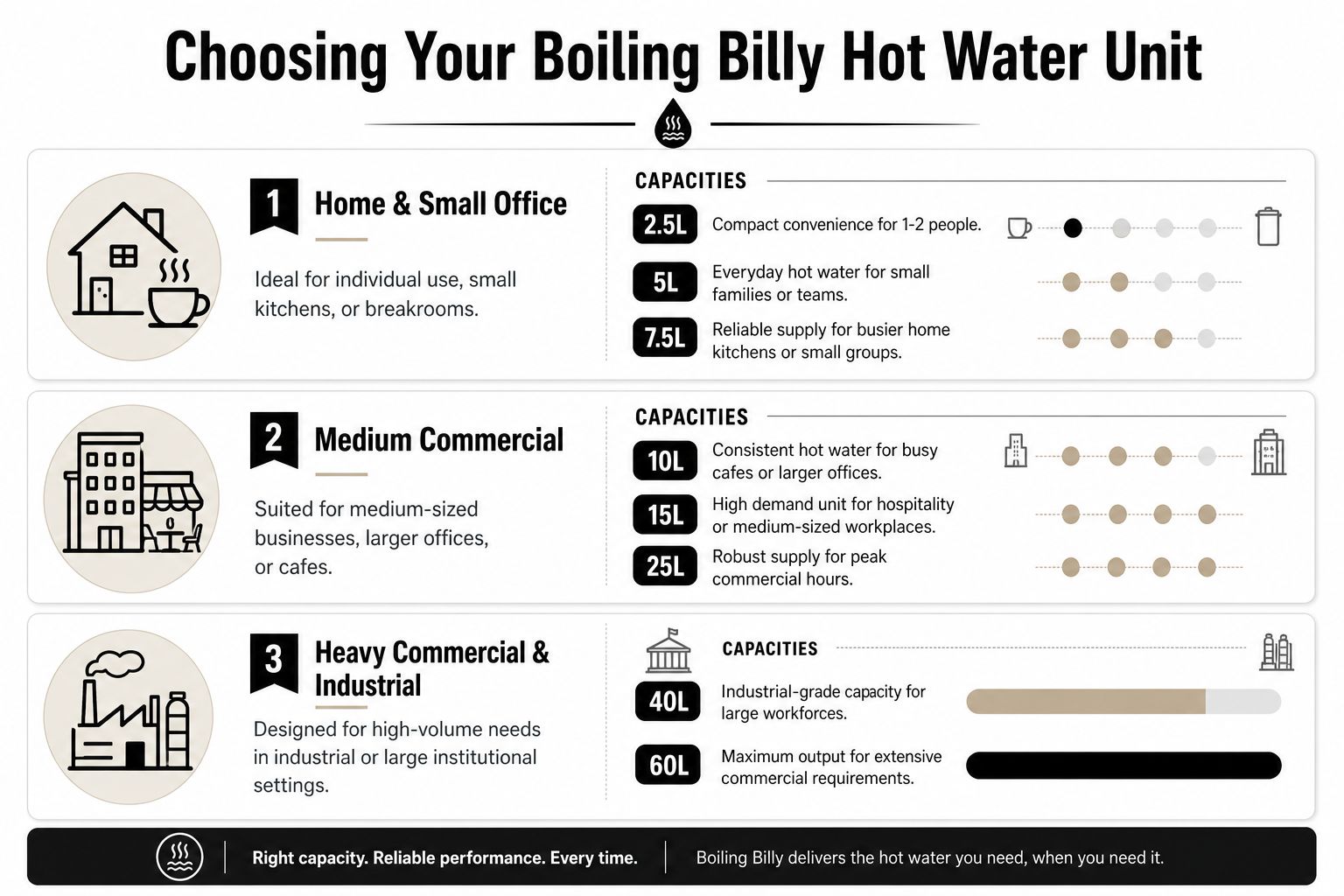
The biggest mistake buyers make is choosing by tank size alone. Tank capacity matters, but it's only part of the story. What matters in daily use is how many cups you need straight away, how quickly the unit recovers, and whether demand comes in short bursts or runs across the day.
Boiling Billy wall-mounted systems are available in capacities from 2.5 L to 60 L with 3.6, 4.8, 6.0, or 7.2 kW heating ratings, and a 5 L Economy model is listed as delivering 25 cups instantly and 110 cups per hour in this Boiling Billy Economy 5 litre specification. Those numbers give you a solid reference point for how to think about the range.
What the numbers mean in real life
A small tank can still work well if demand is spread out. A larger tank becomes important when several people draw boiling water one after another.
Use this simple logic:
- Small group, occasional use: A compact unit can be enough if people aren't lining up at once.
- Shared office or staff room: Look at instant draw-off first, then recovery.
- Hospitality or community use: You need capacity that handles peak bursts without a noticeable drop-off.
- Industrial or large institutional use: Bigger storage and stronger recovery become essential.
If you're comparing fixed wall units with tap-based systems, it also helps to understand where each style fits. This guide to under-sink hot water systems is useful when you're deciding between concealed kitchen hardware and a visible wall-mounted boiler.
Boiling Billy model comparison
| Model | Capacity (Litres) | Instant Cups | Cups Per Hour | Ideal For |
|---|---|---|---|---|
| Economy | 5 L | 25 | 110 | Small offices, tearooms, clinics, light shared use |
| Wall-mounted range | 2.5 L to 60 L | Varies by model | Varies by model | Homes, offices, commercial sites, larger shared facilities |
The table stays deliberately conservative because only the 5 L Economy model has published cup figures in the verified data. For the rest of the range, the right approach is to size the unit by user behaviour, not guesswork.
How to choose without overspending
Start with the busiest period, not the average day. A unit might look fine on paper until everyone wants tea, coffee, or hot water for prep at the same time.
Ask these questions:
How many people may draw water within a short window?
That tells you whether initial stored volume is enough.Is use spread across the day or clustered?
Recovery matters much more when demand comes in waves.Does the site need one draw-off point or several nearby users?
A single well-placed wall unit often works better than a scattered workaround.Will the unit serve drinks only, or food prep as well?
Kitchens usually need more practical output than office beverage stations.
Don't buy a larger unit just because “bigger is safer”. Oversizing can waste space and push installation complexity higher than the site actually needs.
For most buyers, the best result comes from matching the unit to peak use, then checking whether the wall position, water feed, and power supply suit that model.
Where to Install Boiling Billy Units
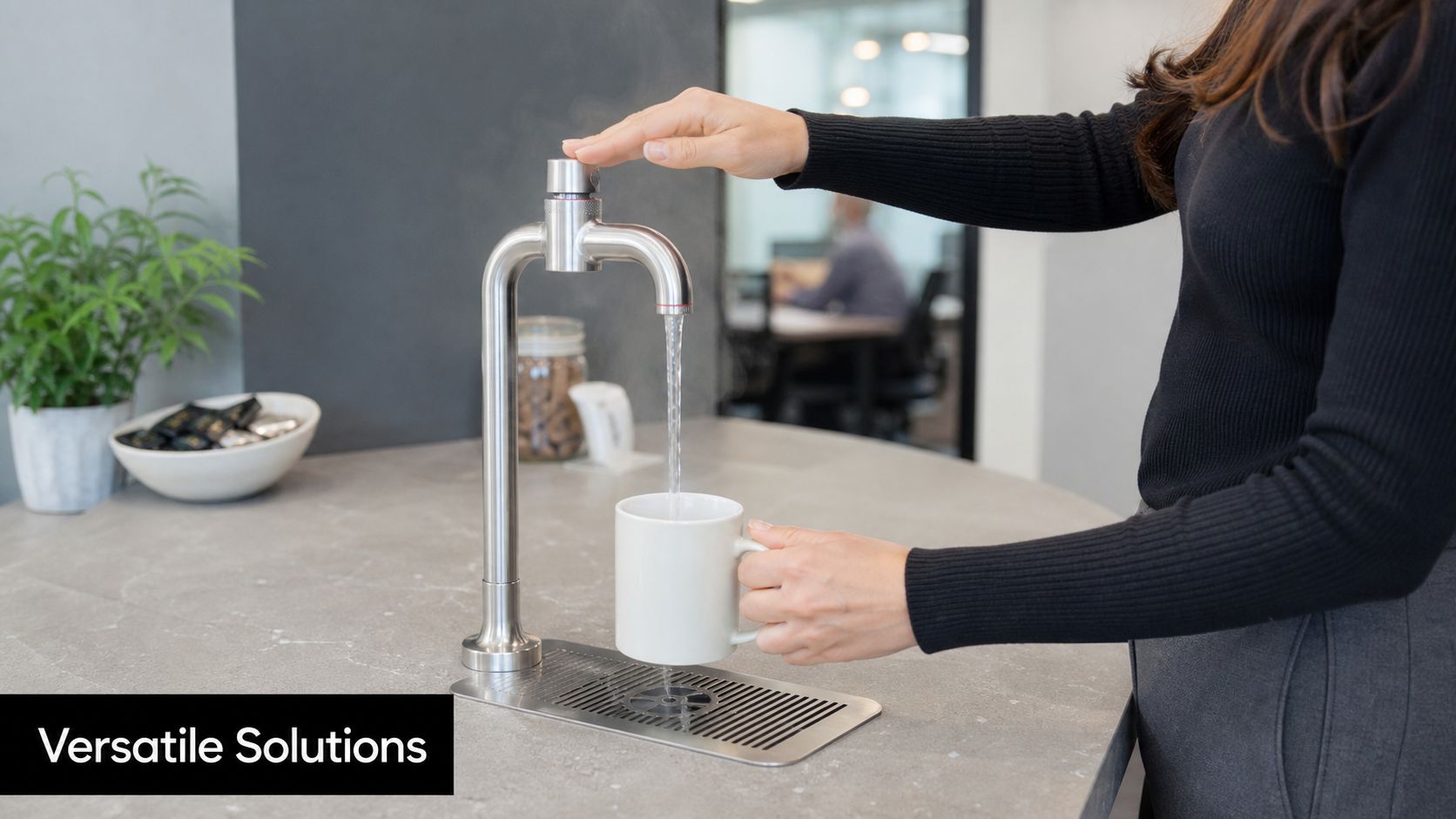
The right model can still disappoint if it's installed in the wrong place. Location affects convenience, safety, cleaning, and how often people use the unit properly.
Home kitchens
In a home kitchen, the best position is usually near the main prep zone but away from clutter. You want easy access for filling pots, mugs, and cooking tasks without creating a pinch point around the sink.
A compact setup works well when the household uses boiling water regularly for tea, coffee, noodles, blanching vegetables, or quick cooking prep. If the kitchen is already crowded with small appliances, a fixed unit often frees the bench more than people expect.
Office tearooms and staff kitchens
Boiling Billy units are particularly sensible. Staff don't want to queue around a kettle, and office managers don't want an appliance that constantly gets moved, overfilled, or left in awkward places.
A tearoom install should keep the draw-off point clear of the main sink traffic if possible. That way one person can fill a mug while someone else rinses dishes or cleans up. In practical terms, better placement often matters just as much as unit size.
Commercial and high-demand sites
Cafes, workshops, schools, clubs, and community centres usually need a tougher approach to placement. The unit has to be accessible, but not exposed to knocks, splashing, or constant obstruction.
Good install locations usually share a few traits:
- Clear working zone: Enough room for mugs, jugs, and safe hand movement.
- Service access: A technician should be able to reach the unit without dismantling half the kitchen.
- Logical traffic flow: People shouldn't cross through a prep line just to get hot water.
- Suitable wall support: Mounting strength matters with larger storage units.
Specialty use and mobile setups
Some buyers ask about caravans, portable buildings, and compact site kitchens. The main issue there isn't just size. It's whether the available water supply, power arrangement, and mounting surface can safely support the unit type being considered.
The best installation point is the one people can use safely every day without blocking the rest of the room.
If the location forces awkward reaching, drips onto other equipment, or crowding near a doorway, it's the wrong location even if the unit technically fits.
Understanding the Installation Process
A Boiling Billy unit isn't a DIY kettle replacement. It's a fixed hot water appliance that needs proper plumbing, correct electrical provision, and a safe mounting position. If any of those basics are wrong, the system can become unreliable, awkward to use, or non-compliant.
Boiling Billy systems are designed for under-sink or above-sink installation and can be paired with recyclable filter cartridges, and installation must comply with all relevant statutory and local requirements in Australia, as described on this Boiling Billy product range page.
What a proper installation includes
The process usually starts with the site, not the unit. The installer checks where the system will sit, how the cold water feed will be run, whether the wall or cabinet space is suitable, and whether the power setup matches the selected model.
The core requirements normally include:
- Secure mounting position: The wall or cabinet area has to support the unit properly.
- Cold water connection: The supply needs to be accessible and arranged for safe servicing.
- Isolation point: A shut-off point should be available so the unit can be serviced without disrupting the whole property. If you're not sure what that component does, this guide on a shut-off valve explains why it matters.
- Electrical suitability: The selected model must match the available power provision.
Why professional installation matters
This isn't only about ticking a compliance box. Professional installation affects how well the unit performs from day one. Poor siting leads to awkward draw-off. Inadequate access makes maintenance harder. A rushed connection job can turn a simple appliance into a recurring callout.
Filtering is worth considering at install time as well. If the site benefits from better-tasting water or cleaner internal operation, it makes sense to set that up from the start rather than retrofit later.
A boiling unit should be easy to isolate, easy to service, and easy to use. If one of those is missing, the install hasn't been thought through properly.
In Melbourne properties, older kitchens and commercial fit-outs often need more planning than buyers expect. That's normal. The important part is getting the location, connections, and access right before the unit goes on the wall.
Maintenance Troubleshooting and Genuine Parts
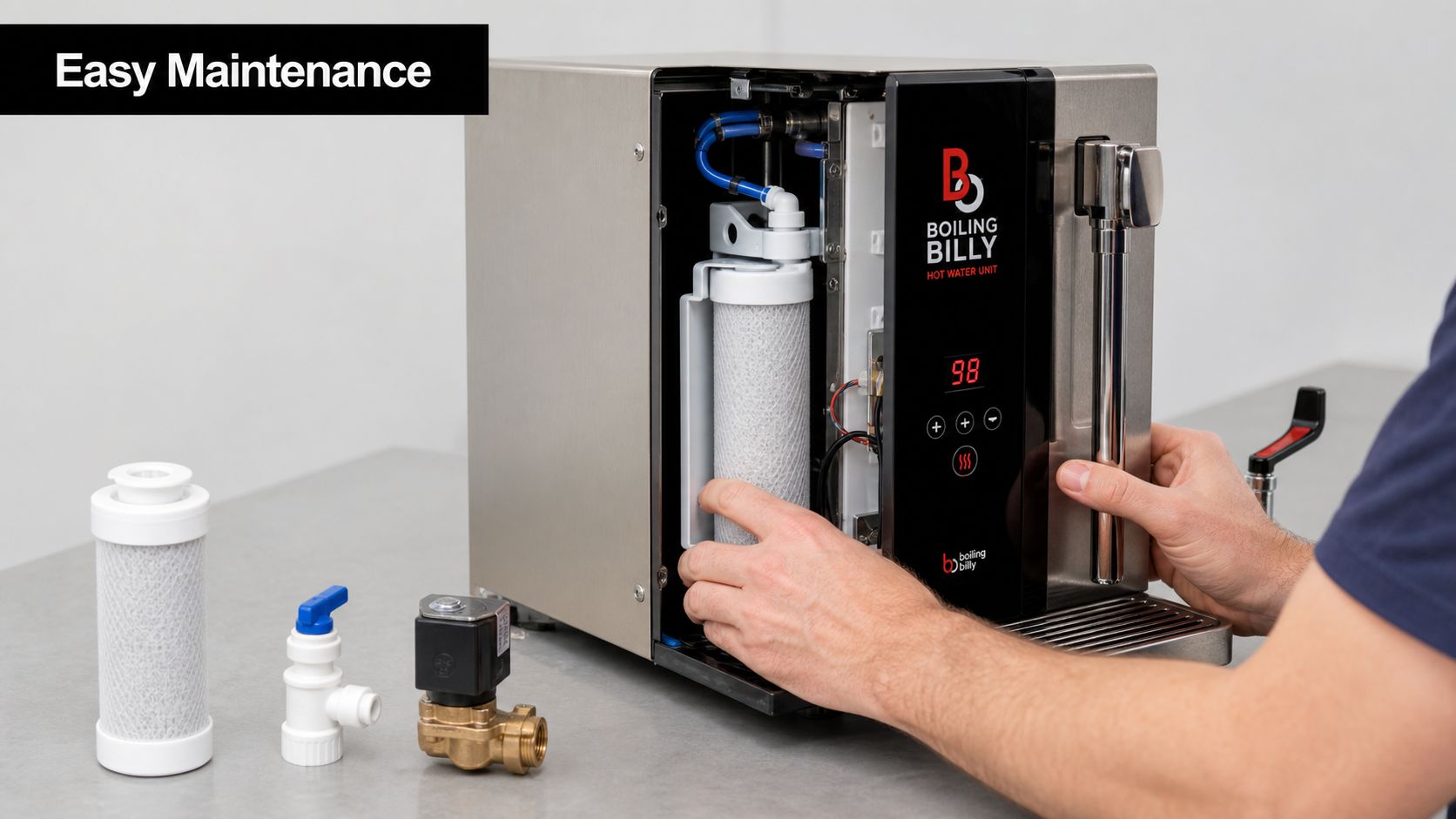
Buying the unit is the easy part. Owning it well is what determines whether it remains convenient or becomes another piece of equipment everyone complains about.
For commercial buyers especially, the question is total cost of ownership. Serviceability, spare parts access, and how quickly faults can be repaired matter just as much as the initial purchase, which is why this commercial hot water review discussing serviceability and downtime is useful background reading.
Routine care that prevents bigger issues
Most day-to-day upkeep is simple. Keep the unit clean, check for drips around the tap or fittings, and pay attention to changes in performance. If recovery feels slower, water quality changes, or the tap starts behaving differently, don't ignore it for months.
Basic owner checks include:
- Look for drips: A minor leak often starts as a nuisance and ends as a service issue.
- Keep the tap area clean: Build-up around outlets affects hygiene and day-to-day use.
- Notice performance changes: Slower delivery or unusual behaviour often signals that servicing is due.
- Replace consumables when required: Filters and related service items shouldn't be left indefinitely.
If you need replacement components, use Boiling Billy hot water parts that match the unit rather than trying to make off-brand substitutions fit.
Common faults and when to call a technician
No hot water, inconsistent temperature, dripping taps, and poor flow are common complaints across fixed hot water equipment. Sometimes the cause is minor. Sometimes it points to a part that has worn or a service item that's overdue.
A practical approach looks like this:
Check the obvious first
Confirm the power supply is on and the water feed hasn't been isolated.Look for visible clues
Drips, staining, or changes around connections can point to the problem area.Don't force a repair
If the unit needs disassembly, stop and book a proper service.Use genuine parts
Correct parts matter for safe operation and long-term reliability.
Some buyers also hear noises and assume the whole unit is failing. That's not always true. If you're trying to understand noise behaviour on hot water equipment more broadly, this guide to homeowner solutions for hissing water heaters gives a useful plain-English overview of what certain sounds can indicate.
Why genuine parts save trouble
The cheapest repair path often becomes the most expensive one later. A mismatched thermostat, tap, seal, or heating component can create repeat faults or shorten the life of nearby parts.
In practical terms, good ownership comes down to three habits. Don't ignore early symptoms. Service the unit before a minor issue becomes downtime. And use parts that are intended for the appliance rather than whatever happens to be available fastest.
Your Local Boiling Billy Experts in Melbourne
A Melbourne office kitchen at 8:30 am tells you a lot about whether a boiling water setup was chosen well. If the unit keeps up, no one notices it. If it runs short, drips, or takes up the wrong spot on the bench, everyone notices.
Buying the unit is only part of the job. The real test is whether it suits the site, can be installed properly in the first place, and can be serviced locally when a tap, seal, thermostat, or other wear part needs attention. That matters in Melbourne properties, where fit-outs range from new office kitchens to older homes and shops with tighter cupboards, ageing pipework, or awkward power and water access.
What Melbourne buyers usually need
Homeowners usually want a unit that clears the kettle off the bench without creating a bulky installation. Business owners tend to care more about recovery, placement, and how fast a fault can be handled before staff start lining up at the sink.
The pattern is usually straightforward:
- Clear advice on model size: A larger unit is not always the better buy if demand is light or intermittent.
- Installation that suits the building: Older Melbourne properties often need a more careful check of access, services, and mounting position.
- Repairs with the right parts: A quick repair only helps if it lasts.
- Ongoing servicing: Planned maintenance reduces nuisance faults and helps avoid unplanned downtime.
At Ring Hot Water, we handle supply, installation, repairs, and maintenance for boiling water equipment across Melbourne, including Sunshine, Yarraville, Footscray, and nearby suburbs. That local coverage makes a practical difference. If a café, office, staff room, or home kitchen has a problem, the owner usually wants someone who already understands the product type, the common failure points, and the typical installation conditions in Melbourne buildings.
The sensible next step
Choose the unit around real demand, not brochure wording. A household kitchen, a small office breakout area, and a commercial site each use hot water differently, and the right answer is rarely the same across all three.
If you are replacing a kettle setup, fitting out a staff kitchen, or trying to keep an existing unit going with the correct parts, get the basics right early. Capacity, location, access for service, and local support usually decide whether the system stays convenient or becomes a recurring nuisance.
If you want help choosing, installing, repairing, or sourcing parts for a Boiling Billy unit in Melbourne, contact Ring Hot Water. We can help you work out the right setup for your home, office, or commercial site, and point you toward a solution that fits the space and the way you use hot water.

