
Solar Hot Water
Solar Hot Water Pump

May
Solar Hot Water Pump: A Complete Guide for 2026
You're usually looking into a solar hot water pump for one of two reasons. Either the system isn't keeping up and you're getting disappointing hot water on a bright day, or you're replacing a failed pump and want to avoid fitting the wrong one twice.
That's the right instinct. In an active solar hot water system, the pump isn't a side component. It's the part that turns rooftop heat into usable hot water at the tap. Get the pump selection, control setup, and installation details right, and the system works smoothly in the background. Get them wrong, and the collectors can be hot while the tank stays underwhelming.
In Australian conditions, that matters because solar water heating is already a mature, mainstream technology. The performance people expect from it depends heavily on circulation, control logic, and hydraulic setup, not just the collector on the roof.
What Is a Solar Hot Water Pump and Why It Matters
A solar hot water pump is the circulating pump used in an active solar water heating system. Its job is simple to describe and critical in practice. It moves the heat-transfer fluid between the roof collectors and the storage tank so the heat you've collected reaches the water you use.
If that pump stops, binds, cavitates, or runs at the wrong duty point, the whole system falls apart. The collectors may still get hot. The pipework may still feel warm. But the tank won't harvest heat properly, and the backup booster ends up doing the heavy lifting.
The reason this matters so much is that solar water heaters can cover a large share of a home's hot-water demand when they're designed and operating properly. The Australian Government's YourHome guidance, cited in this history and performance overview of solar water heating, states that solar water heaters can meet around 50% to 80% of household hot-water demand on average, depending on climate, usage, and system design. The pump is one of the components that decides whether you're closer to the top of that range or struggling below expectation.
A lot of homeowners understand their rooftop PV better than their solar thermal loop. If you need a quick refresher on the bigger picture, this guide to understanding home solar systems is useful because it helps separate electric solar from solar hot water, which are often mixed together in conversation.
Practical rule: If the tank is lukewarm after a strong solar day, don't blame the collector first. Check whether the pump is moving heat effectively.
The pump is the heart of the system because heat in a collector doesn't help anyone until fluid carries it into storage.
Understanding the Circulation Process
A solar hot water system only collects usable heat when the loop is moving it off the roof and into storage at the right time. In practice, the circulation process decides whether the system builds a tank of solar-heated water or leaves the booster to cover the gap.
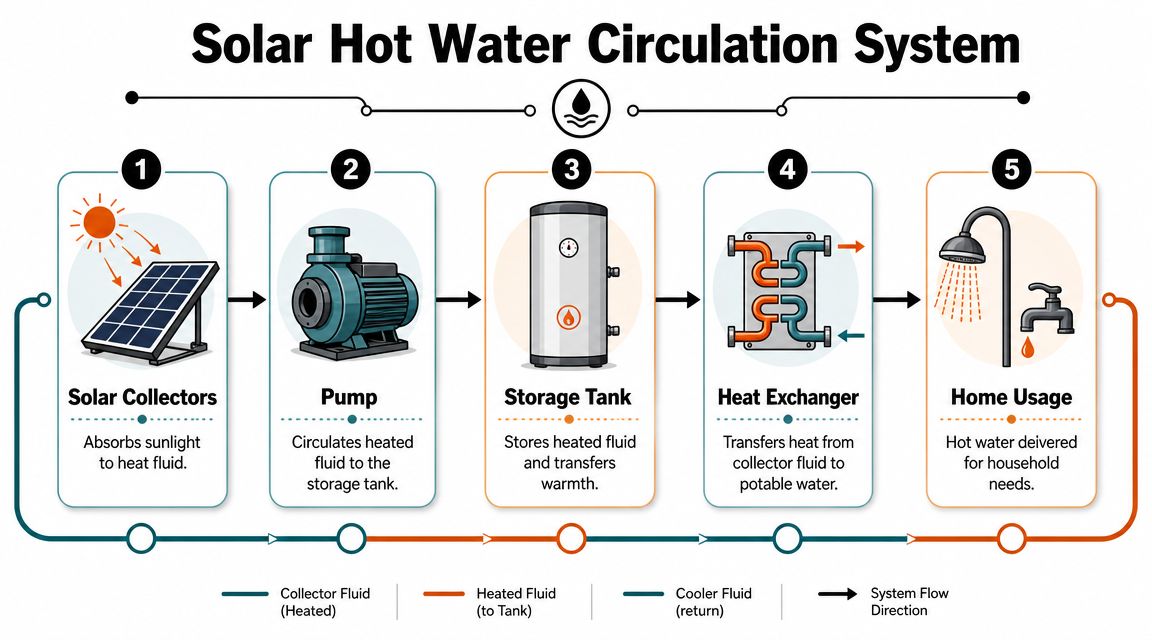
In an active system, the collectors heat a working fluid in the roof circuit. The pump sends that fluid through the solar line to the tank, where a heat exchanger passes the heat into stored water. The cooled fluid then returns to the collectors and the cycle repeats as long as the temperature conditions are favourable.
What actually triggers the pump
The pump does not run just because the sun is out. It runs when the collector is hot enough to give the tank useful heat. That call is usually made by a differential controller reading two temperature sensors.
One sensor measures collector temperature. The other measures tank temperature. When the collector is sufficiently hotter than the tank, the controller starts the pump. When that temperature gap drops away, it shuts the pump off.
That control logic protects both efficiency and hardware life.
- Heat transfer depends on a real temperature gain. If the roof loop is only marginally warm, pumping fluid can cool the tank instead of charging it.
- Run pattern affects pump life. A pump that short-cycles, runs too long in weak sun, or starts with poor sensor placement wears faster and often hides bigger setup problems.
The five parts working together
The circulation loop has five jobs, and the pump sits in the middle of all of them:
- Collectors absorb solar energy and heat the circulating fluid.
- The pump moves that fluid through the solar circuit at a usable flow rate.
- The heat exchanger transfers energy into the stored water.
- The tank stores that heat so it can be used later, not just when the sun is available.
- Fixtures draw hot water as the home calls for it.
If the pump is undersized, air-locked, or badly controlled, the whole sequence suffers. Roof temperatures climb, collector fluid stays hot longer than it should, and the tank gains heat slowly or unevenly. In Australian conditions, especially on bright winter days or during shoulder seasons, that can be the difference between a tank that carries through the evening and one that needs boosting before dinner.
A collector can be performing well on the roof and the system can still deliver poor results if circulation is weak.
Why active and passive systems aren't the same
Active and passive solar hot water systems move heat in different ways. A passive thermosiphon system relies on natural convection. An active system relies on a pump and controls to force circulation through the loop.
For installers and homeowners, that changes the job completely. Once a pump is involved, the system has to deal with pipe friction, valve resistance, heat exchanger pressure drop, and the vertical lift between tank and collectors where relevant. The pump is no longer a small add-on. It becomes the component that determines whether the system can shift heat efficiently, avoid stagnation, and make good use of available solar input.
That is why pump choice and control strategy have such a strong effect on real-world performance, especially in homes already using rooftop PV and trying to cut booster run time.
Exploring Common Solar Hot Water Pump Types
When people ask which solar hot water pump is “best”, the honest answer is that the best pump is the one that matches the system type, power arrangement, and control method. A pump can be excellent in one layout and wrong in another.
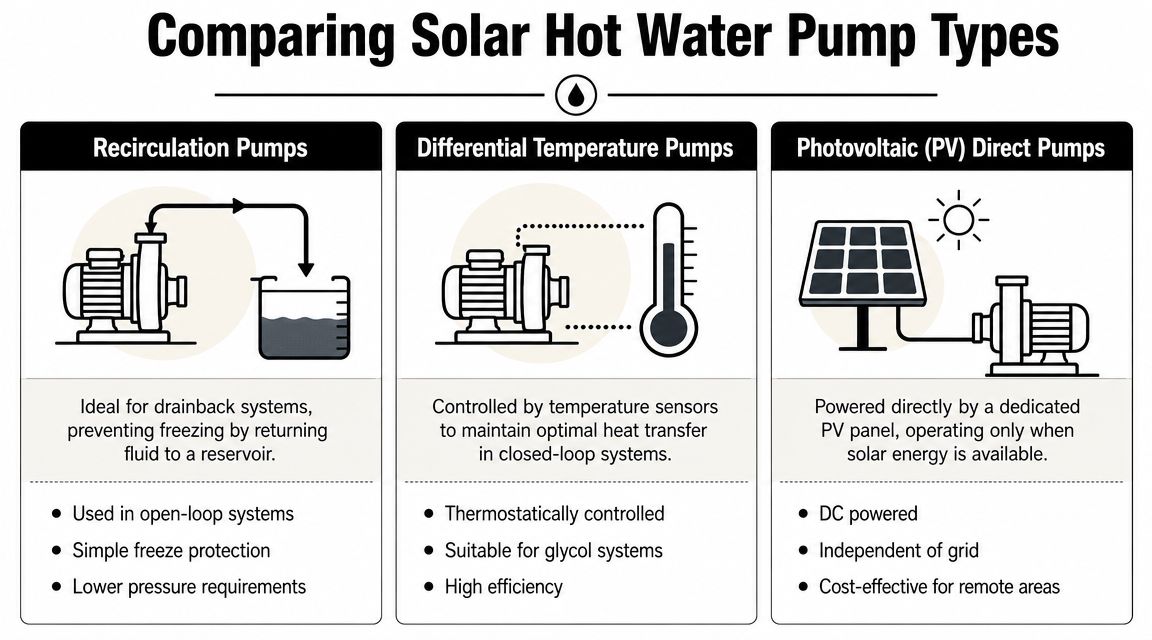
The broad categories below are the ones most installers and homeowners come across in practice.
The main pump options
| Comparison of Solar Hot Water Pump Types | Power Source | Efficiency | Ideal Use Case |
|---|---|---|---|
| AC pump | Household AC supply | Reliable and straightforward in conventional systems | Standard grid-connected active systems |
| DC pump | Direct current, often paired with dedicated DC supply or PV-driven setup | Often chosen where low electrical draw and direct solar operation matter | Off-grid, remote, or solar-priority installations |
| Variable-speed pump | Usually controlled electronically within an active system | Better control over flow matching across changing conditions | Systems where tighter control and smoother operation are priorities |
AC pumps
AC circulators are familiar to most plumbers. They're widely used, simple to integrate with standard controllers, and suit conventional active solar hot water systems well.
Their main strength is compatibility. If the existing system already uses an AC controller output and standard mains-fed controls, an AC replacement often keeps the job simple.
Their weakness is that simple AC pumps can be blunt instruments. If the system load varies a lot through the day, a fixed-speed pump may move more fluid than needed at one point and not enough at another if the design was marginal to begin with.
DC pumps
DC pumps appeal to people trying to use solar electricity more directly or keep electrical consumption low. They're also common in specialised setups where a dedicated DC supply or PV-direct operation makes sense.
In the right application, they're elegant. Fewer conversion steps can mean a cleaner control concept. But they're not automatically the better option for every house. The controller logic, electrical protection, and actual duty point still matter more than the label on the box.
A DC pump that doesn't match the head and flow requirement is still the wrong pump.
Variable-speed pumps
Variable-speed pumps are usually the smartest option when a system benefits from responsive control. Rather than running flat out whenever the controller calls, they can adjust output to suit available heat and circuit conditions.
That can help with:
- Smoother circulation
- Reduced noise
- Better matching between collector gain and heat transfer
- Less pointless electrical use in lightly loaded conditions
Closed-loop and drainback differences
The pump also has to suit the hydraulic design.
A closed-loop system often uses a treated heat-transfer fluid and relies on proper pressure control, venting, and stable circulation through a heat exchanger. The pump must tolerate that environment and the expected operating temperature.
A drainback system behaves differently. The pump often has to establish flow in a way that allows fluid to return to a reservoir when the pump stops. These systems place different demands on startup behaviour and layout.
Don't choose by voltage first. Choose by system design, control method, and duty point.
Sizing Your Pump for Head and Flow Requirements
A solar hot water system can have good collectors, a sound tank, and a decent controller, then still perform poorly because the pump is wrong. The pump is the heart of the circuit. If it cannot move the right volume of fluid through the collectors and back to storage under real operating resistance, the whole system loses efficiency.
What flow and head mean on a real job
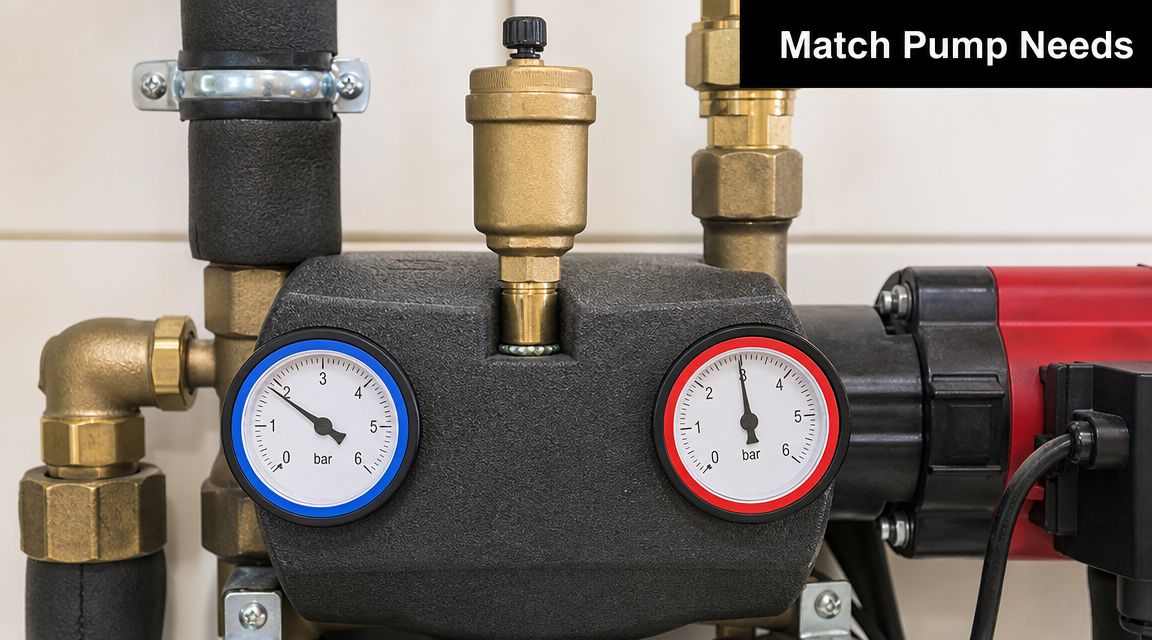
Flow rate is the amount of fluid moving through the solar loop.
Head is the resistance the pump must overcome to maintain that flow. On a roof-mounted solar hot water service, that resistance is not just about height. In a closed loop, static lift is often less important than the losses created by the pipework and components in the circuit.
On site, the main contributors are usually:
- Pipe friction through flow and return lines
- Valves and fittings such as check valves, isolation valves, and elbows
- Heat exchanger pressure drop in the tank or solar pump station
- Collector layout including parallel banks, long pipe runs, and uneven branch lengths
That is why matching a replacement pump by wattage or port size is a gamble. The old pump may have been incorrectly selected in the first place.
What happens when the pump is wrong
An undersized pump leaves heat sitting on the roof. The collectors reach temperature, but the tank does not gain heat fast enough because circulation is weak. In practice, that can mean higher collector temperatures, poorer transfer through the heat exchanger, and more reliance on boosting.
An oversized pump wastes power and can create its own problems. Higher flow is not always better. Push fluid too hard and you can add noise, increase wear, and reduce the temperature rise across the collectors to the point where the controller cycles the system in a less stable way.
On homes with rooftop PV, this matters even more. A well-matched pump and control strategy can use available solar electricity sensibly while still prioritising thermal performance. A badly matched pump just burns through power for no useful gain.
Workshop note: If a pump is noisy and the temperature gain is disappointing, I check the duty point before I blame the collector.
How to size the pump properly
Start with the system duty point. That is the flow rate the collector circuit needs, at the total head the circuit imposes under normal operation.
Check these four items:
- Target flow rate for the collector area and circuit design
- Total head loss from pipe length, fittings, valves, heat exchanger, and collector path
- Pump curve performance at the intended operating point
- Temperature and fluid compatibility with the solar loop fluid and expected stagnation conditions
This step separates a proper replacement from a guess. If you are reviewing options, a product page like this Grundfos solar water circulation pump is useful because it shows the sort of performance data you need to compare. The key question is where the pump will run on its curve in your circuit, not whether the casting looks similar to the old unit.
What installers often miss
Roof height gets too much attention. Friction losses are often the primary issue, especially on Australian homes with long runs from the plant location to collectors, extra bends around framing, roof penetrations, non-return valves, and compact heat exchangers.
I see this regularly on retrofits. A replacement pump gets fitted because the unions line up, but nobody checks the controller settings, the collector layout, or the added resistance from later plumbing changes. The result is a system that runs, but never runs well.
Good sizing is not about buying a bigger pump. It is about choosing the pump that lets the whole solar hot water service operate efficiently and predictably.
Key Installation and Controller Integration Tips
A good pump can be ruined by a poor install. Most recurring faults I see aren't caused by exotic component failure. They come from air trapped in the high points, bad valve arrangement, difficult service access, or sloppy controller setup.
Build the pump into a serviceable circuit
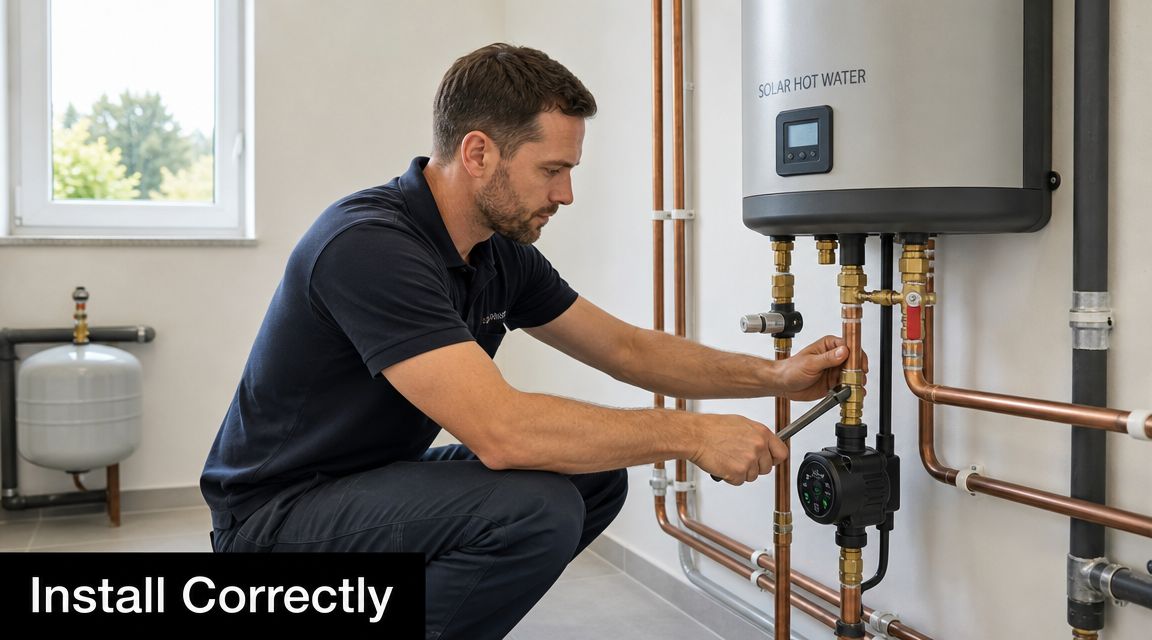
A solar hot water pump should never be installed as if it's a disposable accessory buried in pipework. The surrounding hydraulic components matter just as much as the pump body.
Best-practice guidance in the EPA system specifications, covered in this solar thermal system specification document, calls for balancing valves, shutoff valves, air vents at high points, and pressure relief provisions in active systems. That matches what works on real installations.
A practical checklist looks like this:
- Use shutoff valves so the pump can be isolated for service.
- Fit air management properly at high points because trapped air kills circulation.
- Provide pressure relief where thermal expansion needs to be controlled.
- Balance multiple collector banks so one branch doesn't steal the flow.
If you're sorting out the control side as well, this guide to a solar hot water pump controller is worth reading alongside the pump selection.
Mounting and orientation details that matter
Small installation details decide whether the system runs smoothly or becomes a callback magnet.
Mount the pump in the correct orientation for the manufacturer's design. Support the pipework so the pump isn't carrying misalignment stress. Keep the wiring tidy and protected from heat. Leave enough room to remove the pump without dismantling half the plant area.
A few habits save a lot of grief later:
- Purge the circuit thoroughly before calling the system finished.
- Check for vibration once the pump is under load.
- Confirm controller sensor placement so the pump starts and stops when it should.
- Verify actual circulation rather than assuming the hum means flow exists.
Airlocks don't always announce themselves dramatically. Sometimes the pump sounds normal, the controller says “on”, and the system still transfers heat badly.
This walkthrough helps visualise how installers approach the control side in practice:
Commissioning checks worth doing properly
Don't stop at “pump runs”. Commissioning should confirm that the system is circulating stably and safely.
Check:
- Flow behaviour across the collector circuit
- Differential response between collector and tank temperatures
- Relief device operation
- No obvious air retention after warm-up and cool-down cycles
That's what separates a neat-looking install from one that performs through summer heat and winter starts.
Troubleshooting Common Faults and Maintenance
Most pump problems show up as symptoms long before complete failure. Strange noise, irregular heat gain, cycling at odd times, or poor recovery on sunny days usually tell you something is drifting out of spec.
Routine maintenance is mostly observation. Listen, inspect, and verify that the system behaves logically.
What to check during routine maintenance
Start with the basics:
- Listen for new sounds such as grinding, harsh humming, or crackling flow noise.
- Check around unions and fittings for drips, staining, or residue.
- Watch controller behaviour on a sunny day to confirm the pump starts and stops sensibly.
- Feel the pipe temperatures carefully to confirm there's a believable heat path through the circuit.
If the system has been underperforming, this guide to common problems with solar hot water is a helpful cross-check because pump faults often overlap with broader system issues.
Symptom-based fault finding
| Symptom | Likely cause | First action |
|---|---|---|
| Pump not running in good sun | Power issue, controller fault, seized pump, failed sensor input | Check power supply, controller status, and whether the pump shaft is free |
| Pump runs but water stays tepid | Airlock, weak circulation, wrong pump duty point, blocked path | Purge air, verify flow, and inspect valves and strainers |
| Pump runs at odd times | Sensor placement issue or controller logic fault | Check sensor contact, wiring, and controller settings |
| Pump is noisy | Air in system, cavitation, wear, vibration transfer | Vent the system and inspect mounting and suction conditions |
Cavitation is more serious than people think
Cavitation gets dismissed as “just a noisy pump” far too often. In reality, it can damage components, reduce circulation, and make a healthy-looking system perform badly.
If you want a solid plain-English technical reference, Forge Reliability's cavitation solutions explain the causes and correction methods well. In solar hot water work, trapped air and poor hydraulic conditions are frequent contributors.
A pump that sounds like it's pumping gravel isn't fine. Shut it down and find out why.
Don't replace parts blindly
A dead pump is easy to identify. An underperforming pump is harder. Before replacing it, confirm the fault isn't:
- A stuck check valve
- An air pocket at the collector high point
- A controller calling at the wrong temperature
- A blocked line or fouled heat exchanger
Replacing the pump without checking the circuit often gives you the same poor result with a new invoice attached.
Choosing a Replacement and Where to Get Help
You get the call on a clear afternoon. The roof collectors are hot, the tank is lagging, and the pump has either stopped or is circulating so poorly that the whole system is wasting good solar gain. In that moment, the pump is not a minor accessory. It is the part that decides whether the system moves heat into the tank.
A good replacement starts with the job the pump has to do, not just the model number on the old casing. Match the hydraulic duty, connection layout, temperature rating, fluid compatibility, and electrical setup with the controller. If one of those is wrong, the system may still run, but it will do it badly.
Close-enough replacements cause a lot of grief in solar thermal work. The usual result is low heat transfer, extra noise, short cycling, or repeat call-backs because the actual problem was never corrected.
What to match before ordering
Use the failed pump as a reference point only. Older systems are full of like-for-like replacements that were never properly checked against the actual circuit.
Before ordering, confirm:
- Head and flow duty under the actual pipe run and collector layout
- Pump body and seal materials suited to solar temperatures and the system fluid
- Union size and connection style so the new pump fits without bodged adapters
- Voltage and controller compatibility so the pump starts, stops, and protects correctly
If the old pump gave years of average performance rather than good performance, treat the replacement as a chance to correct the setup, not just restore it.
PV homes change the replacement decision
A lot of Australian homes now have rooftop PV, and that changes the conversation. The right question is often not only which pump fits, but how the pump and controller should operate so the solar hot water service works well alongside daytime solar generation.
That matters because the pump is the heart of the circulation side of the system. Its control strategy determines when heat is harvested, how often the circuit runs, and whether the system makes sensible use of available solar electricity. A pump that is well matched to the collector loop but poorly controlled can still leave performance on the table.
In practical terms, a PV-equipped home often benefits from controller settings or upgrade options that favour effective daytime operation, provided the collector temperature and tank conditions support it. In southern climates such as Melbourne, that strategy needs to stay grounded in winter reality. Available sunlight, roof orientation, and tank recovery patterns still decide what is worth doing.
When an upgrade makes more sense than a straight swap
A direct replacement is fine if the original pump selection and controller logic were sound. Plenty of systems are better served by a broader fix.
That can include:
- Replacing an ageing fixed-speed pump with a modern circulator that better suits the actual duty point
- Updating controller logic or settings so circulation starts and stops at useful temperature differences
- Reviewing operating times in homes that want better alignment between solar hot water production and rooftop PV output
The best help comes from a technician who checks hydraulics and controls together. A plumber who only matches fittings may get the system running. A solar hot water technician who checks pump curve, sensor logic, controller output, and site conditions has a much better chance of getting the whole service working properly again.
Frequently Asked Questions
Some questions come up on nearly every solar hot water pump job. These are the ones worth answering clearly.
| FAQ Section | Answer |
|---|---|
| Question | Answer |
| Can I replace a solar hot water pump with any small circulating pump? | No. The replacement has to suit the system's head, flow requirement, temperature conditions, electrical setup, and connection style. A generic circulator may physically fit and still perform poorly. |
| How do I know if the pump is the problem and not the controller? | Check whether the controller is actually calling for circulation under good solar conditions. If the controller output is live but the pump won't start or circulate properly, the pump is suspect. If there's no call to run, the problem may be with sensors, controller settings, or wiring. |
| Is a noisy pump always failing? | Not always, but it's never something to ignore. Noise can come from airlocks, cavitation, poor mounting, worn bearings, or operation outside the intended duty range. The cause needs to be identified before damage spreads. |
A few quick rules help in the field:
- If the pump is hot but not circulating, suspect seizure or airlock.
- If the pump runs after sunset, inspect the controller and sensor logic.
- If a new pump fixes nothing, go back to the hydraulic circuit and look for blocked flow, trapped air, or valve issues.
For homeowners, the safest move is usually diagnosis before parts. For plumbers, the best habit is confirming the duty point before ordering the replacement.
If you need the right pump, compatible spare parts, or practical advice on hot water system components in Melbourne or anywhere in Australia, Ring Hot Water can help you identify the correct solution and avoid the common mistake of replacing a pump without fixing the underlying system problem.

