
Uncategorized
Water Filtration for Hard Water: A Melbourne Guide
Jul
If you're wiping cloudy spots off glasses, descaling the kettle again, or wondering why your expensive shower screen never looks clean for long, hard water is usually the culprit. In Melbourne, that catches people off guard. The water can be safe and pleasant to drink, yet still carry enough dissolved minerals to create constant maintenance problems inside the home.
The issue gets more serious when you add premium appliances. Instant boiling taps, chilled taps, coffee equipment, dishwashers, and hot water units don't care whether the water looks clear. They react to what is dissolved in it. Calcium and magnesium build up on heating elements, inside small valves, and through narrow internal waterways. That's where minor annoyance turns into service calls, poor flow, and early part replacement.
For homeowners looking into water filtration for hard water, the biggest mistake is buying the wrong type of treatment. A filter that improves taste isn't necessarily a system that stops scale. A product sold as “whole-house protection” may help with sediment but leave hardness untouched. And a drinking water purifier can be excellent at the sink while doing nothing for the rest of the plumbing.
Your Guide to Tackling Hard Water in Melbourne
Melbourne homeowners usually notice the symptoms before they know the name of the problem. The kettle gets a white crust. Tapware loses its shine. Soap doesn't rinse the way it should. A new boiling tap starts looking like an appliance that needs protection from day one.
Hard water means the water carries dissolved minerals, mainly calcium and magnesium. Those minerals aren't dramatic when they first enter the house. The trouble starts when water is heated, evaporates, or moves repeatedly through valves, cartridges, and small-diameter tubing. That is why the kitchen often shows the problem first, especially around boiling and chilled tap systems.
What most people want fixed
Some homeowners want better drinking water. Others want to stop limescale across the whole house. Many want both, but those are not the same job.
In practice, the right solution depends on what is bothering you most:
- Appliance protection: You want to reduce scale affecting a kettle, dishwasher, boiling tap, coffee machine, or hot water service.
- Cleaning relief: You want fewer spots on glass, less residue on fixtures, and easier bathroom cleaning.
- Drinking water quality: You want water at the sink that tastes cleaner and suits chilled or boiling dispensing systems.
- Targeted protection: You only need to protect one expensive appliance under the sink, not every outlet in the property.
Practical rule: Match the treatment method to the actual problem. Scale needs hardness treatment. Taste and odour issues need filtration. Many homes need both.
Why Melbourne buyers need to be careful
In Melbourne, broad advice copied from overseas sites often misses local installation realities. Homes vary. Apartments can have pressure conditions that affect filter selection. Renovated kitchens often add under-sink appliances into already tight cupboards. And instant boiling taps are far less forgiving than a basic mixer.
That is why a good hard water plan starts with three questions:
- Where is scale showing up first?
- Is the goal whole-home protection or one appliance?
- Will the system be feeding a boiling or chilled tap?
Those answers usually narrow the field quickly. Once you understand the difference between filtration and softening, the path becomes much clearer.
What Is Hard Water and Why Is It a Problem
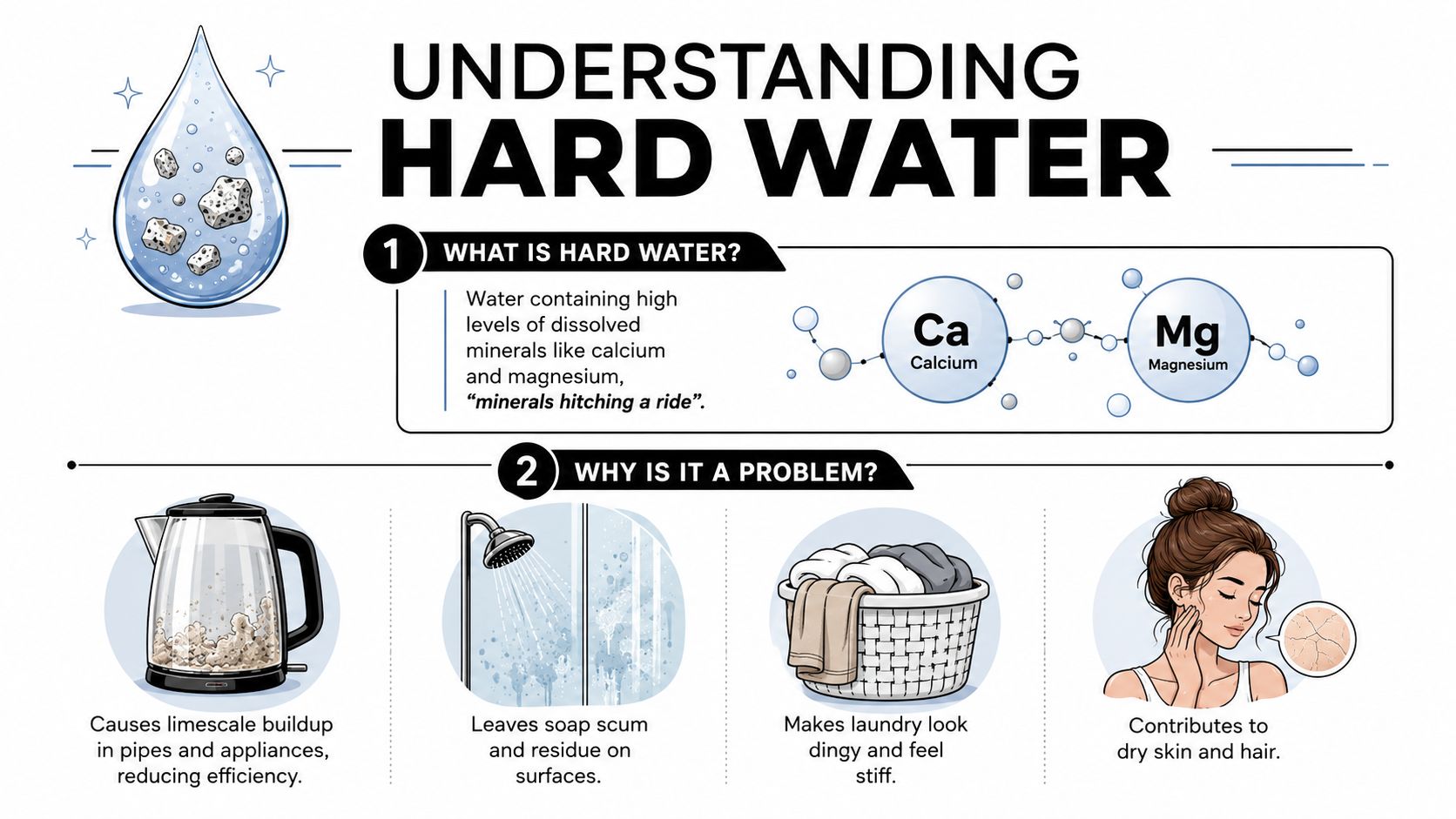
Hard water is water carrying dissolved minerals, mainly calcium and magnesium. A simple way to think about it is that the water has minerals hitching a ride all the way from the supply into your pipes, appliances, and glassware. You don't always see them straight away. You see what they leave behind.
What it looks like in a real home
The most obvious sign is limescale. That white, chalky residue on a kettle element or around a tap spout is mineral build-up. It also forms where you can't see it, inside heating chambers, cartridges, solenoids, and pipework.
Then there is the daily frustration:
- Spots on glassware: Washed glasses dry with a film instead of a clean shine.
- Soap scum: Bathrooms get a sticky residue that takes more scrubbing than it should.
- Laundry issues: Clothes can feel stiff and look dull.
- Skin and hair feel: Some people notice showering leaves skin feeling dry and hair harder to manage.
A lot of homeowners first start investigating water filtration for hard water after trying to fix these symptoms with stronger cleaning products. That rarely works for long because the source is still in the water.
Why appliances suffer first
Heat speeds the problem up. The moment water is heated, hardness minerals are more likely to leave deposits behind. That is why kettles, espresso machines, dishwashers, hot water systems, and under-sink boiling units often show problems before a cold tap does.
If you use a pod coffee machine, regular descaling becomes part of ownership. For smaller appliances, practical maintenance habits still matter, and this guide on keeping your Keurig flavor-rich is a useful reminder that scale affects flavour as well as performance.
Scale doesn't just sit on surfaces. It settles where water is heated, restricted, or forced through small internal passages.
The Melbourne angle
Melbourne water quality is generally good, but that doesn't mean every property experiences water the same way. Mineral content can vary by area, building conditions, and local plumbing setup. In newer kitchens with compact under-sink appliances, even moderate hardness can become a bigger issue because these systems rely on small, precise internal components.
For homeowners, the takeaway is straightforward. If you keep seeing white residue, poor soap performance, or repeated appliance scaling, the problem isn't imaginary and it isn't unusual. It is a water chemistry issue that needs the right treatment, not just better cleaning.
Filtration vs Softening What Your Water Really Needs
This is the point that confuses most buyers. Filtration and softening are not interchangeable. They solve different problems, and if you mix them up, you can spend good money and still have scale.
A simple trade analogy works well here. Filtration is like a guard at the gate checking what comes in. It can catch sediment, improve taste, and reduce chlorine-related issues depending on the media. Softening is different. It changes the chemistry of the water by dealing with the hardness minerals themselves.
What a normal filter can and cannot do
Standard filters are often excellent for:
- Sediment reduction: Catching grit, rust, and visible particles.
- Taste improvement: Activated carbon can improve taste and odour.
- General drinking water treatment: Useful at the kitchen sink when the priority is cleaner-tasting water.
What they don't do is remove calcium and magnesium just because the housing says “whole house” or “premium filtration”.
That misunderstanding is common. As noted by Clean and Native's hard water filter guide, most consumers mistakenly believe activated carbon or whole-house sediment filters remove hardness minerals, while only reverse osmosis or distillation effectively removes dissolved hardness from drinking water in Australia. The same source notes RO systems reduce TDS by 94% in that context.
Softening is the scale solution
If the actual problem is limescale, a standard carbon cartridge won't solve it. You may enjoy the taste more, but the kettle, heating chamber, and tap internals will still collect scale.
That matters a lot in homes with under-sink appliances. A boiling tap can have beautiful filtered water on paper and still scale up badly if the treatment system doesn't address hardness.
This short video gives a useful visual overview before you compare technologies in detail.
A quick way to choose the right path
Use the symptom to guide the treatment:
- If you hate the taste or smell: filtration may be enough.
- If you're battling scale: you need hardness treatment.
- If you want better drinking water and scale control at a dedicated tap: a combined approach often makes more sense.
- If the appliance uses heat: don't assume a generic filter is protection.
Buy for the failure point. If the expensive part of the system is the heater, valve set, or membrane, protect that first.
A Detailed Guide to Hard Water Treatment Systems
Not every hard water setup needs the same equipment. The best system depends on whether you want to protect the whole property, improve one drinking outlet, or defend a single high-value appliance. The technologies below are the ones homeowners most often compare.
Ion exchange softeners
Ion exchange is the technical benchmark for true hardness removal. According to ArchiPro's guide to water filter systems in Australia, ion exchange filtration is the technically optimal method for hard water treatment in Australia because it removes calcium and magnesium ions and replaces them with sodium or potassium ions. The same source notes it is uniquely effective for waters with hardness levels exceeding 1300 mg/L.
That matters because this process addresses the actual cause of limescale, not just the symptoms.
Best fit: homes with clear scale problems, appliance protection priorities, or high-hardness supply.
Trade-off: these systems need ongoing maintenance and enough space for proper installation.
Salt-free conditioners
Salt-free conditioners are usually chosen by people who want lower maintenance and don't want a traditional softener. Their role is generally scale management rather than true mineral removal.
That distinction is important. In practical terms, they may help with scale behaviour in some applications, but they are not the same as removing hardness from the water. If a homeowner's main concern is a sensitive heated appliance, I treat this option cautiously and match it to the exact use case rather than assuming it is equal to softening.
Reverse osmosis systems
RO has a strong place in drinking water treatment. It is especially useful when the goal is cleaner water at a dedicated outlet.
As explained in Waterdrop Australia's guide to water filters, reverse osmosis systems remove 95–99% of dissolved solids, including fluoride and hardness minerals, and can produce water with TDS below 150 ppm, which is considered excellent drinking water quality in Australia. The same source also makes the critical point that RO alone does not effectively soften water without a pre-treatment ion exchange stage when hardness is high, because hardness can impair membrane performance and reduce flow rates.
RO is outstanding for drinking water purification. It is not a magic substitute for proper hardness treatment upstream when the feed water is scale-forming.
Best fit: dedicated drinking water taps, chilled water outlets, and hybrid systems where pre-treatment protects the membrane.
Trade-off: on hard water, membrane life and flow can suffer if you skip the right upstream protection.
Point-of-use scale inhibitor cartridges
These are the compact, targeted options often installed for a single appliance. They are commonly considered under a sink where space is tight and the homeowner wants to protect one specific unit, such as a boiling tap or coffee machine.
They can be a sensible choice when a whole-home system isn't justified. The trade-off is scope. They don't fix the rest of the house, and they need timely cartridge replacement to remain effective.
Hard Water Treatment System Comparison
| Technology | How It Works | Best For | Maintenance | Relative Cost |
|---|---|---|---|---|
| Ion exchange softener | Removes calcium and magnesium by exchanging them with sodium or potassium ions | Whole-home scale control and high-hardness treatment | Regular servicing and media/salt management | Higher |
| Salt-free conditioner | Conditions water to reduce scale formation behaviour | Homes seeking lower-maintenance scale management | Lower routine upkeep | Medium |
| Reverse osmosis | Removes dissolved solids at a drinking water point | Drinking water quality at one outlet | Filter and membrane servicing | Medium |
| Point-of-use scale inhibitor cartridge | Targets scale risk at a specific appliance | Boiling taps, coffee machines, single-use protection | Cartridge replacement | Lower |
Whole Home vs Point of Use Solutions
Once you've chosen a treatment method, the next question is scale. Not water chemistry scale. Installation scale. Do you protect the whole house, or do you protect the one appliance causing stress?
When whole-home treatment makes sense
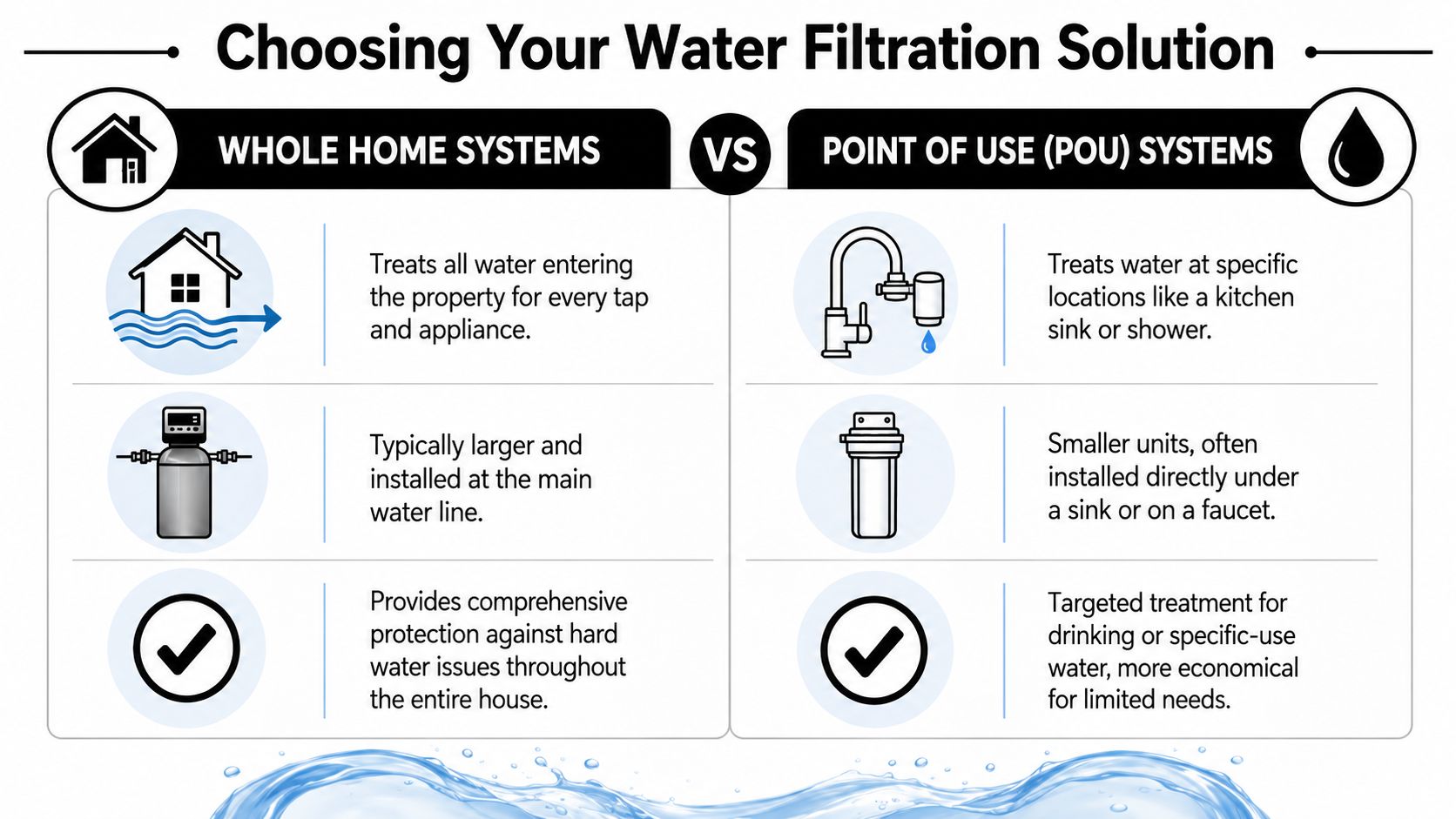
A whole-home system treats water as it enters the property. That means every shower, tap, appliance, and section of pipework benefits from the same upstream protection.
This approach usually suits homeowners who are seeing hard water in multiple places, such as bathrooms, laundry, kitchen fixtures, and hot water equipment. It also makes sense when the goal is broader comfort, easier cleaning, and less scale through the plumbing system.
Choose whole-home if:
- Scale is showing up everywhere: taps, shower glass, kettle, dishwasher, and hot water equipment all show the same signs.
- You want plumbing protection: not just better drinking water, but reduced build-up across the system.
- You plan to stay in the home: broader protection often suits long-term ownership better than patching one problem at a time.
When point-of-use is the smarter move
Point-of-use treatment is installed at a specific outlet or appliance. Under-sink systems are the most common example. This is often the most practical answer when the pain point is highly specific, such as an instant boiling tap, a chilled unit, or a dedicated drinking water outlet.
If you're comparing compact kitchen options, this guide to an under-sink water filter in Melbourne gives a useful overview of where these systems fit.
A point-of-use setup usually works best when budget matters, cupboard space is limited, or the appliance itself is the main asset you want to protect.
A simple decision test
Ask yourself these questions:
- Is the real problem the whole house, or one costly appliance?
- Do you care more about shower glass and laundry, or kitchen equipment and drinking water?
- Is there room at the entry point for a larger system, or only under the sink?
If the only thing keeping you up is the fate of a premium boiling tap, don't overbuild. If every outlet in the house shows scale, don't underbuild.
There is no prestige in installing a whole-home system when a targeted treatment would do the job. There is also no economy in protecting one appliance while scale continues to affect every other heated service in the property.
Boiling Taps and Hard Water A Critical Combination
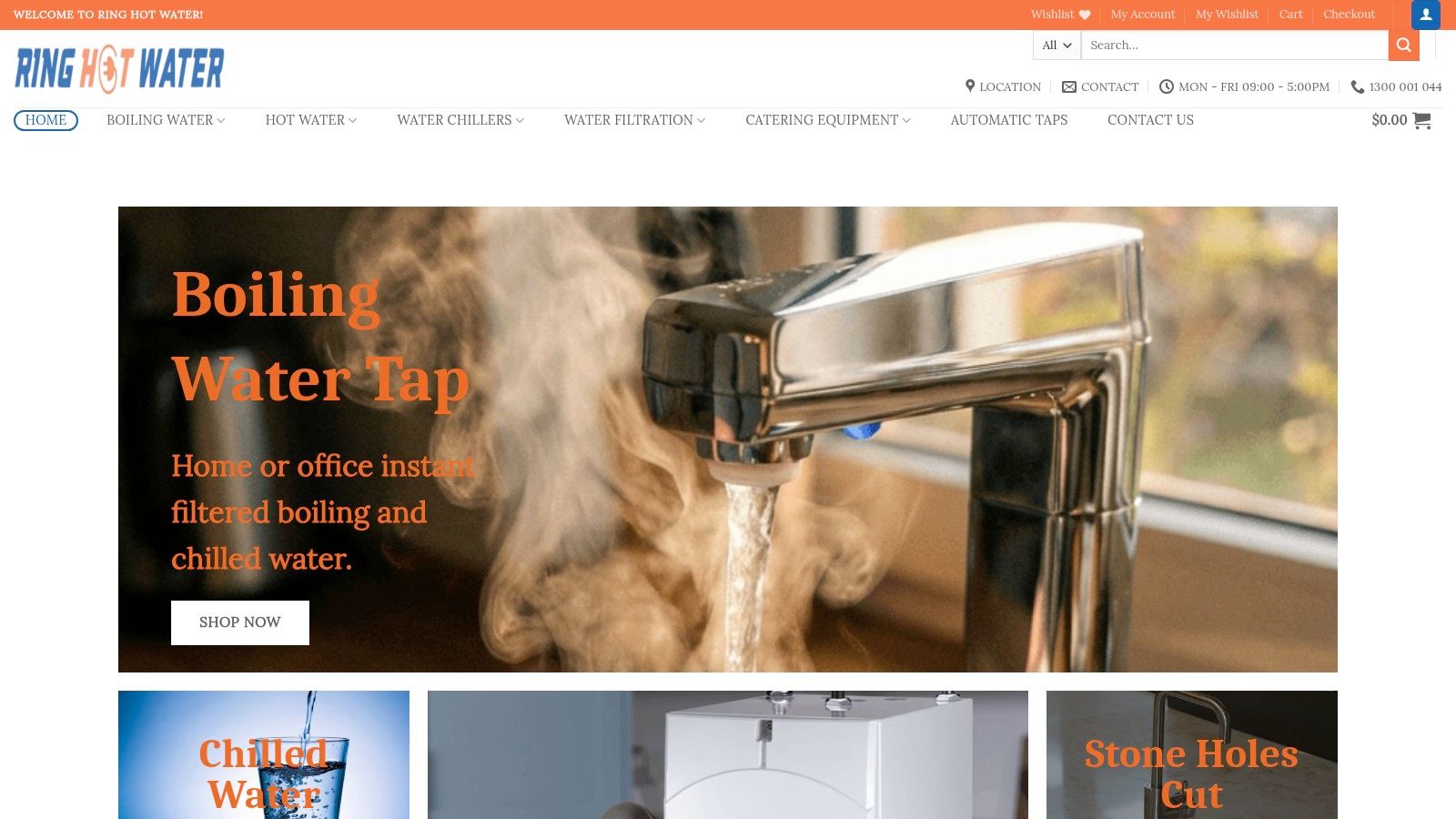
Boiling taps are where hard water stops being a nuisance and starts becoming expensive. These systems heat water quickly, store or process it in compact internal chambers, and rely on narrow waterways, valves, and fittings. That makes them far more sensitive to scale than a standard mixer tap.
Why boiling units are more vulnerable
High temperature accelerates mineral deposition. Inside an instant boiling or boiling-chilled unit, even a modest hardness issue can become a service issue faster than homeowners expect. The common signs are reduced flow, noisy operation, poor heating behaviour, and scale around internal parts that the user never sees until the unit is opened.
For anyone fitting premium kitchen equipment, the treatment system should be chosen with the appliance in mind, not as an afterthought. Water efficiency and product selection also matter in the broader tapware category, and this overview of Australian tapware WELS ratings is useful context when comparing fixtures in a renovation.
Why RO on its own isn't the whole answer
Drinking water quality and scale protection overlap, but they aren't identical. As noted in this guide to water filters in Australia, homeowners often look for under-sink solutions that improve taste and support premium tap systems. But if hardness is part of the water profile, the treatment design has to account for appliance protection as well as drinking quality.
The technical point that matters most comes from the earlier source on RO systems: RO removes 95–99% of dissolved solids including hardness minerals, but RO alone doesn't effectively soften water without a pre-treatment ion exchange stage when hardness is high, because hardness can impair membrane performance and reduce flow rates.
That is why hybrid thinking matters with boiling taps. If the water is hard enough to threaten a heater or compact boiling unit, a nice-looking filter kit alone may leave the vulnerable parts exposed.
A boiling tap is not just another kitchen tap. It is a heated appliance with tapware attached.
For Melbourne homeowners, this is the part generic buying guides usually miss. Compatibility is not only about fittings and cupboard space. It is about matching the treatment method to the way the appliance works.
Professional Installation and Service in Melbourne
A good hard water system can perform badly if it is installed without regard for pressure, backflow protection, service access, or appliance compatibility. That is why professional installation matters more than many homeowners expect, especially in Melbourne kitchens where under-sink layouts are often tight and equipment stacks up quickly.
Compliance is part of the job
In the Australian context, particularly for Melbourne, drinking water treatment systems must comply with AS 3497:2021. As outlined in the Whole House Guide from WA Water Filters, the standard sets minimum requirements for construction and installation, and requires a Pressure Limiting Valve if line pressure exceeds 480 kPa. The same source also requires dual check backflow prevention to ensure water safety.
Those aren't optional extras. They affect safety, compliance, and system longevity.
What to ask before installation
Before you proceed with any water filtration for hard water setup, ask the installer these practical questions:
- Will this system treat hardness, or only improve taste?
- Is it suitable for my boiling or chilled tap model?
- Do pressure conditions require extra protection components?
- How much service space is needed under the sink or at the main line?
- What maintenance will I be responsible for after installation?
If you are arranging local fitting, this guide to water filter installation in Melbourne is a useful starting point for understanding the installation side of the decision.
Think beyond the purchase day
Homeowners often focus on the unit price and forget the service cycle. Some systems need cartridge changes. Some need salt or other consumables. Some are simple but only protect one outlet. Others protect the whole property but need more planning, space, and upkeep.
The right choice is the one you will maintain properly.
A well-selected system should fit the water problem, the appliance load, the available space, and the level of maintenance you're comfortable with. When those four things line up, hard water becomes manageable instead of a recurring headache.
If you want practical advice on the right hard water setup for your home, office, or instant boiling tap, Ring Hot Water can help with product selection, Melbourne installation, repairs, and ongoing support.

