
Water Filters
Water Filter for Taps
May
Water Filter for Taps: The Ultimate 2026 Melbourne Guide
You fill the kettle, boil it for tea, and notice the white crust building up again around the spout. Or you pour a glass straight from the kitchen mixer and catch that faint treated taste that makes you reach for the fridge instead. That's a common moment in Melbourne homes. The water is generally good, but plenty of people still want it to taste better, feel more reliable, and do less damage to kettles, coffee machines, and expensive instant taps.
A good water filter for taps can solve several different problems at once. It can improve taste, reduce certain contaminants, and help protect appliances that don't cope well with sediment or mineral build-up. The tricky part is that “tap filter” can mean several very different systems, and many people buy the wrong one because the packaging sounds reassuring.
I've worked with Melbourne households and workplaces that started with a simple question like, “Do I just need a filter on the tap?” Once you unpack what they want, such as cleaner taste, less scale, better protection for a boiling tap, or safer water from older plumbing, the answer becomes much clearer.
Your Complete Guide to Cleaner Tap Water
Rarely do households begin their journey by shopping for a filtration system. Instead, the process often starts by noticing something small. Water that tastes different from suburb to suburb. Glassware that never quite dries clear. A chilled tap or boiling unit that costs real money and probably shouldn't be fed untreated water without a second thought.
Melbourne water has a good reputation, and that's fair. But “safe to supply” and “ideal for your kitchen habits, your plumbing, and your appliances” aren't exactly the same thing. A family with an older home may worry about what happens inside ageing internal pipes. An office manager may care less about taste and more about keeping a boiling water unit running properly. A café owner may need both.
Clean water decisions usually come down to three practical goals. Better taste, better peace of mind, and better protection for appliances.
That's why this topic gets confusing so quickly. One filter mainly improves chlorine taste. Another targets specific health-related contaminants. Another is chosen less for drinking quality and more because it helps protect heating elements and valves under the sink.
If you've been searching for a water filter for taps and feeling buried in jargon, micron ratings, carbon blocks, reverse osmosis, NSF numbers, you're in the right place. The useful way to approach it is simple. Work out what problem you're trying to solve, match that to the right type of filtration, then make sure the filter can live happily with the tap or appliance you already have, or plan to install.
Why You Should Filter Your Tap Water in Melbourne
The strongest reason to filter tap water usually isn't panic. It's control. People want to know that the water they drink, cook with, and run through valuable appliances is better suited to their home than whatever comes straight through the line.
In Melbourne, the first complaint is often taste. Some people notice chlorine or a general treatment flavour. Others notice kettle scale, film on fixtures, or water that seems fine cold but less pleasant in tea and coffee. Those are practical reasons, not abstract ones. If the water tastes better, people drink more of it. If it carries less sediment and fewer problem minerals into appliances, those appliances usually have an easier life.
There's also a wider shift in public attitude. In 2022, 69% of people surveyed agreed it was necessary to filter their tap water at home, up from 63% in 2020, according to Aquasana's summary of the survey findings. That same source says the trend is tied to health concerns and lower trust in tap water quality as awareness grows around contaminants such as lead, arsenic, and PFAS.
Taste is the gateway reason
A lot of households begin with taste and odour, then later realise filtration can do more. Activated carbon filters are commonly chosen because they target aesthetic issues well. If your water has that pool-like edge, or if you can smell treatment chemicals when filling a bottle, that kind of filter is often the first useful step.
Taste matters more than people admit. If water tastes off, families buy bottled water, fill the fridge with jugs, or avoid drinking enough through the day. A filter at the tap removes that friction.
Health concerns are more specific
Confusion often arises at this stage. Not every filter removes every contaminant. A simple carbon filter may improve taste beautifully and still not be the right answer for PFAS, arsenic, bacteria, or other more demanding concerns. That's why choosing on appearance or price alone can backfire.
For homeowners in older properties, internal plumbing can be part of the question. For people near industrial areas or using tank water in other parts of Victoria, the contaminant profile may be different again. The smart move isn't to guess. It's to identify the issue first, then choose a filter that's certified for it.
Appliance protection is a major reason people miss
Boiling taps, chilled taps, coffee machines, and even kettles all react to water quality. Sediment can clog. Minerals can scale. Taste issues become more obvious when water is heated. If you've invested in a sleek under-sink system, running unfiltered water through it can be a false economy.
A filter doesn't just change what lands in your glass. It changes what reaches valves, cartridges, tanks, and heating chambers.
- For everyday drinking: better taste and odour can make tap water easier to enjoy.
- For cautious households: contaminant-specific filters can add peace of mind when selected properly.
- For kitchens with premium appliances: filtration can help reduce the load on sensitive parts.
That's why filtering tap water in Melbourne isn't about assuming the worst. It's about choosing water quality that matches how you live.
The Main Types of Tap Water Filters Explained
The easiest way to understand filtration is to compare it to home security. Some systems provide basic protection at one entry point. Others protect a whole area. Others guard the entire property.
That's useful because many buyers compare products that shouldn't really be compared. A small faucet attachment and a reverse osmosis under-sink system both filter water, but they don't play the same role.
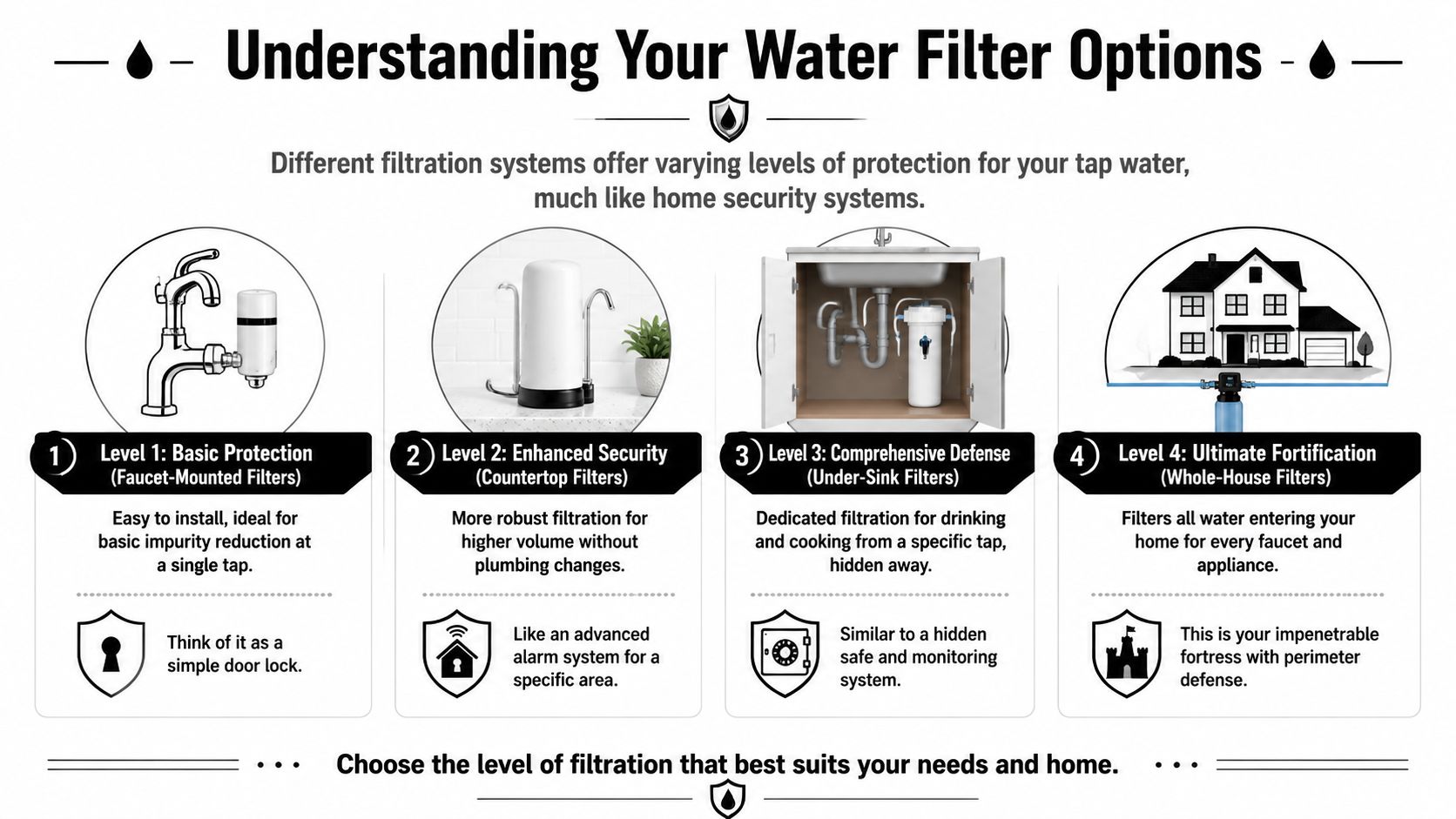
Faucet-mounted filters
This is the simple door lock. A faucet-mounted filter attaches directly to a tap and usually uses carbon-based media to improve water at that point of use.
Its appeal is obvious. It's compact, relatively easy to fit, and gives fast access to filtered drinking water without changing the whole kitchen layout. For renters or anyone wanting a low-commitment starting point, it's often the first product they try.
The limitation is just as important. Faucet filters are usually aimed at taste, odour, and selected contaminants, not every contaminant. They also sit in a visible spot and can affect flow.
Countertop filters
A countertop unit is more like an alarm system for one zone of the house. It gives stronger presence and often a bit more filtration capacity than a simple tap attachment, but without major plumbing work.
These systems suit people who want better filtration but don't want to modify cabinetry or install a dedicated under-sink setup. In some kitchens, though, they take up too much bench space or look bulky next to modern tapware.
For homes with a carefully designed kitchen, that matters more than people expect. A technically decent filter that annoys you every day rarely stays in service for long.
A short video can help you visualise the broad differences in household filter options and setups.
Under-sink filters
This is the hidden safe and monitored system. An under-sink water filter connects below the bench and feeds either a dedicated filtered tap or a compatible filtered-water line. It keeps the hardware out of sight and gives a neater result in most kitchens.
This category covers a lot of ground. Some under-sink systems use carbon block cartridges for taste and selected contaminant reduction. Others add finer filtration stages. Some are built specifically to work upstream of boiling and chilled taps.
If you're comparing these setups in a local context, this guide to an under-sink water filter in Melbourne is useful because it focuses on how people use them in real kitchens rather than treating them as lab equipment.
Whole-house filters
This is the perimeter fence. A whole-house filter treats water as it enters the property, which means every tap, shower, appliance, and outlet receives filtered water at some level.
That doesn't always make it the right choice for drinking water quality alone. Many households still pair whole-house treatment with a dedicated drinking water system at the kitchen. But if sediment protection or broad appliance protection is part of the goal, whole-house filtration can make sense.
Micron ratings in plain English
This is one of the terms that confuses people most. A micron is a unit used to describe how fine the filtration is. It represents the gap size in a sieve. The smaller the holes, the smaller the unwanted material it can physically catch.
According to the CDC's guide to choosing home water filters, filters with 1-micron pores can remove cysts when they're NSF 53/58 certified, while bacteria such as E. coli require 0.3-micron pores. The same CDC reference notes that reverse osmosis can remove up to 99% of contaminants.
That sounds simple, but there's a trade-off. Finer filtration usually means slower flow. That's why two filters can both claim to produce “clean water” and still behave very differently at the tap.
Practical rule: Don't treat a lower micron number as automatically better. It's only better if it matches the problem you need to solve and still delivers acceptable flow for your kitchen.
If you like the science side of this, these molecular level water purification techniques give helpful background on how membrane filtration works beyond the marketing language.
NSF certifications in plain English
If micron rating tells you how fine a filter is, NSF certification tells you what the filter has been tested to reduce. It's the difference between “this sounds good” and “this has been checked against a standard”.
Here's the shorthand most homeowners should know:
- NSF 42 deals with aesthetic issues such as chlorine taste and odour.
- NSF 53 deals with health-related contaminants such as lead, mercury, and cysts.
- NSF 401 relates to certain emerging contaminants, including PFAS in specific certified products.
The point isn't to memorise numbers. The point is to stop buying vague promises. If a brand says “pure”, “advanced”, or “premium” but doesn't clearly show what standard it meets, keep your wallet in your pocket.
Matching the Filter to the Contaminant
A lot of confusion disappears once you stop asking, “What's the best filter?” and start asking, “Best for what?” Chlorine taste needs one sort of answer. Lead risk may need another. PFAS, bacteria, hardness, and sediment can each require different technology.
The biggest mistake I see is assuming a standard carbon filter is a universal fix. It isn't. A carbon cartridge can be excellent for taste and still be the wrong tool for more serious or more specialised contaminants.
What the certification numbers really mean in practice
As explained earlier, NSF 42 is about aesthetic improvement, particularly things like chlorine taste and odour. NSF 53 deals with health-related contaminants such as lead and mercury. According to Shell Water Systems' explanation of faucet filter certifications, standard carbon filters do not remove PFAS, arsenic, or bacteria effectively, which means those concerns require specialised systems such as reverse osmosis or specifically certified products.
That matters when someone buys a compact faucet unit expecting it to solve every water quality concern in one go. It may still be a worthwhile purchase, but only if its job matches your goal.
Filter type vs contaminant removal
| Contaminant | Faucet-Mounted (Carbon) | Under-Sink (Carbon Block) | Reverse Osmosis (RO) |
|---|---|---|---|
| Chlorine taste and odour | Commonly suitable when certified for aesthetic reduction | Commonly suitable when certified for aesthetic reduction | Suitable |
| Sediment | Can help, depending on design | Commonly suitable with pre-filtration | Suitable with staged filtration |
| Lead | Only if specifically certified | Often a stronger option when specifically certified | Suitable |
| Mercury | Only if specifically certified | Often a stronger option when specifically certified | Suitable |
| Cysts | Not all models | Possible when appropriately certified | Suitable |
| Bacteria | Generally not suitable | Not suitable unless designed for that role | More suitable when designed for that role |
| PFAS | Usually not suitable | Only if specifically certified for PFAS | More suitable when designed for that role |
| Arsenic | Not suitable | Usually not suitable in standard carbon form | Suitable |
| High dissolved solids | Not suitable | Not suitable in standard carbon form | Suitable |
Flow rate is the trade-off people feel straight away
The more demanding the filtration, the more likely you are to notice a change in flow, especially in compact tap-mounted systems. That's not a flaw on its own. It is a matter of physics and design. Fine filtration and broad contaminant reduction often ask more of the water as it passes through media or membranes.
A common example is the everyday cartridge refill market. If you're comparing household cartridge styles and want a reference point for what manufacturers highlight around taste and impurity reduction, this Barrons Brita Maxtra Pro multipack is a useful example to inspect. Not because one cartridge suits every home, but because it shows how product claims should be tied to a specific filter format and purpose.
If a filter promises everything, assume nothing until you've checked the certification and the contaminant list.
A practical way to choose
Use this sequence when you're standing in front of product pages that all sound similar:
- Start with the problem. Bad taste, concern about lead, kettle scale, or protection for an instant tap are not the same buying brief.
- Check the standard. Look for the specific NSF certification that matches your concern.
- Match the technology. Carbon for taste and some contaminant reduction. More specialised systems for PFAS, arsenic, bacteria, or dissolved solids.
- Accept the trade-off. Stronger filtration may mean a slower dedicated drinking tap. That's often a normal compromise, not a defect.
Good filtration then becomes much less mysterious. You don't need every technology. You need the right one.
Integrating Filters with Boiling and Chilled Taps
This is the part most online guides barely touch, and it's often the most expensive mistake in a modern kitchen. People spend serious money on an instant boiling tap or a chilled water unit, then place an unsuitable filter in front of it, or skip filtration altogether and hope for the best.
That approach can cause trouble in two directions. Water quality can affect the taste coming out of the tap, and it can also affect the internal life of the appliance itself. Sediment, mineral build-up, and poor filter matching can all interfere with performance.
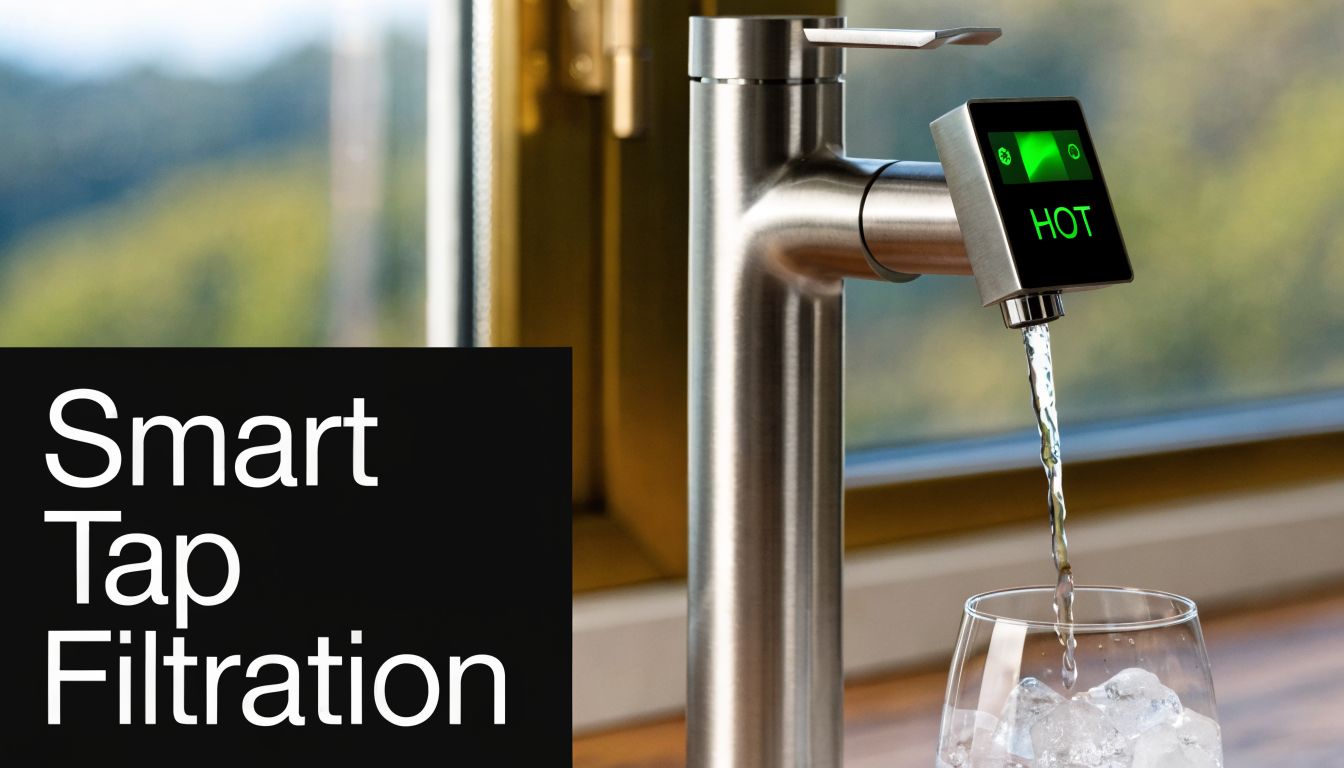
Why integration matters
As noted by Waterdrop's under-sink filtration collection overview, online guides focus heavily on contaminant reduction but offer very little guidance on how under-sink filters interact with instant boiling or chilled water systems. That gap matters in Australian kitchens where under-sink space is tight and one unit often has to work alongside another.
An instant boiling unit isn't just another tap. It has internal components that heat water quickly and repeatedly. A chilled system has its own flow and pressure needs. If the incoming water carries too much sediment or mineral load, those components can suffer. If the filter restricts flow too heavily, the appliance may not perform the way you expect.
The wrong filter can create new problems
Some homeowners assume the most aggressive filter is always the safest choice. Not necessarily. For an appliance-fed setup, the filter has to suit both the water issue and the machine.
A few examples make this clearer:
- If scale is the main enemy: the priority may be protecting heating elements and reducing mineral-related build-up.
- If taste is the complaint: carbon-based filtration may be the key part of the setup.
- If there's a specific contaminant concern: the system has to be checked for compatibility with the appliance, not just contaminant performance.
That's why a filtered drinking tap and a filtered boiling tap may need different planning, even in the same kitchen.
Think of the filter as part of the appliance system
A lot of people treat filtration as an accessory. In these kitchens, it's better to think of it as part of the operating system. The filter, the feed line, the appliance, and the expected water output all need to work together.
A boiling or chilled tap should be specified with its upstream filtration in mind, not as an afterthought.
If you're comparing layouts, this guide to an instant hot water tap is worth reading because it helps frame the tap and the filter as one joined-up installation rather than separate purchases.
This is one of the few situations where product matching matters as much as filtration theory. A technically impressive filter can still be the wrong choice if it starves the unit of flow, consumes too much under-sink space, or doesn't address the scale and sediment issues that shorten appliance life.
A simple kitchen example
Say you're renovating in Melbourne and want one tap that delivers normal cold, filtered drinking water, and near-instant hot water. You don't just need “a filter”. You need a setup that balances taste improvement, appliance protection, service access under the sink, and enough flow for the unit to refill properly.
That's why integrated planning matters. It saves headaches later.
Installation Maintenance and Long-Term Costs
Buying the filter is the easy part. Living with it is where the decision proves itself. A water filter for taps should be simple enough to maintain that you'll keep it working properly. Even a well-chosen system can underperform if the cartridge is overdue, the screen is dirty, or the installation was a poor fit from the start.
DIY versus professional installation
Some filters are straightforward enough for confident DIY users. Faucet-mounted units are the obvious example. They attach directly to the outlet and usually don't require cabinet work or extra plumbing.
Under-sink systems are different. They need space, proper connections, sensible cartridge access, and in many kitchens they must share the cabinet with waste pipes, pull-out bins, or an instant hot or chilled unit. That's where professional fitting becomes practical rather than fancy.
For local setups involving dedicated filtered taps or appliance integration, a specialist installer is usually the cleaner option. If you want to understand what a fitted solution involves, this page on water filter installation in Melbourne shows the kinds of systems and service situations homeowners commonly deal with.
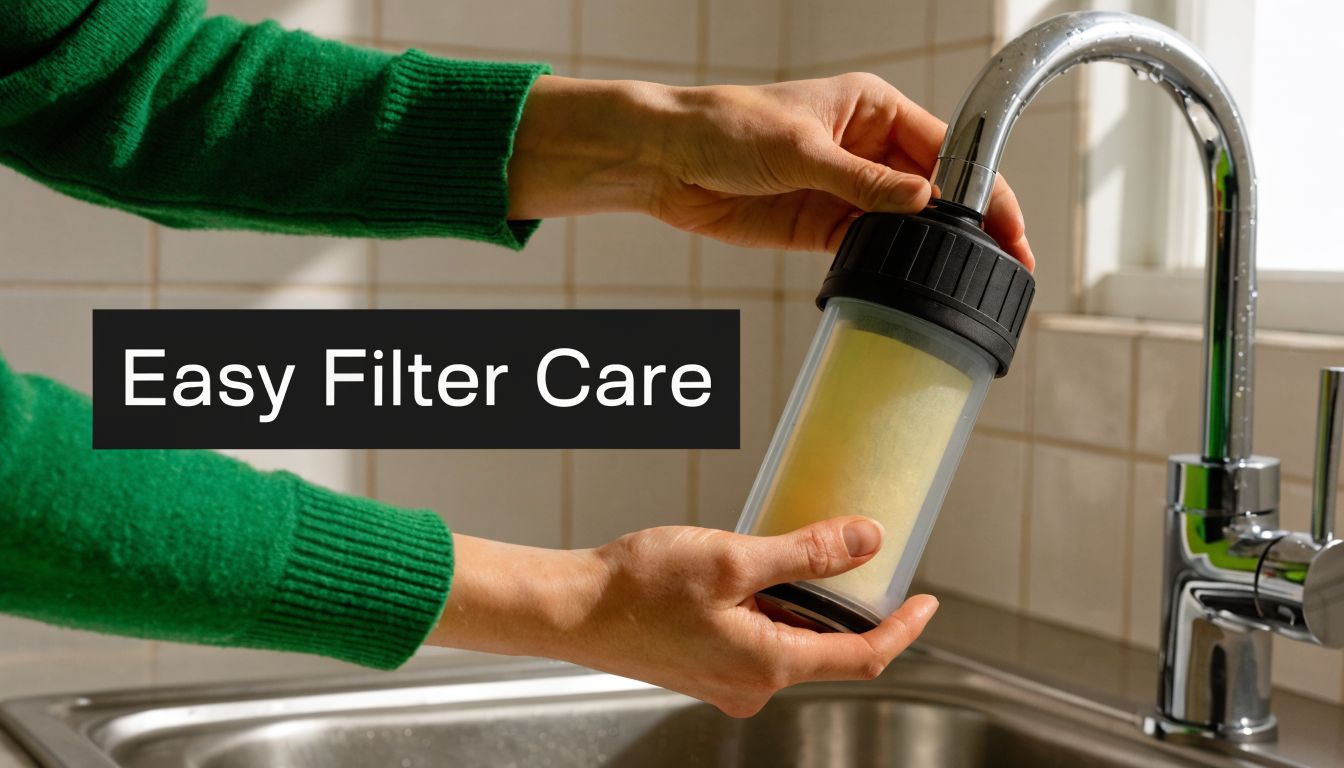
Maintenance is not optional
Many “bad filter” stories begin with this situation. The filter wasn't bad. It was exhausted, clogged, or neglected.
According to Frizzlife's guide to kitchen faucet water filters, faucet filters can reduce water flow by 20% to 50%, and their effectiveness and flow depend heavily on timely cartridge replacement and regular screen cleaning, particularly in hard water areas.
That tells you two things. First, some reduction in flow may be normal. Second, worsening flow is often a maintenance signal.
A workable routine for households
You don't need a complicated schedule. You need a repeatable one.
- Check the flow. If the filtered stream gets noticeably weaker, inspect the screen and cartridge rather than assuming the whole unit has failed.
- Replace on schedule. Follow the cartridge guidance for your specific system. Waiting until water tastes bad means you've already pushed too far.
- Clean accessible parts. Screens and housings can collect debris that affects performance before the cartridge itself is fully spent.
- Watch appliance behaviour. If a boiling or chilled unit starts acting differently, don't only blame the machine. The upstream filter may be overdue.
Thinking about long-term value
It's tempting to compare filtration only by purchase price, but the better comparison is ongoing habit versus ongoing habit. What are you replacing? Bottled water? Jug filters? Repeated kettle descaling? Service calls caused by avoidable sediment or scale issues?
There isn't one fixed formula because homes use water differently. A single person in an apartment and a busy office kitchen won't put the same load on a system. But the method is simple:
- List your current spending on drinking water workarounds and appliance upkeep.
- Add the purchase and maintenance cost of the filter system you're considering.
- Compare convenience, waste reduction, and likely protection for appliances, not just the upfront spend.
Maintenance mindset: The cheapest filter is often the one people forget to maintain. The better value is the system you'll actually service on time.
A well-chosen system doesn't only clean water. It makes daily use easier.
Your Path to Cleaner Water in Melbourne
If you've made it this far, you're already past the hardest part. You know that a water filter for taps isn't one single product category with one obvious answer. It's a matching exercise.
Start with your real goal. If you want water that tastes better, that points you toward one kind of solution. If you're concerned about a specific contaminant, certification becomes the deciding factor. If you're installing a boiling or chilled tap, appliance protection and compatibility move right to the top of the list.
Keep your decision simple
When homeowners get stuck, it's usually because they're trying to compare too many features at once. Strip it back to these checks:
- What bothers you now. Taste, odour, scale, appliance build-up, or a contaminant concern.
- Where you need the treatment. One tap, one kitchen zone, or the whole home.
- What proof the filter offers. Certification matters more than marketing language.
- How it will fit your kitchen. Bench space, under-sink room, and appliance compatibility all count.
- Whether you'll maintain it. A perfect system on paper is useless if cartridge changes become a hassle.
For Melbourne homes, integration matters more than most guides admit
That's especially true in renovated kitchens, apartments, and office fit-outs where cupboard space is tight and people want filtered cold water alongside instant hot or chilled functionality. The neatest solution isn't always the smallest filter. The strongest contaminant spec isn't always the right appliance partner. The smart choice is the one that solves the actual problem without creating a new one.
For many households, the best next step isn't buying immediately. It's narrowing the brief. Decide whether your priority is drinking quality, appliance protection, or both. Once that's clear, product selection gets much easier.
Clean water at the tap should feel ordinary. No fuss, no second guessing, no wondering whether the expensive unit under the sink is accumulating scale or whether the “premium” cartridge you bought is only changing taste and not much else.
If you'd like help choosing a practical setup for your kitchen, office, or appliance combination, contact Ring Hot Water for advice on suitable filtration options, compatibility with boiling and chilled taps, and professional installation support in Melbourne.

