
Uncategorized
How Does an Automatic Sensor Tap Work and Is IT Worth Installing
Jul
You wash your hands, reach for the tap, and end up touching the one part everyone else touched before you. In a public loo, an office kitchenette, a busy café, or even at home when someone's been handling raw chicken, that's the moment a lot of people start looking at sensor taps.
I get why. They look cleaner, feel more modern, and in the right setup they are more practical than a standard mixer. But they're not magic, and they're not always the right choice. Some work brilliantly. Some drive people mad because the sensor is in the wrong spot, the power setup was an afterthought, or the tap doesn't suit the way the sink gets used.
As a Melbourne plumber and water solutions specialist, I've fitted automatic taps in houses, office bathrooms, lunchrooms, and caravans. The question I hear most is simple. How does an automatic sensor tap work, and is it worth installing? The honest answer depends less on the marketing brochure and more on where it's going, who's using it, and whether it's been installed properly.
The End of the Tap Handle
The classic tap handle has one obvious weakness. You wash to get clean, then you touch the dirty part on the way out.
That's why touchless taps took off first in public spaces. In office bathrooms, shopping centres, hotels, and medical settings, they solve a problem people notice straight away. No twisting knobs. No wet handles. No queue of people leaving water running because they only half-closed the tap.
At home, the appeal is a bit different. It's less about “public hygiene” and more about convenience. When your hands are messy from cooking, when kids leave the basin looking like a flood zone, or when an older family member struggles with stiff tap handles, sensor operation starts to make sense.
Where the appeal is real
In practice, people usually want one of four things:
- Cleaner touch points in bathrooms and kitchens
- Less water left running by kids, guests, or staff
- A neater, more modern look in renovated spaces
- Easier operation for people with limited grip or mobility
That all sounds good. The part most articles skip is that a sensor tap only feels “smart” when the basics are right. If detection is patchy, if the spout is too short for the basin, or if the shut-off timing doesn't suit the sink, the novelty wears off fast.
What works in a hotel powder room doesn't always work in a family kitchen.
That's the line I keep coming back to on jobs around Melbourne. A touchless tap in a guest ensuite can be a clean, tidy upgrade. The same style of tap over a deep kitchen sink, where someone wants to rinse vegetables, fill a pot, and wash oversized trays, can feel restrictive unless you choose very carefully.
So yes, sensor taps solve a real problem. But they also create a different set of trade-offs. To decide if they're worth it, you need to know what's happening inside them and what goes wrong in day-to-day use.
How Sensor Taps Actually Work
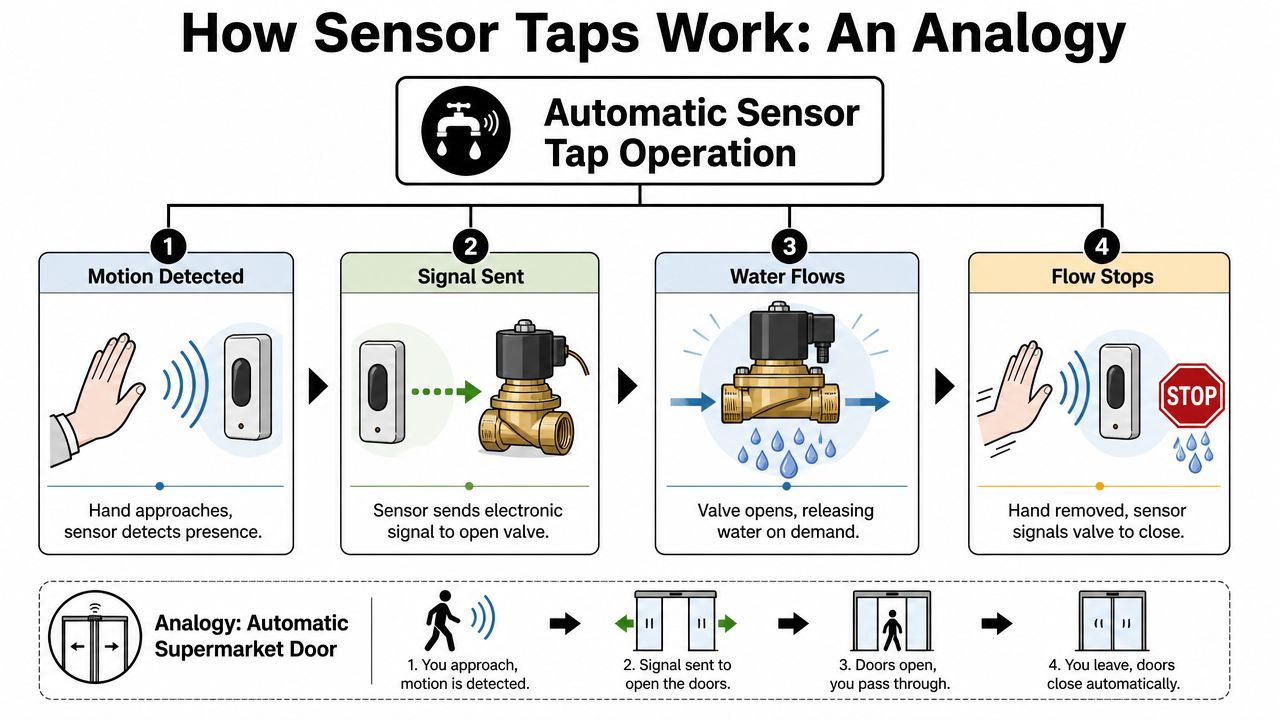
The easiest way to understand a sensor tap is to think about an automatic supermarket door. You walk up, the sensor picks up your presence, and the door opens. You move away, and it closes. A sensor tap follows the same basic logic, just with water instead of glass panels.
Inside the tap system is a four-part setup: an infrared proximity sensor, a latching solenoid valve, a power source, and a PCB control unit. When your hand enters the active zone, the sensor reads the reflected infrared signal, the control unit processes it, and the valve opens. According to this explanation of the four-component operating system, the tap usually activates within 0.3 to 0.5 seconds and the hand is typically detected around 3 to 5 cm from the spout.
The four parts that matter
Here's what each part does on a real install.
Infrared sensor
This is the “eye” of the tap. It sends out an invisible beam and waits for that beam to bounce back when your hands move underneath.PCB control unit
This is the decision-maker. It reads the sensor signal and tells the tap whether to start or stop water flow.Solenoid valve
This is the gatekeeper. Once it gets the signal, it opens the water path. When your hands move away, it closes again.Power source
Sensor taps need electricity to do any of this. That usually means batteries or mains power.
What happens step by step
In use, the chain reaction is quick:
- Your hand moves into range under or near the spout.
- The sensor detects reflected infrared light.
- The control board confirms a valid signal.
- The solenoid valve opens and water starts flowing.
- Your hand leaves the detection zone.
- The valve closes automatically and flow stops.
That's the simple version, but it matters because every complaint about sensor taps usually traces back to one of those steps. If the hand isn't seen properly, the sensor placement is wrong. If the valve chatters, sticks, or drips, the internal hardware needs attention. If the tap is dead, the power source is the first thing to check.
For a practical look at health-focused touch-free setups beyond taps, this article on stopping viruses with dispensers is useful because it shows the same contact-reduction logic in another fixture people use every day.
Installer's view: the technology isn't complicated. The hard part is matching the sensor zone, spout reach, and basin shape so the tap reacts where people naturally place their hands.
If you want a more product-focused breakdown of the mechanism itself, Ring Hot Water also has a guide on how automatic taps work, which explains the core operating principle in plain terms.
The Major Benefits of Going Touchless
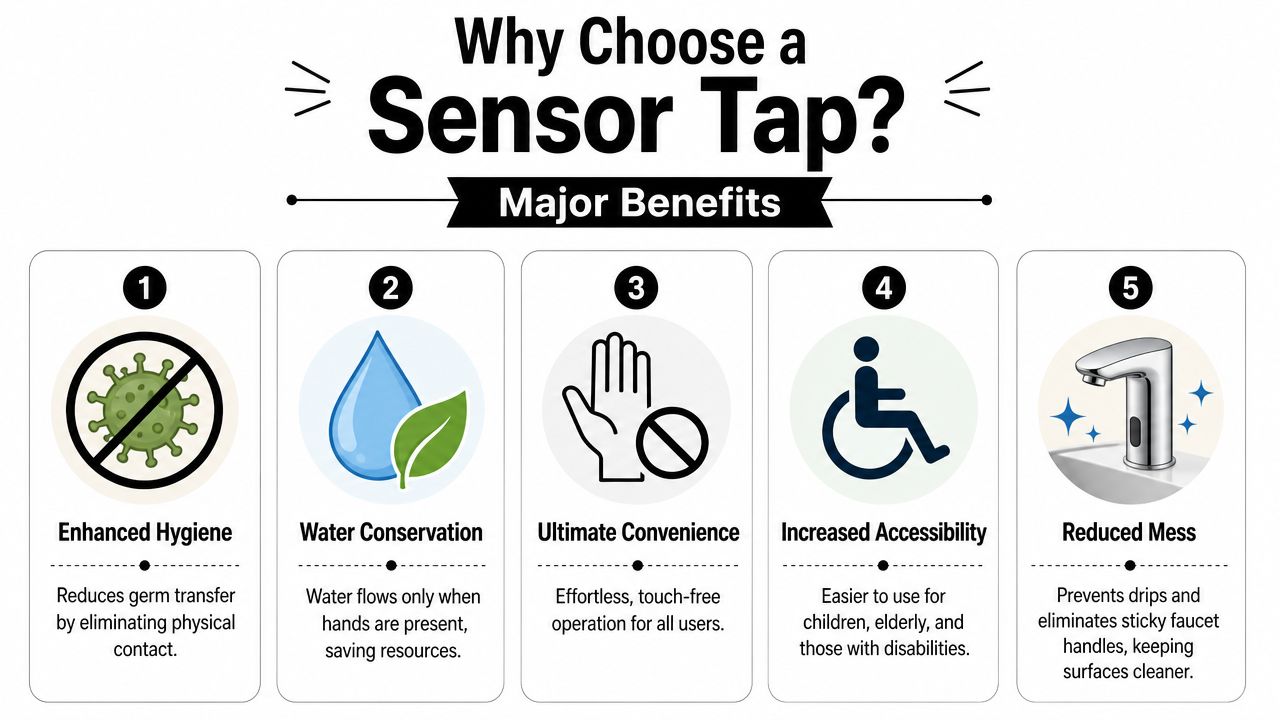
The biggest reason people install a sensor tap is simple. You don't have to touch it. That matters more than it sounds.
In bathrooms, that means fewer shared contact points. In kitchens, it means you can turn water on with messy hands without smearing oil, dough, meat juices, or soap over the handle. In offices and hospitality spaces, it also cuts down on the grubby look that ordinary taps develop around the lever and base.
According to Jaquar's sensor tap guide, these taps use infrared proximity sensing near the spout, respond in 0.3 to 0.5 seconds, shut off automatically when hands move away, and can run on battery or mains power, with batteries typically lasting 5 to 10 years with maintenance. That same guide notes the touch-free operation supports hygiene in Australian households, hotels, and public facilities.
Where sensor taps earn their keep
The benefits are strongest when the users are many, the sink sees constant traffic, or cleanliness matters every hour of the day.
Bathrooms with frequent use
Shared bathrooms in offices, clinics, gyms, and cafés benefit most because every avoided touch point matters.Family homes with kids
A sensor tap doesn't rely on a child remembering to turn the water off properly.Accessible bathrooms
For someone with arthritis or reduced grip strength, no-handle operation can be a real improvement.Messy kitchen tasks
Bakers, home cooks, and hospitality staff like them because the tap can respond without a wrist, elbow, or finger trying to nudge a lever.
It also keeps sinks tidier
This is the underrated part. Standard taps collect soap scum, fingerprints, toothpaste splatter, and the grime that builds up around handles. A touchless setup reduces a lot of that because people aren't grabbing the body of the tap all day.
There's also less accidental dripping and fewer “someone left it running” moments. That doesn't mean every sensor tap guarantees dramatic savings in every home. It means the shut-off feature removes one of the most common causes of waste, which is simple human forgetfulness.
When the tap only runs while hands are in the active zone, the fixture enforces good habits even when users don't.
That's why these taps make such good sense in public and commercial bathrooms. The behaviour is built into the fixture. You don't need every user to be careful. The tap does the stopping for them.
Downsides and Real-World Annoyances
Here's the part brochures don't like talking about. A bad sensor tap is more annoying than a basic tap.
The first issue is cost. You're buying more than a spout and cartridge. You're buying electronics, a valve, a power system, and often a more involved install. If the sink cabinet is tight, if there's no easy power access, or if the basin layout is awkward, labour goes up and the tap has more points of failure than a manual model.
The second issue is user frustration. Not every tap detects hands where people naturally hold them.
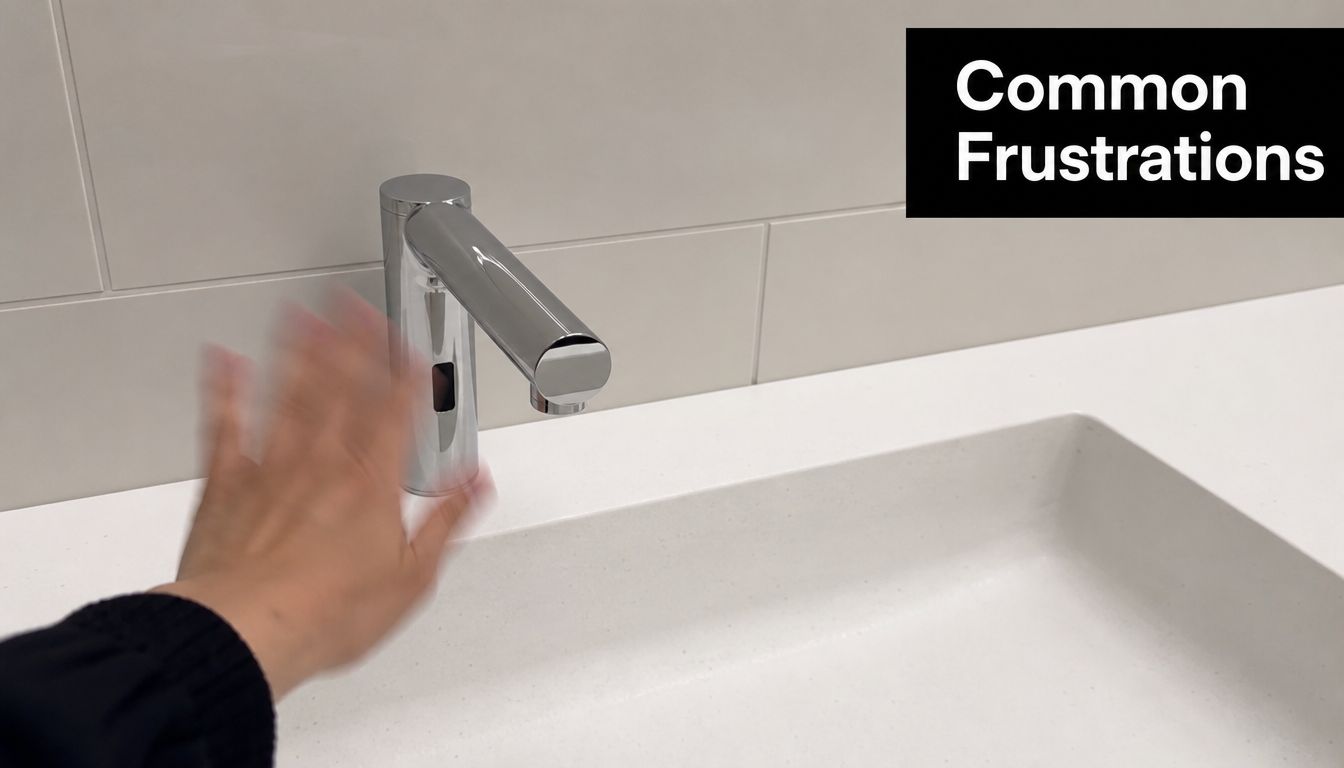
A Reddit discussion highlighted a problem installers and users run into all the time. According to that Reddit thread on poor sensor placement, 70% of users reported detection failing when cupping their hands. That complaint lines up with what I see on jobs where the sensor sits too far back, too high, or in a spot that doesn't match the basin.
The common problems in day-to-day use
Some issues show up quickly.
- The sensor misses your hands when you're trying to cup water, wash your face, or hold something bulky under the spout.
- The flow stops too early if you move slightly outside the active zone while rinsing.
- The tap won't fill a sink well unless the model has a manual override or suitable timed setting.
- Battery neglect causes failures in low-maintenance sites where nobody remembers the tap has electronics inside it.
Other problems take longer.
Where people regret the choice
Homes usually run into trouble when the owner expects a bathroom-style sensor tap to behave like a full-use kitchen mixer. That rarely ends well. Kitchens need flexibility. Bathrooms usually need consistency.
Caravans and RVs have their own trade-offs. Space is tight, power matters, and the tap has to cope with movement, compact cabinetry, and sometimes more fiddly plumbing layouts. In those setups, a sensor tap can work, but only if the unit suits mobile use and the owner understands the maintenance side.
Hard truth: if you have to wave at the tap three times to get water, nobody cares how modern it looks.
The lack of manual control is another sticking point. Some people prefer a handle because they want to run a steady stream while shaving, cleaning the basin, or filling a bucket. If that's a regular part of how the sink gets used, a standard mixer or a hybrid design often makes more sense.
Is a Sensor Tap Worth It For You
Getting to specifics, is a sensor tap worth it? For some users, absolutely. For others, only if they accept the trade-offs. And for a few, I'd steer them elsewhere.
The biggest mistake is assuming all value comes from water savings. In commercial washrooms, there's a stronger case. Billi notes up to 50% water reduction in public washrooms in its article on automatic sensor bathroom taps. But that same discussion leaves a gap for local households, because there isn't the same Melbourne-specific proof showing a clear weekly saving for every home layout.
Sensor Tap Verdict by Use Case
| User Group | Key Driver | ROI | Verdict |
|---|---|---|---|
| Homeowners | Hygiene, convenience, cleaner vanity use | Mixed. Better when used mainly in bathrooms, weaker when bought purely for promised household savings | Worth it if you want touch-free convenience and accept maintenance |
| Offices | Shared hygiene, reduced mess, controlled shut-off | Usually clearer because many users share the same tap every day | Strong yes for bathrooms and common areas |
| Hospitality venues | Presentation, hygiene, reduced handle grime, lower waste from careless use | Often practical where basins get heavy traffic | Usually worth it in wash areas and customer-facing bathrooms |
| Caravan and RV owners | Touch-free use in compact spaces, managing limited water use | Depends heavily on power setup, available room, and how the sink is used | Good niche option, but only with the right model |
| Kitchen-heavy households | Hands-free operation during food prep | Mixed because kitchens need longer flow, flexible rinsing, and pot filling | Choose carefully. A standard mixer may be better |
For Melbourne homeowners
For bathrooms, sensor taps often make sense. They're clean, convenient, and stop water flow automatically. If your main goal is a tidier vanity and less contact after washing hands, they do that well.
For kitchens, I'm more cautious. Plenty of homeowners love the idea, then realise they still want the control of a lever mixer. If you regularly fill stock pots, rinse trays, or clean large pans, a fully automatic tap can feel limiting.
For offices and public-facing spaces
In such situations, the value is easiest to justify. Shared use changes the equation. You're not just buying a tap. You're reducing shared touch points, making the area easier to keep presentable, and reducing waste from taps being left on.
Office managers and fit-out teams also tend to care about consistency. Sensor taps help standardise use. Every person walks up, gets water, walks away, and the flow stops.
For caravans and RVs
I've installed compact water solutions in caravans where every litre matters and every fitting has to earn its space. A sensor tap can be useful there, especially for handwashing, but I wouldn't call it an automatic yes.
You need to think about:
- Power source and how it fits with the van's setup
- Available clearance under the bench or around the basin
- Type of use because a tiny wash basin behaves differently from a kitchen sink
- Servicing access if something fails on the road
If you're still weighing models, layouts, and where a sensor tap suits an Australian setup, this guide to the best automatic sensor tap for an Australian bathroom or kitchen is a practical next read.
Installation and Maintenance Essentials
A sensor tap isn't hard to live with when it's installed properly. Most problems come from poor planning, not from the concept itself.
Battery-powered units are usually the most straightforward. If the plumbing lines are already in the right place and the tap suits the basin, the install is simpler. Mains-powered models need more care, especially when power access, compliance, and moisture protection come into play. If the job involves new power, altered pipework, wall-mounted rough-in, or a basin that barely fits the chosen body, get a licensed tradesperson involved.
What to check before buying
The practical checks matter more than brand hype.
Basin shape and depth
A shallow basin with a badly matched spout can cause splashing and poor detection.Sensor position
If the active zone sits where no one naturally places their hands, the tap will frustrate users from day one.Power access
Battery is simpler in many retrofits. Mains can suit fixed commercial jobs where regular battery servicing isn't desirable.Access for servicing
If you can't comfortably reach the control box, battery pack, or valve, future maintenance becomes painful.
For homeowners doing their homework before booking a plumber, SouthRay Kitchen & Bath's installation guide is a handy general reference for understanding fixture fit-up and basic installation sequence.
Simple maintenance that prevents headaches
Sensor taps don't usually need constant attention, but they do need some.
Clean the sensor eye gently
Soap film, water spots, and grime can interfere with detection.Check power before assuming failure
If the tap stops responding, start with the battery or power supply.Watch for slow shut-off or drips
That can point to valve issues, debris, or wear inside the control assembly.Test user comfort
If everyone waves at the tap awkwardly, the problem may be setup rather than hardware failure.
Keep the sensor area clean and accessible. A perfectly good tap can act faulty when the “eye” is coated in residue.
A quick fault-finding order
If a client calls and says the tap has stopped behaving, I usually work through the basics in this order:
No response at all
Check power first. Then check sensor cleanliness and connections.Runs but won't stop properly
Look at the valve and whether debris or a control fault is holding it open.Starts inconsistently
Check alignment, sensor obstruction, reflective surfaces, and how the user is presenting their hands.
If you want a broader overview of available sensor tap options, use cases, and fitting considerations, Ring Hot Water has a general page on automatic sensor taps that's useful for comparing where these fixtures suit different environments.
The Final Verdict From the Experts
Sensor taps are worth installing when the sink use matches the fixture. That's the honest answer.
For offices, hospitality venues, and shared bathrooms, the answer is usually yes. Touch-free use, cleaner presentation, and automatic shut-off solve real daily problems. For homeowners, it's a qualified yes. They make the most sense in bathrooms and powder rooms, and less sense in kitchens where people want full manual control. For caravan and RV owners, they can be a smart option when water discipline and compact operation matter, but only if the model fits the power and space constraints.
If you're asking how does an automatic sensor tap work and is it worth installing, the decision comes down to fit, not hype. Choose the right tap for the right sink, install it properly, and it's a practical upgrade. Get the wrong one, and you'll be waving at it in frustration.
If you want help choosing, supplying, or installing a sensor tap in Melbourne, Ring Hot Water can help you match the fixture to the actual use case, whether that's a home bathroom, office washroom, caravan, or a more specialised water setup.

