
Uncategorized
Low Power Boiling Water Unit: A Buyer’s Guide for 2026
Jun
You're probably here because the kettle ritual is getting old. Fill it. Wait. Forget it. Re-boil it. Fill it too high for two mugs, then tip the rest down the sink. In a busy Melbourne kitchen or office pantry, that routine steadily adds cost, clutter, and frustration.
A low power boiling water unit fixes a very specific problem. It gives you fast access to boiling water without the bench-hogging kettle, and if it's chosen and installed properly, it can also improve the total cost of ownership over time. The key is to look past the sticker price and judge the whole lifecycle: installation constraints, electrical load, filter servicing, scale management, spare parts, and whether the unit matches your usage pattern.
Why the Kettle's Days Are Numbered in Melbourne
The kettle still works. That's not the point. The problem is that it's rarely used efficiently in real homes and workplaces.
In Melbourne, I see the same pattern over and over. A family keeps a kettle on the bench because it's familiar, even though everyone wants more space and faster access to hot drinks. In offices, staff line up at morning tea while the kettle cycles through one boil after another. In small commercial kitchens, the kettle becomes a stopgap tool doing a job it was never meant to do all day.

That daily annoyance sits inside a much bigger energy story. In Australia, domestic hot water use accounts for approximately one-fifth of residential greenhouse gas emissions and a quarter of total household energy consumption, while an estimated 87% of this water is still heated by fossil fuels, according to research published via ScienceDirect. That matters because every decision about water heating now has a cost, comfort, and efficiency angle.
The shift from appliance to fixture
A kettle is an appliance you tolerate. A boiling water unit is part of the kitchen or pantry setup.
That difference changes how people use hot water. Once boiling water comes through a dedicated tap or wall-mounted unit, people stop overfilling out of habit. They take what they need. The workflow improves. The bench clears up. The room feels more organised.
Practical rule: If hot drinks, instant meals, or prep water are part of the daily routine, a permanent boiling water point usually makes more sense than a portable kettle.
Where the upgrade makes the most sense
The strongest candidates usually fall into a few groups:
- Busy households: Homes where several people make drinks across the day and don't want the wait time.
- Office kitchens: Shared pantries where repeated kettle use slows everyone down.
- Hospitality prep areas: Sites that need frequent access to hot water for service support.
- Accessible kitchens: Setups where lifting and pouring a full kettle isn't ideal.
A low power boiling water unit isn't about novelty. It's about replacing a repetitive, inefficient habit with a cleaner and more durable system.
Understanding How Instant Boiling Water Units Work
It's often assumed these units must be power-hungry because they deliver boiling water so quickly. In practice, the better way to think about them is as a compact insulated hot reserve with controlled reheating, not as a giant mini-boiler.
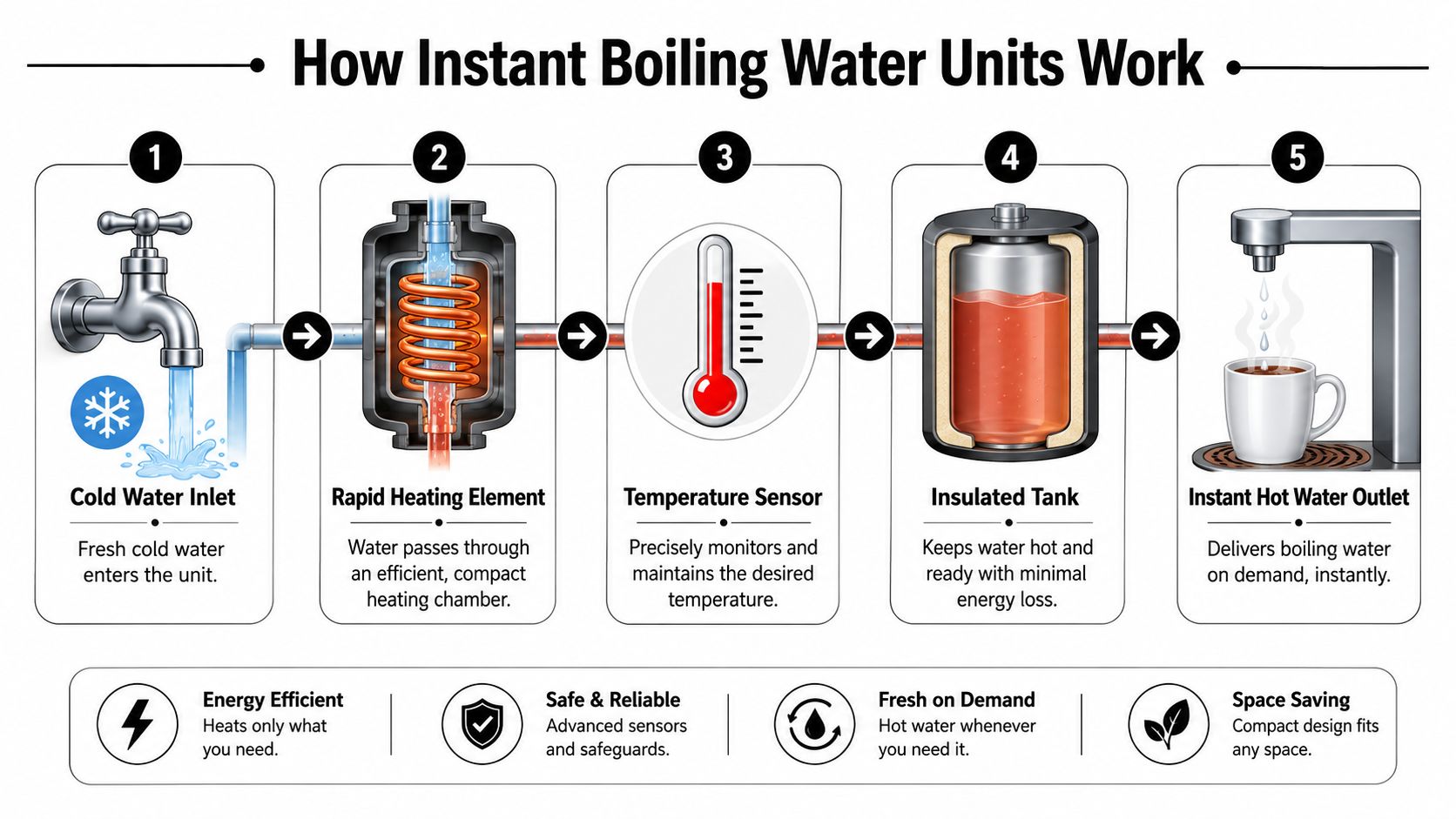
Cold water feeds into the unit. The system heats water in a compact chamber or tank, monitors temperature with a sensor, and holds it ready inside an insulated vessel. When you open the tap, it dispenses immediately and then reheats to maintain the stored volume.
That's why the experience feels different from a kettle. A kettle starts from cold every time. An instant unit maintains readiness.
Two common formats you'll come across
For Melbourne homes and offices, the main styles are straightforward.
| Format | Best fit | What to expect |
|---|---|---|
| Under-sink unit with tap | Homes, office kitchens, higher-end fit-outs | Hidden tank, dedicated tap on the bench, cleaner look |
| Wall-mounted boiler | Staff rooms, utility spaces, service areas | Visible unit, practical access, easier retrofit in some sites |
Under-sink models suit kitchens where appearance matters and bench space is tight. Wall-mounted boilers suit hard-working rooms where convenience matters more than an integrated finish.
A lot of people comparing products also benefit from understanding how these differ from larger hot water systems. If you want a broader overview of point-of-use and whole-of-home flow technology, Voyager Plumbing's homeowner's guide to continuous flow is a useful companion read.
What keeps them efficient
The insulation and controls do most of the heavy lifting. A decent unit doesn't keep reheating large volumes unnecessarily. It stores a modest amount at target temperature, then tops up and reheats as water is drawn off.
Here's a quick visual explanation of that cycle:
What they are not
It's important not to confuse a boiling water unit with:
- A standard under-sink hot water service: That system is usually intended for washing and general domestic hot water, not instant tea-and-coffee duty.
- A whole-home instantaneous heater: Different job, different sizing logic, different economics.
- A kettle in disguise: The user experience and energy behaviour are completely different.
The right unit should feel invisible in use. You turn the tap, fill the cup, and move on. No waiting, no re-boiling, no appliance clutter.
That's its appeal. The technology isn't complicated once you see what it's doing. It's a purpose-built way to keep a small volume of very hot water ready with less fuss.
The Truth About Energy Savings and Performance
“Low power” is one of those phrases that gets misunderstood. It doesn't mean weak performance. It means the system can manage energy better across actual daily use.
A kettle is brutally simple. It draws a high load, heats water from cold, switches off, and repeats that cycle every time someone uses it. That's fine if you boil exactly what you need once in a while. It's not fine if you boil too much water, re-boil half-cooled water, or run the kettle all day in a shared kitchen.
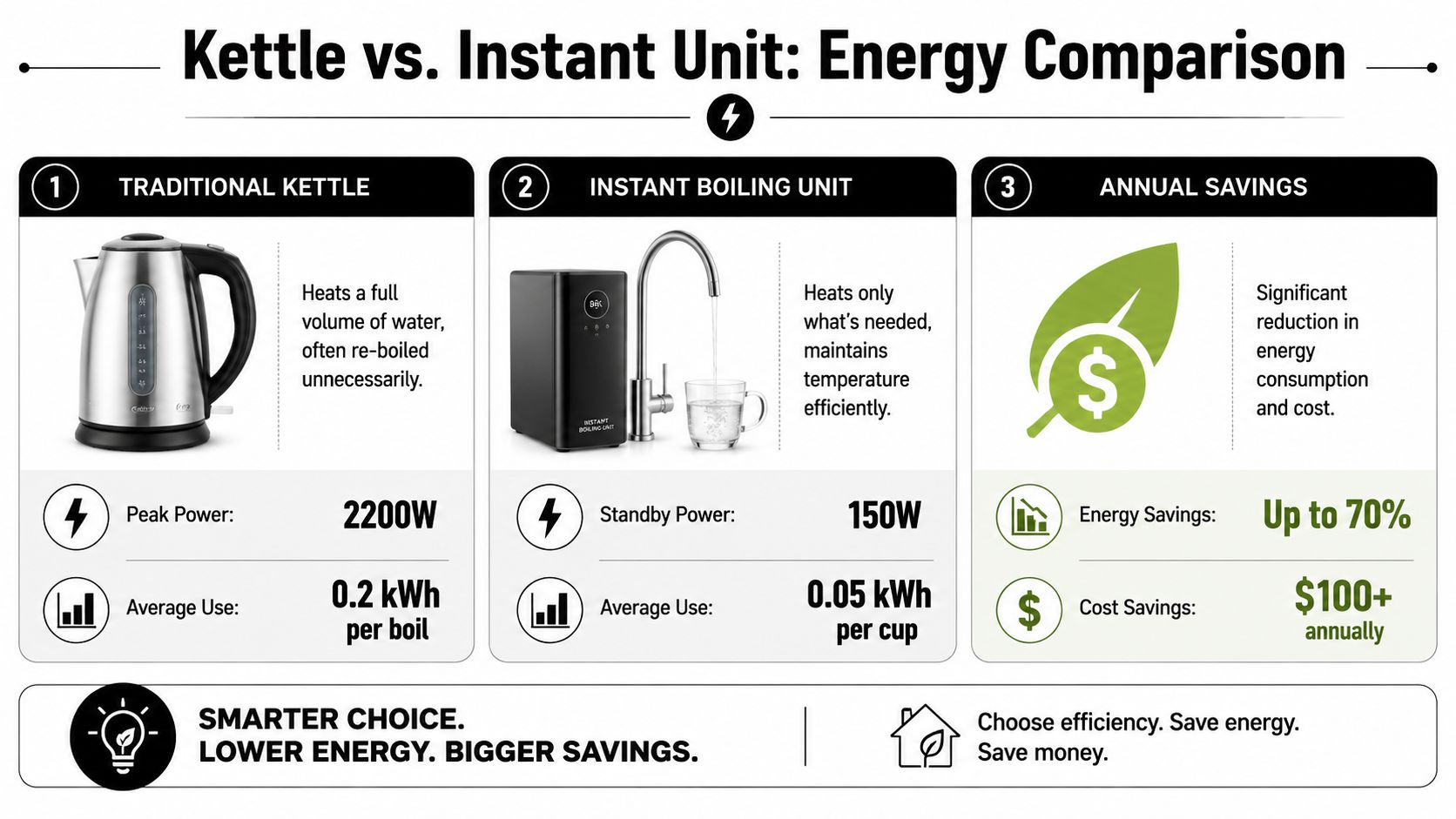
The practical comparison is clearer with real numbers. A 1.7-litre electric kettle operating at 2200 watts takes about 4 minutes and 19 seconds to boil water in Australia and consumes nearly 5 cents per boil, while a boiling water tap with a 10 watt standby draw can use up to 50% less energy under optimal usage patterns, as explained in this Ring Hot Water analysis of kettles versus boiling water taps.
Where the savings really come from
The biggest difference isn't magical appliance efficiency. Electric kettles already convert power to heat very effectively. The gap comes from behaviour.
If someone fills a kettle to the top for one mug, the waste starts immediately. If the kettle gets boiled again because the first boil sat too long, that waste compounds. If six people in an office each run their own cycle across the morning, the pattern gets expensive.
A low power boiling water unit changes that behaviour by design:
- It dispenses what's needed: Users take one cup or one jug, not a guessed full kettle.
- It avoids repeat cold starts: The system keeps water ready instead of reheating from scratch each time.
- It suits frequent use: Shared kitchens and pantries benefit most because standby loss is outweighed by repeated demand.
When a kettle can still make sense
There are cases where a kettle remains perfectly reasonable.
If you live alone, make only the occasional hot drink, and already boil the exact amount each time, the cost advantage of a permanent boiling unit won't be as dramatic. Standby energy only pays off when the unit is used often enough.
That's the part marketing often skips. Usage pattern decides the outcome.
On-site test: Count how often people boil water, how much they overfill, and whether they re-boil. That tells you more than any brochure headline.
Performance isn't the weak point
People sometimes worry that “low power” means slow recovery or poor delivery. In a properly matched unit, that's not the issue. The question is capacity selection, not whether the concept works.
The better way to assess performance is to ask:
| Question | Why it matters |
|---|---|
| How many people will use it? | Determines draw frequency and recovery demand |
| Is usage clustered at tea breaks? | Peak demand matters more than average demand |
| Are you filling cups, jugs, or prep containers? | Outlet volume changes sizing |
| Is the unit always on? | Influences standby versus convenience trade-off |
In other words, low power should be read as smarter power management. When matched to the right environment, the unit gives immediate boiling water and can reduce waste at the same time. When mismatched, it can disappoint. That's why sizing and installation matter as much as the product itself.
Sizing and Capacity Guide for Your Specific Needs
The fastest way to waste money is to buy the wrong size. Too small, and the unit struggles during peak use. Too large, and you pay for capacity you never touch.
For Melbourne buyers, I'd separate the decision into use cases rather than brands. A family kitchen doesn't need the same setup as a staff room or café prep area.
Home kitchens
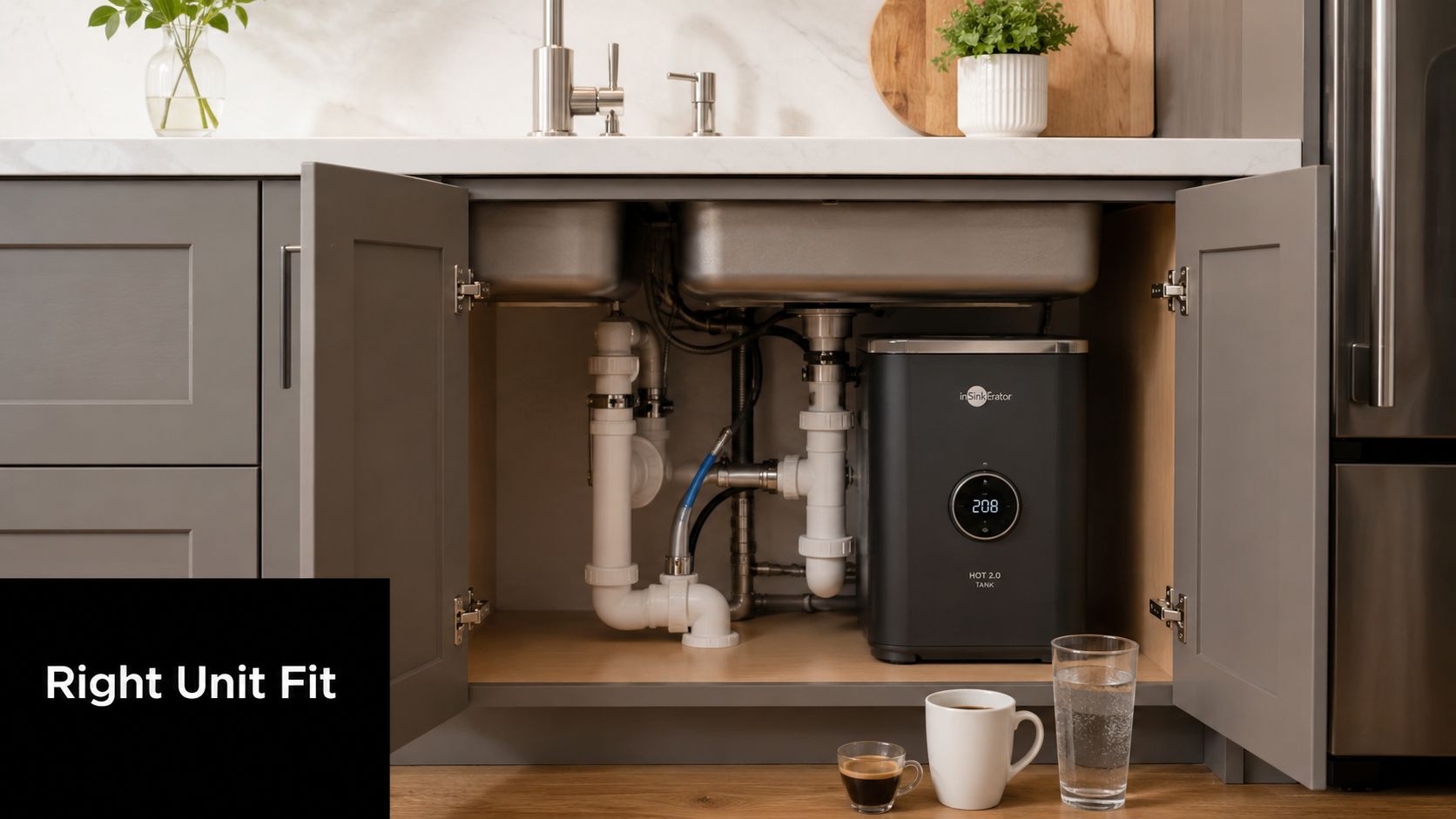
A home unit should prioritise safety, footprint, and ease of use. Most households don't need a commercial-style wall boiler unless the kitchen is handling constant demand.
Look for:
- Child-safe dispensing: Especially important in family homes.
- Compact under-sink fit: Cabinet space matters more than many buyers expect.
- Simple filter access: Servicing is easier when the filter isn't buried behind pipework.
- Tap design that suits the sink zone: Placement affects day-to-day usability.
In many houses, an under-sink setup is the cleanest answer. If you're comparing layouts and product types, this overview of under-sink hot water systems helps clarify what fits where.
Office kitchens and staff rooms
Offices usually need better recovery and better abuse tolerance than homes. Staff don't use the unit gently. They fill mugs back-to-back, top up teapots, and expect it to work without thinking.
One useful benchmark comes from commercial-capable systems. Units like the Billi Eco can serve up to 10 people comfortably with 90 cups of boiling water and 60 cups of chilled water per hour, according to Wilson Hot Water's product information. That doesn't mean every office needs that exact output, but it shows how “low power” doesn't equal low usefulness.
In office kitchens, peak demand matters more than daily average demand. Morning tea break is what exposes an undersized unit.
A small team may be fine with a compact under-sink boiling tap. A larger staff room may need a higher-capacity unit or a wall-mounted boiler built for repeated draws.
Hospitality and food service support
This is where buyers often get it wrong. They install a domestic-style unit into a commercial environment and expect it to cope.
For hospitality-adjacent use, assess the actual task:
| Environment | Better fit | Main priority |
|---|---|---|
| Café back-of-house support | Higher-output under-sink or commercial boiler | Fast recovery |
| Small waiting room or salon | Compact under-sink unit | Space and convenience |
| Shared service counter | Commercial-grade dispensing setup | Reliability under bursts |
| Meeting venue pantry | Boiling and chilled combination unit | Versatility |
If staff are filling jugs, doing frequent tea service, or using hot water during prep, domestic sizing usually falls short. The unit needs to recover fast and stay consistent.
Caravans, compact spaces, and niche installs
Some buyers want a boiling solution in a caravan, tiny kitchenette, studio, or site office. The challenge there isn't just capacity. It's the installation envelope.
Pay attention to:
- Available cupboard height
- Power supply constraints
- Ventilation around the unit
- Access for maintenance
- Whether the tap can be mounted safely in a small sink area
These jobs can work very well, but only if the physical install is thought through before purchase.
A practical way to choose
If you're unsure, use this rough decision filter:
- Count simultaneous users, not total users.
- Map peak demand times.
- Check available under-sink space before choosing the tap.
- Decide whether boiling-only is enough, or whether chilled water also matters.
- Choose serviceability, not just appearance.
A good unit should feel slightly boring in operation. It should keep up. That's the right outcome.
Installation and Ongoing Maintenance Requirements
Installation is where a good product can become a bad ownership experience. Most call-backs on boiling water units come from poor planning around space, power, drainage, isolation valves, or access for service.
For an under-sink unit, the cabinet has to do more than just physically fit the tank. The installer needs room for the unit itself, the tap hoses, the power connection, any filtration components, and safe routing that won't kink or rub over time. If the cupboard is already packed with bins, shelves, or cleaning products, the layout needs a rethink before the job starts.
What a proper installation checks first
A licensed technician will usually assess the site in this order:
- Electrical supply: The unit must have the correct dedicated or suitable power point available for its rating.
- Plumbing access: Isolation, inlet connection, pressure suitability, and clean hose routing all matter.
- Tap position: The bench cut-out and tap reach need to work with the sink and surrounding fittings.
- Service access: Filters, valves, and the unit body should be reachable without dismantling the whole cabinet.
For boiling tap installs in particular, this guide to under-sink boiling water unit installation outlines the practical site issues that often get missed.
Why DIY usually goes wrong
This isn't just about attaching a hose and plugging something in. Boiling water systems involve heat, pressure, electrical load, and user safety. A poor install can cause nuisance faults, poor temperature performance, leaks inside cabinetry, and warranty headaches.
Workshop reality: The easiest unit to own is usually the one that was hardest to rush. Careful installation saves service calls later.
DIY attempts also tend to ignore future maintenance. If the filter head is jammed behind pipework or the tank can't be removed without disconnecting half the cupboard, every future service becomes slower and more expensive.
What maintenance actually involves
The good news is that ongoing care is usually straightforward if the unit was installed sensibly.
Typical lifecycle tasks include:
- Filter replacement: Important for taste, sediment control, and protecting internal components.
- Scale monitoring: Melbourne water conditions vary by area, and some sites need closer attention.
- Seal and hose checks: Small leaks are easier to fix early than after cabinet damage.
- Thermostat and control checks: Particularly on older commercial units or hard-worked office systems.
Some brands make spare parts easy to source. Others don't. That matters more than most buyers realise. A unit with accessible genuine parts is easier to keep running for years than a sleek model that becomes difficult to service once the original filter or valve is due.
The maintenance question buyers should ask
Before buying, ask one simple thing: can this unit be serviced cleanly in the space where it will live?
That question often tells you more about long-term ownership than the brochure does.
The Real Cost and Return on Investment
A low power boiling water unit should be judged as a point-of-use convenience system, not as a substitute for a whole-home hot water strategy. That distinction matters because buyers sometimes compare it to technologies built for a completely different job.
In the Australian context, high-efficiency electric instantaneous water heaters for low-flow applications typically operate at 3.6kW to 7.2kW and are rarely cost-effective for general hot water loads compared with heat pump or solar thermal alternatives, according to the South Australian government energy policy analysis. That doesn't mean a boiling water unit is a poor purchase. It means you should assess it on the right basis.
What total cost of ownership really includes
The upfront figure is only part of the decision. The total ownership cost includes:
- The unit itself: Domestic, office, and commercial models vary widely in build and features.
- Installation complexity: Stone benchtops, tight cabinetry, added filtration, and electrical upgrades all affect the job.
- Consumables: Filters and service parts are part of normal ownership.
- Downtime risk: In a workplace, a failed unit creates disruption even if the repair bill is modest.
For households, the return often comes from convenience, reduced bench clutter, and better daily use habits. For offices and hospitality support areas, time saved can matter just as much as electricity use because staff stop waiting on repeated kettle boils.
How to think about ROI without kidding yourself
The honest calculation is simple. Ask whether the unit will be used often enough, by enough people, in a way that avoids kettle waste and improves workflow.
A strong ROI case usually looks like this:
| Situation | ROI outlook |
|---|---|
| Busy office pantry | Strong, because convenience and repeated use stack up |
| Family kitchen with regular daily use | Often reasonable over the long term |
| Occasional-use holiday property | Weaker, unless convenience is the main goal |
| Hospitality support point | Strong if capacity is matched properly |
If you're also trying to make sense of broader power pricing, tariff structures, and what electricity costs in a solar-equipped property, HighFlow Energy's guide to electricity costs for solar owners is a useful background read.
Buy for the workload you actually have. Not the idealised one in your head, and not the one in the brochure.
The best return comes from a unit that fits the site, gets used properly, and can be maintained without drama. That's lifecycle value. Not just a lower bill.
Your Instant Boiling Water Unit Questions Answered
Are these units safe in homes with children
Yes, if you choose the right tap and install it properly. Child-resistant controls, spring-loaded handles, insulated touch points, and sensible tap placement all help. Safety comes from the full setup, not just the tank under the sink.
Can I install one myself
It's a bad idea. These systems combine plumbing, electrical supply, hot water delivery, and sometimes filtration. A poor install can lead to leaks, nuisance tripping, poor performance, and warranty problems.
How often do filters need replacing
That depends on the unit, the filter type, your local water quality, and how heavily the system is used. The practical answer is to follow the manufacturer's service guidance and replace filters before water taste drops off or flow begins to suffer. In Melbourne, regular filter servicing is part of normal ownership, not an optional extra.
Do low power units actually deliver enough boiling water
Yes, if they're sized for the demand. The problem isn't usually the concept. It's under-specifying the unit for peak use. Homes, offices, and hospitality spaces all need different recovery and storage characteristics.
Can I get boiling and chilled water from the same system
Yes. Combination systems are common, especially in office kitchens, meeting rooms, and premium home fit-outs. They're a good option when you want to reduce fixture clutter and centralise servicing.
What matters more, brand or serviceability
Serviceability. Brand matters, but long-term ownership is easier when filters, valves, hoses, and genuine spare parts are readily available. A unit you can maintain properly will usually outlast a prettier one that becomes difficult to support.
Is a wall-mounted boiler better than an under-sink unit
Neither is automatically better. Wall-mounted boilers suit utility spaces and staff rooms. Under-sink systems suit kitchens where appearance, noise control, and bench space matter more. The site decides the answer.
If you want help choosing, installing, or maintaining the right boiling water setup for a Melbourne home, office, or commercial site, Ring Hot Water can help with product advice, genuine spare parts, and professional service that matches the way the unit will be used.

