
Uncategorized
Aqueous Water Heater: A Complete 2026 Guide
May
You're probably here because you've got one of two problems. You need hot water in a very small space, or you've seen the term Aqueous water heater and you're not quite sure what it means.
That confusion is normal. In everyday trade talk, “aqueous water heater” usually isn't a broad technical category. Most of the time, people are referring to a compact point-of-use heater, often the Aqueous 12V style unit used in caravans, campervans, boats, and tight under-sink spaces. It's a small electric storage heater built for places where a full-size system won't fit.
If you're trying to decide whether one will suit your setup, the specs only tell half the story. The better question is simpler. Will it give you the kind of hot water you expect, with the power and space you have?
Why Compact Hot Water Is a Game-Changer
You notice the value of compact hot water the first time you try to wash up in a caravan with no practical place for a full-size system. The same thing happens in a boat galley, a site shed, or a small office kitchenette. You need hot water at one tap, in one tight spot, without giving up half a cupboard to get it.
That is why the term aqueous water heater usually points people toward a very specific kind of product. In practice, it often means a small 12V-style point-of-use heater for mobile or space-limited setups, not a general household water heater category. That distinction matters, because the primary benefit is not just smaller dimensions on a spec sheet. It is getting usable hot water in places where a standard system is awkward, oversized, or impractical.
A full-size household heater works well when several outlets need to be supplied across a building. A compact Aqueous-style unit solves a different problem. It puts a modest amount of hot water close to the sink or basin, which cuts wasted space and usually cuts the wait at the tap too.
That practical, local use is the whole appeal.
The U.S. Department of Energy notes that water heating is typically the second-largest home energy expense, at about 18% of household energy use, which helps explain why people look closely at smaller, targeted hot water options for specific applications rather than automatically sizing up to a whole-property system (Energy Saver water heating guide).
For mobile and compact installations, the benefit is usually less about headline efficiency claims and more about fit, control, and convenience in daily use. If you only need hot water for one sink, one basin, or a short wash-up routine, heating a small stored volume near the outlet often makes more sense than trying to adapt a domestic-style system to a very small space.
Where these heaters make the most sense
A compact aqueous heater is usually a good match when the hot water job is small, predictable, and close to the outlet:
- Caravans and campervans where storage space is limited and 12V compatibility matters
- Boats and marine cabins where compact equipment is easier to place and service
- Office tea points where one sink needs its own hot water source
- Studios, granny flats, and remote bathrooms where an under-sink install is more practical than extending a larger system
- Workshops and site sheds where simple handwashing hot water is enough
The main thing to keep in mind is expectation. A compact unit is excellent at supplying a nearby tap for short, regular jobs. It is less suitable if you expect long showers, high flow, or several people drawing hot water one after another.
Used for the right job, a small aqueous heater feels a lot like keeping a thermos beside the tap instead of running back to the main kitchen every time you need hot water. That is why these units are so popular in vans, boats, and tight service spaces. They are built for a specific task, and in that task they can be a very smart fit.
How an Aqueous Water Heater Actually Works
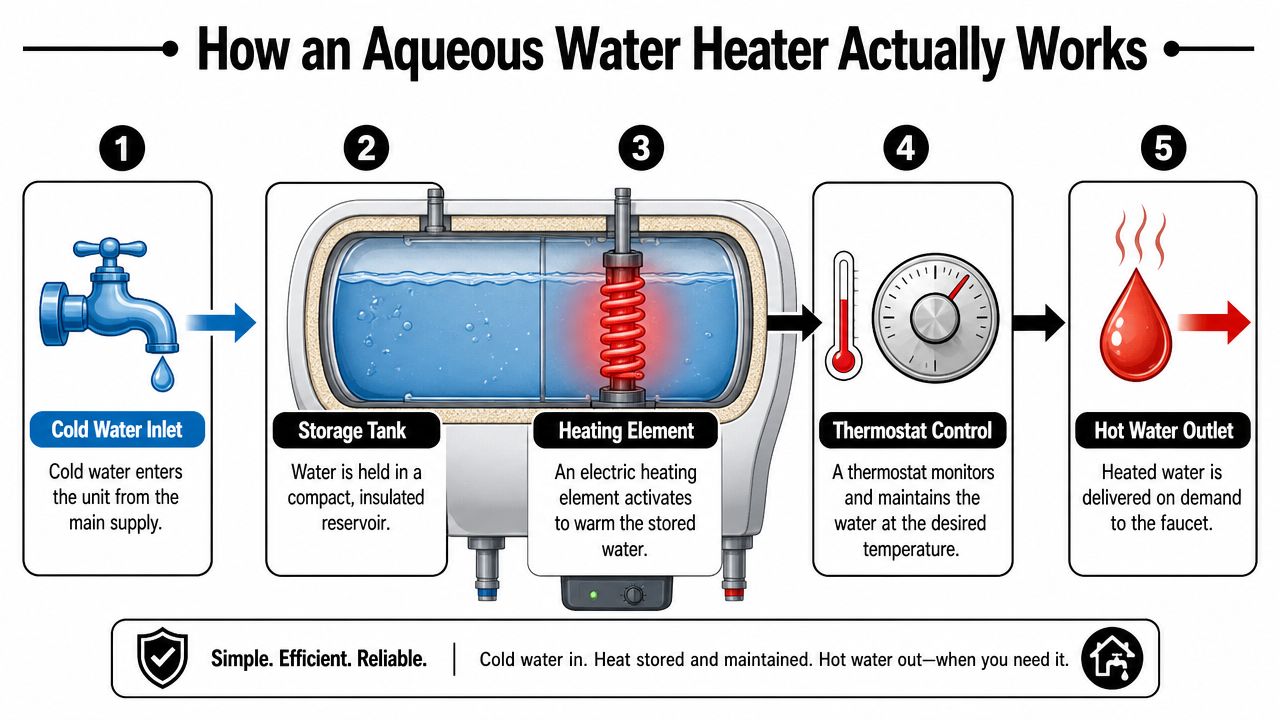
The easiest way to understand an Aqueous water heater is to think of it as a small insulated kettle that stays connected to your plumbing.
It stores a modest amount of water, heats that water with an electric element, then keeps it near your chosen temperature using a thermostat. When you open the tap, you draw from that stored hot water instead of waiting for a distant system to catch up.
The basic parts inside
Most units in this category use the same simple layout:
- Cold water inlet brings fresh water into the tank
- Small insulated tank stores the water so it's ready near the tap
- Heating element warms the stored water
- Thermostat switches the element on and off to hold the set temperature
- Safety valve helps protect the unit from excessive pressure
The reason these heaters feel convenient is that the water is already sitting close to the outlet. You're not heating a long pipe full of cold water first.
A real product example
For the Australian market, the Aqueous MK2 6L is specified with a 1 kW heating element, 6 L capacity, and an adjustable thermostat range of 30°C to 75°C. That mix matters because a small stored volume paired with a relatively strong element supports rapid point-of-use reheating, which is exactly the design goal in compact installs such as cupboards, caravans, and marine spaces (Aqueous MK2 6L product specification).
That's why these units often feel faster in real life than their size suggests. They don't hold a huge reserve, but they don't need to. They only need enough hot water for a nearby task, then they recover.
What happens when you turn on the tap
The process is straightforward:
- Cold water enters the compact tank from the supply line.
- The element heats that stored water to the thermostat setting.
- The insulation slows heat loss while the water sits ready.
- You open the tap and hot water leaves the tank.
- Fresh cold water replaces it, and the heater starts recovering.
Practical rule: These heaters are built for short, local demand. Sink use suits them better than long, high-flow use.
If you're fitting one in a van or under a sink, that's the key idea to hold onto. It's not an instant, limitless heater. It's a small reserve of heated water with quick local delivery.
Choosing the Right Heater for Your Space
The main choice isn't brand first. It's power source and use case.
A compact heater can be exactly right in one setup and completely wrong in another. The trick is matching the heater to the way you'll use it, not the way you hope you'll use it.
Start with the power supply
A 12V heater belongs in mobile or off-grid environments where you're working with vehicle electrics, battery systems, or low-voltage design requirements. A 240V heater suits fixed locations where mains power is available and stable.
That sounds obvious, but plenty of buying mistakes happen because people focus on tank size and forget to ask what the electrical system can realistically support day to day.
A quick comparison
| Application | Recommended Heater Type | Key Consideration |
|---|---|---|
| Caravan sink | 12V compact heater | Battery and charging setup matter as much as the heater itself |
| Campervan handwashing | 12V compact heater | Best for short draws, not extended shower expectations |
| Boat or marine galley | 12V compact heater | Low-voltage operation and enclosed-space suitability |
| Office kitchenette | 240V compact heater | Better choice where mains power is constant |
| Granny flat sink | 240V under-sink heater | Good for fixed plumbing and regular small-volume use |
| Workshop basin | 240V compact heater | Reliable for repeat handwashing without battery concerns |
If you want to look at a mobile-use example, this Aqueous 12V hot water heater shows the kind of product people often mean when they ask about an Aqueous water heater.
Match the heater to the job
Here's the practical way I explain it to customers.
If the heater's job is to wash hands, rinse dishes, or give one sink nearby hot water, a compact unit can be ideal. If the job is repeated showering, winter camping comfort, or multiple outlets, you need to be much more careful.
A small caravan sink and a family shower have completely different hot water expectations. The heater might be physically the same size in both conversations, but the result won't be.
Check physical fit before anything else
The Aqueous 6L/12V unit is described in Australian trade coverage as 305 mm × 305 mm × 304 mm, with Australian WaterMark accreditation. The 12V variant is also described with 12V DC / 160 W input, 0.85 MPa safety valve, and IPX4 water resistance, which is relevant for mobile and enclosed installs where compliance, splash resistance, and low-voltage operation matter (Aqueous 12V unit details).
Those details matter more than many buyers expect. A heater can look compact on a product page and still be awkward once you add hoses, fittings, clearance, and service access.
The Real Trade-Offs of a Compact Water Heater
Compact heaters are easy to like. They save room, shorten the wait for hot water, and can reduce waste from long pipe runs. But you'll only be happy with one if you accept what it can't do.
The first trade-off is volume. A small heater gives you a small stored amount of hot water. That's fine for a sink. It becomes limiting when you try to stretch it into shower duty or repeated heavy use.
Where they shine
For the right job, these units are tidy and practical:
- Space saving because they fit into cupboards, van cabinetry, or service bays
- Point-of-use convenience because the hot water sits near the outlet
- Simple task-focused performance for washing hands, rinsing dishes, or short draws
- Reduced waiting compared with pulling hot water from farther away
That's the upside. The harder part is the power discussion.
The big question for 12V users
In mobile installs, performance depends heavily on the electrical system around the heater. Independent analysis notes that a 12V water heater's performance is heavily constrained by the vehicle's electrical system, including battery, solar, and alternator size. In power-limited scenarios, such heaters may struggle to maintain temperatures above 39°C, which is why gas or mains-powered options can make more sense for consistent, higher-temperature water (independent 12V trade-off analysis).
That doesn't mean a 12V heater is a bad idea. It means you need to judge it by the right standard.
A compact 12V heater is often good at convenience. It isn't always good at abundance.
When another option may suit better
If your real goal is long, repeatable showering, you may be better off comparing against gas or a different style of unit, such as a tankless instant water heater, depending on your site and power setup.
That's especially true if you travel in colder conditions or expect the heater to recover quickly after one user finishes and another starts. A small electric storage unit can do a neat job. It just can't ignore the limits of its energy source.
Practical Advice for Installation and Maintenance
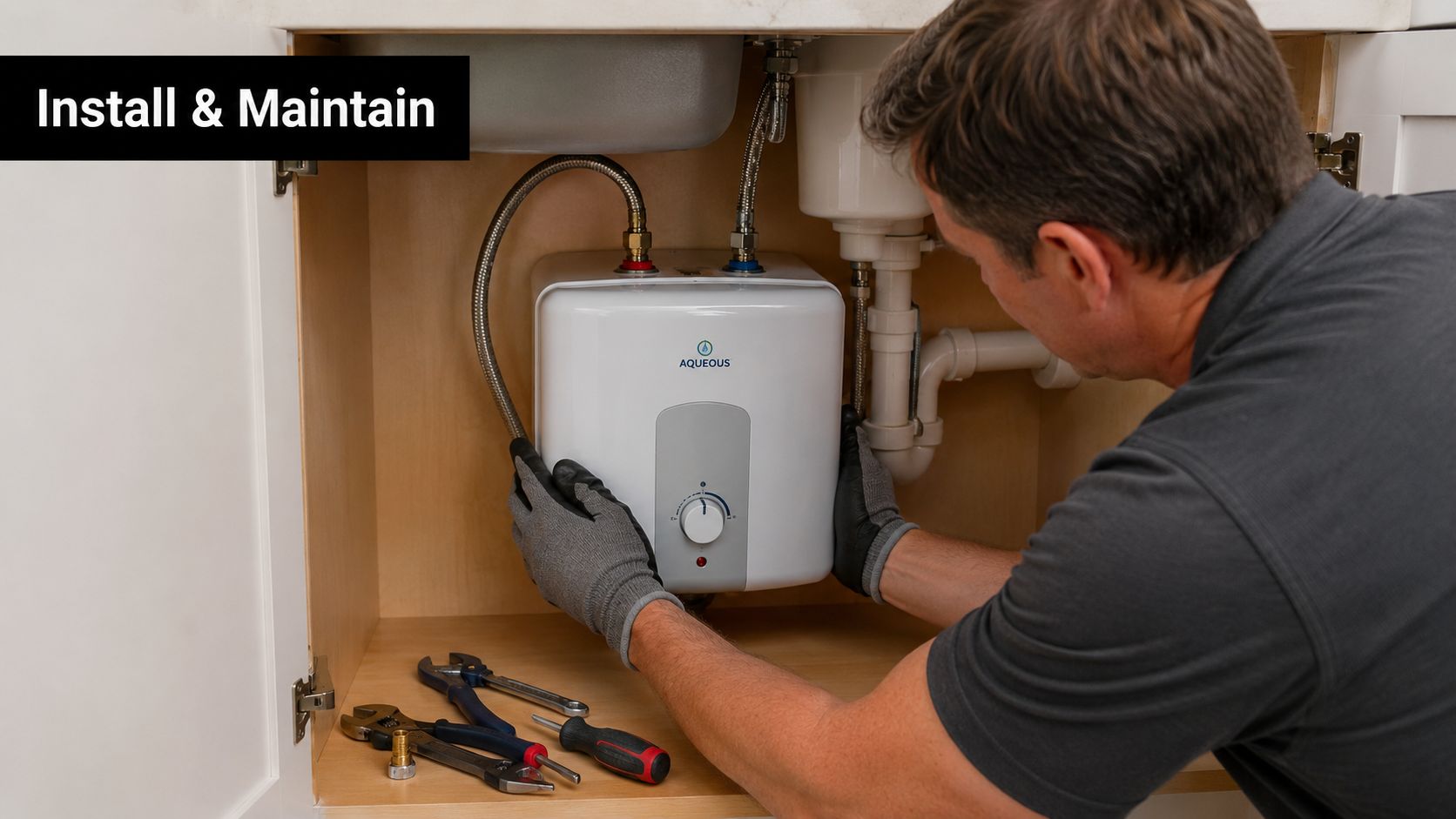
A compact heater is small, but the installation still needs to be taken seriously. The two areas that matter most are safe plumbing connections and correct electrical connection for the unit type.
Get the location right first
Before you connect anything, confirm three things:
- Access for servicing so you can reach valves, fittings, and wiring later
- Enough clearance for hoses and relief valve routing
- A solid mounting position that won't flex or vibrate excessively in mobile use
In caravans and vans, this matters even more because the cupboard may look large enough until you add bends in the pipework and cable routing.
Plumbing details people often miss
The heater needs more than just a cold inlet and hot outlet. You also need the right fittings, proper sealing, and a correctly installed safety valve arrangement.
Pay close attention to:
- Relief valve setup because it's a safety component, not an optional extra
- Pressure compatibility so the incoming supply suits the unit
- Leak checks after the first heat cycle, not just immediately after connection
- Drainage planning if the valve discharges
If you manage rental properties or multi-unit accommodation, planned upkeep matters just as much as the initial install. Landlords and facility managers often benefit from organised maintenance workflows, and these housing repair teams for landlords offer a useful example of how structured repair support can reduce recurring problems across properties.
Electrical caution matters
A 12V heater still needs proper wiring practice. Don't treat low voltage as casual voltage.
Use the correct cable sizing for the run, protect the circuit properly, and make sure the power source matches the intended use pattern. In a mobile setup, poor electrical planning causes more disappointment than the heater itself.
Here's a useful visual walk-through to pair with the practical checks above:
Simple maintenance that makes a difference
Most owners don't need to do anything fancy. They just need to be consistent.
- Test for drips early: Small leaks around fittings usually show up before they become serious.
- Check the relief valve: If a valve isn't operating properly, the unit shouldn't stay in service.
- Look for scale build-up: In hard-water areas, scale can affect heating performance over time.
- Inspect flexible connections: Vibration and movement in caravans can stress hoses and joints.
- Listen for change: If a heater starts sounding different or taking noticeably longer, inspect it before the problem grows.
Good maintenance is mostly about catching small faults while they're still cheap and easy to fix.
Your Pre-Purchase Checklist for an Aqueous Heater
Most bad purchases happen before the unit arrives. The buyer assumes the heater will suit the job, then discovers the issue was power, expectations, or fit.
That's why I always suggest a short checklist before you buy anything.
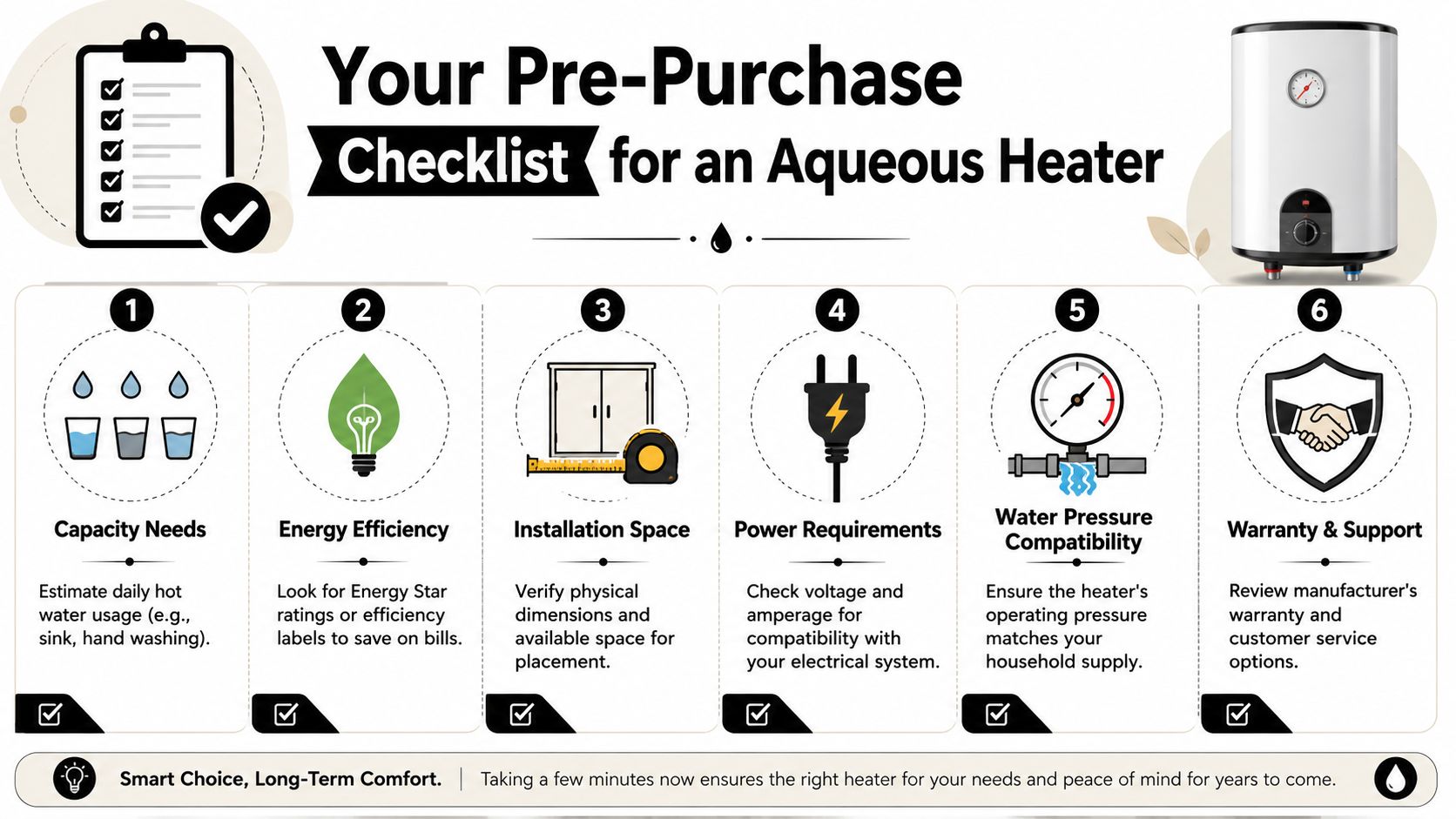
Six questions worth asking
What am I powering it with
If you're on 12V, your battery, solar, and charging setup matter just as much as the heater model.What job am I expecting it to do
Sink use, handwashing, and dish rinsing are one thing. Comfortable showering is another.Will it physically fit with plumbing attached
Measure the cupboard, but also allow for fittings, hose bends, and access.Is it suitable for Australian installation requirements
WaterMark and compatible safety components matter for legal and practical reasons.How much recovery time am I willing to accept
A compact stored-water unit needs time to reheat after use.What support will I have later
Check whether spare parts, valves, thermostats, and elements are realistically available.
The question most buyers skip
Real-world 12V performance deserves special attention. Independent testing has shown that while a thermostat may be rated up to 75°C, a 12V element can struggle to heat water past about 60°C on battery power alone, which affects recovery time and the amount of usable mixed hot water available for tasks like caravan showering (independent 12V performance review).
That's the practical gap between brochure thinking and real use. The unit may be capable on paper, but your electrical system decides what happens on the road.
Buyer check: Don't ask only how hot the thermostat goes. Ask what temperature the system can realistically maintain in your setup.
Think beyond the purchase day
A heater isn't just a product. It's part of an ongoing maintenance picture. If you want a broader look at why routine checks save money and avoid disruption, these notes on proactive property care benefits are worth a read. The same thinking applies to compact hot water systems. A small issue caught early is easier than a failed heater when you need it most.
Finding Spares and Service with Ring Hot Water
A compact Aqueous water heater makes the most sense when it's matched properly to the job, installed neatly, and maintained with the right parts. That's the pattern I see again and again. The units that perform well over time are usually the ones that weren't rushed into the wrong application.
Efficiency also matters more as people replace older equipment with newer electric systems. ENERGY STAR's current criteria show certified split-system heat pump water heaters being benchmarked at a Uniform Energy Factor of at least 2.20 and a First Hour Rating of at least 45 gallons per hour, which reflects the wider move toward better output per unit of energy in modern hot water equipment. The same criteria help underline why choosing a sound, well-maintained unit and using genuine replacement components matters (ENERGY STAR residential water heater criteria).
What usually needs replacing first
On compact heaters, the common service items are rarely glamorous. They're the parts that do the daily work:
- Heating elements
- Thermostats
- Valves
- Flexible hoses
- Threaded fittings and connectors
If one of those parts fails, the heater may still look fine from the outside while performing poorly or unsafely.
Why parts availability matters
Many owners often find themselves stuck. The heater itself might be easy to find, but a matching spare later can be frustrating if you don't know the exact part or supplier.
For example, if you're tracing an element issue, a product page like this Aqueous 10lt hot water element helps identify the sort of genuine replacement component needed for compatible service work.
For Melbourne customers, Ring Hot Water handles installation, repairs, and maintenance across areas including Sunshine, Yarraville, and Footscray. For customers elsewhere in Australia, the online store is the practical side of the business, especially when you need genuine parts for compact heaters, under-sink units, and caravan or RV applications.
The main thing is to treat a compact heater like service equipment, not a throwaway appliance. If the unit is worth installing, it's worth maintaining with the correct parts and sensible advice.
If you're sorting out a compact hot water setup, need help identifying a spare, or want practical advice before you buy, contact Ring Hot Water. The team can help with product selection, parts for Aqueous and other major brands, and installation or repair support for Melbourne customers.

