
Uncategorized
Solar Hot Water Pump Controller: An AU Buyer’s Guide (2026)

May
You know the job. The sun's out, the roof collectors are hot to touch, but the shower goes lukewarm by early evening. The panel, the tank, or the booster are often blamed first. In a lot of Australian systems, the actual decision-maker is the small controller mounted near the tank or in the plant area.
That box decides whether heat gets harvested properly or wasted. If it reads the wrong temperature, switches the pump at the wrong time, or doesn't match the pump and sensor setup, a good solar hot water system can behave like a bad one. For a solid background on how these systems are laid out in homes, this overview of solar hot water systems is a useful starting point before you get into controller-specific faults.
Your Solar Hot Water System's Unsung Hero
A solar hot water pump controller is often treated like a minor accessory. It isn't. It's the logic board that decides when roof heat is worth moving into storage and when it isn't.
That matters in Australia because solar hot water has a long track record here, and under suitable conditions these systems can meet up to 80% of a household's hot water needs according to the WBDG solar water heating guidance. When a system underperforms, the collector area alone usually isn't the whole story. The controller's behaviour is what turns available heat into usable hot water.
On service calls, the pattern is familiar. The owner says, “It's been sunny all day, so why is the tank cold?” If the pump never ran, or ran at the wrong time, the system may have left most of that heat sitting on the roof.
What the controller actually does day to day
The controller sits between the sensors and the pump. It watches temperatures, applies its switching logic, and protects the system from obvious bad operating conditions.
A good one does more than energise a circulator. It manages timing, avoids pointless pump runs, and helps stop the tank from being pushed into conditions it shouldn't see.
Practical rule: If you've got poor hot water after a clear day, don't start by assuming the collector is dirty or worn out. Check whether the controller gave the pump a reason to run.
Clean collectors still matter, especially where grime, pollen, or urban dust build up over time. If you also want a practical non-plumbing read on panel cleanliness and solar performance generally, South Mountain Window Cleaning for solar efficiency gives a useful outside-the-trade perspective. But on a water-heating system, a spotless panel won't help much if the controller logic or sensors are wrong.
Why this small box causes big headaches
Controller faults are frustrating because they can imitate other failures. A dead sensor can look like a dead pump. Bad wiring can look like bad logic. A replacement controller can still perform poorly if it's paired with the wrong probe location or an incompatible pump setup.
That's why the useful question isn't “Do I need a new solar hot water pump controller?” It's “Is the controller the problem, and if I replace it, what must match?”
How a Solar Pump Controller Thinks
A solar hot water pump controller works like a smart thermostat with two places to watch instead of one. It compares the temperature at the collector with the temperature in the storage tank and only runs the pump when moving water will gain heat, not lose it.
That comparison is called differential temperature control. It's the core logic in active solar water heating systems.
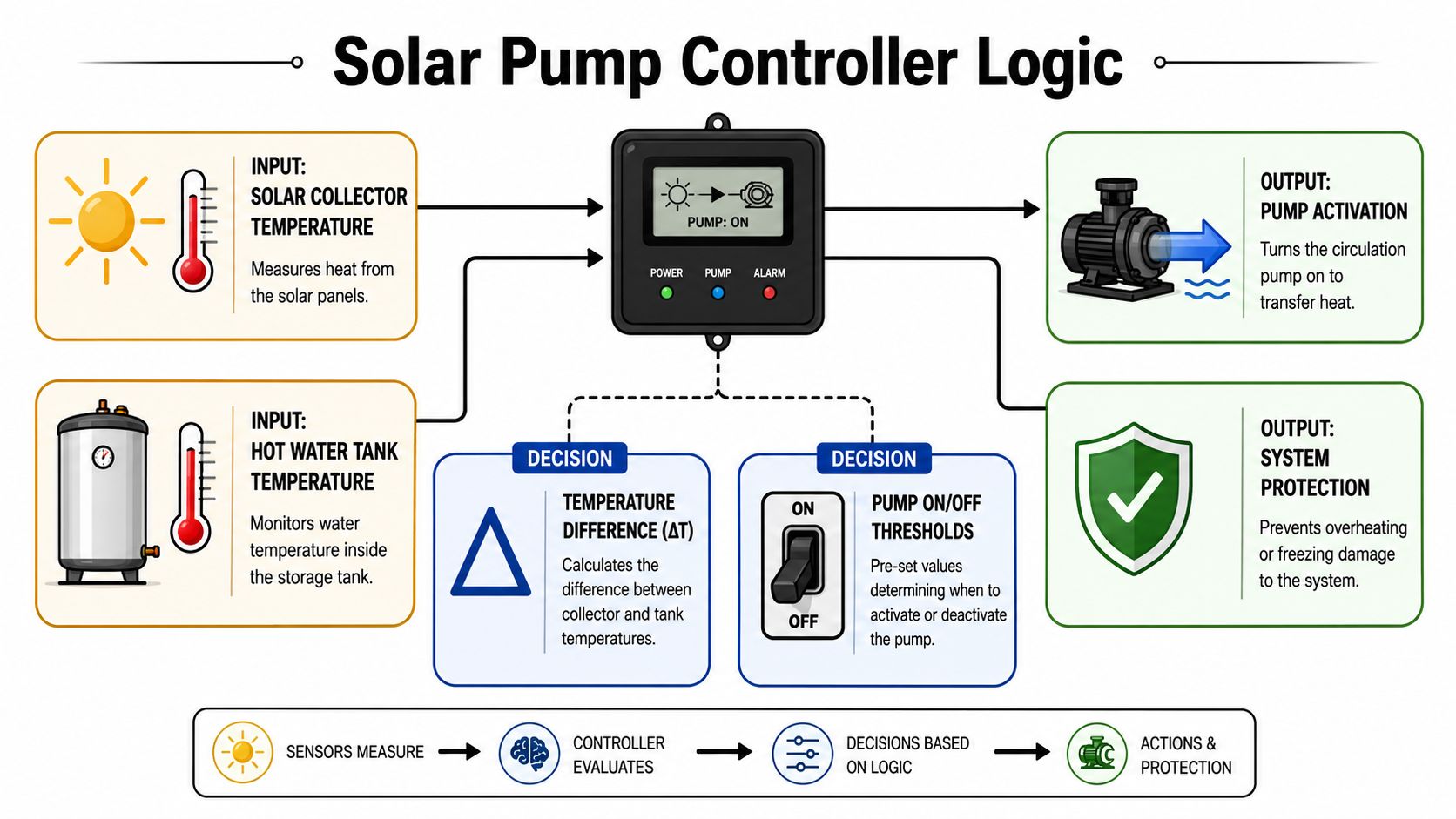
The basic operating logic
The collector sensor tells the controller how hot the roof side is. The tank sensor tells it how hot storage already is, usually down low where incoming cooler water sits.
When the collector is hot enough above the tank, the controller starts the pump. According to the IEA SHC reference, most active solar water heating systems use a differential controller that starts the pump when the collector is about 6°C hotter than the tank water and stops it when the difference drops to 2°C. That gap is there to prevent short-cycling and make sure the system is transferring worthwhile heat.
Why those thresholds matter
If the pump starts too early, you can circulate fluid that isn't meaningfully hotter than the tank. That wastes pump energy and can cool storage instead of heating it.
If the pump stops too late, the same thing happens in reverse. The roof side loses its advantage and the tank starts giving heat back.
A controller that's set or wired properly should do four things well:
- Start with a real heat advantage so the pump only runs when the collector is ahead.
- Stop before reverse heat flow turns the collector loop into a cooler.
- Avoid rapid on-off behaviour that wears components and annoys owners.
- Protect the storage side when temperatures climb too high.
If the collector outlet isn't warmer than the return when the pump is running on a sunny day, the controller may be making the wrong call, or the sensors may be lying to it.
What you can observe without fancy gear
You don't need a full commissioning kit to understand the logic. On a clear day, check whether the display temperature at the collector rises ahead of the tank. Then see if the pump starts only after that margin opens up.
Listen for the circulator. Feel the pipe temperatures carefully and sensibly. Look for a stable run period rather than constant clicking in and out.
If you're pairing a replacement controller with a known circulation pump, it helps to know the pump model and switching requirements. For example, if you're already dealing with a solar-rated circulator such as a Grundfos solar water circulation pump, the controller output has to suit that pump's electrical load and operating arrangement. The controller is the brain, but the pump still has to obey without being overdriven or nuisance-tripped.
Decoding the Different Controller Types
People often use the term solar hot water pump controller as if there's one standard box for every job. In practice, there are a few very different control approaches, and picking the wrong one creates problems fast.
The most common mistake is buying by appearance. Two controllers can look interchangeable on the wall and still be wrong for the system.
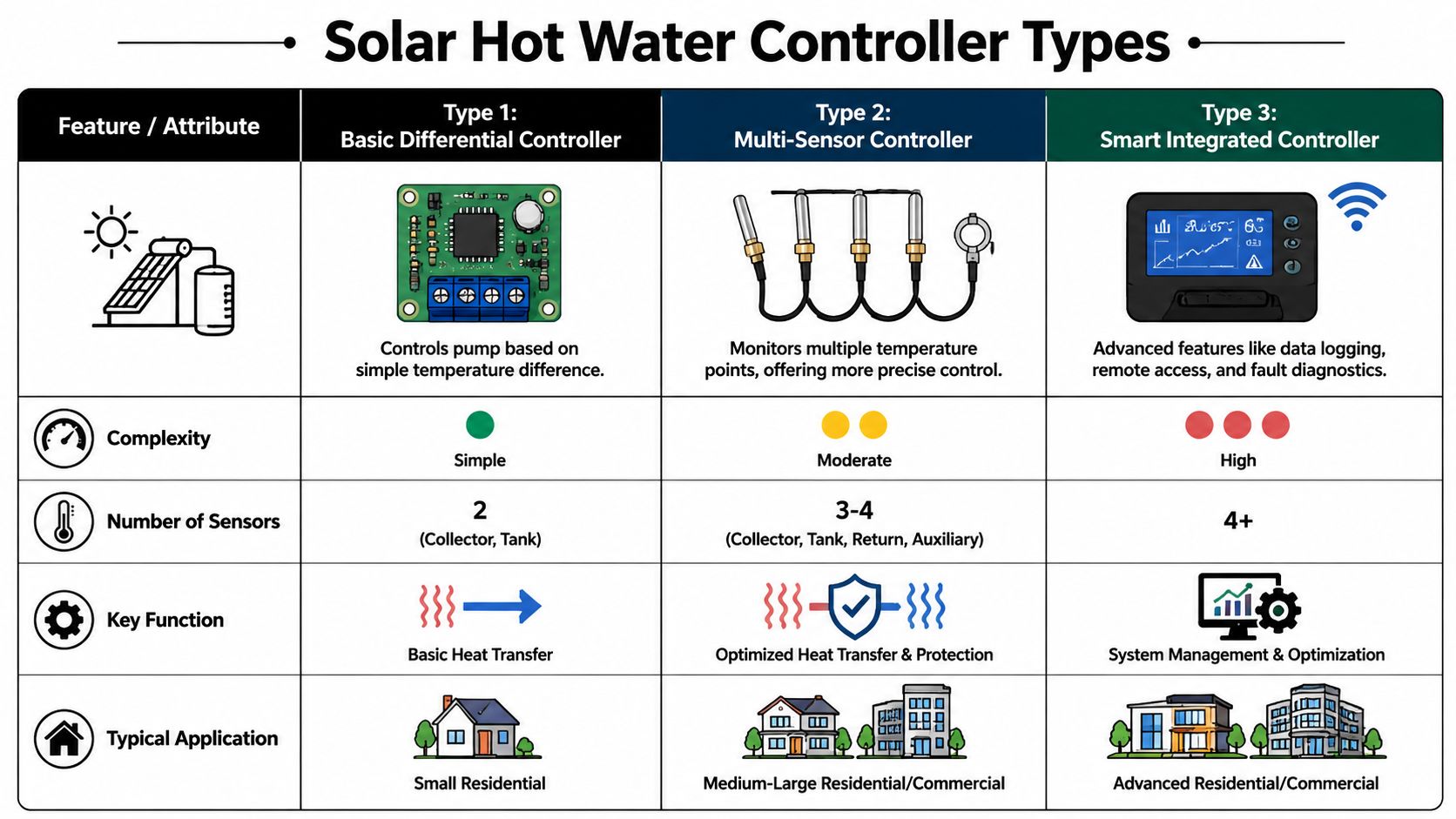
Differential controllers
This is the standard choice for many active solar thermal systems in Australian homes. It uses at least a collector sensor and a tank sensor, compares the two, and switches the pump through a relay output.
These are the workhorses. If your system has a roof collector, a separate storage tank, and an AC circulation pump, this is usually the style you're dealing with.
Some are basic. Others have more sensor inputs, better displays, and relay outputs for extras such as valves. Commercial-grade units used in Australia commonly include multiple temperature sensor inputs, relay outputs for pumps and valves, and low standby power, often under 2.5 W, as described in Delta-T Controls' explanation of how these controllers work.
PV-direct controllers
These belong to a different category. They're used where a dedicated solar photovoltaic source drives a pump arrangement directly, often on remote or off-grid water pumping jobs rather than a conventional domestic solar thermal tank.
They matter because many buyers confuse solar thermal pump control with solar PV water pumping control. Those are not automatically interchangeable. A PV-direct setup has different power input expectations, different pump matching issues, and different wiring risks.
Relay and timer style controls
These are simpler and more limited. They can be useful in narrow applications, but they don't replace a true differential controller in a proper active solar thermal loop.
A timer can force operation during a chosen window. That doesn't mean heat is available when the pump runs. In a thermal system, blind timing is often a poor substitute for temperature-based control.
Which one suits which system
Here's the practical split:
- Standard roof collector and storage tank setup: differential controller
- Dedicated PV-driven water pumping arrangement: PV-direct controller
- Very simple legacy or special-purpose arrangement: relay or timer only, if the design requires it
If you work across plumbing, pumps, and valves, it helps to understand that controller selection is often about the whole control chain, not one device in isolation. A hydraulic control perspective such as this essential guide for UK hydraulics is useful because it shows the same broader principle. The controller only performs well when the sensors, outputs, load, and valve or pump behaviour are matched as one system.
Key Specifications When Choosing a New Controller
Once you know the controller type, the actual buying work begins. At this stage, many replacements go wrong. A controller may fit the wall, power up, and still be the wrong unit.
Read the data plate on the old controller, the pump nameplate, and any sensor markings before you order anything.
The specs that actually matter
The shortlist is usually shorter than people expect. Ignore marketing language and look for the items below.
| Specification | Differential Controller | PV-Direct Controller | What to Look For |
|---|---|---|---|
| Power supply | Usually mains powered | Matched to PV input arrangement | Must suit the system's actual supply |
| Pump output | Relay switched for circulator | Matched to direct-drive or controlled pump setup | Match controller output to pump electrical architecture |
| Sensor inputs | Typically collector and tank, sometimes more | May differ by application | Check number of probes and where they're used |
| Environmental protection | Often indoor or protected mounting requirement | Often harsher install environments | Use suitable enclosure protection for location |
| Protection functions | Heat transfer and system safety logic | Electrical and operating protection for pump setup | Confirm the protections you actually need |
| Compatibility | Common on solar thermal systems | Common on PV water pumping systems | Don't cross-shop these blindly |
Relay output and pump load
A controller output isn't there to “sort of” switch a pump. It must switch it properly. If the relay rating doesn't suit the pump current and startup behaviour, you'll get nuisance trips, overheated contacts, or premature failure.
This is one of the first checks on replacement jobs. If the old controller failed, ask whether it died because it was old, or because it spent years driving a load it shouldn't have been driving.
Sensor count and probe compatibility
A basic system may only need collector and tank sensing. More complex systems use additional points for better control or protection.
Don't assume an old sensor will read correctly on a new controller just because the plug or terminal arrangement looks familiar. Probe type, resistance curve, and immersion depth all matter. If the controller reads the wrong temperature, every other function becomes suspect.
Workshop note: A replacement controller that uses the wrong sensor type can appear to “work” on the screen while making completely wrong switching decisions.
Enclosure and mounting conditions
Controller specs aren't only about electronics. The mounting environment matters. Heat, moisture, dust, and UV exposure all change how reliable the install will be.
That's especially true if the box lives outdoors, on an external wall, or in a damp plant space. If the enclosure arrangement is marginal, expect intermittent faults before outright failure.
Protection features worth having
What matters depends on the system, but buyers usually benefit from checking for:
- Overheat management: useful where strong summer sun can push collector temperatures high
- Frost or low-temperature logic: relevant in colder sites and exposed pipe runs
- Pump and valve relay options: handy when the system controls more than one output
- Clear fault display: useful when diagnosing sensor issues instead of replacing parts blindly
If you're buying a replacement, match the existing system first. Upgrades are fine, but only after compatibility is confirmed.
Installation and Wiring Essentials
A controller swap looks simple until the first nuisance shutdown or backwards heat transfer. Good installation is mostly about matching, placement, and restraint. Don't assume wire colour, terminal labels, or old installer habits are reliable.
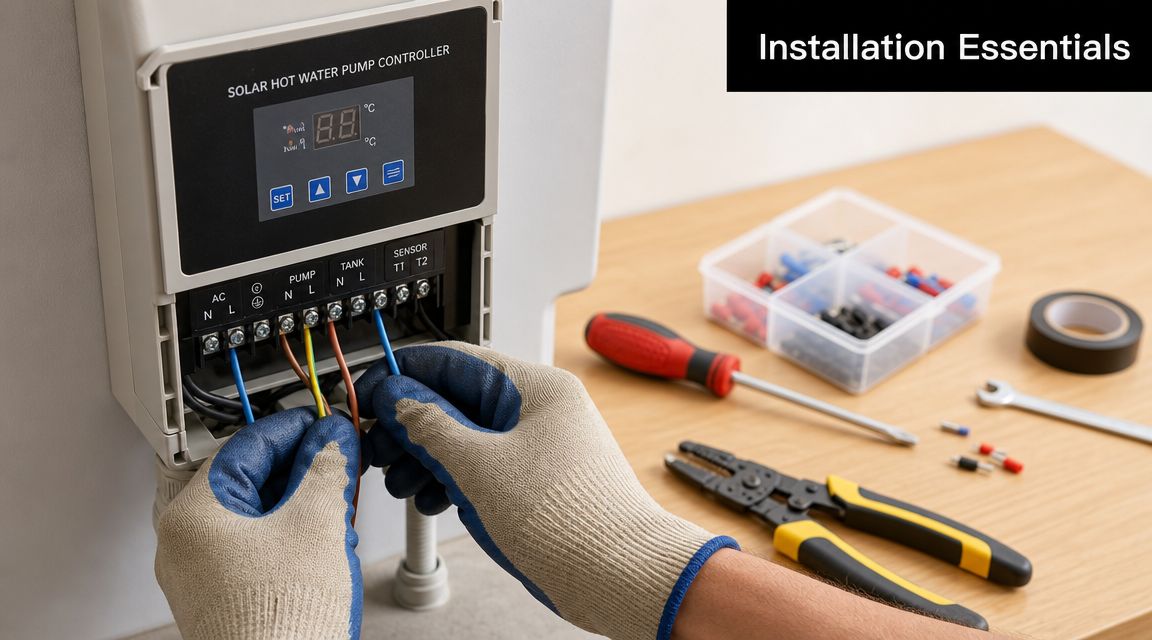
Match the electrics before touching a terminal
Australian specifications for solar pumping controllers often require IP65 protection, or a cabinet with at least that level of protection, and they also stress correct matching between controller specs and pump electrical architecture in the technical specification document used for solar pumping systems.pdf). That matters because a mismatch between controller and pump is a common route to premature failure.
Start with the fundamentals:
- AC or DC pump: the controller must suit the pump architecture
- Voltage: match supply and output expectations exactly
- Current draw: controller switching capacity must cover the pump load
- Wiring sequence and polarity: especially important where the system is sensitive to miswire conditions
If any of those are uncertain, stop there and verify before energising anything.
Sensor placement is not a minor detail
A high-quality controller can't correct bad sensor placement. If the collector probe isn't properly attached or inserted where it should be, the controller will make decisions on false temperatures. Same problem if the tank sensor is too shallow, loose, dry, or buried in the wrong point.
That's why so many “controller failures” turn out to be sensor issues. The box is only as smart as the data it receives.
Good practice usually means:
- Fit the collector sensor where it reads actual collector temperature, not ambient air or nearby pipe lagging.
- Place the tank probe in the intended pocket or immersion point so it reflects storage conditions properly.
- Secure cables away from heat damage and abrasion so the reading stays stable over time.
A controller with perfect logic and bad sensors will still run a bad system.
Enclosure, routing, and clean terminations
Outdoor and semi-outdoor installs need proper sealing. A controller mounted in a damp area without suitable protection often fails from the environment before the electronics wear out.
Keep cable entries neat. Support the cables. Don't leave low points where water can track in. Don't cram signal and power wiring together carelessly if the manufacturer calls for separation.
For a visual walk-through of wiring basics and controller handling, this clip is a useful reference point:
Who should do what
Plumbing and electrical boundaries matter. In Australian installations, plenty of trouble starts when someone competent in one trade overreaches into the other.
A capable DIYer can inspect, identify, photograph terminals, confirm part numbers, and check obvious faults. Final electrical connection, compliance issues, and some replacement work should go to the appropriate licensed trade. That's not bureaucracy. It's how you avoid live faults, damaged pumps, and a controller that dies because one assumption was wrong.
Troubleshooting Faults Before You Replace Anything
Most unnecessary controller replacements come from skipping the boring checks. The owner sees no hot water, the display looks odd, and the controller gets blamed. On site, the fault is often somewhere else.
Service work regularly turns up sensor faults, shading on panels, or reversed pump wiring as the underlying cause of poor output, which is exactly why a methodical checklist matters, as noted in this solar hot water troubleshooting reference video.
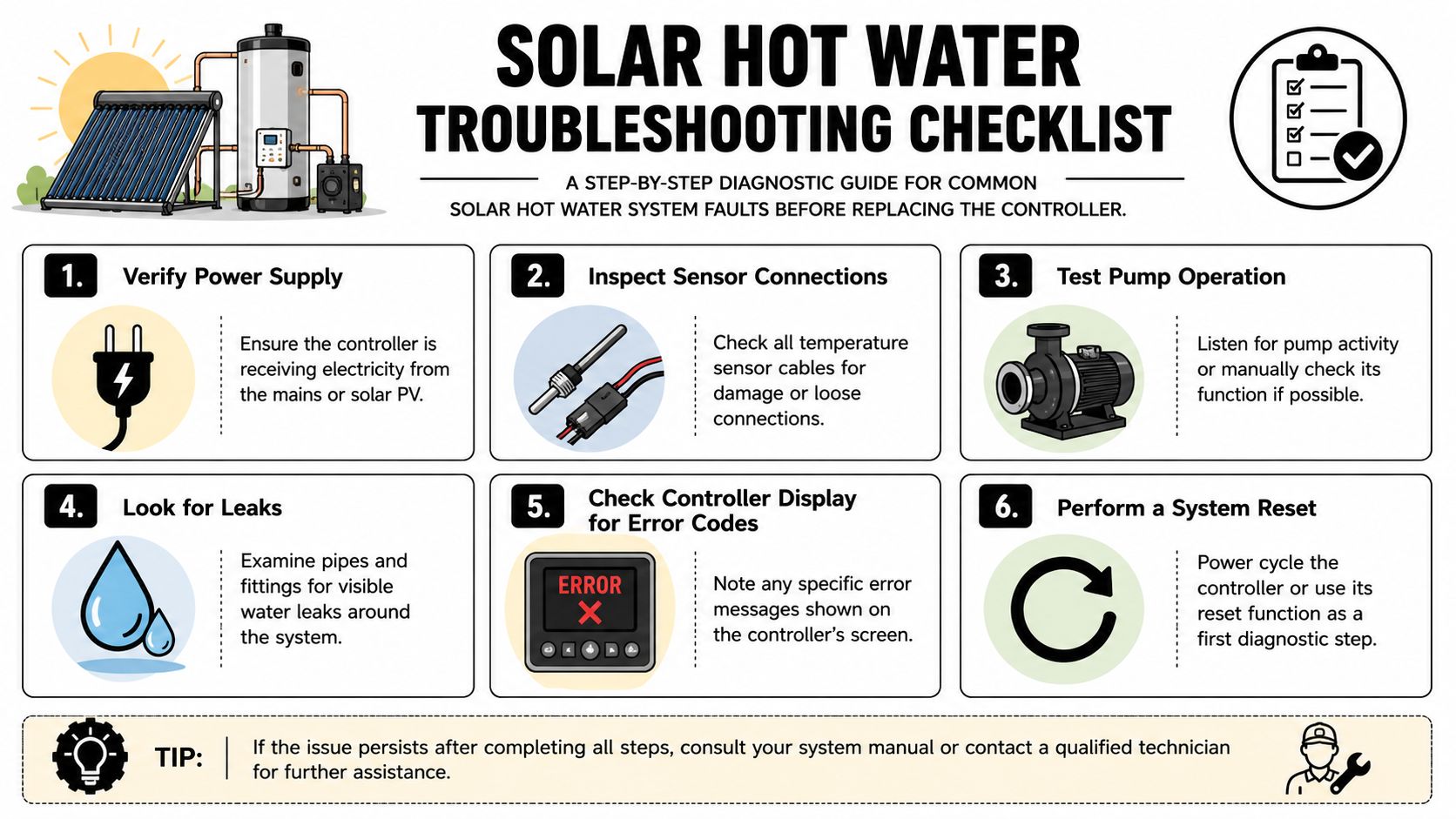
Start outside the controller
If the roof isn't getting decent sun, the controller may be behaving perfectly and still not have enough heat to work with. Trees, new neighbouring structures, and roof changes all affect collection.
Broader site issues matter. If collector access is compromised because roofing work is needed first, it helps to understand practical access and handling considerations such as costs for solar panel detach and reset. Different system, same lesson. Sometimes the fault path starts with the roof, not the control board.
The field checklist that saves money
Run through this in order:
- Power first: confirm the controller is energised and any isolation hasn't been left off.
- Display and error behaviour: note fault codes or blank screens before resetting anything.
- Sensor sanity: compare displayed temperatures with what you'd expect from the weather and tank condition.
- Pump behaviour: listen for operation on a sunny period when the collector should be ahead.
- Pipe temperature direction: if the pump runs, check whether heat seems to be moving the right way.
- Sun access: inspect collector shading, especially if performance dropped after building or vegetation changes.
- Wiring polarity and termination: reversed or loose conductors can create misleading symptoms.
Signs of a real controller fault
A controller becomes the prime suspect when power is present, sensors test or read plausibly, the pump and wiring are sound, sun access is acceptable, and the control output still doesn't behave logically.
Common patterns include a dead display, output relay not switching when conditions are clearly met, or obviously impossible temperature readings after sensor compatibility has been checked.
For a broader homeowner-focused checklist of symptoms before you authorise parts replacement, common problems with solar hot water is a practical companion read.
Don't replace a controller just because it's the easiest part to point at. Replace it when the evidence has boxed the fault into the controller.
If you do reach replacement stage, buy by compatibility. Tank brand alone is not enough. Collector style alone is not enough. Get the controller type, supply, sensor arrangement, and output load right.
Frequently Asked Questions About Solar Pump Controllers
A common Australian callout goes like this: sunny day, roof collectors are hot, but the tank is lukewarm and the controller screen looks normal. In that situation, the screen is only one clue. The controller still has to read the sensors properly, switch the pump at the right time, and suit the wiring and load on that particular system.
Can I use any solar hot water pump controller with any system
No. The replacement has to match the control method, supply voltage, sensor type, and the pump or relay load it needs to switch. Brand names help identify the original setup, but they do not guarantee interchangeability.
On older Australian systems, the catch is often sensor resistance or a controller that also handles a booster, valve, or frost function. That is why a "universal" controller can still be the wrong part.
Can I upgrade an older controller to a newer one
Often, yes, but only after checking the details on the existing unit and wiring. A newer controller may fit the job electrically but still fall short if the old system uses special functions, unusual sensors, or a different mounting arrangement.
I always check the sensor specs first, then the output rating, then any extra terminals for booster or valve control. That order saves time.
If my display is on, does that mean the controller is fine
No. A live display only confirms the unit has power.
A controller can power up and still fail in practice. The sensor reading may be wrong, the relay contacts may not close under load, or the logic may never see the temperature difference needed to start the pump. That is common on ageing units exposed to years of heat in roof spaces and outdoor boxes.
What usually gets missed on DIY replacements
Sensor placement gets missed a lot. If the collector sensor is loose, poorly seated, or installed in the wrong pocket, the controller makes decisions from bad temperature information.
The other miss is output suitability. Some installers look at voltage and stop there. The better check is whether the controller output is rated for the pump, relay, or auxiliary device connected to it.
Are all poor hot-water days caused by the controller
No. Poor solar gain, circulation faults, bad sensors, wiring faults, pump problems, and collector issues can all look like a controller problem from the ground.
That is why fault finding should start with the whole circuit, not the box on the wall.
When should I call a professional
Call one when you cannot clearly identify the supply, terminals, or sensor pair, or when the system combines mains electrical work with plumbing components you are not used to handling. It also makes sense when the controller is tied into a gas booster, electric element timing, motorised valve, or a building management setup.
In Australia, that line matters. Some work crosses into licensed electrical work very quickly.
Is there a simple replacement option if I only need basic control
Sometimes. Ring Hot Water offers a solar hot water controller with temperature display and boost control for systems that only need straightforward operation.
Whether that type suits the job depends on the layout, the sensor arrangement, and what else the controller is expected to switch. Basic control is fine for some systems. It is the wrong choice if the original controller also manages extra functions.
If you need help identifying the right replacement controller, matching sensors and pump outputs, or working out whether the controller is at fault, Ring Hot Water can help with parts advice and Melbourne-based service support.

