
Uncategorized
Solar Hot Water Heater Controller: A Practical Guide

May
You're usually looking at the roof, the tank, or the booster when hot water performance drops. Fair enough. They're the visible parts. But in many Australian active systems, the part deciding whether the whole setup works properly is a small wall-mounted box that often goes unnoticed.
That box is the solar hot water heater controller. If it's reading properly, switching properly, and wired to the right sensors and pump, the system gathers heat and stores it without fuss. If it's not, you can have a sunny day and still end up with poor performance, unnecessary pump run time, or a tank that loses heat instead of gaining it.
In Melbourne, that matters more than people think. Our conditions can swing fast. A controller that copes well with changing sunlight, cool mornings, and hot summer afternoons is often the difference between a system that behaves itself and one that keeps generating service calls.
The Brain Behind Your Solar Hot Water System
Most homeowners understand the basic idea of solar hot water. Collectors on the roof pick up heat from the sun, and the tank stores that heat for showers, washing, and general household use. What's less obvious is how the system decides when to move heat from the roof to the tank.
That decision sits with the controller. In active solar water heaters, the controller works with the pump and sensors to move heat-transfer fluid through the collectors only when there's useful heat available. The distinction between active and passive systems matters here. The controller is one of the defining parts of an active design, because it decides when pumping starts and when it stops, as outlined in the Australian-facing solar water heater guidance from the U.S. Department of Energy energy saver material.
If you're comparing system layouts or trying to understand how your own setup operates, it helps to look at some common solar hot water systems used in Australian homes. The hardware can vary, but the controller's job stays the same. It captures usable solar heat without letting the system waste energy circulating at the wrong time.
Why homeowners notice the symptoms, not the cause
When a controller starts misbehaving, the complaint usually sounds simple:
- Not enough hot water: The collectors may be hot, but the pump isn't moving heat when it should.
- Pump noise at odd times: The controller may be reacting to bad sensor readings or poor settings.
- Inconsistent performance: The system works one day and underperforms the next, even when the weather seems similar.
Practical rule: If the roof collectors, tank, and pump all seem physically intact, the controller and its sensors move high up the suspect list.
A good controller doesn't need to be flashy. It needs to be predictable, readable, and easy to service. That's what holds up best in real Australian installs.
Understanding Core Function with Differential Control
At the heart of a solar hot water heater controller is differential control. That sounds technical, but the operating logic is straightforward. The controller compares the temperature at the collector with the temperature in the storage tank and only runs the circulation pump when the collector is hotter by a preset margin.
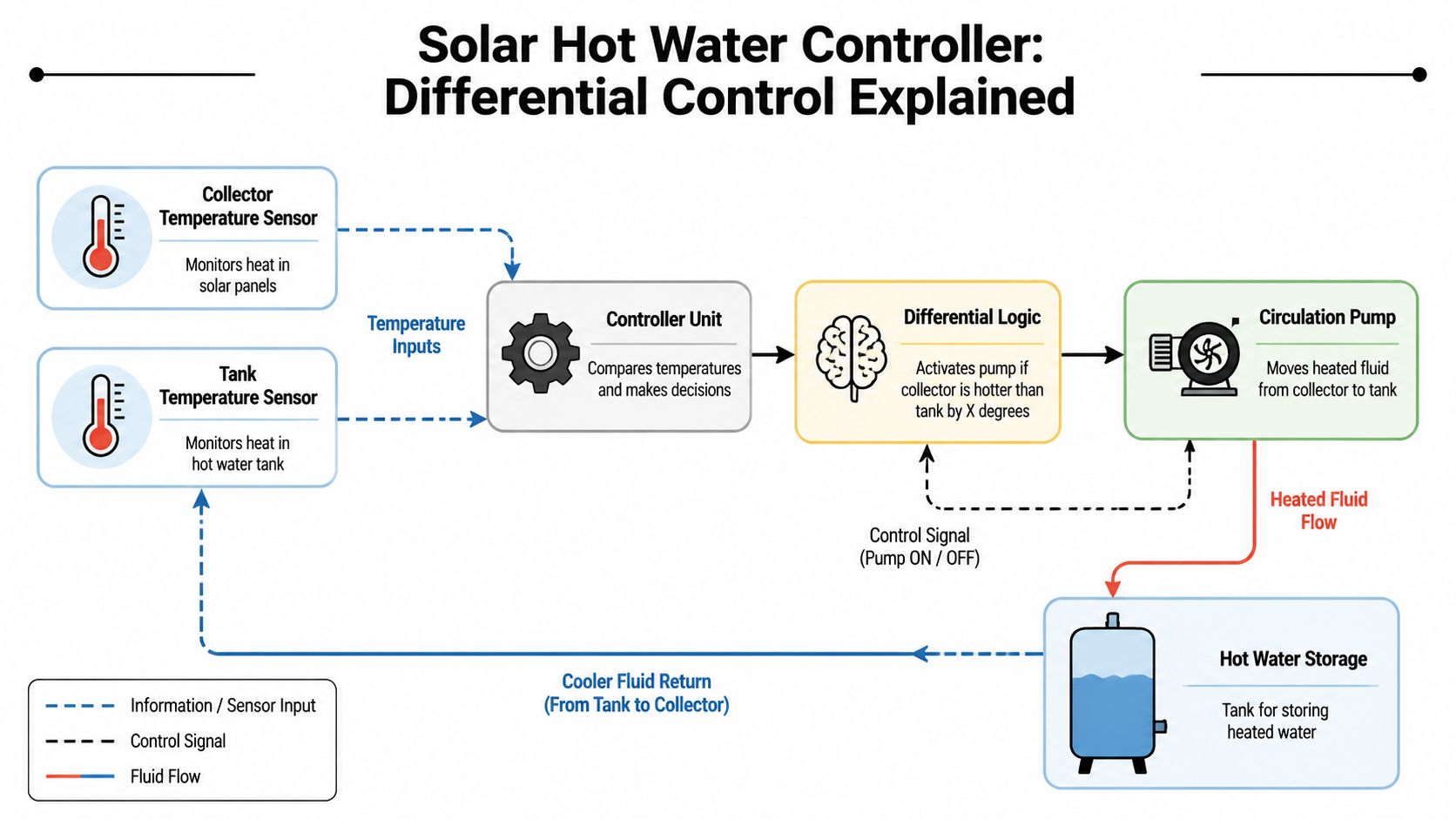
How the controller makes the call
Think of it as a traffic controller for heat. It doesn't care that the sun is out. It cares whether moving fluid right now will increase stored heat in the tank.
A common default switch-on differential is about 8°C, which means the pump starts when the collector is roughly 8°C warmer than the tank sensor reading, according to Delta T Controls guidance on differential operation. Once the pump is running, it keeps going until the temperature difference drops below a lower cut-out threshold. That stop point matters because it prevents the system from pumping just for the sake of pumping.
Here's the simple logic:
- Collector gets hotter than the tank by the set margin.
- Controller energises the pump.
- Heat moves from the collector loop into storage.
- Temperature gap narrows as heat is transferred.
- Controller switches the pump off when useful gain falls away.
That's why a healthy controller protects efficiency in a very practical way. It doesn't just “run the system”. It stops the system from cooling the tank during low solar conditions, late afternoon drop-off, or night-time reversal.
Why this matters in Melbourne conditions
Melbourne doesn't give you steady, all-day consistency. You can get solid sun, patchy cloud, cool ambient temperatures, and sharp late-day drop-offs all in one afternoon. Differential control suits that kind of weather because it reacts to actual temperature conditions, not assumptions.
If the collector isn't hotter enough to deliver a real gain, the pump should stay off.
That one point explains a lot of service issues. Homeowners sometimes assume the pump should run whenever the sun is visible. It shouldn't. If the controller is working properly, it will ignore weak solar input that would only waste power or bleed heat back out of storage.
A short visual helps if you want to picture the sequence in motion:
What differential control doesn't forgive
Differential logic is simple, but it depends on good information. If either sensor is badly placed, poorly connected, or failing, the controller can make the wrong decision with complete confidence.
Common examples include:
- Collector sensor reading ambient air instead of collector temperature
- Tank sensor mounted in the wrong part of the cylinder
- Electrical noise or poor terminations causing unstable readings
- Settings altered without understanding the hydraulic layout
That's why the controller itself is only part of the story. The whole decision chain matters.
How to Choose Between Common Controller Types
Not every solar hot water heater controller suits every job. Some are ideal for a straightforward residential active system. Others are better for larger arrays, auxiliary heating integration, or systems using more advanced pump control.
Australian active systems rely on a controller and pump to circulate fluid, while passive systems do not. That active setup is what allows the system to harvest solar heat intelligently without cooling stored water, as explained in the Energy Saver guide to solar water heaters.
The three broad controller categories
For most buyers and plumbers, the choice usually falls into one of these groups.
| Controller Type | Primary Function | Best For |
|---|---|---|
| Basic differential controller | Compares collector and tank temperatures and switches the pump on or off | Standard residential systems with one collector circuit and one storage tank |
| Advanced controller with pump modulation | Handles differential logic plus finer pump control in systems that suit variable-speed operation | More efficient or more specialised systems where pump behaviour matters |
| Integrated system controller | Coordinates solar loop control with auxiliary heating, safety limits, and sometimes multiple zones or tanks | Complex domestic setups, larger homes, or commercial-style systems |
What works for a standard house
A basic differential controller is the workhorse. If the system has a conventional collector-to-tank loop and no complicated extras, this is often the most reliable option. Fewer functions usually means fewer setup mistakes and easier diagnostics later.
That matters in the field. When you attend a fault call, a simple controller with clear temperatures and obvious outputs is quicker to assess than a menu-heavy unit nobody configured properly in the first place.
Where advanced options earn their place
A more advanced controller starts to make sense when the system itself is more demanding. Variable-speed pump control, multiple sensor points, or management of auxiliary heat sources can be useful, but only if the rest of the installation justifies it.
Use that extra complexity carefully:
- Choose it when the system needs it: Multiple circuits, unusual hydraulic layouts, or integration with boosting controls can justify a smarter unit.
- Skip it when it adds failure points: A small home system doesn't benefit from layers of functions the owner will never use.
- Think about future service: If the controller is obscure, difficult to source, or awkward to program, the next repair becomes harder than it needs to be.
Trade view: Smart features are only valuable when someone can set them correctly and someone else can diagnose them later.
The practical buying question
For most Melbourne homeowners, the right question isn't “What's the fanciest controller?” It's “What controller gives stable operation, clear fault finding, and sensible protection for my setup?”
If the answer is a simple, dependable differential controller, that's usually money well spent. If the system includes auxiliary heat control, multiple zones, or specialised pump requirements, step up only as far as the job requires.
Key Features and Specifications to Compare
Once you've narrowed the controller type, the spec sheet starts to matter. Buyers often get distracted by screens, menus, and connectivity while missing the features that affect reliability.
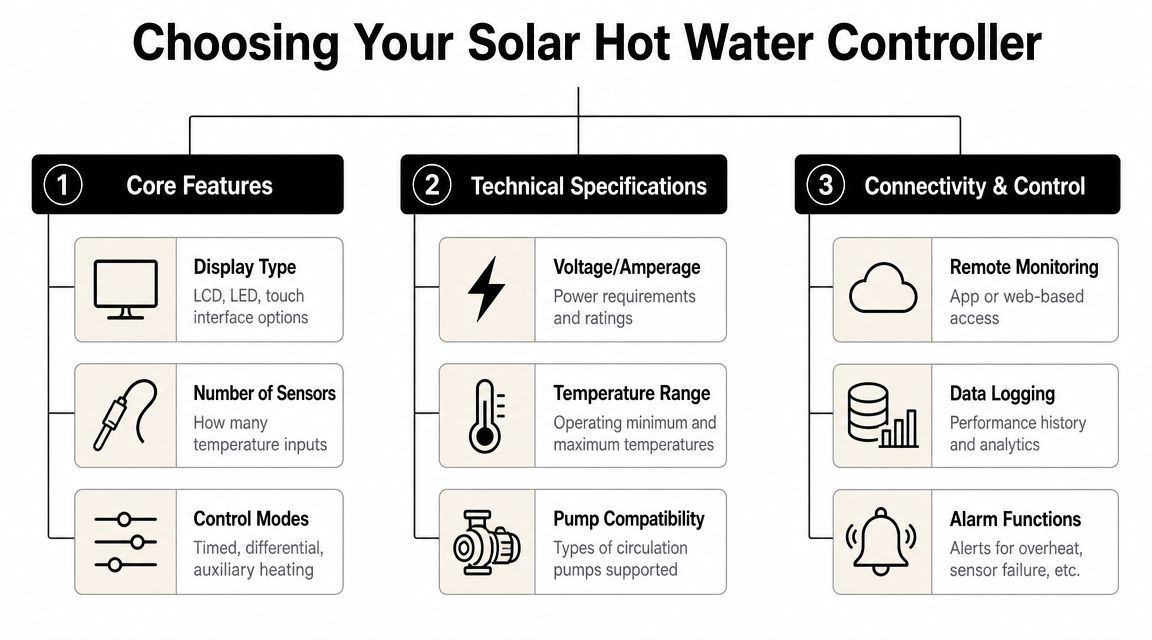
Start with sensor inputs and output hardware
Commercial solar thermal controllers sold in Australia often include multiple PT1000 sensor inputs along with several relay outputs or PWM outputs, which allows more complex control logic for larger or multi-zone systems, according to Australian solar thermal controller product specifications. That flexibility is useful, but only when the installation needs it.
The first thing to check is whether the controller supports the sensors your system uses and how many temperature points it can monitor. A basic domestic setup may only need the essentials. A more involved system might need collector, tank, return, auxiliary, or limit sensing.
Then look hard at the output side. The same product guidance notes that the output relays must be matched to the pump's inrush current to avoid premature failure. In plain language, if the relay is undersized for the pump's electrical demand, it can fail early or stick.
Features worth paying attention to
Some specifications matter every day. Others only matter when something goes wrong. Both deserve attention.
- Display clarity: A readable screen showing real temperatures and system status is far more useful than guessing from a single indicator light.
- Sensor compatibility: If the controller and sensor type don't match properly, your readings can be nonsense from day one.
- Relay quality: This affects longevity. Repetitive switching is normal in solar thermal control.
- PWM output: Useful where the system uses compatible high-efficiency DC pumps.
- Safety logic: Overheat shutdown and temperature-limit control aren't optional extras in a well-thought-out system.
What often gets overlooked
Poor sensor placement can create false differentials. That can shorten pump life and reduce actual solar gain, even when the controller itself is technically sound. A lot of so-called controller faults are really sensing faults.
For drainback and similar safety-sensitive layouts, shutdown logic also matters. If the storage limit is reached, the controller has to stop the pump reliably. Efficiency is part of the job. Protection is part of it too.
A controller with more terminals isn't automatically a better controller. It's only better if those extra functions match the system on the wall and roof.
Essential Installation and Wiring Considerations
A good controller can still perform badly if the installation is sloppy. Most call-backs on solar control systems come from basic setup errors, not exotic failures.
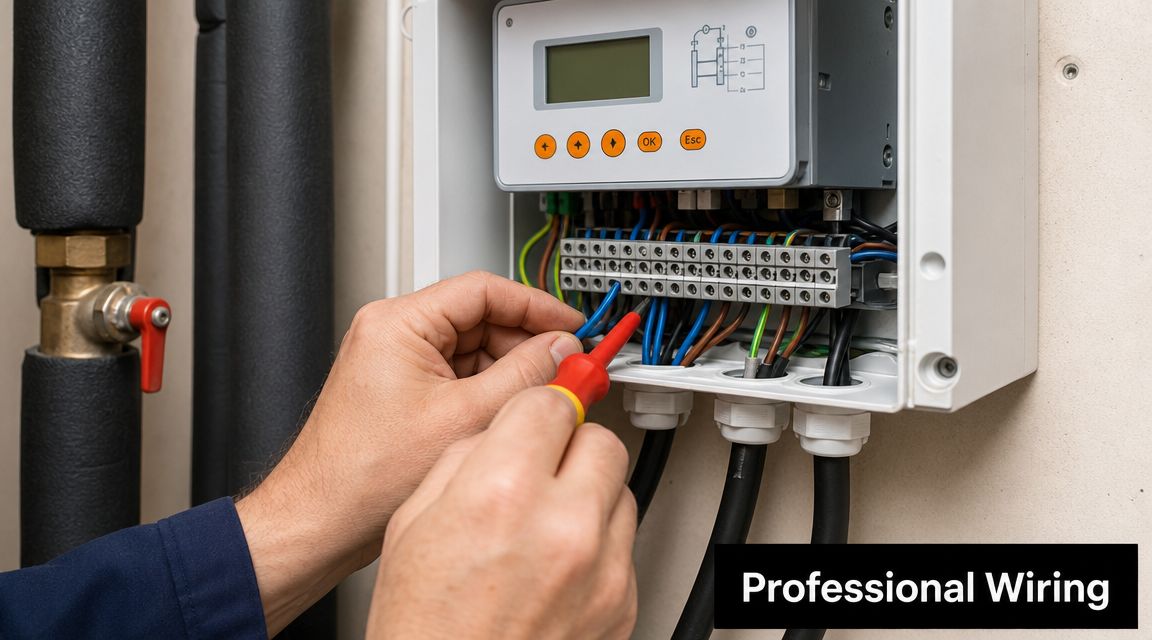
Sensor placement decides whether the logic is truthful
The controller only knows what the sensors tell it. If the collector sensor is loose, poorly clamped, or sitting where it picks up air temperature instead of collector outlet temperature, the controller is making decisions off bad data.
The same goes for the tank sensor. It needs to be positioned where it reflects the part of the tank relevant to charging logic, not just wherever it was easiest to strap it on. If you're replacing a failed probe or checking fitment, using the correct solar hot water sensor with tube matters because the sensor assembly and mounting method affect reading stability.
Wiring mistakes that create expensive faults
Licensed electrical work is essential, but plumbers and homeowners should still understand the common failure points.
Watch these closely:
- Loose terminations: Intermittent faults often start here.
- Shared or noisy cable runs: Sensor wiring can pick up interference if it's routed carelessly.
- Wrong sensor terminals: A controller may power up normally while making completely wrong decisions.
- Relay mismatch: If the controller output isn't suited to the pump load, contact failure becomes likely.
A welded relay is one of the uglier outcomes because the pump may stay on when it shouldn't. Then you're not just chasing poor performance. You're chasing overheating risk, unnecessary cycling, or overnight heat loss.
The apprentice-level rule that saves call-backs
If I had to reduce controller installation to one field lesson, it would be this: mount sensors properly, verify the pump load, and test operation under real temperature conditions before leaving site.
Don't just confirm that the screen lights up. Confirm that the controller reads sensible temperatures and responds correctly when the collector is hotter than the tank. A neat-looking install that hasn't been function-checked isn't finished.
Troubleshooting Maintenance and Sourcing Parts
Controllers don't usually fail without warning. Most systems give clues first. The trick is knowing which clues matter and checking them before a small issue turns into a no-hot-water call.
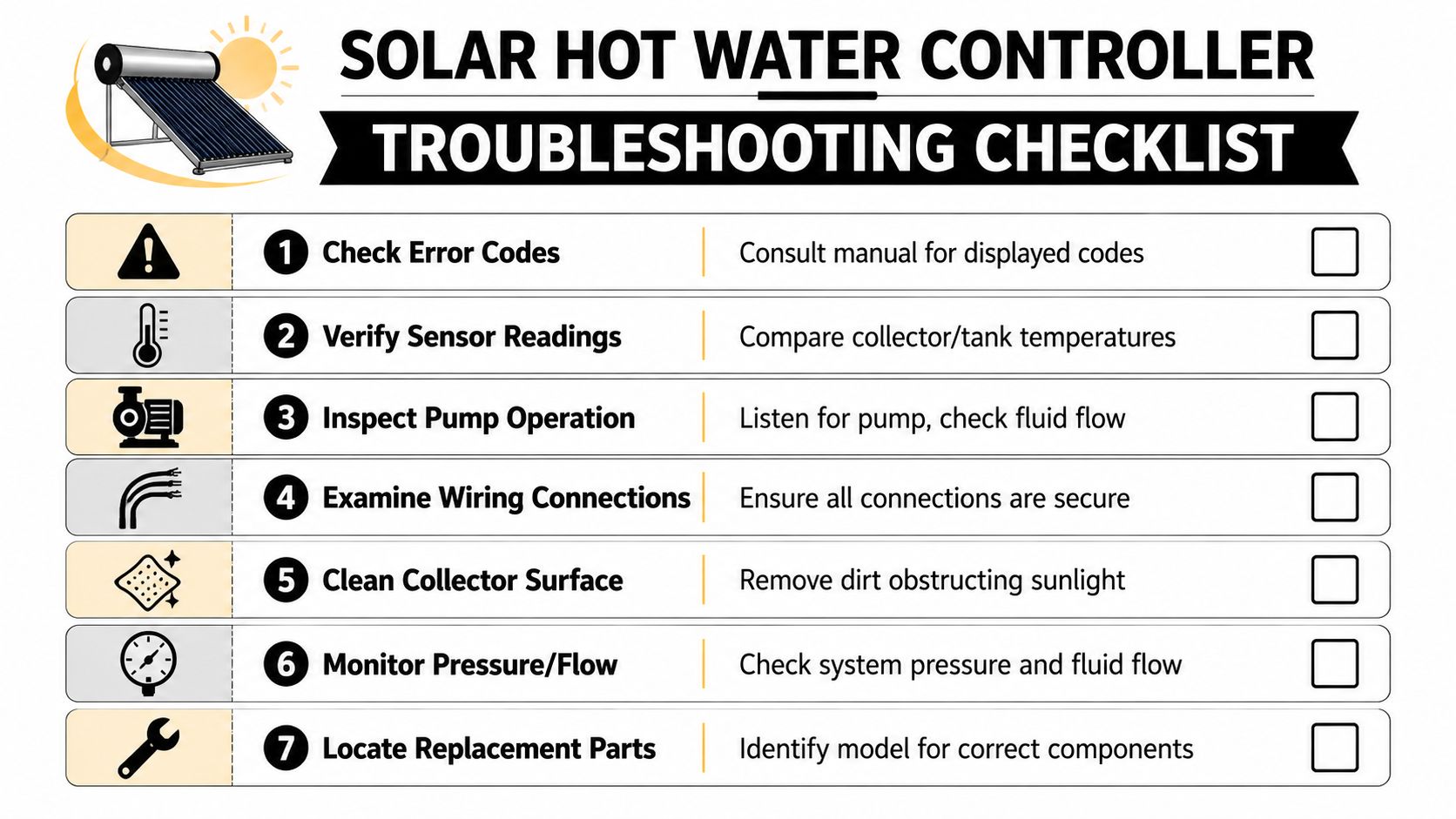
The checks that catch problems early
Maintenance guidance from the Pacific Northwest National Laboratory says a key service check is confirming that the controller shows no errors and verifying that the collector-fluid temperature is higher than the entering fluid temperature while the pump is running. That's a direct performance check of the control logic in an active system, as noted in the PNNL solar water heating maintenance guidance.
That aligns closely with what works in practice. Start with what the controller is telling you, then compare it with what the system should be doing under the weather conditions on the day.
A sensible field checklist looks like this:
- Read the display first: Error codes, impossible temperatures, or blank sensor readings narrow the fault quickly.
- Compare collector and tank behaviour: On a decent sunny period, the collector side should show usable heat before the pump is called.
- Listen to the pump: A pump that hums, chatters, or stays silent when the controller is calling for output tells you plenty.
- Inspect wiring and sensor terminations: Many intermittent issues live here.
- Check the collectors themselves: Dirty glazing, shading, or surface grime can reduce heat pickup. If the collectors need a safe external clean, a practical homeowner resource is Sparkle Tech solar panel cleaning.
What tends to work better in Australian conditions
For local serviceability, durable and readable usually beats feature-heavy and fragile. Controllers with clear displays, straightforward menu structures, and easily sourced probes are generally easier to keep alive over the long term than highly complex units with niche parts.
That doesn't mean advanced controllers are bad. It means they need to suit the install and the people maintaining it. In Melbourne and wider Australian conditions, simplicity often wins because it reduces downtime and shortens diagnosis when something does go wrong.
If a replacement is needed, matching the exact component type matters. Sensor mismatch, wrong output capacity, or a generic substitute can create a new fault while you think you've solved the old one. For replacement components, model-specific options are easier to sort through when you're looking at a dedicated range of solar hot water parts and hot water system parts. One available option in that space is the Ring Hot Water solar hot water controller product, which is a wall-mounted unit with an LCD display and basic troubleshooting guidance on its product page.
Don't judge a controller by how many functions it has. Judge it by whether a competent tech can diagnose it quickly, source parts for it, and return the system to stable operation.
If your solar hot water system is acting up, or you need the right controller, sensor, or replacement part for an Australian setup, Ring Hot Water can help with practical advice, genuine parts, and Melbourne-based service support.

