
Uncategorized
Hot Water Urn Birko: 2026 Buyer & Care Guide

May
You're usually looking for a hot water urn Birko when kettles have already failed the test. One staff kitchen can limp along with a pair of kettles. A church hall morning tea, a factory smoko room, or a function with steady tea and coffee service can't. Someone's always waiting, someone forgets to refill, and the bench ends up wet and crowded.
That's where Birko urns earn their place. In Melbourne, I see them in offices, clubs, school canteens, community centres, and back-of-house prep areas because they're simple, familiar, and built for repeated use. The trick isn't just buying one. It's choosing the right size, setting it up on the right circuit, cleaning it before scale gets ahead of you, and knowing when a tap seal is a quick fix versus when the unit needs proper service.
Why a Birko Urn Is Your Event and Office Workhorse
A common call-out starts the same way. The office has a training day, the urn from storage gets dragged out, and nobody remembers whether it still works. Another one is the community hall that relies on volunteers. They don't want fancy controls. They want hot water, a lid that stays put, and a unit that won't turn a tea break into a half-hour wait.
That's the practical appeal of Birko. The range covers the small end and the catering end without changing the basic logic of how the unit works. You fill it, heat it, draw off what you need, top it up properly, and keep it clean. For buyers who are still deciding what type of unit suits their kitchen or venue, this broader guide to a hot water urn is a useful starting point before narrowing down to Birko.
Where Birko tends to fit best
In day-to-day use, Birko urns suit places that need predictable bulk hot water rather than one cup at a time. That includes:
- Small offices and shared kitchens: Better than running multiple kettles through the morning rush.
- Clubs and halls: Easy for casual users who need straightforward operation.
- Catering prep and service points: Good where tea, coffee, and instant food service happen in batches.
- Workshops and factories: Useful when people need a durable appliance rather than something delicate.
Practical rule: If people are queuing for the kettle more than once a day, an urn usually makes more sense.
What works well is the no-fuss format. Fill level is obvious. Dispensing is simple. The vessel shape is familiar to almost everyone. What doesn't work is buying on brand name alone and ignoring the site. I've seen a perfectly decent urn underperform because it was too small for the demand, parked on a poor bench, or plugged into a circuit already carrying too much kitchen equipment.
Choosing Your Birko Urn Models and Sizes Explained
The wrong size usually shows up at 10:15am. Staff are lined up, the first fill is nearly gone, and the urn that looked fine on paper cannot recover fast enough for the second round. I see that more often than outright product failure.
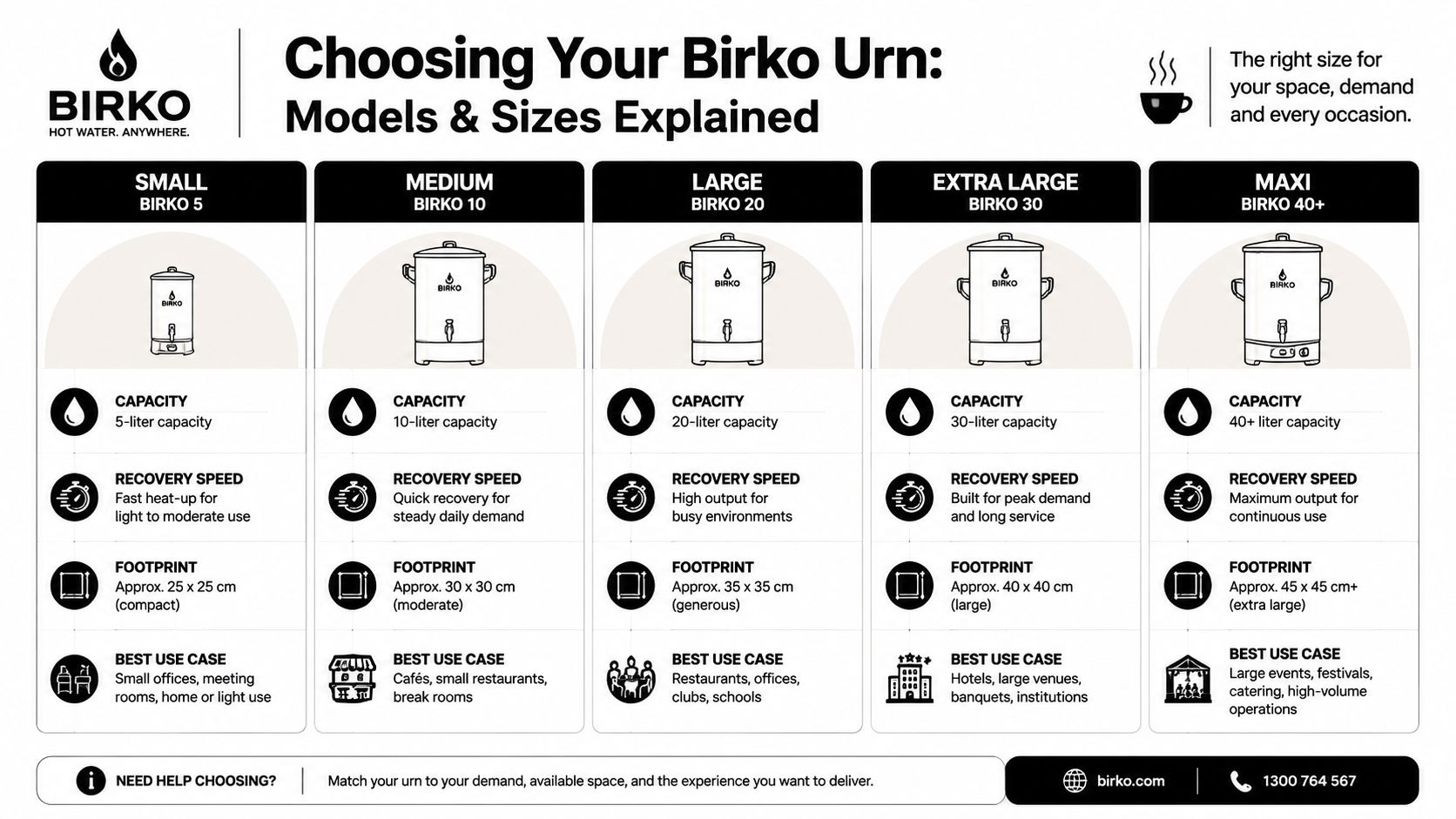
Size selection comes down to three practical checks. How many cups are poured in the busiest window, how quickly the urn has to recover after repeated draw-off, and whether the bench and power supply suit the unit. Capacity matters, but service speed and placement usually decide whether owners stay happy with the purchase six months later.
Start with the light-duty end
For homes, staff rooms, and quieter office kitchens, the Birko 5L domestic urn is often the sensible pick. An Australian retailer's Birko 5L domestic urn listing specifies 5L capacity, about 25 to 30 cups per fill, a 1.5kW element, 220 to 240V operation, and a 10A plug. The same listing gives dimensions of 220mm diameter x 400mm high and 1.9kg net dry weight.
On site, that usually means easy placement and no drama on a standard bench. The trade-off is recovery. A 5L urn works well where people draw a few cups at a time. It starts to feel slow when a whole team hits it back-to-back.
Step up if the demand comes in waves
The 10L commercial urn suits kitchens and service points that get regular bursts of use rather than occasional cups. Birko's official commercial urn range shows the 10L unit sits in the commercial line, which is the point where many buyers should stop comparing by litres alone and start looking at heater power, refill habits, and available bench space.
In practice, 10L is often the best compromise. It gives more headroom than a domestic unit without taking over the counter. For Melbourne offices, church halls, and club kitchens, this is the size I'd usually suggest first if the kettle has already become a bottleneck but a full catering urn feels oversized.
Where the 20L model makes sense
Once the site is serving larger groups over a sustained period, the 20L commercial urn becomes easier to justify. The Birko 20L commercial hot water urn is the sort of unit that fits busy break rooms, functions, and volunteer-run venues where demand stays steady for a longer session rather than peaking for five minutes and disappearing.
The gain is holding more hot water on hand and reducing refill interruptions. The trade-off is obvious. The unit takes more bench room, weighs more once filled, and needs a user who will manage water level properly instead of waiting until the tank is nearly empty.
A practical comparison
| Model type | Best fit | Main strength | Main trade-off |
|---|---|---|---|
| 5L domestic | Home, small office, occasional group use | Compact and easy to place | Slower under repeated draw-off |
| 10L commercial | Office kitchens, moderate service, shared staff areas | Better balance of capacity and recovery | Needs more bench room than a domestic urn |
| 20L commercial | Functions, clubs, catering, busy break rooms | Handles sustained demand more comfortably | Larger footprint and more disciplined refilling |
I'd buy for the busiest half hour, not the average day. That is where sizing mistakes show up first.
A small office that serves ten people across the morning can live happily with a 5L unit. A site that serves the same ten people within eight minutes usually needs the 10L commercial model instead. A hall that runs meetings, urn service, and light catering from the same station is usually better off going straight to 20L and accepting the extra footprint.
The common mistake is treating all litres as equal. They are not. The right Birko urn is the one that fits the demand pattern, the power available, and the way people use the kitchen, not just the one with the biggest tank.
Understanding Key Features and Safety Systems
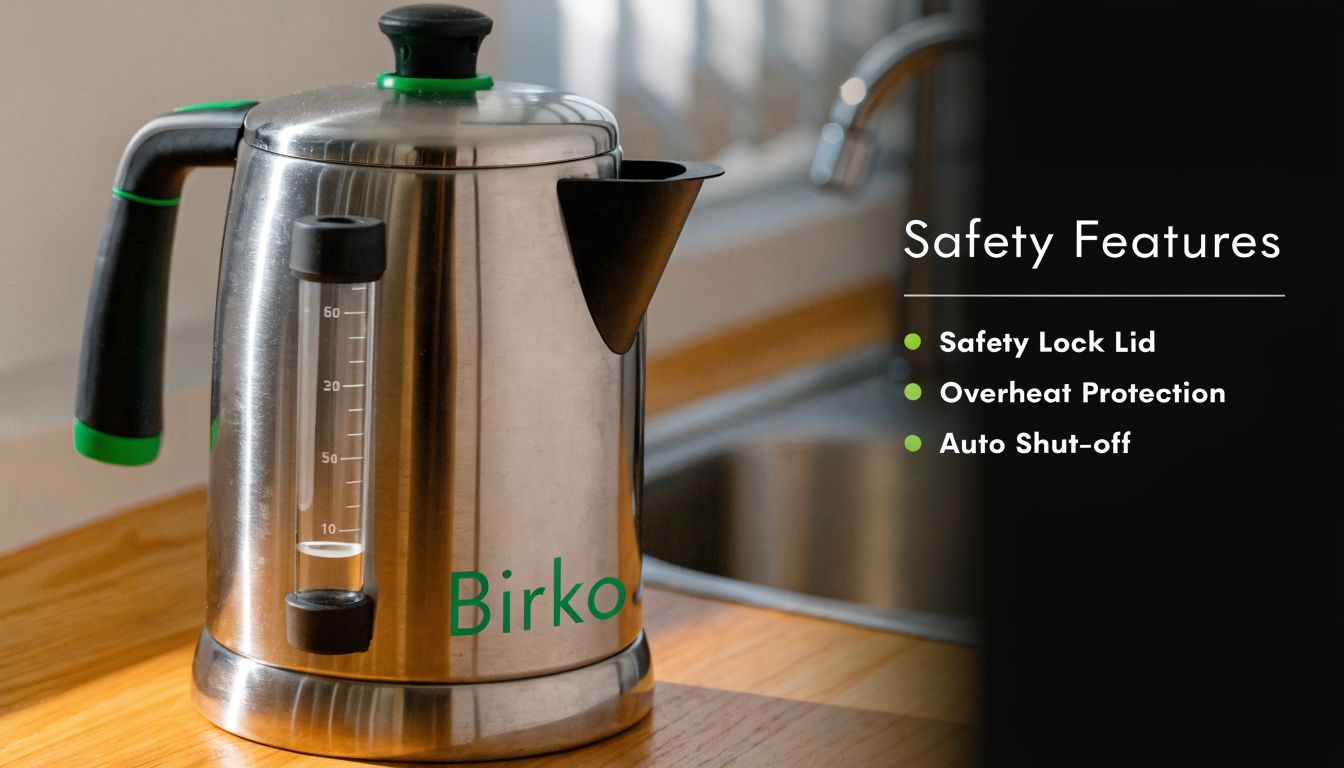
A Birko urn's value isn't just in how much water it holds. The useful features are the ones that reduce mess, make cleaning easier, and stop common failures before they become a repair job.
Features that matter in daily use
Birko commercial urns use a double-walled stainless steel body, a vented twist-to-lock lid, and over-temperature dry-boil protection, which cuts power if the unit runs empty, according to the official Birko 20L commercial urn specification.
Here's what that means on the bench:
- Double-walled body: Helps reduce heat loss through the vessel wall. In practice, that supports more stable holding performance and a cooler external feel than a thin single-wall shell.
- Twist-to-lock lid: Important in shared spaces where people lift, move, or refill the urn in a hurry. A loose lid is where spills start.
- Vented lid design: Steam needs a controlled path out. A blocked or poorly seated lid causes trouble.
- Dry-boil protection: If someone lets the urn run empty, the safety cut-out lowers the chance of cooking the element.
Why the concealed element matters
A concealed element is one of the most useful design choices on an urn. Exposed elements tend to trap scale and residue around the hottest surfaces. That makes cleaning slower and can create localised overheating over time. Concealed designs are easier to wipe out properly and generally cope better with repeated commercial-style use.
That doesn't mean the urn is maintenance-free. It means cleaning is more straightforward, especially around the bottom of the vessel.
A safety device is there to save the urn from one mistake. It's not there to make bad operating habits acceptable.
The practical trade-off is simple. More features mean a more appliance-grade unit, but they don't remove the need for decent operating habits. A twist-lock lid still needs to be seated correctly. Dry-boil protection still means the urn has been run low enough to trip. Good design helps. Good use matters more.
Your Guide to Correct Installation and Setup
Monday morning in a Melbourne staff room is where bad setup shows up fast. Ten people want hot water at once, someone has parked the urn near the sink, the cord is stretched tight, and the first trip to the reset switch happens before smoko. Birko urns are generally straightforward, but they need to be installed like fixed-use equipment, not treated like a kettle that can go anywhere.
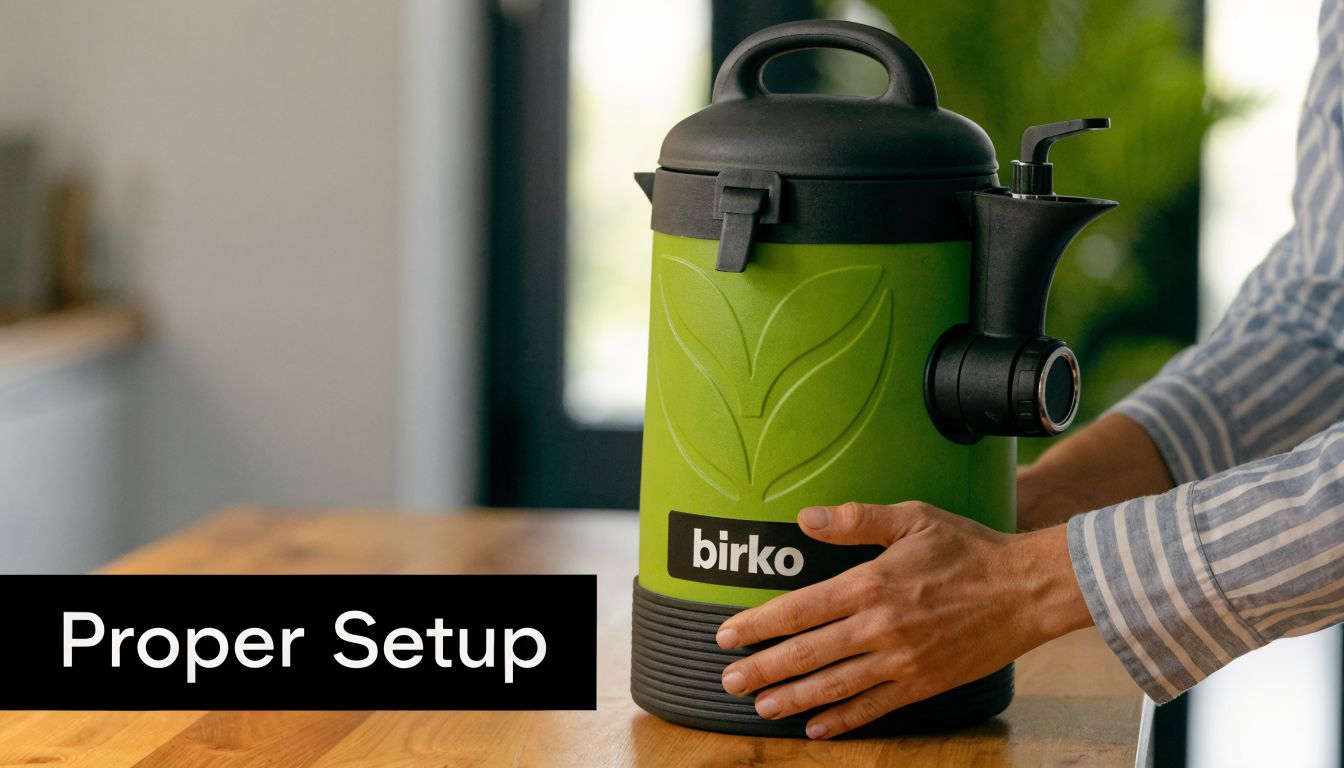
Start with the bench, not the box
Choose the position before the urn is filled. Once full, even a mid-size urn has enough weight to make repositioning awkward and risky.
Use a stable, level, water-resistant bench with enough space above the lid for filling and enough space below the tap for cups and small jugs. Keep the unit clear of bench edges, corners, and narrow shelves where the tap overhangs. In service calls, poor placement is one of the most common causes of small but persistent problems. Drips get ignored, people twist the body to fit cups underneath, and the tap or handles cop the strain.
Keep it out of traffic paths. An urn should be easy to reach, but it should not sit where hips, bags, or cleaning gear can knock it.
Check the power supply before first use
This part gets missed too often. Larger commercial urns pull enough load that circuit sharing matters, especially in older offices, school kitchens, church halls, and site sheds around Melbourne.
Before plugging it in, check these points:
- Use a proper wall outlet. Avoid power boards and double adaptors.
- Check what else is on the circuit. Microwaves, toasters, pie warmers, and boiling water units can push a marginal circuit over the limit.
- Run the cord where it stays dry and visible. No sink edges, no pinch points behind benches, no walkway crossing.
- Leave access around the urn. Staff need room to fill, inspect, and empty it without reaching across steam or hot metal.
If the power point trips under normal use, do not keep resetting it and hoping for the best. That is the point to get the supply checked or book a Birko urn service and repair assessment before the fault gets worse.
Set it up for the people who will actually use it
The best installation is the one that still works when the busiest person in the room is using it one-handed. Put the tap at a comfortable height for mugs. Make sure the lid can be removed without hitting shelves. Keep the water source close enough that refilling does not turn into a carry-and-slop routine across the kitchen.
This sounds minor. It is not. Daily inconvenience creates rough handling, and rough handling shortens the life of taps, lids, and electrical parts.
First-use routine that prevents taste and call-backs
Do not put an urn straight into drink service out of the carton. Factory residue, storage dust, and packaging debris can leave the first batch tasting flat or odd.
Use a simple commissioning routine:
- Rinse the interior well with clean water.
- Wipe accessible internal surfaces with a soft cloth.
- Fill the urn to the correct level and bring it to a full heat cycle.
- Discard the first batch of hot water.
- Refill with fresh water before serving.
I treat this as part of installation, not an optional extra. A lot of early complaints about taste, smell, or “faulty heating” come back to rushed setup rather than an actual problem with the urn.
Performing Long-Term Maintenance and Cleaning
Urns usually don't fail all at once. Performance slips first. Heating feels slower. The tap starts dribbling. The inside gets a rough chalky line. Then someone says the unit “suddenly stopped working”, when in reality it's been asking for attention for months.
Birko urns use a concealed element for easier cleaning and superior corrosion resistance, and the element is described as replaceable on 10L, 20L and 30L models, which matters for long-term serviceability, as noted on this Australian Birko urn listing. That design helps, but no urn stays healthy if scale is allowed to build up unchecked.
The maintenance routine that actually works
You don't need an elaborate schedule. You need a repeatable one.
- Daily check: Empty old water if the urn isn't in constant use, rinse the vessel, and make sure the tap shuts cleanly.
- Weekly attention: Wipe the exterior, clean around the lid seating area, and inspect for seepage around the tap body.
- Periodic descaling: Frequency depends on usage and water quality. Heavy use and harder water mean you'll need to do it more often.
If the urn is in a busy workplace, assign the task. Shared responsibility often means nobody does it.
How to descale without creating another problem
Descaling is simple if done carefully. Use a suitable descaling product or a mild vinegar solution, follow the product directions where applicable, and never attack the interior with harsh abrasives that can scratch surfaces and create more places for residue to hang on.
A sensible process looks like this:
- Switch off and unplug the urn.
- Let it cool enough to handle safely.
- Drain it fully.
- Add the descaling solution and water as appropriate.
- Allow it time to work on the scale.
- Rinse thoroughly more than once.
- Run a fresh boil and discard it before returning the urn to service.
Don't ignore the tap assembly
Most user complaints start at the tap. Slow flow, weeping from the spout, stiffness in operation, or leakage at the fitting all point to a tap assembly that needs cleaning, reseating, or replacement of worn parts.
The important thing is not to over-tighten everything in the hope that the leak disappears. That often turns a simple seal issue into damaged threads or a cracked fitting.
For owners who need repairs or parts support rather than guesswork, Birko urn service is one available option for handling common service issues properly.
Clean the urn before it looks dirty. Once scale is visible, performance has usually been affected for a while.
What works over the long term is boring consistency. Small clean-outs, regular descaling, and quick attention to tap issues keep these units going. Neglect is what makes a serviceable urn look worn out before its time.
Troubleshooting Common Birko Urn Issues
Most Birko urn faults fall into a short list. Not heating. Not heating enough. Leaking from the tap. Cutting out unexpectedly. The right response is to start with the obvious checks and stop before you turn a minor issue into an electrical repair.
If the urn won't heat
Check the power point first. Then check whether the urn is switched on and properly filled. If the unit has been run low or empty, a safety cut-out may have activated. Let it cool, refill correctly, and try again according to the operating instructions for that model.
If there's still no heat after basic checks, stop there. Internal electrical faults, failed controls, and wiring issues aren't DIY jobs for most users.
If the water isn't hot enough
This usually points to one of three practical causes:
- Heavy scale build-up: Heat transfer suffers when mineral build-up lines the vessel and internal surfaces.
- Demand exceeding the urn's recovery rate: The unit may be correctly sized by volume but still too slow for repeated draw-off.
- Thermostat or control issue: More likely when performance has changed noticeably from normal operation.
A common mistake is blaming the urn when the site demand has increased. A staff kitchen that once had ten users may now have thirty. The urn hasn't changed. The workload has.
If the tap leaks or dribbles
Start with a visual inspection. Look for residue around the tap body, signs of seepage at the mounting point, and stiffness in the handle or lever movement. Sometimes the problem is just debris or scale interfering with shut-off. Sometimes the internal seal is worn.
Try this order:
- Empty and cool the urn safely.
- Inspect the tap externally for obvious build-up or looseness.
- Clean the area and test again.
- If leaking continues, treat it as a parts issue rather than forcing the tap tighter.
When to stop and call a technician
Call for service if you notice burning smells, repeated tripping, inconsistent heating, visible damage around controls, or leaks that appear to come from somewhere other than the tap assembly. Also stop using the urn if the body feels unstable, the lid no longer seats correctly, or the plug and lead show signs of damage.
A good rule is simple. If the fix involves anything beyond cleaning, correct filling, or basic external inspection, it's usually time for a technician.
Sourcing Genuine Parts and Professional Service in Australia
Parts quality matters more on urns than people think. A generic seal that almost fits, or a tap assembly that tightens awkwardly, can leave you with leaks, poor shut-off, or repeat failures. On a hot water appliance used by staff or the public, “close enough” isn't good enough.
What to look for when ordering parts
Genuine or correct-spec replacement parts help in three ways:
- Fit: The part matches the body, thread, or mounting arrangement it was designed for.
- Safety: Correct components reduce the risk of heat damage, poor sealing, and unreliable operation.
- Service life: A proper element, seal, or thermostat gives the urn a fair chance of returning to normal operation instead of limping through another short cycle.
For Birko urns, the parts people most often chase are tap components, seals, thermostatic parts, and heating elements on serviceable models. Before ordering anything, confirm the model details from the compliance plate or product label. “Looks about right” is how the wrong part ends up on the bench.
When professional service is the better option
A business usually benefits from professional repair when downtime matters, when the fault is electrical, or when the urn has multiple issues at once. That's especially true in Melbourne offices, hospitality venues, and factories where the urn isn't just convenient. It's part of the daily routine.
If the unit only needs external cleaning and a simple consumable part, a competent buyer can often sort that out. If the problem involves heating inconsistency, recurring safety cut-outs, or internal component failure, a proper service call is the safer path.
For buyers and facilities teams, the best approach is simple. Identify the exact model, use the right part, and don't guess with electrical repairs.
If you need help with a Birko urn, Ring Hot Water supplies Birko-related parts through its online store and provides installation, repair, and maintenance support across Melbourne. If you're not sure whether your urn needs a replacement part or a full service, start with the model details and the fault symptoms. That usually tells you the fastest path back to reliable hot water.

