
Uncategorized
Master Your Birko Hot Water Urn: Guide & Service

May
The usual trigger for buying a birko hot water urn is frustration. The office kettle can’t keep up with the first break. A church hall volunteer is refilling and reboiling while people queue with cups in hand. A cafe uses a domestic appliance for staff tea and suddenly finds it’s become part of service bottleneck instead of solving one.
That’s where a proper urn earns its place. It’s built to heat and hold a larger volume of water, then dispense it repeatedly without the stop-start routine that wastes time and bench space. If you’re deciding between another kettle, a plumbed unit, or a freestanding urn, the practical question isn’t just “will it boil water?” It’s “will it stay useful when demand is messy, repetitive, and real?”
The End of the Kettle Queue
Eight people hit the office kitchen at 10:30, and the kettle stops being a convenience. One person is waiting for it to boil, another is topping it up, someone else lifts it before the cycle finishes, and the line starts again. We see the same pattern in church halls, site offices, and community events across Melbourne. The problem is rarely boiling water. It is having enough hot water ready when several people want it within a short window.
A birko hot water urn is built for that workload. It heats a larger volume, holds temperature, and lets people draw water from a fixed point without repeated lifting and reboiling. In practical terms, that means less waiting, fewer interruptions, and less chance of someone carrying a hot kettle through a crowded room.
The difference matters more once demand becomes uneven. A kettle can cope with occasional use. It struggles when break times bunch together, volunteers are serving continuously, or staff need hot water in the background while other equipment is already in use. An urn suits those jobs because it is designed for repeated dispensing, not one boil at a time.
From a service technician’s point of view, the first sign that a kettle setup has outlived its usefulness is not usually failure. It is the workarounds. Extra kettles appear on the bench. People start decanting water into jugs. Refilling gets rushed. Spills become more common. Those are the conditions that tell you the site needs stored hot water, not another domestic appliance.
Typical pressure points are easy to spot:
- Office kitchens at break time: several cups are needed within minutes, not one after another.
- Community halls and events: volunteers need a safe dispensing point that can handle steady use.
- Back-of-house staff areas: hot water is needed without tying up prep or service space.
- Shared kitchens: repeated lifting, pouring, and reboiling creates unnecessary handling risk.
If you are comparing benchtop options, this guide to office water dispensers and workplace hot water setups gives useful context on where an urn fits, and where a different system makes more sense. For buyers also weighing up fixed hot water equipment, AdVoltage Electrical’s hot water guide is a helpful comparison point.
A kettle queue usually becomes normal before anyone questions it. Once that happens, the delay is built into the day.
Birko Hot Water Urn
Why Trust a Birko Urn for Your Hot Water
Not every stainless urn is worth buying. From a service point of view, the difference usually shows up later. Cheap units often look acceptable on day one, but become difficult to clean, awkward to repair, or inconsistent in temperature holding once they’ve had real use.
Birko has a stronger case than most because it isn’t a recent badge applied to generic imported gear. According to the company’s own history, Birko Electrics has been a domestic manufacturer in Australia since the 1940s, beginning with soldering irons before shifting during WWII into portable heating vessels and later developing the commercial hot water equipment the brand is known for today (Birko company history).
Why that history matters in practice
A long manufacturing history doesn’t guarantee a perfect appliance, but it usually means the product category has been refined around actual Australian use. That matters in schools, clubs, site sheds, commercial kitchens, and back rooms where equipment gets wiped down fast, moved around, topped up often, and expected to keep working without fuss.
What tends to hold value in a Birko urn is straightforward:
- Familiar commercial layout: Tap, lid, handles, sight glass, and body format are conventional and serviceable.
- Built for repeated use: The appliance is meant for holding and dispensing, not occasional boiling.
- Local relevance: Australian-made models matter when buyers care about continuity of parts and service support.
Better than buying on appearance alone
Plenty of buyers compare urns by polished finish and litre rating. That’s not enough. The better question is whether the unit has a real service life once scale, worn seals, tap drips, and daily cleaning start to matter.
That’s also why it helps to understand the broader hot water options in a building before you buy. If you’re weighing an urn against other hot water equipment, AdVoltage Electrical’s hot water guide is useful for seeing where storage, instantaneous, and point-of-use systems solve different problems.
Practical rule: Buy the appliance for the duty cycle you actually have, not the one you wish you had. If people will draw from it all day, choose commercial hardware from the start.
Selecting the Right Birko Urn Model and Capacity
A bad size choice shows up fast in real service. In an office kitchen, it looks like staff waiting for the next refill after the morning rush. At a community hall, it means one volunteer topping up water while everyone else is trying to serve tea. In a cafe back room, it usually means the urn was asked to do a job that really needed more storage or faster recovery.
The mistake is treating litre capacity as the only buying factor. What matters in practice is how the urn will be used across the day. I usually assess three things first: how many cups are poured in a short burst, how often the unit will be refilled, and whether it is covering brief peak demand or sitting in regular service for hours.

A practical way to size the urn
The common Birko sizes each suit a different pattern of use.
| Model size | Best fit | What matters most |
|---|---|---|
| 5L | Small office, meeting room, light event use | Small footprint, quick access to stored hot water, less bench space lost |
| 20L | Staff kitchens, medium functions, regular hospitality support | Better reserve for repeated dispensing and fewer interruptions for refilling |
| 30L | Busy catering, halls, larger venues, worksite demand | Higher output for peak periods and stronger performance under sustained use |
The 5L model suits sites trying to get away from repeated kettle boils without bringing in a large catering urn. It is a sensible fit for meeting rooms, reception areas, and smaller shared kitchens where the main priority is convenience, tidy bench use, and a straightforward serving setup. Features commonly listed for this size include stainless construction, a lockable lid, and a sight glass, which are all practical rather than cosmetic. They help with safe handling, quick level checks, and easier day-to-day use.
Once you step up into the larger commercial range, capacity stops being the only difference.
What the commercial models do better
Birko states that its commercial urns use a concealed heating element, variable thermostat control, replaceable elements on larger models, and over-temperature protection that cuts power if the urn boils dry (Birko commercial urn specifications). Those details matter because they affect cleaning time, service life, and repair options.
From a technician’s point of view, the concealed element is one of the more useful design choices. It leaves fewer awkward surfaces inside the tank, which makes descaling and wipe-downs easier. It also reduces the chance of scale building up heavily around exposed element hardware, which is a common reason older urns start heating poorly.
The replaceable element matters too. At Ring Hot Water, we see plenty of larger urns that are still worth repairing because the main body is sound and the fault is confined to a serviceable part. Buyers who want a clearer picture of where each size fits into day-to-day use can compare typical setups in this commercial hot water urn guide.
Match the model to the job
A 30L urn is not automatically the safer choice. If it sits half-used most days, staff have more water to empty, more internal surface to clean, and more chance of letting old water stand too long between service periods.
A 5L urn can be the right answer, but only if demand is light.
Use these simple buying rules:
- Choose 5L for tea rounds, small teams, interview rooms, and light-duty serving.
- Choose 20L for office kitchens, clubrooms, and medium functions where several people draw hot water across the day.
- Choose 30L for catering runs, halls, site sheds, and venues with strong peak demand.
The best fit is the one that keeps cups flowing without creating extra cleaning, constant refilling, or service calls that could have been avoided at the buying stage.
Installation and First-Time Setup Guide
First setup is where many avoidable problems begin. A birko hot water urn is simple equipment, but it still needs the right bench position, the right fill procedure, and a sensible first run before anyone starts serving from it.
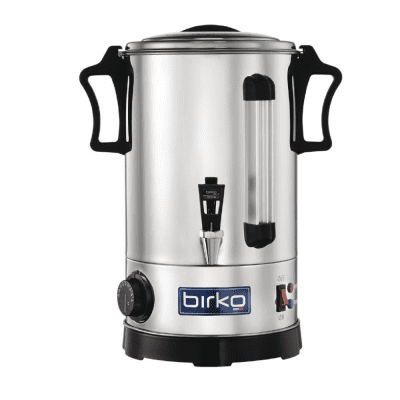
Set the urn up on the right surface
Put the urn on a stable, level, heat-tolerant bench where the tap can overhang enough for easy cup placement. Don’t wedge it into a corner where the lid can’t open properly and staff have to twist their wrists to refill it.
Keep it somewhere people can approach from the front, not the side. Most spills happen when users reach around the body to access the tap or try to fill cups while another person is lifting the lid.
Electrical basics that matter
Commercial urns are simple plug-in appliances, but they still need sensible power use. The most important habits are practical ones:
- Use a proper wall outlet. Don’t run an urn through a flimsy extension lead that also feeds other kitchen gear.
- Keep the cord path clear. If people can catch it with a hip or trolley, relocate the unit.
- Check the rating plate and outlet suitability. If the appliance requires a standard dedicated supply position, don’t improvise.
First rinse and fill
Before the first service, rinse the tank, fill it with clean water, heat it, and discard that first batch. That clears out dust, packaging residue, and the stale taste that can sit in a new vessel after transport and storage.
After that, refill and bring it up to temperature again. Once the water runs clean and tastes neutral, it’s ready for normal use.
Keep the lid seated properly during heating. A poorly seated lid affects heat retention and encourages careless handling around steam.
Thermostat and first use habits
If the urn has variable temperature control, start with the manufacturer’s normal operating setting rather than turning everything to maximum and leaving it there indefinitely. For tea service and general workplace use, consistency matters more than forcing the unit to cycle aggressively.
A few habits make a big difference from day one:
- Don’t switch on an empty urn: Dry heating is one of the fastest ways to create trouble.
- Fill to a sensible working level: Too little water can trigger poor operation, while overfilling makes handling messy.
- Test the tap before service: Make sure the flow is clean and the bench layout allows safe cup clearance.
A careful first setup doesn’t just protect the urn. It also establishes the routines staff tend to follow afterwards.
Your Schedule for Cleaning and Sanitisation
Most urn problems that users call “faults” start as cleaning issues. The water tastes flat, the tap starts to drip, the sight glass looks cloudy, or the heating seems sluggish. In many cases, the appliance isn’t broken. It’s dirty, scaled, or carrying residue in the tap and tank.
Australian-made 30L Birko urns are commonly listed with a double-walled stainless steel body and a chrome-plated brass non-drip tap, and both of those surfaces need regular attention to stay hygienic and free of mineral build-up (30L Birko construction details).

Daily jobs that prevent bigger work
The daily routine should be simple enough that staff will do it.
- Empty leftover water: Don’t leave old water sitting in the urn overnight unless your site has a documented reason and hygiene process for it.
- Wipe the exterior: Use a soft cloth on stainless surfaces, especially around the lid, handles, and tap body.
- Check the dispense area: Drips and tea splashes around the tap harden quickly and attract grime.
If your team needs broader reminders on avoiding residue and grime across kitchen gear, these essential tips for cleaning household appliances are helpful because the same basics apply. Clean little and often, rather than waiting for buildup to become obvious.
Weekly attention to the tap and fittings
Taps get neglected because they still “work” long after they’ve started collecting scale and residue. That’s a mistake. The tap is one of the highest-contact parts of the urn and one of the most likely spots for drips, sticking, and taste issues.
Each week, clean around the tap outlet and inspect the moving parts for stiffness, residue, or mineral staining. Also check the sight glass area if your model has one. Cloudiness there can hide the true water level and make filling less accurate.
A non-drip tap only stays non-drip if someone cleans it before scale hardens inside the mechanism.
Descaling without overcomplicating it
Descaling frequency depends on local water quality and usage. Harder water means you’ll need to descale more often. Heavy use also speeds up build-up because the appliance cycles more and evaporative concentration increases.
A sound approach looks like this:
- Switch off and cool the urn.
- Drain it fully.
- Use an approved descaling product suitable for stainless hot water equipment.
- Rinse thoroughly after treatment.
- Run a fresh heating cycle and discard that water before returning the urn to service.
Avoid abrasive pads inside the vessel. They scratch stainless surfaces and make future cleaning harder. Also avoid random homemade chemical mixes. If a product isn’t approved for food-contact hot water equipment, don’t guess.
Troubleshooting Common Faults and Sourcing Parts
The usual failure point shows up mid-service. A cafe loses hot water before the second breakfast rush, an office urn stops recovering after lunch, or a community hall unit starts dripping across the bench during a function. At that point, the job is to separate a simple fault from a parts fault quickly, because the wrong guess wastes both time and money.

Start with the symptoms you can verify without opening the unit. If the urn is dead, confirm the power point is live, the plug is fully seated, and the control is set to heat. If it has boiled dry recently, stop there. Dry-boil protection can trip for a reason, and repeated resets without finding the cause often turn a small service call into an element or thermostat replacement.
Taste and dispensing faults follow a different pattern. Stale or metallic-tasting water usually points to standing water, scale, or residue around the tank and tap rather than an electrical problem. A dripping tap or a cloudy sight glass is less dramatic than a no-heat call, but these are the faults I see ignored for months, then paired with poor cleaning and inaccurate filling.
The parts that wear first are usually the parts people touch first. Tap seals harden, tap bodies collect mineral build-up, and sight glass assemblies become harder to read once residue sets in. As noted earlier, smaller Birko urns often include a non-drip tap and water-level sight glass. Both are serviceable, but only if the fault is identified before wear spreads to adjoining fittings.
A practical fault guide looks like this:
Knowing when to stop matters. Taps, seals, and external fittings are often straightforward. Internal electrical work is not. If the urn repeatedly trips, heats inconsistently after descaling, or stays cold with confirmed power at the outlet, the next step is testing, not guessing.
For confirmed element failures, part matching matters more than many buyers expect. Birko urns can look similar across capacities while using different internals. If the diagnosis points to the heater, use the correct Birko 1311032 hot water element or the exact equivalent specified for that unit. A close-enough part can fit badly, heat poorly, or fail early.
At Ring Hot Water, we see the same pattern across Melbourne service calls. Owners often replace the visible part first because it feels cheaper, then find the actual fault was scale damage, a thermostat issue, or heat stress from repeated dry boiling. Good troubleshooting saves parts. It also avoids unnecessary downtime.
If you are reviewing operating costs at the same time, broader reading on sustainable energy solutions for homeowners can help put appliance efficiency and replacement decisions in context.
Energy Tips and Expert Melbourne Servicing
Good urn ownership is mostly about matching output to use, then not wasting heat. The simplest energy savings come from behaviour, not gadgets. Fill for the service period you expect. Keep the lid seated. Don't run a large-capacity unit half-neglected for a small, occasional demand if a smaller format would do the job more cleanly.
Safety and efficiency usually point in the same direction. A stable bench position reduces spill risk and accidental contact. A clean tank transfers heat more predictably. A maintained tap stops drips that leave water sitting on benches and around electrical areas.
Small operating habits that help
- Avoid habitual overfilling: Excess stored water means more standing water and more reheating.
- Keep scale under control: A scaled urn works harder and cleans up worse.
- Use the thermostat sensibly: Continuous maximum settings aren't always the most practical operating point.
- Check handles, lid seating, and tap action: Safe dispensing depends on all three working as intended.
For readers thinking more broadly about energy use across the home, workplace, or facility, these ideas on sustainable energy solutions for homeowners are useful context because appliance choice and operating habits always sit inside the bigger energy picture.
If you're in Melbourne and the problem has moved past cleaning and basic checks, local servicing matters. That's especially true when the urn is part of daily business operation and downtime affects staff or customers.
If your birko hot water urn needs a part, repair advice, or a replacement unit, Ring Hot Water provides Melbourne-based support for installation, maintenance, and troubleshooting, with an online store for genuine hot water products and parts delivered Australia-wide.

