
Uncategorized
Caravan Gas Hot Water: Your Guide to Sensor Tap Upgrades
May
Dinner’s on in the caravan. You’ve got oil or marinade on your hands, someone’s waiting to rinse the salad, and the tap handle is the one thing you don’t want to touch. At home, it’s much the same when your hands are full, wet, or messy. In an office kitchen, dozens of people use the same tap every day.
That’s why more people are asking about touchless taps, not just for stylish kitchens, but for practical spaces where water use, hygiene, and convenience matter. If you already have caravan gas hot water, you’re not starting from scratch. You’ve already got the foundation for a much smarter setup.
The Modern Upgrade Your Caravan or Kitchen Deserves
A lot of people assume touchless tap technology belongs in airports, shopping centres, or high-end homes. In practice, it solves very ordinary problems. You stop smearing food over handles. You stop dripping water everywhere while reaching for a lever. You get a cleaner, easier routine.
That matters in a caravan more than is commonly understood. Space is tight. Bench area is limited. Water storage isn’t endless. Anything that helps you use water only when you need it starts to make sense very quickly.
Why it suits caravan life so well
In Australia, gas hot water remains the standard for many RV owners because it works well away from the grid. Over 65% of new caravan installations in 2023 opted for gas due to efficiency and lower running costs, which makes caravan gas hot water a strong base for upgrades like sensor taps, according to this Australian caravan hot water guide.
That’s the key point. You don’t need to replace a proven gas hot water setup just to enjoy a modern tap. In many cases, you’re adding a better point of control at the sink.
The same idea works in homes and offices
The logic is similar whether you’re fitting out a caravan galley, a family kitchen, or a staff lunchroom:
- Less contact: Fewer hands on tap handles means less mess and simpler cleaning.
- Smarter water use: Water stops when hands move away.
- Easier operation: Children, older users, and anyone with sore joints often find touchless taps simpler.
- Cleaner design: One fitting can make a small sink area feel far more organised.
Practical rule: If you already like your hot water system but dislike the tap itself, the tap may be the part worth upgrading first.
A good sensor tap doesn’t fight against a gas system. It complements it. Your heater still does the job of producing hot water. The tap changes how that water is delivered, and that can make daily use feel far more current without turning the whole plumbing system upside down.
How Automatic Sensor Taps Actually Work
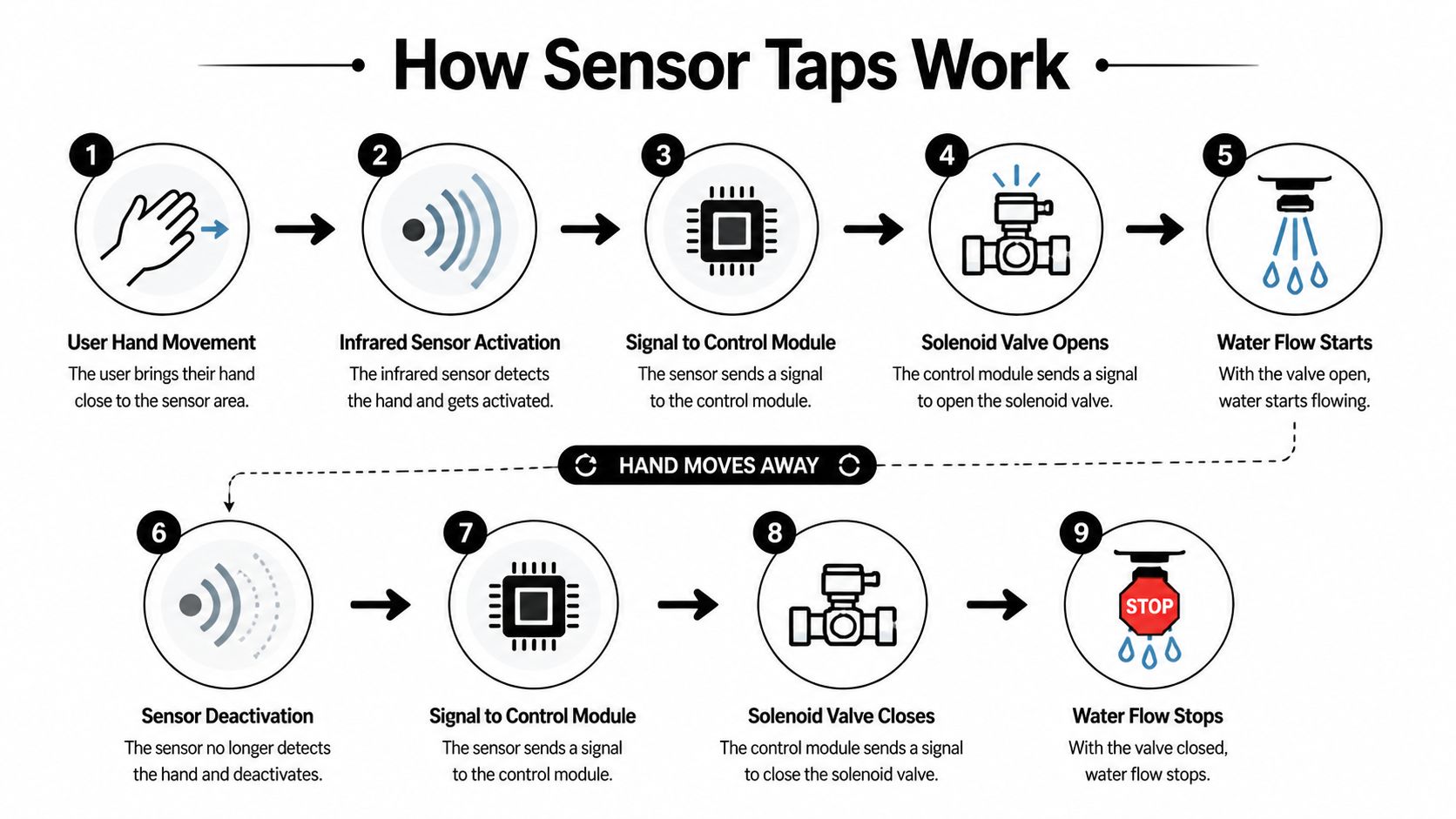
Sensor taps seem mysterious until you strip them back to their parts. They work much like automatic supermarket doors. The system detects your presence, triggers a response, and then stops when you move away.
Under the sink, it’s a straightforward chain of events. One part senses. Another part decides. Another part opens or closes the water path.
The four parts that matter
Most automatic taps are built around these core components:
Sensor
This is the tap’s “eye”. In many models, it sits near the spout and looks for hand movement in a defined zone.Control module
This receives the signal from the sensor and tells the valve what to do.Solenoid valve
Think of this as the gatekeeper. When it receives the signal, it opens to allow water through. When the signal stops, it shuts.Power source
The tap needs electricity to sense and operate the valve. That usually comes from batteries or a mains-connected transformer.
What happens when you put your hands under the spout
The sequence is usually this simple:
- Your hands enter the sensor zone: The sensor detects a change.
- The control box receives that signal: It confirms the tap should activate.
- The solenoid opens: Water begins to flow through the spout.
- You move your hands away: The sensor no longer detects presence.
- The valve closes: Water stops.
That’s why these taps feel immediate when they’re installed properly. There’s no twisting, lifting, or pushing. The response should be clean and predictable.
Hot water and mixed water
A common misunderstanding among readers is that a sensor tap doesn’t “make” hot water. It only controls flow. The actual water temperature depends on what’s feeding the tap.
In a caravan gas hot water setup, the heater warms the water first. The tap then delivers it. Depending on the tap design, temperature may be set with a side mixer, a separate blending valve, or through the plumbing underneath the sink.
Some sensor taps deliver pre-mixed water only. Others are paired with separate controls. That detail matters a lot in caravans where space and plumbing layout are tighter.
Why they’re more reliable than people expect
The technology itself isn’t exotic. Sensors, control boards, and solenoid valves have been used in commercial plumbing for years. What matters most is matching the tap to the water supply and power setup.
Common trouble starts when the wrong unit is installed on a low-pressure caravan pump, or when a mains-rated tap is expected to behave perfectly on a compact 12V system without the right supporting parts. When the tap, power source, and water feed suit each other, day-to-day use is usually very simple.
The Tangible Benefits of Going Touchless
The appeal of a sensor tap isn’t just that it looks modern. Its greater value emerges in daily use, especially when your water and energy are limited.
In a caravan, every litre and every bit of gas counts. In a home or office, people care more about cleanliness, convenience, and not leaving the tap running while they multitask. A touchless fitting helps in both situations.
Hygiene without extra effort
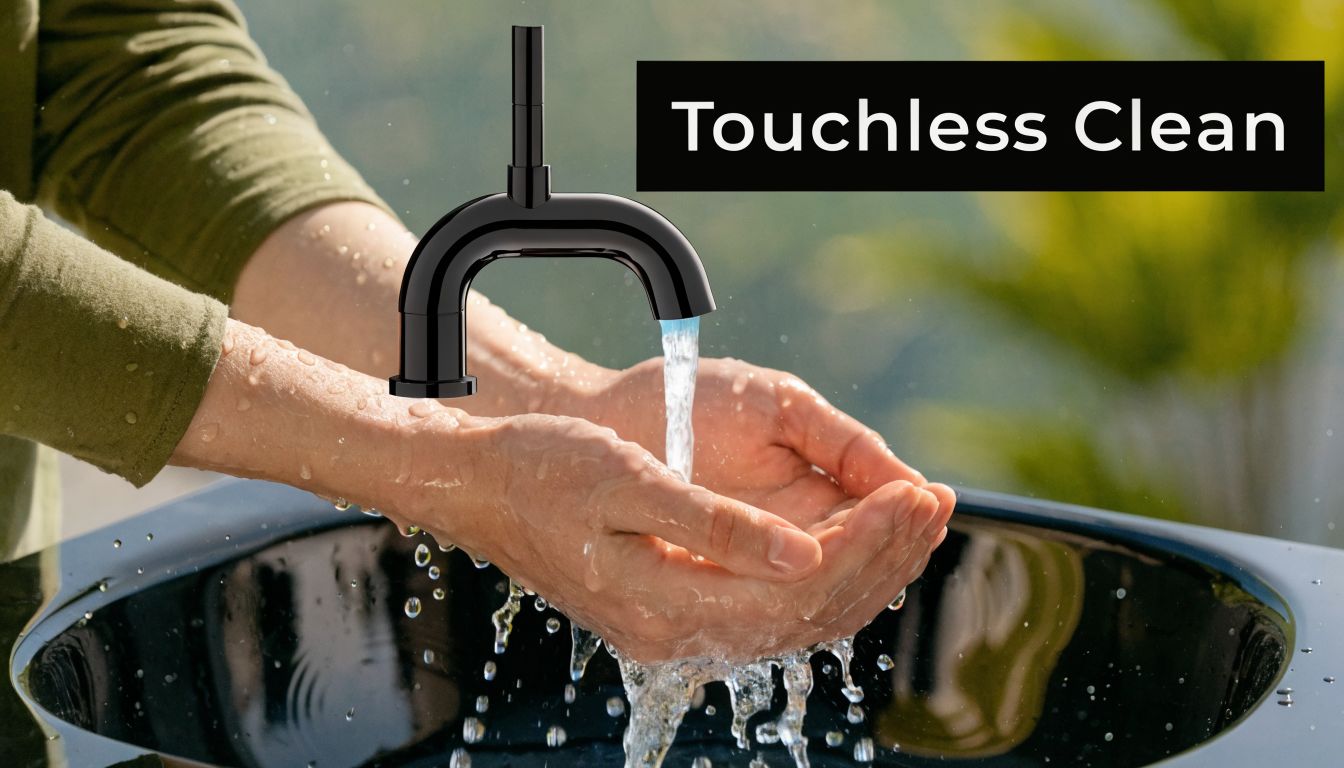
If your hands are dirty, greasy, or covered in flour, a manual tap handle becomes one more thing to clean. Sensor taps remove that step. You wash your hands, and then you walk away. There’s no final touch on a wet handle.
That’s useful in caravan kitchens, shared office spaces, and family homes where the sink gets heavy use. It’s one of those upgrades people appreciate most after they’ve lived with it for a while.
Better control of water use
Touchless taps run only when they detect use. That sounds minor until you live with a limited fresh water tank. A manual tap often gets left on while someone reaches for soap, wipes a bench, or turns to grab a dish.
Modern on-demand caravan gas hot water systems can also help on the energy side. They can reduce overall energy consumption by 30 to 50% compared to older storage models by eliminating standby heat loss, and pairing that with a water-saving sensor tap can create a more economical setup, according to this overview of gas consumption in motorhomes and caravans.
Easier for different users
Not everyone finds standard tap handles easy. Arthritic hands, reduced grip strength, or small children can all turn a simple sink into a daily annoyance. A sensor tap lowers that barrier.
A few examples make it clearer:
- For older users: There’s no twisting force needed.
- For children: Activation is simple and often more intuitive.
- For busy cooks: You can rinse quickly without touching controls.
- For workplaces: Staff don’t need to keep wiping down handles all day.
A tap upgrade isn’t only about style. In many kitchens, it changes who can use the sink comfortably and how often the area needs cleaning.
The convenience people notice first
The first thing most owners mention isn’t technology. It’s ease. Washing vegetables, filling a pot, rinsing hands mid-cooking, or cleaning up after a beach stop in the caravan all become smoother.
That convenience matters because the sink is used constantly. If a small improvement saves frustration every day, it’s usually a worthwhile one.
Choosing Your Ideal Sensor Tap Technology
Not every sensor tap detects your hands in the same way. If you’re choosing one for caravan gas hot water, it helps to know what type of sensor you’re buying and where it works best.
For most caravans and homes, the goal is simple. You want reliable activation, predictable shut-off, and no strange behaviour in a compact sink area. Commercial settings sometimes prioritise toughness and broad detection zones instead.
The main technologies
Active infrared is the widely recognized type. It sends out a beam and looks for the reflection from your hands or an object in front of the tap. It’s common because it’s accurate at close range.
Passive infrared works differently. It detects changes in heat rather than sending out its own active signal. That can suit some uses, but it’s less common for sink taps where precise near-field detection matters.
Microwave sensing uses radar-style detection. It can be very responsive, though in smaller areas it may require careful calibration so it doesn’t trigger when you don’t want it to.
Sensor Technology Comparison
| Sensor Type | How It Works | Best For | Considerations |
|---|---|---|---|
| Active infrared | Projects a signal and detects reflection from hands | Most homes, caravan galleys, office kitchens | Usually the most practical choice for close-range sink use |
| Passive infrared | Detects body heat or temperature change | Selected indoor setups with stable conditions | Can be less precise for compact tap activation |
| Microwave | Uses radar-style motion detection | Some commercial or high-use environments | Detection range may need careful tuning in tight spaces |
What suits a caravan best
A caravan sink is a particular environment. You’re dealing with short bench depth, movement, smaller splash zones, and often a mixed-use space where one sink does everything. That usually pushes the decision toward a tap that reacts only when hands are clearly where they should be.
For that reason, many buyers lean toward active infrared. It tends to suit close-up use better, and the activation area is easier to predict. That matters when the sink is next to a cooktop or when someone is moving around in a narrow aisle.
What suits a home or office better
Homes have more flexibility. If the sink is large and the cabinetry allows easy access to power and control boxes, you can choose from a wider range. Office kitchens often prioritise durability and ease of cleaning over compactness.
A few practical questions help narrow it down:
- How tight is the sink area: Smaller spaces benefit from tighter detection.
- Who uses it: A family kitchen and a staff kitchen have different demands.
- How often is it used: Higher use usually calls for simpler, proven controls.
- What powers it: Battery and mains options can affect which model makes sense.
If you want the safest starting point for a caravan, choose for predictable detection first and appearance second.
Don’t ignore the mixer arrangement
Sensor type is only half the decision. You also need to think about temperature control. Some owners expect the sensor to do everything, then realise the temperature still has to be managed elsewhere.
When we talk customers through this choice, the better conversations usually start with use patterns, not appearance. Are you rinsing hands, washing dishes, filling kettles, or building a broader filtered and specialty-water setup? Once that’s clear, the right sensor technology is easier to choose.
Installation Power and Water System Requirements
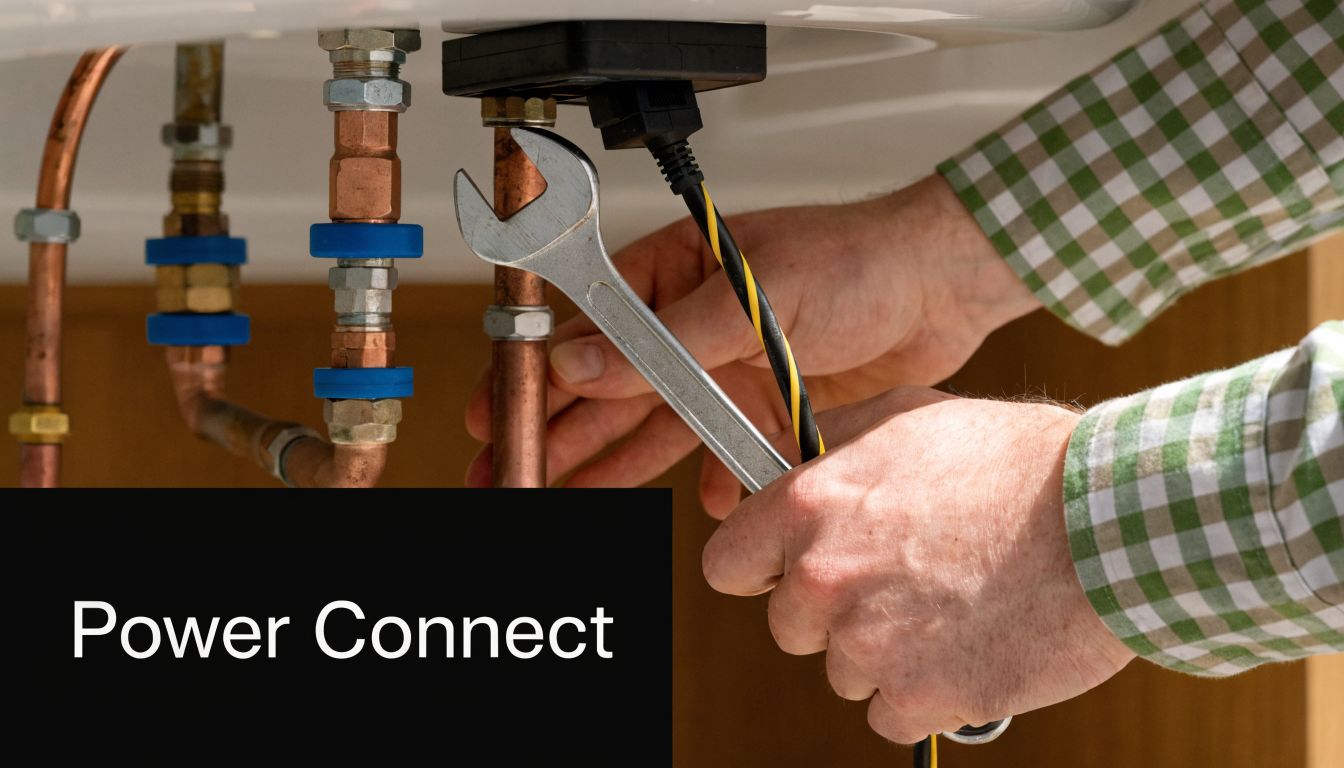
With sensor taps, a good idea either works beautifully or becomes a headache. They aren’t difficult in principle, but they do need the right power arrangement and the right water conditions.
Power options under the sink
Most sensor taps use one of two power setups.
Battery powered
These are often the easiest retrofit option. They’re handy where there’s no simple mains connection available under the sink, which is often the case in caravans. They can also simplify installation in existing homes where the cabinetry is already finished.
Battery units still need access for service. If the control box is buried behind drawers, routine maintenance becomes awkward very quickly.
Mains powered
These suit new kitchens, major renovations, and some commercial spaces. They remove the need for battery changes, but they do require proper electrical provision in the correct location.
In caravans, mains power can work in some setups, but it has to match how the van is used. If the system spends long periods off-grid, battery-backed solutions often make more practical sense.
Water supply matters more than many people realise
A sensor tap is not just a pretty spout with electronics. It has internal components that depend on stable water delivery. That’s where caravan systems differ from houses.
At home, mains pressure is generally the starting point. In a caravan, you may be feeding the tap through a pump, a tank, a pressure limiter, or a mixed arrangement depending on whether you’re free camping or hooked up in a park.
If your pump cycles badly or the flow is weak, the tap may not behave as expected. If you’re dealing with flow issues and want background reading on how to get your RV water running again, that guide is useful before you choose a tap that depends on steady delivery.
Pressure protection is not optional
Many caravan hot water heaters operate at a maximum working pressure of 850kPa and require a 350kPa pressure-reducing valve on the incoming line to prevent damage, as set out in the Suburban SW5EA and SW7EA manual. That’s one of the details professional installers check because excess pressure shortens the life of valves, fittings, and connected tap components.
This catches DIY installers out. They focus on whether the tap physically fits the hole in the sink, but not on what the incoming pressure is doing to the internals.
Fittings and caravan compatibility
Caravans also introduce fitting compatibility issues that homes don’t always have. Compact systems often rely on push-fit plumbing and small-format connections. If you’re pairing a sensor tap with a caravan pump, make sure the hoses, valves, and reducers all suit that layout.
For readers sorting out the pump side of the system, this guide to a 12 V water pump for caravan setups is a useful reference point because tap performance starts with the way water is supplied.
A sensible install checklist looks like this:
- Match the power type: Choose battery or mains based on how the sink area is built.
- Confirm flow stability: A sensor tap needs a water supply that isn’t surging or dropping away.
- Protect the plumbing: Use the correct pressure-reducing valve where required.
- Check fittings early: Caravan plumbing often uses different connectors from domestic kitchens.
- Leave service access: Batteries, control boxes, and valves should remain reachable.
For a quick visual on how plumbing access and under-sink work can play out in a compact setup, this short video is worth a look.
Integrating Boiling Chilled and Filtered Water
Once people understand sensor taps, the next question is usually whether one tap can do more than standard hot and cold. In many kitchens, the answer is yes. The tap can become the front end of a broader under-sink system.
That changes the conversation from basic tap replacement to kitchen planning. Instead of adding separate appliances across the bench, you centralise water delivery at the sink.
What a multi-function setup can include
A modern tap system may be paired with under-sink equipment that delivers:
- Boiling water: Handy for tea, coffee, cooking prep, and quick cleaning tasks.
- Chilled water: Useful in homes, offices, and hospitality spaces where cold drinking water is in constant demand.
- Filtered ambient water: A clean drinking water option without a separate countertop unit.
- Standard hot and cold water: Everyday washing and rinsing still remain part of the system.
In a home or office, this can free up bench space and reduce clutter. In a caravan, the thinking is slightly different. You’re balancing convenience against space, power, and storage, so integration has to be planned more carefully.
Where caravan gas hot water fits in
Caravan gas hot water still handles the everyday washing and showering side of the system. A specialty tap or under-sink unit can then sit alongside that core setup where space and power allow. The important thing is not to confuse the functions.
Your gas hot water service heats water for standard use. A boiling or chilled system handles specific tasks at the sink. They can complement each other, but they aren’t interchangeable.
When this upgrade makes sense
This style of setup usually suits three types of customer:
Homeowners renovating the kitchen
They want fewer appliances on the bench and cleaner lines around the sink.Office managers
They need instant hot drinks, drinking water, and a tidier staff area.Caravan owners planning a premium compact setup
They’re willing to think carefully about cabinet space, access, and how each water service will be powered.
For readers exploring that broader category, this overview of an instant boiling and chilled water tap gives a practical sense of how integrated under-sink systems are usually configured.
The most successful upgrades start with one question. What do you want the sink to do every day, not just what do you want it to look like?
Brands such as Zip and Stiebel Eltron are commonly discussed in this category because they’re well known for under-sink specialty water systems in residential and commercial settings. The important part, though, isn’t the badge on the box. It’s whether the cabinet space, power, ventilation, service access, and plumbing all suit the equipment you’re trying to combine.
Compliance Maintenance and Sourcing Pro Help in Melbourne
Gas and water upgrades are where neat ideas meet legal and safety requirements. With caravan gas hot water, that matters even more because the system travels, vibrates, and often operates in tighter spaces than a domestic installation.
Under Australian standards, gas work in caravans needs proper attention. For caravan installations, AS/NZS 5601.2 is the relevant standard, and in Victoria, incorrect DIY gas installation can lead to significant fines. This Victorian-focused caravan hot water troubleshooting guide also notes that annual gas compliance certificates issued by a licensed technician are often required.
The maintenance basics owners can handle
You don’t need to call a technician for every small check. There are a few routine tasks owners can manage safely around the tap side of the system:
- Clean the sensor lens gently: Use a soft cloth so residue doesn’t block detection.
- Watch for delayed shut-off: That can point to grime on the sensor or a valve issue.
- Check battery condition: If the tap is battery powered and becomes inconsistent, power supply is one of the first things to inspect.
- Look under the sink: Damp fittings, staining, or slow drips need attention early.
When to stop and call a licensed professional
Anything involving the gas appliance, gas line, or compliance certification belongs with a licensed person. The same applies if the water pressure arrangement is unclear or if the tap is being integrated into a more complex under-sink setup.
If you want a plain-English reminder on the importance of Gas Safe registration, that article is UK-focused in terminology, but the basic lesson still applies here. Gas work should always be handled by appropriately licensed professionals in the relevant jurisdiction.
Typical fault patterns
Most tap complaints fall into a short list:
- Tap won’t activate: Sensor window dirty, flat battery, interrupted power, or flow conditions outside the tap’s operating range.
- Tap won’t stop: Sensor confusion, sticky solenoid, or installation fault.
- Poor hot water behaviour: The issue may sit with mixing, pressure, or the heater, not the sensor itself.
For people comparing touchless options with more general kitchen upgrades, this guide to an instant hot water tap helps clarify where ordinary instant systems differ from caravan gas hot water arrangements and sensor-controlled fixtures.
This is also the one place I’ll mention that suppliers matter. Access to genuine valves, fittings, spare hoses, elements, and caravan-compatible parts makes repairs simpler, especially in Melbourne where many owners want installation and after-care from the same place that supplied the components.
Is a Sensor Tap Right for Your Caravan or Home
If you already have caravan gas hot water, a sensor tap can be a sensible next step. It won’t replace your heater. What it does is make daily water use cleaner, easier, and more controlled.
That’s especially helpful when LPG use matters. A typical caravan gas hot water system consumes around 1.3kg of LPG per hour of continuous use, so using water more carefully with a sensor tap can help extend the life of a 9kg gas bottle and reduce refuelling stops, as explained in this caravan hot water systems overview.
For homes and offices, the case is just as strong. Less mess, fewer touched surfaces, and a more capable sink area are benefits people notice straight away. For caravans, the added bonus is that better tap control suits the realities of tank water, pumps, and off-grid living.
If you’re unsure whether your current setup can support a touchless tap, that’s usually a sign to ask before you buy. The right advice at the start saves a lot of frustration later.
If you want specific advice on caravan gas hot water, touchless taps, or a combined boiling and chilled setup, talk to Ring Hot Water. The team can help you work through compatibility, fittings, pressure requirements, and installation options across Melbourne, or help you source the right parts online Australia-wide.
