
3 Way Taps
Your 3 Way Tap Kitchen Mixer Tap With Filtered Water Guide

May
A lot of kitchens end up solving one problem by creating three more. The kettle lives on the bench because it’s used all day. The filter jug takes up fridge space or sits next to the sink. Bottled water creeps in when the tap water taste isn’t quite right. Then someone starts looking at an under-sink boiler or chiller and realises the tap setup is now the thing holding the whole upgrade back.
That’s usually the point where a 3 way tap kitchen mixer tap with filtered water starts making sense. Instead of adding another little appliance or another small tap somewhere on the sink, you bring standard hot, standard cold, and filtered drinking water together into one properly integrated fixture. If you’re also planning under-sink boiling or chilled water, that single decision often determines whether the final kitchen feels clean and organised or patched together.
The Modern Solution for a Cluttered Kitchen
In plenty of Melbourne homes, the kitchen bench becomes a parking area for water gear. There’s the kettle near the powerpoint, a filter jug drying beside the sink, reusable bottles waiting to be filled, and sometimes a benchtop dispenser because nobody wants to keep buying bottled water. Offices run into the same problem. The lunchroom starts with one appliance, then another, and before long the sink area feels crowded and awkward.
A 3 way mixer tap changes that because it treats water delivery as one system, not a collection of workarounds. You keep normal hot and cold for washing up and food prep, but you also get filtered water from the same tap body. The visual difference is immediate. So is the workflow. You’re not shifting a jug, reaching past a kettle, or explaining to guests which little tap does what.
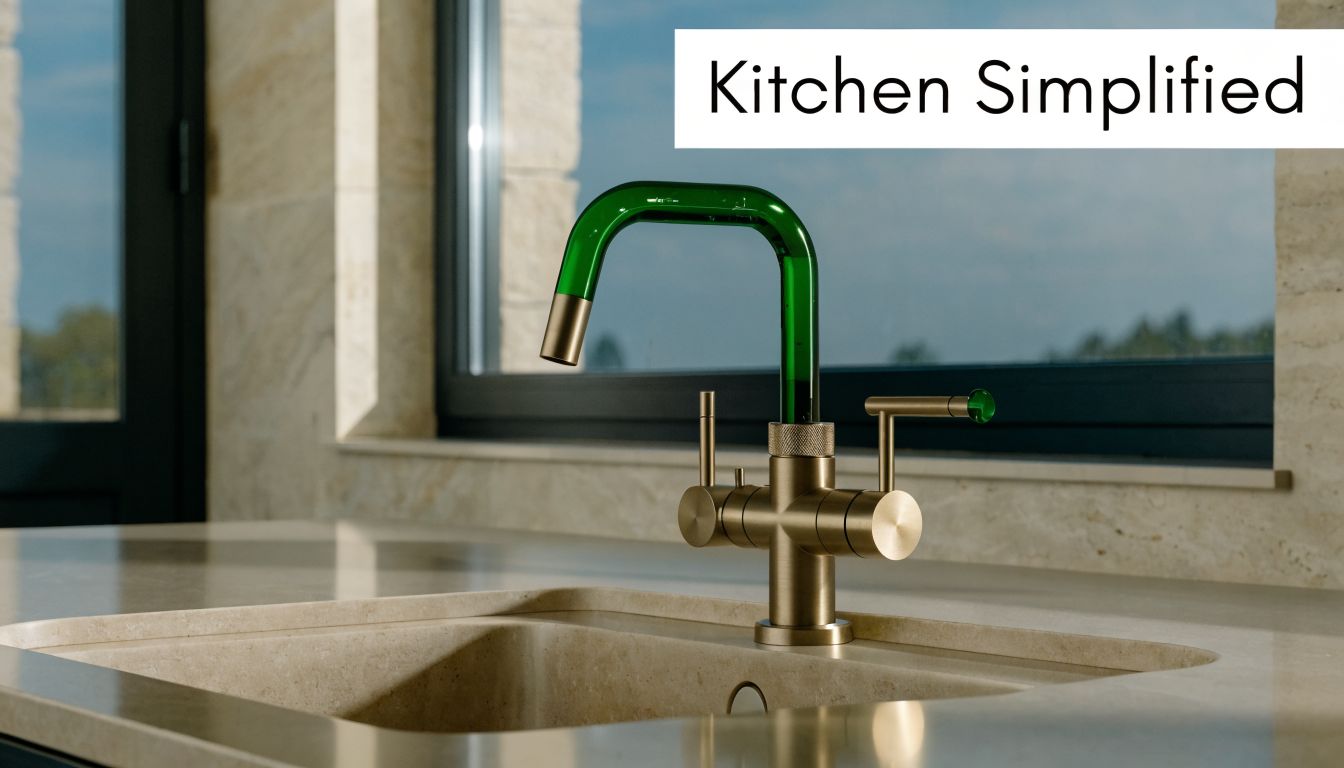
For households already considering a boiling water upgrade, the tap becomes even more important. An instant hot water tap option can remove the kettle from the bench entirely, but it works best when the rest of the plumbing layout is planned around filtration and daily sink use, not added as an afterthought.
What people usually want
Most buyers aren’t chasing novelty. They want a kitchen that works better every day:
- Less clutter: Fewer separate taps, jugs, dispensers, and benchtop appliances.
- Cleaner lines: One spout looks intentional. Extra fixtures often look retrofitted.
- Faster routines: Fill a pot, rinse vegetables, pour drinking water, all from one location.
- A better long-term setup: Easier to pair with under-sink filtration, boilers, and chillers.
A good kitchen tap doesn’t just deliver water. It removes friction from everything that happens around the sink.
Understanding the 3-Way Kitchen Tap
A 3-way kitchen tap combines standard hot and cold water with a separate filtered drinking water line in one fixture. You still get one tap body at the sink, but internally the supplies stay isolated. That is the part many buyers want clarified before they commit, especially if they are also planning under-sink filtration, a boiling unit, or a chiller.
The internal design is straightforward. One line carries mains hot water. One carries mains cold water. The third carries filtered water from the treatment system under the sink to its own outlet inside the spout. In a properly specified tap, filtered water does not pass through the same internal path as regular hot or cold.
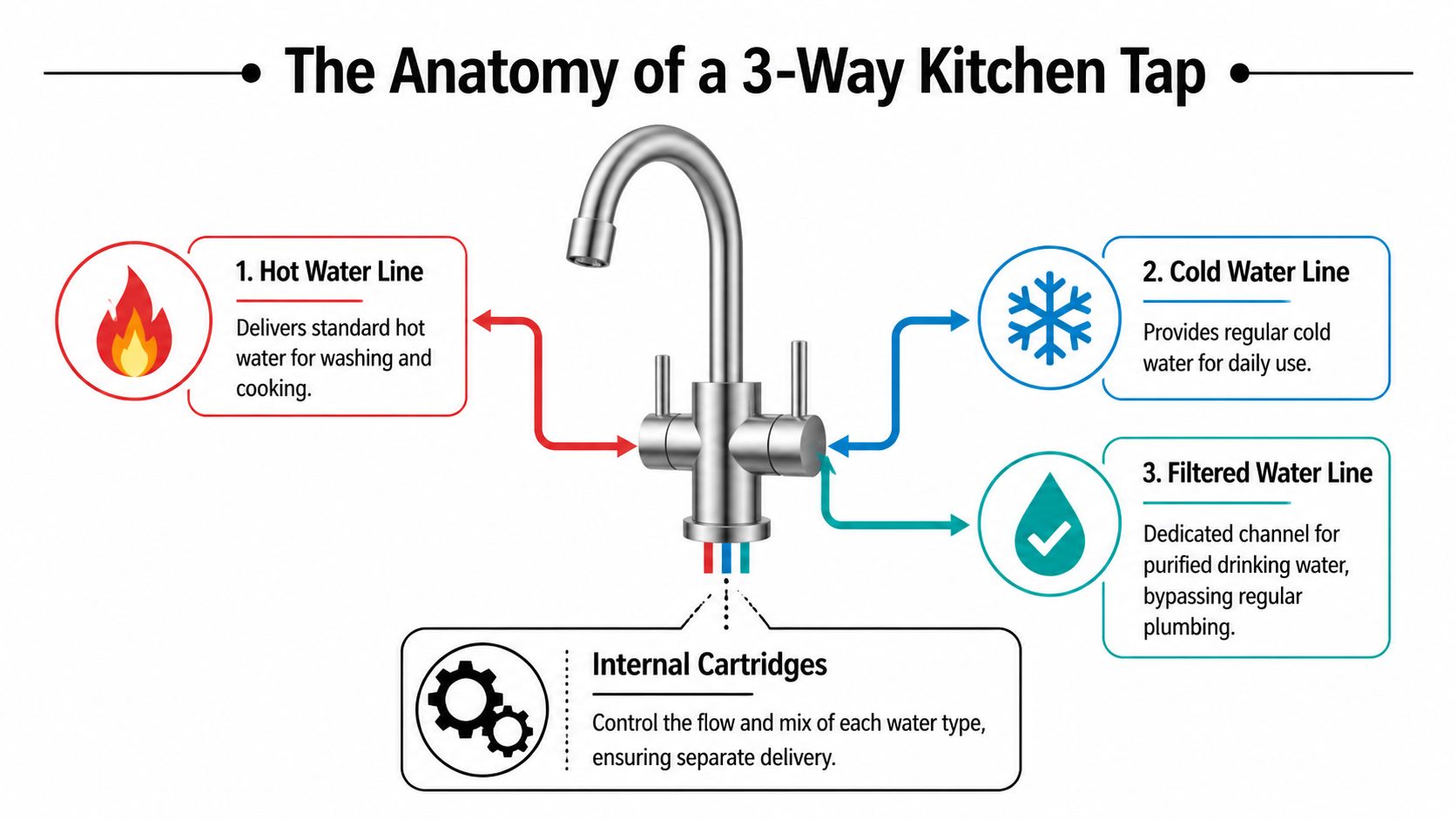
From above the bench, you see one spout. Inside the tap, the water paths remain separate.
That separation matters in real use. You can rinse dishes with mains hot water, then fill a glass or bottle with filtered water from the same tap assembly without adding a second small dispenser to the sink or stone. It also matters for system planning. If the filtered line is feeding from a carbon filter only, the tap needs to preserve taste and odour improvements. If it is connected to a more advanced under-sink setup, such as filtration paired with boiling or chilled delivery, the tap has to be matched to the pressure, temperature, and outlet design of that full system.
What each pathway does
Here is the practical breakdown:
- Hot water line: Supplies normal mains hot water for washing up, cleaning, and general kitchen use.
- Cold water line: Delivers standard mains cold water for day-to-day sink tasks.
- Filtered water line: Connects to the under-sink filter system and sends treated drinking water through its own dedicated channel.
This is why a 3-way tap suits kitchens that need more than a cosmetic upgrade. It is not only about reducing clutter. It is about combining tapware, filtration, and often future appliance upgrades into one layout that makes sense.
In Melbourne homes, that joined-up approach matters because water quality varies across suburbs and households notice different issues. Some want to reduce chlorine taste. Some are trying to cut kettle scale. Others are planning for instant boiling or chilled filtered water and want to avoid replacing the tap again later. The tap choice affects all of that, along with the ongoing cost of cartridges, servicing access under the sink, and whether replacement parts are easy to source in Australia.
Why the design works
Older setups usually force a compromise. One tap handles washing. Another small tap handles drinking water. Then a separate appliance may handle boiling or chilled water. Each extra fixture adds bench or sink clutter, another hole, and another item to maintain.
A well-designed 3-way tap simplifies that layout while keeping the supplies separate. That is why we often recommend looking at the whole under-sink arrangement before choosing the tap finish or handle style. The better decision is usually the one that fits the filtration unit, leaves enough cabinet room for future upgrades, and keeps filter changes accessible without pulling half the kitchen apart.
Practical rule: If filtered water is part of the plan, choose a 3-way tap that suits the full under-sink system you want to run, not just the tap style you like today.
Core Benefits of an All-in-One Tap Solution
The appeal isn’t just that one tap can do more. It’s that the sink becomes easier to use all day.
In a busy kitchen, convenience isn’t measured by features on a brochure. It’s measured by how many extra movements you remove. If drinking water comes from a separate jug in the fridge, someone has to refill it. If boiling water depends on the kettle, someone has to wait. If filtered water needs its own small tap, you’ve added another fixture to clean around and another hole in the bench or sink.
Convenience that holds up in daily use
An all-in-one tap setup works well because it matches how people move in a kitchen. One person rinses produce. Another fills a bottle. Someone else is washing mugs. There’s less confusion because the sink remains the single water station instead of becoming part sink, part appliance zone.
This is just as useful in an office kitchen as it is at home. Staff don’t need to ask whether the water from the jug is fresh, whether the kettle’s been left on, or which dispenser does what. A neater setup usually gets used properly because it feels obvious.
Better use of bench space
Benchtop space is expensive in practical terms, even if no one thinks of it that way. Every jug, kettle, or water appliance claims room near the sink or powerpoint. Once they spread out, prep space shrinks and the kitchen starts looking busier than it needs to.
A 3-way tap helps because it removes visual duplication. You don’t have a main mixer plus a separate filtered tap competing for the same area. If the kitchen is being renovated, this often supports a much cleaner final look.
Where the difference is most noticeable
- Small kitchens: Less hardware around the sink makes the whole room feel less cramped.
- Family kitchens: One central tap setup simplifies school bottles, cooking, and cleanup.
- Office lunchrooms: Fewer loose appliances means less mess and fewer points of failure.
- Entertaining areas: A single sleek fixture looks more deliberate than add-on solutions.
Filtered water where you actually need it
Filtered water is most useful when it’s the easiest option, not the backup option. If it takes more effort to access than regular tap water, people stop using it consistently. Integrated filtered water changes that. It’s right at the main sink, where glasses, bottles, kettles, saucepans, and cooking prep already happen.
For households trying to reduce bottled water use, this matters. The system only works if it fits normal habits.
A quieter kind of upgrade
Some kitchen upgrades are obvious. Others improve the room by removing small annoyances. This falls into the second category.
You don’t stand in front of a 3-way tap admiring its complexity. You notice that the bench is clearer, the sink area is easier to clean, and the water setup finally feels thought through.
Integrating Your Tap with Filters Boilers and Chillers
A 3-way tap becomes far more useful when you stop viewing it as a stand-alone tap and start viewing it as the visible control point for an under-sink water system. That’s where most of the value sits. The tap on the sink is only one part. The filter, any boiling unit, any chiller, the tubing runs, the isolation valves, and the available cabinet space all have to work together.
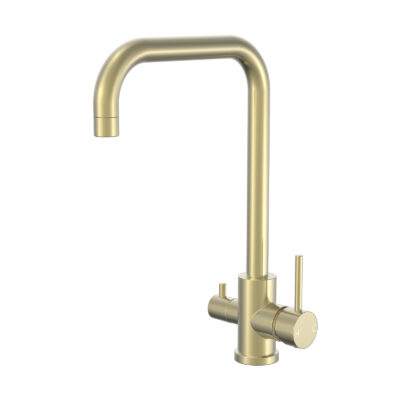
The tap is the front end of a larger system
In the simplest installation, the 3-way tap connects to hot mains, cold mains, and an under-sink filter. That already gives you a cleaner sink layout than a separate mixer plus a separate filter tap.
Things get more interesting when the filtered line feeds from a more complete setup. In some kitchens, filtered water is supplied through a dedicated cartridge filtration system. In others, the filtered side is paired with an under-sink boiling unit, a chiller, or both, depending on how the kitchen is used.
A few combinations seen regularly in Melbourne homes and workplaces include:
- 3-way tap plus under-sink filter: A straightforward drinking water upgrade without changing how standard hot and cold are used.
- 3-way tap plus boiling unit: Useful where the goal is to reduce kettle use and speed up tea, coffee, and cooking prep.
- 3-way tap plus chiller: Common in offices, break rooms, and homes that want cold filtered water on demand.
- 3-way tap plus boiling and chilled system: Best suited to users who want one integrated water station rather than separate appliances.
Compatibility matters more than brand names
People often start by choosing a brand first. In practice, the better starting point is compatibility. The tap, filter head, tubing size, pressure requirements, and available under-sink footprint all need to be checked before anything is ordered.
That’s especially true when mixing components from different systems. Many under-sink units can be made to work together, but that doesn’t mean every combination is tidy, serviceable, or sensible. A plumber or specialist usually looks at four things first:
| Checkpoint | Why it matters |
|---|---|
| Cabinet space | Boilers, chillers, filters, and pipework all need room for installation and future servicing. |
| Access to isolation valves | Maintenance becomes much easier when units can be shut off without dismantling half the cabinet. |
| Routing for tubing | Tight bends, crowding around bins, and rubbing against sharp cabinet edges cause problems later. |
| Service access | Filters and cartridges need to be changed without removing the whole system. |
A common mistake is planning the system around what fits on paper, not what can be accessed once the unit is in place beside waste pipes, cleaning products, and pull-out bins.
Total cost of ownership is where most guides fall short
This is the part many buyers don’t get straight answers on. Upfront tap cost is only one piece of the decision. The long-term cost of ownership matters too, especially the replacement schedule for filters and the maintenance demands of the under-sink equipment.
A useful point raised in 2 Magpies’ discussion of 3-way filter taps for Australia is that many guides focus on convenience and appearance but provide very little Australian-specific guidance on filter replacement frequency, annual running cost, or how water conditions in places like Melbourne can affect filter life. That gap matters because it’s difficult to compare a 3-way filtered tap with a separate boiling or chilled system if you only look at purchase price.
Buyers usually underestimate maintenance when they compare systems. Not because maintenance is excessive, but because no one explains it clearly at the start.
What Melbourne conditions can change
Melbourne water conditions vary by area, and mineral content can affect how cartridges and tap internals age over time. That doesn’t mean integrated systems are a bad idea. It means the system should be chosen with local use in mind.
As a general rule, households should ask about:
- Filter replacement access: Can the cartridge be changed easily inside the existing cabinet?
- Sediment and mineral exposure: Will the chosen filtration setup cope well with local supply conditions?
- Appliance heat load: If a boiling unit is installed, is there enough ventilation around it?
- Usage pattern: A family kitchen, office kitchenette, and hospitality prep area all place very different demands on the same hardware.
For readers comparing filtration methods more broadly, this SouthRay Kitchen & Bath guide to RO is a useful background read on how reverse osmosis systems work and where they fit relative to other under-sink options.
Later in the planning stage, it also helps to speak with someone who handles actual installations rather than only product sales. A local water filter installation service in Melbourne is useful because they can look at the cabinet, waste layout, and intended equipment together instead of treating the tap as a separate purchase.
A supplier in this space may offer compatible tapware such as a 3-way mixer that combines mains hot, mains cold, and filtered water through separate internal channels, alongside under-sink systems from brands like Zip, Stiebel Eltron, Boiling Billy, and others. The right choice depends less on the logo and more on whether the whole system remains easy to install, service, and live with.
A quick visual reference helps if you’re still picturing how these systems sit together beneath the sink:
How to Choose the Right 3-Way Mixer Tap
A 3-way tap can look good in a product photo and still be the wrong tap to live with. The buying decision gets easier when you ignore the marketing language and assess the tap the same way a plumber would. Start with what it’s made from, how it operates internally, how it fits your sink use, and whether parts will still be available when something eventually needs service.
Internal quality matters more than surface finish
Finish catches the eye first. Cartridge quality usually determines whether the tap stays pleasant to use.
Advanced mixer taps use ceramic disc valves, which are regarded as the longest-lasting and most leak-proof valve systems available, and the single handle regulates both flow and temperature by controlling the proportion of hot and cold water entering the mixing chamber, as outlined in the Wikipedia overview of a tap valve). Compared with older rubber washer systems, ceramic discs are a meaningful quality indicator, especially in places where mineral buildup can punish cheaper internals.
If I’m checking a tap for long-term use, I care more about the cartridge and body construction than whether the brochure says “designer finish”.
A simple buyer’s checklist
Use this when comparing taps side by side:
- Body material: Solid brass bodies generally feel more substantial and hold up better than lightweight alternatives.
- Ceramic disc internals: A strong sign that the manufacturer hasn’t cut corners on the working parts.
- Filtered water control: Make sure the filtered function is intuitive. If guests can’t work it out, the design isn’t as clever as it looks.
- Spout clearance: Check whether the height and reach suit stock pots, tall bottles, and large pans.
- Swivel movement: Important for double bowls, island sinks, and busy prep areas.
- Parts support: Ask whether replacement cartridges, hoses, and fittings are available locally.
Spout shape changes usability
A high gooseneck looks elegant, but the key question is whether it makes sink tasks easier. For many kitchens, it does. It gives more room for rinsing trays, filling pasta pots, and manoeuvring bulky cookware.
Square spouts and low-profile designs can work well too, particularly in tighter contemporary kitchens. The trade-off is usually clearance and splash behaviour. What looks sharp in a showroom can become annoying with a deep sink and large frying pans.
A practical comparison
| Tap feature | Usually works well for | Watch for |
|---|---|---|
| High gooseneck spout | Filling tall pots, large family kitchens, flexible sink use | Can overpower a very compact sink area |
| Square modern spout | Minimalist kitchen designs | Less forgiving clearance for oversized cookware |
| Pull-out style concepts | Multi-task prep zones | More moving parts can mean more maintenance |
| Compact fixed spout | Smaller sinks and secondary kitchenettes | Less reach and less working room |
Don’t treat warranty and support as fine print
Two taps can look almost identical online and perform very differently once they’ve been in service for a while. The difference often shows up later, when a cartridge fails or a fitting starts weeping and you need a matching part.
That’s why it’s worth buying through suppliers that also understand the filtration side of the job. If you’re comparing options for a filtered setup, reviewing a local range of under sink water filter options in Melbourne can help you match the tap to the system rather than buying each component in isolation.
Workshop view: A premium tap isn’t just one that looks heavier. It’s one that can still be serviced properly years after installation.
Planning Your Installation and Maintenance
Most homeowners can tell whether a tap will look right in the kitchen. Fewer can see the hidden installation issues until the cabinet doors are open. That’s where projects either stay simple or become frustrating.
The basic requirement is straightforward. A 3-way tap needs connections for mains hot, mains cold, and filtered water. But once you add an under-sink filter, boiling unit, or chiller, you also need enough space to mount equipment securely, route tubing neatly, and leave access for future servicing.
What to check before installation day
Under the sink, these are the first things to inspect:
- Usable cabinet space: Not just empty volume, but serviceable space around bins, traps, and stored items.
- Tap hole suitability: Some replacements can use the existing opening. Others may need a different configuration.
- Isolation valves: You want easy shutoff access for maintenance and repairs.
- Power availability: Required for many boiling and chilled units.
- Ventilation and heat management: Important when a boiler sits inside a confined cabinet.
If the cabinet is already crowded with a pull-out bin, disposal unit, cleaning caddy, and awkward trapwork, the neatest solution on paper can turn messy quickly.
DIY versus licensed plumber
There’s a big difference between changing a basic mixer and installing a full filtered, boiling, or chilled water setup. Confident DIYers may be comfortable with simple cartridge swaps or basic maintenance, but installation crosses into another category once you’re dealing with water supply connections, under-sink appliances, and the need to avoid leaks in a closed cabinet.
A licensed plumber is the safer call when:
- The tap is part of a full under-sink system, not just a stand-alone fixture.
- The cabinet layout is tight, making routing and future service access more difficult.
- A boiling or chilled unit is involved, which adds complexity and setup requirements.
- You want the installation checked as a whole, including pressure behaviour, fitting security, and leak testing.
Ongoing maintenance that actually matters
The good news is that most systems don’t need constant attention. They need sensible attention.
A simple maintenance rhythm looks like this:
- Wipe the tap body regularly: Use a soft cloth and a finish-safe cleaner. Harsh abrasives shorten the life of decorative coatings.
- Watch the handle feel: If operation becomes stiff or rough, don’t force it. That’s often an early sign that service is needed.
- Replace filters on the correct schedule: Follow the specific system guidance rather than waiting for taste changes alone.
- Check under the sink occasionally: Look for slow drips at fittings, signs of cabinet moisture, or tubing under strain.
If a filter change is awkward enough that you keep putting it off, the installation wasn’t planned well enough in the first place.
The real maintenance trap
The biggest issue isn’t usually the filter itself. It’s poor access. I’ve seen plenty of under-sink layouts where the equipment technically fits, but every service job requires removing half the cabinet contents and twisting around the waste pipe just to reach the cartridge.
That’s why install quality matters as much as product choice. A well-planned system is easier to own because the maintenance tasks are realistic. You can get to the parts that need attention. You can isolate the unit. You can change a filter without turning it into a weekend project.
Local Tap Installation and Support in Melbourne
For Melbourne buyers, the practical question isn’t only which tap to choose. It’s who can help if the system needs to be installed properly, repaired later, or matched with the right fittings from the start.
That local support matters more with integrated systems than with ordinary tapware. A 3-way tap may connect to filters, under-sink boiling tanks, chillers, or a broader drinking water setup. If one part isn’t compatible or serviceable, the whole sink arrangement suffers. Local knowledge helps when cabinet space is tight, water quality varies by suburb, or an existing system needs to be upgraded rather than replaced outright.
In Melbourne’s west, including Sunshine, Yarraville, and Footscray, there’s value in dealing with a specialist that handles more than one part of the chain. That means supply, installation, repairs, maintenance, and access to genuine spare parts. It also means support for brands commonly found in local homes and workplaces, including Zip, Stiebel Eltron, Boiling Billy, Birko, Insinkerator, Crown, Kwikboil, Everboil, Everchill, and Robatherm.
For tradespeople and property managers, parts access is just as important as the initial install. John Guest fittings, brass threaded fittings, valves, elements, thermostats, flexible hoses, and other service items keep systems running without improvised fixes.
Your 3-Way Tap Questions Answered
Can I install a 3-way tap myself
If it’s a simple tap replacement, some handy homeowners may be tempted. Once filtration, boiling units, or chillers are part of the job, a licensed plumber is the sensible option. The risk isn’t only getting the tap connected. It’s ending up with poor access, minor leaks inside the cabinet, or a setup that becomes hard to service later.
How often do filters need replacing
That depends on the filter type, household use, and local water conditions. The important point is to treat replacement as part of ownership, not an optional extra. In Melbourne, it’s worth discussing local supply conditions and usage habits before choosing a system, because those factors affect how practical the long-term running cost will feel.
Is the filtered water as good as a separate filter tap
In a proper 3-way design, filtered water travels through its own dedicated line inside the tap assembly. The convenience advantage is obvious. You get integrated filtered water without adding a second visible tap to the sink.
Will a 3-way tap reduce water pressure
Not necessarily. Pressure behaviour depends more on the overall system design, the filter setup, and the condition of the plumbing than on the idea of a 3-way tap itself. A well-matched system should feel normal in everyday use.
Where can I read general plumbing FAQs before I commit
If you want a broader consumer-friendly reference on common installation concerns, these plumbing service frequently asked questions are a useful companion read before speaking with an installer.
If you’re weighing up a 3 way tap kitchen mixer tap with filtered water, Ring Hot Water can help you compare the tap, filtration, and under-sink system as one integrated setup rather than three separate purchases. That’s often the difference between a kitchen upgrade that looks tidy on day one and one that still works smoothly years later.

