
Boiling Hot Water
Instant Boiling and Chilled Water Tap The Complete Guide
Apr
If your kitchen bench is crowded with a kettle, water filter jug, soda bottles, and whatever else didn’t fit in the cupboard, you’re not alone. In offices, the version is usually worse. A tired urn in the corner, a fridge full of bottles, and someone always waiting for hot water while the morning rush builds.
That’s usually the point when people start looking at an instant boiling and chilled water tap. Not because it’s trendy, but because it solves a cluster of everyday annoyances in one move. You get boiling water for tea, coffee, cooking, and cleaning. You get chilled filtered water without opening the fridge. You clear bench space. You cut down on the small delays that make a kitchen or staff room feel clunky.
The part most websites skip is what ownership in Melbourne looks like. The tap itself is only one part of the decision. Water quality, under-sink space, servicing, filter changes, and installation conditions matter just as much as the finish on the spout. If you ignore those details, a premium system can become an expensive frustration.
The End of the Kettle A Modern Kitchen Upgrade
A kettle made sense when it was the simplest option. It still works, but it creates friction all day. You fill it, wait for it, reboil it, and leave it on the bench because it’s used too often to put away. Then you still need cold drinking water from the fridge or a separate filter system.
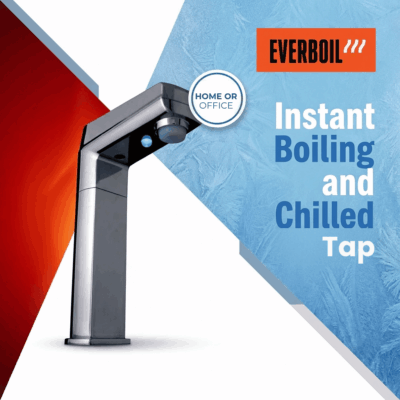
An instant boiling and chilled water tap removes that stop-start routine. The tap sits where you already work, and the heavy lifting happens under the sink. That changes how the kitchen feels. Less clutter. Fewer appliances. Less waiting.
What changes day to day
At home, the biggest shift is speed. You stop planning around the kettle. Pasta water starts faster. Tea is immediate. A glass of cold filtered water is there without rummaging through the fridge.
In workplaces, the benefit is less about luxury and more about flow. Staff don’t queue around a kettle or keep topping up an urn. Hospitality venues also value consistency. Quick service matters, but so does having water ready when demand spikes.
Practical rule: If you use hot and cold drinking water many times every day, a dedicated tap usually improves the room more than another benchtop appliance ever will.
Why people replace more than a kettle
Most buyers start by thinking they’re replacing one appliance. In reality, they’re often replacing several habits at once:
- Boiling water on demand means no repeated kettle cycles.
- Chilled filtered water reduces reliance on bottled water and fridge storage.
- One permanent fixture frees up bench space in smaller Melbourne kitchens.
- Cleaner kitchen lines suit renovations where visual clutter matters as much as function.
That doesn’t mean it’s right for every property. If you rarely drink tea or coffee, have limited cabinet space, or don’t want ongoing maintenance, a simpler setup may suit you better. But for households and offices that use water constantly, this upgrade earns its place quickly because it changes routine, not just appearance.
How an Instant Water Tap Actually Works
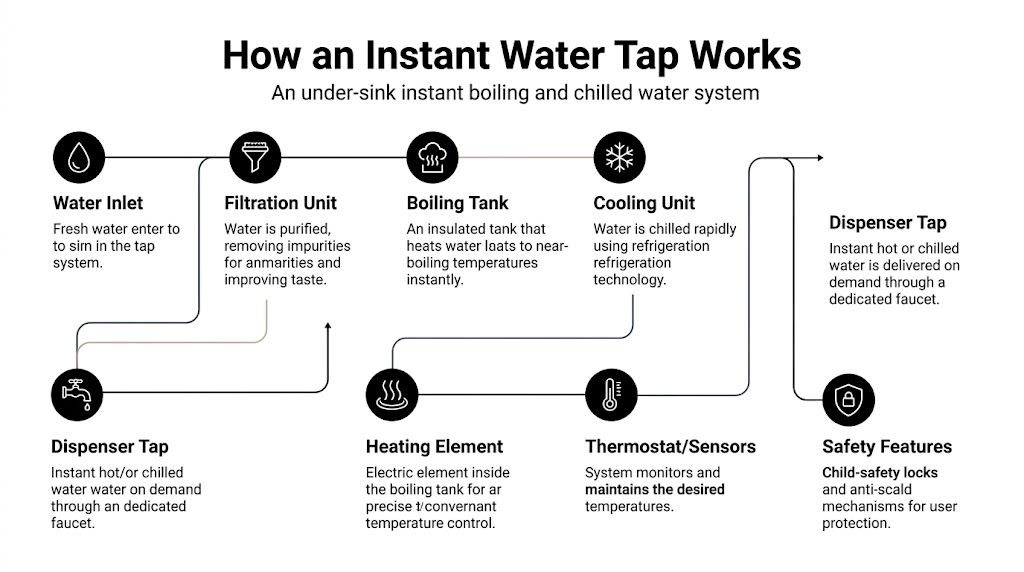
Under the bench, an instant boiling and chilled water tap works like a personal waterworks system. Fresh mains water enters the unit, passes through filtration, then splits into separate paths for heating and chilling. The tap on the sink is only the visible part. The core engineering sits in the cabinet below.
That matters because good systems provide more than heated and cooled water. They manage temperature, flow, recovery, and safety in a compact space that has to perform every day without turning your cabinet into a service headache.
The main parts under the sink
Most systems are built around a few core components:
Inlet and filtration
Mains water feeds into a filter cartridge before it reaches the heating or cooling sections. That improves taste and helps protect the internal components from sediment and scale.Boiling tank
This is an insulated tank that keeps water near boiling and ready to dispense. Better systems hold temperature accurately and recover fast after use.Chilling unit
This cools filtered water and stores chilled water ready for use. Depending on the system, it may use water-cooled or air-cooled technology.Control and safety hardware
Sensors, thermostats, valves, and safety locks manage temperature and dispensing so the unit performs safely in homes and shared workplaces.
Why the better systems use less power
A lot of buyers assume a kettle must be cheaper to run because it’s familiar. In practice, the answer depends on how often you use hot and cold water. In Victoria, where residential electricity prices average AUD 0.35 to 0.45 per kWh, efficiency matters more than many people expect. Billi states that its systems use heat exchange technology to preheat incoming cold water with residual boiler heat, reducing energy input by up to 30% compared with traditional electric urns. The same overview says its water-cooled chilling setup cuts compressor runtime by 40 to 50% and keeps water wastage to under 1L per hour versus 5 to 10L per hour in air-cooled alternatives, with estimated annual energy savings of AUD 150 to 300 for moderate use in Melbourne homes (Billi’s overview of instant boiling and chilled taps).
The important point isn’t just the number. It’s the design logic. Better systems reuse heat, minimise waste, and avoid running harder than they need to.
A well-designed under-sink system isn’t just faster than a kettle. It’s built to avoid the repeated energy waste that comes from heating and cooling water the hard way.
Filtration isn’t an extra
People often think of filtration as a nice add-on. In Melbourne, it’s part of the core system decision. Filtered water tastes better, but filtration’s role in protecting the unit itself is even more valuable.
If the water entering the boiler carries sediment or scale-forming minerals, components wear faster and performance drifts. You may first notice it as slower flow, temperature inconsistency, or more frequent servicing. In harder water areas, the filter and maintenance plan are part of the installation decision from day one, not something to think about later.
What happens when you turn the handle
The user experience is simple because the internal process is not. When you activate boiling water, the system draws from the heated reservoir rather than starting from cold like a kettle. When you ask for chilled water, it draws from stored cooled water or a chilled reserve depending on the design.
That’s why these taps feel immediate. The unit has already done the work in the background. The better the internal engineering, the less you notice it, and that’s exactly how it should be.
Are They Worth The Investment A Look at Pros and Cons
The short answer is yes for some buyers, no for others. That’s the honest view. An instant boiling and chilled water tap makes strong sense when you use it heavily, value bench space, and want one built-in solution instead of several separate appliances. It makes less sense if your usage is light or you want the cheapest possible setup now, regardless of maintenance later.
Marketing usually leans too hard on convenience. Convenience is real, but it’s not the whole case. The better question is whether the system fits the way your home or workplace uses water every day.
Where the value shows up
At home, the value usually appears in routine. Frequent tea and coffee drinkers notice it first. Families notice the clear bench and the reduction in appliance clutter. Renovators often care just as much about the cleaner finish as the function.
For offices and hospitality, the argument is usually operational. A kettle feels harmless until it’s used repeatedly across the day. The same goes for an urn left running because nobody wants to wait when demand hits. Marketing often skips hard local comparisons, but it’s fair to say that with rising Australian power costs, an insulated instant tap with low standby power can use less energy daily than boiling a full kettle several times, and replacing an always-on commercial urn can improve return on investment while cutting wasted energy in Melbourne workplaces (Zip Water’s discussion of instant filtered systems).
The trade-off most buyers underestimate
The upfront spend is only one part of ownership. The bigger issue is whether the buyer has planned for the full setup. That includes cabinet space, power access, water line position, and ongoing servicing.
If those basics are right, the system usually operates smoothly. If they’re wrong, the install gets awkward and the long-term ownership cost goes up.
| Instant Boiling & Chilled Tap Pros vs. Cons | |
|---|---|
| Pros (The Benefits) | Cons (The Considerations) |
| Bench space comes back because the kettle, filter jug, and some bottled water storage can disappear. | Upfront cost is substantial compared with a standard mixer and kettle. |
| Hot and cold filtered water is immediate, which suits busy households and shared kitchens. | Professional installation is usually required, especially for warranty protection and safe setup. |
| Energy use can be more controlled than repeated kettle boils or always-on urn use in the right setting. | Filters and servicing are ongoing, not optional if you want reliable performance. |
| Safety features can be better than a kettle on the bench, especially with child locks and controlled dispensing. | Under-sink space is needed, and some cabinets simply aren’t ideal. |
| A neater kitchen or staff room often improves how the whole space works. | Water quality affects maintenance, so some Melbourne properties need more attention than others. |
Who usually gets the best return
These systems generally work best for:
- Busy households that use hot drinks, cooking water, and cold drinking water throughout the day.
- Office kitchens where many people need fast access without queueing.
- Hospitality spaces that want speed and a cleaner service area.
- Renovation projects where appearance and function carry equal weight.
They’re less compelling when usage is occasional, cabinet space is very limited, or the buyer isn’t willing to keep up with filters and service intervals.
Buy the system for the way you live or work now, not for the version of the kitchen you imagine you’ll use later.
Planning Your Installation in a Melbourne Kitchen
Most installation problems are predictable. They usually come from assumptions. People assume the unit will fit, the cupboard has enough airflow, the old plumbing will be fine, or there’s a power point somewhere nearby. Sometimes that’s true. Often it isn’t.
A proper site check solves that before anything is ordered. If you’re still weighing up options, it helps to understand the practical side early. This overview of an instant hot water tap installation shows the sort of planning points that matter before the tap goes in.
Check the cabinet first
The tap on top may look compact, but the under-sink unit needs a sensible amount of room around it. The issue isn’t just whether the components can physically fit. You also need access for filters, hoses, and future servicing.
Look for these basics:
- Clear floor space inside the cabinet so tanks and filters don’t crowd each other.
- Access to the front and sides for cartridge changes and plumbing checks.
- Enough room for normal use so you’re not giving up the entire sink cupboard to one appliance.
A cramped install usually costs more in labour and becomes annoying later.
Ventilation and heat matter
Chilled and boiling systems generate heat under the bench. If warm air gets trapped, performance suffers and the cabinet becomes a poor environment for the equipment.
Some kitchens need venting adjustments or a more careful layout. This matters even more when the cupboard already contains bins, cleaning products, or tightly packed storage. Good installation is partly about appliance placement, not just pipe connections.
If the unit can’t breathe, it won’t perform the way the brochure suggests.
Plumbing and power requirements
Most Melbourne homes have the basics needed for installation, but older properties can surprise you. Common checks include an accessible cold water line, suitable isolation, and a clean route for hoses and drain arrangements where required.
Power is another simple but important point. The unit needs an appropriate power connection within reach. Extension leads and improvised electrical work have no place under a wet cabinet.
A practical installation checklist usually covers:
Bench readiness
The tap location must suit use, reach, and clearance above the sink.Cold water connection
The unit needs a proper feed, not a makeshift tee hidden behind clutter.Electrical access
Safe local power is part of the job, not an afterthought.Service access
Filters need changing and components may need inspection later.
Why licensed installation matters
A boiling tap isn’t the place for guesswork. The install affects safety, warranty, performance, and lifespan. A licensed plumber will check pressure, fit the system correctly, and make sure the kitchen still works around it.
For offices and hospitality sites, professional installation matters even more because downtime costs more than the labour saved by trying to cut corners. If the tap is part of your daily workflow, it needs to be set up cleanly from the start.
Choosing Your System Top Brands and Key Features
Brand matters, but not in the way most buyers think. The logo on the box matters less than the match between the system and the job. A small household, a busy office kitchen, and a hospitality prep area don’t need the same thing.
That’s why comparing features properly is more useful than comparing taglines.
Start with the water options you’ll actually use
Some buyers want only boiling and chilled. Others also want ambient filtered or sparkling. The mistake is paying for a feature set that looks impressive but won’t be used.
Billi and Zip are common choices when buyers want a premium integrated setup. Other names people compare include Stiebel Eltron, InSinkErator, Boiling Billy, and commercial-style boiling water units where design matters less than output. Ring Hot Water supplies and services systems across these categories, including under-sink boiling taps and related chillers, but the right choice still comes down to usage pattern and site conditions rather than brand loyalty.
Capacity changes the user experience
In a home, modest output may be fine. In an office, recovery speed matters far more. If several people draw boiling water back to back, an undersized unit becomes frustrating quickly.
Premium engineering can earn its keep. Zip states that its Power-Pulse Technology keeps boiling water within 0.22°C of the setpoint, typically 98°C, and that standard 35mm bench hole compatibility can help plumbers complete installation in around 2 to 3 hours. The same specification highlights childproof safety locks as an important feature for family settings (Zip HydroTap product specification).
That sort of precision matters more in shared kitchens and hospitality than many buyers expect. Tea, coffee, and food prep all feel more consistent when the water doesn’t sag in temperature after the first couple of uses.
Compare the features that affect ownership
Don’t just compare finishes. Compare the points that shape daily use and future servicing.
Dispensing style
Some taps use levers, some push buttons, some electronic controls. What feels sleek in a showroom can feel awkward in a busy kitchen.Safety controls
Child locks and deliberate boiling-water activation are essential in homes with kids and sensible in workplaces too.Filtration format
Easy-to-replace cartridges make long-term ownership simpler. Hard-to-access filters usually become neglected filters.Tap finish and form
Chrome, black, and brushed metallic finishes all have their place, but make sure the look suits the rest of the kitchen, not just the tap display.
A chilled-water-focused setup is often worth considering separately too, especially if boiling isn’t the main priority. This guide to an under sink water chiller is useful when you’re comparing mixed-use systems against dedicated cooling options.
A video can also help you judge form factor and operation before you commit:
A simple way to narrow the shortlist
Ask four direct questions:
- How many people will use it every day
- Is chilled water as important as boiling water
- Do you want the tap to blend in or stand out
- Are you prepared for routine filter and service work
Those answers usually narrow the field faster than any showroom demo.
Understanding Maintenance and Long-Term Costs
The biggest myth in this category is that once the tap is in, you can forget about it. You can’t. An instant boiling and chilled water tap is reliable when it’s maintained. Left alone indefinitely, it becomes less efficient, less pleasant to use, and more likely to need repair.
This is the part many marketing pages rush past. They focus on the first week of ownership. Real buyers need to think about year two, year five, and beyond.
Filters are part of the running cost
Filter changes aren’t optional. They affect taste, flow, and internal protection. The replacement interval varies with local water quality, and that matters across Melbourne because water conditions aren’t identical from suburb to suburb.
The broad rule is simple. If your water carries more sediment or contributes to scale, the filter and service schedule become more important. The same applies to homes that use the system heavily every day. If you’re checking replacement options, this overview of Zip filter replacement gives a practical starting point for what’s involved.
Descaling is where many owners fall behind
Boiling systems don’t like neglect. Hard water areas may need more frequent descaling, and that’s one reason long-term costs vary between properties. A buyer in one suburb may have a fairly simple maintenance pattern, while another with harder water may need a more hands-on service routine.
The important thing is to expect this upfront. Installation complexity and ongoing maintenance costs are often poorly explained in marketing, yet filter replacements, descaling, and the question of whether DIY work affects warranty are central parts of ownership in Melbourne homes (discussion of maintenance gaps in water dispenser marketing).
A premium tap still needs ordinary maintenance. Price doesn’t cancel scale, sediment, or worn consumables.
What owners can watch for
Not every issue means a major fault. A few signs often point to routine service needs instead:
- Slow flow often suggests the filter is due or there’s a restriction in the line.
- Change in taste can indicate filter exhaustion.
- Temperature inconsistency may point to servicing, scale, or setup issues.
- Minor drips or odd noises are worth checking early before they become bigger repairs.
Some owners are comfortable changing filters themselves. Others prefer scheduled servicing. Both approaches can work, but only if they follow the manufacturer’s requirements. If warranty protection matters, it’s worth confirming what counts as approved maintenance before touching the system.
The real ownership question
The right question isn’t “How much is the tap?” It’s “What will this system cost and require over its full life in my kitchen?” That includes consumables, service access, water quality, and the ease of getting genuine parts when needed.
Buyers who understand that tend to be happier with the result because they’re choosing the full package, not just the shiny tap above the bench.
Your Melbourne Expert for Instant Water Solutions
An instant boiling and chilled water tap can be one of the most useful upgrades in a kitchen or staff room. It clears bench space, simplifies routine, and gives fast access to filtered hot and cold water in one fixture. But the product alone isn’t the full solution.
What matters just as much is the fit between the system, the property, and the maintenance plan. Melbourne homes and workplaces aren’t all the same. Water quality varies. Cabinet layouts vary. Usage patterns vary. A system that works beautifully in one kitchen may be the wrong pick for another if nobody has looked properly at installation access, servicing needs, or long-term running requirements.
That’s where local specialist support matters. For homeowners, it means getting a system that suits the kitchen instead of forcing the kitchen to suit the brochure. For office managers and hospitality operators, it means fewer surprises after purchase and a clearer path for maintenance, repairs, and replacement parts. For plumbers and trade buyers, it means access to genuine fittings and product knowledge that saves time on site.
Ring Hot Water supports that full lifecycle across Melbourne, including Sunshine, Yarraville, and Footscray, and also supplies genuine parts and filters Australia-wide through its online store. Whether the job is a new install, a filter replacement, a repair, or sourcing specific fittings, the practical goal is the same. Keep the system safe, efficient, and easy to live with.
If you’re weighing up an instant boiling and chilled water tap from Ring Hot Water, the best next step is a practical conversation about your kitchen, usage, and maintenance expectations. That makes it easier to choose a system that fits properly from day one and stays reliable over time.

