
Uncategorized
What Is the Best Instant Hot Water Solution for a Small Office in Australia
Jul
The usual small office hot water setup starts with good intentions and ends with a queue at the kettle. One person wants tea, another needs instant coffee before a meeting, someone else has just emptied the kettle and forgotten to refill it. By mid-morning, the bench is crowded, the sink is splashed, and the whole thing feels more makeshift than professional.
That's when many office managers start searching for the best instant hot water solution for a small office in Australia. Most guides make it sound simple. Buy an instant unit, mount it, and move on. In practice, office hot water is about trade-offs. You're balancing convenience, noise, power supply, bench space, maintenance, and the kind of daily use your team has.
In small Australian offices, the wrong choice often isn't obvious until after installation. The unit may work, but it might hum too loudly near desks, trip electrical limits, or cost more to run than expected. The best setup is usually the one that fits the office, not the one with the most aggressive “instant” marketing.
Beyond the Kettle The Quest for Efficient Office Hot Water
A kettle works fine until it becomes shared infrastructure.
In a five-person office, that tipping point comes quickly. The kettle gets boiled half full for one mug, then boiled again ten minutes later. Staff wait around for it. Someone carries it while it's overfilled. Someone else leaves it on the only clear patch of bench next to the milk and coffee supplies. What looked cheap and easy starts wasting time in small, repetitive ways.
That's even more obvious after an office move. Businesses often sort desks, internet, and access cards first, then realise the kitchenette has become a daily bottleneck. If you've recently relocated, this kind of practical setup issue sits in the same category as the broader essential first month moving advice most businesses and households overlook when they're focused on the bigger logistics.
What a better system fixes
A proper office hot water system does more than heat water. It changes how the kitchenette works.
- It removes waiting time: staff don't stand around watching a kettle boil.
- It frees bench space: under-sink and integrated options tidy the work area.
- It looks more professional: especially in client-facing kitchens or reception areas.
- It gives predictable access: you don't rely on whoever last used the kettle.
For some offices, a simple dispenser is enough. For others, a plumbed-in unit makes more sense, especially where tea and coffee demand is constant. If you're weighing simpler workplace setups first, it helps to compare these options against broader office water dispenser choices.
The main upgrade isn't the water temperature. It's the reduction in daily friction.
The best office systems feel almost invisible. People walk in, press a lever or tap, fill a cup, and get on with work. That's the ultimate goal.
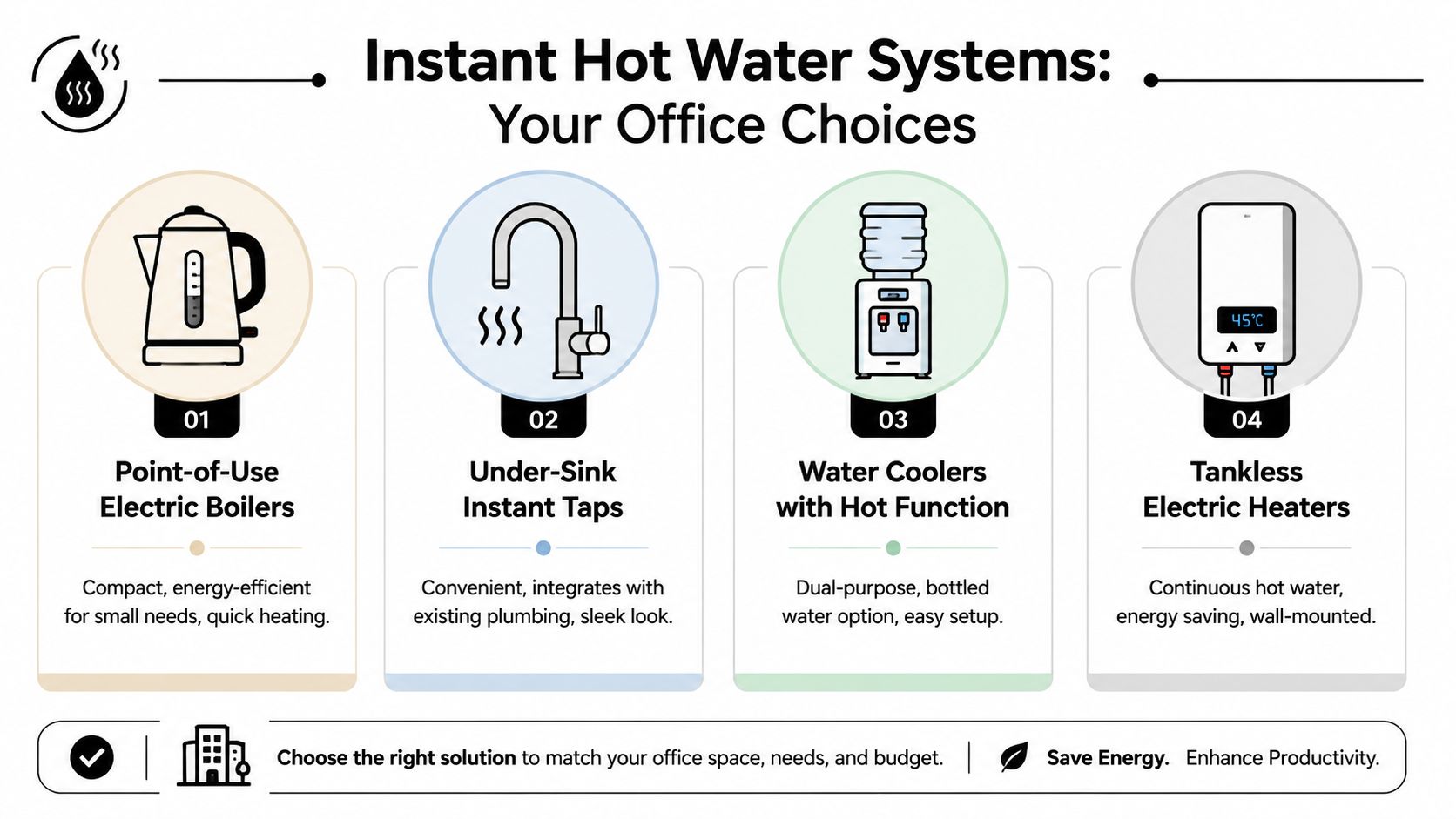
Understanding Your Instant Hot Water System Options
Not every “instant” system works the same way. Some store hot water ready to go. Others heat it as it passes through. Some are built for a single sink. Others are made for a staffroom with steady demand.
Under-sink boiling taps
Think of these as a hidden mini hot water station under the bench with a dedicated tap above. The tank sits inside the cupboard, out of sight, while the tap on the sink delivers hot water on demand.
They suit offices that want a clean look and don't want equipment sitting on the bench. In small teams, they're often the most balanced option because they combine tidy installation, quick access, and straightforward day-to-day use. If you want to see how these units differ by tap style, tank size, and use case, this guide to an instant hot water dispenser is a useful starting point.
Wall-mounted boilers
A wall-mounted boiler is the workhorse option. It hangs visibly on the wall and usually dispenses from a tap or spout below. These systems are made for heavier use and are common in staffrooms, lunchrooms, and utility areas.
They're practical rather than subtle. If your office makes a lot of tea and coffee in short bursts, this style handles volume well. The trade-off is appearance and wall space.
Hot water urns
An urn is the portable function-over-form option. It's familiar, simple, and easy to replace.
That makes it popular in temporary setups, community rooms, and low-budget office kitchens. The downside is that it takes bench space, looks basic, and doesn't give the polished feel many modern offices want. It's also easier to bump, shift, or overfill.
Point-of-use heaters
A point-of-use heater is like a small dedicated helper for one sink or one task. These units are often compact and intended to serve a local tap without trying to run a whole office kitchen setup.
They can work well where the demand is light and localised. The key is understanding whether the unit stores water or heats it continuously. That difference matters a lot once you consider electrical load and noise.
Combined boil-and-chill units
These are the all-in-one premium option. One system can provide boiling water and chilled drinking water from the same area, often through one integrated tap or paired outlets.
They're a strong fit for offices that want to replace several appliances at once. Instead of a kettle, a separate water cooler, and bottled water clutter, you get one organised system. They cost more upfront, but they can simplify the whole kitchenette.
Practical rule: Start with how your team uses hot water, not with the product category. A neat-looking tap won't help if the office actually needs higher output through the day.
How to Choose the Right System for Your Australian Office
The right unit on paper can still be the wrong unit in a real office. Selection comes down to how the kitchenette behaves during a normal workday, how quiet the room needs to stay, and what the building can support without extra electrical work.
Start with usage patterns
Don't just count staff. Watch behaviour.
A six-person office where everyone makes one coffee at staggered times has very different demand from a six-person office where the team all breaks at once. The first can run happily on a compact system. The second needs better recovery and less waiting between pours.
A practical shortlist usually starts with these questions:
- How many consecutive cups are needed: Morning rush matters more than total daily use.
- Is the kitchenette client-facing: Appearance matters more in reception and meeting areas.
- How much bench and cupboard space is available: Some offices have tight joinery and little clearance.
- Do staff need only boiling water, or chilled water too: That changes the value of combined systems.
Don't ignore noise and electrical demand
Many buying guides fall short. Existing content often recommends electric instantaneous systems for small offices but misses the office-specific issue of energy cost and noise. Data noted in Canstar's hot water systems guide shows continuous-flow electric systems have significantly higher energy demands than heat pumps, and community feedback highlighted in the verified brief recommends quieter alternatives for office settings.
In a home, a bit of operating noise may be easy to overlook. In an office beside desks, it isn't. A hot water unit that sounds acceptable in a garage or laundry can become irritating in a quiet shared workspace.
For workplace-specific buying considerations, this guide on choosing a boiling water unit for a workplace kitchen helps frame the decision around daily use rather than brochure claims.
A practical checklist before you commit
Use this when comparing units or talking to an installer:
- Power compatibility: Ask whether the system suits the existing office circuit or needs dedicated wiring.
- Recovery behaviour: A unit can be “instant” for one cup and slow for the next four.
- Safety controls: Boiling taps should have sensible activation and anti-scald design.
- Maintenance access: If the cupboard is cramped, servicing becomes harder and more expensive.
- Fit with the room: The best unit should disappear into the routine, not dominate the kitchenette.
If the office is quiet, open-plan, or client-facing, noise should be treated as a primary selection factor, not an afterthought.
A Detailed Comparison of Popular Office Hot Water Solutions
For most small offices, the main decision isn't between ten different products. It's usually between a compact under-sink system, a wall-mounted boiler, or keeping a portable urn because it seems easier.
The strongest all-round option for many Australian small offices is the under-sink storage heater. Verified trade data indicates that, for a small office in Australia, an under-sink storage heater is more efficient than an instantaneous electric system because its peak demand is about 2 to 3 kW, compared with 6 to 12 kW for instantaneous electric systems, while also producing less noise and placing less strain on standard office circuits, according to JR Gas & Water's category guidance.
Why under-sink storage often wins
This difference matters more than it first appears. A small office usually doesn't have the electrical headroom of a commercial kitchen. An instantaneous electric unit can behave like a sprinter who needs a huge burst of power all at once. An under-sink storage heater is more like a steady walker. It heats, holds, and tops up in manageable cycles.
That's why storage-based systems often fit normal office conditions better. They ask less from the wiring, stay quieter, and still give near-immediate hot water for the kind of use most offices have.
Office Hot Water System Comparison
| Feature | Under-Sink Boiling Tap (e.g., Zip) | Wall-Mounted Boiler (e.g., Birko) | Portable Hot Water Urn |
|---|---|---|---|
| Best fit | Small offices with regular daily use and limited bench space | Offices with heavier shared demand | Temporary setups or low-cost staffrooms |
| Visual impact | Minimal, with hardware hidden below bench | Visible appliance on wall | Visible on bench |
| Power behaviour | Generally easier to integrate in standard office settings when storage-based | Can be suitable where higher output is needed | Simple plug-in approach |
| Noise in office use | Usually better suited to quieter kitchens | Depends on model and placement | Usually acceptable, but not discreet |
| Space use | Saves bench space, uses cupboard space | Uses wall space, keeps bench clearer | Takes bench space |
| Ease of use | Very easy for staff and visitors | Straightforward in utility-style kitchens | Familiar but less polished |
| Main compromise | Needs under-sink room and proper installation | More industrial appearance | Feels temporary and clutters the area |
What doesn't work as well
Instantaneous electric systems can sound appealing because “tankless” suggests efficiency. In many office settings, though, that headline benefit doesn't outweigh the practical drawbacks. If a system needs major electrical work, adds operational noise, and doesn't match typical staffroom demand patterns, it stops being the smart option.
The best office unit isn't the one that heats water fastest in isolation. It's the one that fits the building, the daily rhythm, and the people using it.
Our Recommended Solutions for Your Small Office
Most small offices don't need the biggest unit on the market. They need the one that suits their layout, staff habits, and tolerance for noise.
The five to ten person office
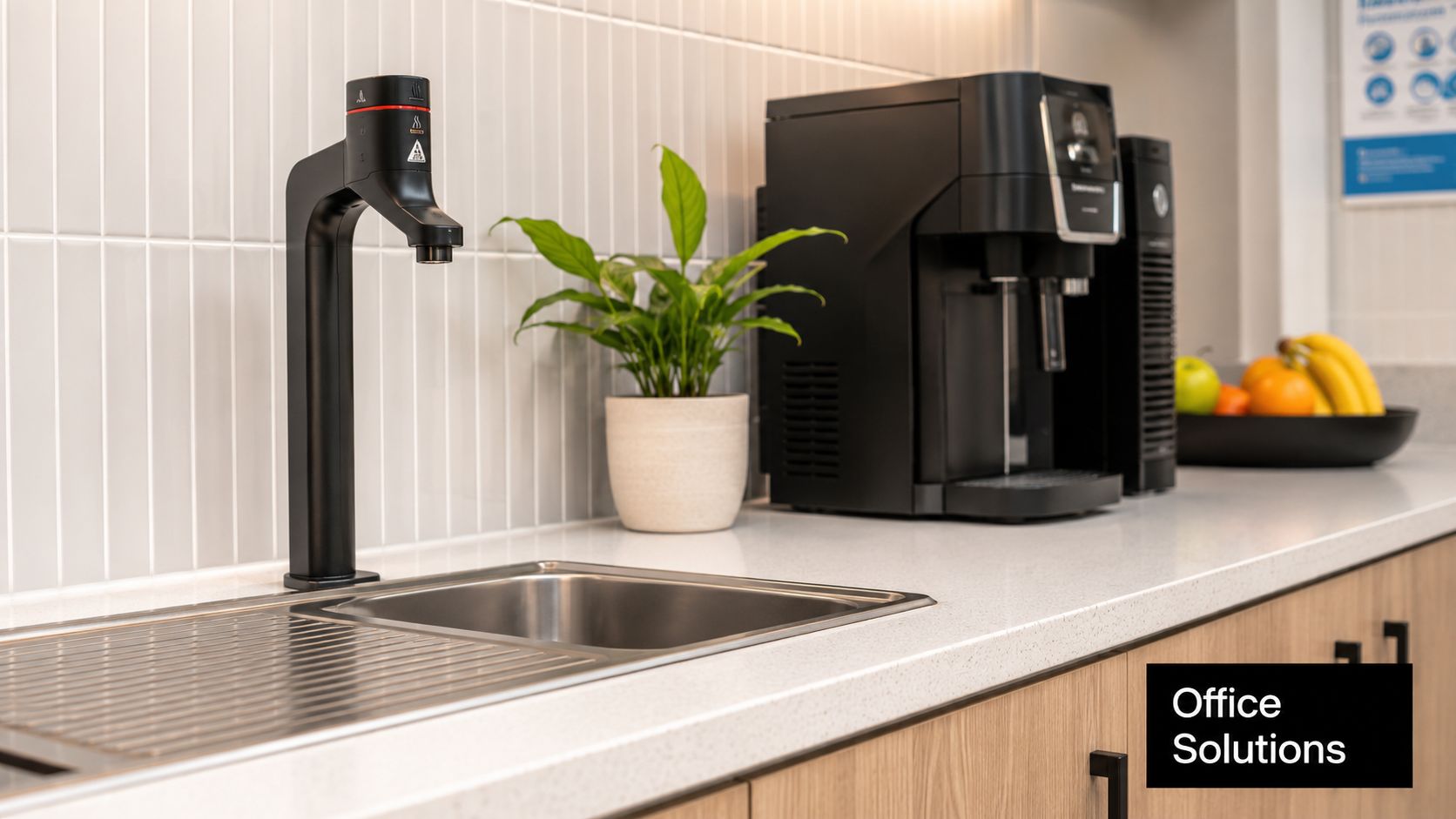
For a compact team, an under-sink boiling tap with a storage-based unit is usually the best fit. This type of office wants convenience without visual clutter. The kitchenette might double as a staff hub and a client-facing area, so appearance matters.
A setup built around brands commonly seen in this space, such as Stiebel Eltron, Zip, or Insinkerator, usually makes sense when the office wants something tidy, reliable, and easy for everyone to use.
The creative studio or client-facing workspace
Design studios, consultancies, and boutique agencies often care as much about the look of the kitchen as the function. In these spaces, a visible wall-mounted boiler can feel too industrial unless the back-of-house area is separate.
That's where a neat under-sink tap earns its keep. It removes the kettle from sight, keeps the bench clear, and gives the room a more finished feel.
The busier back-office or staffroom
If the office has more people using hot water in clusters, a wall-mounted boiler can still be the right answer. It's not the prettiest option, but it handles heavier staffroom use well.
This is also where it helps to avoid the wrong “instant” technology. In Australia's commercial sector, instantaneous electric systems are generally discouraged for small offices because they can use more than 15 kWh/day in continuous use and reach up to 55 dB operational noise, while storage-based or heat pump alternatives are preferred for quieter operation and better economics, as set out in the verified brief with supporting reference to the My Efficient Electric Home discussion.
A quick visual walkthrough can help if you're comparing common workplace unit styles and layouts:
The temporary office or low-commitment lease
If you're in a short lease or fitting out a transitional space, a portable urn can still be reasonable. It won't give the same finish or convenience, but it avoids more involved plumbing work.
That said, temporary solutions have a habit of becoming permanent. If the office is stable and the kitchenette gets daily use, it's usually better to install a system you won't be apologising for six months later.
Budgeting for Installation Maintenance and Running Costs
The purchase price is only part of the decision. In office kitchens, the actual cost shows up in installation complexity, service access, and how the unit behaves over time.
Installation in a real office
Leased spaces often create the biggest hesitation. Managers worry that a plumbed-in system will mean major bench changes, cabinet rebuilding, or difficult make-good work at the end of the lease.
In practice, many modern retrofits are more straightforward than people expect. Verified background in the brief points to an under-served area in the market around modular under-sink boiling tap retrofits for small Australian offices, including compact units designed to avoid major plumbing changes, with examples discussed alongside under-sink office systems at WaterPeople.
That doesn't mean every kitchenette is easy. Existing pipework, cupboard access, power location, and bench cut-outs still determine what's feasible. But plenty of offices can retrofit an under-sink unit without a full kitchen rebuild.
What to budget for beyond the unit
A sensible office budget should allow for more than the appliance itself:
- Licensed installation: Plumbed systems should be installed properly for safety, compliance, and warranty protection.
- Possible electrical adjustment: Some units are simple replacements. Others need a better power arrangement nearby.
- Filtration and consumables: If the system includes filtration, replacement intervals matter.
- Future servicing access: Tight cupboards can turn a simple service job into a fiddly one.
Running costs and maintenance discipline
Many businesses lose money, often unnoticed. They buy on headline convenience and ignore how the unit runs every day.
Storage-based under-sink systems are often easier to live with because they suit intermittent office demand. A badly matched instantaneous unit can look efficient in theory but become expensive or annoying in use. The practical test is simple. If staff can get hot water quickly, the unit stays quiet, and it doesn't force electrical upgrades, you're usually in the right category.
A cheap purchase can become an expensive office fixture if it's hard to service, awkward to access, or poorly matched to the site.
Where to Source Your System and Find a Professional Installer
Once you know what type of system suits the office, buy from a supplier that knows the category properly. That matters for warranty support, spare parts, and making sure you receive the correct fittings and accessories for the model you've chosen.
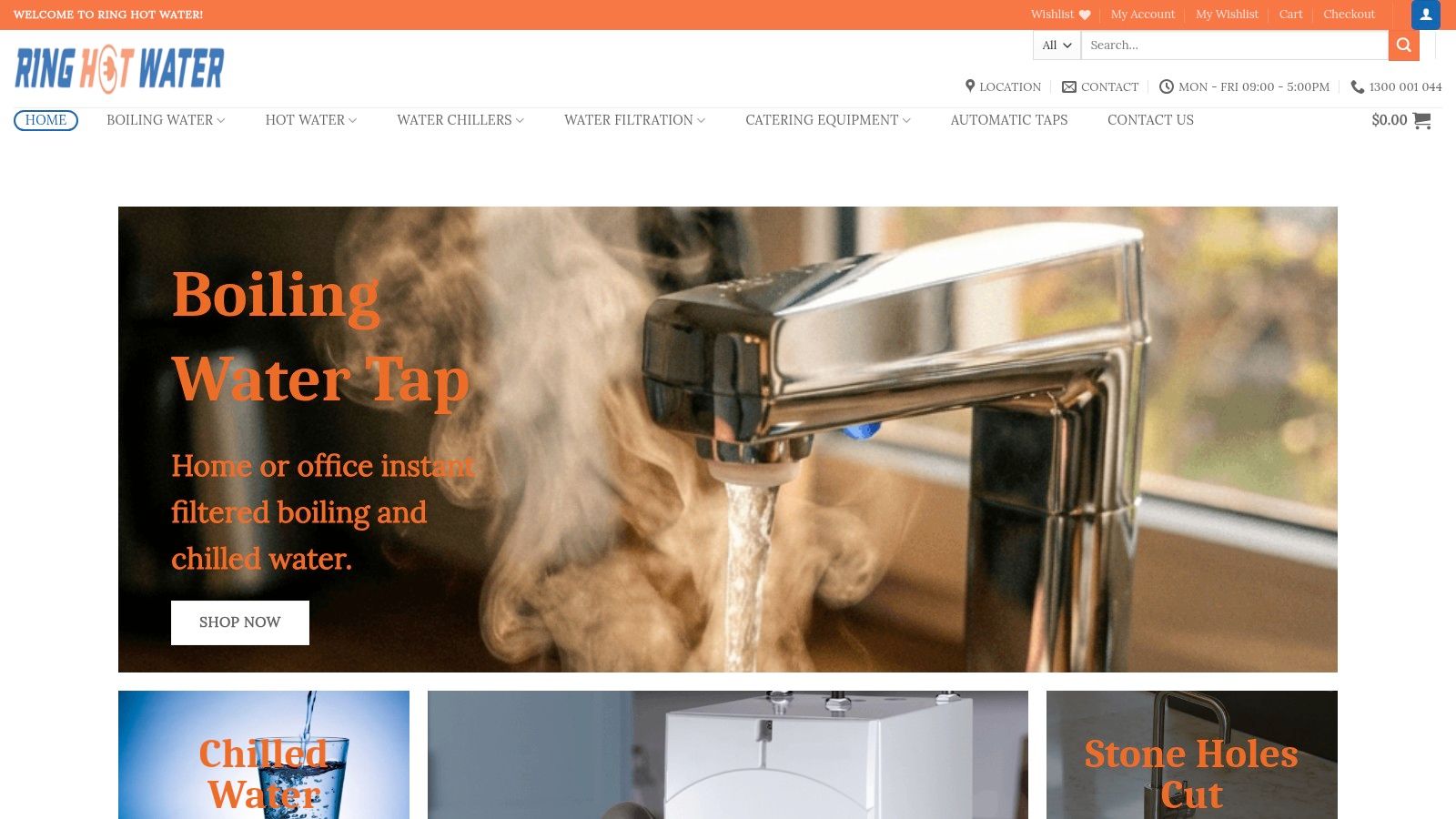
A good installer matters just as much as the product. Office hot water systems sit at the intersection of plumbing, power, safety, and everyday usability. Correct placement, tidy pipe runs, service access, and clean commissioning all make a difference once the unit is in daily use.
If you're in Melbourne, local support is especially valuable because site constraints vary widely between older office suites, refurbished warehouses, and newer fit-outs. Australia-wide buyers should still look for genuine products from authorised specialists rather than generic marketplace listings with patchy after-sales support.
The best outcome is simple. The right unit arrives complete, gets installed correctly, and works in the background without creating another office problem to manage.
If you're ready to replace the kettle with a proper workplace setup, Ring Hot Water can help you choose the right system, source genuine products Australia-wide, and arrange expert installation, servicing, and repairs across Melbourne.

