Uncategorized
Commercial Instant Hot Water System Your Melbourne Guide
Jul
It's usually the same problem. The staff kitchen is flat out at 8:30. The café is already pouring coffees. The prep sink needs reliable hot water. Someone has plugged in a kettle, someone else is waiting on a slow storage unit, and the whole setup feels too small for the business you're running.
That's when a commercial instant hot water system starts to make sense. Not because it sounds modern, but because time lost at the sink or bench keeps showing up in labour, interruptions, service delays, and complaints from staff who just want the system to work.
In Melbourne, I see businesses make the same mistake in both directions. Some buy too small and run out during peak demand. Others buy on marketing promises and discover too late that the electrical supply in the tenancy can't support the unit they wanted. The hardware matters, but the practical detail matters more.
What Is a Commercial Instant Hot Water System
A commercial instant hot water system heats water as it's needed, instead of storing a big volume in a tank and keeping it hot all day. In practice, that covers a few different setups. It might be an under-sink boiling and chilled tap in an office breakout area, a wall-mounted boiler in a lunchroom, or an instantaneous heater feeding hot water quickly in a commercial workspace.
The common thread is simple. You get hot water on demand without waiting for a tank to recover.
In a busy Melbourne café, that can mean less bench clutter and less stop-start workflow. In an office, it means staff aren't lining up for the kettle or emptying an urn during the morning rush. In aged care, health, or food prep settings, it can also mean tighter control over outlet temperature and safer daily use.
The category isn't niche anymore. The broader Australia water heaters market was recorded at USD 783.96 million in 2024, with projections to reach USD 1,038.63 million by 2030 at a 4.8% CAGR, reflecting stronger uptake of energy-efficient systems in commercial settings, according to TechSci Research's Australia water heaters market report.
Where these systems fit best
Some environments suit instant systems immediately:
- Office kitchens: Staff want tea, coffee, and basic kitchen hot water without the mess of kettles and waiting.
- Hospitality venues: Fast turnover matters, and delays at one point in service ripple through the whole shift.
- Aged care and healthcare spaces: Temperature control and safe delivery matter as much as speed.
- Workshops and commercial amenities: A compact system can solve a hot water problem where a bulky storage tank is awkward.
Practical rule: If your team needs hot water repeatedly across the day, and especially in short peaks, an on-demand setup is usually worth assessing.
What it is not
It isn't a magic box that suits every site. A commercial instant hot water system still has to match actual demand, available power, plumbing layout, service access, and compliance requirements.
That's why generic “tankless is always better” advice misses the point. Some sites are perfect for it. Some aren't. The right answer depends on what happens during your busiest half hour, not what looks good in a brochure.
The Technology Behind On-Demand Hot Water
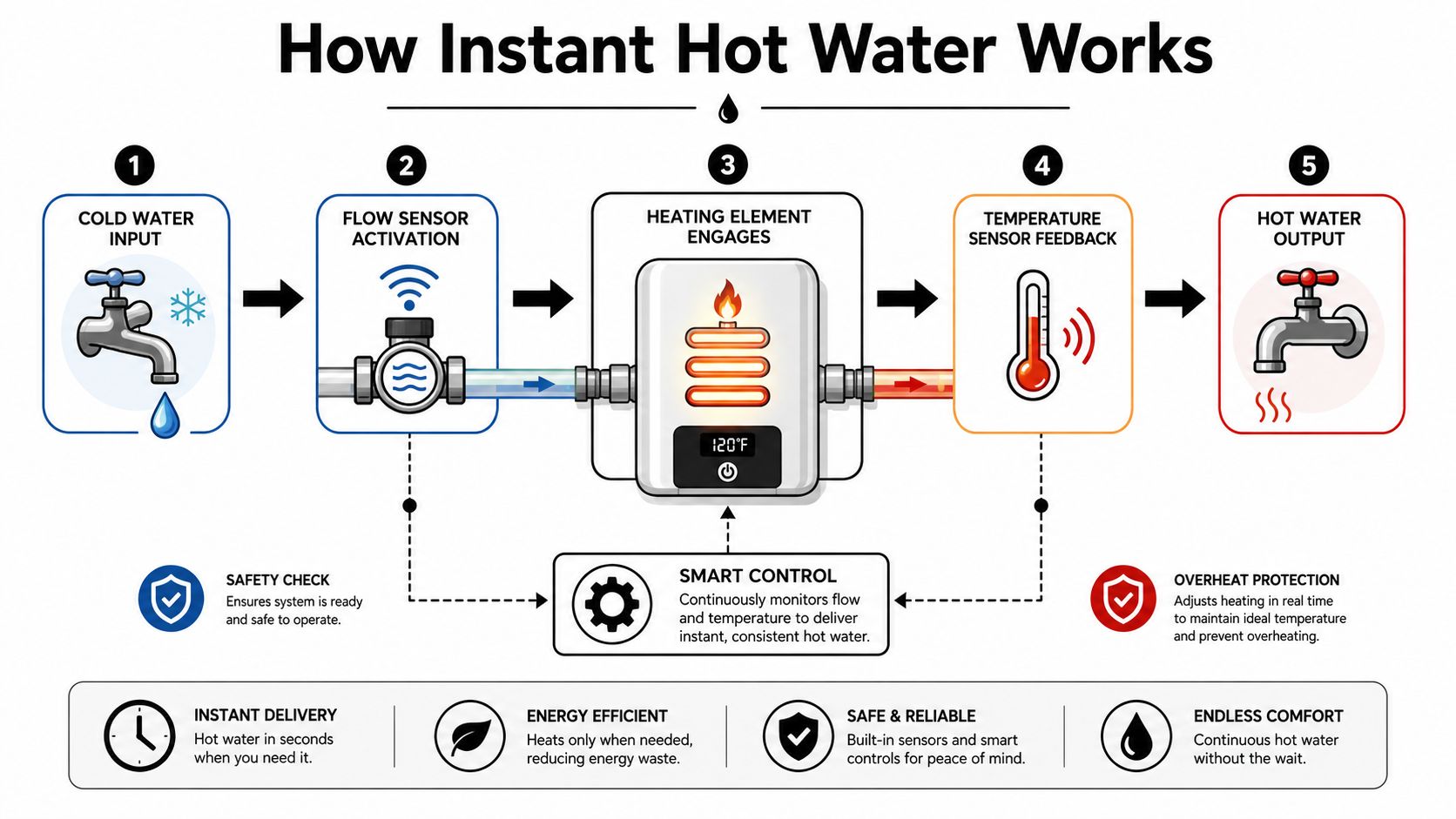
An instant unit works more like a radiator than a bucket. Water moves through the system, sensors detect flow, a heating source engages, and the unit controls temperature as the water passes through. A storage system does the opposite. It heats a volume, stores it, loses heat over time, then reheats again.
That basic difference is why these systems appeal to businesses trying to cut wasted energy and speed up access.
What happens inside the unit
A typical setup follows a simple sequence:
- Cold water enters the unit
- A flow sensor detects demand
- The heating element or burner engages
- A temperature sensor monitors output
- Hot water leaves the outlet at the set temperature
That's the mechanical advantage. The system only works when there's demand, instead of keeping stored water hot in the background.
According to Australian Hot Water's explanation of how hot water systems work, instantaneous systems avoid the 30 to 90 minute reheat time associated with storage tanks and also avoid standby energy waste because they heat water on demand.
Why businesses notice the difference
In day-to-day use, the gain isn't just technical efficiency. It's workflow. Staff don't have to plan around a depleted tank. A kitchen doesn't get caught short because several draws happened close together. An office manager doesn't need three kettles on the bench to cover morning demand.
For people who like seeing the concept in other compact applications, these Utah RV instant hot water tips are useful because they show the same on-demand principle in a smaller, space-sensitive setting.
If you're comparing commercial and domestic tankless concepts, this overview of a tankless instant water heater is also a useful reference point.
Hot water demand comes in bursts. The best systems are the ones that recover with the business, not against it.
Electric and gas do the job differently
Electric models use heating elements. Gas models use a burner. Both can deliver fast response, but the site conditions decide what's realistic. In Melbourne fit-outs, that practical distinction matters more than the sales label on the carton.
What works on paper may still fail in operation if the unit can't keep pace with the demand profile, incoming water temperature, or site services. That's why understanding the mechanism matters before you get into pricing.
Choosing Your Commercial Instant Hot Water System
The right system starts with the environment, not the brand. A small office kitchenette, a staff room in a warehouse, a catering prep area, and a healthcare utility room all need different things from the same broad category.
Some businesses need near-boiling water at a tap. Others need controlled warm water for handwashing or food service. Others need a dedicated boiling water unit that can keep up with repeated draws.
Commercial instant hot water system types
| System Type | Ideal Environment | Key Feature | Common Brands |
|---|---|---|---|
| Under-sink boiling and chilled tap | Offices, boardrooms, premium staff kitchens | Saves bench space and gives fast dispensing at the tap | Zip, Insinkerator |
| Wall-mounted boiler | Lunchrooms, schools, shared amenities, busy staff areas | High-traffic hot water access from a fixed unit | Birko, Stiebel Eltron, Boiling Billy |
| Commercial urn | Catering, events, temporary service areas | Portable bulk boiling water where fixed install isn't practical | Birko, Crown |
| Water chiller with hot water pairing | Offices, hospitality, waiting areas | Supports both chilled and hot service points | Everchill, Robatherm |
Under-sink and tap systems
These suit workplaces that care about presentation, bench space, and convenience. The unit is hidden below, the tap does the visible work, and the space feels less cluttered than a kettle-and-urn setup.
They're especially good where people want frequent smaller draws across the day rather than one big batch. That's why they're popular in offices, meeting areas, and upgraded staff kitchens.
Wall-mounted boilers and dedicated units
This is the workhorse category. Wall-mounted units make sense in places where people fill cups one after another and the unit needs to keep coping without constant refilling.
If there's one lesson here, it's this. Don't confuse domestic convenience with commercial duty. A proper wall-mounted commercial unit is built for repeated use, easier service access, and a more predictable response during busy periods.
Selection check: Ask what the unit is expected to do between 8:00 and 9:00 in the morning. That answer usually narrows the field quickly.
Single-phase has a place, but know its limits
Some Australian-designed single-phase electric instantaneous models, including Stiebel Eltron units, are certified to deliver a maximum output of 50°C without a tempering valve, making them compliant with AS3498 and well suited to safety-sensitive settings such as aged care and commercial kitchens. The same source states they can reduce energy consumption by up to 30% compared with stored hot water units because they avoid standby losses. That detail is outlined on Stiebel Eltron's single-phase electric instant hot water system page.
That doesn't mean single-phase solves every commercial hot water job. It means some lower-temperature and safety-led applications can use it very effectively.
For workplaces comparing tea, coffee, and staff kitchen solutions, this guide to a workplace tea coffee hot water unit helps frame what type of setup suits a shared office environment.
What usually works best
A quick way to narrow the choice:
- Small office fit-out: Under-sink boiling tap or compact wall unit
- Shared staff amenities: Wall-mounted boiler
- Event or temporary catering use: Commercial urn
- Safety-led lower-temperature use: Suitable compliant instantaneous model with the right outlet setting
The wrong choice usually happens when the buyer focuses on product style before checking demand pattern, service access, and site power.
Sizing Your System for Peak Demand
Sizing is where good projects stay good. If the system can't handle the busiest part of your day, the energy discussion won't matter because the users will hate it.
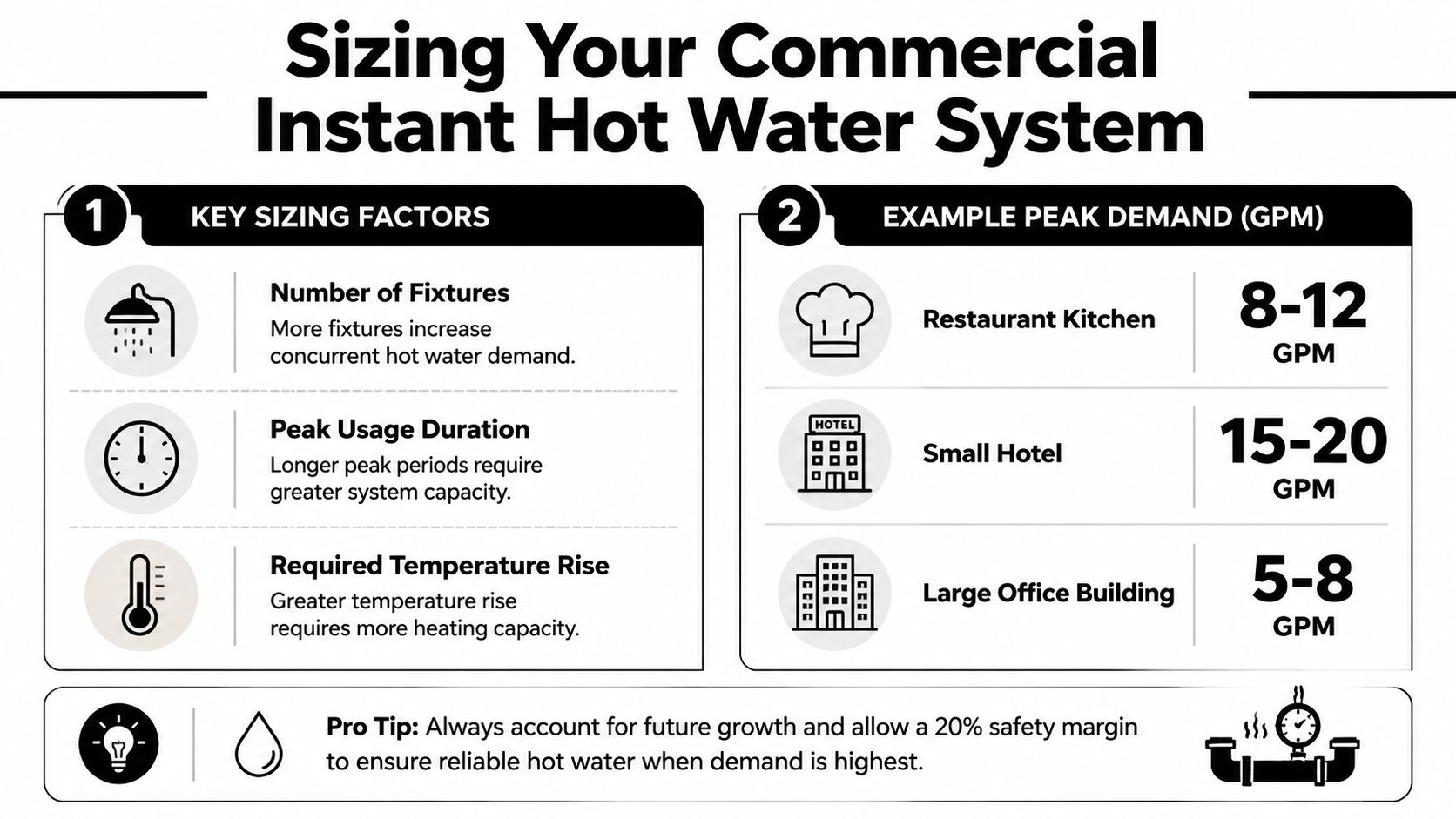
Underestimation of demand stems from thinking in daily totals. Commercial hot water systems should be sized around peak demand, not average use.
Start with the busiest window
Look at the period when everyone wants hot water at once. In an office, that's often the first hour of the morning and straight after lunch. In hospitality, it might be pre-service prep or a concentrated wash-up period.
Work through these questions:
- How many users draw water in the same window
- What are they doing with it
- How hot does it need to be at the point of use
- Is the draw short and repeated, or longer and continuous
A cup-making station behaves differently from a sink used for repeated cleaning draws. One needs quick repeated dispense. The other needs sustained flow without sharp temperature drop.
Think in draw-off and recovery
A system has to do two jobs. It needs enough immediate supply for the first wave, and it needs enough recovery to keep going after that.
That's why I look at:
- Initial draw-off: What the unit can supply straight away
- Recovery: How quickly it can keep supplying after the first burst
- Temperature rise requirement: What the unit must do given the incoming water temperature
If you want a good primer on the broader logic behind demand calculations, this heating load calculation guide is useful because it shows how system sizing starts with real operating conditions, not guesswork.
A practical sizing method
For a workplace system, use a simple planning process:
- List the outlets that will rely on the unit
- Mark the busiest time block in the day
- Estimate simultaneous users, not total staff headcount
- Separate beverage use from cleaning or wash-up use
- Add a margin for real behaviour, because staff rarely queue neatly one at a time
If you size to average use, the system will disappoint exactly when people notice it most.
A lot of oversizing comes from fear. A lot of undersizing comes from optimism. The best result sits in the middle and is based on the busiest realistic operating pattern.
Analysing Energy Use and Real-World Costs
Efficiency claims are where buyers get caught. Yes, on-demand heating is attractive because it avoids the standby losses that come with stored hot water. But for many Melbourne businesses, the primary cost question isn't only the unit's rating. It's whether the building can effectively support the unit you want.
That's the part glossy product pages often skip.

The 3-phase issue most guides gloss over
Most high-demand commercial instant electric systems need 3-phase power to deliver the heating performance businesses expect. That's a major practical barrier because many smaller commercial premises don't have it available without electrical upgrade work. This infrastructure mismatch is highlighted in discussion referenced by My Efficient Electric Home.
Often, projects falter when someone chooses a tankless electric unit for a café, office tenancy, or light commercial site, then learns the tenancy only has single-phase supply suitable for lighter loads. Suddenly the “efficient” option carries electrical works, switchboard review, and coordination costs that weren't in the first quote.
What to include in the real cost picture
Don't compare units on purchase price alone. Compare the whole job.
Look at:
- Electrical capacity: Can the existing supply run the unit properly?
- Upgrade implications: Will the switchboard, cabling, or protection need changes?
- Use pattern: Will the business benefit from on-demand operation?
- Downtime risk: What happens if the chosen system underperforms in winter or during the busiest shift?
- Maintenance access: Can the unit be serviced easily once installed?
A cheap unit that needs major power upgrades isn't the cheaper option.
Where instant systems still make strong financial sense
They can make excellent sense where the site already has suitable services, demand is regular, and the business benefits from not holding hot water in storage. They also suit applications where compact footprint and quick response save space and simplify operations.
Where they don't make sense is when the building services are weak, the expected load is unrealistic for the available power, or the system is being selected as a trend rather than a fit-for-purpose tool.
In Melbourne, that means the first serious question isn't “Which brand?” It's “What power is available at the tenancy, and what hot water load does the business really need?”
Installation Maintenance and Common Spare Parts
A commercial instant hot water system isn't a set-and-forget appliance. If the business relies on it every day, installation quality and maintenance discipline decide whether it stays reliable or becomes a recurring headache.
That matters more in hospitality, shared workplaces, and service environments where temperature inconsistency gets noticed quickly.
Installation basics that can't be skipped
These systems need proper plumbing and, depending on the model, the correct electrical or gas connection arranged by licensed trades. Access matters too. If a unit is boxed in too tightly, future service becomes slower and more expensive.
The install should account for:
- Isolation access: So the unit can be serviced without unnecessary disruption
- Clearance for maintenance: Filters, sensors, valves, and elements need to be reachable
- Water quality considerations: Incoming water affects scaling and internal wear
- Safe outlet configuration: Especially where staff or the public use the fixture
For teams that manage quotes across multiple works, tools like Exayard plumbing estimating software can help structure labour, materials, and service allowances properly instead of underpricing the actual install effort.
The maintenance costs people forget
The hidden cost usually isn't dramatic failure. It's gradual performance decline. Sediment buildup, scale, blocked filters, sticking valves, and sensor issues can all lead to unstable temperatures or slower response.
That's the under-discussed part. A troubleshooting source discussing commercial instant systems notes that sediment buildup and sensor failure can contribute to inconsistent temperatures, and that maintenance burden needs to be considered in total ownership, especially when people are comparing options under state incentive settings in Victoria. That issue is raised in this commercial instant system maintenance discussion on YouTube.
Here's a practical service video worth reviewing:
Common spare parts that keep systems going
The parts that tend to matter most are not exotic. They're the service items and wear items that restore normal operation fast.
Typical examples include:
- Heating elements: When output drops or the unit stops heating correctly
- Flow sensors: When the system doesn't respond cleanly to demand
- Thermostats: For temperature control faults
- Valves and hoses: Especially where ageing fittings create leaks or pressure issues
- Filters: For protecting the system and preserving water quality
- Fittings and connectors: Small parts that can hold up a repair if they're not on hand
The cheapest maintenance plan is regular service before the busy season, not emergency repair during it.
For businesses that already rely on boiling water units in staff kitchens or commercial settings, arranging proper boiling water unit service in Melbourne is often the difference between a unit that lasts well and one that becomes unreliable early.
Navigating Safety Compliance and Melbourne Service
Safety settings aren't an afterthought. They're part of selecting the right commercial instant hot water system in the first place.
In Australian commercial use, some instant systems are engineered to hold a fixed outlet temperature of 75°C by default, with adjustable settings between 55°C and 85°C, helping maintain thermal stability for sanitisation while supporting compliance with AS3498. That operating range is outlined in this commercial reference guide from Hot Water Professionals.
What compliance means in practice
For a business, compliance isn't just paperwork. It affects how the system is configured, who uses it, where it's installed, and whether additional control measures are needed at the outlet.
A few practical points matter most:
- Public or staff-facing outlets: Need safe delivery temperatures appropriate to the use case
- Food and sanitation tasks: May require higher controlled temperatures at specific points
- Aged care and vulnerable-user settings: Need tighter attention to scald prevention
- Servicing and adjustments: Should be handled by people who understand both the unit and the standard
Local support matters because commercial hot water issues are rarely convenient. When a system fails, runs cold, or drifts out of specification, you need someone who can diagnose the problem on site and restore compliant operation without turning it into a drawn-out exercise.
If you need expert help choosing, installing, repairing, or servicing a commercial instant hot water system in Melbourne, Ring Hot Water can help. They supply instant boiling and chilled systems, commercial urns, wall-mounted units, genuine spare parts, and local service support across Melbourne, with practical advice grounded in effective on-site practices.

