
Uncategorized
Workplace Tea Coffee Hot Water Unit: Guide for 2026
Jul
The usual trigger for this purchase is frustration, not strategy. Staff queue at the kettle, someone forgets to refill it, the kitchen bench stays cluttered, and the first rush of the morning turns into dead time. Then the office manager gets asked to “look into a better setup” and is handed a few product brochures that make everything sound simple.
It isn't simple if you care about long-term cost, safety, servicing, and whether the unit will cope with your peak demand. A workplace tea coffee hot water unit can save time and cut hassle, but only when the selection matches the site, the usage pattern, and the compliance requirements. The sticker price is only one line item. Running cost, filtration, installation constraints, and scalding controls matter just as much.
Beyond the Kettle The Business Case for a Hot Water Unit
A kettle works until too many people rely on it. In a small team, that might mean a mild inconvenience. In a busy office, it becomes a daily bottleneck that repeats every morning and again after lunch.
The broader business case gets clearer when you look at staff behaviour around hot drinks. Approximately 75% of Australian workers consume at least one cup of coffee during a typical working day, and when staff buy café coffee themselves, the average direct spend is about $1,300 AUD per employee per year. By comparison, employers that provide a managed on-site machine solution bring the cost down to between $2.50 and $4.50 per employee per day, which represents a 30–50% cost saving before accounting for productive time recaptured when staff don't leave the building according to Australian workplace coffee benchmarks.
That doesn't mean every workplace needs a full bean-to-cup coffee program. It does mean hot water provision should be treated as an operating decision, not a kitchen accessory purchase. Tea, instant coffee, plunger coffee, noodles, soup, and client refreshments all depend on reliable hot water.
What the kettle usually costs you
A standard kettle setup often creates hidden operating issues:
- Queue time: One or two kettles can't handle a concentrated morning rush.
- Bench clutter: Kettles, refill jugs, tea boxes, mugs, and power cords crowd small kitchens.
- Inconsistent output: Water may not be ready when people need it, or staff reboil partial fills repeatedly.
- Mess and wear: Spills, scale buildup, and constant handling shorten appliance life.
Practical rule: If people are waiting for hot water most mornings, you've already outgrown the kettle.
Why dedicated units change the equation
A proper workplace tea coffee hot water unit does two jobs at once. It improves access for staff, and it gives the business more control over cost and infrastructure.
Office managers usually notice three improvements first:
- Faster drink service during peak periods.
- Tidier kitchen layouts with fewer loose appliances.
- Less ad hoc maintenance, because the system is designed for repeated use rather than domestic stopgaps.
That's why these systems belong in the same conversation as printers, filtered water, and staff amenities. They support workflow. They also send a message about how the workplace is run. When hot drinks are part of the day for most staff, a reliable unit isn't a luxury item. It's practical infrastructure.
Decoding the Options Types of Hot Water Units
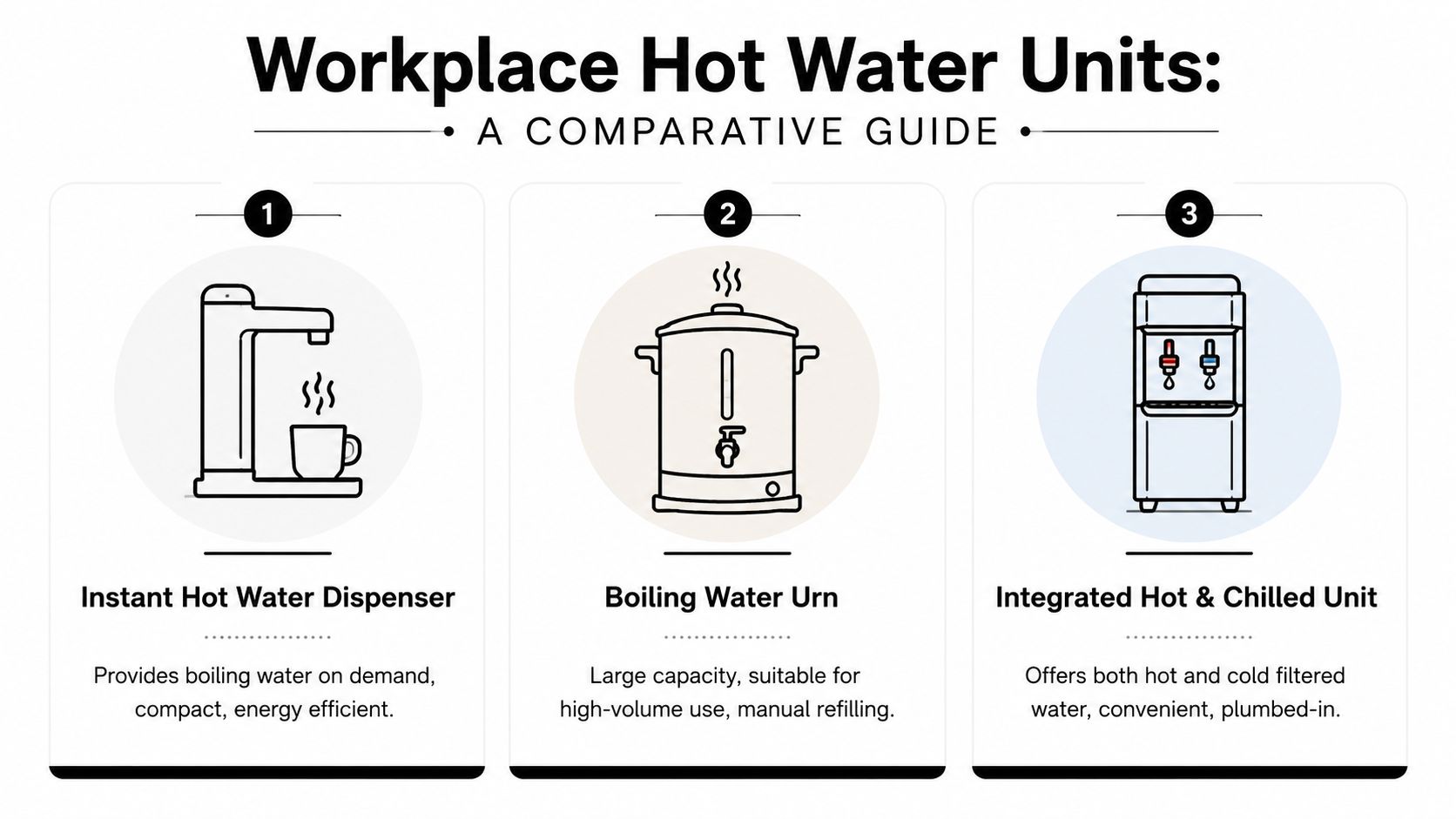
The market uses a lot of overlapping language. Boilers, dispensers, urns, boiling taps, and integrated units can all sound similar until you match them to a real kitchen.
The quickest way to narrow the field is to ignore brand marketing and focus on how water is delivered, where the unit sits, and how your staff use it.
Under-sink boiling taps
These systems hide the tank under the bench and dispense near-boiling water through a dedicated tap. They suit office kitchens where presentation matters, bench space is limited, and staff want immediate access without managing a separate countertop appliance.
What works well: clean appearance, reduced clutter, quick access, and a more professional client-facing kitchen.
What doesn't: they need suitable cupboard space, plumbing access, and room for servicing. If the under-sink area is already crammed with bins, cleaning chemicals, or other services, installation can become awkward fast.
Wall-mounted boiling units
These are common in workplaces that need high-frequency hot water without giving up bench space. They're mounted above a sink or bench and are designed for repeated use through the day.
Some on-wall units are built to maintain 98°C to 100°C water while using as little as 0.8kW in sleep mode, and replacing kettles with these systems can reduce energy use by 35–45% per user per day according to installation and maintenance guidance on Stiebel Eltron-style boiling units.
They're a strong fit for larger teams, staff lunchrooms, and sites that want an obvious, durable hot water point.
Freestanding or bench urns
Urns still have a place, especially for training rooms, church halls, temporary setups, catering, and seasonal overflow. They're straightforward and familiar, but they aren't always the cheapest option over time if the unit stays in permanent daily use.
Australian commercial urn guidance notes that workplace urns typically need 3.5kW to 5.0kW to heat a 2.4L reservoir in 15–25 minutes and deliver 60+ cups per hour, and undersized circuits can delay heating by up to 40% according to Australian hot water urn performance guidance.
If an urn is slow, the problem isn't always the urn. Sometimes the circuit supplying it is wrong for the load.
Integrated hot and chilled units
These combine boiling and chilled filtered water in one system. They suit workplaces trying to solve two kitchen issues at once, especially where bottled water, kettles, and separate dispensers have created clutter.
A simple comparison helps:
| Unit type | Best fit | Main strength | Main trade-off |
|---|---|---|---|
| Under-sink boiling tap | Office kitchens and client areas | Clean look and instant access | Needs cupboard space and service access |
| Wall-mounted unit | Busy staff kitchens | Strong throughput and durability | More visible, less design-led |
| Urn | Events, overflow, temporary use | Simple and familiar | Slower recovery if setup is wrong |
| Integrated hot and chilled unit | Multi-use workplaces | Solves hydration and hot drinks together | More complex install and servicing |
Choosing the Right Unit for Your Staff and Space
The right unit usually reveals itself once you answer a few operational questions accurately. Most bad purchases happen because the buyer chose by appearance, not by daily use.
Start with demand. Not average demand. Peak demand.
Ask how your team actually uses hot water
If twenty people all want tea or instant coffee between 8:30 and 9:00, that matters more than what happens over the rest of the day. A unit that seems fine on paper can become a daily annoyance if it can't recover quickly during the morning rush.
Use this checklist when comparing options:
- How many people need access at the same time: Small teams can often use an under-sink boiling tap comfortably. Larger teams usually need a wall-mounted unit or a more high-capacity plumbed system.
- What's being made: Tea and instant coffee are one thing. Filling French presses, soup cups, and kitchen prep containers asks more from the system.
- Is usage concentrated or steady: Burst demand needs fast recovery. Steady all-day use gives you more flexibility.
- Do clients use the kitchen: If visitors see the area regularly, neat tap-based systems usually make more sense than a bench full of appliances.
- What space do you really have: Measure the cupboard, not just the bench. A good-looking tap won't help if there's no room for the tank, filter, or service access.
Factor in energy and layout
Energy use matters, but only after capacity and suitability. A more efficient unit that frustrates staff every morning isn't a saving. It's just a different problem.
For many offices, wall-mounted units are attractive because they can hold boiling temperature while reducing kettle dependence. If you're comparing broader office kitchen setups, this guide on water dispensers for office kitchens is useful for weighing hot water access against bench space and traffic flow.
For sites reviewing all staff amenity points together, not just drinks, it also helps to think about placement strategy. Resources on vending machine locations for workplaces and commercial sites can be surprisingly relevant because the same traffic logic applies. Put the unit where people can access it without blocking walkways, microwave space, or sink use.
Match the unit to the environment
A few common fits tend to work well:
- Compact office kitchen: Under-sink boiling tap.
- Large staff breakout area: Wall-mounted boiler.
- Training room or occasional function area: Commercial urn.
- Workplace upgrading both hydration and hot drinks: Combined hot and chilled plumbed unit.
Buy for the busiest half hour of the day, not the quietest six hours.
That one decision prevents most complaints.
The Critical Role of Water Filtration and Hygiene
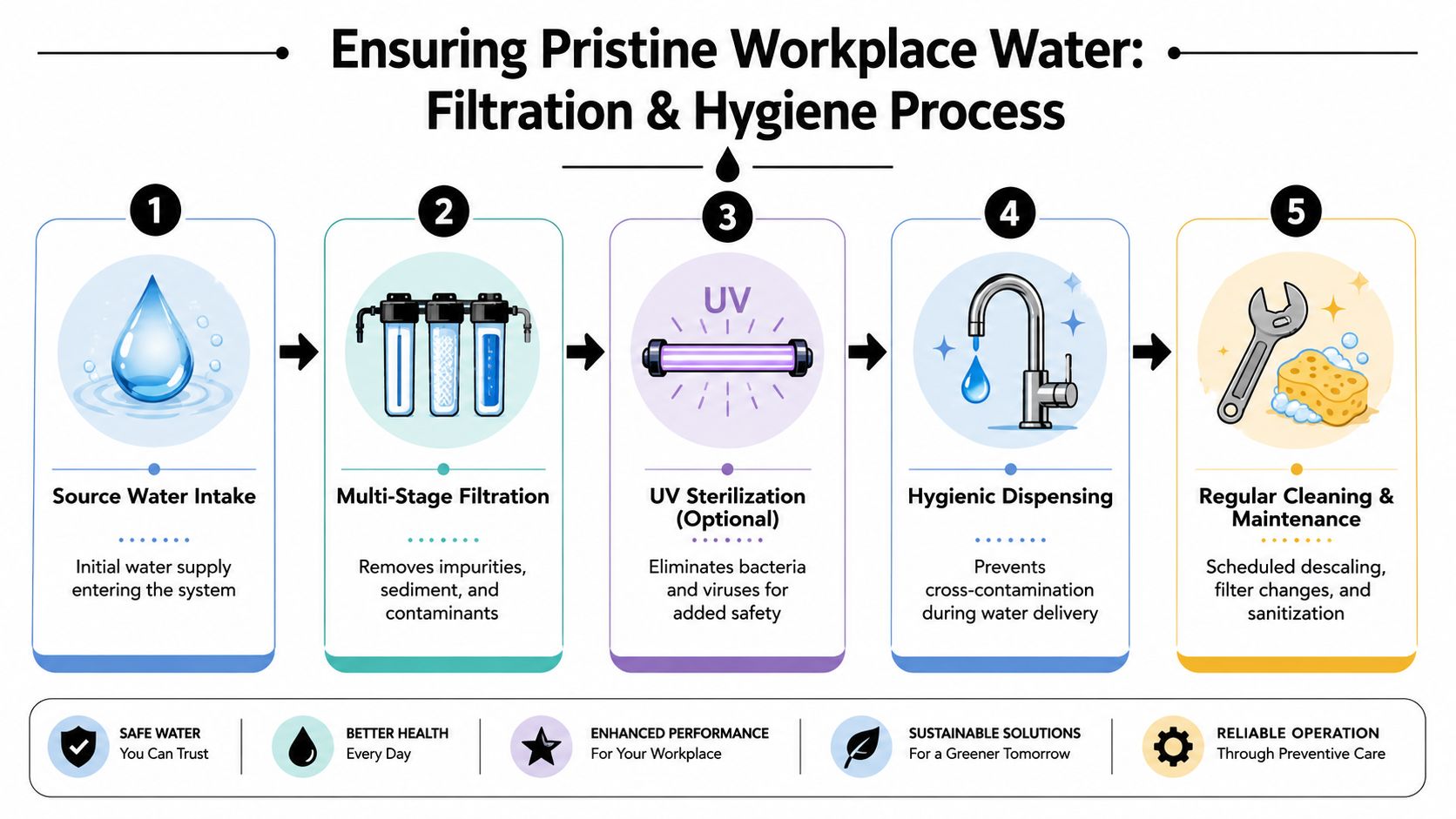
Filtration gets treated like an optional extra far too often. It isn't. It protects taste, protects internal components, and reduces the kind of avoidable faults that make a unit seem unreliable when the actual issue is water quality.
In Melbourne, water conditions vary enough that scale, sediment, and general build-up can affect performance over time. Heating elements, valves, and internal pathways don't last well if the incoming water is carrying what the unit shouldn't be processing untreated.
Filtration protects more than flavour
People notice taste first. The bigger issue is equipment life.
A well-chosen filter setup helps with:
- Scale control: Less mineral buildup on heating components.
- Sediment reduction: Better protection for valves and internal fittings.
- Consistent output: Fewer fluctuations caused by partial blockages or fouled components.
- Serviceability: Cleaner internals generally mean easier maintenance and fewer unpleasant surprises.
If the unit is going into a workplace kitchen for permanent use, the filtration side should be planned at the same time as the hot water side. It's worth reviewing dedicated options for workplace water filter installation in Melbourne before the plumber arrives, not after the first taste complaint or scale issue.
Hygiene and compliance aren't optional
The bigger reason to treat this seriously is health and safety. In Australian workplaces, a key compliance challenge is balancing two different risks. Tap water needs to be limited to 50°C or below to reduce scalding risk, while stored hot water needs to stay at 60°C or above to control legionella, and Victorian requirements place that responsibility on licensed plumbers according to Victorian OHS guidance on dining facilities and hot water risks.
That's where cheap comparisons usually fall apart. A brochure might focus on cup capacity, appearance, or boil time, but those aren't the only questions that matter. You also need to know how the system manages safe delivery temperature, storage temperature, and maintenance access.
The professional standard is simple. If a unit can't be installed and maintained safely, it isn't the right unit for the site.
Modern instant boiling systems can balance hygiene and user safety, but only when they're specified correctly and installed properly. Filtration, thermostatic control, and accessible servicing all work together. Ignore one of those pieces and the total ownership cost rises quickly.
Your Pre-Installation and Compliance Checklist
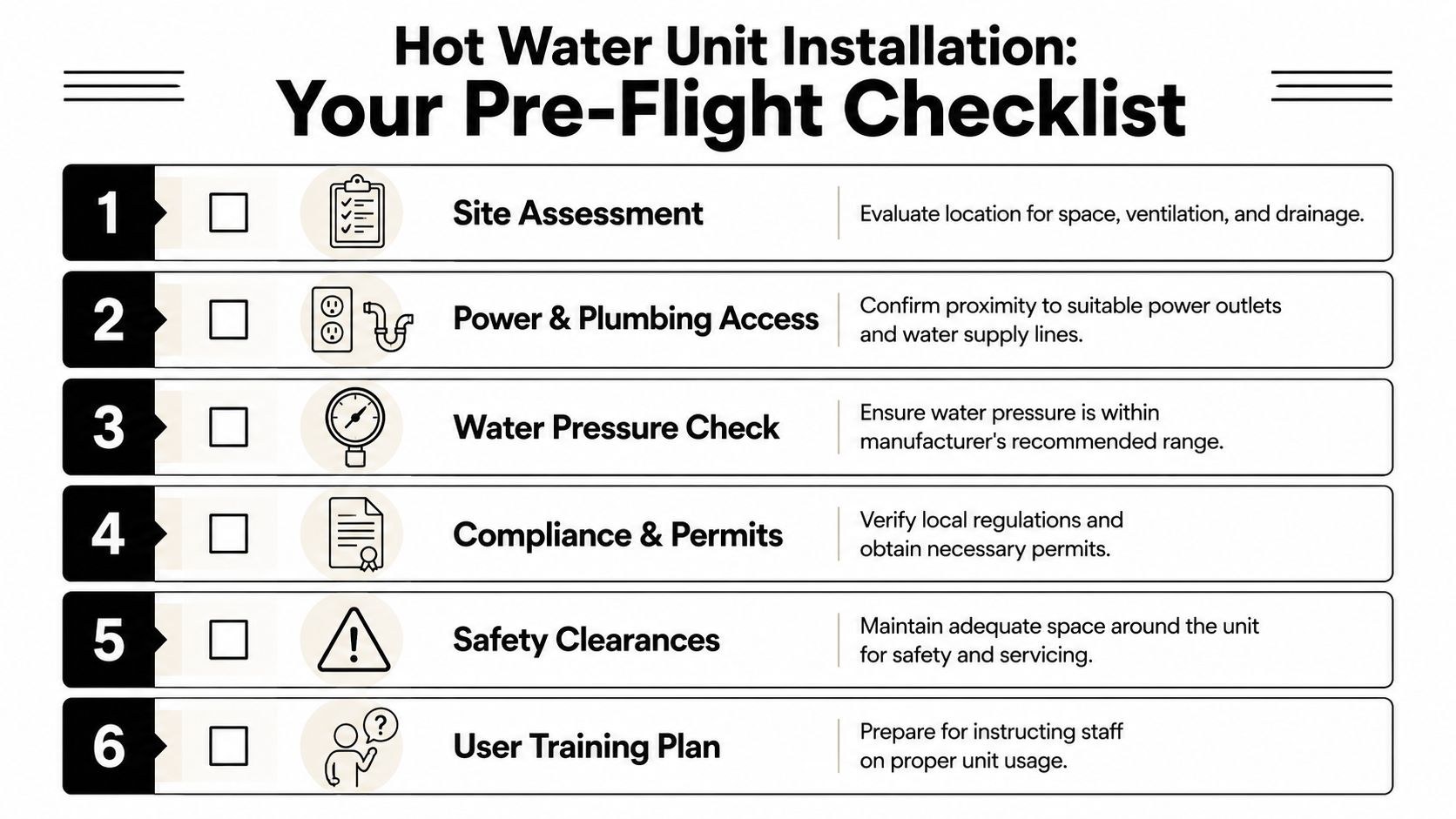
Installation day goes smoothly when the site has already been checked properly. It goes badly when the team discovers there's no isolation access, the cupboard can't fit the tank, or the power supply doesn't suit the unit.
That's why pre-install planning matters more than most buyers expect.
Site checks that prevent expensive surprises
Before approving any workplace tea coffee hot water unit, confirm the basics on site.
- Water supply: You need a suitable mains cold water connection in the right position for the chosen unit.
- Drainage or waste arrangement: Some setups need a proper waste path, especially where venting or overflow protection is involved.
- Electrical supply: Don't assume the nearest outlet is acceptable. Commercial units often need dedicated supply and proper isolation.
- Cupboard and wall space: Measure height, width, and depth. Include clearance for hoses, filters, and future servicing.
- Access for maintenance: A unit that fits physically may still be a poor install if a technician can't reach valves, filters, or connections safely.
Know the legal boundary
A lot of office managers worry they're required by law to provide tea and coffee. That isn't the actual issue. The legal issue starts once you provide equipment.
Australian workplace guidance makes the distinction clearly. There's no legal obligation to provide refreshments, but employers still carry a duty of care under OHS to manage risks, including scalding risks from water above 50°C at the tap, as outlined in Australian guidance on tea and coffee provision in workplaces.
So the practical question isn't “Do we have to provide it?” It's “If we provide it, is it safe and compliant?”
A practical pre-approval checklist
Use this before placing the order:
- Confirm the installation location: Avoid pinch points near microwaves, fridges, and busy sink areas.
- Check who will install it: Use licensed trades where required, especially for plumbing and electrical work.
- Review user risk: Think about children, visitors, older staff, and any environment where accidental contact is more likely.
- Plan servicing access: Filters and internal parts must be reachable without dismantling cabinetry.
- Set staff expectations: Even good systems need basic user care and simple kitchen rules.
If you're comparing office amenity upgrades more broadly, this overview of vending and water filtration in workplace settings is a useful companion because it looks at how beverage infrastructure fits into the wider lunchroom setup.
Planning for Lifetime Costs and Maintenance
The cheapest quote often becomes the most expensive system to own. That's usually because buyers compare purchase price only and ignore the rest of the cost stack.
A better way to assess a workplace tea coffee hot water unit is to treat it like a small asset with ongoing operating needs.
A simple total cost model
Think of total cost of ownership like this:
Purchase price + installation + energy + consumables + servicing + downtime risk
Each line matters.
- Purchase price: The visible number everyone notices first.
- Installation: Can increase if electrical supply, isolation, waste, or cabinetry changes are needed.
- Energy: Varies by unit type, standby behaviour, and whether you're replacing repeated kettle use.
- Consumables: Filters are the main recurring cost in most plumbed systems.
- Servicing: Descaling, thermostat checks, valve replacement, and general maintenance keep the unit reliable.
- Downtime risk: A failed unit in a busy office has a cost even if it doesn't show on the invoice.
What good ownership looks like
The best long-term setups are usually boring in the right way. They heat properly, stay clean, don't leak, and don't generate constant complaints.
A simple in-house routine helps:
- Daily check: Wipe the tap or outlet area and look for drips.
- Weekly check: Clear clutter around the unit and confirm no one has blocked service access.
- Monthly review: Look for scale signs, unusual noise, slower delivery, or user-reported taste changes.
- Scheduled service: Replace filters and inspect critical parts in line with manufacturer guidance and site conditions.
A neglected unit rarely fails all at once. It usually gives warnings first, and staff notice them before management does.
That's why maintenance should be budgeted from day one. A unit that's serviced predictably will usually cost less and cause fewer interruptions than one left untouched until something breaks.
Your Melbourne Solution with Ring Hot Water
For Melbourne workplaces, the practical advantage of using a specialist is that supply, fit-off, repairs, and spare parts are all part of the same conversation. That matters when you're choosing between a Zip wall unit, a Stiebel Eltron boiling system, a Birko urn, or an Insinkerator-style under-sink setup and want advice tied to the site, not just to a catalogue.
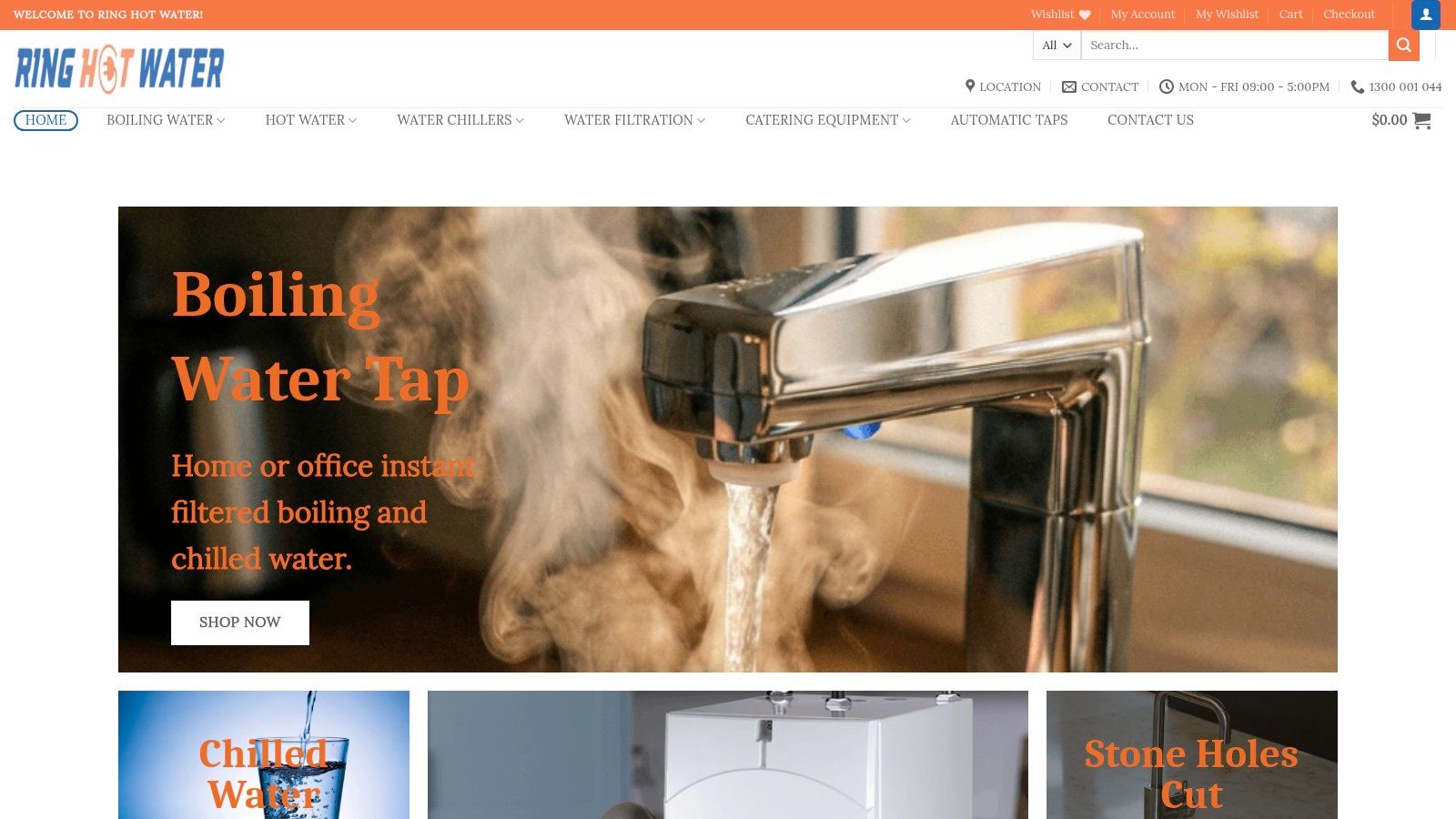
Ring Hot Water supplies and services instant boiling and chilled water systems, filtration components, and commercial hot water hardware across Melbourne, with an online store for products and genuine replacement parts available more broadly. For an office manager, that's useful because selection, installation realities, and aftercare can be reviewed together rather than split across multiple suppliers.
What a specialist should help you sort out
The right supplier should be able to answer practical questions quickly:
- Which unit type fits the kitchen layout
- Whether the existing plumbing and power are suitable
- What filtration setup makes sense for the site
- How servicing and parts replacement will be handled
- What staff need for simple day-to-day use
That support matters more than glossy product sheets. A unit only performs well over time if it's properly matched, installed, and maintained.
When to ask for help
Bring in advice early if any of these apply:
- You're fitting out a new office kitchen.
- The current kettle or urn setup causes daily delays.
- The team wants boiling and chilled water from one point.
- You're getting recurring taste, scale, or reliability complaints.
- You need replacement parts rather than a full unit change.
If you're reviewing product options directly, this overview of a commercial hot water dispenser for workplace use is a good starting point for comparing what suits office kitchens, staff rooms, and higher-demand environments.
If you're planning a workplace upgrade and want advice that covers selection, compliance, filtration, installation, and ongoing servicing, contact Ring Hot Water. A quick discussion around staff numbers, kitchen layout, and daily demand usually narrows the right solution fast.

