
Uncategorized
How Do I Choose a Boiling Water Unit for My Workplace Kitchen
Jul
The question usually comes up after the same week keeps repeating itself. Staff are lined up at the kettle before the first meeting. Someone forgets to refill it. Someone else overfills it. The bench ends up wet, the power point area gets messy, and the kitchen starts feeling too small for the number of people using it.
That's when a boiling water unit stops being a nice upgrade and starts looking like a workplace fix.
If you're asking how do I choose a boiling water unit for my workplace kitchen, the wrong way to do it is to shop by sticker price alone. The cheaper unit often becomes the expensive one once you factor in lost time, slow recovery, filter neglect, awkward installation, and the bigger problem most buyers miss: whether anyone local can service it quickly and get parts when something fails. In a busy office, showroom, factory lunchroom, or staff kitchen, downtime matters.
A good unit should suit your demand, fit the room properly, install cleanly, stay safe to use, and remain easy to maintain for years. That's the difference between a unit people rely on every day and one everyone complains about after the first few months.
Ending the Workplace Kettle Chaos
The pattern is familiar. The first staff member in switches the kettle on. Two more arrive with mugs. Then someone wants hot water for porridge, another wants tea, and somebody else needs it for instant noodles before a training session. The kettle boils, empties, gets refilled, and the queue starts again.
By mid-morning, the kitchen bench looks overworked. There's a puddle near the sink, the kettle cord is twisted around other appliances, and people are standing around waiting for water instead of getting back to work.
A dedicated boiling water unit solves more than boiling speed. It changes how the kitchen functions. Staff can fill a cup quickly, the bench stays clearer, and the hot water point becomes predictable instead of turning into a daily bottleneck. In client-facing spaces, it also looks more organised. In staff-only areas, it works better.
What usually goes wrong with the first purchase
Many workplaces buy the first unit that seems affordable and compact. That's where trouble starts.
They pick a stylish tap without checking whether the under-sink cupboard has room for the tank and ventilation. Or they choose a wall-mounted boiler that suits a workshop lunchroom but looks out of place in a reception kitchen. Sometimes they buy too small, and the queue comes back in a new form. Other times they buy too large, and pay for capacity they never use.
The right unit should remove friction from the kitchen, not shift the problem from the kettle to the cupboard, wall space, or service schedule.
The better approach is practical. Work out how many people need it, when they use it, what kind of drinks and meals it supports, what utilities are available on site, and who will service it when it needs filters, parts, or fault diagnosis. That's how you get value over the full life of the unit, not just on the day you approve the invoice.
Calculating Your Office Capacity Needs
Capacity is the first decision that matters. Get it wrong and every other feature becomes secondary. A premium tap with the wrong recovery rate still creates queues. A large boiler in a small office still wastes money and cupboard space.

Start with peak demand, not headcount
Office managers often begin with total staff numbers. That's useful, but it's not enough. What matters more is how many people draw boiling water within the same short window.
A workplace with steady all-day use can run well on a modest unit. A workplace where employees arrive together, break together, and make drinks at the same time needs stronger recovery and faster delivery. If you're comparing options, it helps to review the main categories of water dispensers for office kitchens so you can match demand patterns to the right style of unit.
Use this simple method:
Count likely users during the busiest period
Don't use total staff. Use the number who are likely to make drinks in the morning rush, at lunch, or during scheduled breaks.Estimate hot water uses per person in that period
Tea, coffee, herbal drinks, soups, noodles, and food prep all count.Check whether the usage is concentrated or spread out
A concentrated rush needs stronger recovery. Spread-out use is easier on the unit.Add a margin for visitors and meeting rooms
Offices with regular guests, boardroom catering, or training sessions often use more boiling water than expected.
A practical office example
Take a mid-sized office. Not everyone uses the kitchen at once, but the morning coffee run creates a sharp spike. If several staff make hot drinks back-to-back and a few also prepare breakfast or instant lunches, a low-capacity unit will recover too slowly. It might dispense well for the first few mugs, then slow down or produce water that's not as hot as people expect.
That's the classic sign of under-sizing. Staff start saying the unit “doesn't keep up”, even though the issue isn't the brand. It's the mismatch between demand and recovery.
Over-sizing has its own problems. You pay more upfront, dedicate more space to the system, and may carry higher ongoing costs for a unit that rarely gets pushed. In small offices, that's unnecessary.
Questions that sharpen your estimate
Ask these before choosing a model:
When is the heaviest use window
Morning rush, lunch break, shift handover, or all-day trickle?What are people making
Tea and instant coffee use less water than soups, oats, noodles, or filling a plunger.Is there a boardroom or client area nearby
Shared demand changes sizing.Will the unit replace a kettle entirely
If yes, assume people will use it more often than they use the kettle now.
This walkthrough is useful if you want to see typical unit styles in context:
Practical rule: Size for the busiest realistic period, not the quiet average day.
What works in practice
For most workplaces, the sweet spot is a unit that handles the usual rush comfortably without being oversized for the rest of the day. The best result isn't maximum capacity. It's enough usable output with solid recovery, fitted to the way your staff use the kitchen.
If you're unsure, map one normal day of kitchen traffic before speaking to suppliers. That short exercise usually tells you more than any brochure.
Comparing Boiling Water Unit Types
Once capacity is clear, the next decision is format. Most workplace kitchens end up choosing between under-sink boiling taps, wall-mounted boilers, and commercial urns. All three can do the job. They just solve different problems.
Under-sink taps
These are the neatest option. The tank hides in the cupboard, while the tap sits on the bench beside the sink. In a modern office kitchen, showroom, or meeting area, this is often the cleanest-looking solution.
The benefit isn't just appearance. You free up bench area, remove the clutter of a separate appliance, and create a more permanent hot water point. Many office managers also prefer the controlled dispensing and reduced visual bulk.
The trade-off is installation complexity. Under-sink systems need enough cabinet space, airflow, access for servicing, and the right power and plumbing layout. Some cupboards look large enough until you account for pipework, waste fittings, cleaning products, and filter housings. If the kitchen is tight, that matters. If you're also weighing a combined hot and cold option, this guide to an instant boiling and chilled water tap helps show where these units suit best.
Wall-mounted boilers
Wall-mounted units are the practical workhorses. They suit staff lunchrooms, warehouses, schools, workshops, and older kitchens where under-bench space is limited or already crowded with storage.
They're usually easier to inspect visually, easier to access for service, and straightforward for staff to understand. If aesthetics matter less than reliability and accessibility, wall-mounted boilers are often the better fit.
Their downside is obvious. They're visible. In a polished office kitchen, some people don't like the commercial look. They also occupy wall space that might otherwise be used for shelving or splashback clearance.
Commercial urns
Urns still have a place, especially in temporary setups, function spaces, training rooms, churches, clubrooms, and seasonal overflow demand. They're familiar, portable, and simple.
But in permanent workplace kitchens, urns are often the least efficient long-term choice. They take up bench space, can look dated, and are more likely to be moved, overfilled, left on unnecessarily, or cleaned inconsistently. They also don't integrate into the kitchen the way a fixed unit does.
The best unit isn't the fanciest one. It's the one that best fits your space, budget, and daily demand.
Boiling Water Unit Type Comparison
| Feature | Under-Sink Taps (e.g., Zip, Stiebel Eltron) | Wall-Mounted Boilers (e.g., Boiling Billy, Birko) | Commercial Urns (e.g., Robatherm, Crown) |
|---|---|---|---|
| Bench space | Excellent, only the tap is visible | Good, bench stays clear | Poorer, unit sits on bench |
| Appearance | Best for polished office kitchens | Functional, commercial look | Basic and utilitarian |
| Installation | More involved | Moderate | Minimal for basic setup |
| Service access | Can be tighter under cupboards | Usually easier to access | Simple, but less integrated |
| Best use case | Offices, boardrooms, client areas | Breakrooms, lunchrooms, back-of-house | Temporary or flexible setups |
| Daily convenience | High | High | Moderate |
| Mobility | Fixed | Fixed | Portable |
| Long-term fit | Strong if correctly installed | Strong for practical spaces | Better as a stop-gap than a permanent upgrade |
What works where
A reception kitchen and a factory crib room shouldn't be specified the same way. That's one of the most common buying mistakes.
- Client-facing office or showroom usually benefits from an under-sink tap because presentation matters.
- Busy staff kitchen with limited cupboards often suits a wall-mounted boiler better.
- Temporary site kitchen or multi-use hall may be fine with an urn, especially if the setup changes often.
The key is to match the unit to the room and the habits of the people using it. Buying on looks alone usually ends badly. Buying on raw capacity alone can do the same.
Essential Technical and Space Requirements
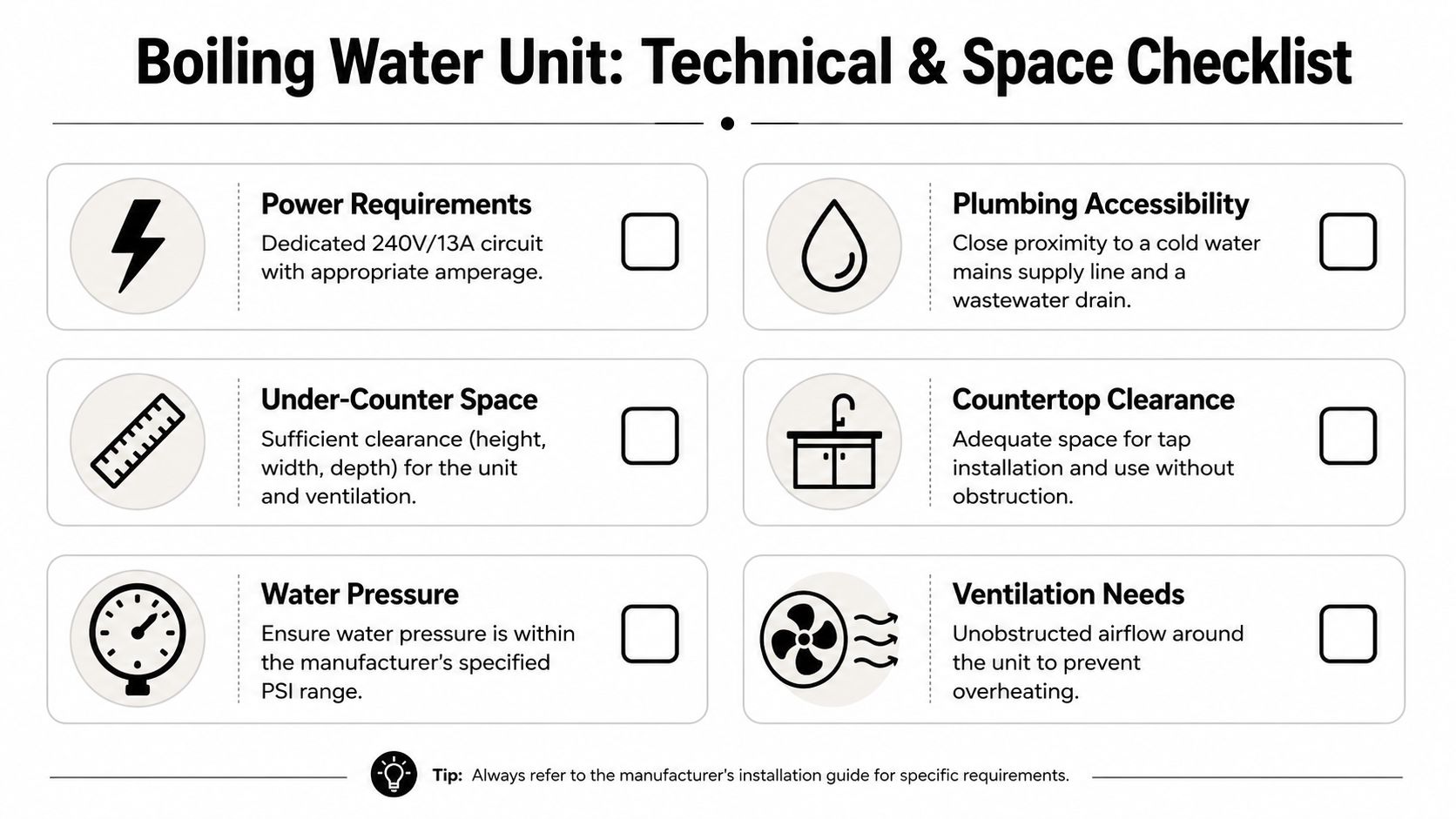
A unit can look perfect on paper and still be the wrong choice for the site. Most expensive surprises happen before the first cup is poured. They happen when the installer opens the cupboard, checks the power supply, or traces the plumbing and finds the kitchen isn't ready for the model that was ordered.
Power and plumbing first
Check electrical supply before you shortlist anything. Some units can work with a standard plug arrangement, while others need a dedicated circuit or a different connection type. If the kitchen already has a fridge, microwave, dishwasher, and other appliances sharing nearby outlets, don't assume there's suitable spare capacity for a boiling unit.
Plumbing matters just as much. You need accessible cold water feed, isolation, and in some cases a waste route depending on the system design and accessories. Under-sink units are especially sensitive to cramped or badly organised cupboards.
Use this pre-purchase checklist:
Power suitability
Confirm what the unit requires, then verify what the kitchen has. Don't rely on guesswork from a photo.Cold water connection
Make sure there's practical access, not just theoretical access behind fixed panels or crowded pipework.Waste arrangement
Some installations are simple. Others become awkward when the sink cabinet is already full of traps, hoses, and cleaning systems.Isolation access
Servicing is harder and riskier when the water shut-off is hidden or difficult to reach.
Space means more than the product dimensions
This catches buyers out all the time. They measure the width of the cupboard, see that the tank will fit, and stop there. But the unit also needs room for hoses, filter heads, bends in the tubing, ventilation clearance, and future service access.
A packed cupboard shortens service life and turns routine maintenance into a frustrating job. If a technician has to dismantle half the cabinet contents just to change a filter or inspect a fitting, the unit is in the wrong place or the wrong format.
A cupboard that is technically large enough can still be functionally too small.
Water quality and filtration
Filtration isn't an optional extra in most workplaces. It protects taste, protects components, and reduces the kind of scale build-up that shortens element life and causes nuisance faults. That's particularly important where water quality creates residue over time.
If the manufacturer specifies a filter setup, follow it. Don't save money by fitting an incompatible cartridge or skipping it altogether. Poor filtration decisions usually show up later as service calls, reduced performance, and warranty arguments nobody wants.
A site check saves grief
Before ordering, stand in the kitchen and answer these plainly:
- Where will staff stand to use the unit
- Can the tap or outlet be reached comfortably
- Will cupboard doors, bins, or drawers interfere
- Can the installer and future service technician access everything cleanly
A boiling water unit should fit the kitchen without creating a new obstacle. If the layout feels forced before installation, it won't feel better afterwards.
Safety, Installation and Long-Term Maintenance
Boiling water in a workplace is a convenience, but it's also a risk point. That's why safety features and maintenance discipline matter more than many buyers expect. The unit isn't just another benchtop appliance. It becomes part of the daily workflow for staff, visitors, cleaners, and maintenance personnel.
Safety features worth insisting on
Different environments need different safeguards, but some features are worth prioritising almost every time. Taps with a safety lock, twist activation, or spring return help reduce accidental operation. Insulated surfaces and controlled outlet design also matter, especially where people are moving quickly in a shared kitchen.
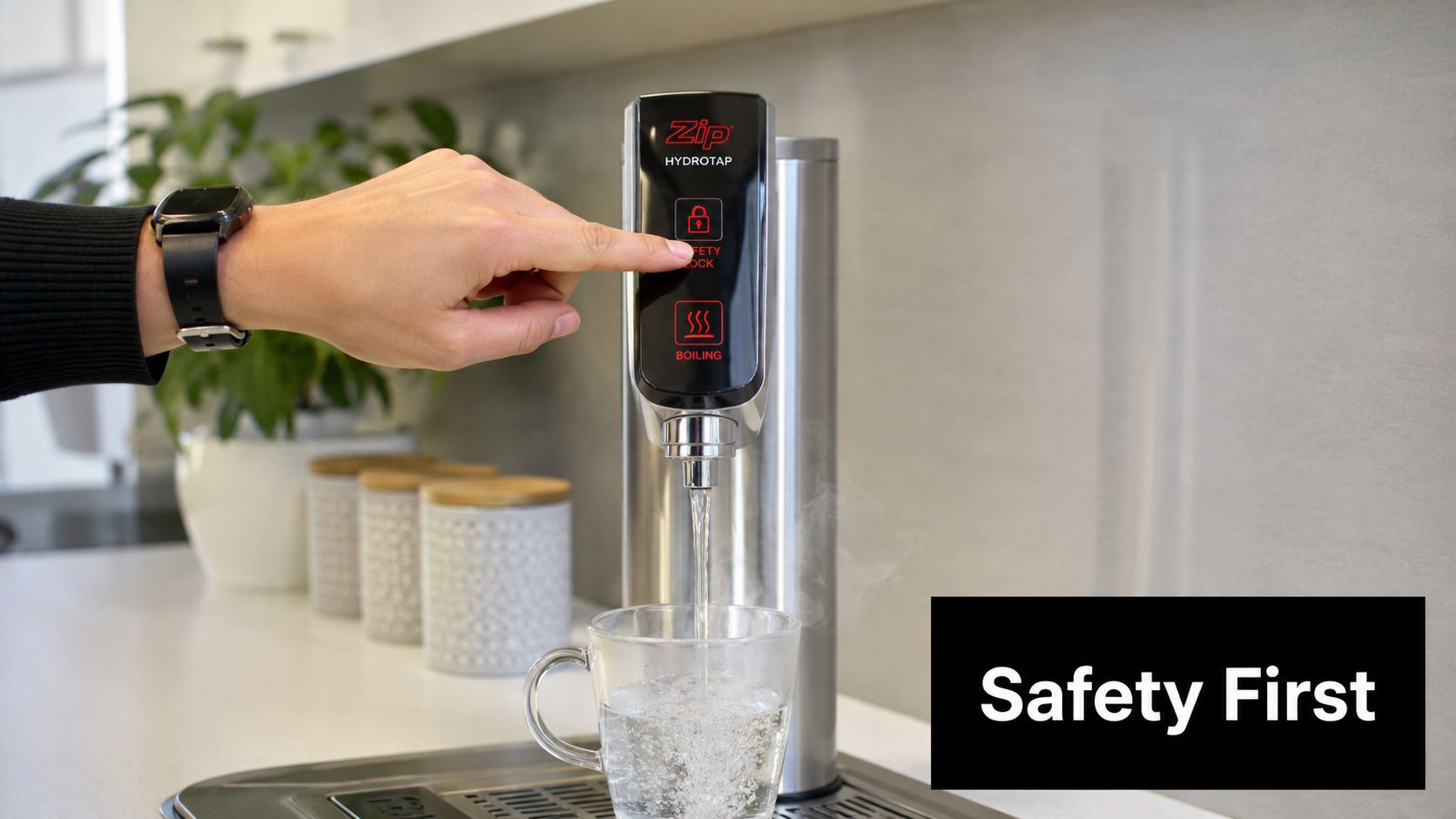
Look for:
Safer dispensing controls
Better than a simple open lever in most shared workplaces.Automatic shut-off protection
Useful if the unit detects fault conditions or abnormal heating behaviour.Stable tap positioning
A tap or outlet shouldn't wobble, twist loosely, or feel vulnerable to impact.Clear user operation
Staff shouldn't need a lesson every time they want hot water.
Why professional installation isn't optional
A poor install can turn a good unit into a constant problem. Leaks under a cupboard aren't always obvious straight away. Bad electrical setup creates a bigger risk. Poor hose routing can stress fittings. Inadequate ventilation can overheat components. Incorrect tap positioning can make the unit awkward and less safe to use.
That's why fixed boiling units should be installed by qualified trades who understand both the product and the site conditions. Compliance matters, but so does practical workmanship. The neatest installations usually come from teams who've worked on these units repeatedly, not from someone treating it like a basic appliance swap. If you're reviewing what a proper setup involves, this overview of under-sink boiling water unit installation is a useful baseline.
Maintenance is part of the ownership cost
The unit you buy today will only stay reliable if someone looks after it. Filters need replacing. Scale needs attention. Safety features need checking. Seals, valves, and other wear parts don't last forever.
What doesn't work is the “leave it until it fails” approach. In offices, that usually means the fault appears on the busiest day, staff go back to the kettle, and the workplace loses the convenience it paid for.
A better pattern is simple:
- Set a service reminder based on the manufacturer's guidance and actual usage.
- Replace filters on schedule rather than waiting for taste or flow problems.
- Inspect for leaks and heat stress during routine kitchen checks.
- Use genuine or compatible approved parts when components wear out.
Neglected units rarely fail at a convenient time. They fail when the kitchen is busiest and nobody has a spare plan.
Kitchen compliance thinking matters
Even though a boiling water unit isn't the same as drainage or grease infrastructure, the same discipline applies. Workplaces should treat serviceable kitchen equipment as part of a broader compliance mindset. For businesses managing food areas or commercial kitchen operations, guidance on how to ensure restaurant grease trap compliance is a good example of how small maintenance failures can become larger operational problems when ignored.
A boiling water unit should be easy to use, safe by design, and straightforward to maintain. If any of those three are weak at purchase stage, the problems will show up later.
Budgeting Supplier Vetting and Your Final Checklist
Sticker price is the easiest number to compare, and often the least useful. The better question is what the unit will cost your workplace over its full life. That means energy use, filters, service access, installation quality, downtime risk, and spare parts availability.
A cheap unit with awkward servicing and hard-to-source parts can become a nuisance asset. A more expensive unit with strong local support can be the better buy because it stays running, parts arrive faster, and technicians already know the system.
Think in total cost of ownership
When comparing quotations, don't just compare model names and upfront supply price. Compare the full ownership picture.
Ask what ongoing costs are likely to look like in practical terms:
Filters and consumables
How easy are they to source, and does the unit rely on a proprietary setup?Routine service access
Will a technician be able to work on it without dismantling cabinetry?Spare parts support
Are valves, thermostats, tap components, and fittings realistically available?Downtime exposure
If the unit fails, can someone local attend promptly, or will you wait while parts are tracked down?
That last point gets overlooked constantly. In a busy workplace, local serviceability has real value. If nobody nearby carries parts for your chosen brand, the purchase price stops looking attractive very quickly.
Vet the supplier, not just the product
The supplier matters almost as much as the unit. You're not only buying hardware. You're buying advice, installation quality, support, and access to parts later.
Use this checklist when speaking to suppliers:
Which brands do you service, not just sell
There's a big difference.Do you carry genuine spare parts locally
Especially for brands like Zip, Birko, and Boiling Billy.Who handles installation and future maintenance
A clean handover now is worth a lot later.What happens if the unit faults after installation
Ask about response process, not vague promises.Can you assess the site before final recommendation
Serious suppliers want to avoid mismatches.
Here's the kind of contact point you want to see from a supplier that supports both product advice and after-sales help:
Don't ignore the surrounding kitchen habits
Sometimes the boiling water decision sits inside a broader staff kitchen review. If your workplace is also looking at beverage stations, takeaway habits, or meeting room drink service, it's worth considering what else is creating recurring waste and cost. For example, a comprehensive review of disposable coffee cups can help frame whether the kitchen setup encourages more sustainable daily use.
The final shortlist test
Before approving a unit, ask yourself:
- Does it suit peak demand without obvious overkill
- Will it fit the space properly, including service access
- Does it have the right safety features for the workplace
- Can local technicians maintain it and source parts
- Will it still be a sensible choice in a few years
If the answer to any of those is shaky, keep looking. The best purchase usually isn't the cheapest or the most premium-looking. It's the one that keeps working, fits the kitchen properly, and can be supported locally without drama.
If you want help choosing a workplace boiling water unit that suits your kitchen, usage, and long-term servicing needs, Ring Hot Water can help with product advice, genuine parts, installation support, and ongoing maintenance across Melbourne.

