Uncategorized
Is a Boiling Water Tap More Energy Efficient Than a Kettle in Australia? The
Jun
If you're asking whether a boiling water tap is more energy efficient than a kettle in Australia, the usual online answers miss the part that determines the result. They compare appliances, but not habits.
That's a problem because in Australian homes and workplaces, usage pattern matters more than brochure claims. A kettle can be very efficient if you boil only what you need. A boiling water tap can be more efficient if people keep making drink after drink and would otherwise reboil a kettle all day. The actual cost sits in that gap between ideal use and real use.
That's also why broad overseas comparisons often feel incomplete for local buyers. Australian households face different electricity pricing, different kitchen routines, and different expectations around convenience. If you're trying to save with Cashback Australia on energy, this is one of those purchases where the smartest decision comes from matching the appliance to the way you live, not the way manufacturers hope you'll use it.
For a closer look at the hardware itself, Ring Hot Water also has a practical guide to the instant boiling water tap format and how it fits into Australian kitchens.
The Boiling Point on Kettle vs Tap Energy Efficiency
The short answer is sometimes yes, sometimes no.
A boiling water tap isn't automatically more efficient than a kettle, and a kettle isn't automatically the cheaper option to run. The better choice depends on four things: how often you need hot water, whether you overfill the kettle, how much standby power you're willing to tolerate, and how high your local electricity rates are.
The Australian question most people skip
Many comparisons start from the wrong assumption. They treat energy efficiency like a fixed product feature. In practice, it's a behaviour question.
In Australia, public guidance on appliance efficiency consistently points out that a kettle is near-100% efficient at converting electricity into heat, so the waste usually comes from the user, not the appliance itself. If you boil too much water, reboil old water, or fill a large kettle for one mug, your costs rise. If you don't, the kettle is hard to beat for occasional use.
Early comparison table
| Option | How it uses power | Best for | Less suited to |
|---|---|---|---|
| Electric kettle | Draws high power only while boiling | Occasional hot drinks, low-use homes, renters | Repeated daily boils where people overfill or reboil |
| Boiling water tap | Maintains heat with ongoing standby use and reheats as needed | Busy homes, shared kitchens, offices, frequent drink stations | Low-use households where standby power runs all day for little benefit |
Practical rule: If your kitchen has long gaps between uses, a kettle usually makes more sense. If people want hot water repeatedly across the day, a boiling tap starts to make a stronger efficiency case.
What Australian buyers should focus on
The most useful way to assess the question isn't “Which appliance is better?” It's this:
- Count frequency: How many separate times do people want boiling or near-boiling water?
- Watch behaviour: Does your household boil one cup or half a kettle?
- Price standby: A boiling tap can save energy during heavy use, but it doesn't switch off when nobody's home unless you manage it that way.
- Separate energy from convenience: They overlap, but they're not the same thing.
That distinction matters. Plenty of households choose a boiling water tap because it improves workflow, frees bench space, and removes waiting time. Those are valid reasons. They're just not always the same as the cheapest energy outcome.
Understanding Peak Load vs Standby Loss
Why do some Australian kitchens save money with a boiling tap while others are better off with a kettle, even when the tap uses only a small amount of power at rest?
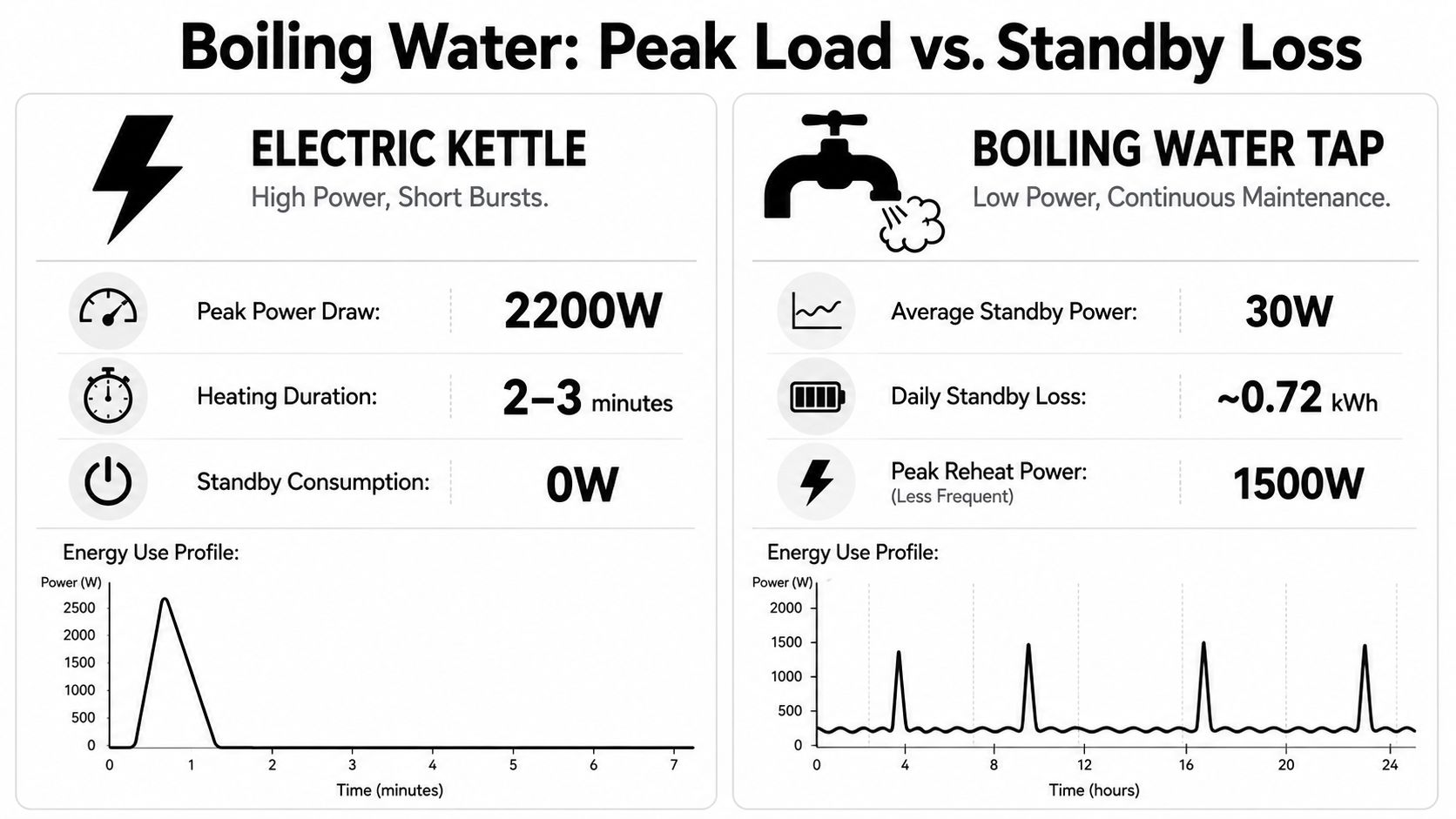
The answer sits in the difference between peak load and standby loss. A kettle concentrates its electricity use into a short, high-demand burst. A boiling water tap spreads part of its electricity use across the whole day by keeping stored water near serving temperature.
How the load profile changes the result
One published comparison from Brita describes a kettle drawing 2 to 3 kilowatts while heating, while a boiling water tap may have a standby draw of around 10 watts and may use up to 50% less energy in the right usage pattern.
Those figures are useful, but only if you read them in context.
A kettle's high wattage looks expensive because the number is large. In practice, the appliance runs at that load for only a few minutes, then stops drawing meaningful power. A boiling tap does the opposite. Its standby draw is small, but it can continue through work hours, overnight, weekends, and holidays unless the unit is switched off or programmed around occupancy.
For Australian buyers, that distinction matters because local electricity tariffs are high enough that standby consumption is not trivial. The question is not which product has the lower wattage at any moment. The question is which pattern matches the way your kitchen is used.
What standby loss means on a real bill
Standby loss is the energy used to keep water hot when nobody is actively pouring it. That cost is easy to underestimate because it arrives subtly, rather than in one obvious heating cycle.
Peak load is different. A kettle places a heavier short-term demand on the circuit, but the cost is tightly linked to each boil. If a household boils only one or two cups at a time and does not overfill, the kettle's stop-start pattern can be very efficient. If six people make drinks across the morning, then again after lunch, repeated kettle boils can waste more energy than a tap holding a small reservoir near temperature.
This is why UK-style comparisons often miss the Australian reality. They often focus on the appliance alone, not on the interaction between local tariffs, occupancy, and idle hours. In an Australian office that runs five days a week, standby losses over evenings and weekends need to be counted. In a family home with long daytime absences, they matter even more.
Where each appliance tends to win
Use pattern decides the outcome more than product category.
| Usage pattern | What usually happens | Better fit |
|---|---|---|
| One or two boils, widely spaced | Standby hours outweigh convenience gains | Kettle |
| Repeated drinks in short blocks | Reboiling and overfilling start to add up | Boiling tap |
| Kitchen unused for long stretches | Stored hot water sits there losing heat | Kettle |
| Shared office or busy family kitchen | Many small draws favour ready hot water | Boiling tap |
There is also a peak-demand angle that gets overlooked. A kettle draws a larger load in one burst, but Australian households are billed mainly on energy consumed, not on short appliance spikes. For most homes, the bigger cost risk is not the kettle's brief peak. It is the boiling tap's background consumption during hours when no one needs it.
For buyers comparing other on-demand hot water formats, the same logic applies to tankless instant water heater systems. Efficiency depends less on the label and more on whether the system avoids unnecessary stored-heat losses in your actual usage pattern.
Calculating the Running Costs in Melbourne and Beyond
Many articles become frustrating for Australian readers. They'll say a boiling tap “uses less energy” or that a kettle “costs less to buy”, then stop before converting those ideas into a local decision.
The most practical Australian benchmark available for kettles is straightforward. One consumer guide says a 1.7-litre kettle at 2200 watts can take 4 minutes 19 seconds to boil, and that a kettle can cost almost 5 cents per boil depending on size and wattage, according to Waterpeople's guide to boiling water taps.
That figure is useful because it gives you a working ceiling for repeated kettle use. But it still doesn't answer your bill unless you know how often the kettle is used.
A realistic way to compare cost in Australia
Because Australia-specific running-cost modelling is still thin, the safest approach is to use the verified kettle benchmark above and compare it against the standby-versus-frequency logic already outlined.
Here's the core point: you can't calculate a universal Melbourne winner without measuring your own behaviour. A household that boils one kettle in the morning and one at night behaves very differently from an office kitchenette where ten people make drinks in waves all day.
Boiling Water Tap vs Kettle Annual Cost Scenarios Melbourne 2026
The table below avoids invented dollar figures for boiling taps and instead shows the likely direction of cost based on verified evidence.
| Usage Scenario | Kettle Annual Cost | Boiling Tap Annual Cost |
|---|---|---|
| Low-use household | Usually lower, especially if users boil only what they need | Usually higher or harder to justify because standby power keeps running |
| Busy family kitchen | Can rise quickly if the kettle is repeatedly overfilled or reboiled | Can be competitive and may be lower if use is frequent across the day |
| Small office or shared staff room | Often less efficient in practice because people reboil repeatedly | Often the stronger running-cost option because demand is steady and frequent |
What Melbourne buyers should do instead of guessing
Use a simple audit over a normal week.
Count boiling events
Don't count cups. Count how many separate times someone starts the kettle.Check fill behaviour
If people fill to the top for one or two mugs, the kettle's theoretical efficiency won't help much.Note dead hours
If nobody uses hot water for long stretches, standby loss matters more.Separate home from office logic
An office pantry and a two-person apartment shouldn't be judged by the same standard.
Cost check: A kettle's per-boil benchmark is easy to understand. A boiling tap's economics depend on whether it replaces repeated waste or simply adds continuous standby to a low-use kitchen.
Where the crossover usually happens
The crossover point is behavioural, not universal.
For a low-use home, the kettle usually stays ahead because you only pay when you boil. For a high-frequency kitchen, especially a shared one, a boiling tap can start to make more sense because it reduces repeated full-kettle cycles. That's also why many buyers considering whether to replace a kettle with a tap should begin with routine mapping before they think about brands or finishes.
The Australian gap nobody should ignore
One of the biggest gaps in published coverage is that Australia-specific running-cost comparisons are still limited, especially ones that reflect local electricity pricing, actual kettle habits, and all-day standby power together. That's why imported or brand-led comparisons often sound more certain than they should.
If you want the honest answer, it's this: in Australia, your kitchen routine decides the winner more than the appliance label does.
When to Choose a Tap or Kettle for Household vs Office Use
Who uses boiling water often enough for a boiling tap to beat a kettle on running cost in Australia?
The answer usually depends less on the appliance and more on the pattern of use. In homes and workplaces, both options turn electricity into heat efficiently. The key difference is whether you pay in short bursts when you boil, or all day through standby losses plus occasional draw-off. For Australian customers facing relatively high electricity prices, that distinction matters.
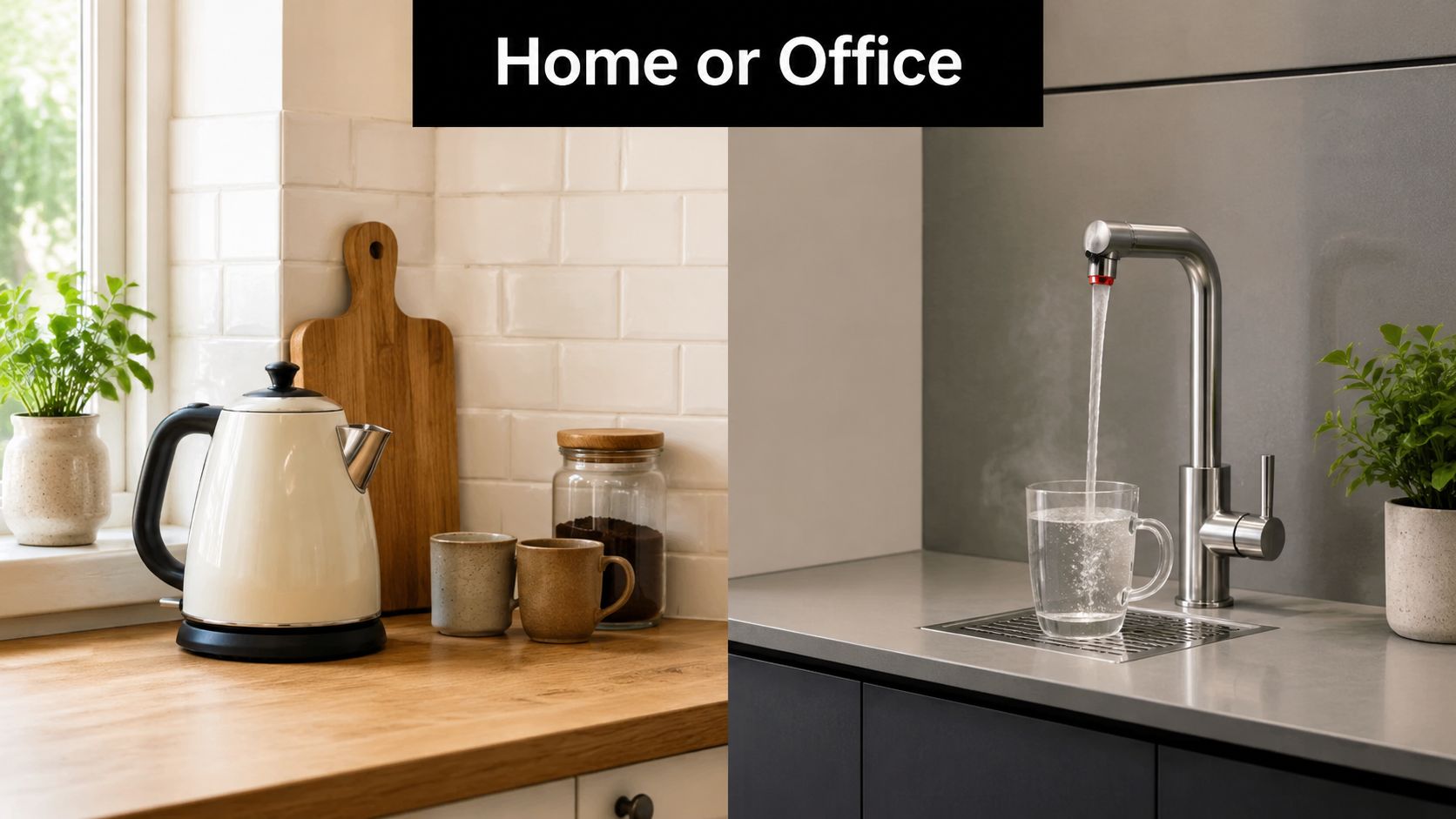
The occasional user at home
A low-use household usually gets better value from a kettle.
If one or two people make a few hot drinks a day, a kettle only draws power when needed. A boiling tap keeps a tank hot between uses, so part of the electricity bill arrives even during quiet periods. In an Australian apartment, granny flat, or two-person household where the kitchen sits idle for hours, standby cost can outweigh any savings from avoiding overfilling.
The practical test is simple. If you often boil exactly what you need, the kettle is hard to beat.
The busy family kitchen
A family kitchen changes the maths because demand is scattered across the day. Breakfast drinks, school lunches, instant meals, baking prep, and visitors can produce repeated partial uses that encourage overfilling and reboiling.
In that setting, a boiling tap can reduce waste if the alternative is a large kettle being filled well above what each person needs. The gain is behavioural, not automatic. A disciplined household using a smaller kettle carefully may still spend less overall. A household that repeatedly boils surplus water may find the tap narrows the gap or pulls ahead on convenience with only a modest running-cost penalty.
A useful rule is frequency plus spread. If boiling water is needed many times from early morning to late evening, a tap has a stronger case than it does in a kitchen with two short usage windows.
The office pantry or staff room
An office is where boiling taps often make the most operational sense, even before energy savings are considered.
Shared kitchens create a pattern kettles handle badly. One person fills for four cups. Another reboils ten minutes later. Someone leaves water sitting, then starts again. The result is not just extra electricity use. It is delay, clutter, and small interruptions repeated across the workday.
A boiling tap suits offices best when demand is frequent, spread across many users, and concentrated into short break periods. In that environment, standby power is easier to justify because the unit is serving people regularly. The value also comes from shaving minutes off repeated kettle cycles, which matters more in a workplace than at home.
A short demonstration often helps people visualise how these systems fit into a working kitchen:
The hospitality or high-traffic setting
High-traffic spaces are a separate category. Waiting rooms, training rooms, communal break areas, and light hospitality settings often need fast access to boiling water throughout the day, not just at morning tea.
Here, a kettle can become the wrong tool even if its raw energy profile looks acceptable in isolated boils. Service speed, queueing, refill frequency, and bench management start to matter more. A boiling tap or commercial boiling unit is often the better fit because it supports continuous shared use with less interruption.
That is also why suppliers such as Ring Hot Water come up more often in business discussions than in low-use household comparisons. The relevant products are not limited to domestic boiling taps. They also include wall-mounted boilers, chillers, urns, and replacement parts designed for heavier demand.
For Australian buyers, the dividing line is usually straightforward. Choose a kettle for low-frequency, predictable use. Consider a boiling tap for high-frequency, spread-out demand where standby losses are offset by reduced reboiling, less wasted water, and better workflow.
Installation Maintenance and Return on Investment
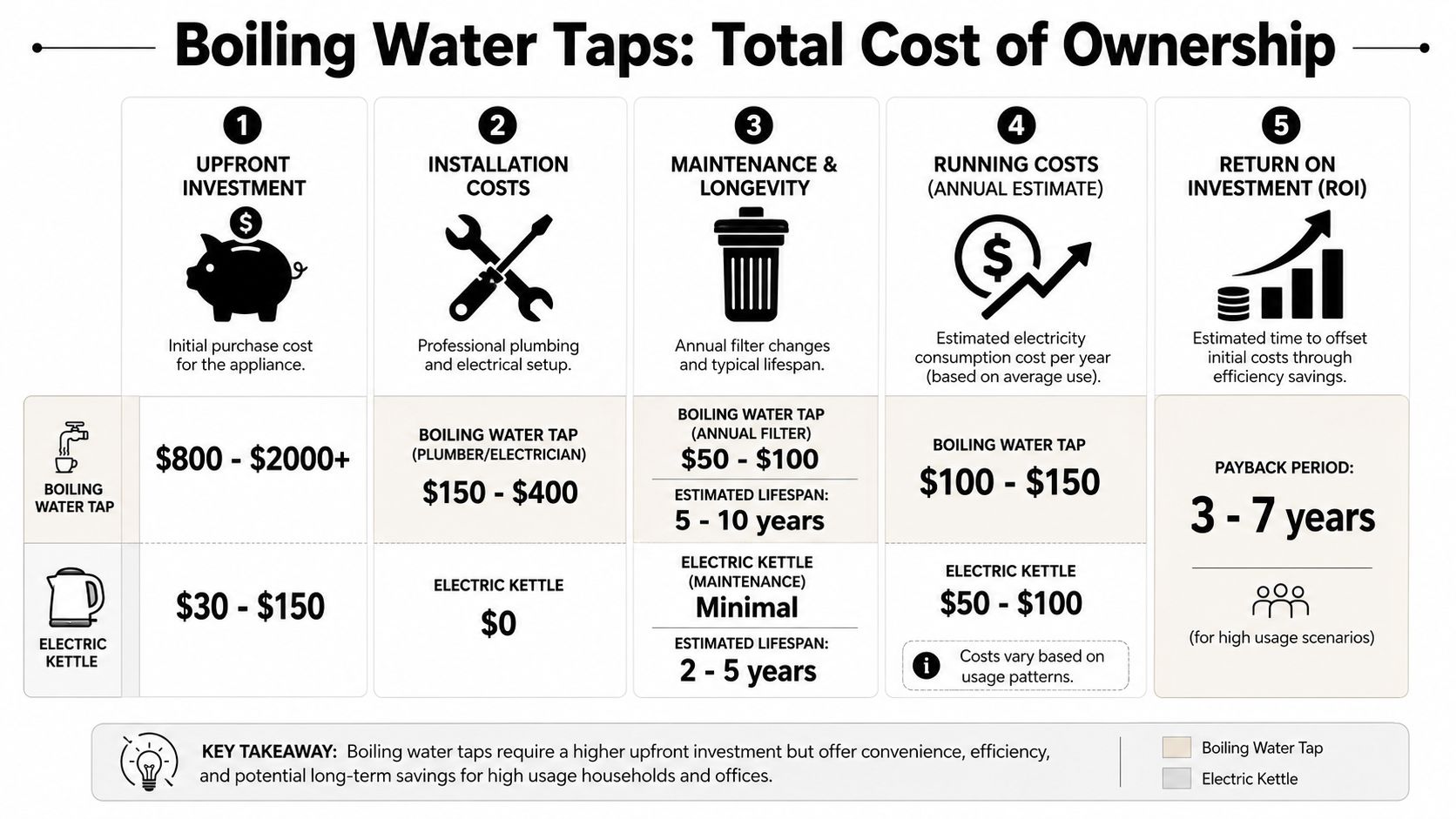
Running cost is only part of the ownership picture. For most Australians, the larger financial question is whether the energy savings, if they happen, are meaningful enough to justify the extra cost of buying and maintaining a boiling tap.
That's where the simple “taps are more efficient” pitch often falls apart.
Why upfront cost changes the answer
A kettle is usually a low-friction purchase. You buy it, plug it in, and replace it easily when it fails.
A boiling tap is different. It's a system purchase. You're paying for the tap, the under-sink unit, installation complexity, and often regular filter or servicing requirements depending on the model. Even if the tap reduces energy use in a busy setting, the savings can still be too small to deliver a quick payback.
One independent analysis reached that exact conclusion. It found that savings are often small enough that the upfront cost can take years to recover, and that a kettle can still be cheaper for many households even if the boiling tap uses less energy in high-use settings, according to this independent review of boiling tap payback and costs.
What a realistic ROI calculation looks like
A sensible return-on-investment check in Australia should include more than electricity:
- Purchase cost for the tap system itself
- Installation cost for plumbing and, where required, electrical work
- Standby power over the full week, not just during active kitchen hours
- Filter replacement and maintenance if your chosen model requires it
- Kettle replacement pattern if you're comparing against a basic appliance that may be swapped out easily
If you leave out any of those, the payback estimate becomes too optimistic.
Buyer warning: A boiling tap can be the right kitchen upgrade and still not be the fastest financial payback. Convenience and workflow often carry more weight than pure energy savings.
Who usually gets the best return
Return tends to be strongest where all of these are true:
| Setting | ROI outlook |
|---|---|
| Low-use home | Usually weak. Standby can outweigh the savings from avoided kettle boils |
| Busy household | Mixed. Better if people frequently overfill or reboil |
| Office or shared workplace | Often stronger because frequent use spreads the fixed costs across more demand |
| Renovation project | Sometimes easier to justify because installation is being done anyway |
The ownership decision most people actually make
Most buyers don't choose a boiling tap because they expect a dramatic drop in their power bill. They choose it because it changes the kitchen.
It clears bench space. It removes waiting. It can make a family kitchen or office pantry feel more organised. When the usage level is high enough, the running-cost argument supports the purchase. When usage is low, convenience usually becomes the only honest reason to proceed.
That's not a weakness. It's just a more accurate way to think about total value.
The Final Verdict Which Is Right for Your Australian Kitchen
So, is a boiling water tap more energy efficient than a kettle in Australia?
It can be, but only in the right usage pattern.
If your household or workplace uses hot water frequently across the day, a boiling tap can reduce the repeated waste that comes from full-kettle boils, reheating from cold, and inconsistent user habits. That's where its efficiency case is strongest.
If your hot water use is occasional, a kettle usually remains the smarter energy choice because it only uses electricity when you switch it on. In low-use settings, standby power becomes hard to justify.
Choose a kettle if
- You make hot drinks only occasionally
- Your household has long periods with no demand
- You want the lowest upfront cost
- You're renting, moving soon, or don't want installation work
- You're disciplined about boiling only the amount of water you need
Choose a boiling water tap if
- Your family uses hot water repeatedly throughout the day
- You manage a staff kitchen, office pantry, or shared break room
- People often overfill and reboil the kettle
- Bench space, convenience, and faster kitchen flow matter to you
- You're happy to think in long-term ownership terms rather than instant payback
The biggest mistake is expecting one answer to fit every Australian kitchen. Energy efficiency here is behavioural. A kettle rewards careful use. A boiling tap rewards frequent use.
If you want the practical conclusion, it's this: low-use kitchens usually save more with a kettle, high-use kitchens often get better results from a boiling tap, and the financial case for the tap gets much stronger in offices than in quiet homes.
If you're comparing options for a Melbourne home, office, or hospitality space, Ring Hot Water offers boiling and chilled water systems, spare parts, and servicing support that can help you match the right setup to your actual usage pattern rather than buying on guesswork alone.

