
Uncategorized
Guide: What Is the Best Under-sink Hot Water System for an Australian Kitchen
Jun
You're usually looking into this after the same few annoyances pile up.
The kettle hogs bench space. It takes longer than it should when everyone wants a tea or coffee at once. The sink is a walk away from the main hot water service, so you run water and wait. Then you start wondering whether an under-sink system is worth it, or whether it's one of those products that looks clever in a showroom and becomes a headache once it's inside a real Australian kitchen cabinet.
That's the right question to ask.
For most homes, the answer to what is the best under-sink hot water system for an Australian kitchen isn't about picking the flashiest tap. It's about getting the right type of unit for the way you use the sink, making sure it fits the cabinet, and making sure the plumbing and electrical side is compliant from day one. Running costs matter. So does service access. So does whether the unit leaves room for your bin pull-out, filter cartridges, trap and hoses.
Tired of Waiting for the Kettle to Boil?
The usual trigger is a busy kitchen at the wrong time. Breakfast is underway, two people want hot drinks, someone is rinsing lunch containers, and the kettle is parked on the bench doing one slow job at a time.

That frustration is real, but the better question is what changes once the unit goes under the sink. In Australian kitchens, the answer is not just faster hot water. It is whether the system fits around the trap, pull-out bin, filter cartridges and cleaning products, whether the power supply is in the right spot, and whether the product itself is approved for use here.
I see the cabinet problem every week. A client buys a nice-looking under-sink unit online, then we open the cupboard and find a bin drawer on one side, a water filter on the other, and barely enough room left for the hoses to bend properly. On paper the unit fit. In a real cabinet, it didn't.
Why buyers look at these systems now
Under-sink hot water used to be treated as a premium extra. In practice, many households look at it for plain everyday reasons. They want to clear the bench, stop waiting for hot water at the sink, and avoid wasting water while the main service catches up.
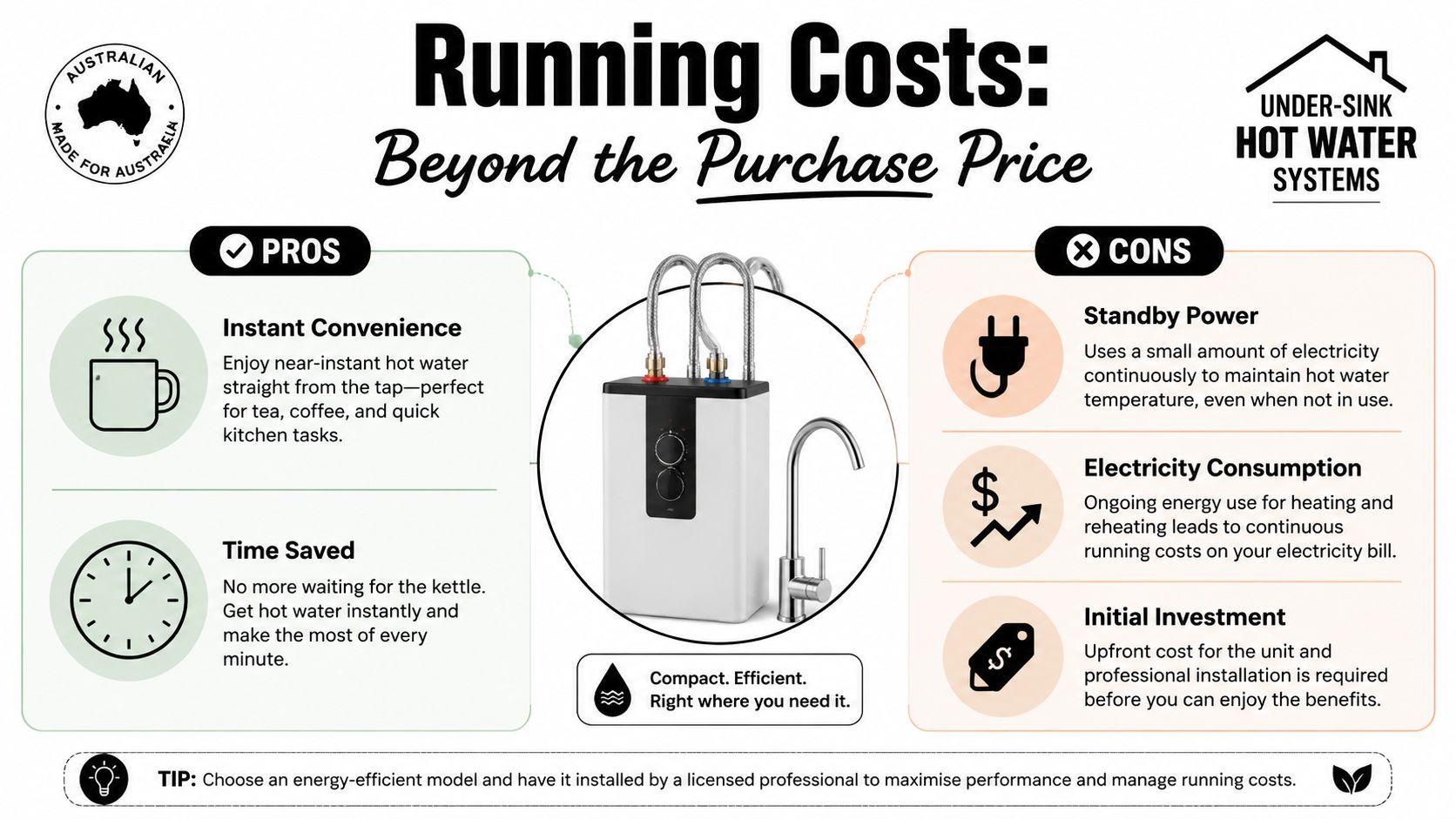
Running costs matter as well. Some systems only heat small amounts as needed. Others keep a small tank hot under the bench, which can use more power over time even if the upfront price looks sharper. The cheap unit is not always the cheap unit to own.
Compliance catches people out too. For an Australian kitchen, the unit and its components should be WaterMark certified where required, and the electrical side has to suit the product and the site conditions. That is not brochure material, but it matters more than the tap finish.
Practical rule: Choose the system that fits the cabinet, suits how the sink is actually used, and can be installed compliantly without awkward electrical or plumbing work. Speed matters. So do space, service access and ongoing power use.
Decoding Your Options Main System Types
The biggest mistake buyers make is comparing brand names before they've worked out the system type. Start with the hardware category first. Once you know that, the brand shortlist gets much easier.
The three setups most Australian buyers actually choose
Some households want one tap that does nearly everything. Others just want boiling water for drinks. Others need a compact heater under the sink for washing and general sink use.
Here's the simple breakdown.
| System Type | Primary Function | Typical Use Case | Pros | Cons |
|---|---|---|---|---|
| All-in-one boiling, chilled and sometimes sparkling tap | Multiple water types from one tap | High-use kitchens, entertaining, premium renovations | Saves bench space, very convenient, combines functions | Higher upfront cost, more under-sink components, needs careful layout |
| Dedicated instant boiling tap | Fast near-boiling or boiling water for drinks and food prep | Tea, coffee, quick cooking tasks | Focused function, cleaner setup than a kettle, frees bench space | Usually doesn't replace standard hot water for washing up |
| Compact under-bench storage heater | Supplies sink hot water from a small local tank | Kitchens needing quick hot water for washing and light prep | Straightforward for local sink use, hidden under bench | Takes cabinet room, can have standby losses, must be sized properly |
All-in-one systems
This is the premium end of the market. Think of the taps people install when they want filtered boiling water, often chilled water as well, from one fixture. They suit busy kitchens where convenience matters every day and the household is happy to pay more for fewer appliances on the bench.
The trade-off is under the sink. These systems can eat up more cabinet room than people expect because you're often fitting a command unit, filtration, hoses and ventilation clearances. They work well, but only if the cabinetry and plumbing layout are planned around them.
Dedicated instant boiling taps
These are more focused. They're ideal for households that mainly want fast cups of tea, coffee and quick cooking water without stepping up to a full all-in-one setup.
They're often the sweet spot for buyers who want the convenience of instant hot water but don't need chilled or sparkling features. If you're comparing broader electric hot water options for a home, especially in Queensland conditions, this guide to the best hot water service for Brisbane homes is useful context because it shows how different electric systems suit different use patterns.
For buyers considering instant technology specifically, Ring Hot Water also has a useful overview of tankless instant water heater options that helps clarify where point-of-use units fit.
Compact under-bench storage heaters
These are the practical workhorses. They're less about boiling water for drinks and more about giving a kitchen sink its own local hot water source. In some homes, that's exactly the right answer, especially where the main hot water service is a long run away or the kitchen is part of an extension.
The best unit on paper isn't the best unit in your kitchen if it steals the whole cabinet or can't be serviced without removing half the plumbing.
These systems are simple in concept, but sizing matters. Too small and they run out under repeated use. Too large and you've given away cabinet space and increased idle losses for no real gain.
Matching Capacity and Performance to Your Household
Once you've picked the system type, capacity becomes the primary decision point. At this stage, a lot of buyers either overspend or end up disappointed.
A kitchen system should match what happens in your house. Two people making a couple of coffees in the morning need something different from a family using the sink constantly for drinks, rinsing, cooking and repeated clean-up.
Think in habits, not just specs
The useful way to size an under-sink unit is to ask:
- Drinks only: Are you mostly making tea and coffee?
- Cooking support: Do you want quick hot water for pasta, blanching or food prep?
- Sink use: Will it also cover hand washing and light dish rinsing at the kitchen sink?
- Back-to-back demand: Do several people use it within a short window?
Australian product guidance notes that kitchen sink hot water heaters can deliver water up to 75°C within seconds when they're correctly sized and installed with the right thermostat, safety controls and a dedicated circuit, according to kitchen sink hot water heater guidance from Ring Hot Water.
That sounds straightforward, but it's only true when the unit suits the demand. A small point-of-use heater can feel excellent for one or two quick draws, then drop away when several uses happen one after another.
What works in practice
Use this as a rough decision framework, without getting lost in litres and marketing labels:
Light-use household
A couple, apartment kitchen, mostly drinks and quick rinsing. A smaller point-of-use unit or dedicated boiling setup usually makes sense.Average family kitchen
Repeated use across the morning and evening. For such usage, recovery speed matters as much as tank size.Heavy-use kitchen
Lots of tea and coffee, regular cooking, more than one person using the sink back-to-back. Don't undersize it just to save cabinet room.
Buy for the busiest half hour of your normal day, not the quietest one.
Don't confuse temperature with performance
Some buyers chase the hottest number and miss the bigger issue. The better question is whether the system can maintain useful output during repeat use without constant waiting. That's where electrical capacity, thermostat control and recovery speed all matter together.
If you're unsure, map out one normal day in the kitchen. Count the moments when someone needs hot water quickly. That will tell you more than a brochure ever will.
Understanding Energy Use and True Running Costs
Purchase price gets most of the attention. Ongoing cost is what decides whether you stay happy with the system.
Australian buyers tend to ask a fair question. Is an under-sink unit cheaper to run than what I've already got, or am I just swapping kettle use for another electric appliance? The honest answer is that it depends on the system type, how often you use it, and whether the unit sits there reheating stored water all day.
Where the money goes
The biggest trade-off is standby loss versus point-of-use efficiency.
Instant point-of-use systems heat water as needed. That avoids the standby losses you get with stored-volume heaters, and Australian supplier guidance notes that this design can reduce energy use and utility costs compared with traditional storage heaters. Storage-style under-sink units can still work well, but they'll generally keep some volume of water hot in reserve, whether you need it right then or not.
Australian guidance also points out that running costs and installation constraints are often ignored in favour of product features, even though buyers need to know how these systems fit local power and plumbing realities. Bromic's guide describes point-of-use heaters as compact, easy to install and suitable for quick hot water at the sink in its overview of under-sink water heaters.
What usually works best
If your kitchen use is short, frequent and localised, instant systems are often the smarter fit. If you prefer a reserve of sink hot water and have the cabinet room and acceptable standby trade-off, a mini-tank can still be a practical answer.
This video gives a useful visual overview of how buyers think through these trade-offs in real kitchens.
Running-cost mistakes I see often
- Buying oversized gear: More capacity than you use can mean extra idle energy use and lost cabinet space.
- Ignoring power access: A unit that needs electrical work can change the total project cost fast.
- Comparing unit price only: Installation, filters and servicing matter just as much as the sticker price.
A cheap unit that needs awkward installation or wastes cabinet space often costs more in the long run than a better-matched system.
Water Filtration Corrosion and System Longevity
Filtration gets treated as a taste upgrade. It's more than that. In many kitchens, it's what protects the system.
Under-sink hot water units, boiling taps and filtered tap systems all depend on clean water moving through valves, chambers and fittings. When water quality is rough on equipment, scale and corrosion don't announce themselves early. They shorten service life. Performance slips. Flow drops off. Components work harder than they should.
Why filtration matters beyond taste
A decent filter does two jobs. First, it improves what comes out of the tap. Second, it helps protect the hardware below the sink.
That matters more in Australian homes than many buyers realise. Water quality varies a lot by area, and the best filtration choice depends on what you're trying to remove and what equipment you're protecting. If you're comparing local filtration options, this overview of under-sink water filters in Melbourne is a useful starting point.
When advanced filtration makes sense
Not every home needs reverse osmosis. But some do.
A current Australian comparison identifies the Pure Water Systems EcoHero 5-Stage as the only under-sink reverse-osmosis option in Australia described as WaterMark AS/NZS 3497 certified, and the same source reports 95.7% TDS reduction in testing. It also notes that for households on chloramine supply, reverse osmosis is the only single-stage technology that can simultaneously address fluoride, PFAS, and chloramine at the kitchen tap, according to this Australian under-sink water filter comparison.
That's a water treatment point, not a hot water performance claim. But it matters because homeowners often combine hot, chilled and filtered water equipment under the same sink. Once you do that, filtration quality affects both water quality and the overall setup's reliability.
The maintenance part people skip
Filter changes aren't optional. Leave them too long and you don't just lose water quality. You also make the rest of the system work under poorer conditions.
A simple habit helps:
- Write the install date inside the cabinet
- Keep the filter model handy
- Replace on schedule, not when the taste turns
- Check nearby fittings while you're in there
That small routine is cheaper than chasing avoidable service issues later.
Installation Compliance and Cabinet Space
A good buying decision can lead to a flawed installation.
A system can be perfect on paper and still fail in a real cabinet because the trap is in the wrong place, the filter can't be removed without dismantling pipework, or there's no proper power arrangement. In Australia, compliance isn't a side issue. It's one of the first things you should check.
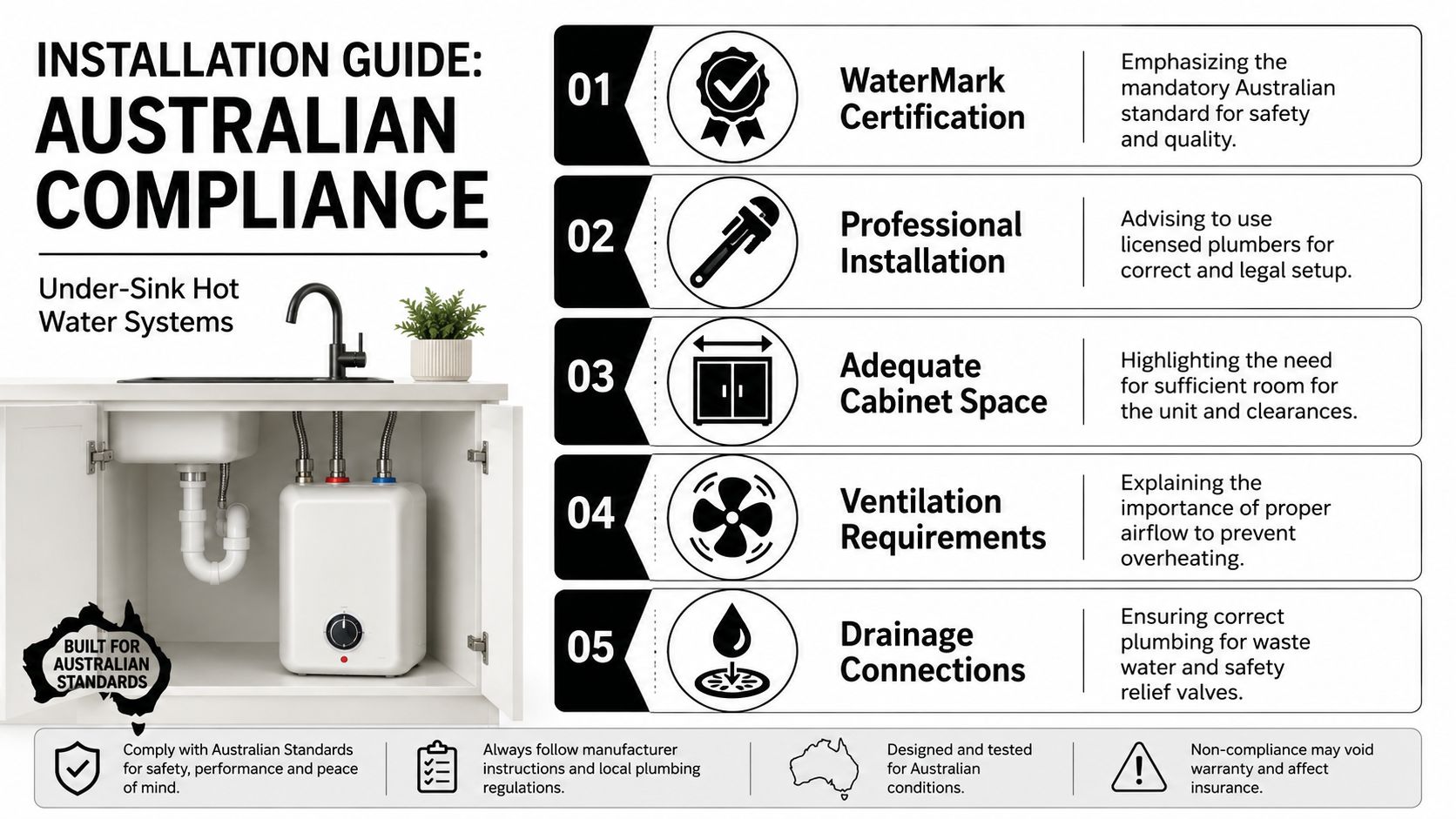
WaterMark is not optional
In Australia, regulatory compliance and verified certification are major markers of quality in under-sink systems. The under-sink filtration comparison mentioned earlier highlights one model as the only under-sink reverse-osmosis option in Australia described as WaterMark AS/NZS 3497 certified, while also reporting contaminant reduction performance. The broader lesson is simple. Compliance and documented performance matter more than appearance or bargain pricing.
If a product connects into your plumbing system, treat certification as a basic requirement, not a bonus feature.
Who needs to install it
For most under-sink hot water jobs, you'll need a licensed plumber for the water connection. Depending on the unit, you may also need a licensed electrician if the system requires a dedicated circuit or other electrical work.
That's not red tape for the sake of it. These units combine water, heat and power in a tight cupboard. Safe installation depends on correct valves, correct drainage arrangements where required, and a power supply that matches the appliance.
Pressure control also matters. If you're trying to understand where a valve fits into the system, this guide to the pressure limiting valve explains why pressure management can affect appliance protection and compliant installation.
For a general example of how licensed plumbing services frame proper installation and repairs, even outside Australia, firms such as Stultz Plumbing Boerne are a reminder that plumbing fixtures work best when installed and serviced professionally rather than treated as DIY hardware.
Measure the cabinet twice. Then measure the filter swing-out space, hose path, power access and service clearance. Most fit problems happen around the unit, not because of the unit itself.
How to measure the cabinet properly
Don't just measure width, height and depth of the empty cupboard and call it done. Check these five things:
Trap position
If the waste trap sits dead centre, it may block the ideal mounting area.Door opening and hinges
Wide hardware can interfere with side-mounted filters or access panels.Service clearance
You need room to remove filters, inspect fittings and work on the unit later.Ventilation
Some systems need airflow to avoid heat build-up.Other cabinet users
Pull-out bins, cleaning products and stored items often compete for the same space.
The best install is the one that still makes sense six months later when someone needs to change a filter or service a valve.
Your Decision Guide and Practical Next Steps
A good under-sink system looks right in the showroom. The right one still works for your kitchen after the install, fits around the trap and bin, meets Australian requirements, and does not leave you with higher running costs than you expected.
That is the actual decision.
The best choice usually comes down to four things. What temperature you need, how often the tap will be used, how much cupboard space you can give up, and what services are already available under the bench. Get those four right and the product shortlist gets much shorter very quickly.
A practical shortlist you can take to a supplier
Take this checklist with you and complete it thoughtfully:
- Use case: Do you want boiling water for drinks, hot water for sink work, or one tap that does several jobs?
- Demand pattern: Is it occasional use in a quiet kitchen, or repeated use in a family kitchen where recovery time matters?
- Cabinet reality: How much usable space is left once you allow for the trap, valves, hinges, filters, and service access?
- Power and plumbing: Is there a suitable power point, and will the installation need extra electrical or plumbing work?
- Ongoing upkeep: Are you prepared for filter changes, servicing, and replacing parts when they wear out?
Those answers matter more than brochure features.
My rule of thumb by kitchen type
- Small kitchen with limited cupboard space: Keep the setup simple and compact. Fancy tapware means little if the unit blocks storage or is awkward to service.
- Busy family kitchen: Prioritise recovery rate and practical capacity. An undersized unit is one of the most common buying mistakes.
- Renovation or new kitchen: Plan the unit, tap, power, and filtration together before cabinetry is finalised.
- Poor water quality area: Pay close attention to filtration, warranty conditions, and what corrosion or scale may do over time.
Practical next steps before you buy
- Measure the actual install zone, not just the cupboard shell
- Confirm the available power supply and whether an electrician will be needed
- Decide whether you want drinks convenience or proper sink hot water performance
- Check WaterMark compliance and installation requirements
- Ask who will service the unit and where spare parts come from
If a supplier cannot answer those points clearly, keep looking.
Ring Hot Water is one option in this space. The company supplies under-sink boiling and chilled systems, kitchen sink hot water heaters, filtration products, spare parts, and Melbourne installation services. That suits buyers who want product supply and after-sales support handled by the same specialist, rather than sourcing each part of the job separately.

