
Uncategorized
Electric Hot Water Heater for RV: The Australian Guide

Jun
You pull into a powered site after a long day on the road. The van is level, the fridge is running, dinner is half sorted, and all you want is a proper hot shower instead of another quick rinse with lukewarm water. That's usually the moment people start caring a lot more about their RV hot water system than they did when they were comparing brochures.
An electric hot water heater for an RV sounds simple until you try to make it work in real Australian conditions. Buyers often focus on tank size, brand, or whether the unit is “instant”. The bigger issue is whether it will run on the power available at the sites you use, fit the space you've got, and comply with the electrical rules that apply to caravans and motorhomes here.
A lot of generic advice online is written for North American rigs and North American power. That's where people get caught. In Australia, the practical questions are different. Can the heater run on your campsite connection without nuisance tripping? Will it leave enough capacity for the battery charger, induction cooktop, or air-conditioner? Is the install safe for a transportable structure, not just a house?
The Dream of Hot Water on the Road
Anyone who has spent time travelling through regional Australia knows how much comfort matters after the novelty wears off. A hot shower after dust, salt, rain, or a cold morning start can make a small van feel civilised. For many owners, that's the point where the hot water system stops being an accessory and starts being essential.
The trouble starts when people assume “electric” means easy. In a house, you've usually got a much bigger power budget and a fixed installation. In an RV, every appliance competes for a limited supply, and the hot water heater is one of the loads that can expose weak planning very quickly.
What catches owners out
The most common mistake isn't choosing a bad heater. It's choosing a heater that doesn't suit the way the RV is used.
Some owners spend most of their time in powered parks and want reliable, clean, on-demand hot water without dealing with gas bottles. Others split their time between powered sites and off-grid stops, where electric water heating becomes far less practical unless the setup has been designed around it. Then there's the owner who buys a compact electric unit because it fits neatly under a seat, only to find it clashes with the rest of the van's loads every evening.
Practical rule: If your hot water plan only works when nothing else is running, it isn't a practical RV setup.
Australian buyers need advice built around local supply conditions, mobile installation standards, and realistic use on the road. That means looking past marketing terms and checking three things first: heater type, available power, and compliant installation.
Storage Tank vs Tankless Heaters
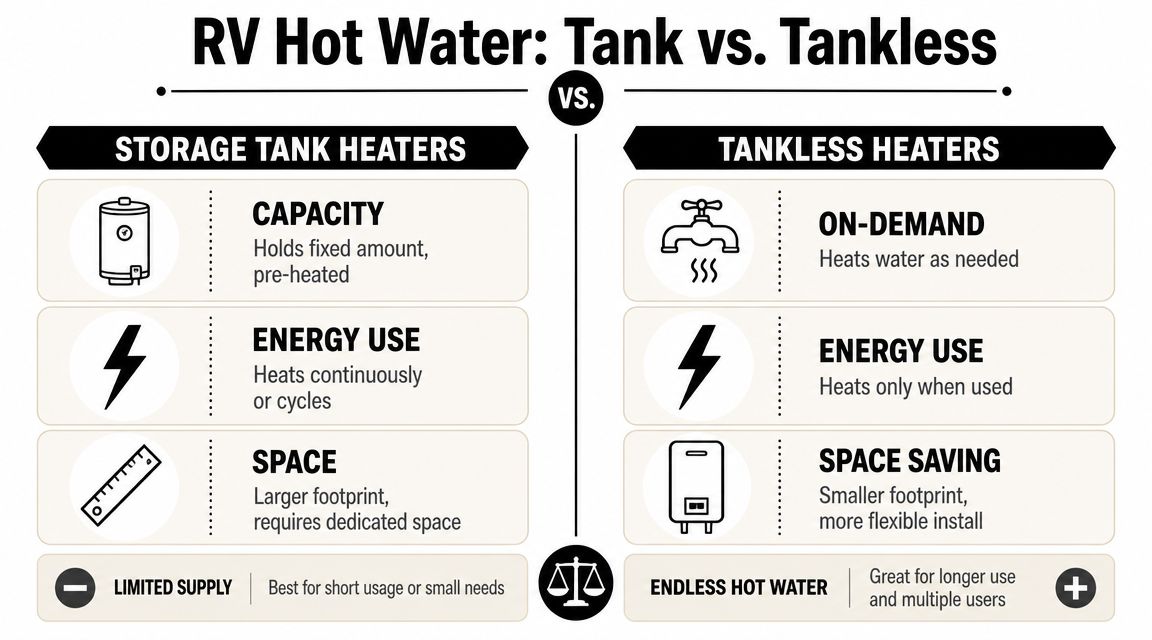
This is the first real fork in the road. Most RV electric systems come down to storage tank heaters or tankless heaters, and they behave very differently in everyday use.
A storage tank heater works like a small household cylinder. It heats and stores a fixed amount of water, then reheats after use. A tankless heater is closer to a continuous-flow tap. Water passes through the unit and is heated as you use it.
How they differ in daily use
A storage tank is predictable. If the tank is hot, you've got a known amount of hot water ready to go. That suits owners who want a simple routine and don't mind waiting for recovery after a longer shower or multiple uses close together.
A tankless heater is attractive because it avoids standby heating and doesn't run out in the same way. The U.S. Department of Energy guide on demand-type water heaters says these units can be 24%–34% more energy efficient than conventional storage tanks for households using 41 gallons or less per day, and still 8%–14% more efficient for homes using about 86 gallons per day. In RV use, where hot water demand is usually intermittent and lower than a household, that efficiency logic is easy to see.
That said, tankless isn't automatically better. It depends heavily on flow rate, incoming water temperature, and the electrical capacity available. A unit that looks impressive on paper can disappoint if the van's power setup can't support it properly.
The practical trade-offs
| Feature | Storage Tank Heater | Tankless (Instantaneous) Heater |
|---|---|---|
| Footprint | Usually bulkier and needs dedicated space | Usually more compact and easier to place |
| Hot water delivery | Fixed stored volume | On-demand while conditions allow |
| Recovery | Needs time to reheat after depletion | No stored reserve, performance depends on live heating capacity |
| Energy profile | Can cycle to maintain heat | Heats only when water is drawn |
| Water pressure sensitivity | Often more forgiving | Usually more dependent on stable flow |
| Best fit | Simple setups, predictable use | Powered touring setups chasing compactness and efficiency |
Which one suits which traveller
A solo traveller or couple using short showers and mostly powered sites often prefers tankless for the smaller footprint and on-demand feel. A family or anyone who values predictable output may lean towards storage, especially if they understand and accept the recovery delay.
There's also the installation space issue. Storage systems often demand a more committed layout decision. Tankless systems can be easier to package in a tight build, although the plumbing and electrical side still need proper thought.
For owners comparing compact options and water heating layouts, some of the same design logic shows up in units like an Aqueous water heater guide, where footprint, access, and serviceability matter just as much as headline features.
A heater that looks efficient in a catalogue can still be frustrating in a van if the flow requirement, space claim, or power demand doesn't match real use.
Navigating Australian RV Power Realities
Most electric hot water decisions are determined by this factor. In Australia, the main issue isn't whether electric water heating can work. It can. The primary concern is whether it can work on the power you'll have at camp.
The national mains supply is based around 230/240 V, not the 110/120 V system common in North America, which means an electric RV water heater has to suit Australian voltage and the vehicle's onboard wiring. The broader point from the Camplux overview of RV tankless heater selection is that buyers need to think in terms of voltage compatibility and total load planning, not just heater size.
10A sites and 15A connections
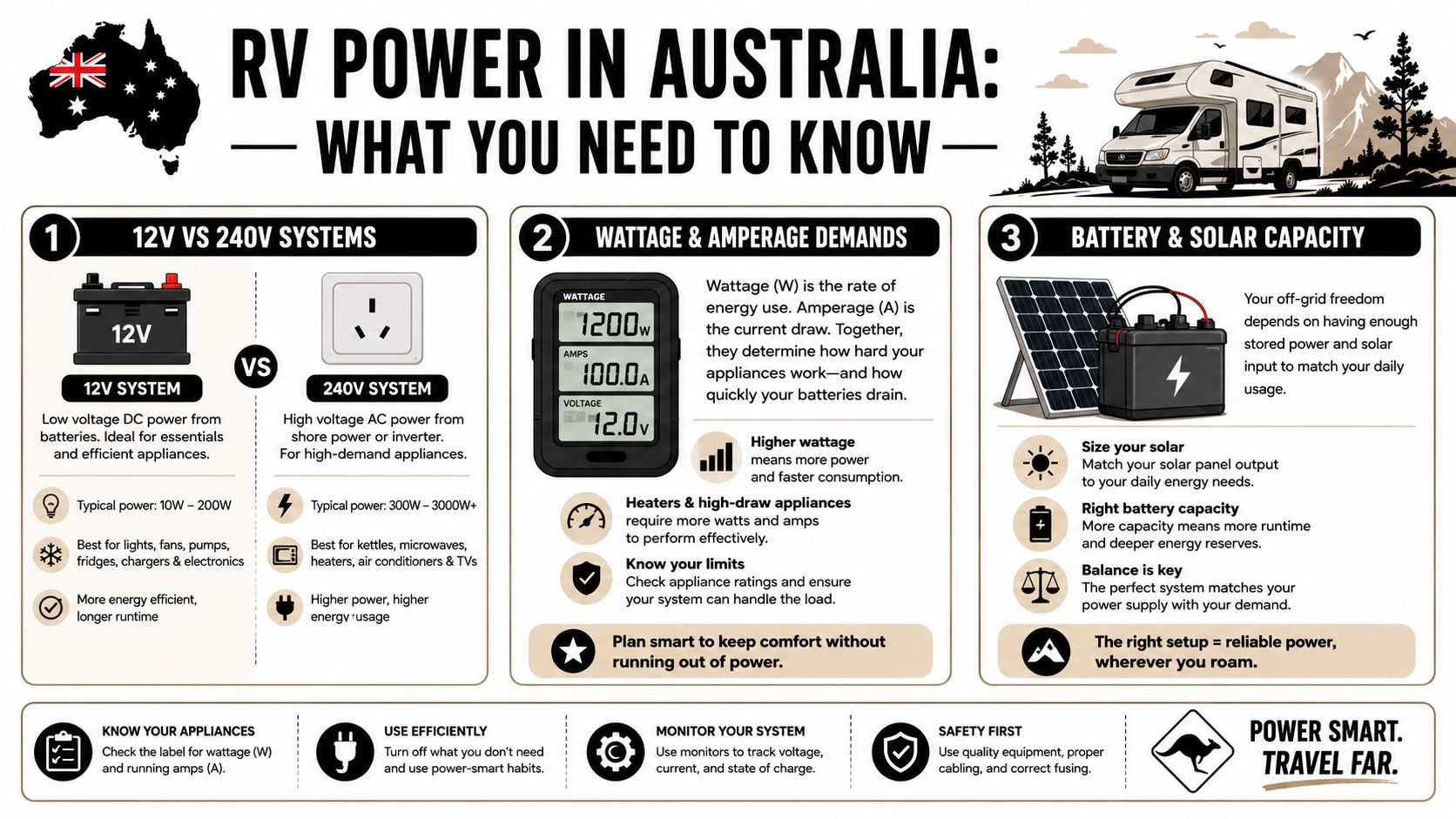
The big real-world constraint is campsite supply. According to the JD Power guide discussing electric tankless RV heaters, most powered campsites in Australia provide a 230V/10A supply (about 2.4kW), while higher-load RVs require a 15A connection. That one detail changes everything.
On a typical 10A site, your heater isn't the only thing using power. The battery charger, microwave, kettle, cooktop, toaster, and air-conditioner all draw from the same limited supply. If the heater takes a large share of that budget, you can easily trip the breaker when another appliance kicks in.
12V isn't the same conversation
Owners often mix up the 12V side of the van with the 240V side. Your pump, lighting, and some controls may be 12V. Most meaningful electric water heating is a 240V conversation tied to shore power.
That's why water delivery and power planning go hand in hand. If you're also working through pump choice, flow stability, and caravan plumbing layout, a detailed 12 V water pump for caravan guide is worth reading alongside heater selection.
Battery condition matters too, especially in vans where pumps, controls, and other support equipment are cycling constantly. If you want a plain-English refresher on keeping auxiliary battery systems healthy, the Van Dyke Outdoors battery care guide is a useful reference.
This video gives a helpful visual primer on RV power basics before you lock in any heater choice.
What works and what doesn't
What works is a heater matched to the connection you use most of the time. What doesn't work is buying on marketing alone and assuming every powered site will support the same load.
A van that lives on 10A sites needs a far more conservative plan than a rig routinely connected to 15A infrastructure. That's especially true if you expect to shower while the air-conditioner is running or while the charger is recovering batteries after a drive.
Sizing Capacity and Installation Planning
Choosing the right unit starts with your use pattern, but it finishes with a tape measure, a load check, and a hard look at the plumbing path. Plenty of unsuitable systems get bought because the owner started with brochure features instead of installation realities.
In Australia, the mains standard is 230/240V, so any electric RV water heater has to be compatible with that supply and with the van's onboard wiring. The key issue, as noted in the earlier source material, isn't just heater size. It's whether the heater can sit inside the van's total electrical budget without creating a nuisance or safety problem.
Start with the way you use hot water
Ask practical questions, not aspirational ones.
- Shower style: Do you want quick rinse showers, or are you expecting home-style run time?
- Occupancy: Is this for one person, a couple, or a full family rotation after the beach?
- Site use: Are you mainly on powered sites, or only occasionally?
- Concurrent loads: Will hot water be used when the charger, cooktop, or air-con are also likely to be on?
A storage tank suits users who can work within a fixed volume and let the system recover. A tankless unit suits users who value continuous supply more than reserve storage, provided the flow and power conditions are right.
Measure the real install space
A surprising number of RV heater headaches begin with a space that was measured casually. Cabinet doors need clearance. Plumbing bends need room. Service access matters. So does the path for wiring and drain or relief components.
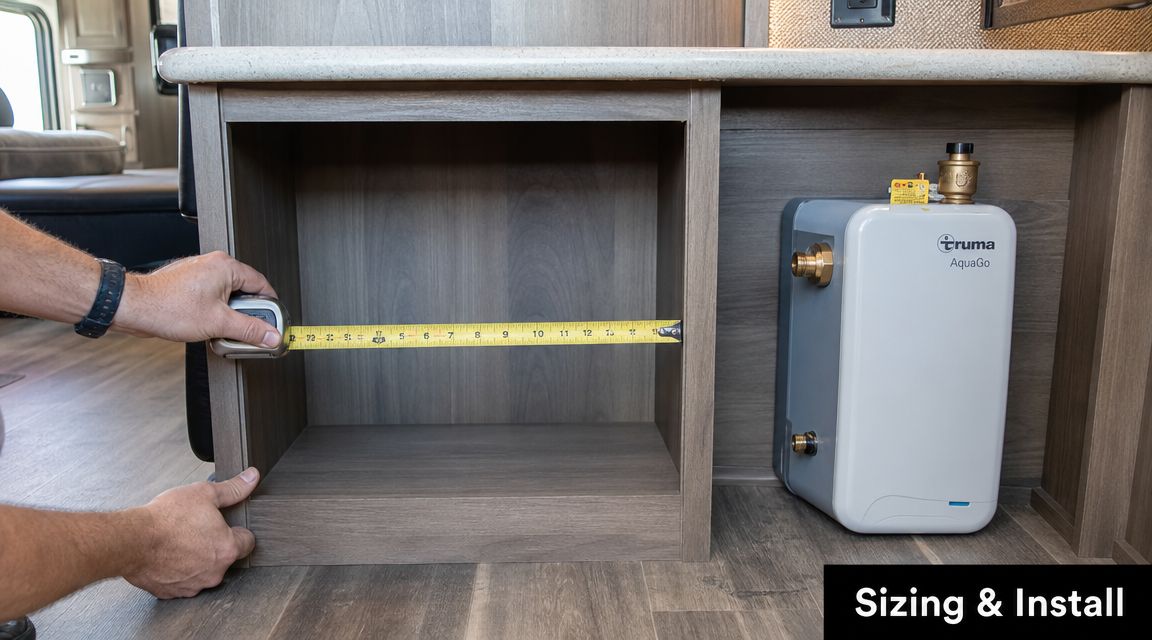
When checking a location, look beyond the body of the heater itself.
- Access for maintenance matters. If you can't reach the element, thermostat, or fittings later, a minor repair becomes an unnecessary removal job.
- Pipe routing needs to stay clean. Tight bends, awkward reducers, and unsupported joins create long-term trouble.
- Surrounding heat and moisture should be considered. Even electric units need sensible placement in a compact mobile environment.
Don't buy to the cavity size alone. Buy to the cavity, the fittings, the cable route, and the service access.
Plan the plumbing and the electrical together
Owners often treat plumbing and electrical as separate jobs. In an RV they affect each other constantly. Flow stability affects heater performance. Heater draw affects whether the rest of the van can operate normally.
Use this checklist before installation:
- Confirm supply compatibility: The heater must suit Australian 230/240V service and the van's onboard electrical design.
- Check the likely campsite connection: If the van mainly uses standard powered sites, size the system around that reality.
- Review circuit capacity: The hot water heater shouldn't be treated like an isolated appliance if it shares the same practical power budget as chargers and kitchen loads.
- Assess water flow quality: Tankless systems in particular need a stable, usable flow to perform consistently.
- Leave room for service parts: Relief valves, hoses, filters, and electrical access all need consideration before the unit is boxed in.
Match expectations to the vehicle
The right heater in the wrong van becomes the wrong heater. That's the cleanest way to put it.
A modest unit that fits the available supply and gets installed properly will usually outperform an oversized “upgrade” that strains the site connection, crowds the cabinet, and causes repeated trips. Good installation planning doesn't feel exciting, but it prevents the expensive mistakes.
Essential RV Fittings and Spare Parts
A hot water system doesn't fail as a complete concept. It usually fails at a single point. A tired element, a faulty thermostat, a leaking fitting, a damaged hose, or a valve that's no longer doing its job can stop the whole system from performing properly.
That's why spares matter. In caravan and RV work, the support parts are often what decide whether a repair is quick and straightforward or a drawn-out hunt for something obscure.
Parts owners should recognise
Some components are worth being able to identify on sight.
- Heating element: This is the part that converts electrical energy into heat. If it fails, you may still have power to the unit but no meaningful hot water.
- Thermostat: It controls water temperature and protects against overheating conditions.
- Pressure relief valve: This is a safety component, not an optional extra. It allows pressure to discharge when required.
- Anode rod: On storage tank systems that use one, this sacrificial part helps protect the tank from internal corrosion.
- Flexible hoses and threaded fittings: These are often where small leaks begin, especially after vibration, poor support, or repeated disassembly.
Why caravan-specific fittings matter
RV plumbing is compact and mobile. That changes the way fittings behave over time. Vibration, thermal movement, and limited service space punish cheap or mismatched components faster than a fixed domestic installation would.
A proper replacement part needs to suit the heater, the plumbing standard in the van, and the available access. Owners often lose time because they know a fitting is leaking but can't identify whether they need a new valve, hose, adaptor, or sealing component.
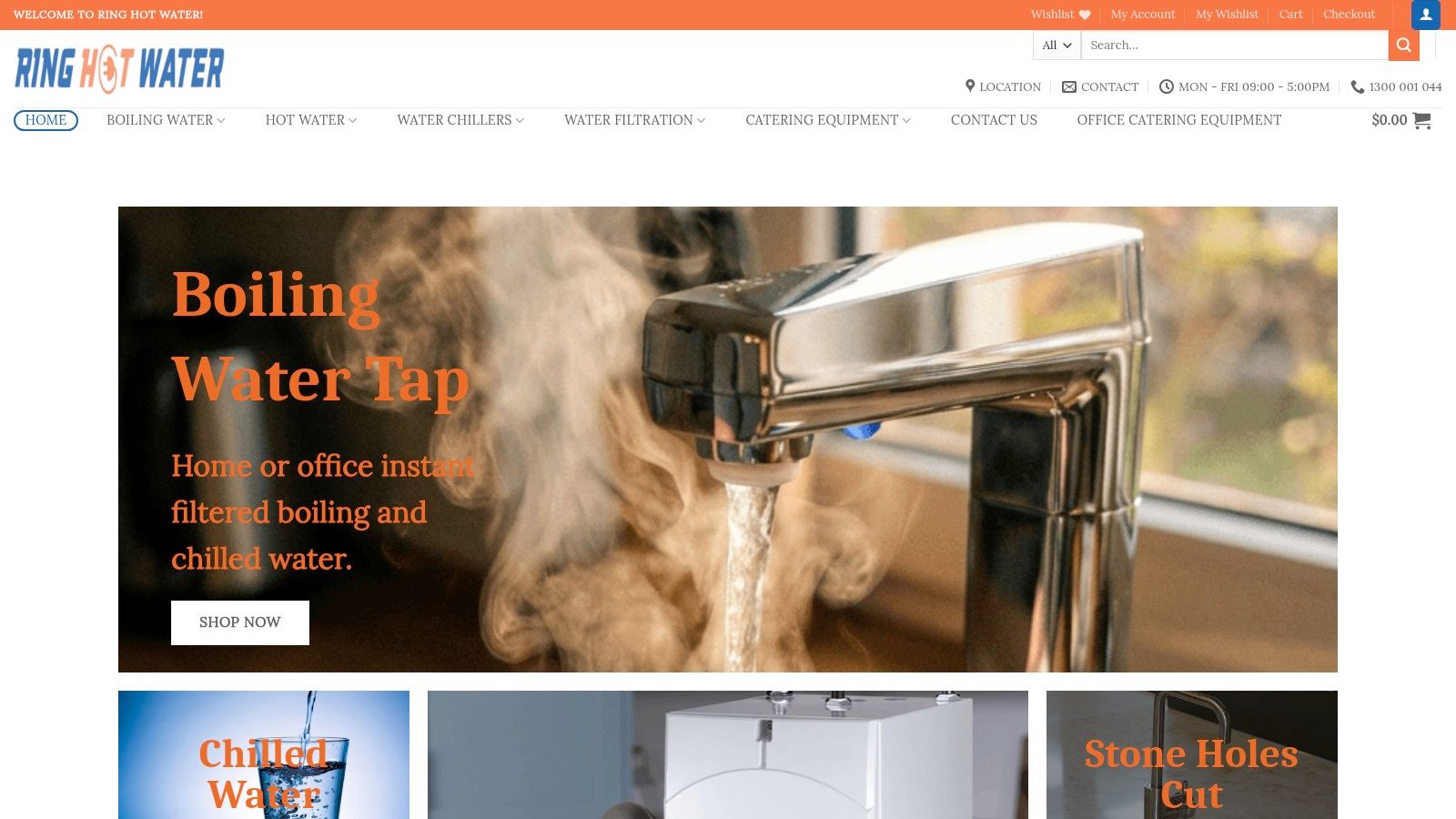
The screenshot below shows the sort of specialist parts environment that matters when you're trying to match components rather than improvise them.
What's worth carrying
If you travel often, it makes sense to keep a few known-good service items on hand. That doesn't mean carrying half a workshop. It means keeping the parts that are small, failure-prone, and hard to match in regional areas.
A heater is only as reliable as the valve, hose, or control part that hasn't failed yet.
A sensible kit often includes common fittings, sealing components, and any model-specific consumables your system relies on. If your setup uses a storage tank with an anode, keep that on your service radar. If it uses an element and thermostat combination known to be replaceable, know what model you've got before you need the part in a hurry.
Maintenance Troubleshooting and Safety
Most hot water systems give warning signs before they fail completely. Reduced temperature, slower recovery, occasional tripping, unusual cycling, or minor leaks are all worth acting on early. In a van, small issues escalate fast because space is tight and systems are interconnected.
Good maintenance doesn't need to be complicated. It needs to be regular and appropriate to the system type.
Routine care that prevents bigger repairs
A storage tank benefits from periodic flushing and inspection, especially if the water source varies from trip to trip. If the system uses an anode, inspect it as part of normal service rather than waiting for obvious tank problems.
Tankless systems need clean water flow and attention to scale or debris that may affect performance over time. They also depend on controls and sensors working properly, so intermittent faults shouldn't be ignored.
For element-related diagnosis, a practical starting point is knowing how to identify whether the heater is powered but not producing heat. This guide on how to test a hot water element is useful when the symptoms point toward an electrical heating fault.
Common problems and the likely cause
- No hot water at all: Start with supply, switching, protection devices, and whether the element is operating.
- Water not hot enough: Check thermostat behaviour, flow rate, incoming water conditions, and whether the heater is undersized for the demand.
- Power tripping during use: Look at total site load, not just the heater. Concurrent appliances are often the actual trigger.
- Pressure relief discharge or leaks: Treat these as faults to assess properly, not annoyances to bypass.
If a system keeps tripping, it's telling you something important. Don't solve that by ignoring the protection.
Safety isn't optional
In Australia, caravan electrical installations must comply with AS/NZS 3001:2008, which means the heater's supply, wiring, and protection need to be designed for mobile use. The referenced material on this point makes the takeaway clear. Professional installation and compliance are a safety requirement, not a nice extra.
That matters because RVs aren't houses. They flex, move, get wet, and operate from changing external supplies. A hot water heater may look like a compact appliance, but once it's integrated into the van it becomes part of a regulated electrical and plumbing environment.
The owners who stay out of trouble are usually the ones who take protection devices seriously, keep relief valves functional, and get faults checked before they turn into repeated trips or water damage.
Your Partner for RV Hot Water in Australia
Choosing an electric hot water heater for an RV in Australia comes down to fit, load, and compliance. The right unit suits the way you travel, the space you have, and the power you'll really use at camp. The wrong unit can still look impressive in a product listing.
The biggest blind spot for many buyers is campsite power. A heater that seems perfect on paper may be frustrating in practice if it can't share supply with the rest of the van. That's why proper selection starts with honest load planning, then moves to plumbing layout, service access, and safe installation.
Parts support matters just as much after the install. So does having access to the right fittings, valves, elements, thermostats, and replacement components when something eventually needs attention. In RV work, reliable hot water usually comes from good decisions made before the first trip, not from scrambling after a failure on the road.
If you want a system that works properly in Australian conditions, treat the hot water heater as part of the full RV setup, not as a standalone gadget. That approach saves money, avoids nuisance faults, and gives you a much better chance of getting the simple result everyone wants: dependable hot water when the day is done.
If you need help choosing parts, replacing a failed component, or sorting out the right hot water setup for your caravan or motorhome, Ring Hot Water can help with genuine products, practical advice, and Australia-wide online supply, plus installation and service support across Melbourne.

