
Uncategorized
Master Your Solar Hot Water Controller in Melbourne

May
If you're standing under a shower in Melbourne wondering why the water is only warm after a bright day, the problem often isn't the collector on the roof. It isn't always the tank either. A lot of the time, the weak link is the solar hot water controller.
That small control box decides when the pump runs, when it stops, when the system protects itself from excess heat, and whether your backup heater cuts in too early. When it's set up well, a solar hot water system feels almost invisible. You just get hot water. When it's set up badly, you get lukewarm mornings, unnecessary boosting, noisy pump cycling, and summer overheating that shortens component life.
In Australian conditions, the controller matters more now than it used to. Homes aren't just dealing with solar thermal anymore. Many are also juggling rooftop PV, export limits, tariff headaches, and the simple question every owner asks sooner or later: can this system use more of my own solar instead of sending it away?
Why Your Solar Hot Water System Needs a Smart Brain
A solar hot water system isn't just a roof collector and a storage tank joined by pipes. Something has to decide when moving water or heat transfer fluid makes sense. Without that decision-making, the system can collect heat poorly, lose heat at the wrong time, or rely too heavily on boosting.
That's where the controller earns its keep. It acts as the operating brain of the whole setup. It watches temperatures, switches pumps, applies safety limits, and stops the system doing dumb things like circulating when the collector isn't hot enough to add useful heat.
An Australian fact sheet from the Energy Efficiency and Savings Information notes that solar water heaters can reduce conventional water-heating demand by about two-thirds and can pay for themselves within 4 to 8 years according to the EESI solar water heating fact sheet. In real jobs, whether you get close to that outcome depends heavily on control quality, sensor accuracy, and whether the booster is working with the system rather than against it.
What goes wrong without good control
A poorly controlled system usually shows one or more of these signs:
- Warm rather than hot water: The pump starts too late, stops too early, or the booster timing clashes with solar gain.
- High energy bills: The electric or gas backup carries more load than it should.
- Summer stress: Tanks overheat, relief valves weep, and the owner assumes that's normal.
- Winter nuisance behaviour: Freeze settings become too aggressive and the pump runs when it shouldn't.
If you've already invested in rooftop generation, it's also worth looking at system efficiency more broadly. Clean collector surfaces and good solar access still matter, and some of the practical ideas in Sparkle Tech's efficiency guide translate well to the general principle of getting the most from available sun.
Practical rule: If the controller isn't reading the right temperatures or making the right timing decisions, the rest of the system can't perform properly, no matter how good the hardware looks on paper.
Understanding the Solar Hot Water Controller
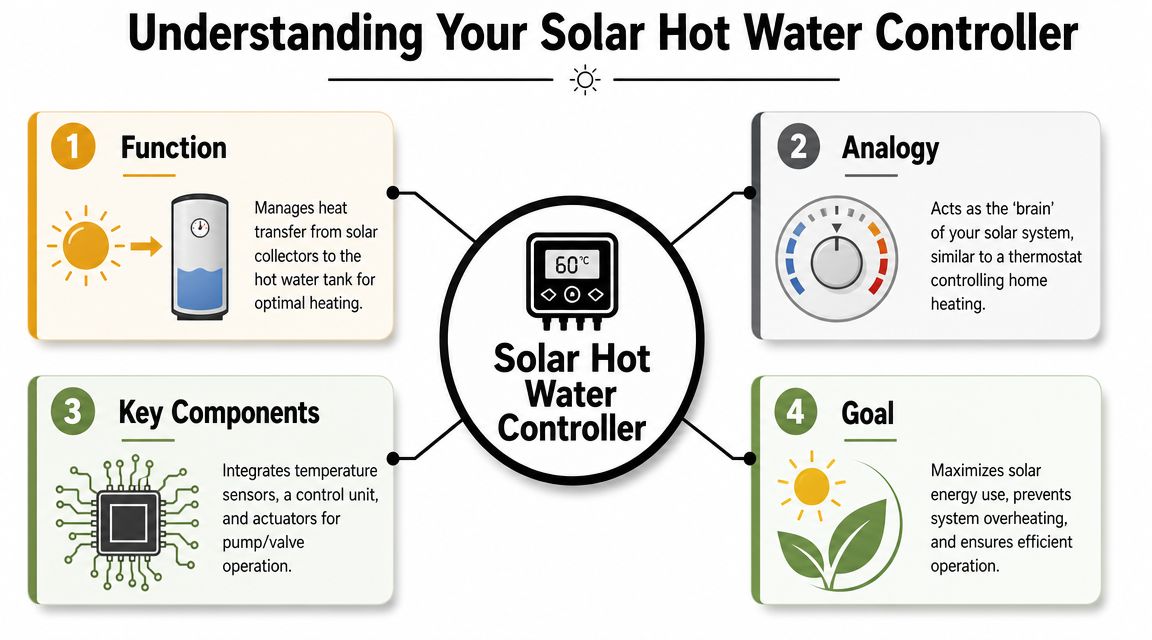
A solar hot water controller is best thought of as a thermostat for the whole solar hot water system, not just the tank. It doesn't just ask whether water is hot enough. It compares what's happening at different parts of the system and decides whether heat should be harvested, held back, or diverted.
What the controller actually watches
In a typical active solar thermal setup, the controller reads temperatures from sensors fitted to the collector circuit and the tank. It then switches the circulation pump on only when the roof is hot enough to deliver useful heat into storage. If the temperature difference isn't there, the pump stays off.
That sounds simple, but it's the difference between a system that harvests free energy and one that circulates fluid for no benefit.
The controller may also manage:
- Pump operation so heat moves only when there's a gain
- Tank temperature limits to avoid overheating
- Protective modes for cold weather or stagnation conditions
- Backup coordination so electric or gas boosting doesn't take over too early
Why that matters in Australia
Solar water heating isn't a novelty here. It sits inside a technology family with a long commercial history. Historical summaries note that the first wave of modern commercial solar hot water development scaled through the 1920s to 1950s, with renewed growth after the 1973 oil crisis, as outlined in this background on solar water heating history. That long history matters because it tells you the controller isn't part of an experimental system. It's part of a mature, proven one.
For owners trying to compare options or match a controller to an existing system, browsing a specialist range such as solar hot water components and categories helps you see how many system layouts and spare-part variations are in the market.
A controller doesn't create heat. It protects the heat you've collected and decides when that heat is worth moving.
The parts around it
Three components usually make or break controller performance:
| Component | What it does | What happens if it's wrong |
|---|---|---|
| Sensor | Tells the controller actual temperature | Bad readings, false starts, poor heating |
| Pump | Moves heat from collector to tank | No transfer, noisy cycling, overheating |
| Relay or switching output | Lets the controller run loads safely | Intermittent operation or failed switching |
A homeowner sees a little box on the wall. A plumber or technician sees the traffic controller for the whole thermal side of the system.
How Different Types of Controllers Work
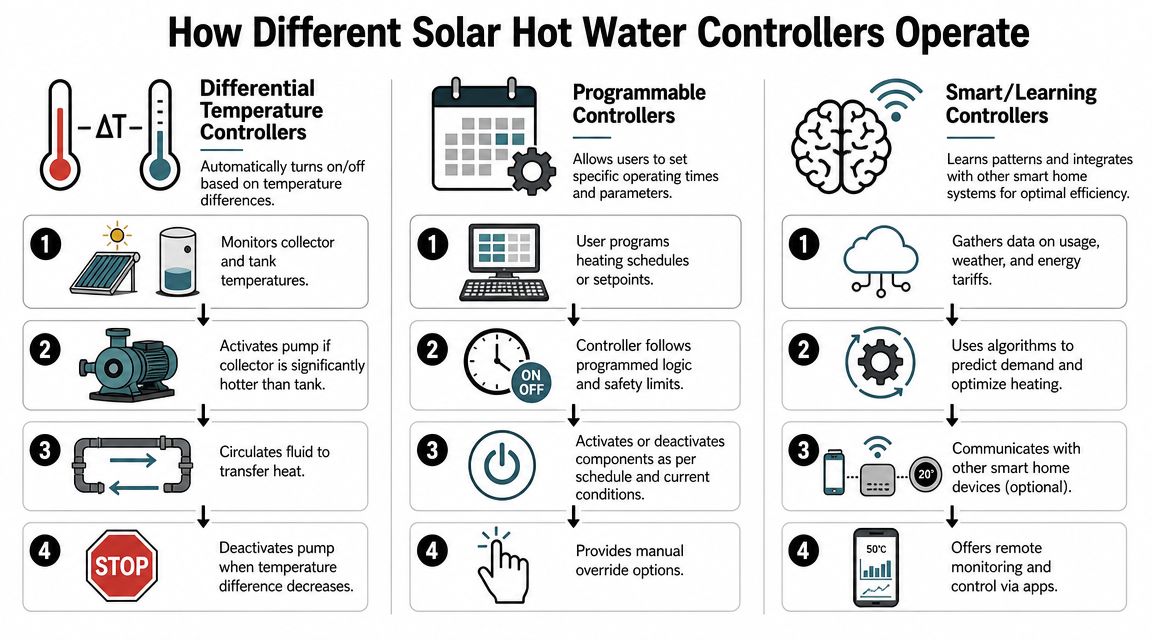
Not every controller does the same job. In Melbourne homes and commercial sites, I usually group them into three broad camps. The trick is knowing whether you're controlling a solar thermal loop, a simple heating source, or the use of surplus rooftop PV.
Differential temperature controllers
This is the standard workhorse in many Australian solar thermal systems. It compares collector temperature with tank temperature and only runs the pump when there's a positive heat gain. The collector has to be hotter than the tank by a set differential, otherwise the pump stays off.
That logic matters because it stops reverse heat loss during low sun, cloud cover, or evening conditions. If the roof isn't offering useful heat, circulating fluid just throws energy away.
Most Australian solar thermal systems use this approach, and this explanation of differential controller operation also highlights the modern reality that controllers now sit in a market with over 4.1 million rooftop solar PV installations in Australia.
Best fit:
- Roof collectors feeding a dedicated solar storage tank
- Systems that need proper heat-harvest logic
- Homes where efficiency matters more than simple timer control
Less suited to:
- Very basic setups where no active solar loop exists
- Owners expecting app-based energy management from a basic unit
Thermostat or simple programmable controllers
Some systems use simpler control logic. Instead of comparing collector and tank temperatures in real time, they rely more on a tank setpoint, a timer, or a simpler switching rule.
These can work in narrower applications. They're easier to understand, and sometimes that's exactly why they stay in service for years. But they don't make the same quality of decisions as a proper differential controller in an active solar thermal system.
Common trade-offs include:
- Lower complexity: Easier to replace and often easier for owners to operate
- Less adaptive behaviour: Doesn't respond as well to changing solar conditions
- Higher risk of waste: Can run heating or pumping at times that don't add much value
PV-integrated controllers and diverters
This application often sparks interest among many modern Australian households. A PV-integrated controller or energy diverter doesn't mainly manage collector heat from a solar thermal panel. Instead, it uses surplus rooftop PV electricity to heat water through an element rather than exporting that power.
For homes with rooftop solar, that can make hot water part of a broader self-consumption strategy. The controller becomes less of a pump manager and more of a load manager.
If a customer asks, "Will this help me use my own solar?", they're often talking about a diverter or integrated load control function, not a basic thermal pump controller.
Best fit:
- Homes with rooftop PV and daytime surplus generation
- Owners trying to reduce low-value exports
- Sites where electric boosting can be shifted into solar hours
What doesn't work well is confusing these controller types. A differential solar thermal controller won't automatically solve PV export questions. A PV diverter won't replace the thermal protection logic needed in an active collector loop. On some properties, the right answer is a system that coordinates both.
A quick decision view
| Controller type | Main job | Strong point | Limitation |
|---|---|---|---|
| Differential | Moves thermal heat only when useful | Efficient collector harvesting | Doesn't answer all PV export questions |
| Simple thermostat or programmable | Meets basic heating or timing rules | Straightforward operation | Cruder control logic |
| PV-integrated or diverter | Uses surplus PV for water heating | Better solar self-use | Not a substitute for thermal loop protection |
Key Features to Compare When Choosing a Controller
When you're choosing a controller, don't start with the brand sticker. Start with the problems the controller must solve on your site. A small household system in Melbourne has different needs from a café with recirculation, backup boosting, and heavy morning demand.
Inputs and outputs that match the real system
One of the first things I check is whether the controller can see enough of the system and switch enough loads. Some commercial-style units sold into the Australian market provide 3 x RTD inputs and can control 2 additional devices, allowing one logic core to coordinate solar harvesting, backup boosting, and another load such as recirculation, as outlined in the EPA system specifications material.
That matters because a controller with too few inputs is effectively blind. A controller with too few outputs forces awkward workarounds.
The shortlist that matters
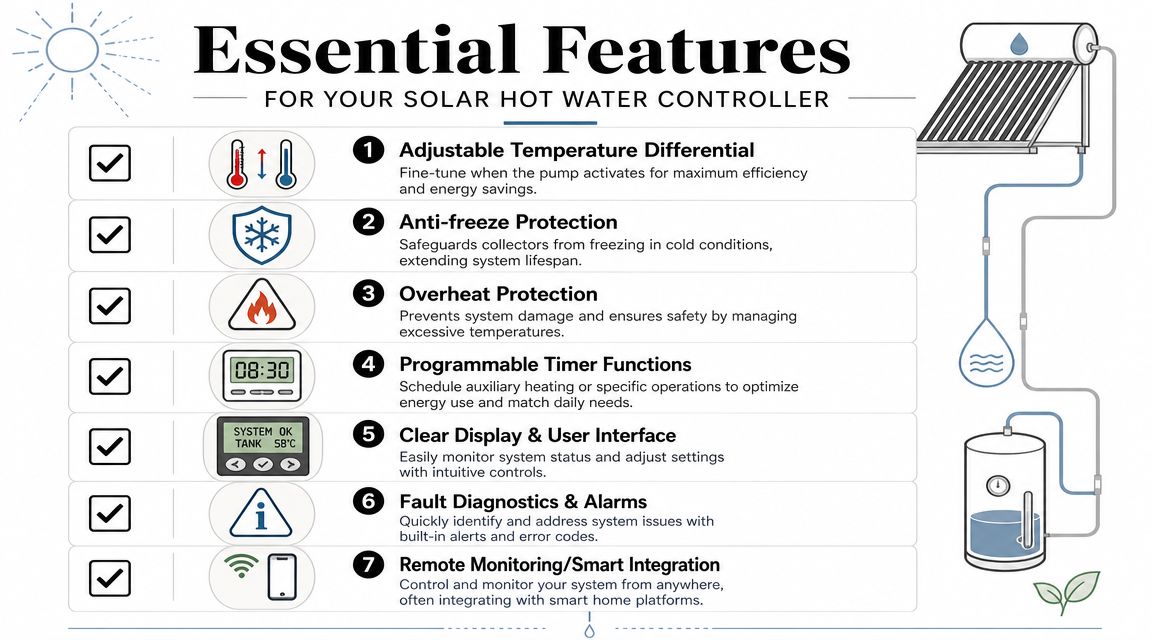
Look for features that solve actual operating problems:
- Adjustable differential control: Lets the installer fine-tune when the pump starts and stops instead of relying on rough default behaviour.
- High-temperature shutdown: Important for tank protection and summer operation.
- Freeze protection logic: Useful in conditions where collectors and pipework are exposed to cold snaps.
- Booster management: Helps the system prioritise solar before calling for electric or gas backup.
- Fault display or alarms: Makes servicing much faster when something goes wrong.
- Usable interface: A controller shouldn't need a decoding exercise just to check a sensor reading.
Protection functions aren't optional
Melbourne doesn't give you one steady season. You'll see mild periods, cold mornings, hot spells, and the occasional stretch that exposes weak settings quickly. A controller that only switches a pump on and off without proper protections is false economy.
Three functions deserve close attention.
Frost protection
If the system uses exposed collector pipework, frost protection settings help stop freeze damage. The catch is that aggressive settings can cause unnecessary pump operation. The setting needs to suit the system design and local conditions, not just be switched on blindly.
Overheat and stagnation control
Summer problems often develop gradually. The tank hits limit temperature, solar input has nowhere to go, and the owner notices discharge or odd noises. Good control logic manages shutdown and heat-limiting behaviour before that turns into repeat service work.
Backup integration
A badly integrated booster can wipe out solar gains by heating too early or too often. Good control keeps backup available without letting it dominate the system.
For related protection hardware on the plumbing side, it's also worth understanding how a pressure limiting valve works in hot water systems, because control logic and pressure protection often intersect when a system is running hot.
Buyer check: Ask what the controller can monitor, what it can switch, and what protective actions it can take without extra add-ons.
Installation and Wiring Essentials
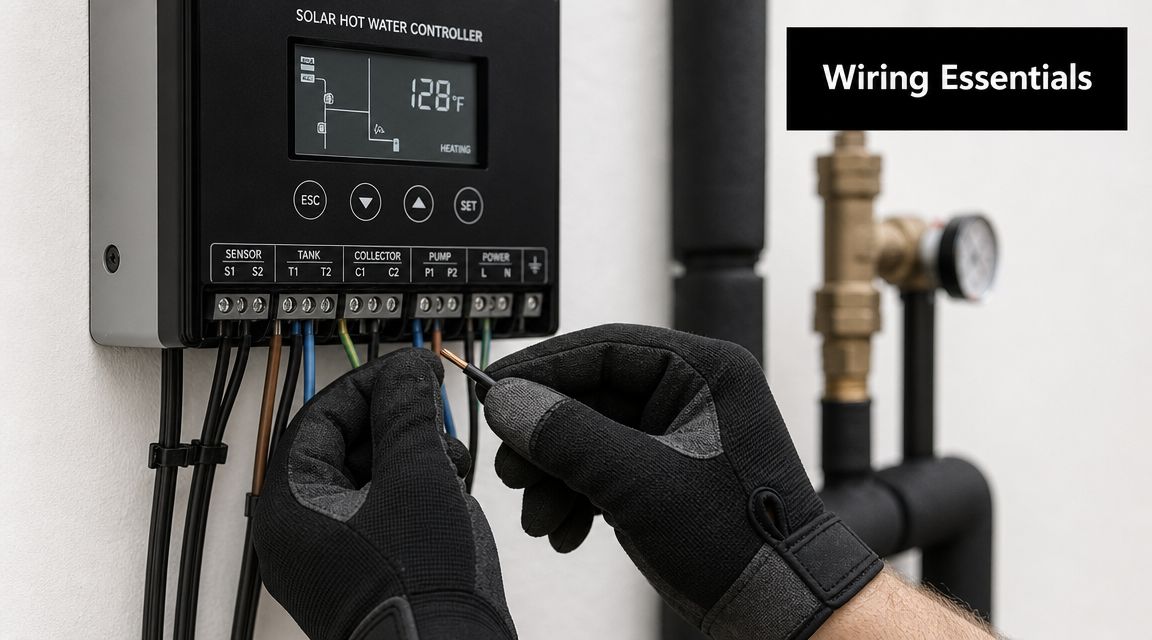
A good controller can still perform badly if it's installed carelessly. Most controller faults I see in the field aren't really controller faults at all. They're wiring mistakes, sensor placement problems, or compatibility issues between old and new components.
Sensor placement decides everything
A controller is only as smart as the temperatures it reads. If the collector sensor is poorly attached, insulated badly, or sitting in a spot that doesn't reflect actual collector outlet temperature, pump control becomes guesswork. The same goes for the tank sensor.
Typical installation mistakes include:
- Tank sensor mounted too high: The controller thinks the whole tank is hotter than it really is.
- Collector sensor in the wrong pocket or on the wrong pipe: The pump starts late or short-cycles.
- Loose thermal contact: The reading drifts and faults appear intermittent rather than obvious.
If you're replacing a faulty temperature sensor, matching the correct type matters. A product such as this NTC10K solar hot water sensor suits specific controller designs, but sensor type always has to match the control board's expectations.
Wiring and load matching
The controller output has to suit the load it's switching. That sounds basic, but it's where a lot of retrofits go sideways. Pump current, switching method, relay rating, and the presence of backup devices all need to line up properly.
A few practical rules help:
- Confirm the pump requirements first. Don't assume the old and new controllers switch loads the same way.
- Check sensor compatibility before mounting the new board. Mismatched sensors produce believable but wrong readings.
- Separate electrical neatness from electrical correctness. Tidy wiring is good. Correct terminals and safe isolation are what matter.
- Use a licensed electrician for mains electrical work. Controller replacement often looks simple until live switching and fault tracing enter the picture.
Compatibility beats improvisation
Retrofits can work well, but only if the installer checks the whole chain. That includes collector type, pump setup, tank sensor arrangement, booster method, and any frost or overheat logic built into the original design.
The fastest way to create a nuisance service call is to fit a controller that can power on but fails to interpret the system around it.
Common Faults and Troubleshooting Your Controller
Most owners call when they see a symptom, not a failed component. They say the pump won't stop, the water isn't hot, or the screen is flashing a code. The job is to separate controller failure from sensor trouble, pump trouble, or a system that was never configured properly for local conditions.
A common knowledge gap is exactly that distinction. In Australian conditions, controller-related trouble can come from sensor placement, relay wear, or wrong settings for local weather, including overly aggressive freeze protection or weak stagnation settings, as discussed in this overview of solar hot water performance factors and climate-related issues.
Start with the symptom, not the spare part
Before replacing anything, check what the system is doing.
| Symptom | Likely Cause (Controller-Related) | What to Check First |
|---|---|---|
| Pump runs at night | Wrong differential setting, sensor misread, stuck relay | Compare collector and tank readings on the display |
| No hot water after a sunny day | Failed sensor input, controller not switching pump, bad parameter setup | Check whether the controller shows rising collector temperature |
| Tank gets too hot in summer | High-limit shutoff not set correctly, overheat function disabled | Review max tank setting and protection mode |
| Pump starts and stops repeatedly | Loose sensor contact, unstable reading, poor differential values | Inspect sensor mounting and cable condition |
| Error code on display | Sensor open circuit, short circuit, internal board issue | Identify which sensor channel is in fault |
| Booster runs too often | Timer or backup logic set too aggressively | Check whether boosting is scheduled before solar collection window |
What a homeowner can check safely
There are a few checks that don't require opening electrical covers or dismantling plumbing:
- Read the display in full sun: Is the collector shown as warmer than the tank?
- Listen for the pump: Does it start when the roof is clearly hot?
- Note the timing: Is the booster operating early morning, midday, or overnight?
- Watch repeat behaviour: One odd cycle can happen. Repeated odd cycles point to a setting or component problem.
If the display values don't make physical sense, don't start by blaming the pump. Bad temperature information often sits upstream of every other symptom.
When it's probably not the controller
A controller gets blamed for plenty it didn't cause. If the pump has seized, a non-return issue is allowing reverse circulation, a valve is stuck, or the collector loop has poor flow, the controller may be giving correct commands to a system that can't respond.
That said, relay wear is real. Older controllers can still display normally while failing to switch loads reliably. That's why diagnosis matters more than swapping parts on suspicion.
When to call a technician
Call for service when:
- the display is dead or unstable
- fault codes return after reset
- the pump output doesn't match the displayed logic
- the system overheats repeatedly
- wiring, sensor resistance, or relay testing is needed
A clean diagnosis saves money. Replacing a controller won't fix a badly placed sensor. Replacing a sensor won't fix a welded relay. Good service starts by proving which part has failed.
Purchasing and Servicing Controllers in Melbourne
A common Melbourne callout goes like this. The tank is lukewarm after a run of sunny days, the rooftop PV is exporting well, and everyone assumes the solar hot water side must be fine because the panels are on the roof. In practice, the controller is often where the decision-making goes wrong. Buying the right replacement matters, but buying one that suits the existing sensors, pump logic, and booster arrangement matters more.
That gets more important on older systems, where model ranges have changed and direct replacements are not always an exact fit. Ring Hot Water offers a solar hot water controller for replacement across several system types. That can be useful when the job is a retrofit rather than a full system rebuild, but compatibility still needs to be checked against the site, not the box.
What to ask before you buy
Ask the supplier or technician for straight answers on these points:
- What systems is this controller compatible with?
- Which sensor type does it require?
- Can it manage backup boosting or only the solar loop?
- Does it include frost, over-temperature, and holiday protection suited to local conditions?
- Is it a true replacement for the existing controller, or will wiring changes be needed?
Melbourne homes now add another layer. A lot of owners want hot water to work in step with rooftop PV so they can use more of their own generation instead of sending it back to the grid. Some controllers can help with that. Some cannot. A standard solar thermal controller and a PV diverter do different jobs, and mixing those up is an expensive way to end up with a system that still runs the booster at the wrong time.
If you're comparing standards and compliance language across different renewable products and markets, this background on information on MCS certifications gives useful context on the difference between product claims and documented certification pathways.
Servicing is cheaper than guessing
A proper service visit should do more than confirm the screen still lights up. It should include sensor verification, switching checks under load, review of temperature setpoints, and inspection for the faults that show up in Australian roofs and plant areas: sun-baked enclosures, brittle cable insulation, water ingress, ant damage, and relays that click but do not switch cleanly.
That sort of visit usually costs less than chasing the wrong part.
For commercial sites and larger homes, servicing also needs to look at usage pattern. A controller that is technically working can still be set badly for the building. I've seen systems boosted too early in the day, which wastes solar gain, and others left so conservative that occupants run out of hot water despite having usable roof heat available. Good servicing fixes the hardware faults and the operating logic.
In Melbourne, that is often the difference between a small adjustment in spring and a no-hot-water call on a hot January afternoon.

